
Chapter 25 Land Use Regulation and Real Property




- Slides: 32
Chapter 25 Land Use Regulation and Real Property
Real Property The land itself as well as buildings, trees, soil, minerals, timber, plants, and other things permanently affixed to the land Land buildings Land is the most common form of real property ▪ A landowner usually purchases the surface rights to the land Buildings constructed on land are real property Copyright © 2013 Pearson Education, Inc. Publishing as Prentice Hall. 25 -2
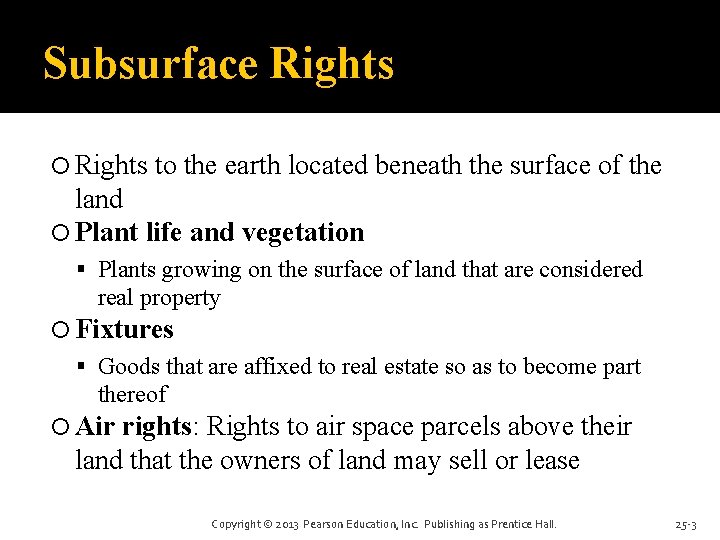
Subsurface Rights to the earth located beneath the surface of the land Plant life and vegetation Plants growing on the surface of land that are considered real property Fixtures Goods that are affixed to real estate so as to become part thereof Air rights: Rights to air space parcels above their land that the owners of land may sell or lease Copyright © 2013 Pearson Education, Inc. Publishing as Prentice Hall. 25 -3
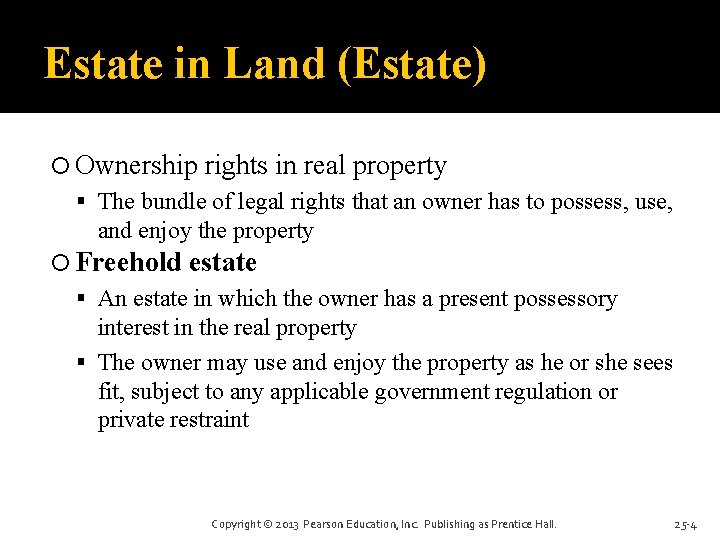
Estate in Land (Estate) Ownership rights in real property The bundle of legal rights that an owner has to possess, use, and enjoy the property Freehold estate An estate in which the owner has a present possessory interest in the real property The owner may use and enjoy the property as he or she sees fit, subject to any applicable government regulation or private restraint Copyright © 2013 Pearson Education, Inc. Publishing as Prentice Hall. 25 -4
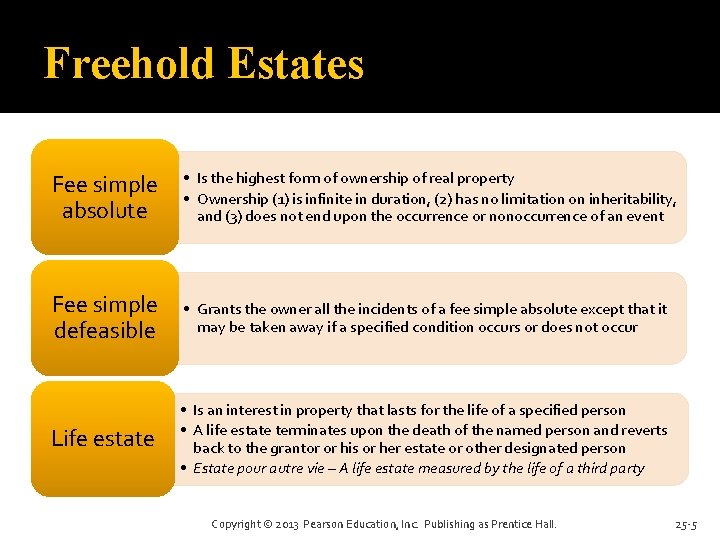
Freehold Estates Fee simple absolute • Is the highest form of ownership of real property • Ownership (1) is infinite in duration, (2) has no limitation on inheritability, and (3) does not end upon the occurrence or nonoccurrence of an event Fee simple defeasible • Grants the owner all the incidents of a fee simple absolute except that it may be taken away if a specified condition occurs or does not occur Life estate • Is an interest in property that lasts for the life of a specified person • A life estate terminates upon the death of the named person and reverts back to the grantor or his or her estate or other designated person • Estate pour autre vie – A life estate measured by the life of a third party Copyright © 2013 Pearson Education, Inc. Publishing as Prentice Hall. 25 -5
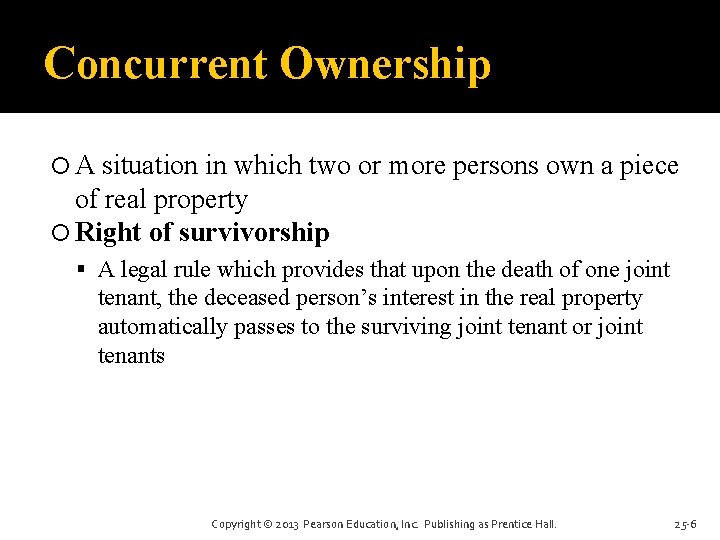
Concurrent Ownership A situation in which two or more persons own a piece of real property Right of survivorship A legal rule which provides that upon the death of one joint tenant, the deceased person’s interest in the real property automatically passes to the surviving joint tenant or joint tenants Copyright © 2013 Pearson Education, Inc. Publishing as Prentice Hall. 25 -6
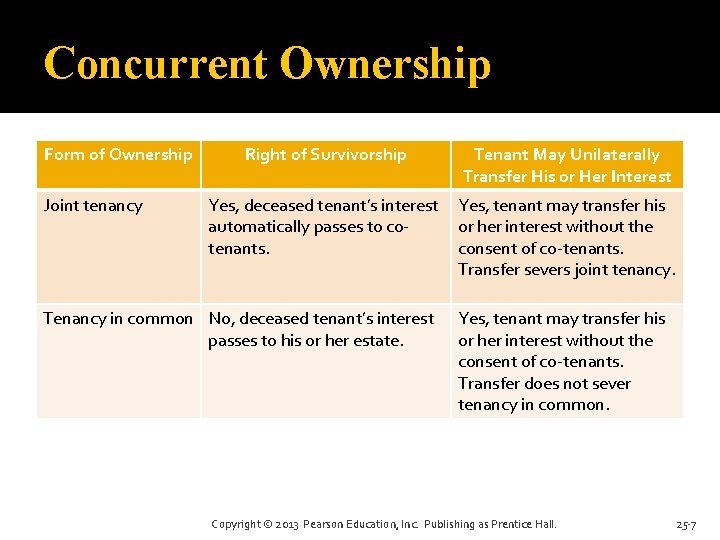
Concurrent Ownership Form of Ownership Joint tenancy Right of Survivorship Tenant May Unilaterally Transfer His or Her Interest Yes, deceased tenant’s interest automatically passes to cotenants. Yes, tenant may transfer his or her interest without the consent of co-tenants. Transfer severs joint tenancy. Tenancy in common No, deceased tenant’s interest passes to his or her estate. Yes, tenant may transfer his or her interest without the consent of co-tenants. Transfer does not sever tenancy in common. Copyright © 2013 Pearson Education, Inc. Publishing as Prentice Hall. 25 -7
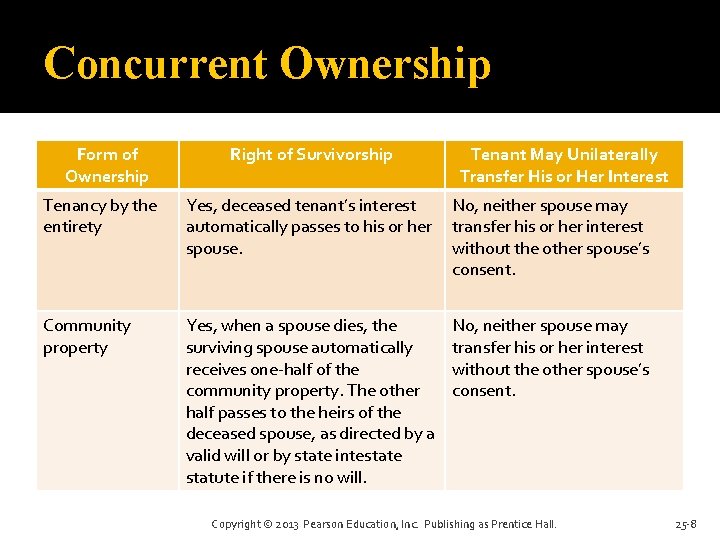
Concurrent Ownership Form of Ownership Right of Survivorship Tenant May Unilaterally Transfer His or Her Interest Tenancy by the entirety Yes, deceased tenant’s interest automatically passes to his or her spouse. No, neither spouse may transfer his or her interest without the other spouse’s consent. Community property Yes, when a spouse dies, the surviving spouse automatically receives one-half of the community property. The other half passes to the heirs of the deceased spouse, as directed by a valid will or by state intestate statute if there is no will. No, neither spouse may transfer his or her interest without the other spouse’s consent. Copyright © 2013 Pearson Education, Inc. Publishing as Prentice Hall. 25 -8
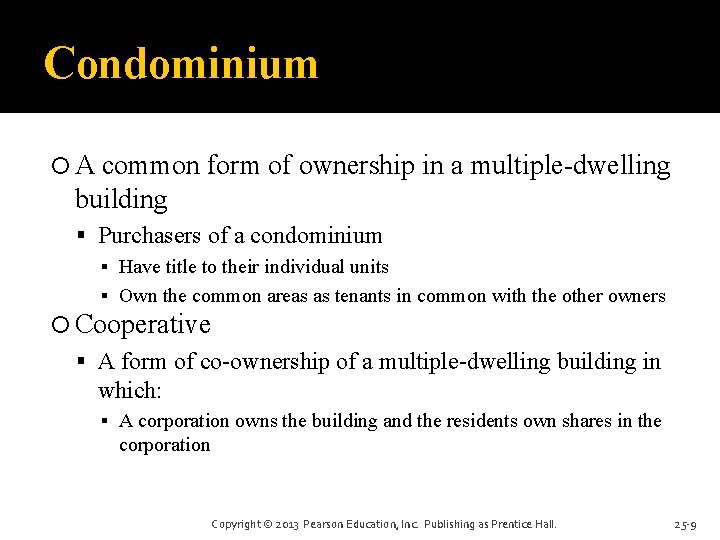
Condominium A common form of ownership in a multiple-dwelling building Purchasers of a condominium ▪ Have title to their individual units ▪ Own the common areas as tenants in common with the other owners Cooperative A form of co-ownership of a multiple-dwelling building in which: ▪ A corporation owns the building and the residents own shares in the corporation Copyright © 2013 Pearson Education, Inc. Publishing as Prentice Hall. 25 -9
Future Interest The interest that a grantor retains for himself or herself or a third party Reversion: A right of possession that returns to a grantor after the expiration of a limited or contingent estate Remainder: A right of possession that returns to a third party upon the expiration of a limited or contingent estate A person who possesses this right is called a remainder beneficiary Copyright © 2013 Pearson Education, Inc. Publishing as Prentice Hall. 25 -10
Sale of Real Estate Sale (conveyance): The passing of title from a seller to a buyer for a price It is the most common method for transferring ownership rights in real property A real estate sales contract is executed by the parties ▪ Statute of Frauds – the contract must be in writing The seller delivers a deed to the buyer The buyer pays the purchase price at the closing, or settlement Copyright © 2013 Pearson Education, Inc. Publishing as Prentice Hall. 25 -11
Deed An instrument that describes a person’s ownership interest in a piece of real property Grantor: A party who transfers an ownership interest in real property Grantee: A party to whom an interest in real property is transferred General warranty deed (grant deed) A deed that protects a grantee of real property from defects in title caused by the grantor and prior owners of the property Copyright © 2013 Pearson Education, Inc. Publishing as Prentice Hall. 25 -12
Deed Special warranty deed (limited warranty deed) A deed that protects a grantee of real property from defects in title caused by a grantor The seller is not liable for: ▪ Defects in title that existed before the seller obtained the property ▪ Encumbrances that were present when the seller obtained the property Quitclaim deed A deed in which a grantor of real property transfers whatever interest he or she has in the property to a grantee Copyright © 2013 Pearson Education, Inc. Publishing as Prentice Hall. 25 -13
Recording Statute A state statute Requires a mortgage or deed of trust to be recorded in the county recorder’s office of the county in which the real property is located Recording the deed gives constructive notice to the world of the owner’s interest in the property Copyright © 2013 Pearson Education, Inc. Publishing as Prentice Hall. 25 -14
Quiet Title Action An action brought by a party, seeking an order of the court declaring who has title to disputed property The court “quiets title” by its decision Adverse possession A situation in which a person who wrongfully possesses someone else’s real property obtains title to that property if certain statutory requirements are met Copyright © 2013 Pearson Education, Inc. Publishing as Prentice Hall. 25 -15
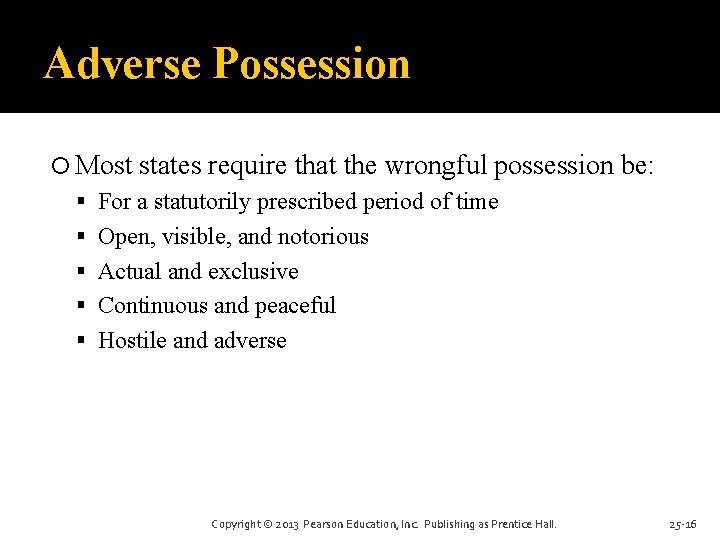
Adverse Possession Most states require that the wrongful possession be: For a statutorily prescribed period of time Open, visible, and notorious Actual and exclusive Continuous and peaceful Hostile and adverse Copyright © 2013 Pearson Education, Inc. Publishing as Prentice Hall. 25 -16
Nonpossessory Interest A situation in which a person holds an interest in another person’s property without actually owning any part of the property Easement A given or required right to make limited use of someone else’s land without owning or leasing it Copyright © 2013 Pearson Education, Inc. Publishing as Prentice Hall. 25 -17
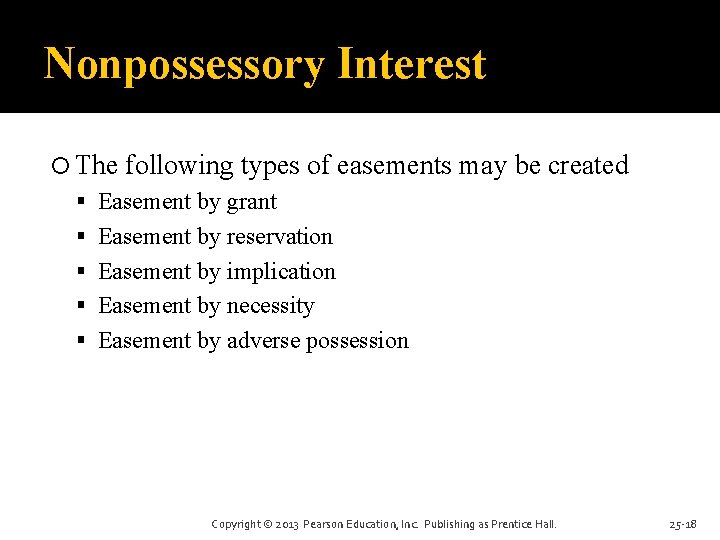
Nonpossessory Interest The following types of easements may be created Easement by grant Easement by reservation Easement by implication Easement by necessity Easement by adverse possession Copyright © 2013 Pearson Education, Inc. Publishing as Prentice Hall. 25 -18
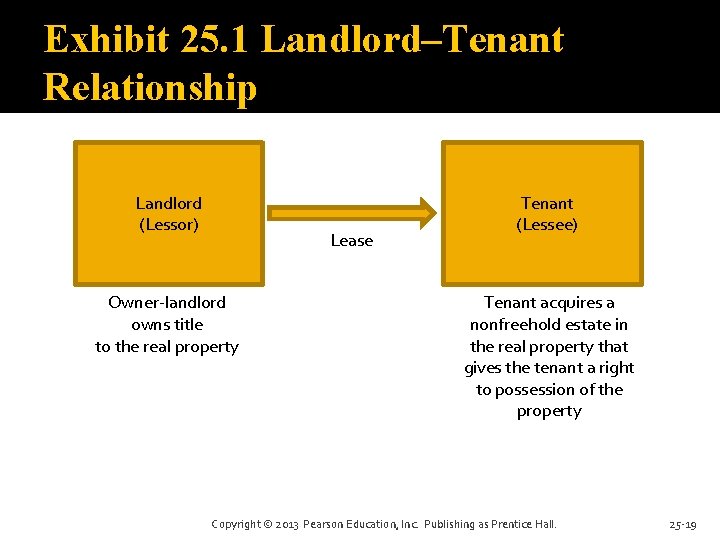
Exhibit 25. 1 Landlord–Tenant Relationship Landlord (Lessor) Lease Owner-landlord owns title to the real property Tenant (Lessee) Tenant acquires a nonfreehold estate in the real property that gives the tenant a right to possession of the property Copyright © 2013 Pearson Education, Inc. Publishing as Prentice Hall. 25 -19
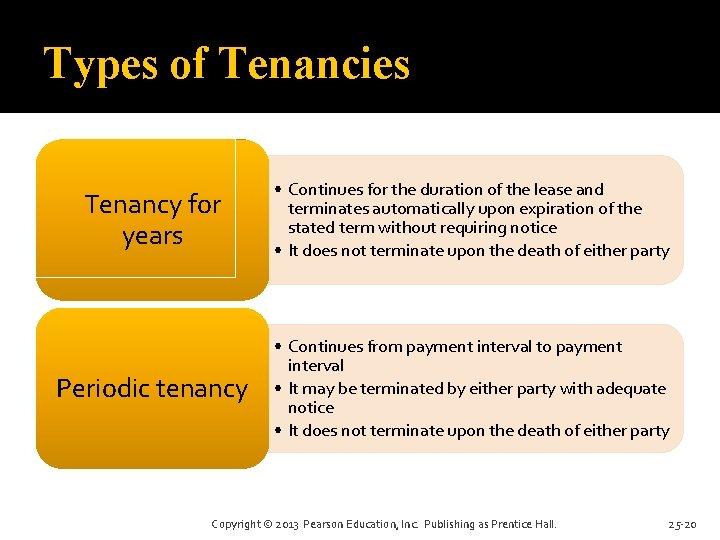
Types of Tenancies Tenancy for years • Continues for the duration of the lease and terminates automatically upon expiration of the stated term without requiring notice • It does not terminate upon the death of either party Periodic tenancy • Continues from payment interval to payment interval • It may be terminated by either party with adequate notice • It does not terminate upon the death of either party Copyright © 2013 Pearson Education, Inc. Publishing as Prentice Hall. 25 -20
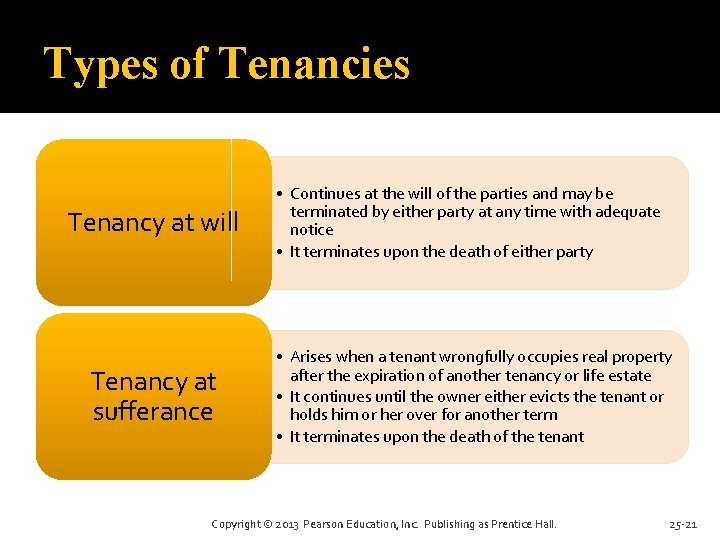
Types of Tenancies Tenancy at will Tenancy at sufferance • Continues at the will of the parties and may be terminated by either party at any time with adequate notice • It terminates upon the death of either party • Arises when a tenant wrongfully occupies real property after the expiration of another tenancy or life estate • It continues until the owner either evicts the tenant or holds him or her over for another term • It terminates upon the death of the tenant Copyright © 2013 Pearson Education, Inc. Publishing as Prentice Hall. 25 -21
Implied Warranty of Habitability A warranty which provides that leased premises must be fit, safe, and suitable for ordinary residential use Rent control ordinances: Local laws that stipulate the amount of rent a landlord can charge for residential housing Copyright © 2013 Pearson Education, Inc. Publishing as Prentice Hall. 25 -22
Civil Rights Act of 1866 A federal statute Prohibits discrimination in the selling and renting of property based on race or color The law applies to ▪ All rentals of public and private property ▪ Property owners renting separate units within a dwelling in which they live ▪ Persons renting out space in their own homes Copyright © 2013 Pearson Education, Inc. Publishing as Prentice Hall. 25 -23
Fair Housing Act of 1968 A federal statute Makes it unlawful for a party to refuse to sell, rent, finance, or advertise housing to any person because of his or her ▪ ▪ ▪ ▪ Race Color National origin Sex Religion Disability Familial status Copyright © 2013 Pearson Education, Inc. Publishing as Prentice Hall. 25 -24
Fair Housing Act of 1968 The law does not apply to the following A person who owns a building of four or fewer units and occupies one of the units and leases the others A person who leases a single-family dwelling and does not own more than three single-family dwellings The act is administered by the U. S. Department of Housing and Urban Development (HUD) Copyright © 2013 Pearson Education, Inc. Publishing as Prentice Hall. 25 -25
Americans with Disabilities Act of 1990 A federal statute Prohibits discrimination against disabled individuals in employment, public services, public accommodations and services, and telecommunications Amended by Americans with Disabilities Act Amendments Act of 2008 (ADAAA) Title III of the ADA: A section of a federal statute Prohibits discrimination on the basis of physical or mental disability in places of public accommodation operated by private entities Copyright © 2013 Pearson Education, Inc. Publishing as Prentice Hall. 25 -26
State and Local Fair Housing Laws State and local governments may provide: fair housing laws that prohibit discrimination in housing Zoning generally ▪ Establish land use districts within the municipality ▪ Restrict the height, size, and location of buildings on a building site ▪ Establish aesthetic requirements or limitations for the exterior of buildings Copyright © 2013 Pearson Education, Inc. Publishing as Prentice Hall. 25 -27
Zoning ordinances: Local laws that are adopted by municipalities and local governments to: Regulate land use within their boundaries Zoning commission Formulates zoning ordinances Conducts public hearings Makes recommendations to the city council ▪ City council votes to enact an ordinance Copyright © 2013 Pearson Education, Inc. Publishing as Prentice Hall. 25 -28
Zoning Variance: An exception that permits a type of building or use in an area that would not otherwise be allowed by a zoning ordinance Nonconforming uses: Uses for real estate and buildings that already exist in a zoned area The buildings are permitted to continue even though they do not fit within a new zoning use established for the area Copyright © 2013 Pearson Education, Inc. Publishing as Prentice Hall. 25 -29
Eminent Domain and “Taking” Due Process Clause: A clause of the U. S. Constitution that allows the government to take property for “public use” Eminent domain: The government’s power to take private property for public use, provided that just compensation is paid to the private property holder Copyright © 2013 Pearson Education, Inc. Publishing as Prentice Hall. 25 -30
Eminent Domain and “Taking” Just Compensation Clause: A clause of the U. S. Constitution Requires the government to compensate the property owner, and possibly others, when the government takes property under its power of eminent domain Copyright © 2013 Pearson Education, Inc. Publishing as Prentice Hall. 25 -31
Copyright © 2013 Pearson Education, Inc. Publishing as Prentice Hall. 25 -32