
Chapter 25 Integrative Health Practices Lydia De Santis


- Slides: 32
Chapter 25 Integrative Health Practices Lydia De. Santis Joseph T. Catalano Copyright © 2015. F. A. Davis Company
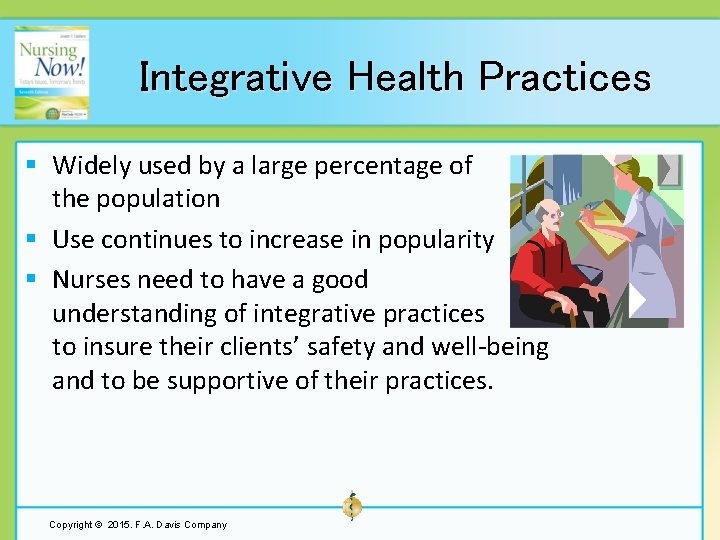
Integrative Health Practices § Widely used by a large percentage of the population § Use continues to increase in popularity § Nurses need to have a good understanding of integrative practices to insure their clients’ safety and well-being and to be supportive of their practices. Copyright © 2015. F. A. Davis Company
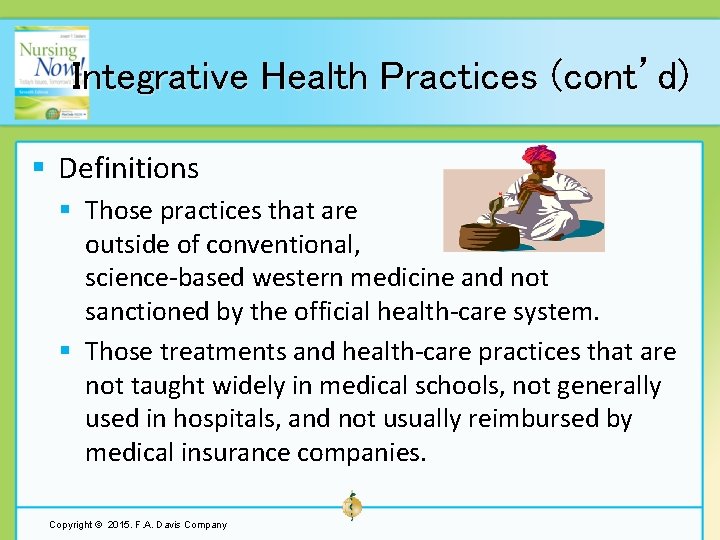
Integrative Health Practices (cont’d) § Definitions § Those practices that are outside of conventional, science-based western medicine and not sanctioned by the official health-care system. § Those treatments and health-care practices that are not taught widely in medical schools, not generally used in hospitals, and not usually reimbursed by medical insurance companies. Copyright © 2015. F. A. Davis Company
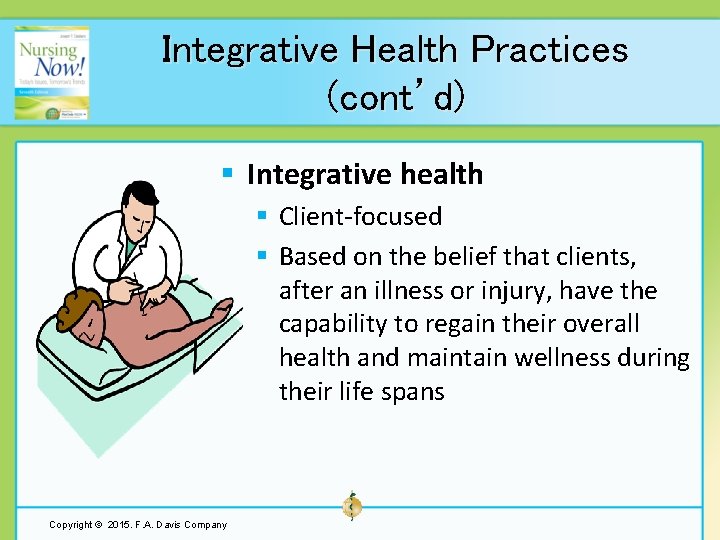
Integrative Health Practices (cont’d) § Integrative health § Client-focused § Based on the belief that clients, after an illness or injury, have the capability to regain their overall health and maintain wellness during their life spans Copyright © 2015. F. A. Davis Company
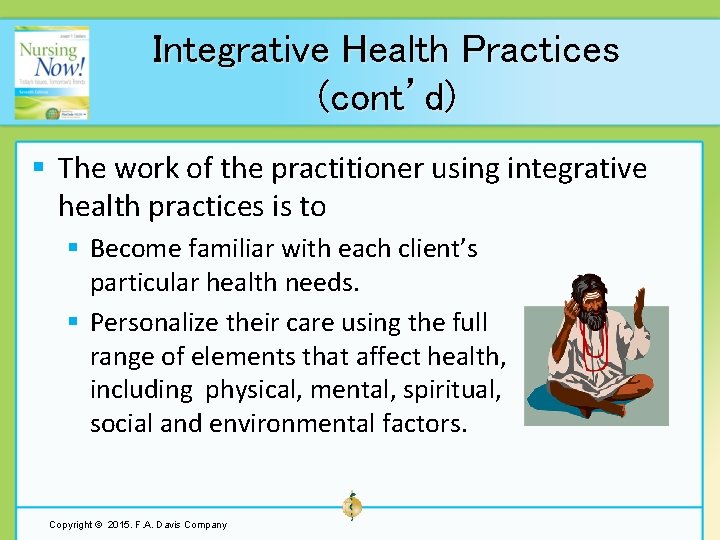
Integrative Health Practices (cont’d) § The work of the practitioner using integrative health practices is to § Become familiar with each client’s particular health needs. § Personalize their care using the full range of elements that affect health, including physical, mental, spiritual, social and environmental factors. Copyright © 2015. F. A. Davis Company
Integrative Health Practices (cont’d) § Therapies and practices are called alternative when they are used in place of conventional therapies. § Therapies are called integrative or complementary when they are used with conventional therapies. § The term healing is preferred to medicine because alternative and complementary modalities typically are based in holistic philosophies. Copyright © 2015. F. A. Davis Company
Integrative Health Practices (cont’d) § Primary users are § Women § Ages 35 to 49 § People with higher educational levels (some graduate education) § Those with annual incomes of more than $50, 000 § Ethnic groups with traditional practices Copyright © 2015. F. A. Davis Company
Integrative Health Practices (cont’d) § Why their use has increased § Dissatisfaction with conventional health care § Desire for greater control over one’s health § Desire for cultural and philosophical congruence with personal beliefs about health and illness § Belief in the effectiveness of alternative therapies § Individual’s health status § Rising cost of conventional health care Copyright © 2015. F. A. Davis Company
Integrative Health Practices (cont’d) § Why their use has increased (cont’d) § Dissatisfaction with conventional health care § Desire for greater control over one’s health § Desire for cultural and philosophical congruence with personal beliefs about health and illness Copyright © 2015. F. A. Davis Company
Integrative Health Practices (cont’d) § Why their use has increased (cont’d) § Belief in the effectiveness of integrative therapies § Individual’s health status § Rising cost of conventional health care Copyright © 2015. F. A. Davis Company
Integrative Health Practices (cont’d) § Classifying integrative methods § The healing matrix contrasts conventional and integrative modalities and practitioners. § The National Center for Complementary and Alternative Medicine (NCCAM) classifications include seven major categories of classified integrative methods that are defined and subdivided into practices. Copyright © 2015. F. A. Davis Company
Comparing Conventional and Integrative Practices Conventional § Focuses on physical § Reduces humans to simple beings who are all anatomically and physiologically similar § Emphasis is placed on diagnosis and cure based on physical symptoms Copyright © 2015. F. A. Davis Company Integrative § Takes a holistic “multibody” approach § Takes into consideration the complexity of each person § Includes both the material and nonmaterial aspects of the individual and self-healing forces
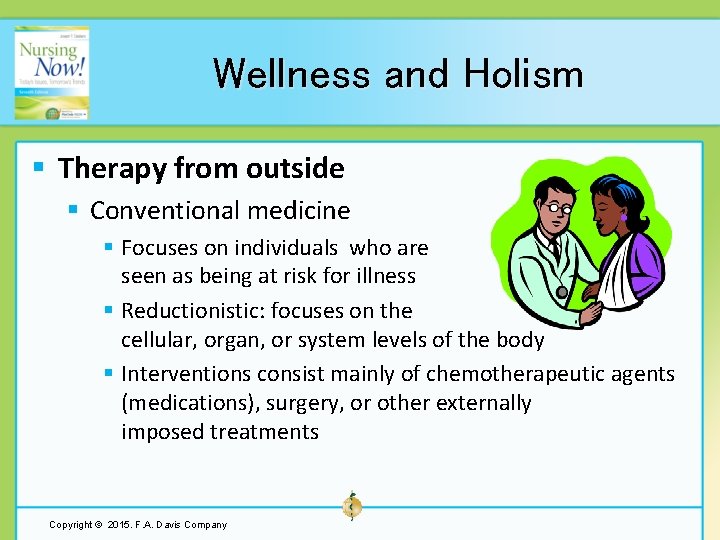
Wellness and Holism § Therapy from outside § Conventional medicine § Focuses on individuals who are seen as being at risk for illness § Reductionistic: focuses on the cellular, organ, or system levels of the body § Interventions consist mainly of chemotherapeutic agents (medications), surgery, or other externally imposed treatments Copyright © 2015. F. A. Davis Company
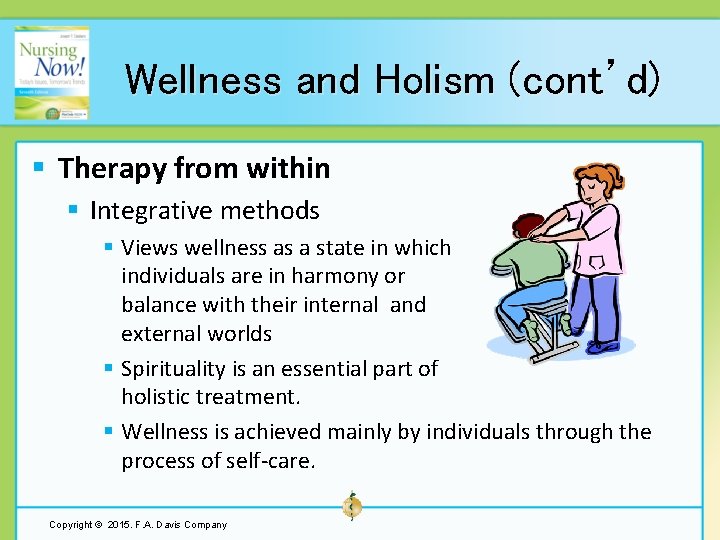
Wellness and Holism (cont’d) § Therapy from within § Integrative methods § Views wellness as a state in which individuals are in harmony or balance with their internal and external worlds § Spirituality is an essential part of holistic treatment. § Wellness is achieved mainly by individuals through the process of self-care. Copyright © 2015. F. A. Davis Company
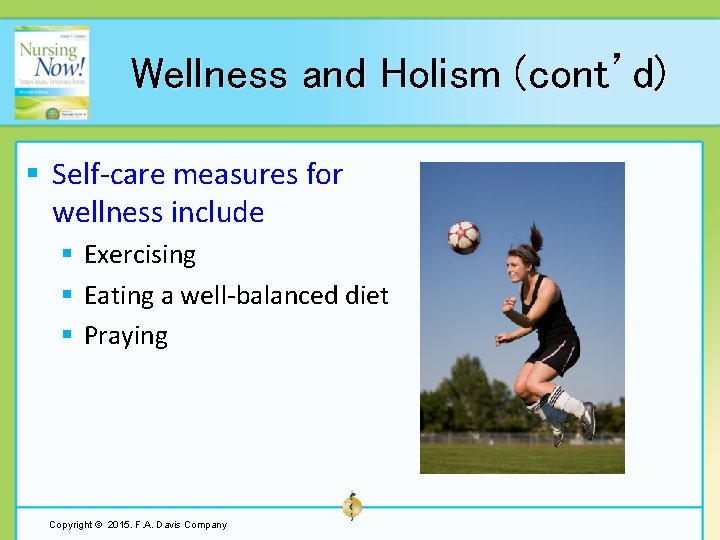
Wellness and Holism (cont’d) § Self-care measures for wellness include § Exercising § Eating a well-balanced diet § Praying Copyright © 2015. F. A. Davis Company
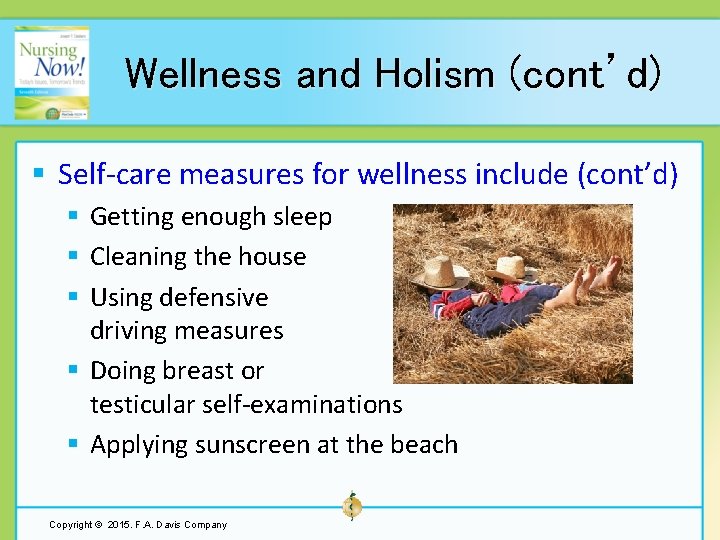
Wellness and Holism (cont’d) § Self-care measures for wellness include (cont’d) § Getting enough sleep § Cleaning the house § Using defensive driving measures § Doing breast or testicular self-examinations § Applying sunscreen at the beach Copyright © 2015. F. A. Davis Company
Wellness and Holism (cont’d) § Self-healing § Integrative healers focus on helping people determine why the cells of their body are sick and search for imbalances from a holistic perspective. Copyright © 2015. F. A. Davis Company
Wellness and Holism (cont’d) § The placebo response § The placebo effect is at work in all therapeutic intervention. § Four factors § Endorphin-mediated response § Belief of the client § Belief of the healer § The client–healer relationship Copyright © 2015. F. A. Davis Company
Wellness and Holism (cont’d) § Energy systems § Electrical-chemical reactions are produced in the nervous system and help regulate other body systems. § Electrical impulses trigger heartbeats. § Electrical currents regulate the production of hormones. § Blood is composed of iron; therefore, magnetic forces exist in all parts of the body. Copyright © 2015. F. A. Davis Company
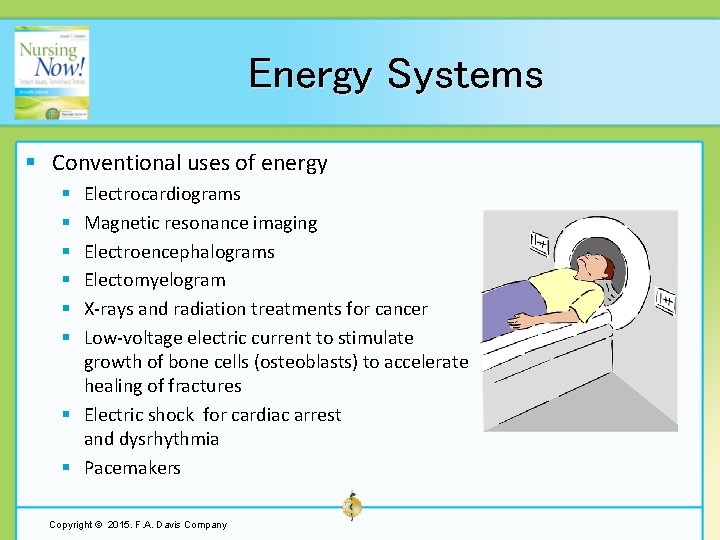
Energy Systems § Conventional uses of energy Electrocardiograms Magnetic resonance imaging Electroencephalograms Electomyelogram X-rays and radiation treatments for cancer Low-voltage electric current to stimulate growth of bone cells (osteoblasts) to accelerate healing of fractures § Electric shock for cardiac arrest and dysrhythmia § Pacemakers § § § Copyright © 2015. F. A. Davis Company
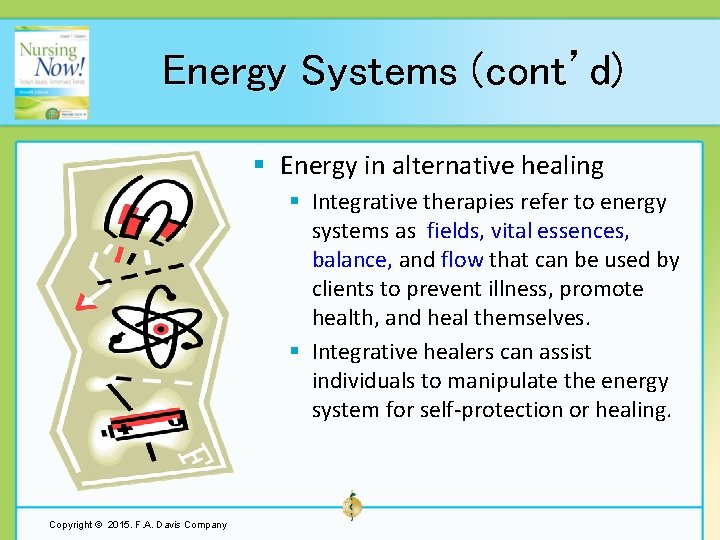
Energy Systems (cont’d) § Energy in alternative healing § Integrative therapies refer to energy systems as fields, vital essences, balance, and flow that can be used by clients to prevent illness, promote health, and heal themselves. § Integrative healers can assist individuals to manipulate the energy system for self-protection or healing. Copyright © 2015. F. A. Davis Company
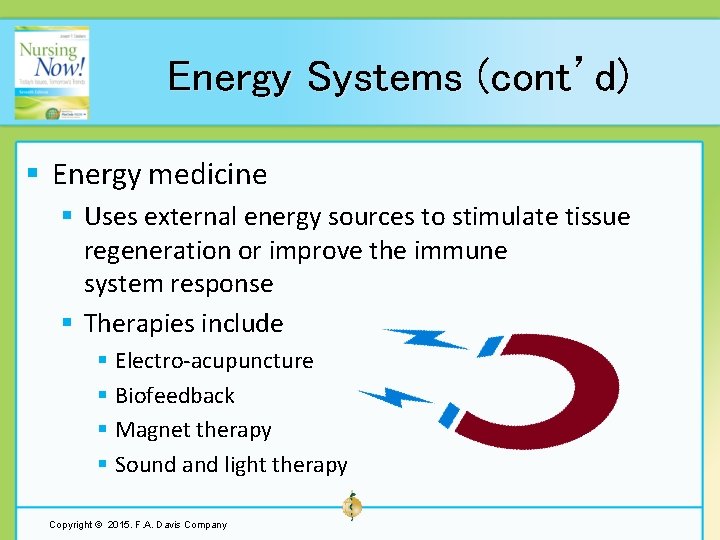
Energy Systems (cont’d) § Energy medicine § Uses external energy sources to stimulate tissue regeneration or improve the immune system response § Therapies include § Electro-acupuncture § Biofeedback § Magnet therapy § Sound and light therapy Copyright © 2015. F. A. Davis Company
Energy Systems (cont’d) § Vital essences and balance § In many integrative models, illness reflects blockage, loss, or imbalance of body energy or vital essence. § Disturbance of internal body energy can result from external or internal factors. § The treatment is aimed at removing the blockage of energy flow with acupuncture, acupressure, chiropractic adjustment, craniosacral therapy, or reflexology. Copyright © 2015. F. A. Davis Company
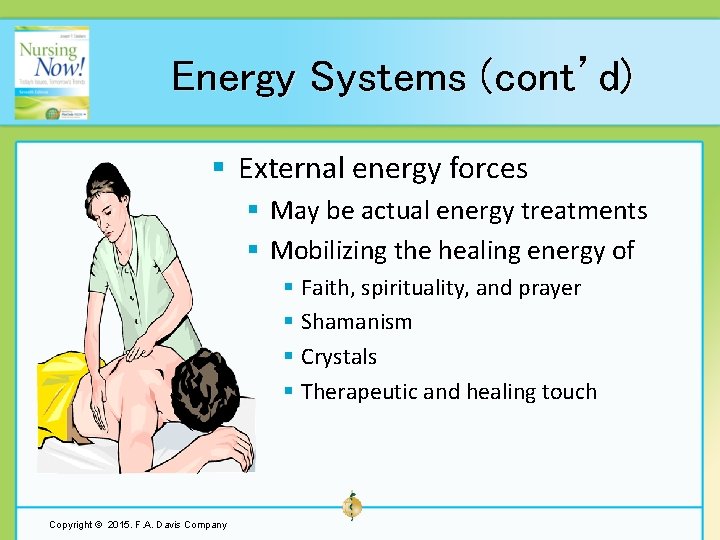
Energy Systems (cont’d) § External energy forces § May be actual energy treatments § Mobilizing the healing energy of § Faith, spirituality, and prayer § Shamanism § Crystals § Therapeutic and healing touch Copyright © 2015. F. A. Davis Company
Nutrition § In conventional health care, nutrition and diet are usually considered adjuncts to biomedical treatment. § In integrative systems, nutrition is commonly seen as a way of life and a method of preventing illness. Copyright © 2015. F. A. Davis Company
Nutrition (cont’d) § Benefits of natural foods § Integrative modalities recommend only foods produced in a natural manner and in their natural environment § Rationale includes § Concerns about food production and processing § Belief that the person-body, as both an energy system and a physical entity, is designed to live in a natural environment § Belief that what is eaten directly affects an individual’s health § Increased consumption of nutrient-poor and energy-rich foods Copyright © 2015. F. A. Davis Company
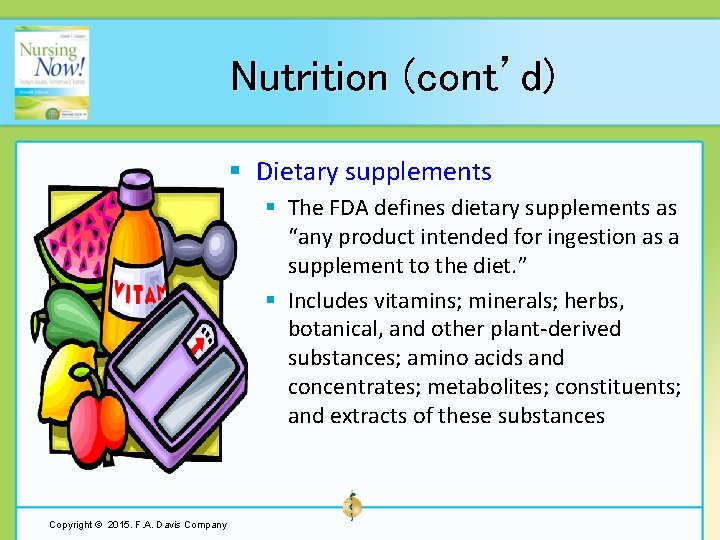
Nutrition (cont’d) § Dietary supplements § The FDA defines dietary supplements as “any product intended for ingestion as a supplement to the diet. ” § Includes vitamins; minerals; herbs, botanical, and other plant-derived substances; amino acids and concentrates; metabolites; constituents; and extracts of these substances Copyright © 2015. F. A. Davis Company
Nutrition (cont’d) § Regulation of supplements § Nutritional supplements are not regulated by the FDA. § If manufacturers make no claims that they are effective against a disease, they do not need to be tested for safety and effectiveness before they are sold to the public. § There has been a gradual increase in the regulation of these products. Copyright © 2015. F. A. Davis Company
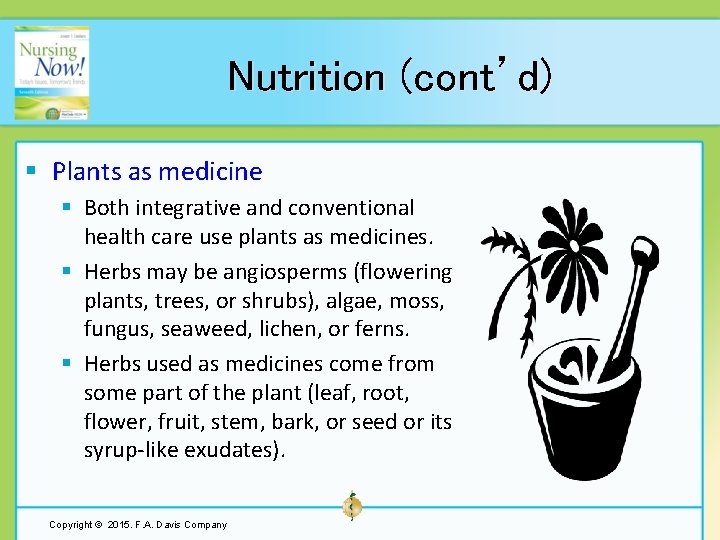
Nutrition (cont’d) § Plants as medicine § Both integrative and conventional health care use plants as medicines. § Herbs may be angiosperms (flowering plants, trees, or shrubs), algae, moss, fungus, seaweed, lichen, or ferns. § Herbs used as medicines come from some part of the plant (leaf, root, flower, fruit, stem, bark, or seed or its syrup-like exudates). Copyright © 2015. F. A. Davis Company
Nutrition (cont’d) § Herbal traditions § Western pharmacology § Chinese medicine § Ayurvedic medicine Copyright © 2015. F. A. Davis Company
Paradox of Integrative Healing Practices § Nurses feel uncomfortable with the use of herbal products and integrative therapies because of Unclear definitions of practices Unregulated use Lack of foundation in the biomedical sciences Basis in concepts of holism, self-care, and theoretical constructs that come from beliefs different from those of biomedicine and the science § Few standards or regulations for practitioners § § Copyright © 2015. F. A. Davis Company
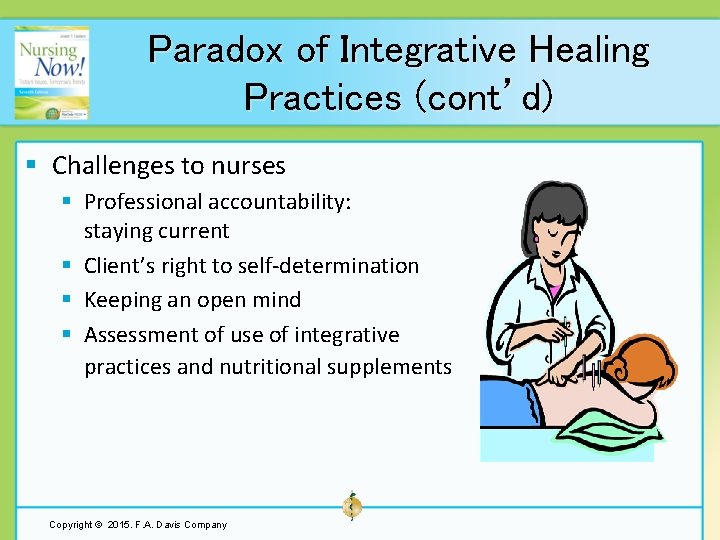
Paradox of Integrative Healing Practices (cont’d) § Challenges to nurses § Professional accountability: staying current § Client’s right to self-determination § Keeping an open mind § Assessment of use of integrative practices and nutritional supplements Copyright © 2015. F. A. Davis Company