
Chapter 25 Electric Potential 1 Electrical Potential Energy
- Slides: 54
Chapter 25 Electric Potential 1
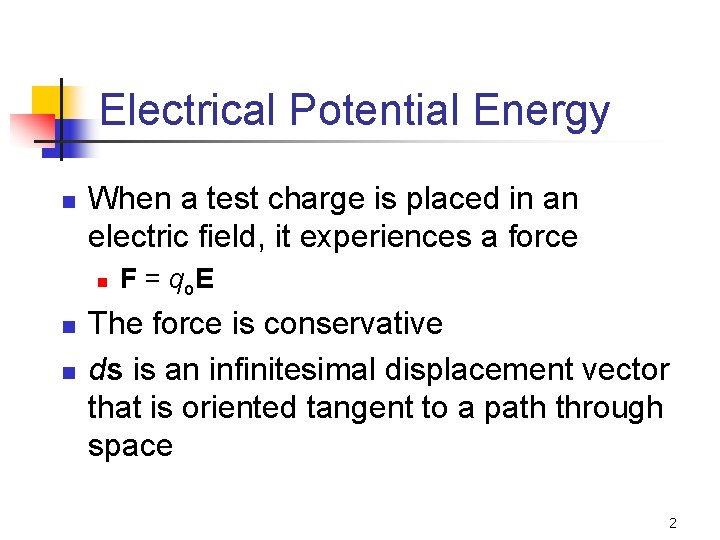
Electrical Potential Energy n When a test charge is placed in an electric field, it experiences a force n n n F = q o. E The force is conservative ds is an infinitesimal displacement vector that is oriented tangent to a path through space 2
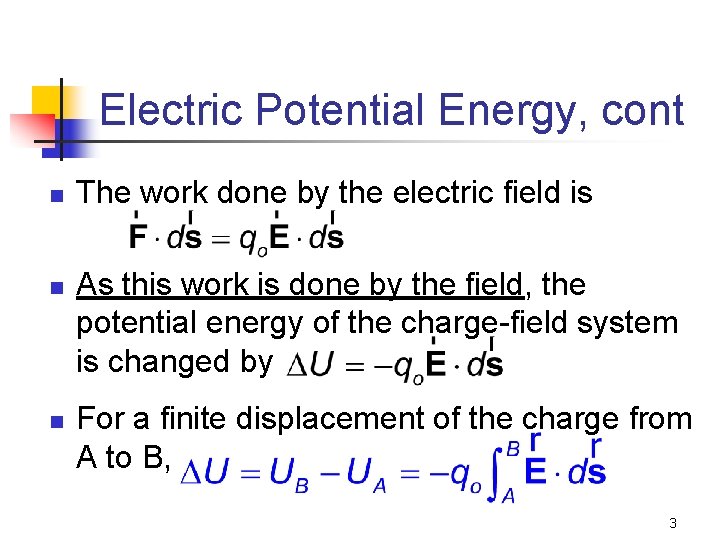
Electric Potential Energy, cont n n n The work done by the electric field is As this work is done by the field, the potential energy of the charge-field system is changed by For a finite displacement of the charge from A to B, 3
Electric Potential Energy, final n n Because qo. E is conservative, the line integral does not depend on the path taken by the charge This is the change in potential energy of the system 4
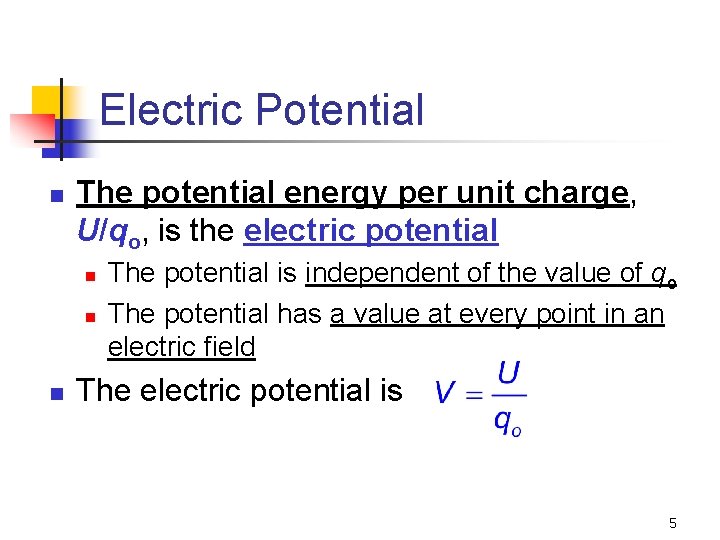
Electric Potential n The potential energy per unit charge, U/qo, is the electric potential n n n The potential is independent of the value of qo The potential has a value at every point in an electric field The electric potential is 5
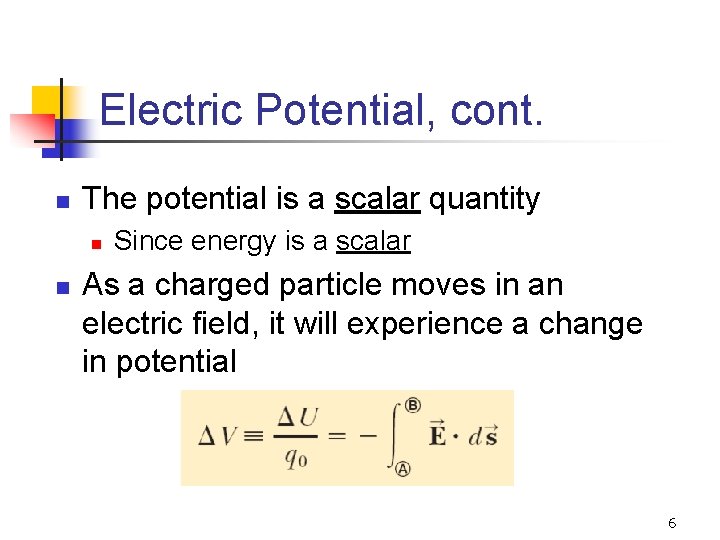
Electric Potential, cont. n The potential is a scalar quantity n n Since energy is a scalar As a charged particle moves in an electric field, it will experience a change in potential 6
Electric Potential, final n n The difference in potential ΔV is the meaningful quantity The potential difference between A and B depends only on the source charge distribution (consider points A and B without the presence of the test charge) n n n The difference in potential energy exists only if a test charge is moved between the points We often take the value of the potential to be zero at some convenient point in the field Electric potential is a scalar characteristic of an electric field, independent of any charges that may be placed in the field 7
Work and Electric Potential n n If an external agent moves a test charge from A to B in an electric field without changing its kinetic energy, the agent performs work which changes the potential energy of the system: W = ΔU The work done by an external agent in moving a charge q through an electric field at constant velocity is W =ΔU = qΔV 8
Units n 1 V = 1 J/C n n n V is a volt It takes one joule of work to move a 1 coulomb charge through a potential difference of 1 volt In addition, 1 N/C = 1 V/m n This indicates we can interpret the electric field as a measure of the rate of change with position of the electric potential 9
Electron-Volts n n Another unit of energy that is commonly used in atomic and nuclear physics is the electron-volt One electron-volt is defined as the energy a charge-field system gains or loses when a charge of magnitude e (an electron or a proton) is moved through a potential difference of 1 volt n 1 e. V = 1. 60 x 10 -19 J 10
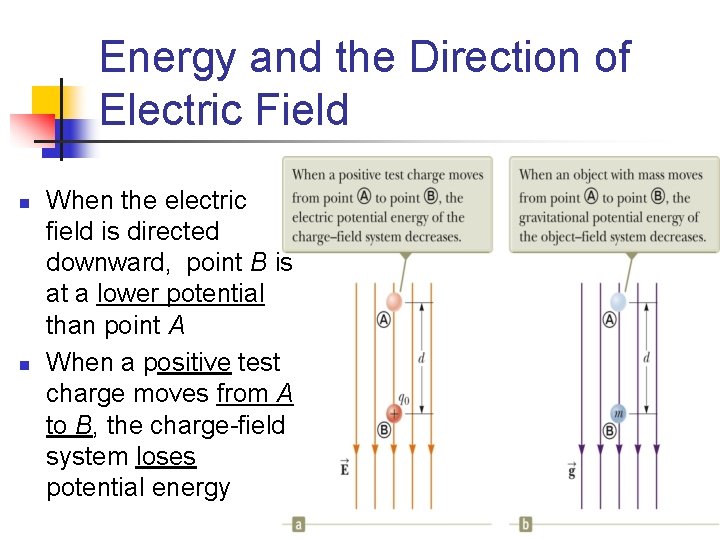
Energy and the Direction of Electric Field n n When the electric field is directed downward, point B is at a lower potential than point A When a positive test charge moves from A to B, the charge-field system loses potential energy 11
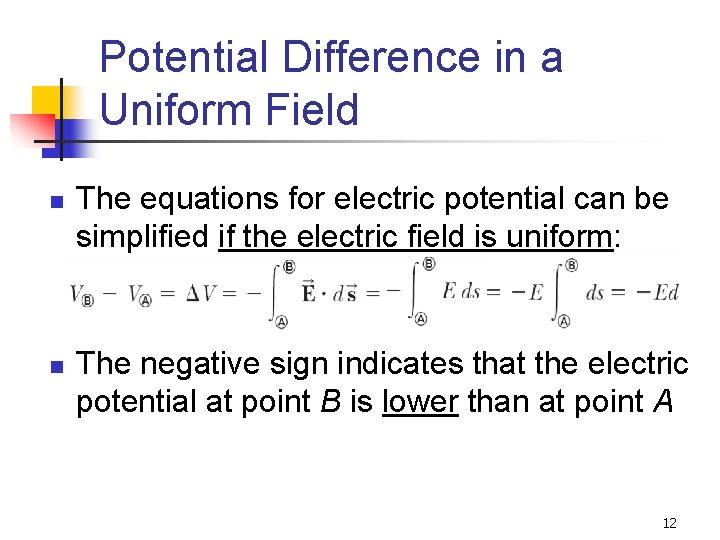
Potential Difference in a Uniform Field n n The equations for electric potential can be simplified if the electric field is uniform: The negative sign indicates that the electric potential at point B is lower than at point A 12
More About Directions n A system consisting of a positive charge and an electric field loses electric potential energy when the charge moves in the direction of the field n n An electric field does work on a positive charge when the charge moves in the direction of the electric field The charged particle gains kinetic energy equal to the potential energy lost by the charge-field system n Another example of Conservation of Energy 13
Directions, cont. n n If qo is negative, then ΔU is positive A system consisting of a negative charge and an electric field gains potential energy when the charge moves in the direction of the field n In order for a negative charge to move in the direction of the field, an external agent must do positive work on the charge 14
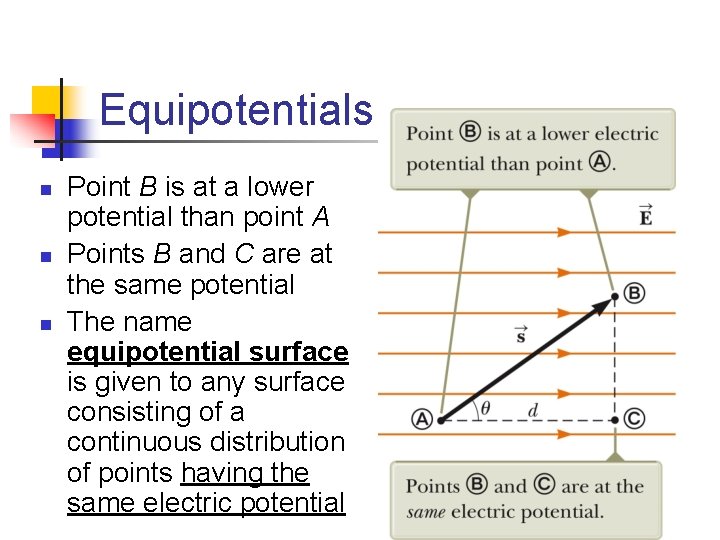
Equipotentials n n n Point B is at a lower potential than point A Points B and C are at the same potential The name equipotential surface is given to any surface consisting of a continuous distribution of points having the same electric potential 15
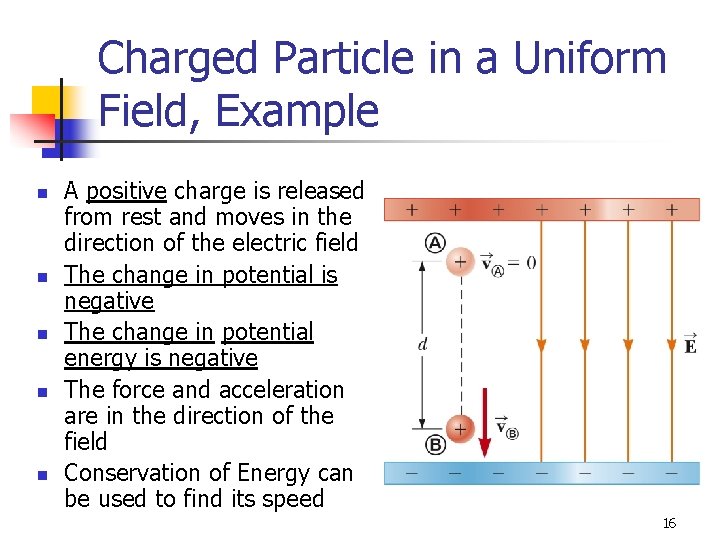
Charged Particle in a Uniform Field, Example n n n A positive charge is released from rest and moves in the direction of the electric field The change in potential is negative The change in potential energy is negative The force and acceleration are in the direction of the field Conservation of Energy can be used to find its speed 16
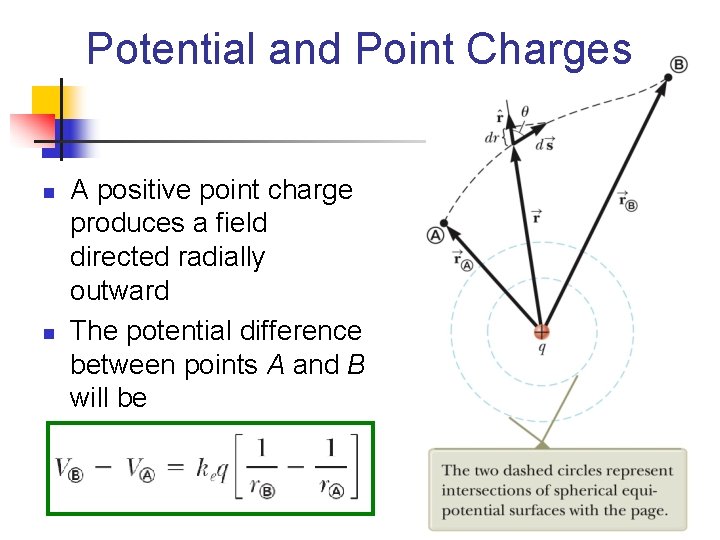
Potential and Point Charges n n A positive point charge produces a field directed radially outward The potential difference between points A and B will be 17
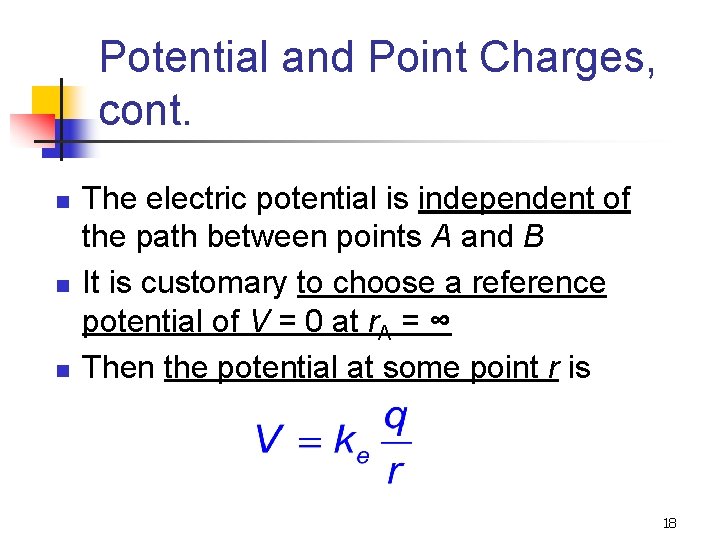
Potential and Point Charges, cont. n n n The electric potential is independent of the path between points A and B It is customary to choose a reference potential of V = 0 at r. A = ∞ Then the potential at some point r is 18
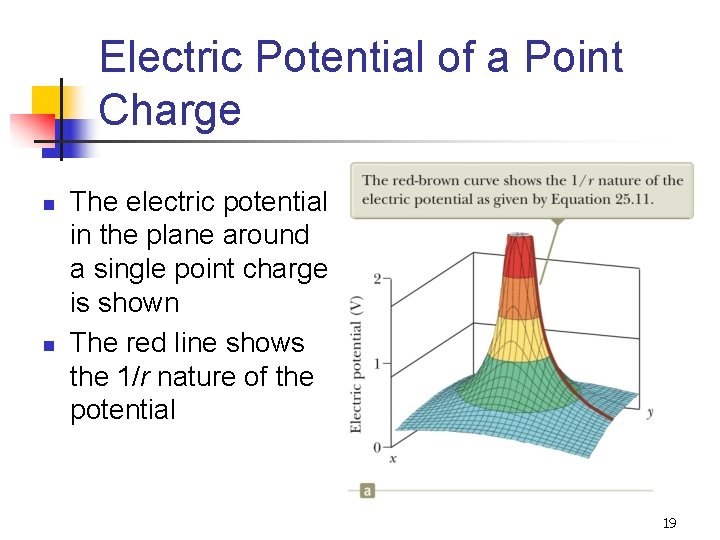
Electric Potential of a Point Charge n n The electric potential in the plane around a single point charge is shown The red line shows the 1/r nature of the potential 19
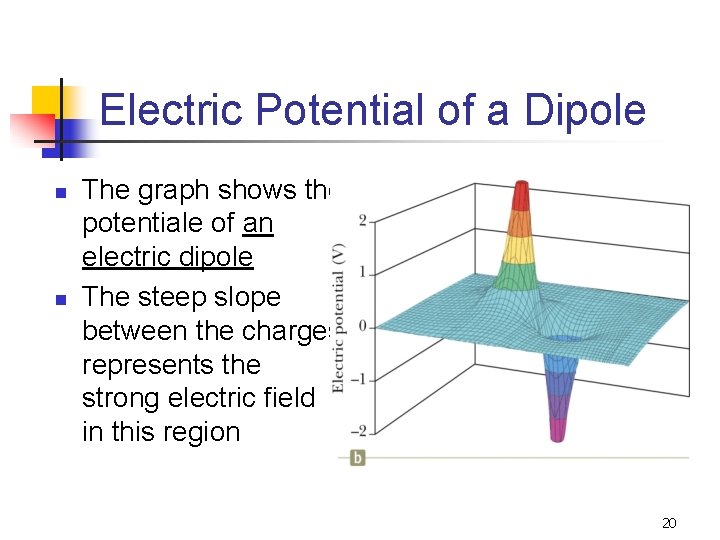
Electric Potential of a Dipole n n The graph shows the potentiale of an electric dipole The steep slope between the charges represents the strong electric field in this region 20
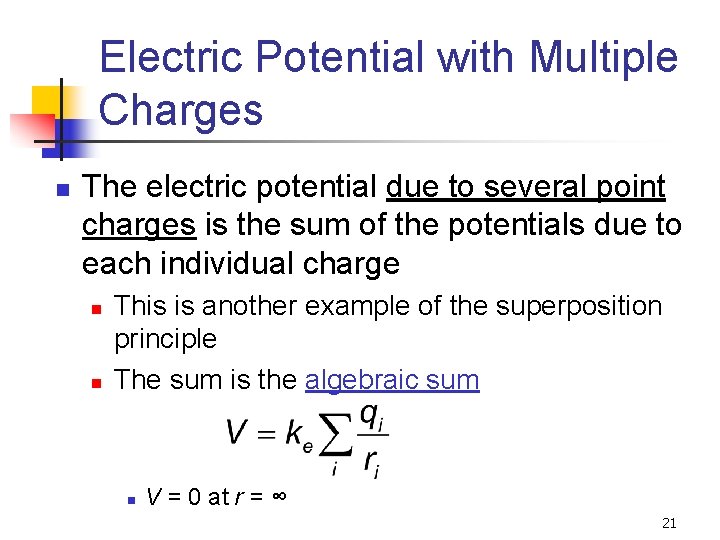
Electric Potential with Multiple Charges n The electric potential due to several point charges is the sum of the potentials due to each individual charge n n This is another example of the superposition principle The sum is the algebraic sum n V = 0 at r = ∞ 21
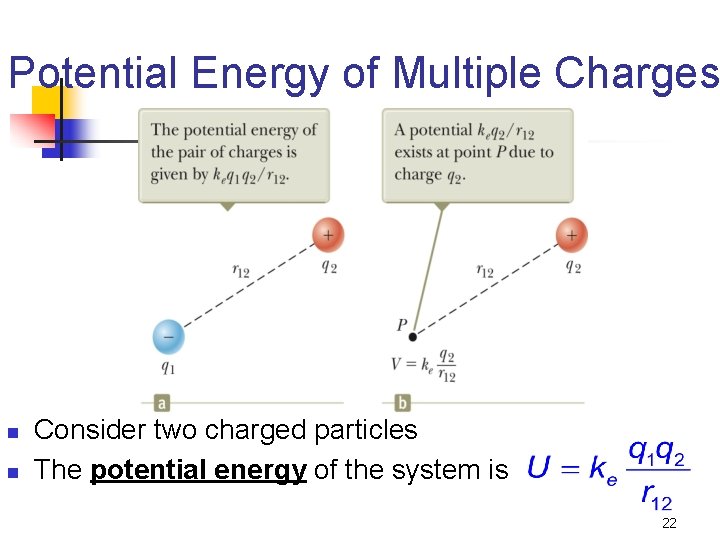
Potential Energy of Multiple Charges n n Consider two charged particles The potential energy of the system is 22
More About U of Multiple Charges n n If the two charges are the same sign, U is positive and positive work must be done by an external agent to bring two charges near one another If the two charges have opposite signs, U is negative and negative work is done to prevent q 1 from accelerating toward q 2 as they are brought near each other 23
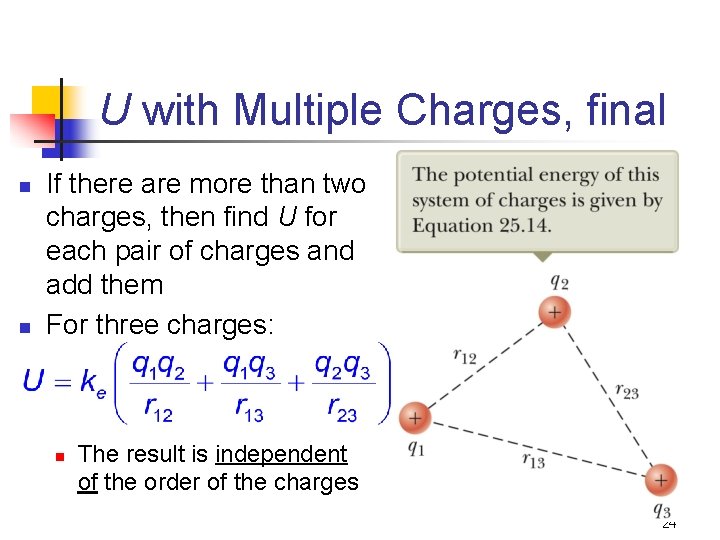
U with Multiple Charges, final n n If there are more than two charges, then find U for each pair of charges and add them For three charges: n The result is independent of the order of the charges 24
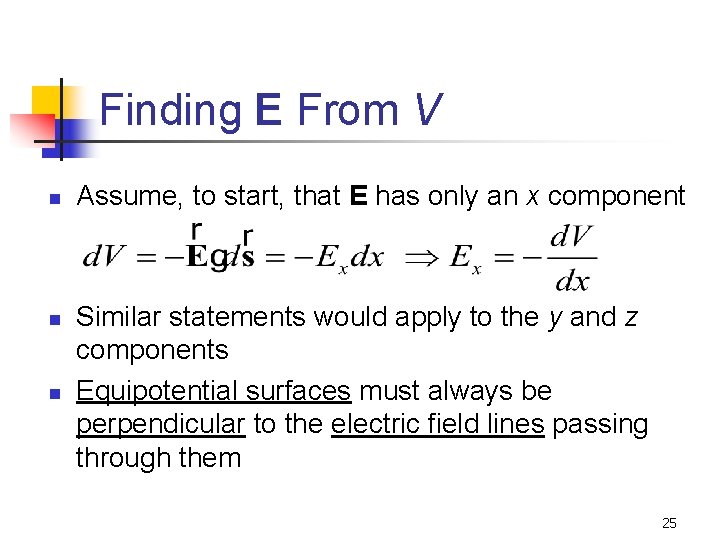
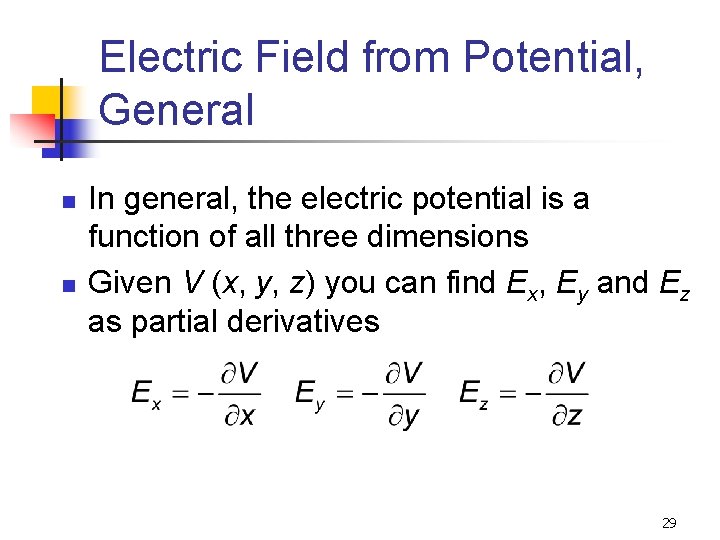
Finding E From V n n n Assume, to start, that E has only an x component Similar statements would apply to the y and z components Equipotential surfaces must always be perpendicular to the electric field lines passing through them 25
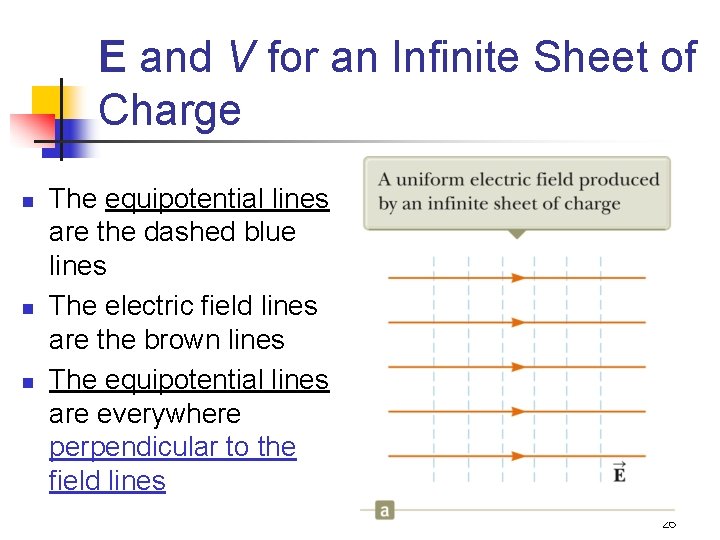
E and V for an Infinite Sheet of Charge n n n The equipotential lines are the dashed blue lines The electric field lines are the brown lines The equipotential lines are everywhere perpendicular to the field lines 26
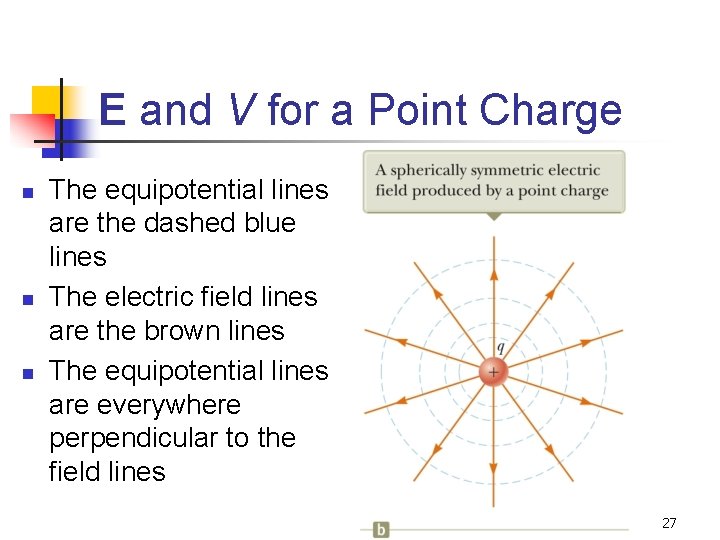
E and V for a Point Charge n n n The equipotential lines are the dashed blue lines The electric field lines are the brown lines The equipotential lines are everywhere perpendicular to the field lines 27
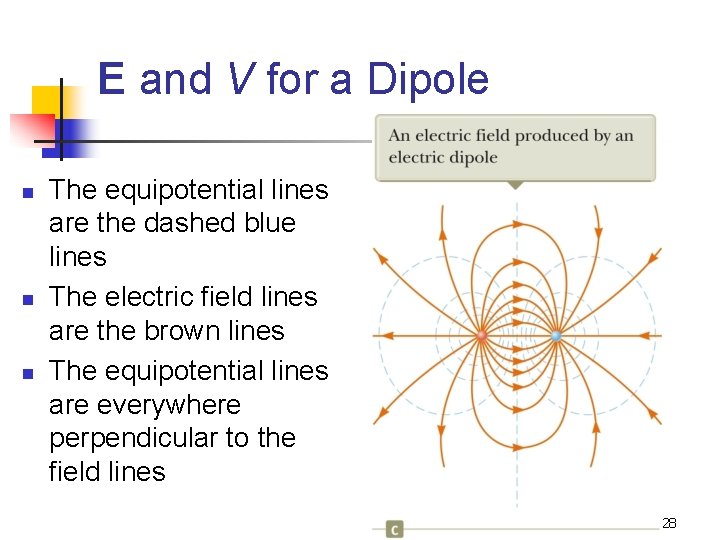
E and V for a Dipole n n n The equipotential lines are the dashed blue lines The electric field lines are the brown lines The equipotential lines are everywhere perpendicular to the field lines 28
Electric Field from Potential, General n n In general, the electric potential is a function of all three dimensions Given V (x, y, z) you can find Ex, Ey and Ez as partial derivatives 29
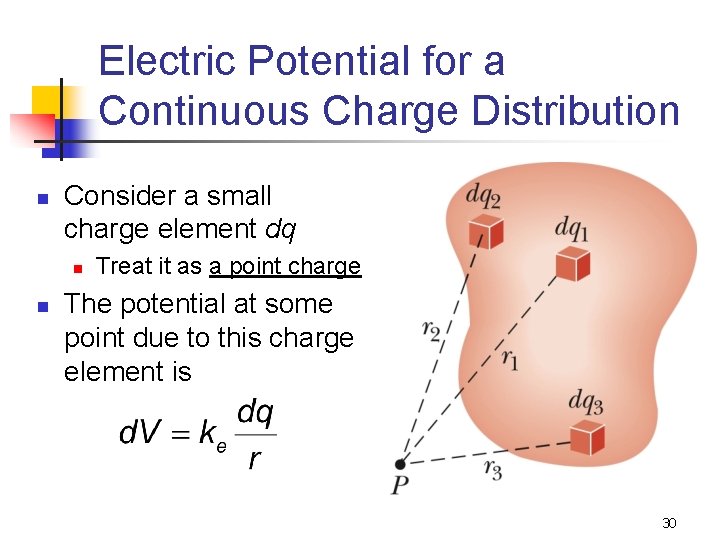
Electric Potential for a Continuous Charge Distribution n Consider a small charge element dq n n Treat it as a point charge The potential at some point due to this charge element is 30
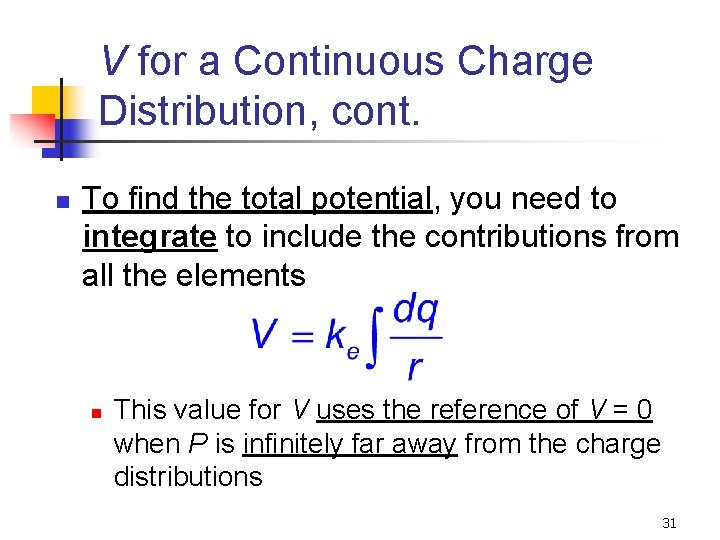
V for a Continuous Charge Distribution, cont. n To find the total potential, you need to integrate to include the contributions from all the elements n This value for V uses the reference of V = 0 when P is infinitely far away from the charge distributions 31
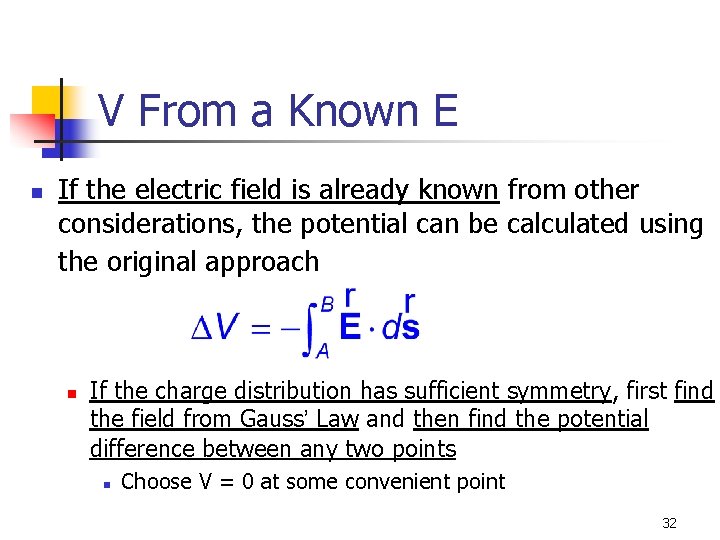
V From a Known E n If the electric field is already known from other considerations, the potential can be calculated using the original approach n If the charge distribution has sufficient symmetry, first find the field from Gauss’ Law and then find the potential difference between any two points n Choose V = 0 at some convenient point 32
Problem-Solving Strategies n Conceptualize n n Think about the individual charges or the charge distribution Imagine the type of potential that would be created Appeal to any symmetry in the arrangement of the charges Categorize n Group of individual charges or a continuous distribution? 33
Problem-Solving Strategies, 2 n Analyze n General n n Scalar quantity, so no components Use algebraic sum in the superposition principle Only changes in electric potential are significant Define V = 0 at a point infinitely far away from the charges n If the charge distribution extends to infinity, then choose some other arbitrary point as a reference point 34
Problem-Solving Strategies, 3 n Analyze, cont n If a group of individual charges is given n n If a continuous charge distribution is given n Use the superposition principle and the algebraic sum Use integrals for evaluating the total potential at some point Each element of the charge distribution is treated as a point charge If the electric field is given n n Start with the definition of the electric potential Find the field from Gauss’ Law (or some other process) if 35 needed
Problem-Solving Strategies, final n Finalize n n n Check to see if the expression for the electric potential is consistent with your mental representation Does the final expression reflect any symmetry? Image varying parameters to see if the mathematical results change in a reasonable way 36
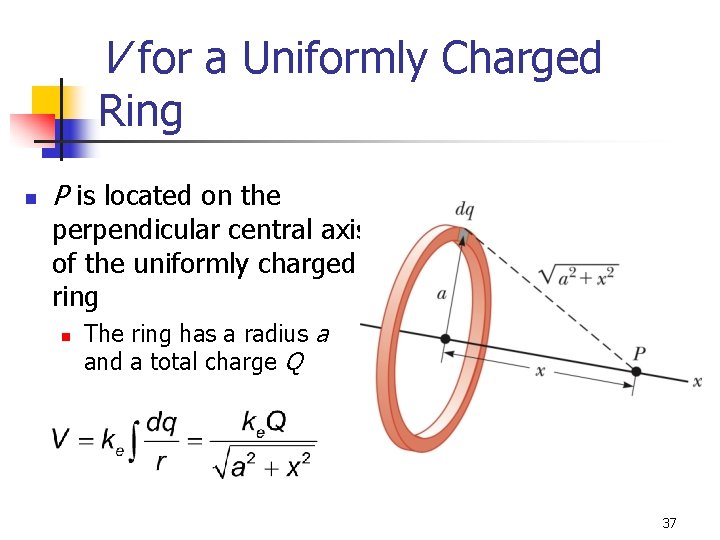
V for a Uniformly Charged Ring n P is located on the perpendicular central axis of the uniformly charged ring n The ring has a radius a and a total charge Q 37
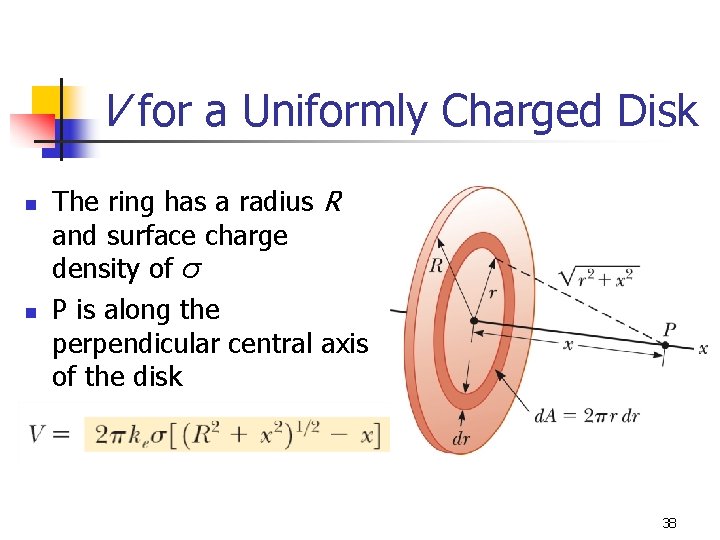
V for a Uniformly Charged Disk n n The ring has a radius R and surface charge density of σ P is along the perpendicular central axis of the disk 38
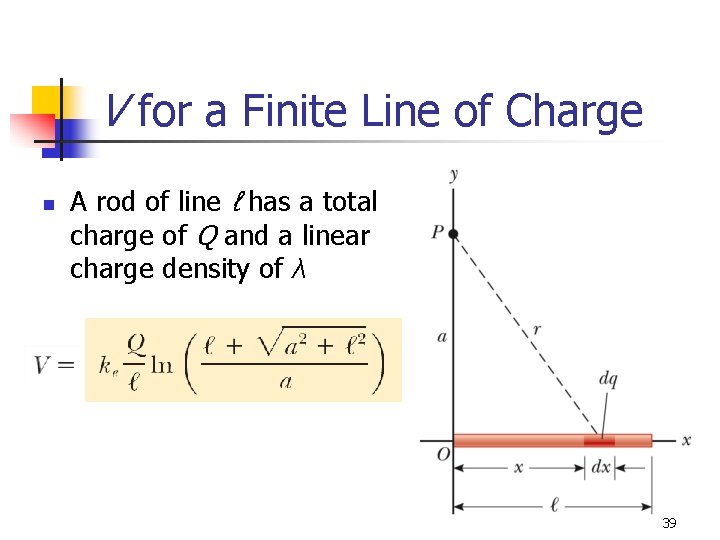
V for a Finite Line of Charge n A rod of line ℓ has a total charge of Q and a linear charge density of λ 39
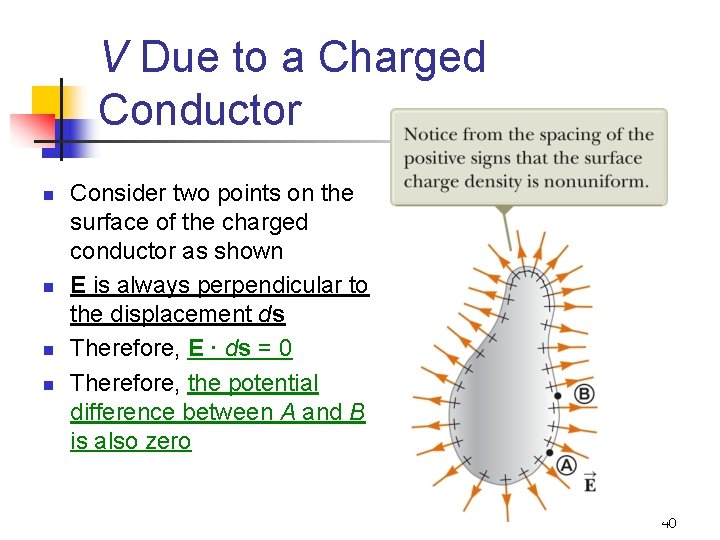
V Due to a Charged Conductor n n Consider two points on the surface of the charged conductor as shown E is always perpendicular to the displacement ds Therefore, E · ds = 0 Therefore, the potential difference between A and B is also zero 40
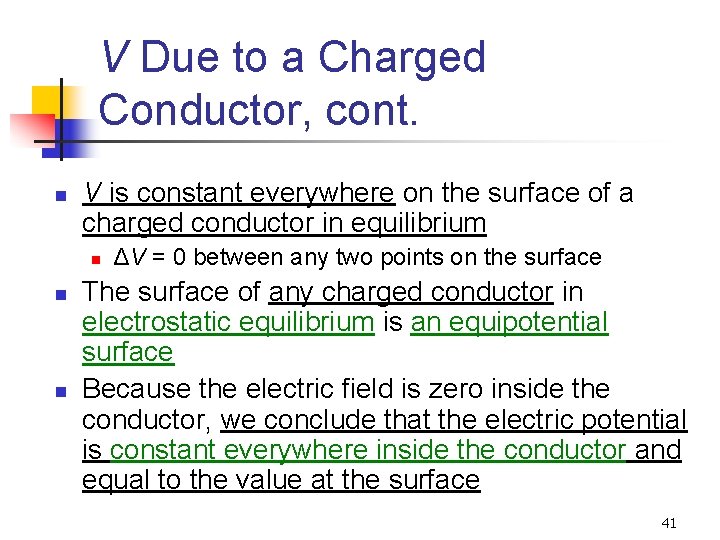
V Due to a Charged Conductor, cont. n V is constant everywhere on the surface of a charged conductor in equilibrium n n n ΔV = 0 between any two points on the surface The surface of any charged conductor in electrostatic equilibrium is an equipotential surface Because the electric field is zero inside the conductor, we conclude that the electric potential is constant everywhere inside the conductor and equal to the value at the surface 41
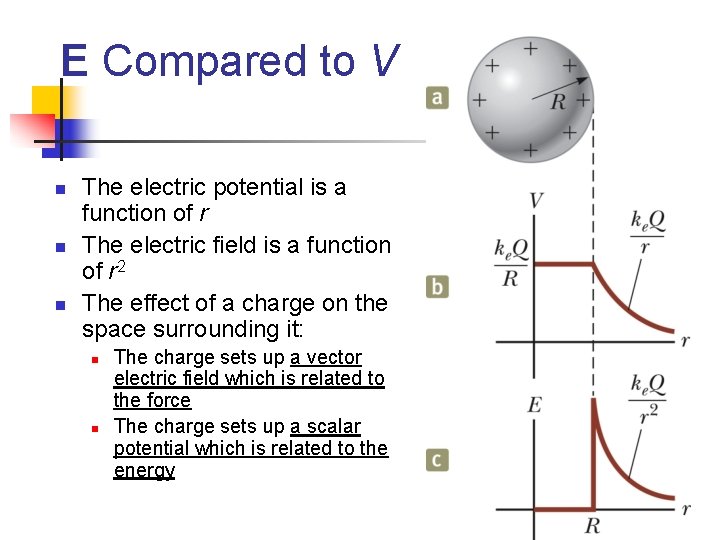
E Compared to V n n n The electric potential is a function of r The electric field is a function of r 2 The effect of a charge on the space surrounding it: n n The charge sets up a vector electric field which is related to the force The charge sets up a scalar potential which is related to the energy 42
Irregularly Shaped Objects n The charge density is high where the radius of curvature is small n n And low where the radius of curvature is large The electric field is large near the convex points having small radii of curvature and reaches very high values at sharp points 43
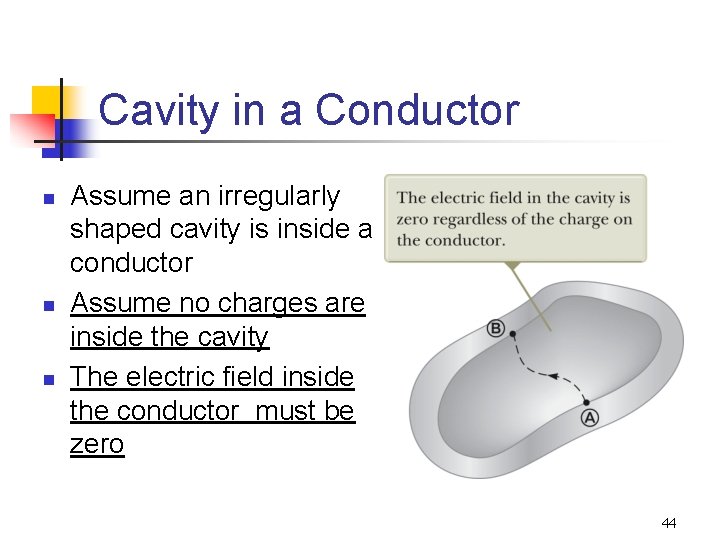
Cavity in a Conductor n n n Assume an irregularly shaped cavity is inside a conductor Assume no charges are inside the cavity The electric field inside the conductor must be zero 44
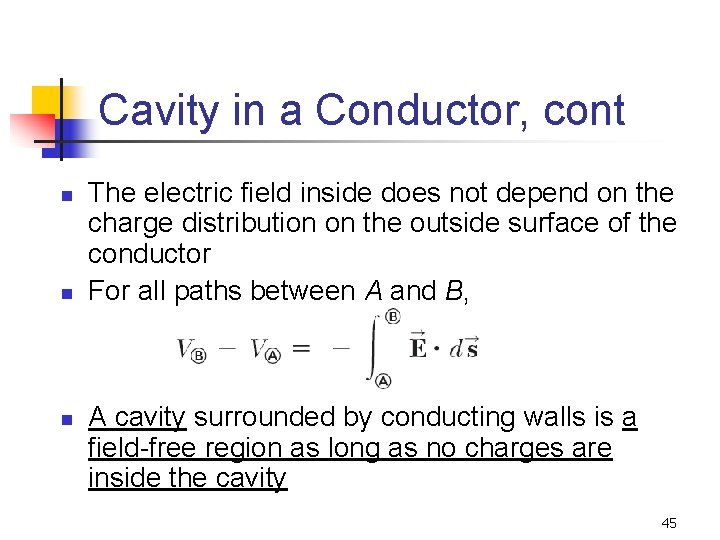
Cavity in a Conductor, cont n n n The electric field inside does not depend on the charge distribution on the outside surface of the conductor For all paths between A and B, A cavity surrounded by conducting walls is a field-free region as long as no charges are inside the cavity 45
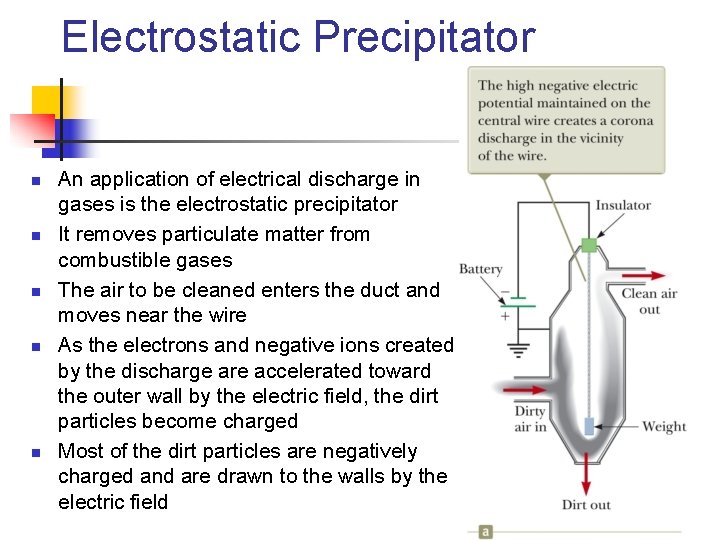
Corona Discharge n n If the electric field near a conductor is sufficiently strong, electrons resulting from random ionizations of air molecules near the conductor accelerate away from their parent molecules These electrons can ionize additional molecules near the conductor 46
Corona Discharge, cont. n n n This creates more free electrons The corona discharge is the glow that results from the recombination of these free electrons with the ionized air molecules The ionization and corona discharge are most likely to occur near very sharp points 47
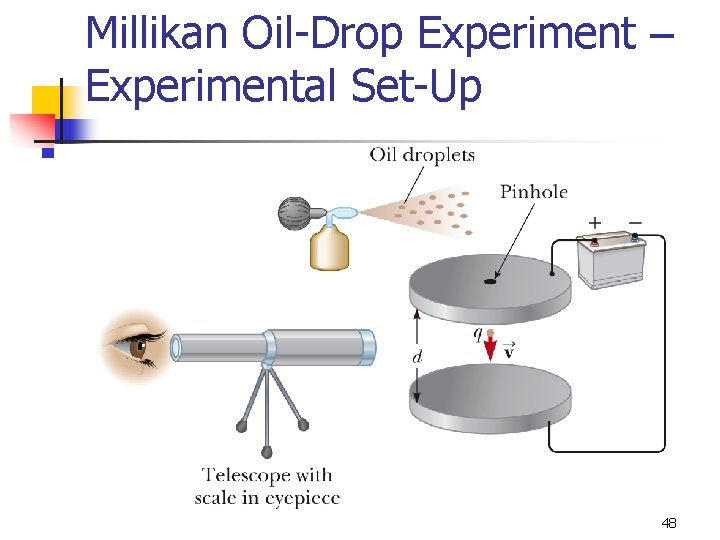
Millikan Oil-Drop Experiment – Experimental Set-Up 48
Millikan Oil-Drop Experiment n n n Robert Millikan measured e, the magnitude of the elementary charge on the electron He also demonstrated the quantized nature of this charge Oil droplets pass through a small hole and are illuminated by a light 49
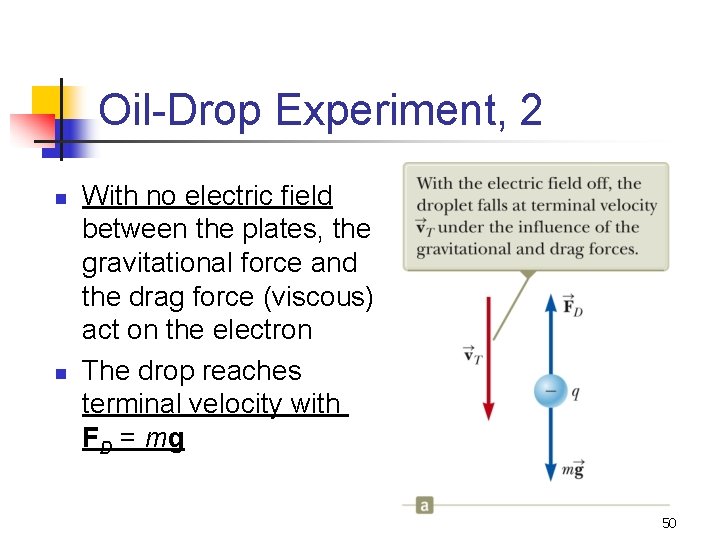
Oil-Drop Experiment, 2 n n With no electric field between the plates, the gravitational force and the drag force (viscous) act on the electron The drop reaches terminal velocity with FD = mg 50
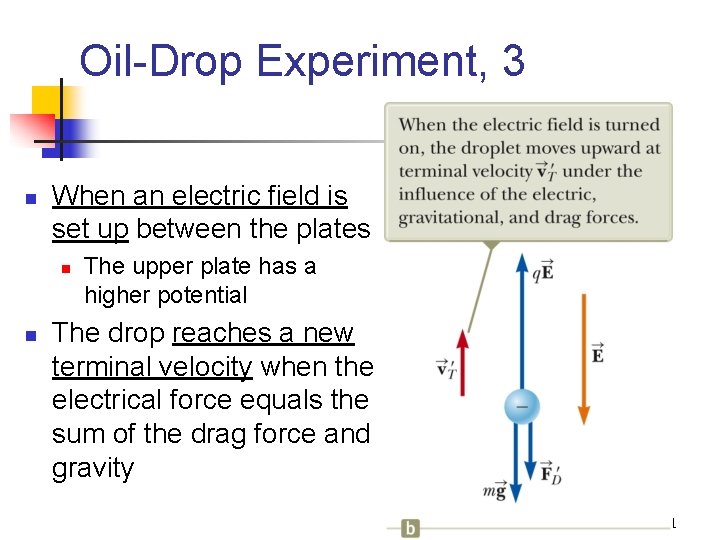
Oil-Drop Experiment, 3 n When an electric field is set up between the plates n n The upper plate has a higher potential The drop reaches a new terminal velocity when the electrical force equals the sum of the drag force and gravity 51
Oil-Drop Experiment, final n n The drop can be raised and allowed to fall numerous times by turning the electric field on and off After many experiments, Millikan determined: n n n q = ne where n = 0, -1, -2, -3, … e = 1. 60 x 10 -19 C This yields conclusive evidence that charge is quantized 52
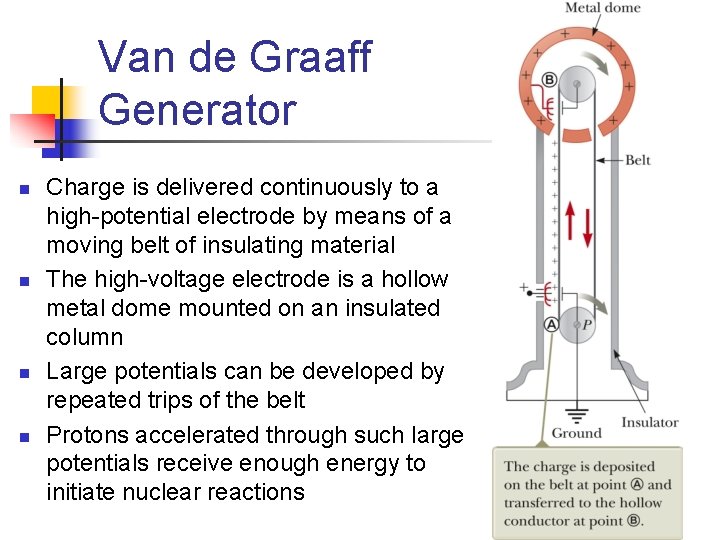
Van de Graaff Generator n n Charge is delivered continuously to a high-potential electrode by means of a moving belt of insulating material The high-voltage electrode is a hollow metal dome mounted on an insulated column Large potentials can be developed by repeated trips of the belt Protons accelerated through such large potentials receive enough energy to initiate nuclear reactions 53
Electrostatic Precipitator n n n An application of electrical discharge in gases is the electrostatic precipitator It removes particulate matter from combustible gases The air to be cleaned enters the duct and moves near the wire As the electrons and negative ions created by the discharge are accelerated toward the outer wall by the electric field, the dirt particles become charged Most of the dirt particles are negatively charged and are drawn to the walls by the electric field 54