
Chapter 25 Control of Body Temperature and Water
Chapter 25 Control of Body Temperature and Water Balance (체온조절과 수분균형) © 2012 Pearson Education, Inc.
• Thermoregulation (체온조절) • Osmoregulation and Excretion (삼투조절과 배 설) © 2012 Pearson Education, Inc.
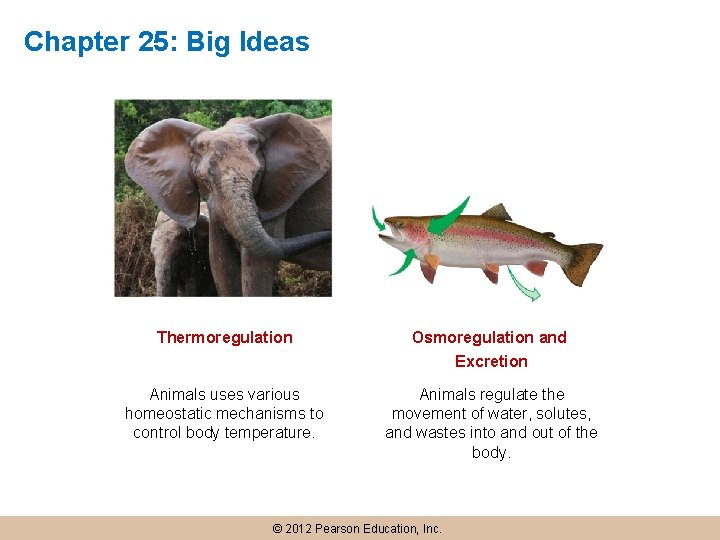
Chapter 25: Big Ideas Thermoregulation Osmoregulation and Excretion Animals uses various homeostatic mechanisms to control body temperature. Animals regulate the movement of water, solutes, and wastes into and out of the body. © 2012 Pearson Education, Inc.
§ Homeostasis (항상성) is the maintenance of steady internal conditions despite fluctuations in the external environment. § Examples of homeostasis include – thermoregulation—the maintenance of internal temperature within narrow limits, – osmoregulation—the control of the gain and loss of water and solutes, and – excretion—the disposal of nitrogen-containing wastes. © 2012 Pearson Education, Inc.
Thermoregulation (체온조절) © 2012 Pearson Education, Inc.
25. 1. 1 An animal’s regulation of body temperature helps maintain homeostasis § Ectothermic animals (외온동물) – Gain most of their heat from external sources (외부환경) – Include many fish, most amphibians, lizards, and most invertebrates. § Endothermic animals (내온동물) – Derive body heat mainly from their metabolism (대사작용) – include birds, mammals, a few reptiles and fish, and many insects. © 2012 Pearson Education, Inc.
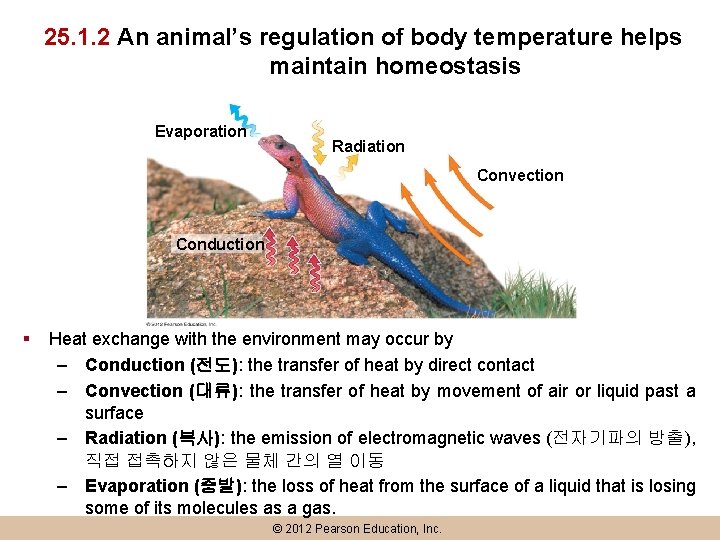
25. 1. 2 An animal’s regulation of body temperature helps maintain homeostasis Evaporation Radiation Convection Conduction § Heat exchange with the environment may occur by – Conduction (전도): the transfer of heat by direct contact – Convection (대류): the transfer of heat by movement of air or liquid past a surface – Radiation (복사): the emission of electromagnetic waves (전자기파의 방출), 직접 접촉하지 않은 물체 간의 열 이동 – Evaporation (증발): the loss of heat from the surface of a liquid that is losing some of its molecules as a gas. © 2012 Pearson Education, Inc.
25. 2. 1 Thermoregulation involves adaptations that balance heat gain and loss § 동물의 체온조절 적응방법: 5가지 1. Metabolic heat production (대사에 의한 열 생성) – hormonal changes boost the metabolic rate in birds and mammals, – birds and mammals shiver, – organisms increase their physical activity – honeybees cluster and shiver. 2. Insulation (단열) is provided by hair, feathers, and fat layers. 3. Circulatory adaptations (순환계의 적응) – 피부혈관의 수축 (열 보호)과 확장 (열손실): increased or decreased blood flow to skin – Countercurrent heat exchange (역류열교환): 이웃하는 두 혈관을 통해서 따뜻하거나 (동맥) 차가운(정맥) 혈액이 반대방향으로 흐름 © 2012 Pearson Education, Inc.
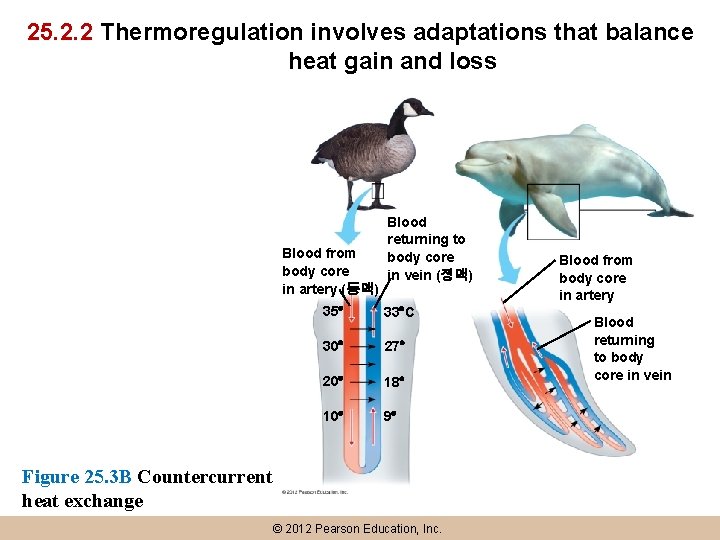
25. 2. 2 Thermoregulation involves adaptations that balance heat gain and loss Blood from body core in artery (동맥) Blood returning to body core in vein (정맥) 35 33 C 30 27 20 18 10 9 Figure 25. 3 B Countercurrent heat exchange © 2012 Pearson Education, Inc. Blood from body core in artery Blood returning to body core in vein
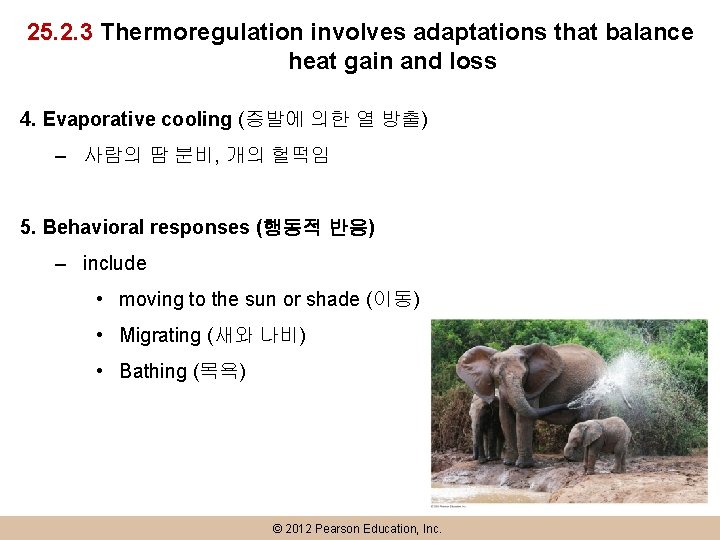
25. 2. 3 Thermoregulation involves adaptations that balance heat gain and loss 4. Evaporative cooling (증발에 의한 열 방출) – 사람의 땀 분비, 개의 헐떡임 5. Behavioral responses (행동적 반응) – include • moving to the sun or shade (이동) • Migrating (새와 나비) • Bathing (목욕) © 2012 Pearson Education, Inc.
Osmoregulation and Excretion (삼투조절과 배설) © 2012 Pearson Education, Inc.
25. 3. 1 Animals balance the level of water and solutes through osmoregulation (삼투조절) § Osmoregulation (삼투조절): the homeostatic control of the uptake and loss of water and solutes such as salt and other ions. § Osmosis is one process whereby animals regulate their uptake and loss of fluids. § Osmoconformers (삼투순응자) – have body fluids with a solute concentration equal to that of seawater (주변 환경과 체액의 용질농도를 동일하게 유지) – Include many marine invertebrates (해양무척추동물) § Osmoregulators (삼투조절자) • Have body fluids whose solute concentrations differ from that of their environment (외부 환경과 독립적으로 체액의 용질농도를 유지) • must actively regulate water movement • Include many land animals (육상동물), freshwater animals (담수어류) such as trout (송어), and marine vertebrates such as sharks. © 2012 Pearson Education, Inc.
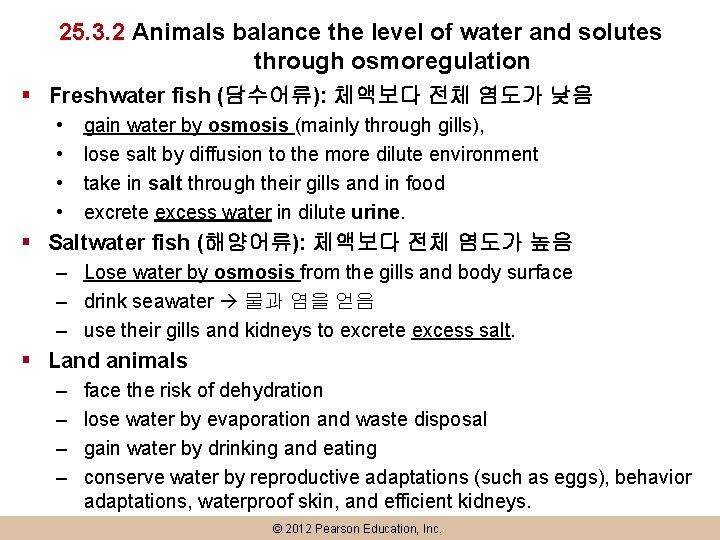
25. 3. 2 Animals balance the level of water and solutes through osmoregulation § Freshwater fish (담수어류): 체액보다 전체 염도가 낮음 • • gain water by osmosis (mainly through gills), lose salt by diffusion to the more dilute environment take in salt through their gills and in food excrete excess water in dilute urine. § Saltwater fish (해양어류): 체액보다 전체 염도가 높음 – Lose water by osmosis from the gills and body surface – drink seawater 물과 염을 얻음 – use their gills and kidneys to excrete excess salt. § Land animals – – face the risk of dehydration lose water by evaporation and waste disposal gain water by drinking and eating conserve water by reproductive adaptations (such as eggs), behavior adaptations, waterproof skin, and efficient kidneys. © 2012 Pearson Education, Inc.
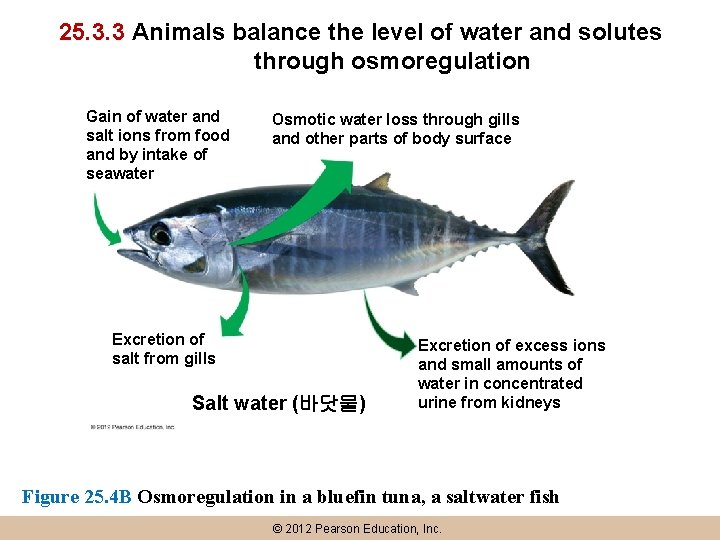
25. 3. 3 Animals balance the level of water and solutes through osmoregulation Gain of water and salt ions from food and by intake of seawater Osmotic water loss through gills and other parts of body surface Excretion of salt from gills Salt water (바닷물) Excretion of excess ions and small amounts of water in concentrated urine from kidneys Figure 25. 4 B Osmoregulation in a bluefin tuna, a saltwater fish © 2012 Pearson Education, Inc.
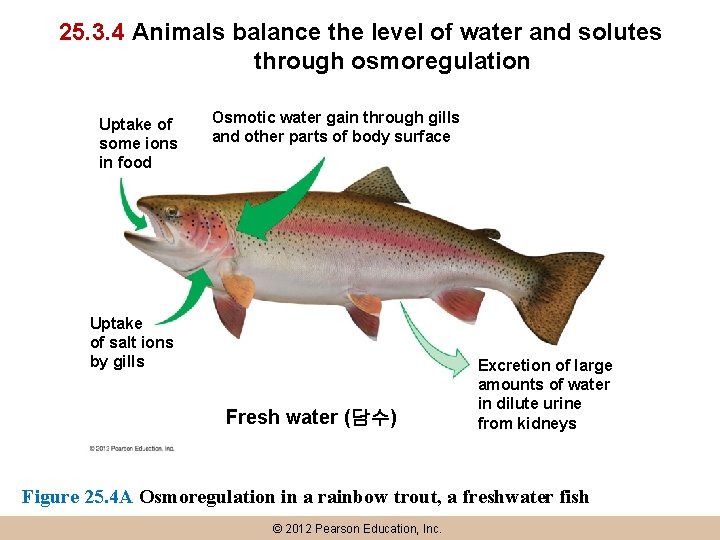
25. 3. 4 Animals balance the level of water and solutes through osmoregulation Uptake of some ions in food Osmotic water gain through gills and other parts of body surface Uptake of salt ions by gills Fresh water (담수) Excretion of large amounts of water in dilute urine from kidneys Figure 25. 4 A Osmoregulation in a rainbow trout, a freshwater fish © 2012 Pearson Education, Inc.
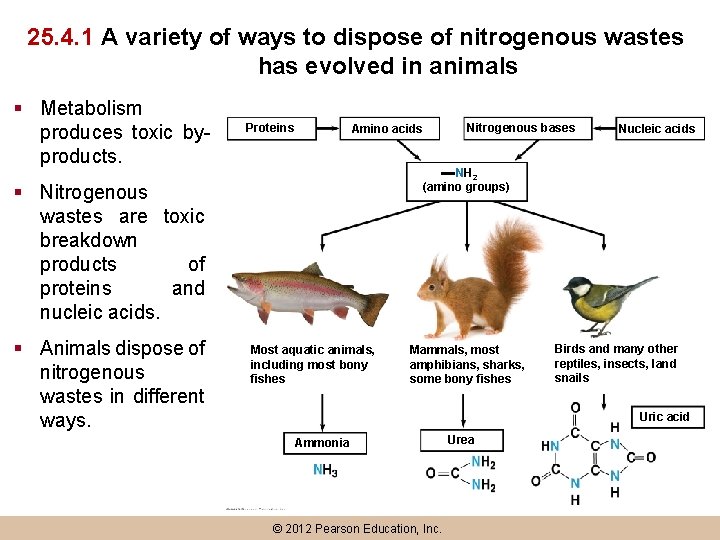
25. 4. 1 A variety of ways to dispose of nitrogenous wastes has evolved in animals § Metabolism produces toxic byproducts. Proteins Amino acids Nucleic acids NH 2 (amino groups) § Nitrogenous wastes are toxic breakdown products of proteins and nucleic acids. § Animals dispose of nitrogenous wastes in different ways. Nitrogenous bases Most aquatic animals, including most bony fishes Mammals, most amphibians, sharks, some bony fishes Birds and many other reptiles, insects, land snails Uric acid Ammonia © 2012 Pearson Education, Inc. Urea
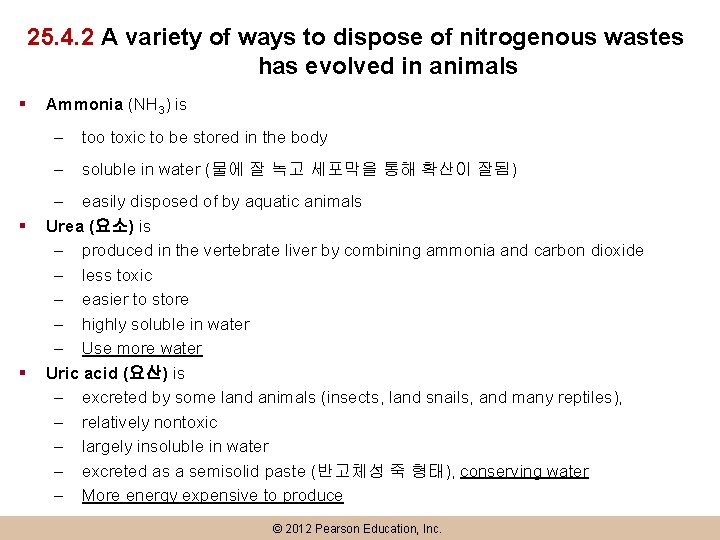
25. 4. 2 A variety of ways to dispose of nitrogenous wastes has evolved in animals § § § Ammonia (NH 3) is – too toxic to be stored in the body – soluble in water (물에 잘 녹고 세포막을 통해 확산이 잘됨) – easily disposed of by aquatic animals Urea (요소) is – produced in the vertebrate liver by combining ammonia and carbon dioxide – less toxic – easier to store – highly soluble in water – Use more water Uric acid (요산) is – excreted by some land animals (insects, land snails, and many reptiles), – relatively nontoxic – largely insoluble in water – excreted as a semisolid paste (반고체성 죽 형태), conserving water – More energy expensive to produce © 2012 Pearson Education, Inc.
25. 5 The urinary system (비뇨계) plays several major roles in homeostasis § The urinary system – forms and excretes urine (요소) – regulates water and solutes in body fluids. § In humans, the kidneys (콩팥, 신장) are the main processing centers of the urinary system. § Nephrons (네프론) – Are the functional units of the kidneys (하나의 신장에 백만 개 이상 존 재) – extract a fluid filtrate (여액) from the blood – refine the filtrate to produce urine. § Urine is – drained from the kidneys by ureters (요관) – stored in the urinary bladder (방광) – expelled through the urethra (요도) © 2012 Pearson Education, Inc.
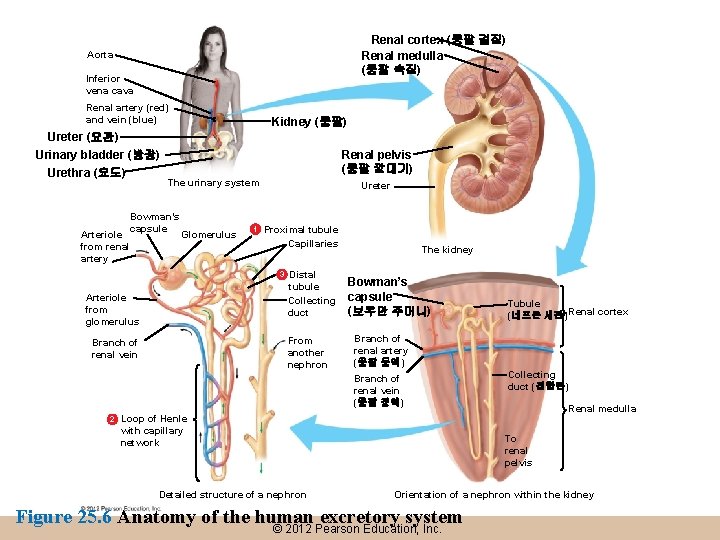
Renal cortex (콩팥 겉질) Renal medulla (콩팥 속질) Aorta Inferior vena cava Renal artery (red) and vein (blue) Kidney (콩팥) Ureter (요관) Urinary bladder (방광) Urethra (요도) Arteriole from renal artery Renal pelvis (콩팥 깔대기) The urinary system Bowman’s capsule Glomerulus 1 Ureter Proximal tubule Capillaries 3 Arteriole from glomerulus Distal tubule Collecting duct From another nephron Branch of renal vein The kidney Bowman’s capsule (보우만 주머니) Branch of renal artery (콩팥 동맥) Branch of renal vein (콩팥 정맥) 2 Loop of Henle with capillary network Detailed structure of a nephron Tubule (네프론 세관) Renal cortex Collecting duct (집합돤) Renal medulla To renal pelvis Orientation of a nephron within the kidney Figure 25. 6 Anatomy of the human excretory system © 2012 Pearson Education, Inc.
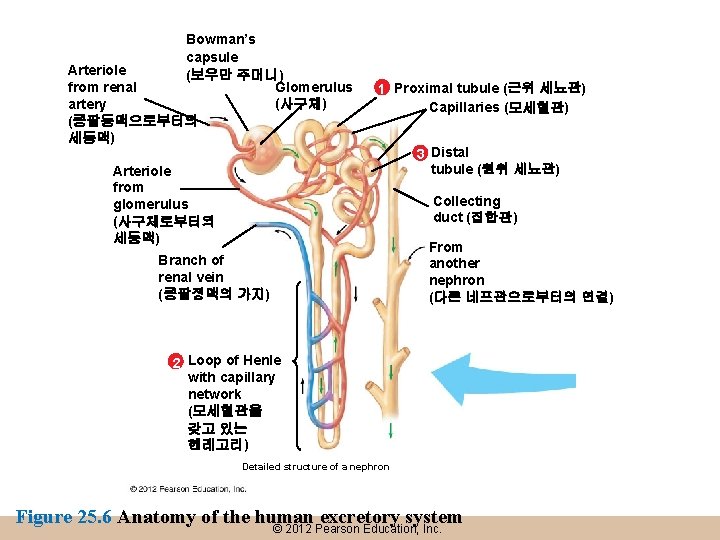
Bowman’s capsule Arteriole (보우만 주머니) Glomerulus from renal (사구체) artery (콩팥동맥으로부터의 세동맥) 1 Proximal tubule (근위 세뇨관) Capillaries (모세혈관) 3 Distal tubule (원위 세뇨관) Arteriole from glomerulus (사구체로부터의 세동맥) Collecting duct (집합관) Branch of renal vein (콩팥정맥의 가지) From another nephron (다른 네프관으로부터의 연결) 2 Loop of Henle with capillary network (모세혈관을 갖고 있는 헨레고리) Detailed structure of a nephron Figure 25. 6 Anatomy of the human excretory system © 2012 Pearson Education, Inc.
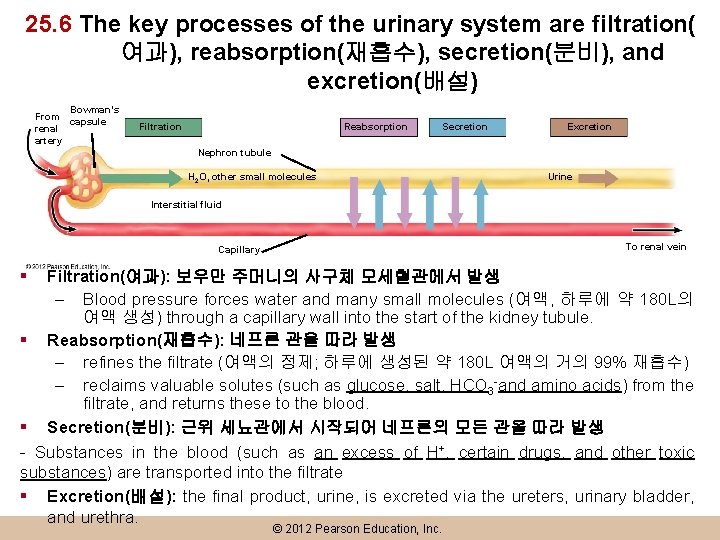
25. 6 The key processes of the urinary system are filtration( 여과), reabsorption(재흡수), secretion(분비), and excretion(배설) Bowman’s From capsule renal artery Reabsorption Filtration Secretion Excretion Nephron tubule H 2 O, other small molecules Urine Interstitial fluid To renal vein Capillary § Filtration(여과): 보우만 주머니의 사구체 모세혈관에서 발생 – Blood pressure forces water and many small molecules (여액, 하루에 약 180 L의 여액 생성) through a capillary wall into the start of the kidney tubule. § Reabsorption(재흡수): 네프론 관을 따라 발생 – refines the filtrate (여액의 정제; 하루에 생성된 약 180 L 여액의 거의 99% 재흡수) – reclaims valuable solutes (such as glucose, salt, HCO 3 -and amino acids) from the filtrate, and returns these to the blood. § Secretion(분비): 근위 세뇨관에서 시작되어 네프론의 모든 관을 따라 발생 - Substances in the blood (such as an excess of H+, certain drugs, and other toxic substances) are transported into the filtrate § Excretion(배설): the final product, urine, is excreted via the ureters, urinary bladder, and urethra. © 2012 Pearson Education, Inc.
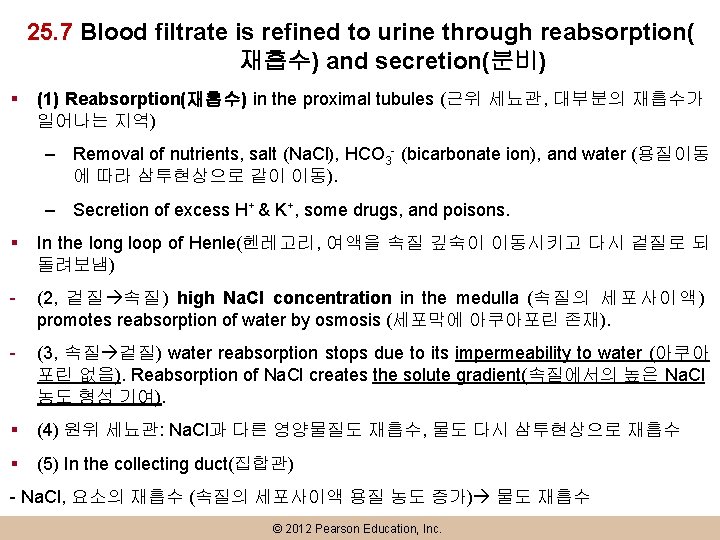
25. 7 Blood filtrate is refined to urine through reabsorption( 재흡수) and secretion(분비) § (1) Reabsorption(재흡수) in the proximal tubules (근위 세뇨관, 대부분의 재흡수가 일어나는 지역) – Removal of nutrients, salt (Na. Cl), HCO 3 - (bicarbonate ion), and water (용질이동 에 따라 삼투현상으로 같이 이동). – Secretion of excess H+ & K+, some drugs, and poisons. § In the long loop of Henle(헨레고리, 여액을 속질 깊숙이 이동시키고 다시 겉질로 되 돌려보냄) - (2, 겉질 속질) high Na. Cl concentration in the medulla (속질의 세포사이액) promotes reabsorption of water by osmosis (세포막에 아쿠아포린 존재). - (3, 속질 겉질) water reabsorption stops due to its impermeability to water (아쿠아 포린 없음). Reabsorption of Na. Cl creates the solute gradient(속질에서의 높은 Na. Cl 농도 형성 기여). § (4) 원위 세뇨관: Na. Cl과 다른 영양물질도 재흡수, 물도 다시 삼투현상으로 재흡수 § (5) In the collecting duct(집합관) - Na. Cl, 요소의 재흡수 (속질의 세포사이액 용질 농도 증가) 물도 재흡수 © 2012 Pearson Education, Inc.
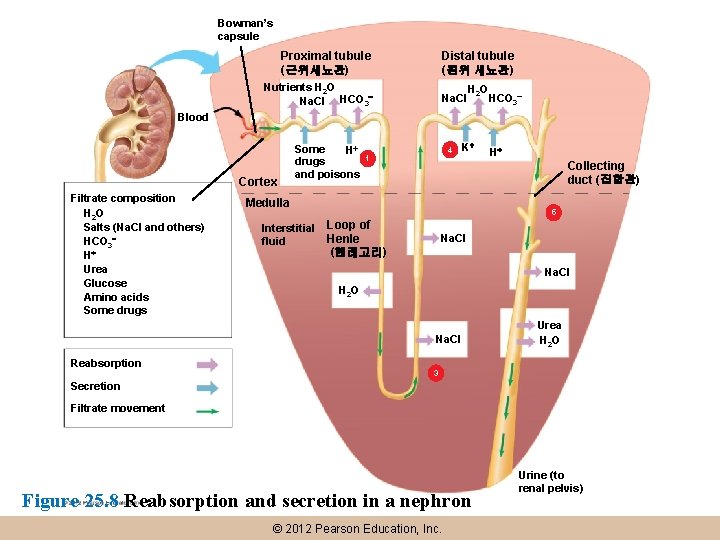
Bowman’s capsule Proximal tubule (근위세뇨관) Distal tubule (원위 세뇨관) Nutrients H 2 O Na. Cl HCO 3 Na. Cl H 2 O HCO 3 Blood Cortex Filtrate composition H 2 O Salts (Na. Cl and others) HCO 3 H Urea Glucose Amino acids Some drugs Some H drugs and poisons 4 1 K Collecting duct (집합관) Medulla 5 Interstitial fluid Loop of Henle (헨레고리) Na. Cl 2 Na. Cl H 2 O Na. Cl Reabsorption H Urea H 2 O 3 Secretion Filtrate movement Figure 25. 8 Reabsorption and secretion in a nephron © 2012 Pearson Education, Inc. Urine (to renal pelvis)
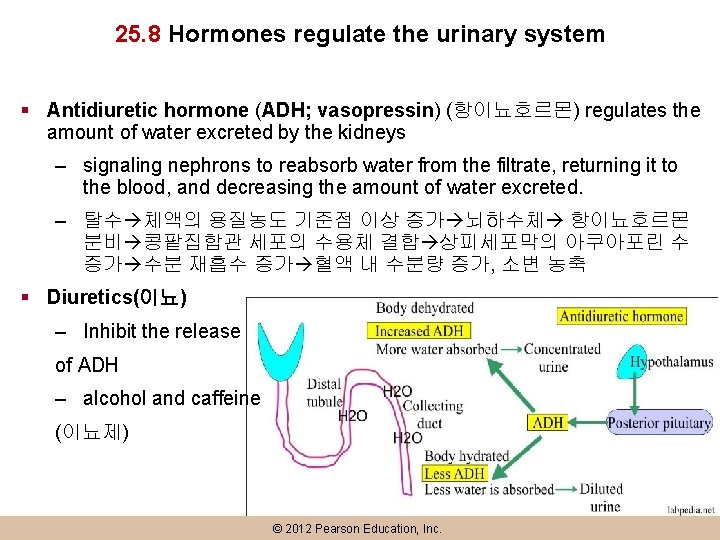
25. 8 Hormones regulate the urinary system § Antidiuretic hormone (ADH; vasopressin) (항이뇨호르몬) regulates the amount of water excreted by the kidneys – signaling nephrons to reabsorb water from the filtrate, returning it to the blood, and decreasing the amount of water excreted. – 탈수 체액의 용질농도 기준점 이상 증가 뇌하수체 항이뇨호르몬 분비 콩팥집합관 세포의 수용체 결합 상피세포막의 아쿠아포린 수 증가 수분 재흡수 증가 혈액 내 수분량 증가, 소변 농축 § Diuretics(이뇨) – Inhibit the release of ADH – alcohol and caffeine (이뇨제) © 2012 Pearson Education, Inc.
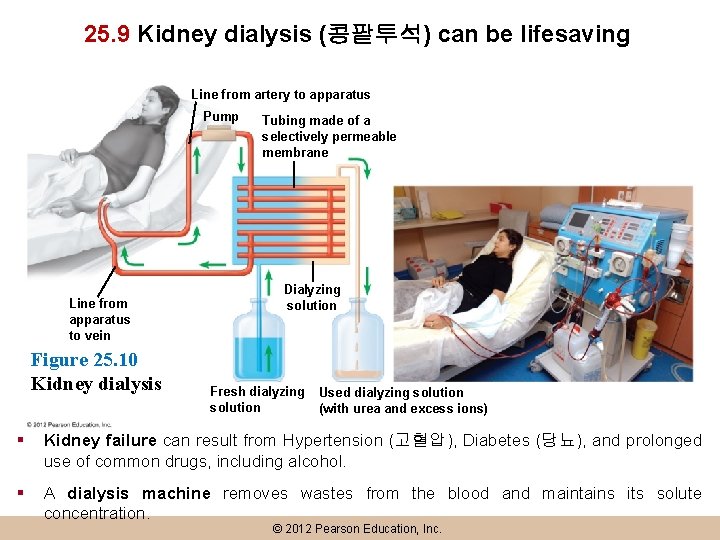
25. 9 Kidney dialysis (콩팥투석) can be lifesaving Line from artery to apparatus Pump Line from apparatus to vein Figure 25. 10 Kidney dialysis Tubing made of a selectively permeable membrane Dialyzing solution Fresh dialyzing solution Used dialyzing solution (with urea and excess ions) § Kidney failure can result from Hypertension (고혈압), Diabetes (당뇨), and prolonged use of common drugs, including alcohol. § A dialysis machine removes wastes from the blood and maintains its solute concentration. © 2012 Pearson Education, Inc.
- Slides: 25