
Chapter 24 ThreePhase Systems ThreePhase Voltage Generation Threephase
- Slides: 33
Chapter 24 Three-Phase Systems
Three-Phase Voltage Generation • Three-phase generators – Three sets of windings and produce three ac voltages • Windings are placed 120° apart – Voltages are three identical sinusoidal voltages 120° apart 2
Three-Phase Voltage Generation • Set of voltages such as these are balanced • If you know one of the voltages – The other two are easily determined 3
Four-Wire Systems • Three loads have common return wire called neutral • If load is balanced – Current in the neutral is zero • Current is small – Wire can be smaller or removed – Current may not be zero, but it is very small 4
Four-Wire Systems • Outgoing lines are called line or phase conductors 5
Three-Phase Relationships • Line voltages – Voltages between lines either at the generator (EAB) or at the load (VAB) 6
Three-Phase Relationships • Phase voltages – Voltages across phases • For a Y load, phases are from line to neutral • For load, the phases are from line to line 7
Three-Phase Relationships • Line currents – Currents in line conductors • Phase currents – Currents through phases – For a Y load two currents are the same 8
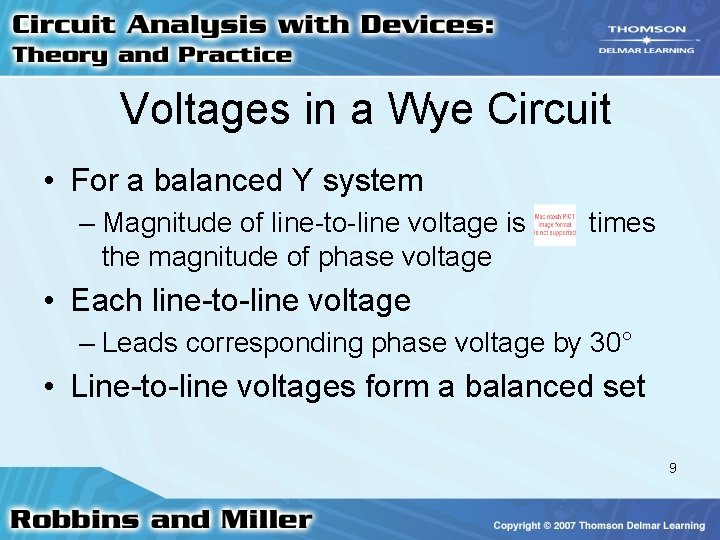
Voltages in a Wye Circuit • For a balanced Y system – Magnitude of line-to-line voltage is the magnitude of phase voltage times • Each line-to-line voltage – Leads corresponding phase voltage by 30° • Line-to-line voltages form a balanced set 9
Voltages for a Wye Circuit • Nominal voltages – 120/208 -V – 277/480 -V – 347/600 -V systems 10
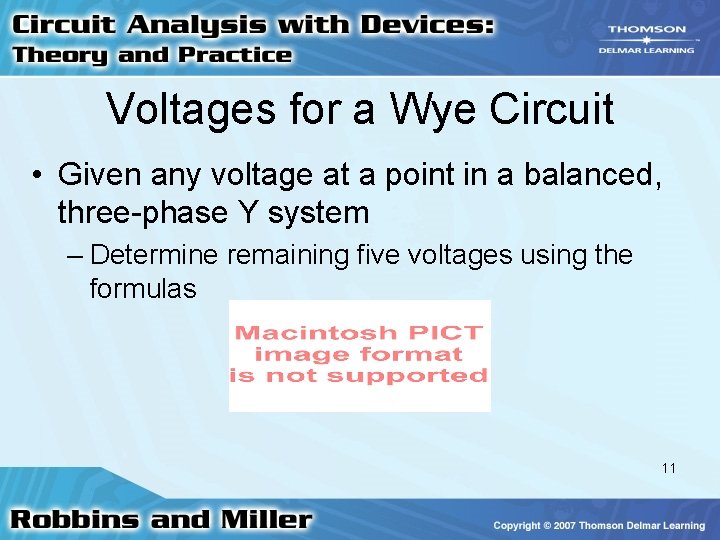
Voltages for a Wye Circuit • Given any voltage at a point in a balanced, three-phase Y system – Determine remaining five voltages using the formulas 11
Currents for a Wye Circuit • Line currents – Same as phase currents – Ia = Van/Zan • Line currents form a balanced set – If you know one current • Determine the other five currents by inspection 12
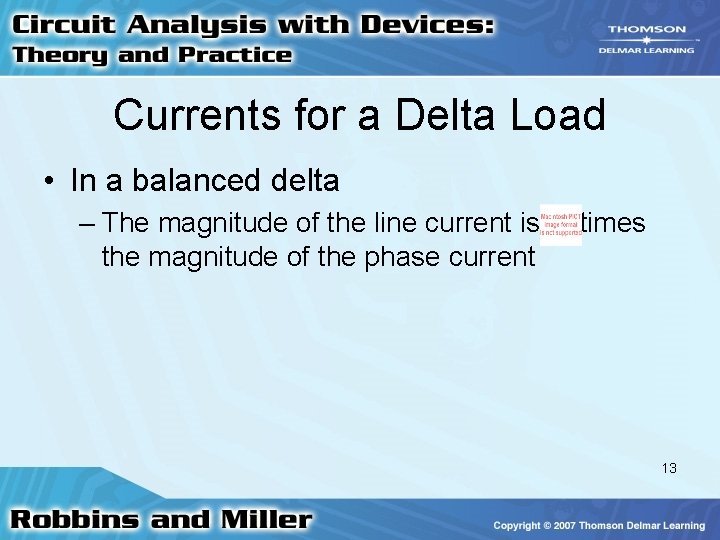
Currents for a Delta Load • In a balanced delta – The magnitude of the line current is the magnitude of the phase current times 13
Currents for a Delta Load • Each line current lags its corresponding phase current by 30° • For any current in a balanced, three-phase delta load – Determine remaining currents by inspection 14
Power in a Balanced System • To find total power in a balanced system – Determine power in one phase – Multiply by three • Use ac power formulas previously developed 15
Power in a Balanced System • Since magnitudes are the same for all three phases, simplified notation may be used 16
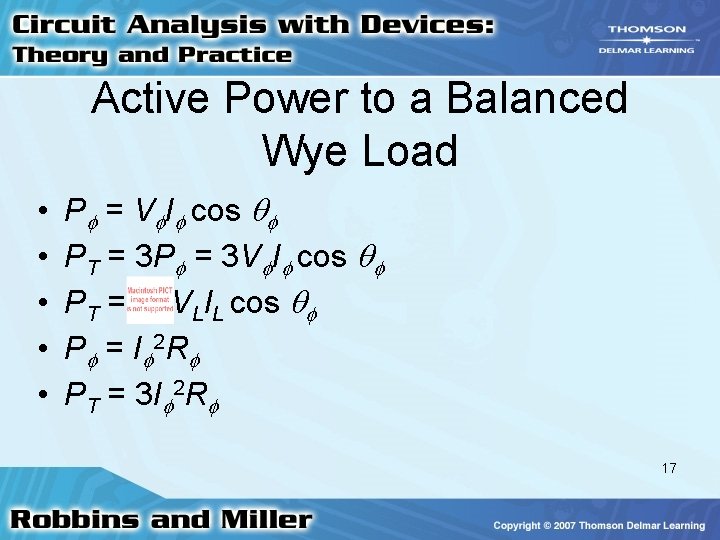
Active Power to a Balanced Wye Load • • • P = V I cos PT = 3 P = 3 V I cos PT = VLIL cos P = I 2 R PT = 3 I 2 R 17
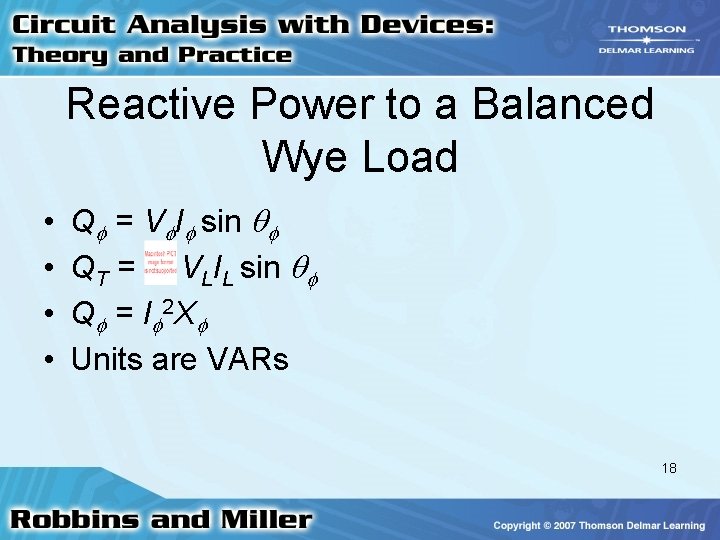
Reactive Power to a Balanced Wye Load • • Q = V I sin QT = VLIL sin Q = I 2 X Units are VARs 18
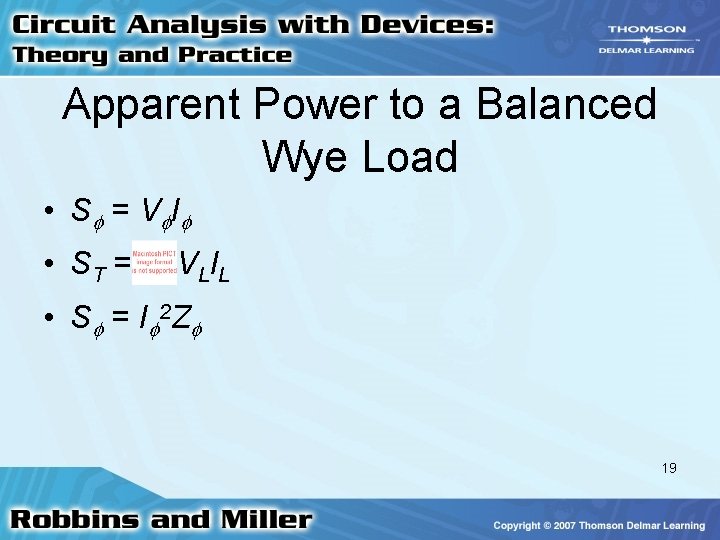
Apparent Power to a Balanced Wye Load • S = V I • ST = V LI L • S = I 2 Z 19
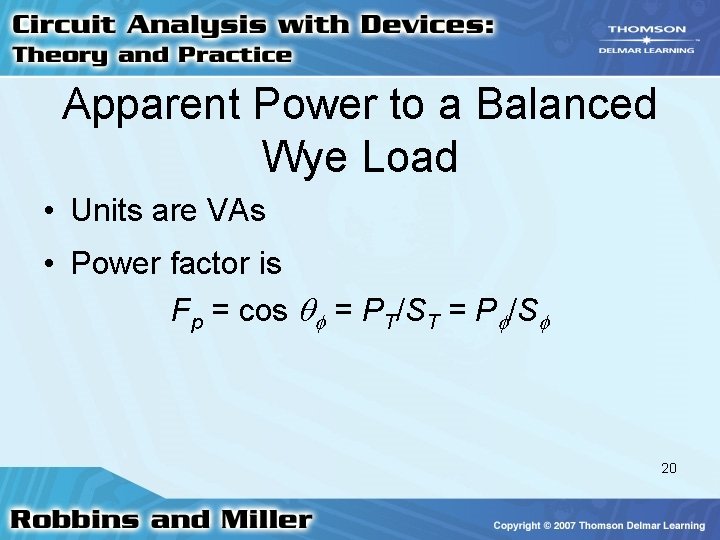
Apparent Power to a Balanced Wye Load • Units are VAs • Power factor is Fp = cos = PT/ST = P /S 20
Power to a Balanced Delta Load • Power formulas for load are identical to those for Y load • In all these formulas – Angle is phase angle of the load impedance 21
Power to a Balanced Delta Load • You can also use single-phase equivalent in power calculations – Power will be power for just one phase 22
Measuring Power in Three. Phase Circuits • Measuring power to a 4 -wire Y load requires three wattmeters (one meter phase) • Loads may be balanced or unbalanced • Total power is sum of individual powers 23
Measuring Power in Three. Phase Circuits • If load could be guaranteed to be balanced – Only one meter would be required – Its value multiplied by 3 24
Measuring Power in Three. Phase Circuits • For a three-wire system – Only two meters are needed • Loads may be Y or • Loads may be balanced or unbalanced • Total power is algebraic sum of meter readings 25
Measuring Power in Three. Phase Circuits • Power factor for a balanced load – Obtain from wattmeter readings using a watts ratio curve 26
Measuring Power in Three. Phase Circuits • From this, can be determined • Power factor can then be determined from cos 27
Unbalanced Loads • Use Ohm’s law – For unbalanced four-wire Y systems without line impedance • Three-wire and four-wire systems with line and neutral impedance – Require use of mesh analysis 28
Unbalanced Loads • One of the problems with unbalanced loads – Different voltages are obtained across each phase of the load and between neutral points 29
Unbalanced Loads • Unbalanced four-wire systems without line impedance are easily handled – Source voltage is applied directly to load • Three-wire and four-wire systems with line and neutral impedance – Require use of mesh analysis 30
Power System Loads • Single-phase power – Residential and business customers • Single-phase and three-phase systems – Industrial customers – Therefore, there is a need to connect both single-phase and three-phase loads to threephase systems 31
Power System Loads • Utility tries to connect one third of its single-phase loads to each phase • Three-phase loads are generally balanced 32
Power System Loads • Real loads – Seldom expressed in terms of resistance, capacitance, and inductance – Rather, real loads are described in terms of power, power factors, etc. 33