
Chapter 24 Stable Mineral Assemblages in Metamorphic Rocks

Chapter 24. Stable Mineral Assemblages in Metamorphic Rocks • Equilibrium Mineral Assemblages • At equilibrium, the mineralogy (and the composition of each mineral) is determined by T, P, and X • “Mineral paragenesis” refers to such an equilibrium mineral assemblage • Relict minerals or later alteration products are thereby excluded from consideration unless specifically stated
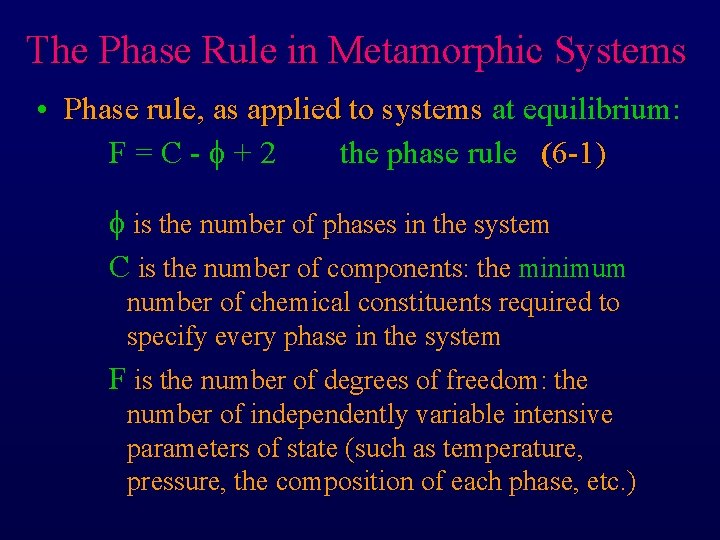
The Phase Rule in Metamorphic Systems • Phase rule, as applied to systems at equilibrium: F=C-f+2 the phase rule (6 -1) f is the number of phases in the system C is the number of components: the minimum number of chemical constituents required to specify every phase in the system F is the number of degrees of freedom: the number of independently variable intensive parameters of state (such as temperature, pressure, the composition of each phase, etc. )

The Phase Rule in Metamorphic Systems • A typical sample from a metamorphic terrane F Likely select a sample from within a zone, and not from right on an isograd • Alternatively, pick a random point anywhere on a phase diagram F Likely point will be within a divariant field and not on a univariant curve or invariant point • The most common situation is divariant (F = 2), meaning that P and T are independently variable without affecting the mineral assemblage
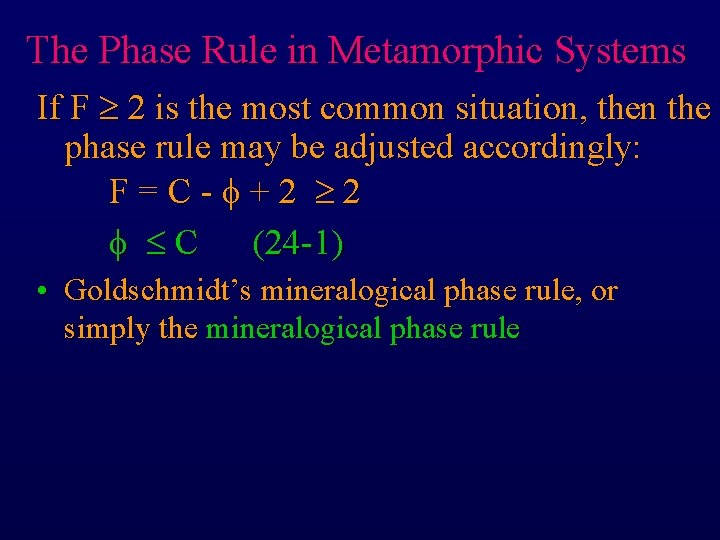
The Phase Rule in Metamorphic Systems If F 2 is the most common situation, then the phase rule may be adjusted accordingly: F=C-f+2 2 f C (24 -1) • Goldschmidt’s mineralogical phase rule, or simply the mineralogical phase rule
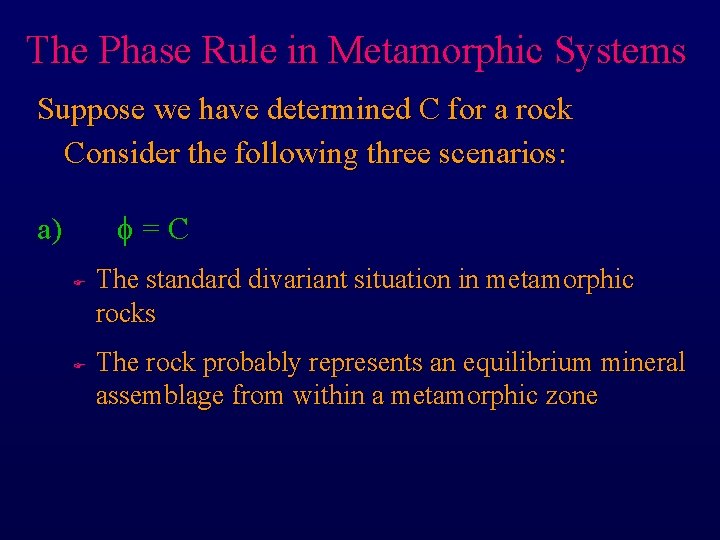
The Phase Rule in Metamorphic Systems Suppose we have determined C for a rock Consider the following three scenarios: f=C a) F F The standard divariant situation in metamorphic rocks The rock probably represents an equilibrium mineral assemblage from within a metamorphic zone
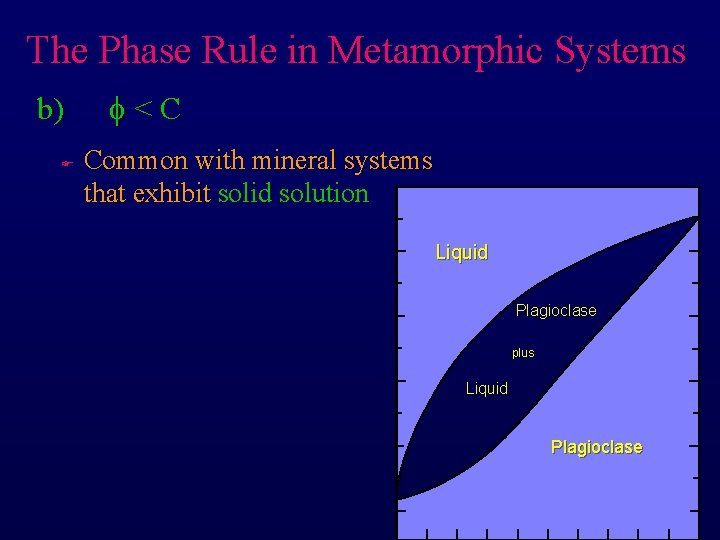
The Phase Rule in Metamorphic Systems b) F f<C Common with mineral systems that exhibit solid solution Liquid Plagioclase plus Liquid Plagioclase
The Phase Rule in Metamorphic Systems c) f>C A more interesting situation, and at least one of three situations must be responsible: 1) F < 2 s The sample is collected from a location right on a univariant reaction curve (isograd) or invariant point F
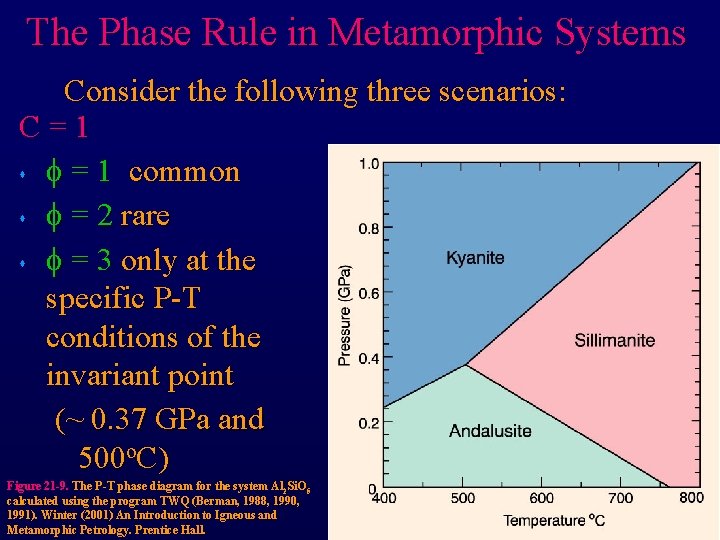
The Phase Rule in Metamorphic Systems Consider the following three scenarios: C=1 s f = 1 common s f = 2 rare s f = 3 only at the specific P-T conditions of the invariant point (~ 0. 37 GPa and 500 o. C) Figure 21 -9. The P-T phase diagram for the system Al 2 Si. O 5 calculated using the program TWQ (Berman, 1988, 1990, 1991). Winter (2001) An Introduction to Igneous and Metamorphic Petrology. Prentice Hall.
The Phase Rule in Metamorphic Systems 2) Equilibrium has not been attained s The phase rule applies only to systems at equilibrium, and there could be any number of minerals coexisting if equilibrium is not attained
The Phase Rule in Metamorphic Systems 3) We didn’t choose the # of components correctly • Some guidelines for an appropriate choice of C F Begin with a 1 -component system, such as Ca. Al 2 Si 2 O 8 (anorthite), there are 3 common types of major/minor components that we can add a) Components that generate a new phase s Adding a component such as Ca. Mg. Si 2 O 6 (diopside), results in an additional phase: in the binary Di-An system diopside coexists with anorthite below the solidus
The Phase Rule in Metamorphic Systems 3) We didn’t choose the # of components correctly b) Components that substitute for other components s s Adding a component such as Na. Al. Si 3 O 8 (albite) to the 1 -C anorthite system would dissolve in the anorthite structure, resulting in a single solid-solution mineral (plagioclase) below the solidus Fe and Mn commonly substitute for Mg Al may substitute for Si Na may substitute for K
The Phase Rule in Metamorphic Systems 3) We didn’t choose the # of components correctly c) “Perfectly mobile” components s Either a freely mobile fluid component or a component that dissolves in a fluid phase and can be transported easily The chemical activity of such components is commonly controlled by factors external to the local rock system They are commonly ignored in deriving C for metamorphic systems
The Phase Rule in Metamorphic Systems Consider the very simple metamorphic system, Mg. O-H 2 O Possible natural phases in this system are periclase (Mg. O), aqueous fluid (H 2 O), and brucite (Mg(OH)2) F How we deal with H 2 O depends upon whether water is perfectly mobile or not F A reaction can occur between the potential phases in this system: Mg. O + H 2 O Mg(OH)2 Per + Fluid = Bru retrograde reaction as written (occurs as the rock cools and hydrates) F
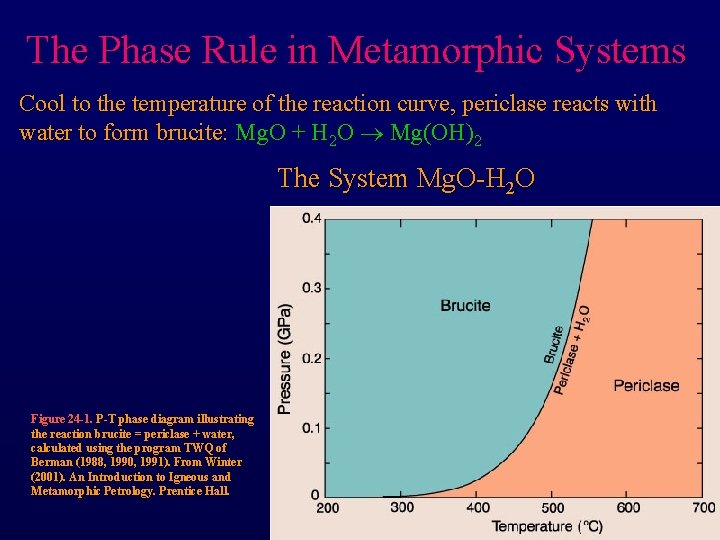
The Phase Rule in Metamorphic Systems Cool to the temperature of the reaction curve, periclase reacts with water to form brucite: Mg. O + H 2 O Mg(OH)2 The System Mg. O-H 2 O Figure 24 -1. P-T phase diagram illustrating the reaction brucite = periclase + water, calculated using the program TWQ of Berman (1988, 1990, 1991). From Winter (2001). An Introduction to Igneous and Metamorphic Petrology. Prentice Hall.
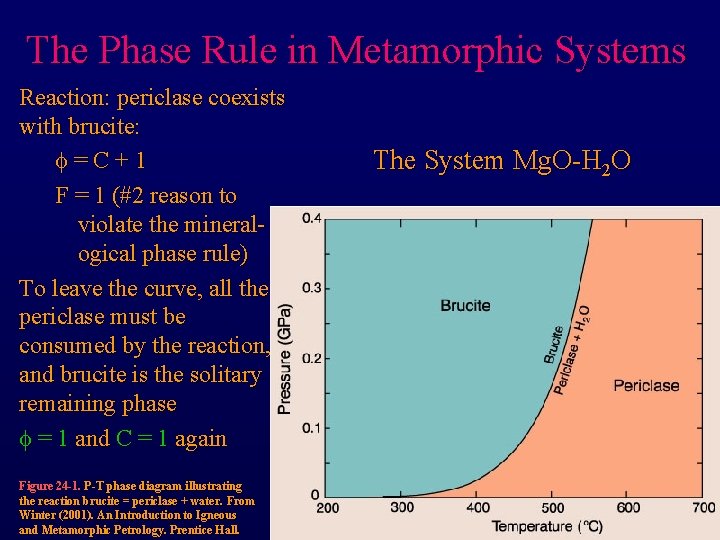
The Phase Rule in Metamorphic Systems Reaction: periclase coexists with brucite: f=C+1 F = 1 (#2 reason to violate the mineralogical phase rule) To leave the curve, all the periclase must be consumed by the reaction, and brucite is the solitary remaining phase f = 1 and C = 1 again Figure 24 -1. P-T phase diagram illustrating the reaction brucite = periclase + water. From Winter (2001). An Introduction to Igneous and Metamorphic Petrology. Prentice Hall. The System Mg. O-H 2 O
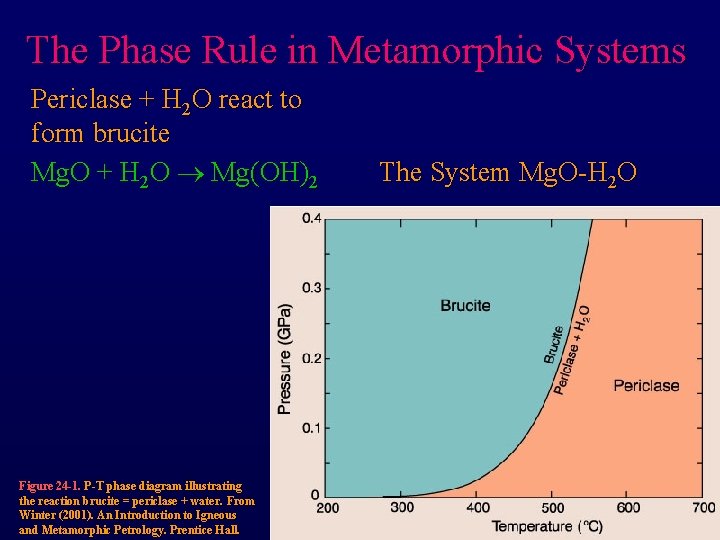
The Phase Rule in Metamorphic Systems Periclase + H 2 O react to form brucite Mg. O + H 2 O Mg(OH)2 Figure 24 -1. P-T phase diagram illustrating the reaction brucite = periclase + water. From Winter (2001). An Introduction to Igneous and Metamorphic Petrology. Prentice Hall. The System Mg. O-H 2 O
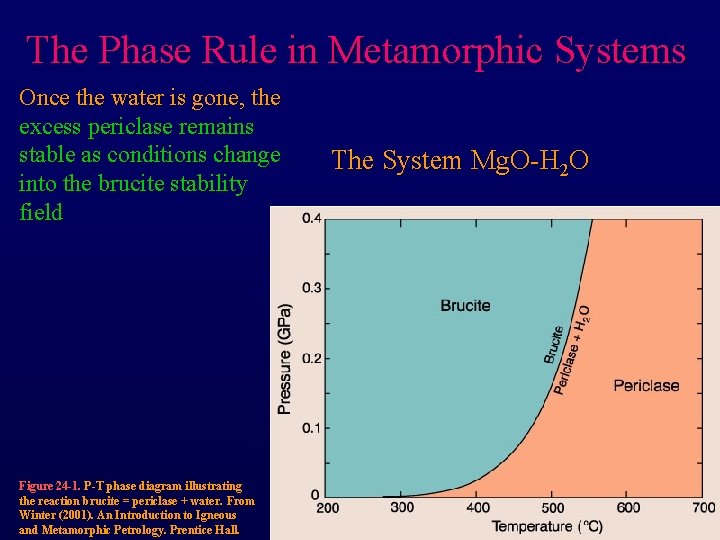
The Phase Rule in Metamorphic Systems Once the water is gone, the excess periclase remains stable as conditions change into the brucite stability field Figure 24 -1. P-T phase diagram illustrating the reaction brucite = periclase + water. From Winter (2001). An Introduction to Igneous and Metamorphic Petrology. Prentice Hall. The System Mg. O-H 2 O
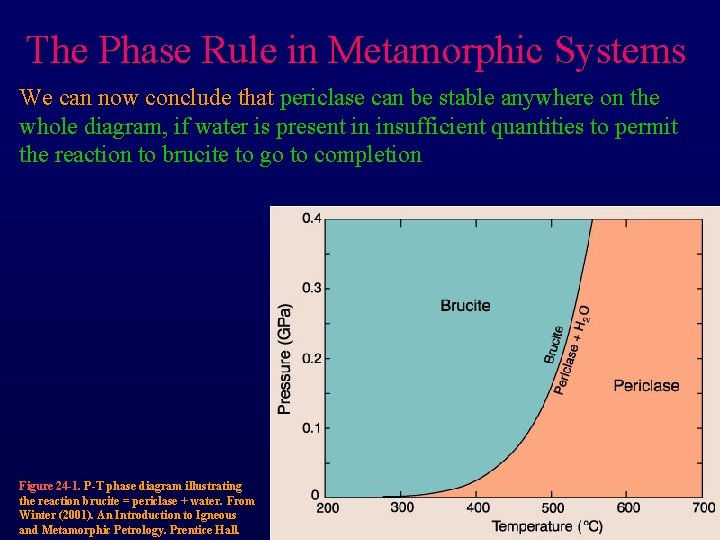
The Phase Rule in Metamorphic Systems We can now conclude that periclase can be stable anywhere on the whole diagram, if water is present in insufficient quantities to permit the reaction to brucite to go to completion Figure 24 -1. P-T phase diagram illustrating the reaction brucite = periclase + water. From Winter (2001). An Introduction to Igneous and Metamorphic Petrology. Prentice Hall.

The Phase Rule in Metamorphic Systems At any point (other than on the univariant curve itself) we would expect to find two phases, not one f = brucite + periclase below the reaction curve (if water is limited), or periclase + water above the curve Figure 24 -1. P-T phase diagram illustrating the reaction brucite = periclase + water. From Winter (2001). An Introduction to Igneous and Metamorphic Petrology. Prentice Hall.
The Phase Rule in Metamorphic Systems How do you know which way is correct? • The rocks should tell you F F F The phase rule is an interpretive tool, not a predictive tool, and does not tell the rocks how to behave If you only see low-f assemblages (e. g. Per or Bru in the Mg. O-H 2 O system), then some components may be mobile If you often observe assemblages that have many phases in an area (e. g. periclase + brucite), it is unlikely that so much of the area is right on a univariant curve, and may require the number of components to include otherwise mobile phases, such as H 2 O or CO 2, in order to apply the phase rule correctly
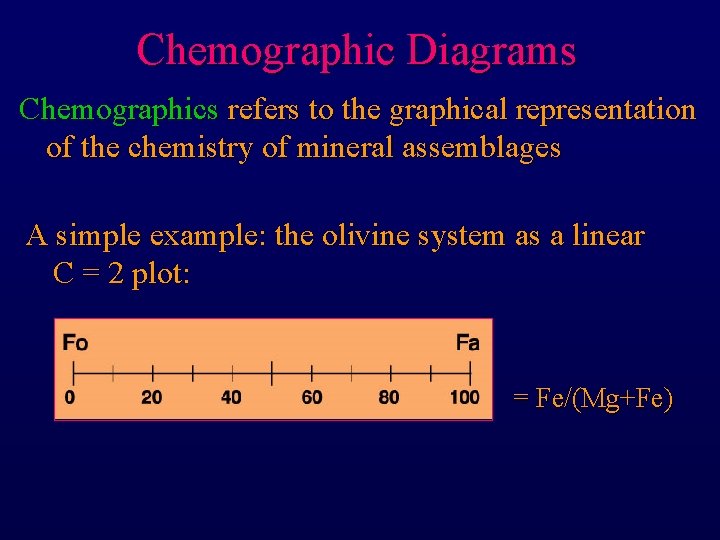
Chemographic Diagrams Chemographics refers to the graphical representation of the chemistry of mineral assemblages A simple example: the olivine system as a linear C = 2 plot: = Fe/(Mg+Fe)

Chemographic Diagrams 3 -C mineral compositions are plotted on a triangular chemographic diagram as shown in Fig. 24 -2 x, y, z, xyz, and yz 2
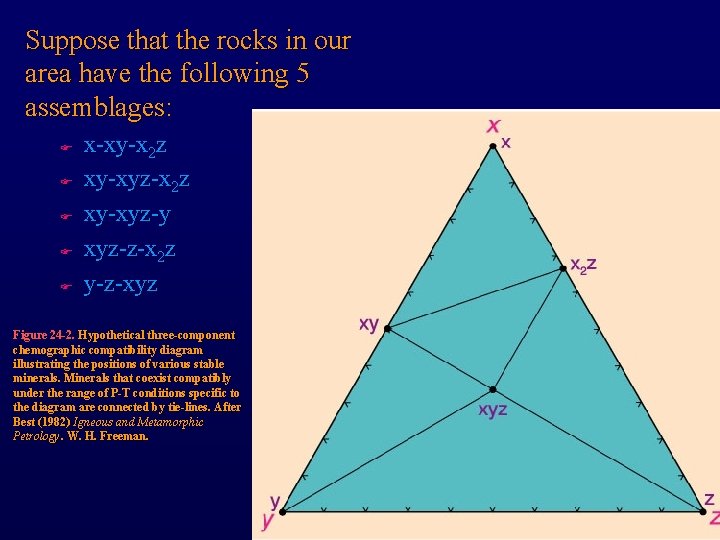
Suppose that the rocks in our area have the following 5 assemblages: F F F x-xy-x 2 z xy-xyz-y xyz-z-x 2 z y-z-xyz Figure 24 -2. Hypothetical three-component chemographic compatibility diagram illustrating the positions of various stable minerals. Minerals that coexist compatibly under the range of P-T conditions specific to the diagram are connected by tie-lines. After Best (1982) Igneous and Metamorphic Petrology. W. H. Freeman.
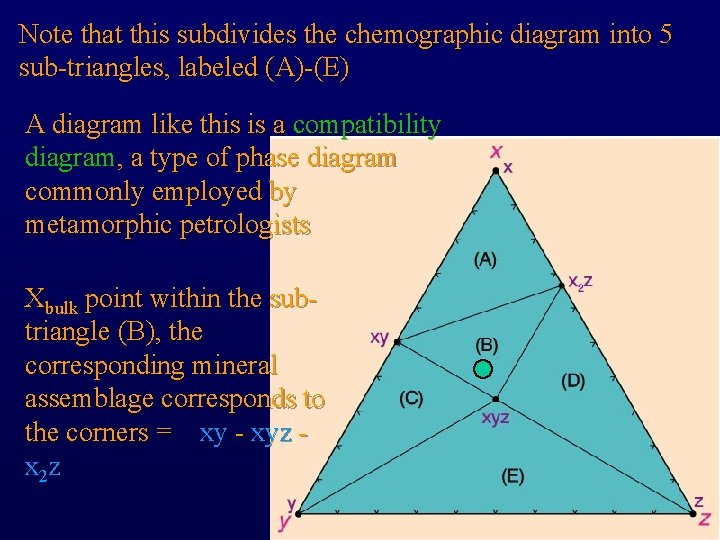
Note that this subdivides the chemographic diagram into 5 sub-triangles, labeled (A)-(E) A diagram like this is a compatibility diagram, a type of phase diagram commonly employed by metamorphic petrologists Xbulk point within the subtriangle (B), the corresponding mineral assemblage corresponds to the corners = xy - xyz x 2 z
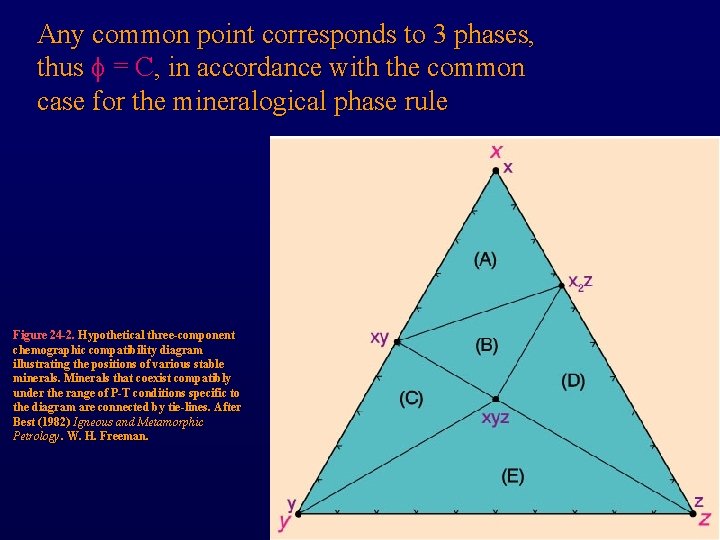
Any common point corresponds to 3 phases, thus f = C, in accordance with the common case for the mineralogical phase rule Figure 24 -2. Hypothetical three-component chemographic compatibility diagram illustrating the positions of various stable minerals. Minerals that coexist compatibly under the range of P-T conditions specific to the diagram are connected by tie-lines. After Best (1982) Igneous and Metamorphic Petrology. W. H. Freeman.
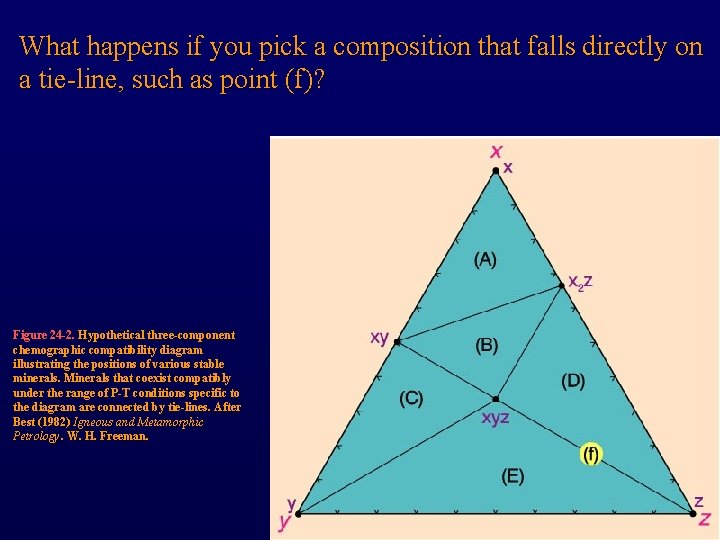
What happens if you pick a composition that falls directly on a tie-line, such as point (f)? Figure 24 -2. Hypothetical three-component chemographic compatibility diagram illustrating the positions of various stable minerals. Minerals that coexist compatibly under the range of P-T conditions specific to the diagram are connected by tie-lines. After Best (1982) Igneous and Metamorphic Petrology. W. H. Freeman.
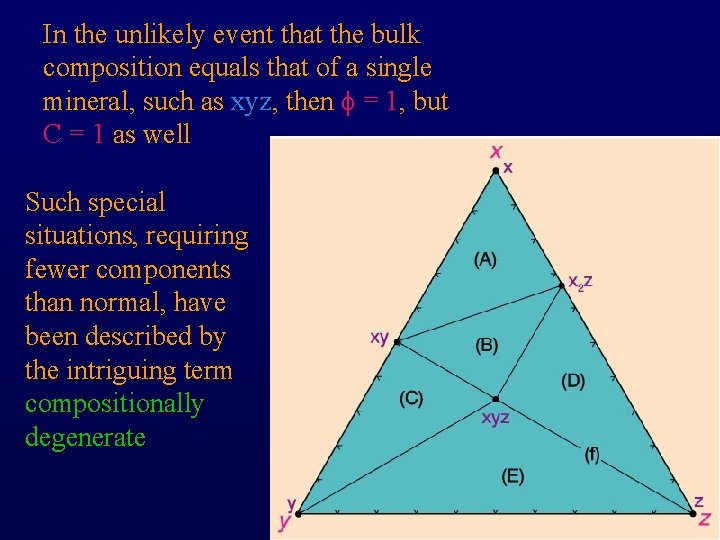
In the unlikely event that the bulk composition equals that of a single mineral, such as xyz, then f = 1, but C = 1 as well Such special situations, requiring fewer components than normal, have been described by the intriguing term compositionally degenerate
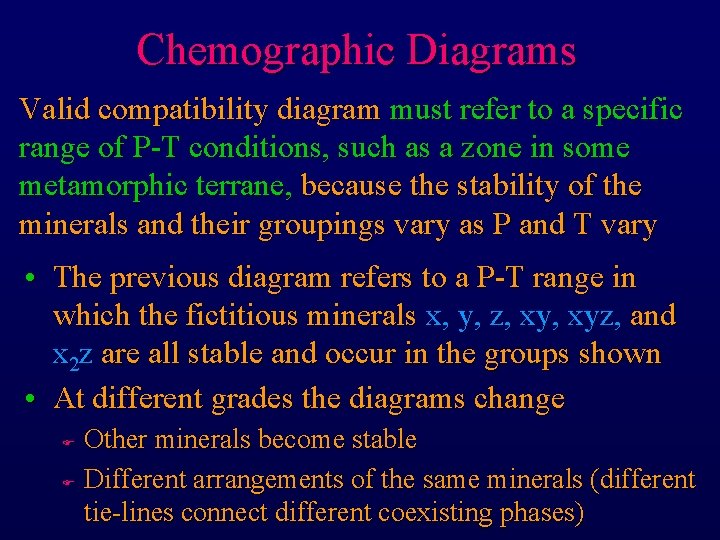
Chemographic Diagrams Valid compatibility diagram must refer to a specific range of P-T conditions, such as a zone in some metamorphic terrane, because the stability of the minerals and their groupings vary as P and T vary • The previous diagram refers to a P-T range in which the fictitious minerals x, y, z, xyz, and x 2 z are all stable and occur in the groups shown • At different grades the diagrams change Other minerals become stable F Different arrangements of the same minerals (different tie-lines connect different coexisting phases) F
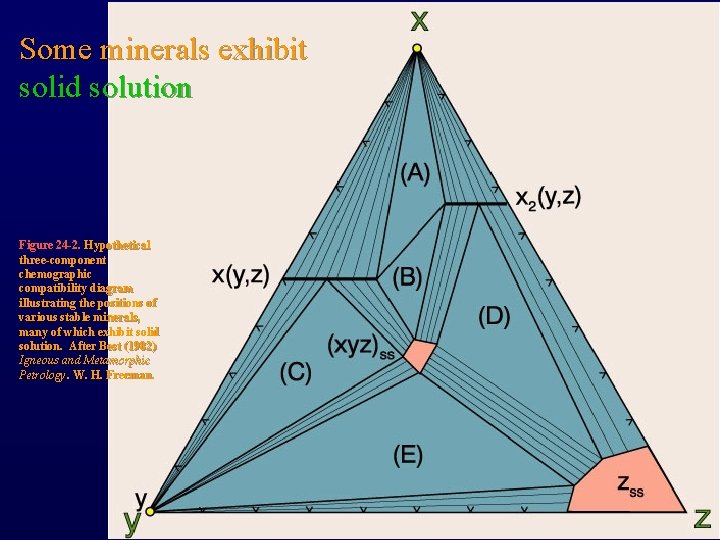
Some minerals exhibit solid solution Figure 24 -2. Hypothetical three-component chemographic compatibility diagram illustrating the positions of various stable minerals, many of which exhibit solid solution. After Best (1982) Igneous and Metamorphic Petrology. W. H. Freeman.
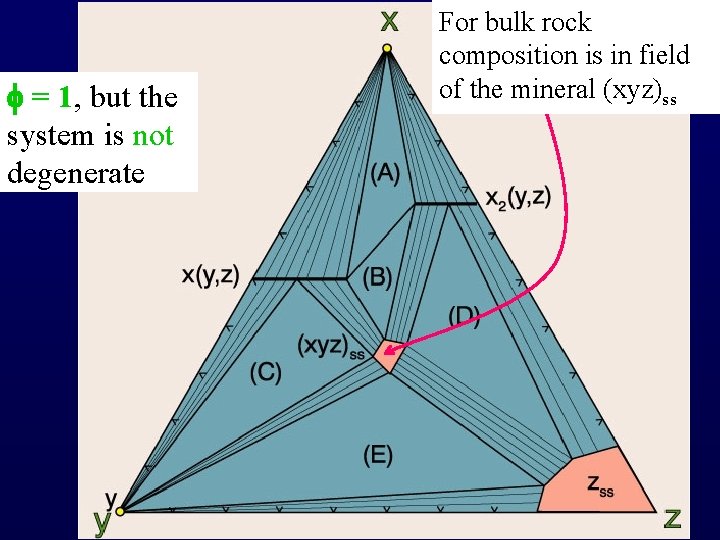
f = 1, but the system is not degenerate For bulk rock composition is in field of the mineral (xyz)ss
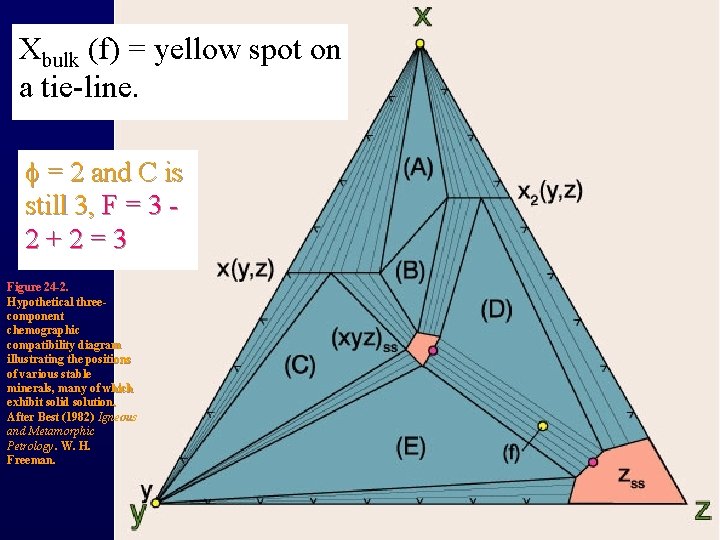
Xbulk (f) = yellow spot on a tie-line. f = 2 and C is still 3, F = 3 2+2=3 Figure 24 -2. Hypothetical threecomponent chemographic compatibility diagram illustrating the positions of various stable minerals, many of which exhibit solid solution. After Best (1982) Igneous and Metamorphic Petrology. W. H. Freeman.
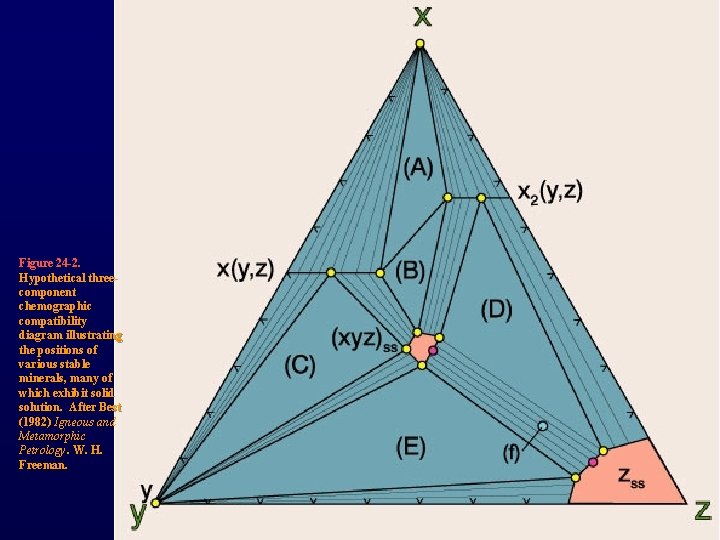
Figure 24 -2. Hypothetical threecomponent chemographic compatibility diagram illustrating the positions of various stable minerals, many of which exhibit solid solution. After Best (1982) Igneous and Metamorphic Petrology. W. H. Freeman.
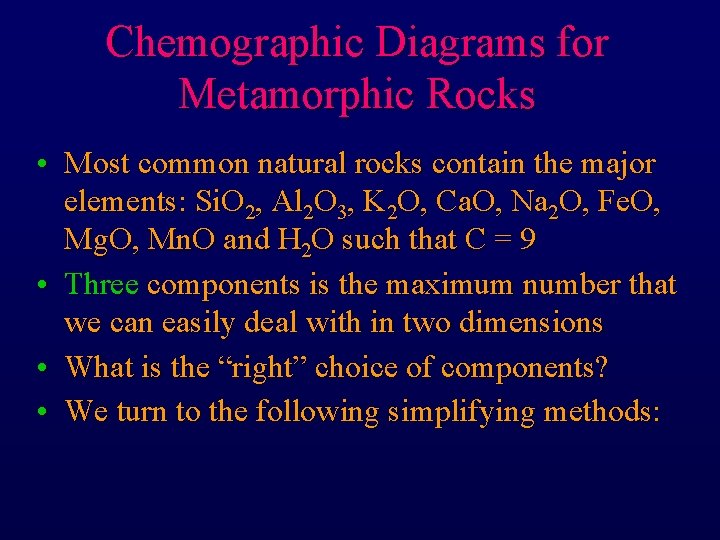
Chemographic Diagrams for Metamorphic Rocks • Most common natural rocks contain the major elements: Si. O 2, Al 2 O 3, K 2 O, Ca. O, Na 2 O, Fe. O, Mg. O, Mn. O and H 2 O such that C = 9 • Three components is the maximum number that we can easily deal with in two dimensions • What is the “right” choice of components? • We turn to the following simplifying methods:
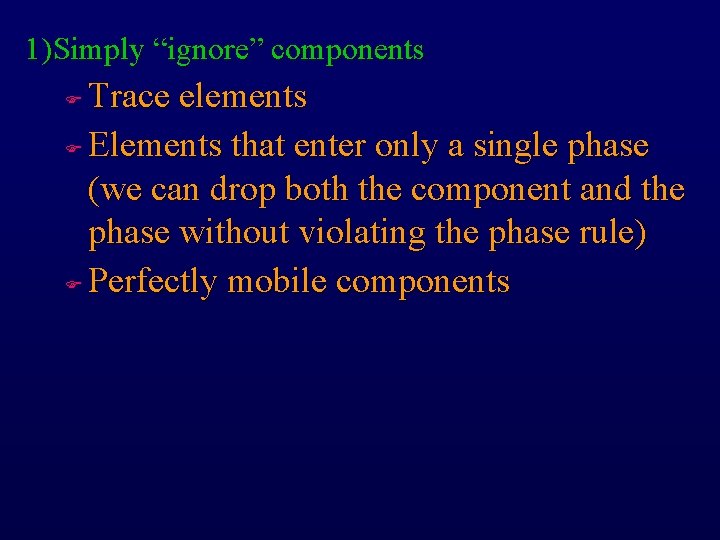
1)Simply “ignore” components Trace elements F Elements that enter only a single phase (we can drop both the component and the phase without violating the phase rule) F Perfectly mobile components F
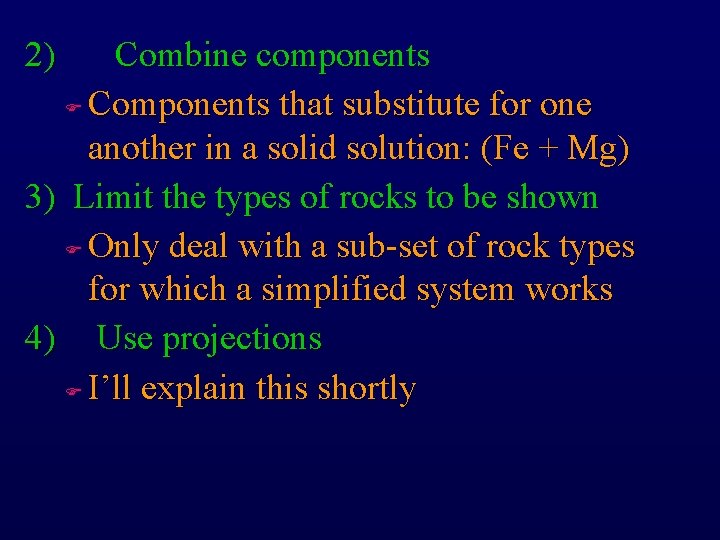
2) Combine components F Components that substitute for one another in a solid solution: (Fe + Mg) 3) Limit the types of rocks to be shown F Only deal with a sub-set of rock types for which a simplified system works 4) Use projections F I’ll explain this shortly
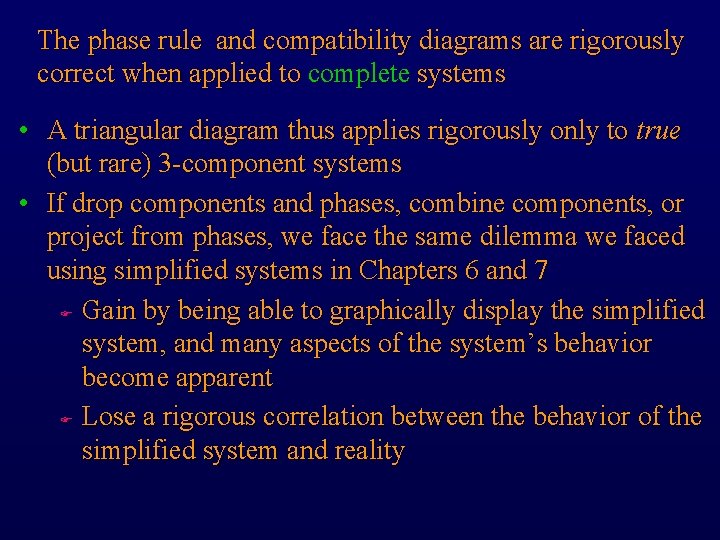
The phase rule and compatibility diagrams are rigorously correct when applied to complete systems • A triangular diagram thus applies rigorously only to true (but rare) 3 -component systems • If drop components and phases, combine components, or project from phases, we face the same dilemma we faced using simplified systems in Chapters 6 and 7 F Gain by being able to graphically display the simplified system, and many aspects of the system’s behavior become apparent F Lose a rigorous correlation between the behavior of the simplified system and reality
The ACF Diagram • Illustrate metamorphic mineral assemblages in mafic rocks on a simplified 3 -C triangular diagram • Concentrate only on the minerals that appeared or disappeared during metamorphism, thus acting as indicators of metamorphic grade
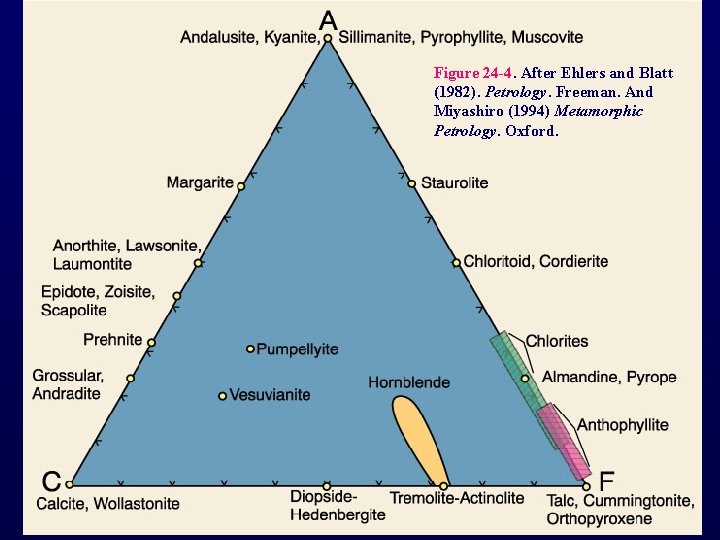
Figure 24 -4. After Ehlers and Blatt (1982). Petrology. Freeman. And Miyashiro (1994) Metamorphic Petrology. Oxford.
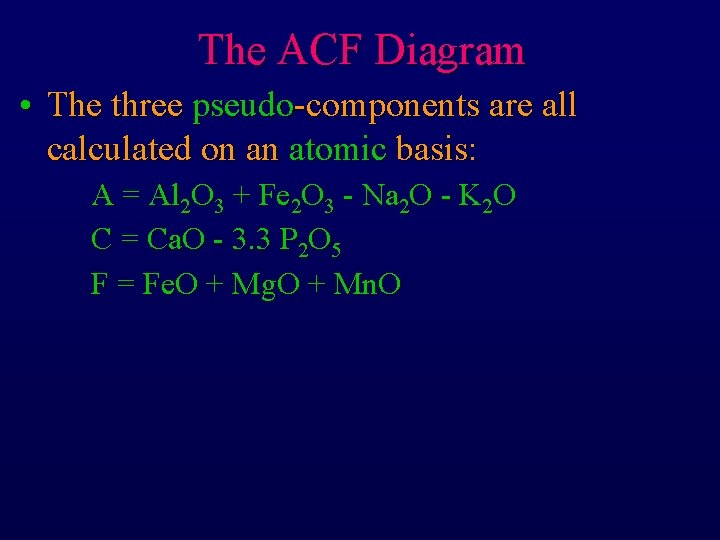
The ACF Diagram • The three pseudo-components are all calculated on an atomic basis: A = Al 2 O 3 + Fe 2 O 3 - Na 2 O - K 2 O C = Ca. O - 3. 3 P 2 O 5 F = Fe. O + Mg. O + Mn. O
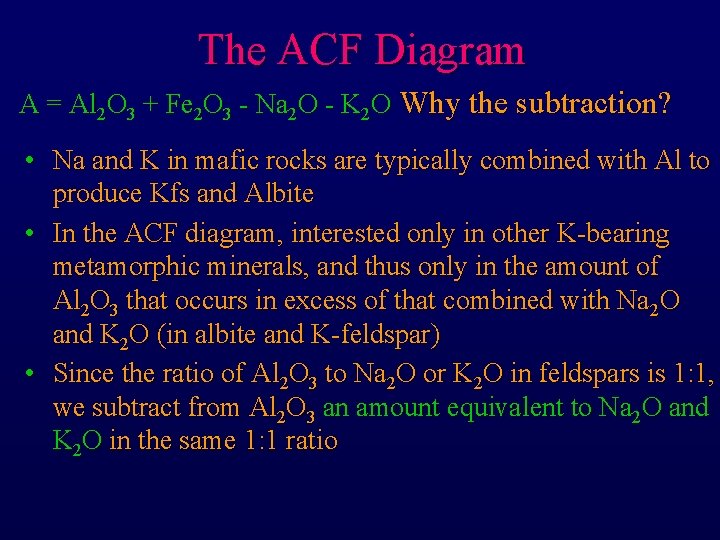
The ACF Diagram A = Al 2 O 3 + Fe 2 O 3 - Na 2 O - K 2 O Why the subtraction? • Na and K in mafic rocks are typically combined with Al to produce Kfs and Albite • In the ACF diagram, interested only in other K-bearing metamorphic minerals, and thus only in the amount of Al 2 O 3 that occurs in excess of that combined with Na 2 O and K 2 O (in albite and K-feldspar) • Since the ratio of Al 2 O 3 to Na 2 O or K 2 O in feldspars is 1: 1, we subtract from Al 2 O 3 an amount equivalent to Na 2 O and K 2 O in the same 1: 1 ratio
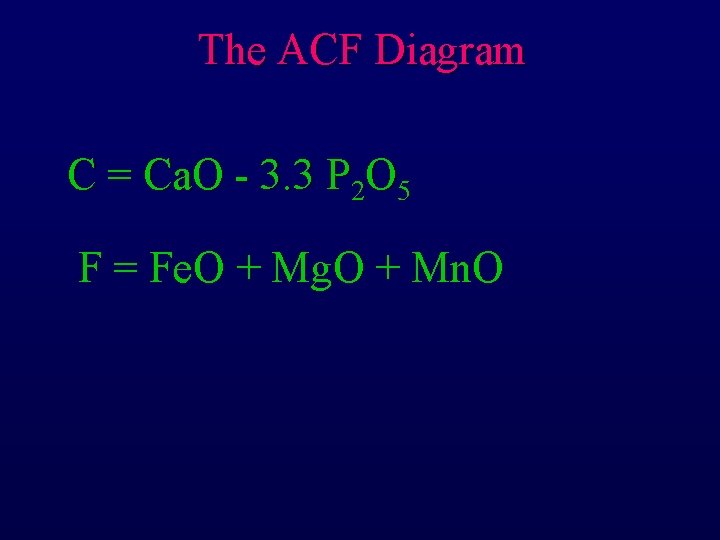
The ACF Diagram C = Ca. O - 3. 3 P 2 O 5 F = Fe. O + Mg. O + Mn. O

The ACF Diagram By creating these three pseudo-components, Eskola reduced the number of components in mafic rocks from 8 to 3 • Water is omitted under the assumption that it is perfectly mobile • Note that Si. O 2 is simply ignored F We shall see that this is equivalent to projecting from quartz • In order for a projected phase diagram to be truly valid, the phase from which it is projected must be present in the mineral assemblages represented
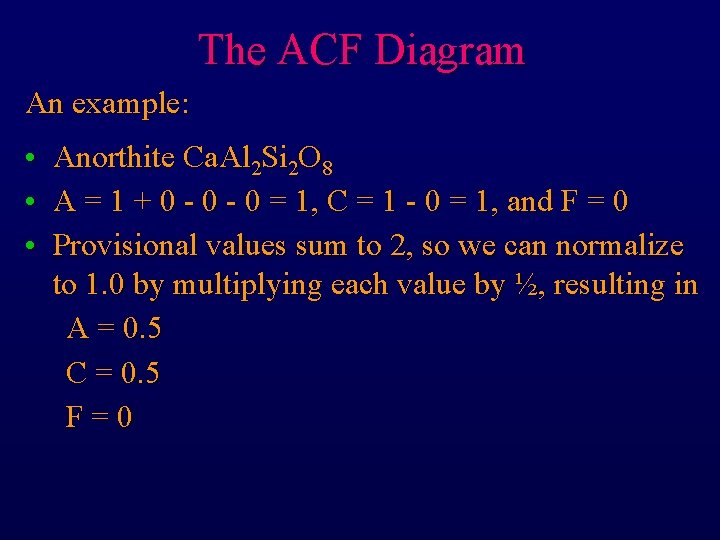
The ACF Diagram An example: • • • Anorthite Ca. Al 2 Si 2 O 8 A = 1 + 0 - 0 = 1, C = 1 - 0 = 1, and F = 0 Provisional values sum to 2, so we can normalize to 1. 0 by multiplying each value by ½, resulting in A = 0. 5 C = 0. 5 F=0

Figure 24 -4. After Ehlers and Blatt (1982). Petrology. Freeman. And Miyashiro (1994) Metamorphic Petrology. Oxford.
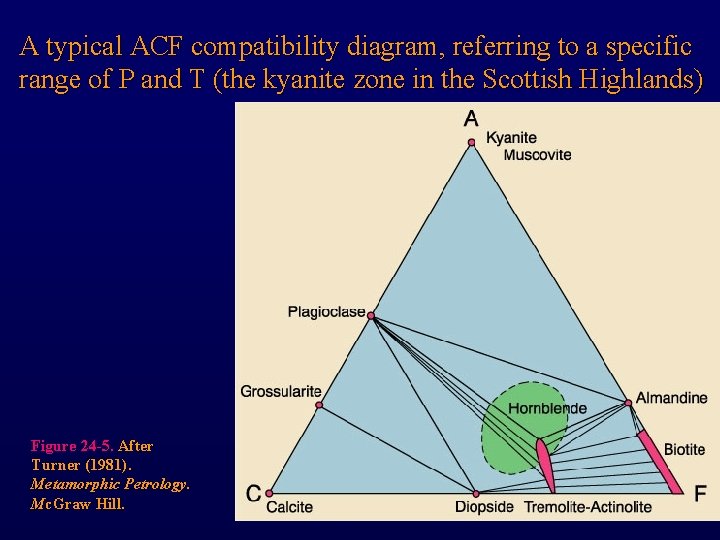
A typical ACF compatibility diagram, referring to a specific range of P and T (the kyanite zone in the Scottish Highlands) Figure 24 -5. After Turner (1981). Metamorphic Petrology. Mc. Graw Hill.
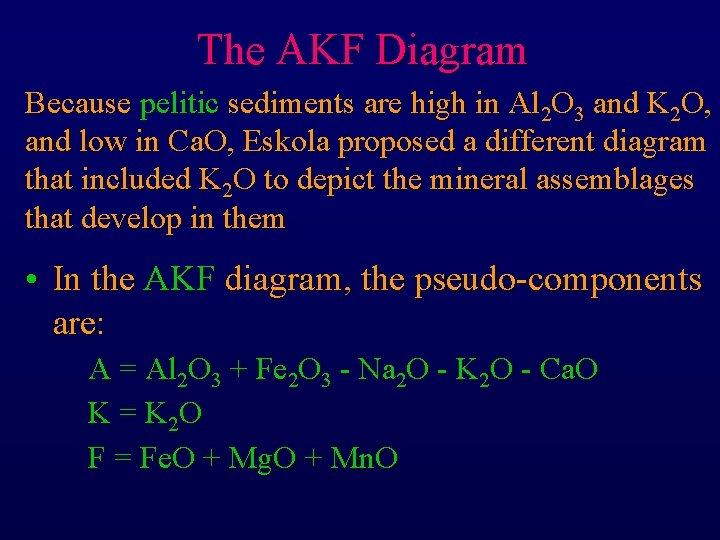
The AKF Diagram Because pelitic sediments are high in Al 2 O 3 and K 2 O, and low in Ca. O, Eskola proposed a different diagram that included K 2 O to depict the mineral assemblages that develop in them • In the AKF diagram, the pseudo-components are: A = Al 2 O 3 + Fe 2 O 3 - Na 2 O - K 2 O - Ca. O K = K 2 O F = Fe. O + Mg. O + Mn. O
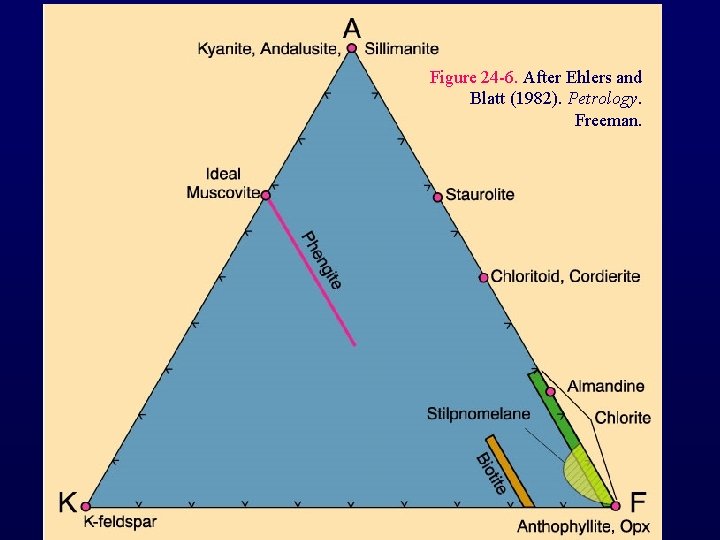
Figure 24 -6. After Ehlers and Blatt (1982). Petrology. Freeman.
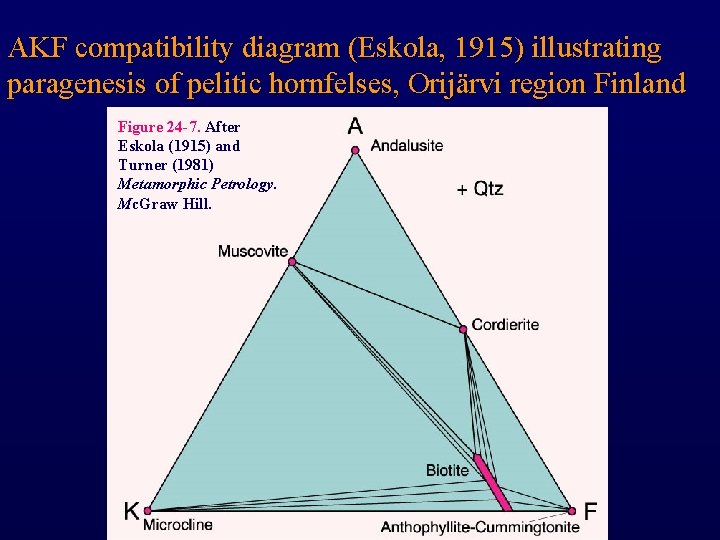
AKF compatibility diagram (Eskola, 1915) illustrating paragenesis of pelitic hornfelses, Orijärvi region Finland Figure 24 -7. After Eskola (1915) and Turner (1981) Metamorphic Petrology. Mc. Graw Hill.
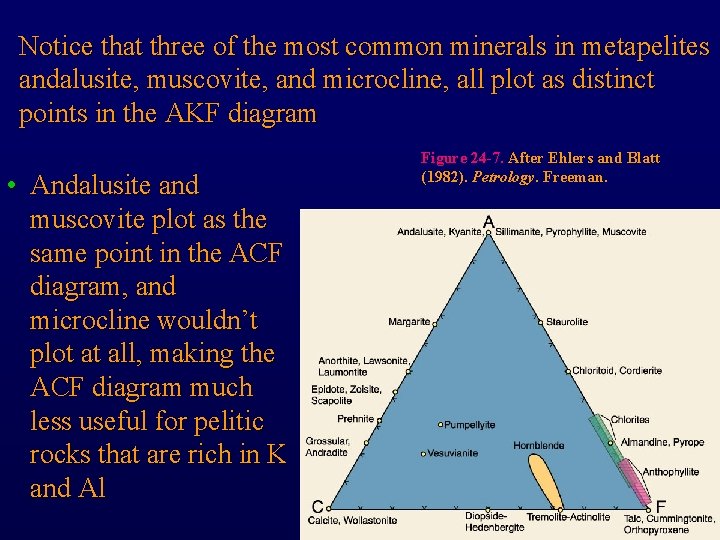
Notice that three of the most common minerals in metapelites andalusite, muscovite, and microcline, all plot as distinct points in the AKF diagram • Andalusite and muscovite plot as the same point in the ACF diagram, and microcline wouldn’t plot at all, making the ACF diagram much less useful for pelitic rocks that are rich in K and Al Figure 24 -7. After Ehlers and Blatt (1982). Petrology. Freeman.
Projections in Chemographic Diagrams When we explore the methods of chemographic projection we will discover: • Why we ignored Si. O 2 in the ACF and AKF diagrams • What that subtraction was all about in calculating A and C • It will also help you to better understand the AFM diagram in the next section and some of the shortcomings of projected metamorphic phase diagrams
Projection from Apical Phases Example- the ternary system: Ca. O-Mg. O-Si. O 2 (“CMS”) • Straightforward: C = Ca. O, M = Mg. O, and S = Si. O 2… none of that fancy subtracting business! Let’s plot the following minerals: Fo - Mg 2 Si. O 4 Per - Mg. O En - Mg. Si. O 3 Qtz - Si. O 2 Di - Ca. Mg. Si 2 O 6 Cc - Ca. CO 3
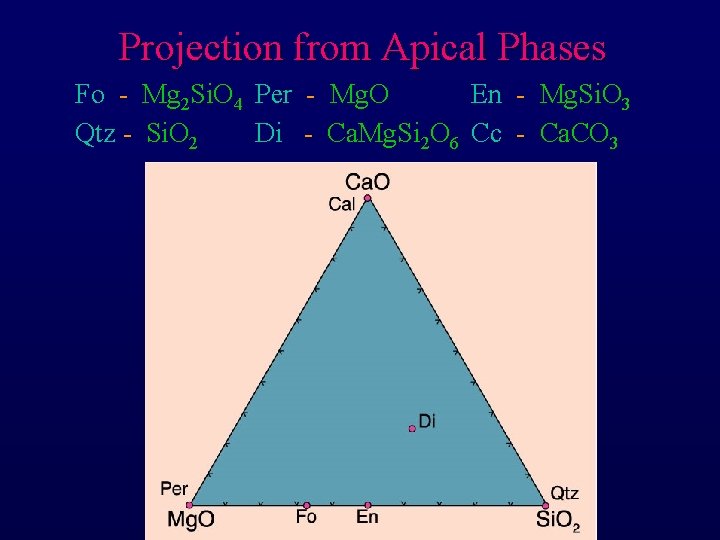
Projection from Apical Phases Fo - Mg 2 Si. O 4 Per - Mg. O En - Mg. Si. O 3 Qtz - Si. O 2 Di - Ca. Mg. Si 2 O 6 Cc - Ca. CO 3
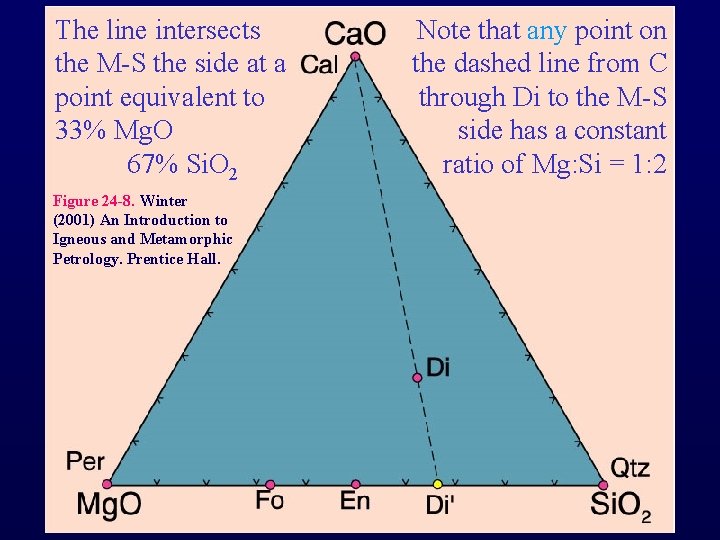
The line intersects the M-S the side at a point equivalent to 33% Mg. O 67% Si. O 2 Figure 24 -8. Winter (2001) An Introduction to Igneous and Metamorphic Petrology. Prentice Hall. Note that any point on the dashed line from C through Di to the M-S side has a constant ratio of Mg: Si = 1: 2
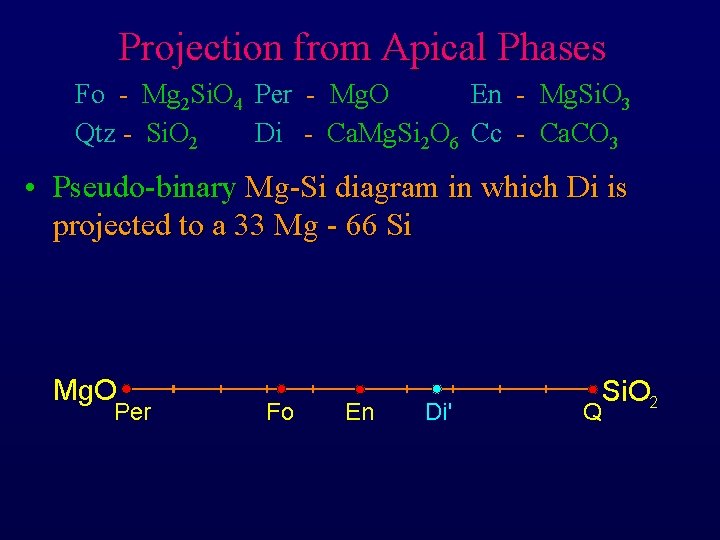
Projection from Apical Phases Fo - Mg 2 Si. O 4 Per - Mg. O En - Mg. Si. O 3 Qtz - Si. O 2 Di - Ca. Mg. Si 2 O 6 Cc - Ca. CO 3 • Pseudo-binary Mg-Si diagram in which Di is projected to a 33 Mg - 66 Si Mg. O Per Fo En Di' Si. O 2 Q
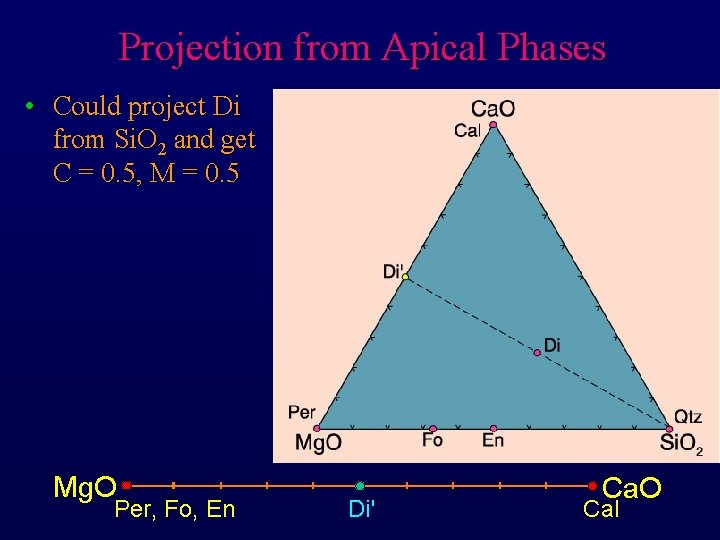
Projection from Apical Phases • Could project Di from Si. O 2 and get C = 0. 5, M = 0. 5 Mg. O Per, Fo, En Di' Ca. O Cal
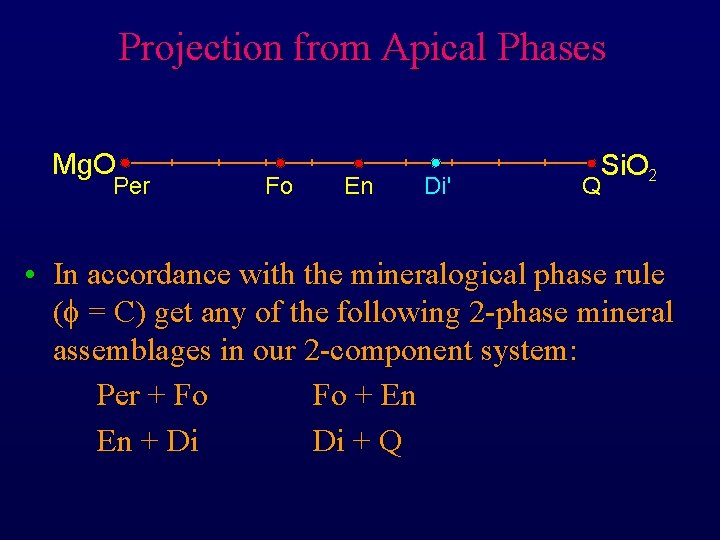
Projection from Apical Phases Mg. O Per Fo En Di' Si. O 2 Q • In accordance with the mineralogical phase rule (f = C) get any of the following 2 -phase mineral assemblages in our 2 -component system: Per + Fo Fo + En En + Di Di + Q
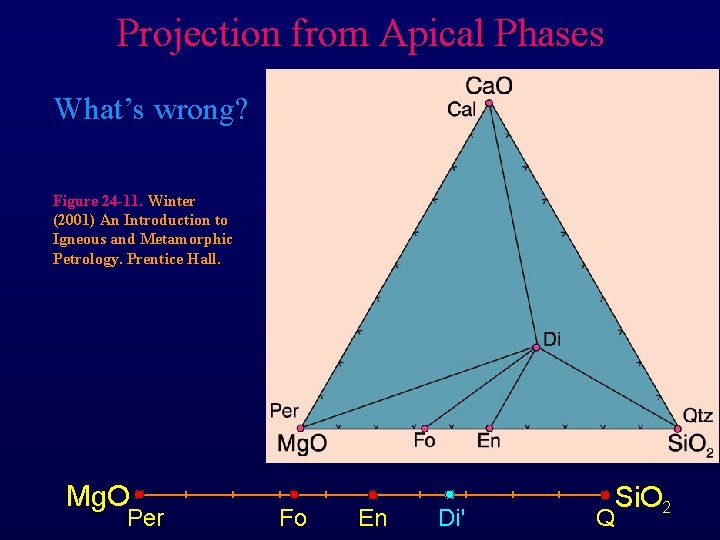
Projection from Apical Phases What’s wrong? Figure 24 -11. Winter (2001) An Introduction to Igneous and Metamorphic Petrology. Prentice Hall. Mg. O Per Fo En Di' Si. O 2 Q
Projection from Apical Phases • ACF and AKF diagrams eliminate Si. O 2 by projecting from quartz • Math is easy: projecting from an apex component is like ignoring the component in formulas • The shortcoming is that these projections compress the true relationships as a dimension is lost
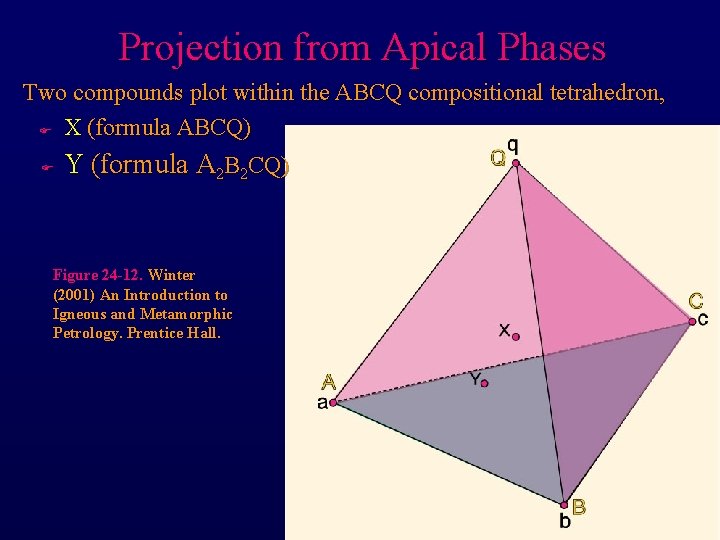
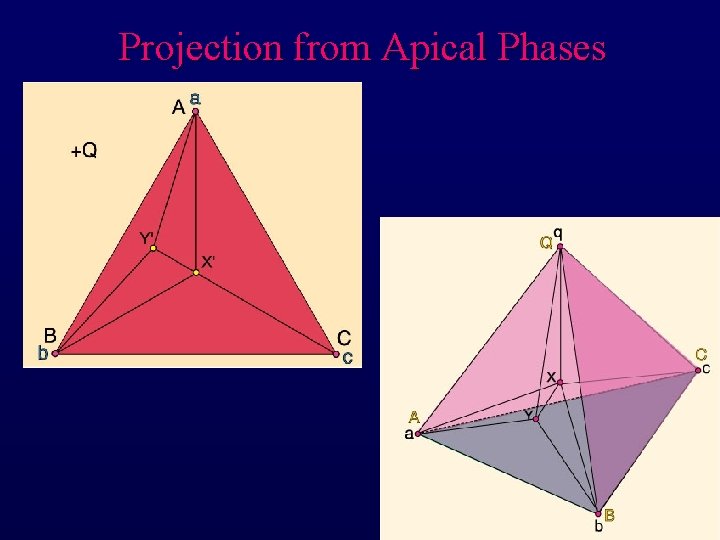
Projection from Apical Phases Two compounds plot within the ABCQ compositional tetrahedron, F X (formula ABCQ) F Y (formula A 2 B 2 CQ) Figure 24 -12. Winter (2001) An Introduction to Igneous and Metamorphic Petrology. Prentice Hall.
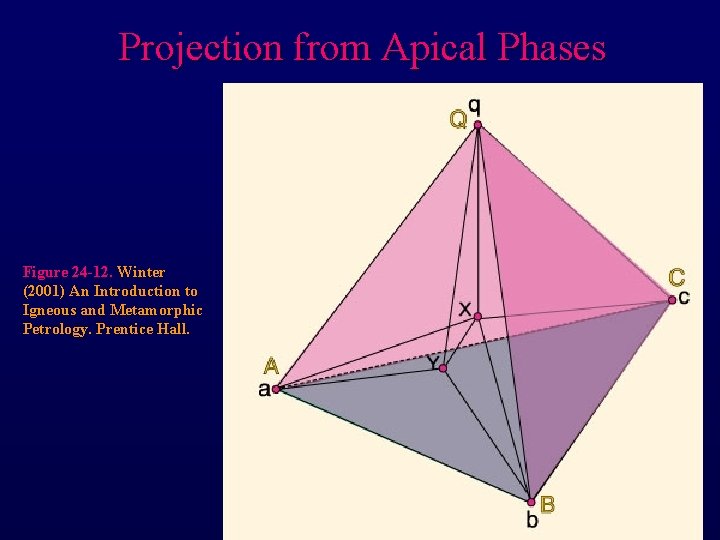
Projection from Apical Phases Figure 24 -12. Winter (2001) An Introduction to Igneous and Metamorphic Petrology. Prentice Hall.
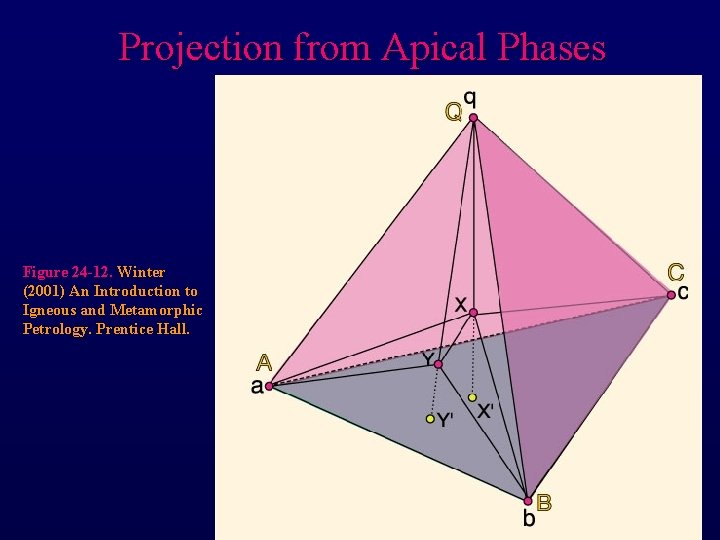
Projection from Apical Phases Figure 24 -12. Winter (2001) An Introduction to Igneous and Metamorphic Petrology. Prentice Hall.
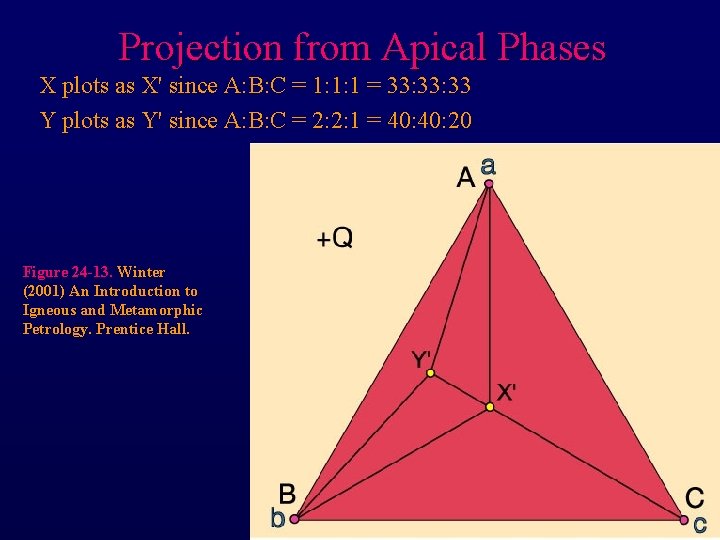
Projection from Apical Phases X plots as X' since A: B: C = 1: 1: 1 = 33: 33 Y plots as Y' since A: B: C = 2: 2: 1 = 40: 20 Figure 24 -13. Winter (2001) An Introduction to Igneous and Metamorphic Petrology. Prentice Hall.
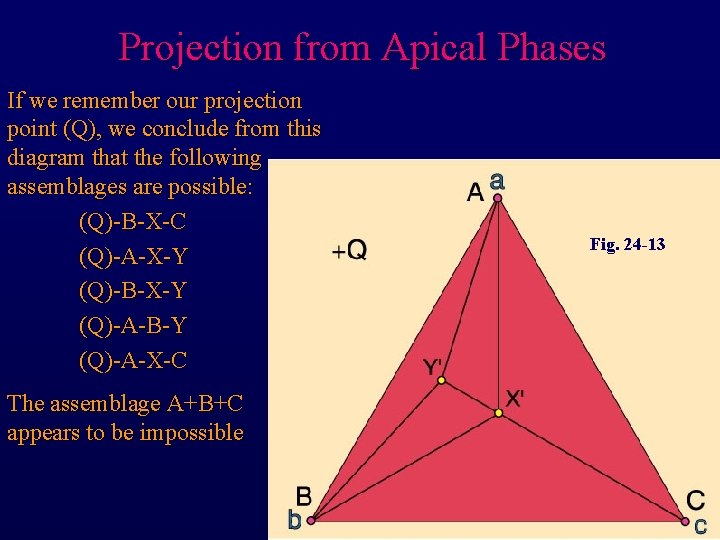
Projection from Apical Phases If we remember our projection point (Q), we conclude from this diagram that the following assemblages are possible: (Q)-B-X-C (Q)-A-X-Y (Q)-B-X-Y (Q)-A-B-Y (Q)-A-X-C The assemblage A+B+C appears to be impossible Fig. 24 -13
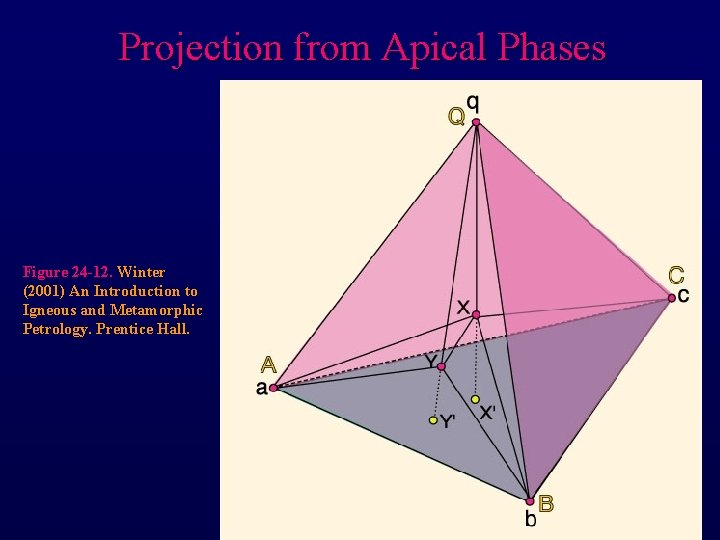
Projection from Apical Phases Figure 24 -12. Winter (2001) An Introduction to Igneous and Metamorphic Petrology. Prentice Hall.
Projection from Apical Phases
J. B. Thompson’s A(K)FM Diagram An alternative to the AKF diagram for metamorphosed pelitic rocks • Although the AKF is useful in this capacity, J. B. Thompson (1957) noted that Fe and Mg do not partition themselves equally between the various mafic minerals in most rocks
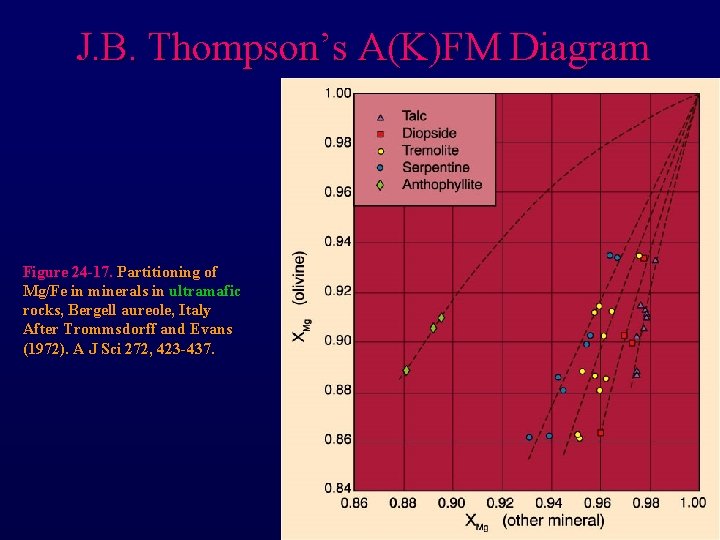
J. B. Thompson’s A(K)FM Diagram Figure 24 -17. Partitioning of Mg/Fe in minerals in ultramafic rocks, Bergell aureole, Italy After Trommsdorff and Evans (1972). A J Sci 272, 423 -437.
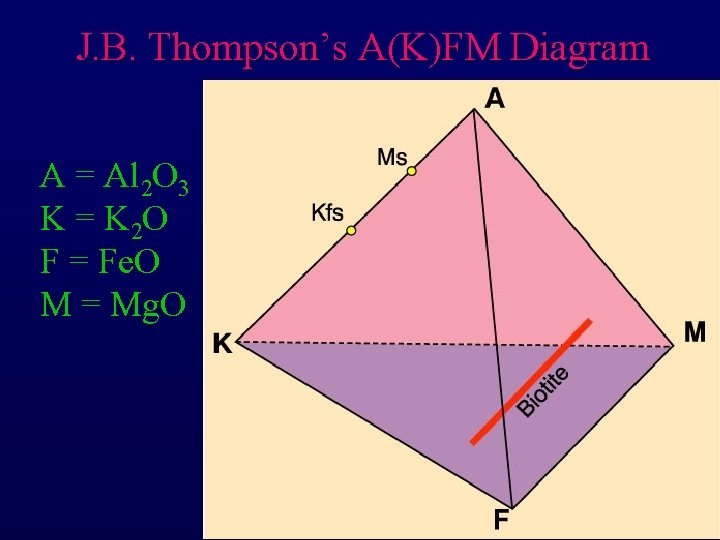
J. B. Thompson’s A(K)FM Diagram A = Al 2 O 3 K = K 2 O F = Fe. O M = Mg. O
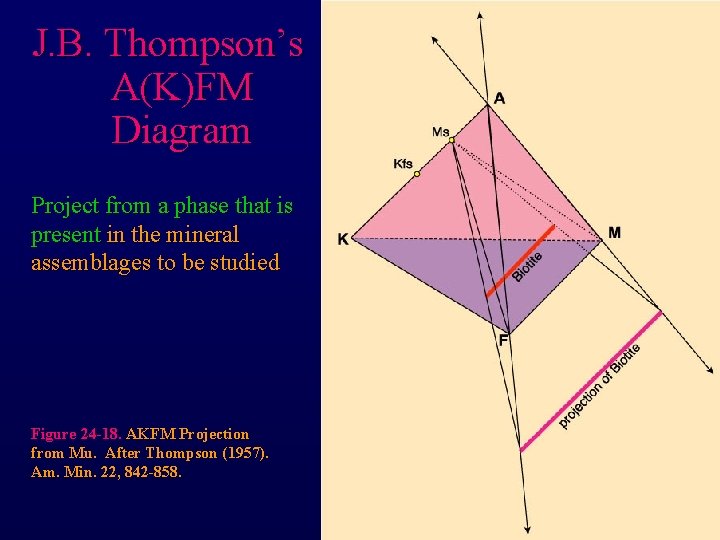
J. B. Thompson’s A(K)FM Diagram Project from a phase that is present in the mineral assemblages to be studied Figure 24 -18. AKFM Projection from Mu. After Thompson (1957). Am. Min. 22, 842 -858.
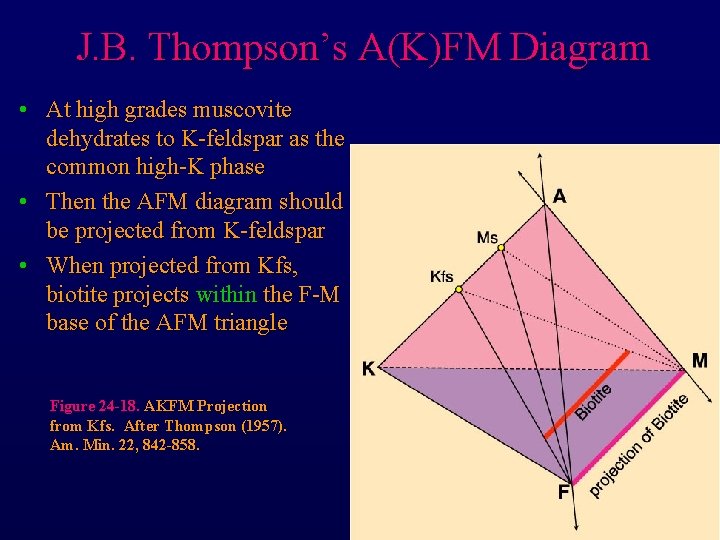
J. B. Thompson’s A(K)FM Diagram • At high grades muscovite dehydrates to K-feldspar as the common high-K phase • Then the AFM diagram should be projected from K-feldspar • When projected from Kfs, biotite projects within the F-M base of the AFM triangle Figure 24 -18. AKFM Projection from Kfs. After Thompson (1957). Am. Min. 22, 842 -858.
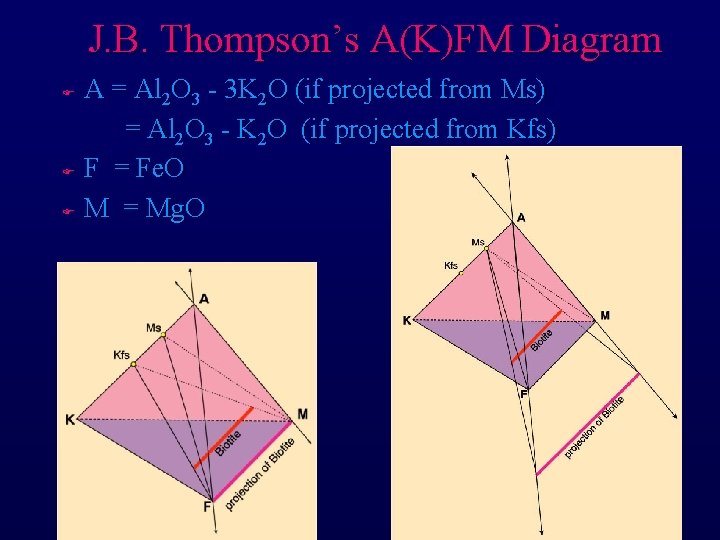
J. B. Thompson’s A(K)FM Diagram A = Al 2 O 3 - 3 K 2 O (if projected from Ms) = Al 2 O 3 - K 2 O (if projected from Kfs) F F = Fe. O F M = Mg. O F
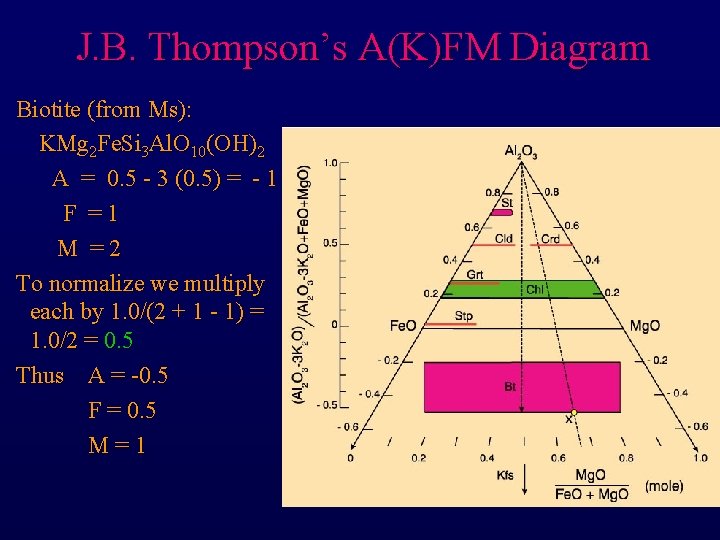
J. B. Thompson’s A(K)FM Diagram Biotite (from Ms): KMg 2 Fe. Si 3 Al. O 10(OH)2 A = 0. 5 - 3 (0. 5) = - 1 F =1 M =2 To normalize we multiply each by 1. 0/(2 + 1 - 1) = 1. 0/2 = 0. 5 Thus A = -0. 5 F = 0. 5 M=1
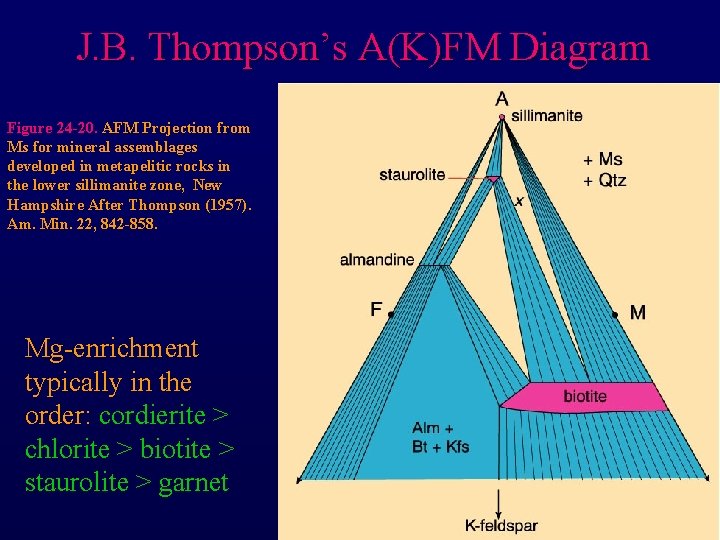
J. B. Thompson’s A(K)FM Diagram Figure 24 -20. AFM Projection from Ms for mineral assemblages developed in metapelitic rocks in the lower sillimanite zone, New Hampshire After Thompson (1957). Am. Min. 22, 842 -858. Mg-enrichment typically in the order: cordierite > chlorite > biotite > staurolite > garnet

Choosing the Appropriate Chemographic Diagram • Example, suppose we have a series of pelitic rocks in an area. The pelitic system consists of the 9 principal components: Si. O 2, Al 2 O 3, Fe. O, Mg. O, Mn. O, Ca. O, Na 2 O, K 2 O, and H 2 O • How do we lump those 9 components to get a meaningful and useful diagram?
Choosing the Appropriate Chemographic Diagram Each simplifying step makes the resulting system easier to visualize, but may overlook some aspect of the rocks in question F Mn. O is commonly lumped with Fe. O + Mg. O, or ignored, as it usually occurs in low concentrations and enters solid solutions along with Fe. O and Mg. O F In metapelites Na 2 O is usually significant only in plagioclase, so we may often ignore it, or project from albite F As a rule, H 2 O is sufficiently mobile to be ignored as well
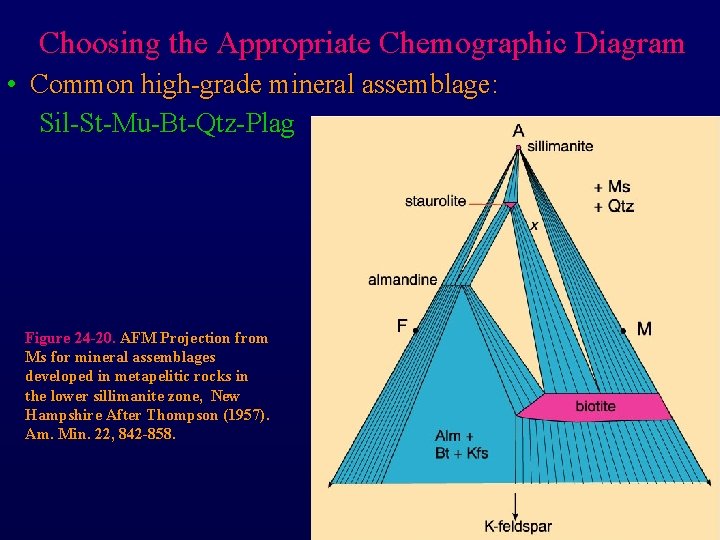
Choosing the Appropriate Chemographic Diagram • Common high-grade mineral assemblage: Sil-St-Mu-Bt-Qtz-Plag Figure 24 -20. AFM Projection from Ms for mineral assemblages developed in metapelitic rocks in the lower sillimanite zone, New Hampshire After Thompson (1957). Am. Min. 22, 842 -858.
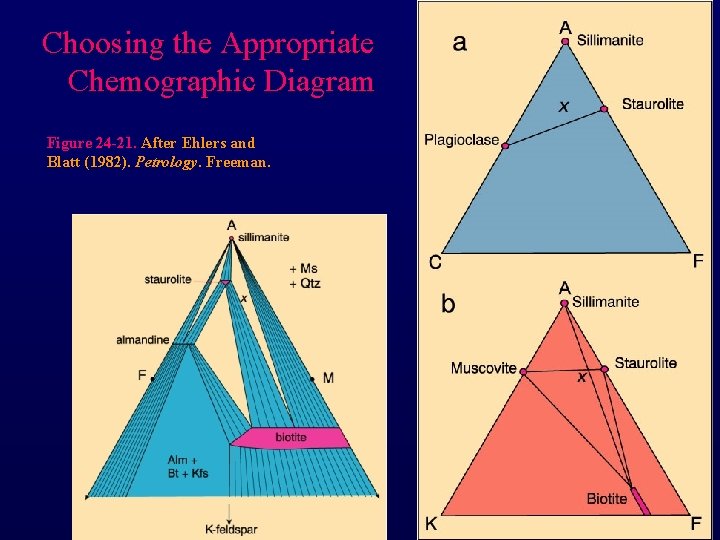
Choosing the Appropriate Chemographic Diagram Figure 24 -21. After Ehlers and Blatt (1982). Petrology. Freeman.
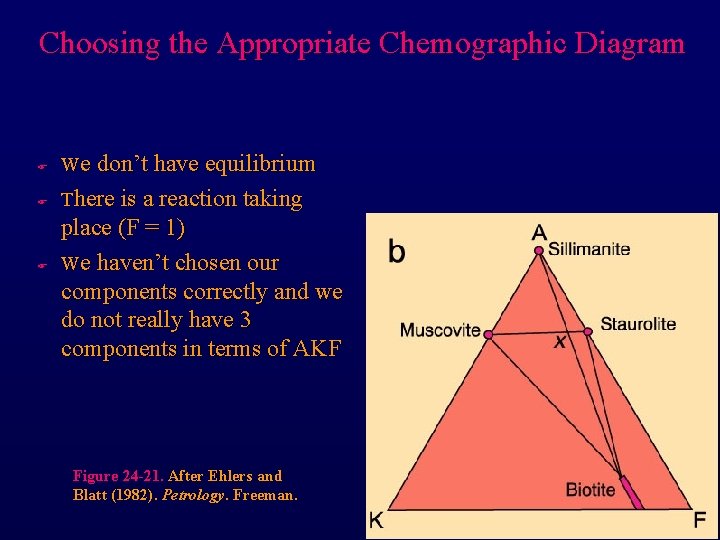
Choosing the Appropriate Chemographic Diagram F We don’t have equilibrium F There is a reaction taking F place (F = 1) We haven’t chosen our components correctly and we do not really have 3 components in terms of AKF Figure 24 -21. After Ehlers and Blatt (1982). Petrology. Freeman.
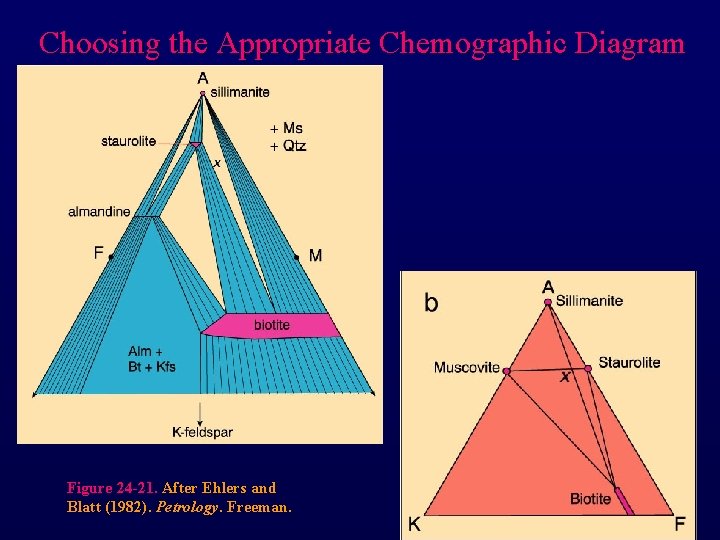
Choosing the Appropriate Chemographic Diagram Figure 24 -21. After Ehlers and Blatt (1982). Petrology. Freeman.
Choosing the Appropriate Chemographic Diagram • In summary, myriad chemographic diagrams have been proposed to analyze paragenetic relationships in various metamorphic rock types • Most such diagrams are triangular, since this is the maximum number that can be represented easily and accurately in two dimensions • In some cases a natural system may conform to a simple 3 -component system, and the resulting metamorphic phase diagram is rigorous in terms of the mineral assemblages that develop • Other diagrams are simplified by combining components or projecting
Choosing the Appropriate Chemographic Diagram • Variations in the mineral assemblage that develops in metamorphic rocks result from 1) Differences in bulk chemistry 2) differences in intensive variables, such as T, P, PH 2 O, etc (metamorphic grade) • A good chemographic diagram permits easy visualization of the first situation • The second can be determined by a balanced reaction in which one rock’s mineral assemblage contains the reactants and another the products • These differences can often be visualized by comparing separate chemographic diagrams, one for each grade
- Slides: 81