
Chapter 24 Soft Tissue Injuries Principles of Bandaging
Chapter 24 Soft Tissue Injuries Principles of Bandaging 1
Functions of the Skin l Protection of the body -water tight -not penetrable by bacteria l Regulation of body temperature -hot environment: sweat evaporates -cold environment: vessels constrict l Sensation 2
Layers of the Skin (1 of 2) Epidermis: l Outermost layer consists of dead cells being rubbed off and replaced l Deeper part contains cells with pigmentation 3
Layers of the Skin (2 of 2) Dermis: l Inner layer l Contains special structures of the skin -sweat glands -hair follicles -blood vessels -specialized nerve endings Subcutaneous Tissue: mostly fat 4
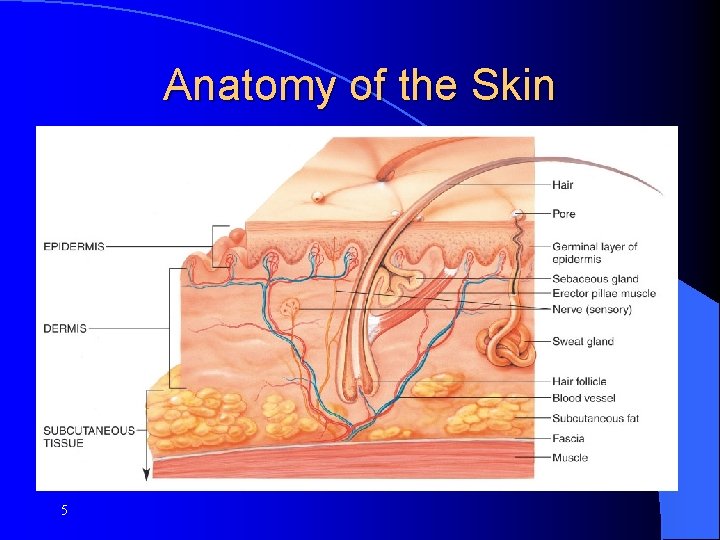
Anatomy of the Skin 5
Soft-Tissue Injuries l Closed injuries – Soft-tissue damage beneath the skin l Open injuries – Break in the surface of the skin l Burns – Soft tissue receives more energy than it can absorb 6

Closed Soft Tissue Injuries 7
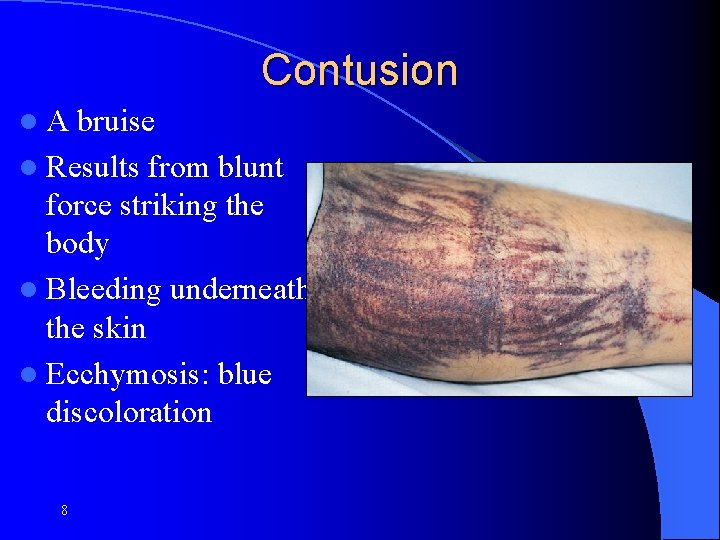
Contusion l. A bruise l Results from blunt force striking the body l Bleeding underneath the skin l Ecchymosis: blue discoloration 8
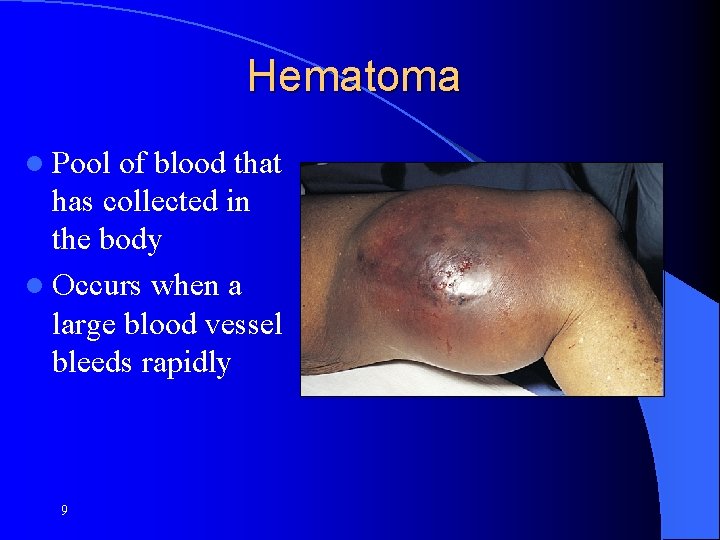
Hematoma l Pool of blood that has collected in the body l Occurs when a large blood vessel bleeds rapidly 9
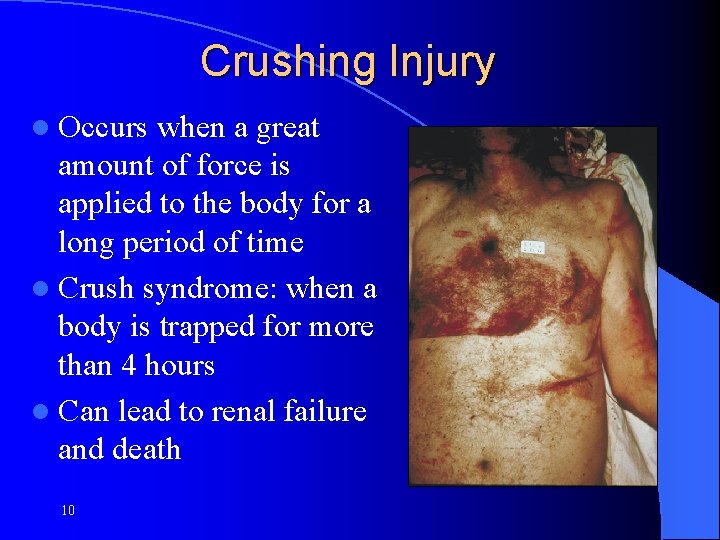
Crushing Injury l Occurs when a great amount of force is applied to the body for a long period of time l Crush syndrome: when a body is trapped for more than 4 hours l Can lead to renal failure and death 10
Compartment Syndrome l Results from the swelling that occurs whenever tissues are injured. l Injured cells leak fluid into the spaces between cells l Pressure compress the tissues l Hallmark sign is pain out of proportion for the injury 11

Open Soft Tissue Injuries 12
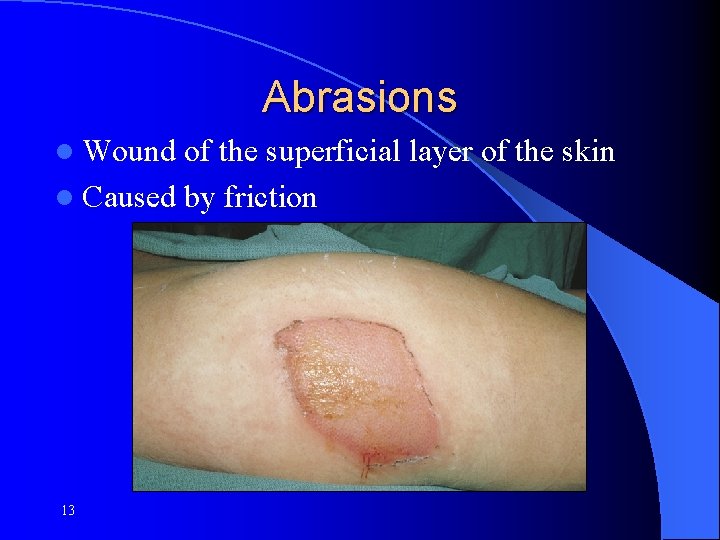
Abrasions l Wound of the superficial layer of the skin l Caused by friction 13
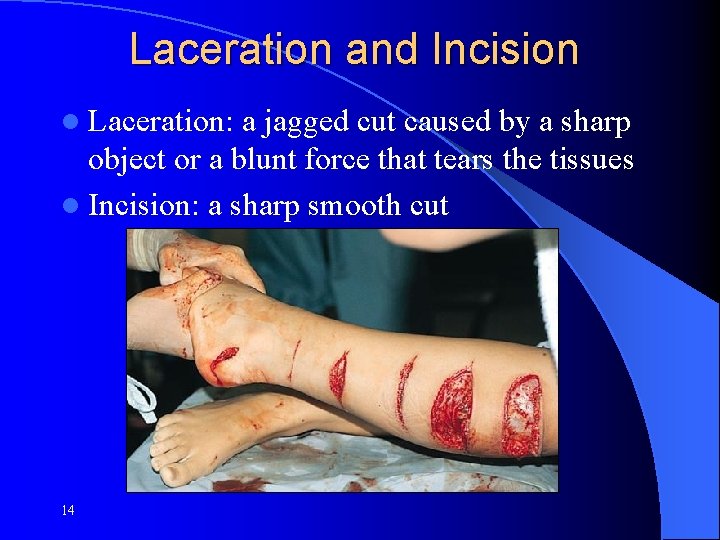
Laceration and Incision l Laceration: a jagged cut caused by a sharp object or a blunt force that tears the tissues l Incision: a sharp smooth cut 14
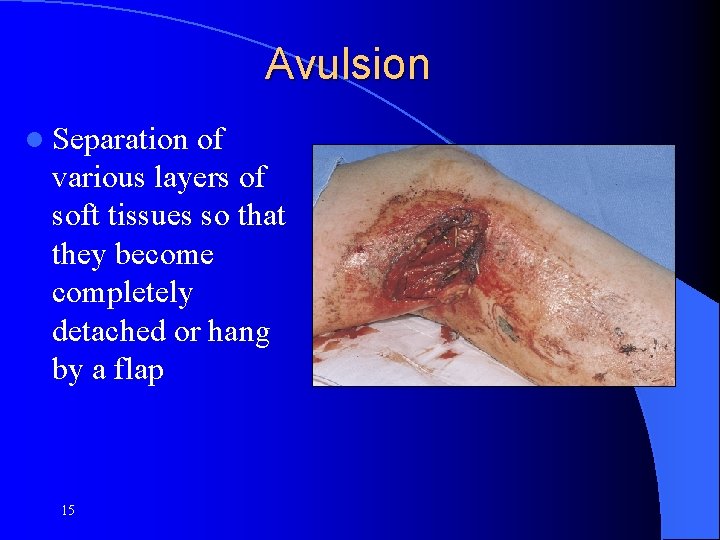
Avulsion l Separation of various layers of soft tissues so that they become completely detached or hang by a flap 15
Amputation l An injury in which part of the body is completely severed l Can include extremities, digits, scalp, ears, penis, nose, and lips 16
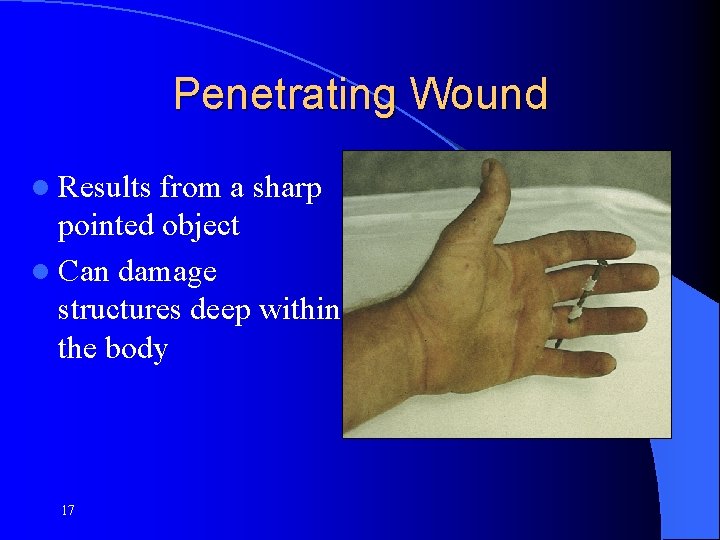
Penetrating Wound l Results from a sharp pointed object l Can damage structures deep within the body 17
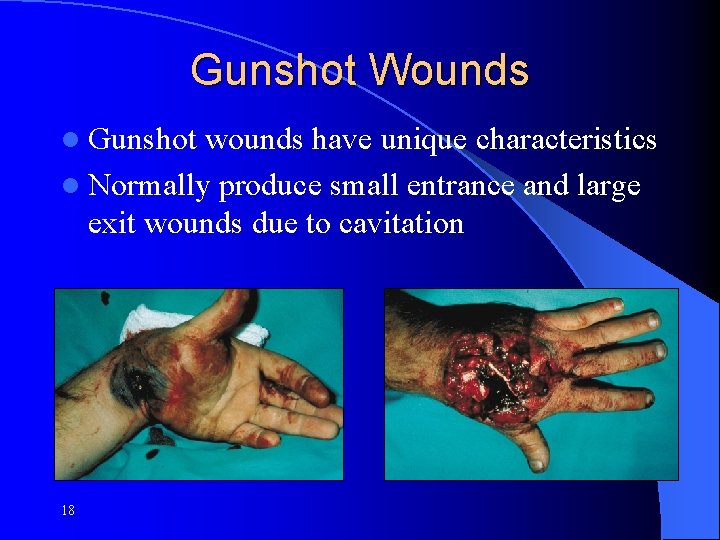
Gunshot Wounds l Gunshot wounds have unique characteristics l Normally produce small entrance and large exit wounds due to cavitation 18
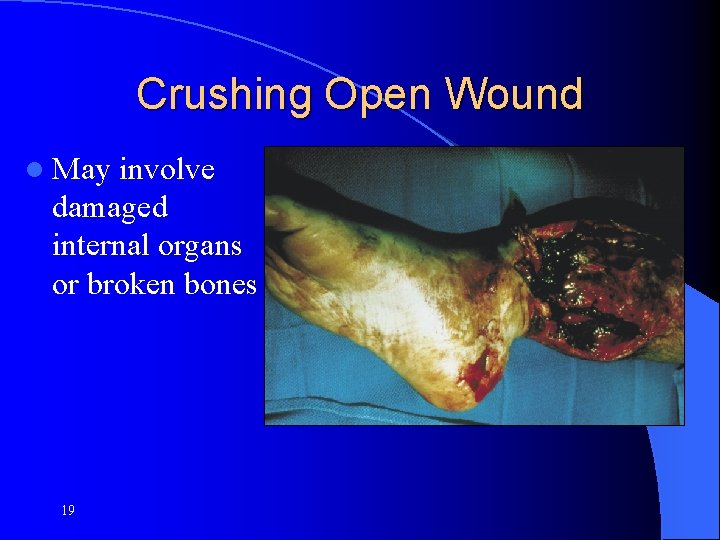
Crushing Open Wound l May involve damaged internal organs or broken bones 19
Care for Soft Tissue Injuries l Use proper BSI precautions. l Administer oxygen if needed. l Treatment priority is ABCs—including controlling bleeding. l Treat/prevent shock 20
Care for Closed Injuries RICES l Rest—keep patient quiet and comfortable as possible. l Ice slows bleeding. l Compression over an injury slows bleeding. l Elevation above the level of the heart reduces swelling. l Splinting decreases bleeding and reduces pain. 21
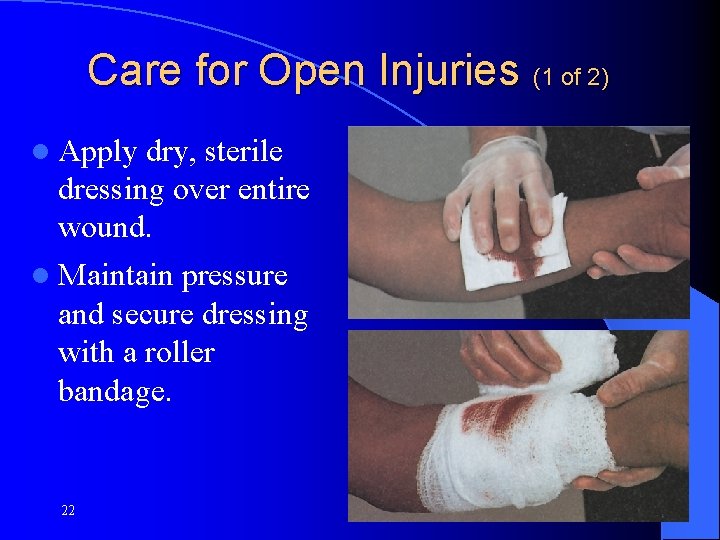
Care for Open Injuries (1 of 2) l Apply dry, sterile dressing over entire wound. l Maintain pressure and secure dressing with a roller bandage. 22
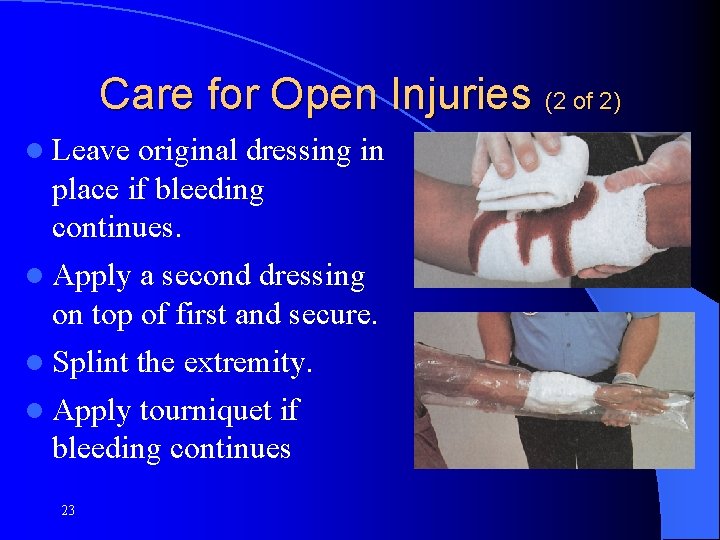
Care for Open Injuries (2 of 2) l Leave original dressing in place if bleeding continues. l Apply a second dressing on top of first and secure. l Splint the extremity. l Apply tourniquet if bleeding continues 23
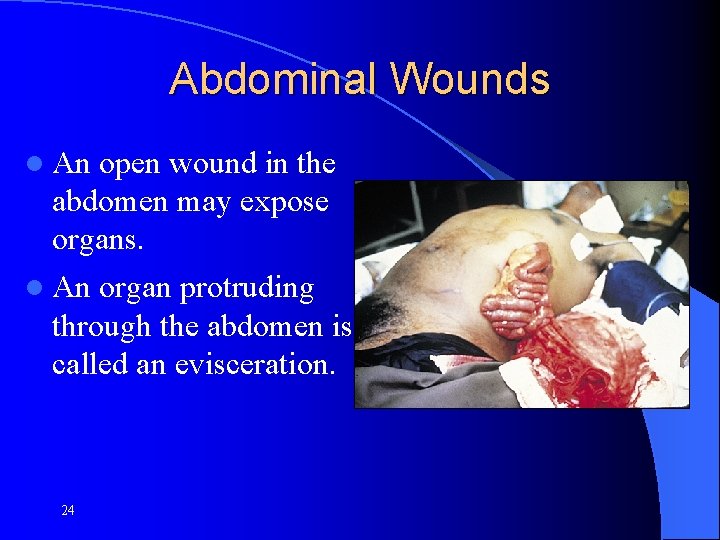
Abdominal Wounds l An open wound in the abdomen may expose organs. l An organ protruding through the abdomen is called an evisceration. 24
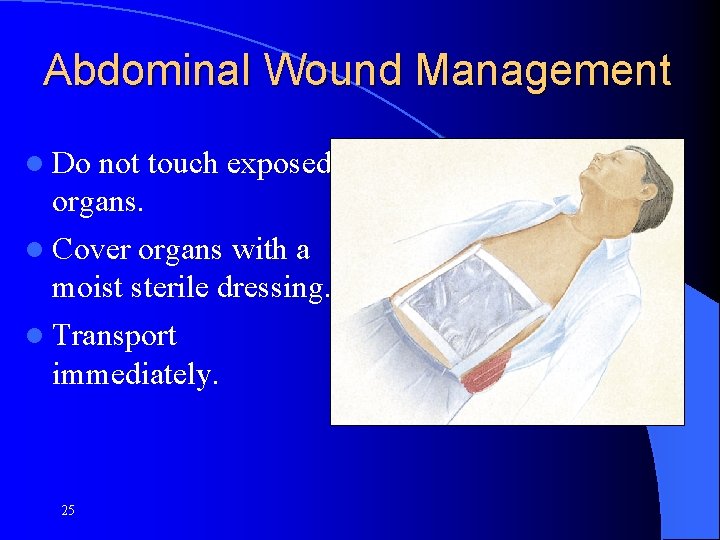
Abdominal Wound Management l Do not touch exposed organs. l Cover organs with a moist sterile dressing. l Transport immediately. 25
Impaled Objects (1 of 3) l Do not attempt to move or remove the object unless: – Impaled in cheek causing airway obstruction – Object in chest that interferes with CPR l Objects may require shortening to accommodate transport 26
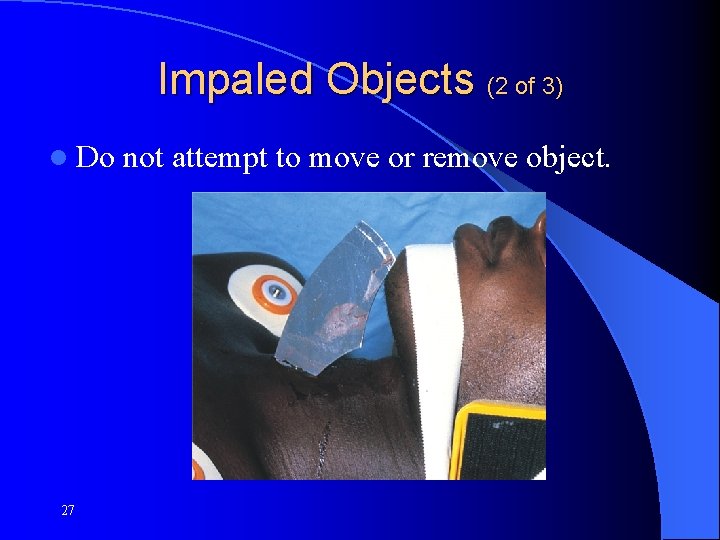
Impaled Objects (2 of 3) l Do 27 not attempt to move or remove object.
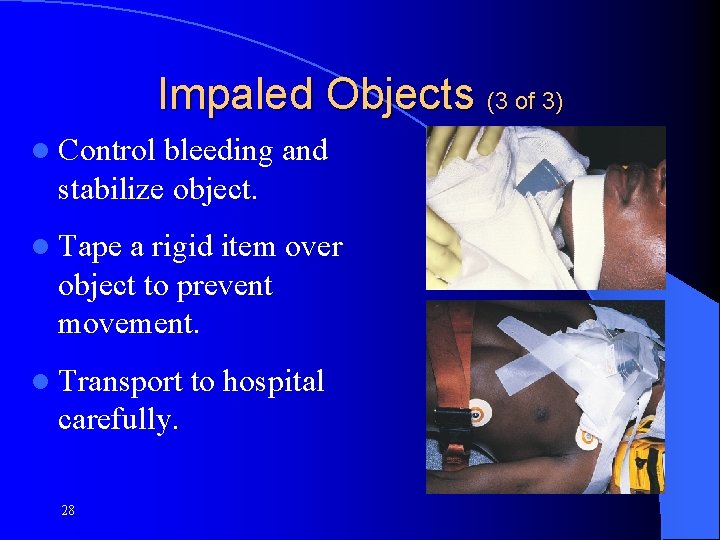
Impaled Objects (3 of 3) l Control bleeding and stabilize object. l Tape a rigid item over object to prevent movement. l Transport carefully. 28 to hospital
Amputations l Immobilize a partial amputation with bulky dressings and a splint. l Wrap a complete amputation in a dry sterile dressing and place in a plastic bag. l Put the bag in a cool container filled with ice. l Transport 29 severed part with patient.
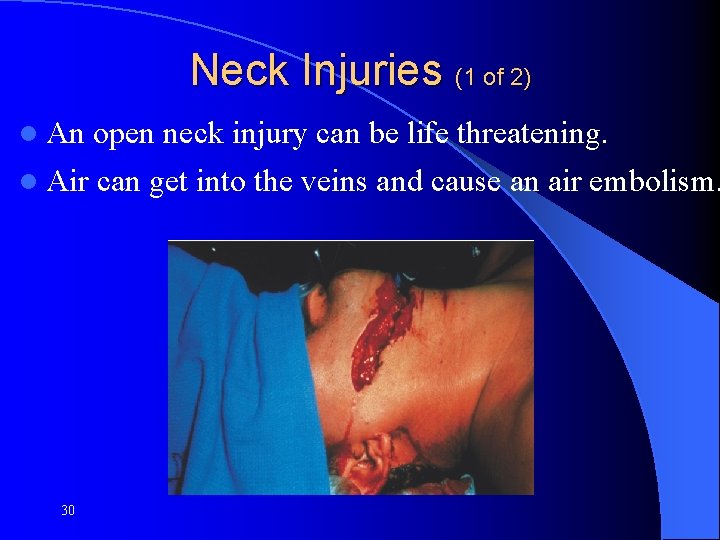
Neck Injuries (1 of 2) l An open neck injury can be life threatening. l Air can get into the veins and cause an air embolism. 30
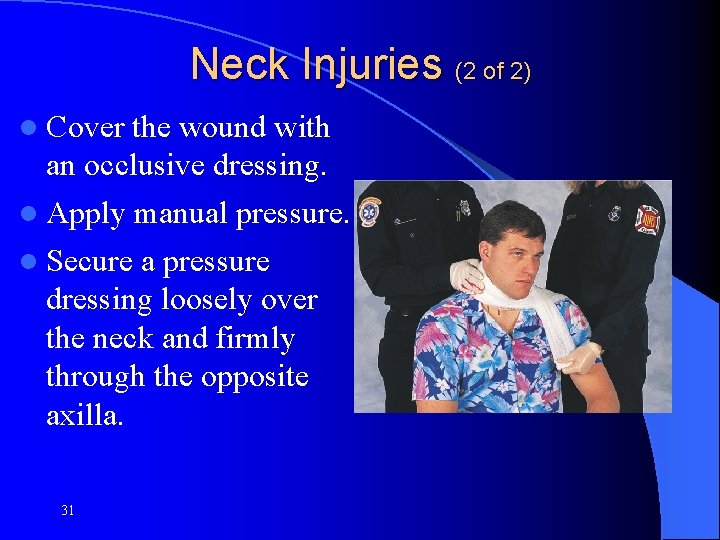
Neck Injuries (2 of 2) l Cover the wound with an occlusive dressing. l Apply manual pressure. l Secure a pressure dressing loosely over the neck and firmly through the opposite axilla. 31
Principles of Bandaging Dressings and Bandages l Functions – Stop bleeding – Protect wound – Prevent contamination l Dressings – universal dressings – 4 X 4 gauze pads – Adhesive type dressings – Occlusive dressings 32
Bandaging Bandages: l Purpose – to hold a dressing in place – applies or continues pressure to wound – should not interfere with circulation 33
Bandaging Types of Bandages l Self adherent l Gauze rolls l Triangular bandages (cravats) l Adhesive tape l Air splint 34
Applying a Pressure Bandage 1. Cover wound with a bulky sterile dressing. 2. Apply hand pressure over wound until bleeding stops 3. Apply firm roller bandage (Kerlix) 4. Check for bleeding and circulation 5. Apply additional dressings and bandages as needed (do not remove soaked ones) 6. Communicate with patient. 35
Principles of Bandaging (1 of 2) There are no hard fast rules for bandaging wounds as long as the following conditions are met: l Bleeding is controlled l The dressing is opened carefully and handled in a aseptic (sterile) technique l Dressings and bandages are snugged but does not affect the blood supply to affected parts. 36
Principles of Bandaging (2 of 2) l The bandage is securely tied so that it will not move. l No loose ends that could get caught while moving the patient. l The bandages must be checked and rechecked for bleeding or impeding of circulation. 37
- Slides: 37