
Chapter 24 SingleSource Shortest Paths Shortest Paths How



![. . continued • No-path Property If δ(s, v)=∞, then d[v]=∞ always. Proof d[v]](https://slidetodoc.com/presentation_image_h2/a11db9164d58d9f68442a60775b24c7b/image-16.jpg ". . continued • No-path Property If δ(s, v)=∞, then d[v]=∞ always. Proof d[v]")
![The Bellman-Ford Algorithm • Allows negative-weight edges. • Computes d[v] and π[v] for all](https://slidetodoc.com/presentation_image_h2/a11db9164d58d9f68442a60775b24c7b/image-18.jpg "The Bellman-Ford Algorithm • Allows negative-weight edges. • Computes d[v] and π[v] for all")


- Slides: 33
Chapter 24. Single-Source Shortest Paths
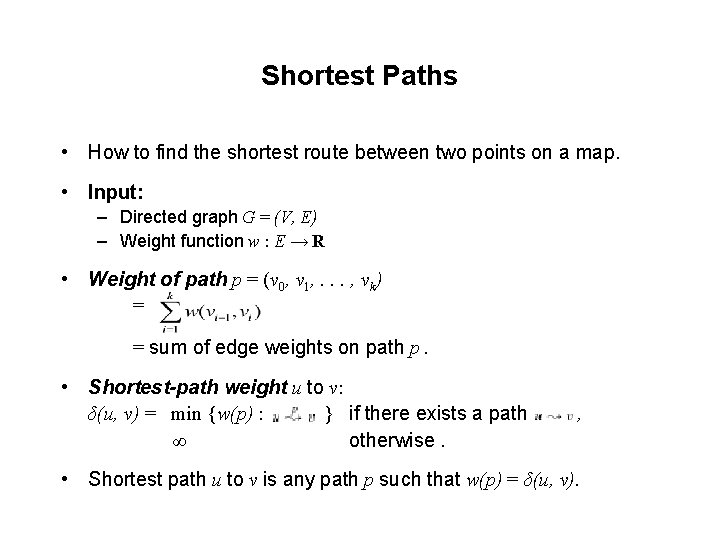
Shortest Paths • How to find the shortest route between two points on a map. • Input: – Directed graph G = (V, E) – Weight function w : E → R • Weight of path p = (v 0, v 1, . . . , vk) = = sum of edge weights on path p. • Shortest-path weight u to v: δ(u, v) = min {w(p) : } if there exists a path ∞ otherwise. , • Shortest path u to v is any path p such that w(p) = δ(u, v).
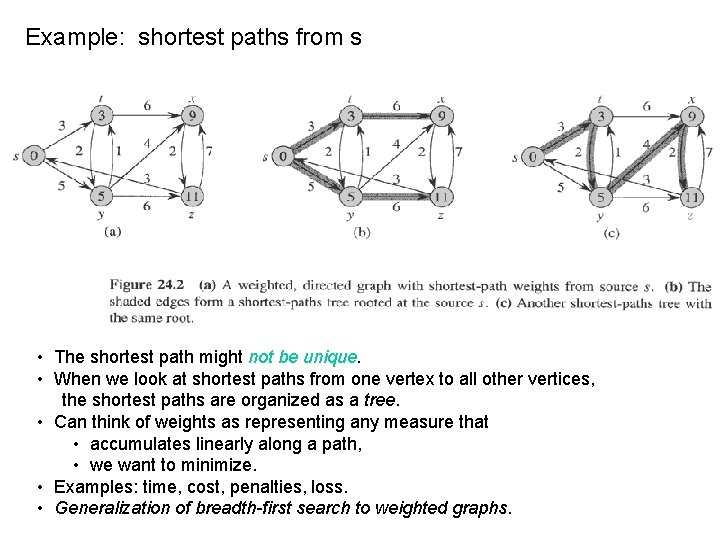
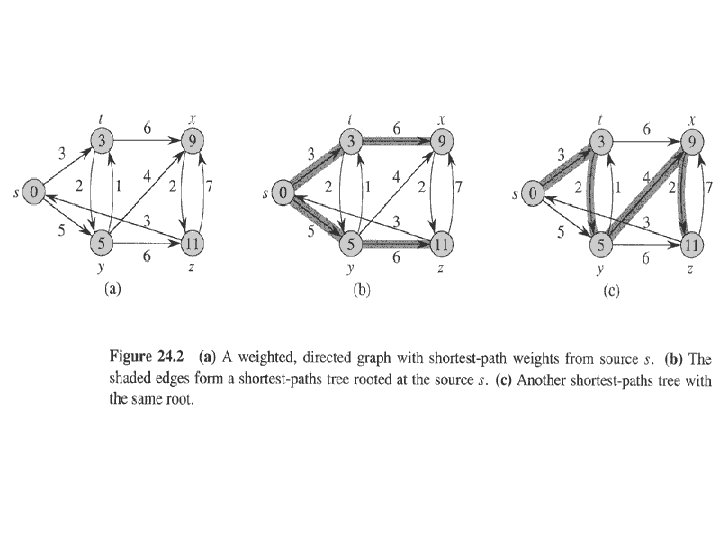
Example: shortest paths from s • The shortest path might not be unique. • When we look at shortest paths from one vertex to all other vertices, the shortest paths are organized as a tree. • Can think of weights as representing any measure that • accumulates linearly along a path, • we want to minimize. • Examples: time, cost, penalties, loss. • Generalization of breadth-first search to weighted graphs.
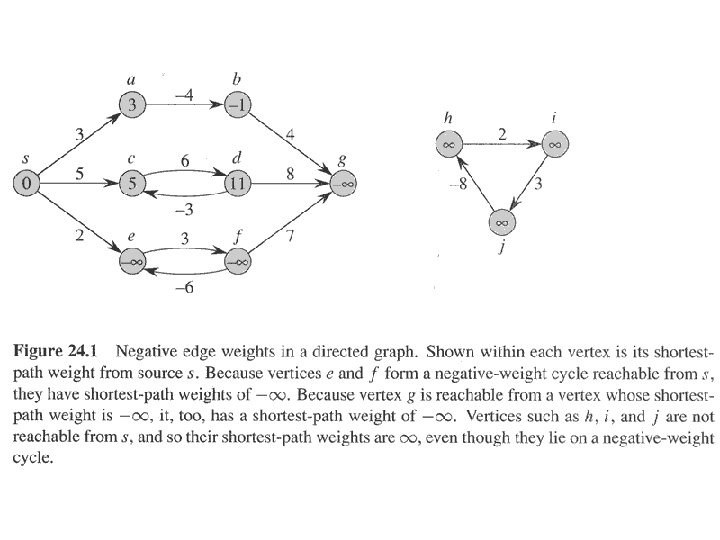
. . continued • Variants – Single-source: Find shortest paths from a given source vertex s V to every vertex v V. – Single-destination: Find shortest paths to a given destination vertex. – Single-pair: Find shortest path from u to v. No way known that’s better in worst case than solving single-source. – All-pairs: Find shortest path from u to v for all u, v V. • Negative-weight edge OK, as long as no negative-weight cycles are reachable from the source. – If we have a negative-weight cycle, we can just keep going around it, and get w(s, v) = -∞ for all v on the cycle. – But OK if the negative-weight cycle is not reachable from the source. – Some algorithms work only if there are no negative-weight edges in the graph. We’ll be clear when they’re allowed and not allowed.
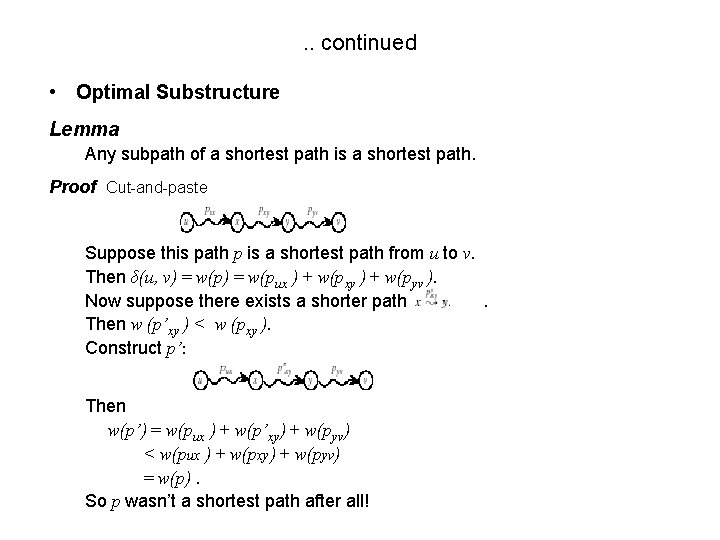
. . continued • Optimal Substructure Lemma Any subpath of a shortest path is a shortest path. Proof Cut-and-paste Suppose this path p is a shortest path from u to v. Then δ(u, v) = w(pux ) + w(pxy ) + w(pyv ). Now suppose there exists a shorter path. Then w (p’xy ) < w (pxy ). Construct p’: Then w(p’) = w(pux ) + w(p’xy) + w(pyv) < w(pux ) + w(pxy) + w(pyv) = w(p). So p wasn’t a shortest path after all!
. . continued • Cycles Shortest paths can’t contain cycles: – Already ruled out negative-weight cycles. – Positive-weight we can get a shorter path by omitting the cycle. – Zero-weight: no reason to use them assume that our solutions won’t use them. • Output of single-source shortest-path algorithm For each vertex v V: – d[v] = δ(s, v). • Initially, d[v]=∞. • Reduces as algorithms progress. But always maintain d[v] ≥ δ(s, v). • Call d[v] a shortest-path estimate. – π[v] = predecessor of v on a shortest path from s. • If no predecessor, π[v] = NIL. • π induces a tree—shortest-path tree.
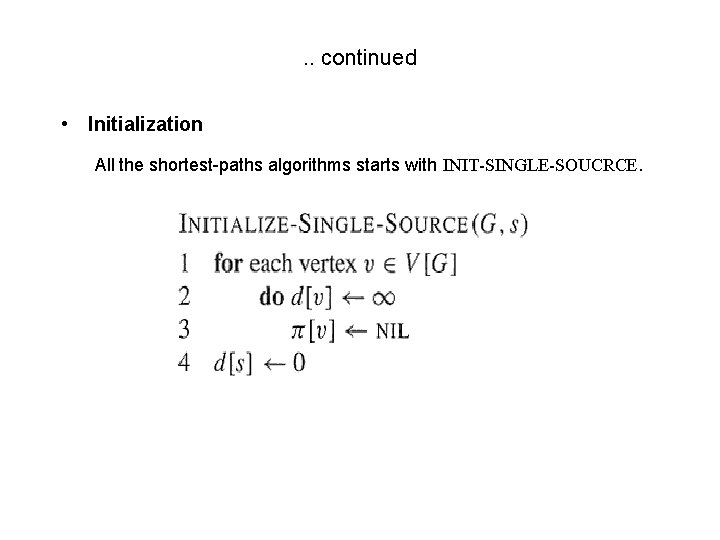
. . continued • Initialization All the shortest-paths algorithms starts with INIT-SINGLE-SOUCRCE.
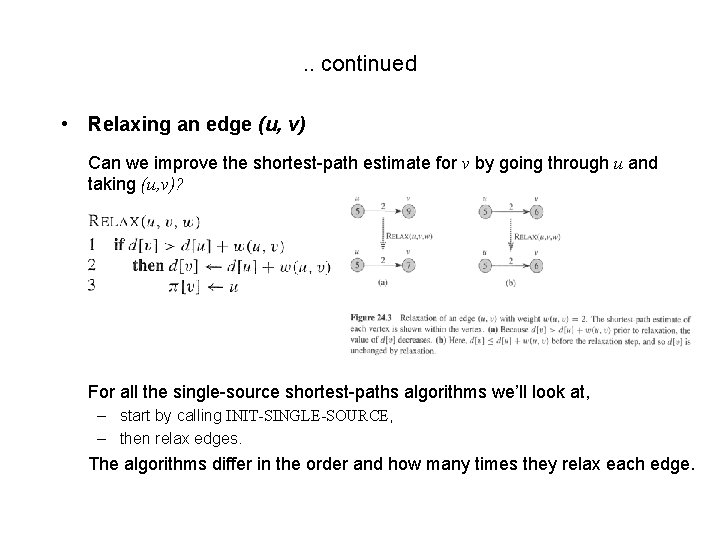
. . continued • Relaxing an edge (u, v) Can we improve the shortest-path estimate for v by going through u and taking (u, v)? For all the single-source shortest-paths algorithms we’ll look at, – start by calling INIT-SINGLE-SOURCE, – then relax edges. The algorithms differ in the order and how many times they relax each edge.
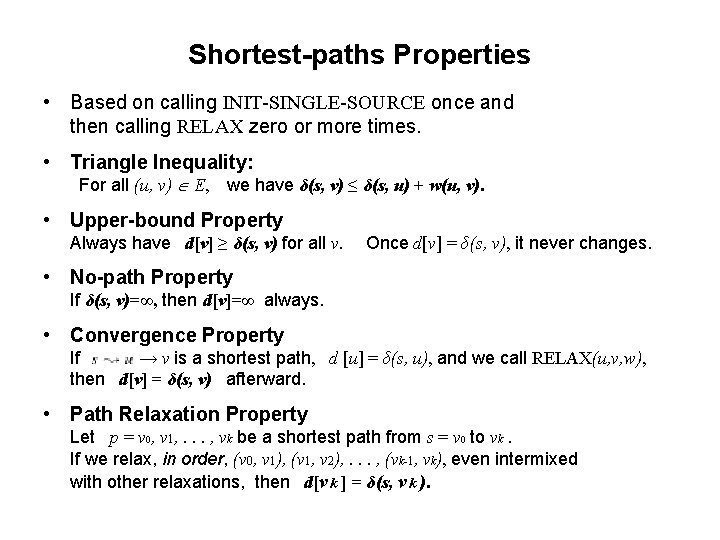
Shortest-paths Properties • Based on calling INIT-SINGLE-SOURCE once and then calling RELAX zero or more times. • Triangle Inequality: For all (u, v) E, we have δ(s, v) ≤ δ(s, u) + w(u, v). • Upper-bound Property Always have d[v] ≥ δ(s, v) for all v. Once d[v] = δ(s, v), it never changes. • No-path Property If δ(s, v)=∞, then d[v]=∞ always. • Convergence Property If → v is a shortest path, d [u] = δ(s, u), and we call RELAX(u, v, w), then d[v] = δ(s, v) afterward. • Path Relaxation Property Let p = v 0, v 1, . . . , vk be a shortest path from s = v 0 to vk. If we relax, in order, (v 0, v 1), (v 1, v 2), . . . , (vk-1, vk), even intermixed with other relaxations, then d[v k ] = δ(s, v k ).
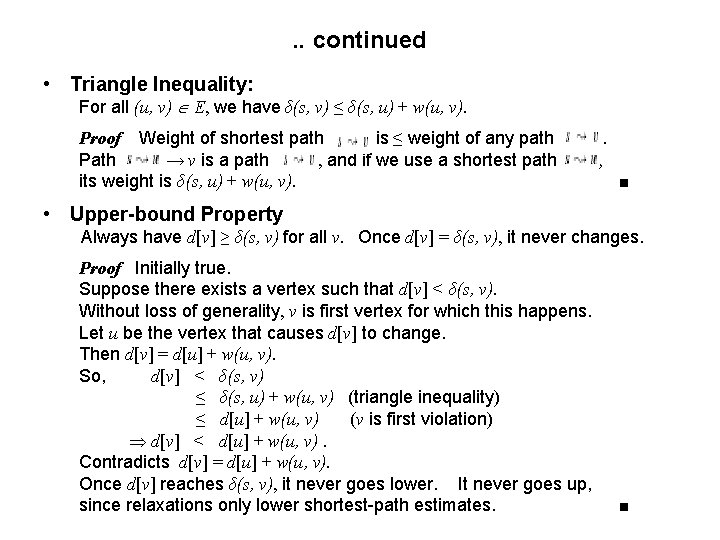
. . continued • Triangle Inequality: For all (u, v) E, we have δ(s, v) ≤ δ(s, u) + w(u, v). Proof Weight of shortest path is ≤ weight of any path Path → v is a path , and if we use a shortest path its weight is δ(s, u) + w(u, v). . , ■ • Upper-bound Property Always have d[v] ≥ δ(s, v) for all v. Once d[v] = δ(s, v), it never changes. Proof Initially true. Suppose there exists a vertex such that d[v] < δ(s, v). Without loss of generality, v is first vertex for which this happens. Let u be the vertex that causes d[v] to change. Then d[v] = d[u] + w(u, v). So, d[v] < δ(s, v) ≤ δ(s, u) + w(u, v) (triangle inequality) ≤ d[u] + w(u, v) (v is first violation) d[v] < d[u] + w(u, v). Contradicts d[v] = d[u] + w(u, v). Once d[v] reaches δ(s, v), it never goes lower. It never goes up, since relaxations only lower shortest-path estimates. ■
. . continued • No-path Property If δ(s, v)=∞, then d[v]=∞ always. Proof d[v] ≥ δ(s, v)=∞ d[v]=∞. ■ • Convergence Property If → v is a shortest path, d [u] = δ(s, u), and we call RELAX(u, v, w), then d [v] = δ(s, v) afterward. Proof After relaxation: d [v] ≤ d [u] + w(u, v) (RELAX code) = δ(s, u) + w(u, v) = δ(s, v) (lemma—optimal substructure) Since d [v] ≥ δ(s, v), must have d [v] = δ(s, v). ■
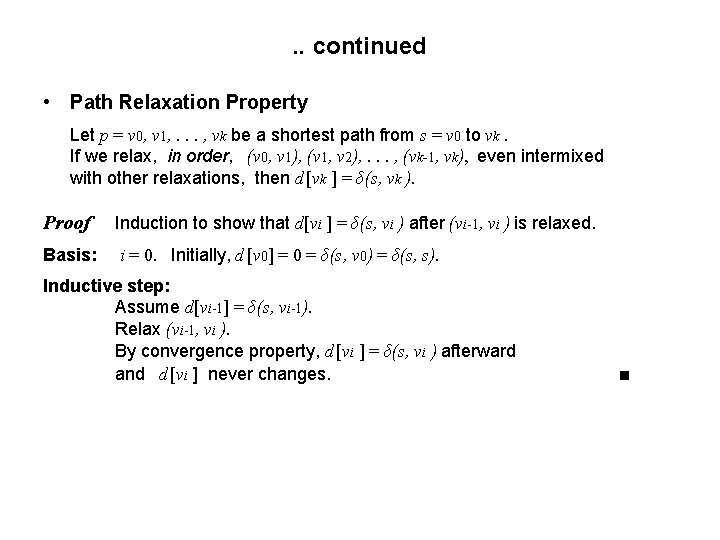
. . continued • Path Relaxation Property Let p = v 0, v 1, . . . , vk be a shortest path from s = v 0 to vk. If we relax, in order, (v 0, v 1), (v 1, v 2), . . . , (vk-1, vk), even intermixed with other relaxations, then d [vk ] = δ(s, vk ). Proof Induction to show that d[vi ] = δ(s, vi ) after (vi-1, vi ) is relaxed. Basis: i = 0. Initially, d [v 0] = 0 = δ(s, v 0) = δ(s, s). Inductive step: Assume d[vi-1] = δ(s, vi-1). Relax (vi-1, vi ). By convergence property, d [vi ] = δ(s, vi ) afterward and d [vi ] never changes. ■
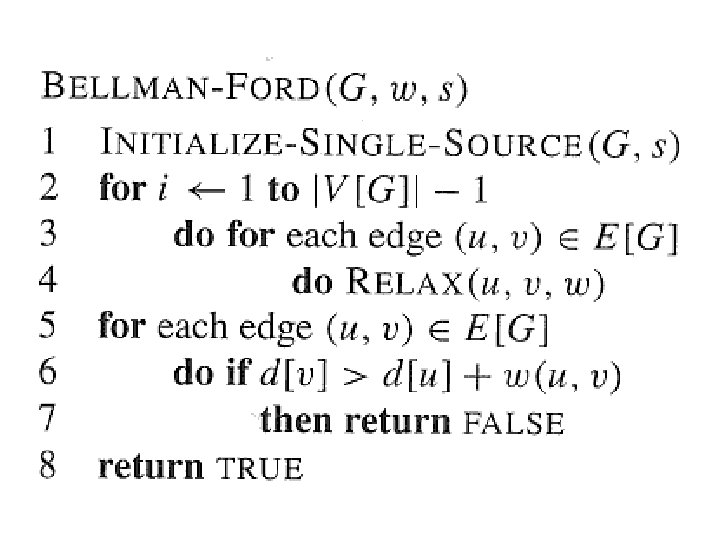
The Bellman-Ford Algorithm • Allows negative-weight edges. • Computes d[v] and π[v] for all v V. • Returns TRUE if no negative-weight cycles reachable from s, FALSE otherwise. • Core: The first for loop relaxes all edges |V| -1 times. • Time: (VE).
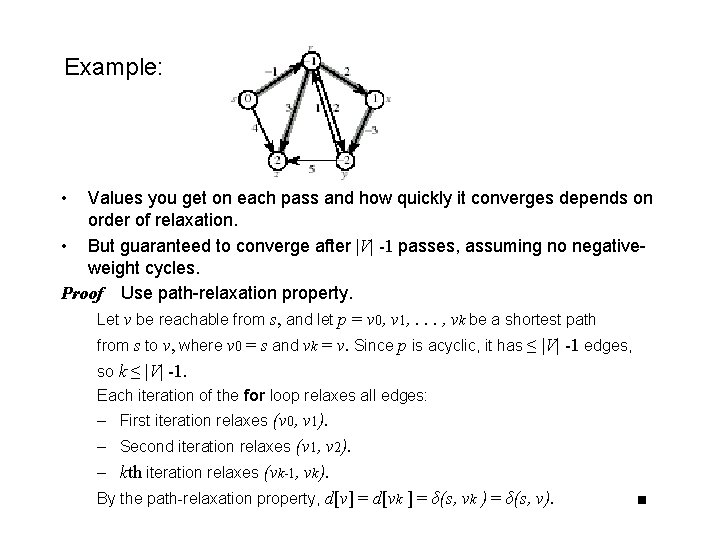
Example: • Values you get on each pass and how quickly it converges depends on order of relaxation. • But guaranteed to converge after |V| -1 passes, assuming no negativeweight cycles. Proof Use path-relaxation property. Let v be reachable from s, and let p = v 0, v 1, . . . , vk be a shortest path from s to v, where v 0 = s and vk = v. Since p is acyclic, it has ≤ |V| -1 edges, so k ≤ |V| -1. Each iteration of the for loop relaxes all edges: – First iteration relaxes (v 0, v 1). – Second iteration relaxes (v 1, v 2). – kth iteration relaxes (vk-1, vk). By the path-relaxation property, d[v] = d[vk ] = δ(s, vk ) = δ(s, v). ■
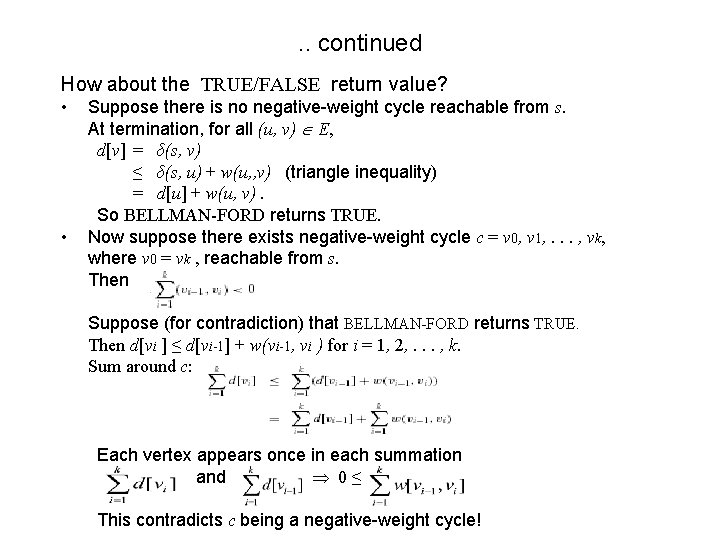
. . continued How about the TRUE/FALSE return value? • • Suppose there is no negative-weight cycle reachable from s. At termination, for all (u, v) E, d[v] = δ(s, v) ≤ δ(s, u) + w(u, , v) (triangle inequality) = d[u] + w(u, v). So BELLMAN-FORD returns TRUE. Now suppose there exists negative-weight cycle c = v 0, v 1, . . . , vk, where v 0 = vk , reachable from s. Then Suppose (for contradiction) that BELLMAN-FORD returns TRUE. Then d[vi ] ≤ d[vi-1] + w(vi-1, vi ) for i = 1, 2, . . . , k. Sum around c: Each vertex appears once in each summation and 0≤ This contradicts c being a negative-weight cycle!
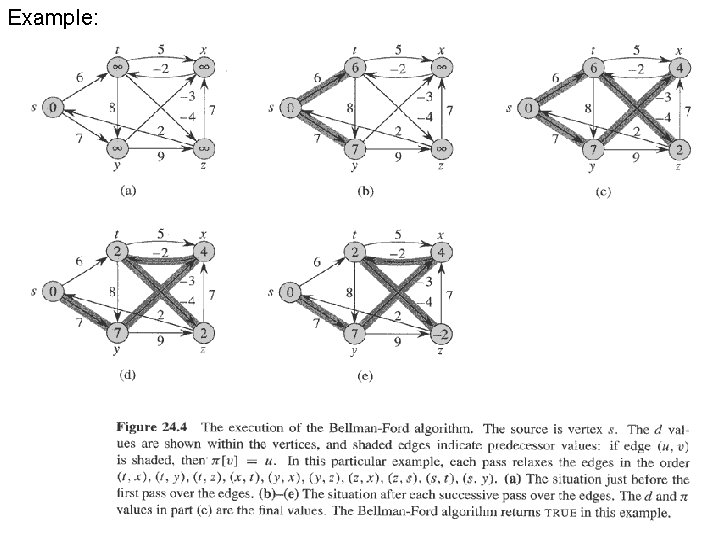
Example:
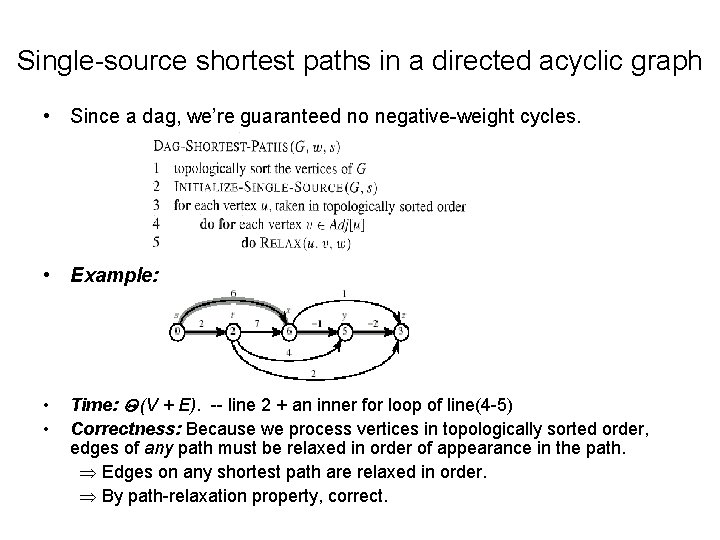
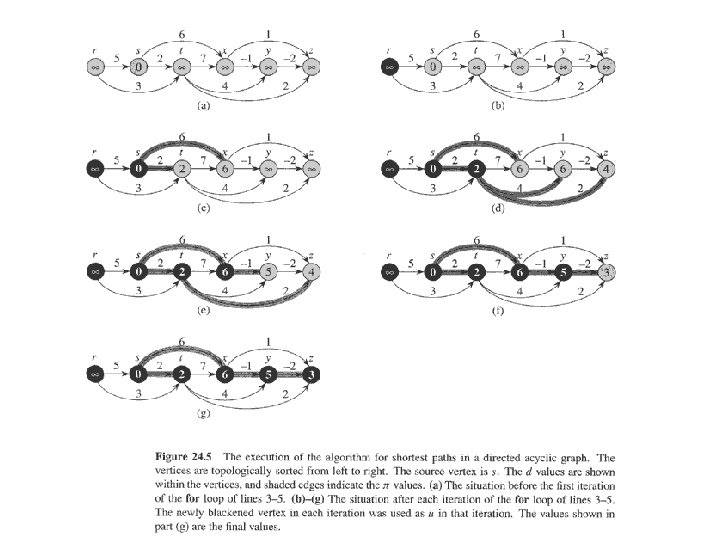
Single-source shortest paths in a directed acyclic graph • Since a dag, we’re guaranteed no negative-weight cycles. • Example: • • Time: (V + E). -- line 2 + an inner for loop of line(4 -5) Correctness: Because we process vertices in topologically sorted order, edges of any path must be relaxed in order of appearance in the path. Edges on any shortest path are relaxed in order. By path-relaxation property, correct.
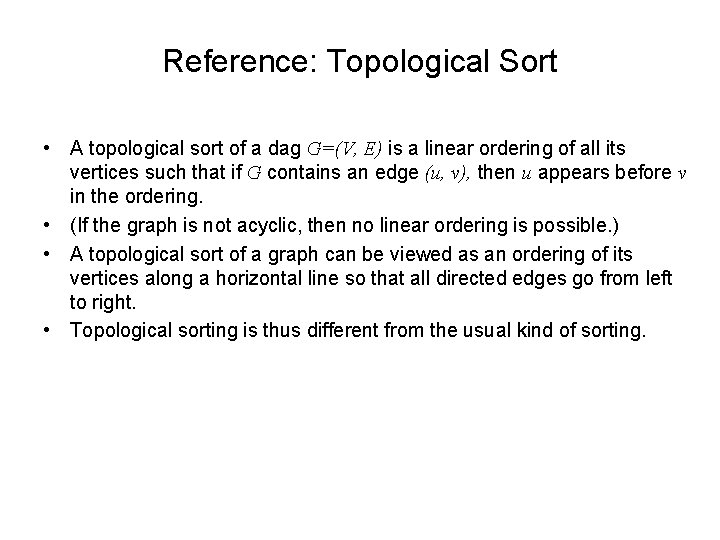
Reference: Topological Sort • A topological sort of a dag G=(V, E) is a linear ordering of all its vertices such that if G contains an edge (u, v), then u appears before v in the ordering. • (If the graph is not acyclic, then no linear ordering is possible. ) • A topological sort of a graph can be viewed as an ordering of its vertices along a horizontal line so that all directed edges go from left to right. • Topological sorting is thus different from the usual kind of sorting.
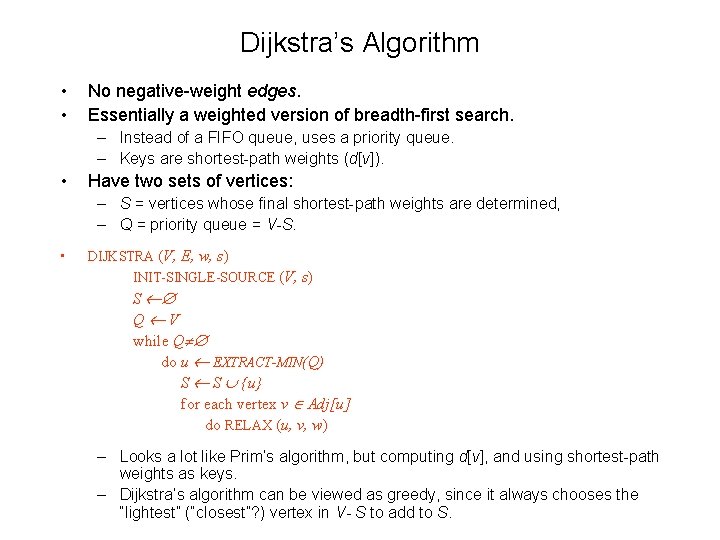
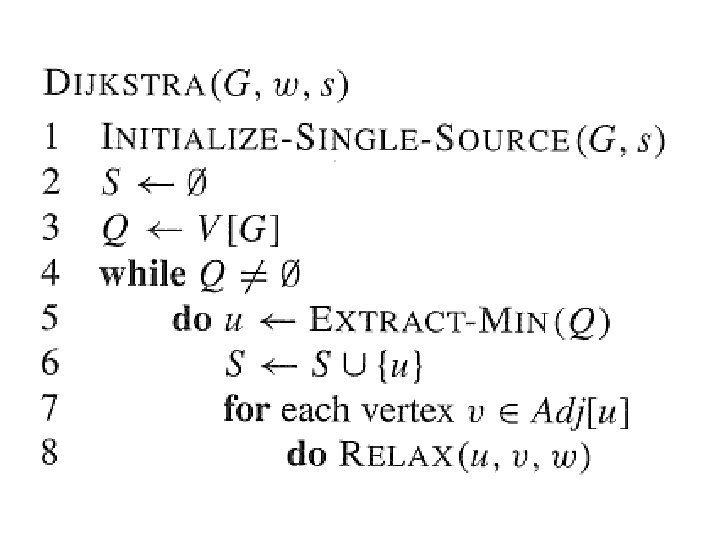
Dijkstra’s Algorithm • • No negative-weight edges. Essentially a weighted version of breadth-first search. – Instead of a FIFO queue, uses a priority queue. – Keys are shortest-path weights (d[v]). • Have two sets of vertices: – S = vertices whose final shortest-path weights are determined, – Q = priority queue = V-S. • DIJKSTRA (V, E, w, s) INIT-SINGLE-SOURCE (V, s) S Q V while Q do u EXTRACT-MIN(Q) S S {u} for each vertex v Adj[u] do RELAX (u, v, w) – Looks a lot like Prim’s algorithm, but computing d[v], and using shortest-path weights as keys. – Dijkstra’s algorithm can be viewed as greedy, since it always chooses the “lightest” (“closest”? ) vertex in V- S to add to S.
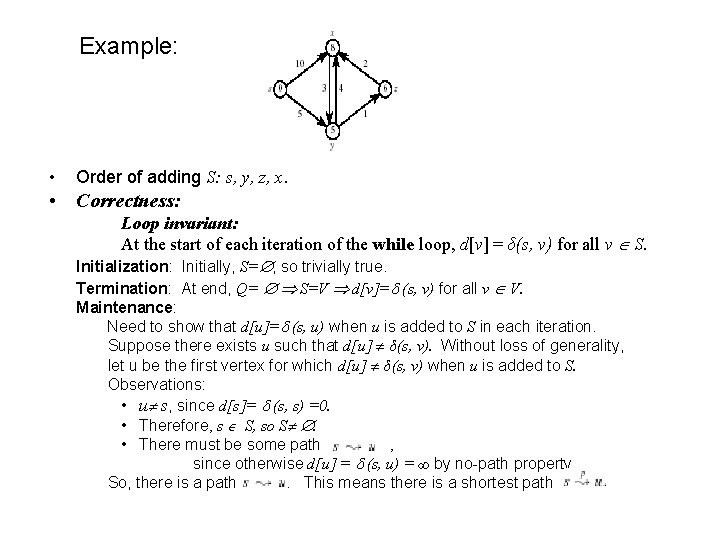
Example: • Order of adding S: s, y, z, x. • Correctness: Loop invariant: At the start of each iteration of the while loop, d[v] = δ(s, v) for all v S. Initialization: Initially, S= , so trivially true. Termination: At end, Q= S=V d[v]= (s, v) for all v V. Maintenance: Need to show that d[u]= (s, u) when u is added to S in each iteration. Suppose there exists u such that d[u] δ(s, v). Without loss of generality, let u be the first vertex for which d[u] δ(s, v) when u is added to S. Observations: • u s, since d[s]= (s, s) =0. • Therefore, s S, so S . • There must be some path , since otherwise d[u] = (s, u) = ∞ by no-path property. So, there is a path. This means there is a shortest path
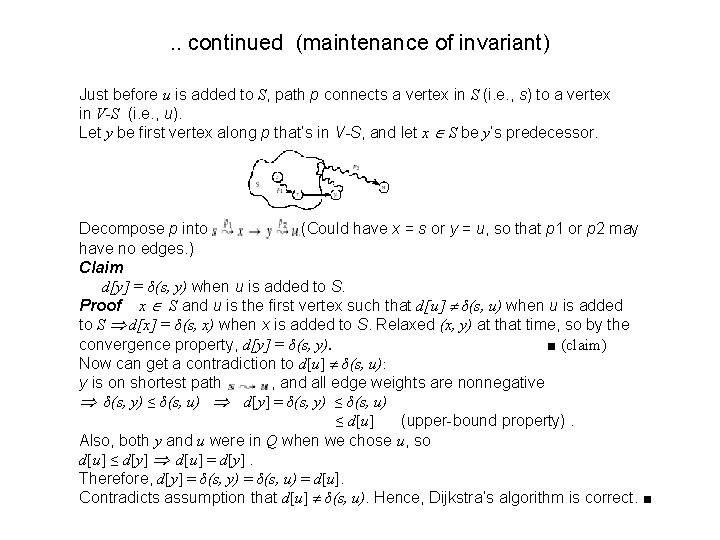
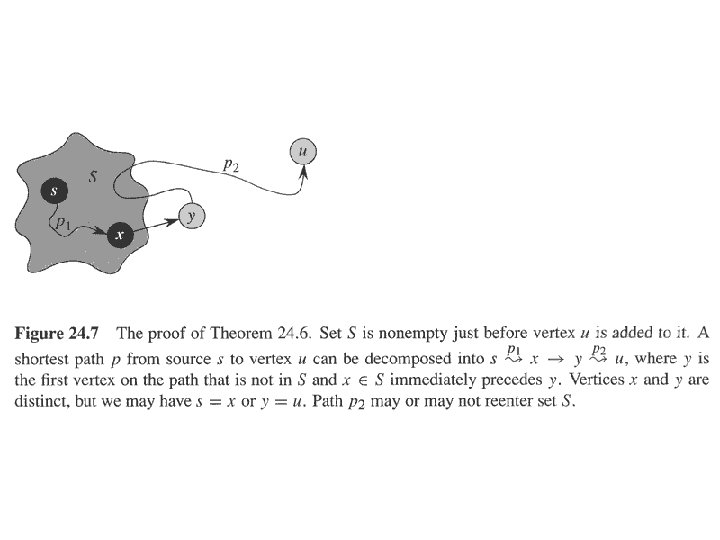
. . continued (maintenance of invariant) Just before u is added to S, path p connects a vertex in S (i. e. , s) to a vertex in V-S (i. e. , u). Let y be first vertex along p that’s in V-S, and let x S be y’s predecessor. Decompose p into (Could have x = s or y = u, so that p 1 or p 2 may have no edges. ) Claim d[y] = δ(s, y) when u is added to S. Proof x S and u is the first vertex such that d[u] δ(s, u) when u is added to S d[x] = δ(s, x) when x is added to S. Relaxed (x, y) at that time, so by the convergence property, d[y] = δ(s, y). ■ (claim) Now can get a contradiction to d[u] δ(s, u): y is on shortest path , and all edge weights are nonnegative δ(s, y) ≤ δ(s, u) d[y] = δ(s, y) ≤ δ(s, u) ≤ d[u] (upper-bound property). Also, both y and u were in Q when we chose u, so d[u] ≤ d[y] d[u] = d[y]. Therefore, d[y] = δ(s, y) = δ(s, u) = d[u]. Contradicts assumption that d[u] δ(s, u). Hence, Dijkstra’s algorithm is correct. ■
. . continued Analysis: Like Prim’s algorithm, depends on implementation of priority queue. • If binary heap, each operation takes O(lg V) time O((V+E) lg V) = (E lg V) if all vertices are reachable from the source. • If a Fibonacci heap: – Each EXTRACT-MIN takes O(1) amortized time. – There are O(V) other operations, taking O(lg V) amortized time each. – Therefore, time is O(V lg V + E).