
Chapter 24 Section 2 The Inner Planets The
- Slides: 17
Chapter 24: Section 2 The Inner Planets
The Inner Planets • called Terrestrial Planets • First 4 planets: Mercury, Venus, Earth, & Mars • All have solid crust surface • Most have an atmosphere of some kind • Most at least have one moon
Mercury
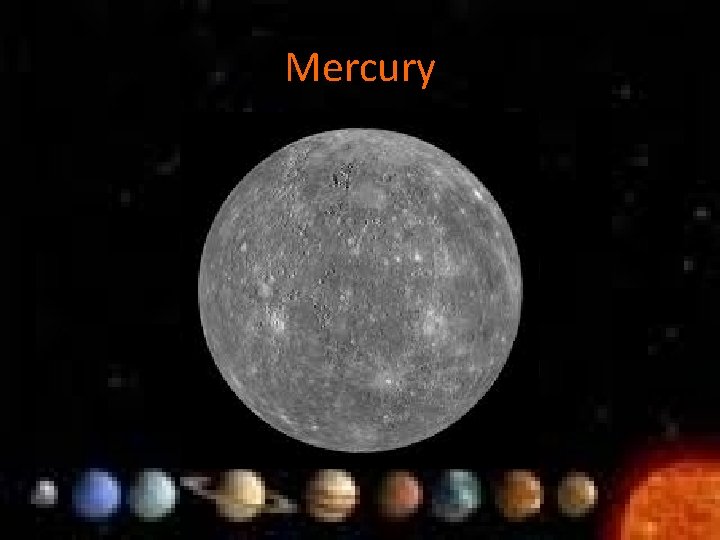
Mercury • closest planet to the sun • Nicknamed “the swift planet” – revolution time: 88 Earth days – Rotation time: 59 Earth days • smallest planet (of the 8 main ones) • Probed by Mariner 10 (1974 – 1975) – – imaged 45% of surface crater riddled (similar to our moon) has large cliff lined valleys has a weak magnetic field (indicates iron core)
Mercury continued… • Probed by Mariner 10 (1974 – 1975) continued. . – Very thin atmosphere: • made of Hydrogen, Helium, Sodium & Potassium – surface temperatures can reach up to about: • Daytime: 800 o. F • Night: -290 o. F – **HUGE TEMPERATURE SWING FROM DAY TO NIGHT!
Venus
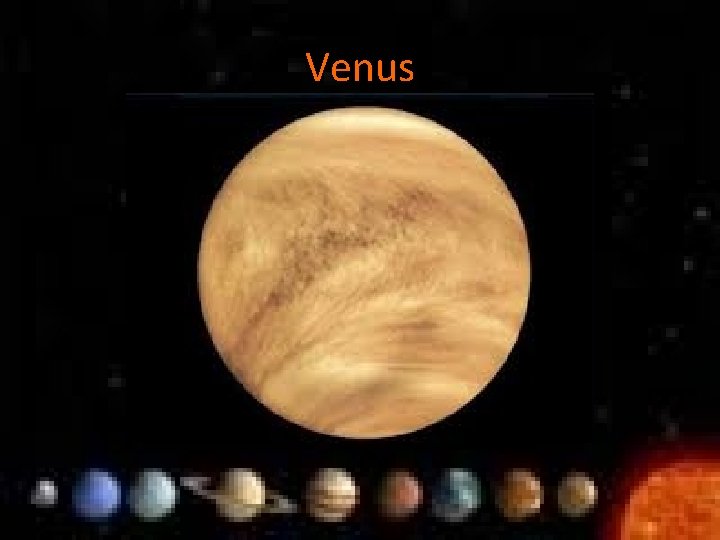
Venus • Second planet from the sun – Revolution: 225 days – Rotation: Retrograde = spins backwards (243 earth days) • Probed by Venera (Russian) in 1970 • Probed by Magellan (US) in 1990 to 1994 • “Earth’s Twin Sister” – Size, Mass, Gravity similar to Earth
Venus continued… • Atmosphere: Thick & toxic – Air Pressure = 90 times that of Earth – Mostly carbon dioxide, some nitrogen – Clouds: Rain sulfuric acid • Only allow 2% of sunlight through to surface – Solar energy trapped = extreme Greenhouse Effect – layer of clouds traps heat making it hot enough to melt lead
Venus continued… • Surface temperature = about 8800 F • Surface covered by craters, fault lines, & Volcanoes • has atmospheric lightening bursts caused by sulfuric acid clouds • Winds = 300 km / hr.
Earth
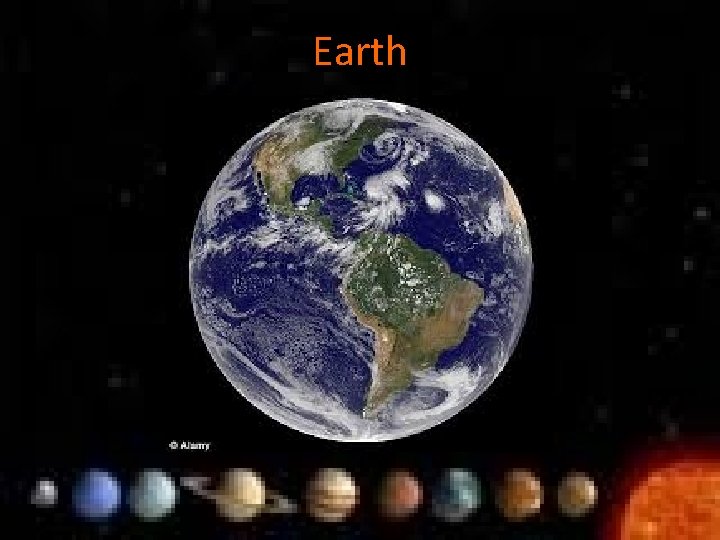
Earth • “Third Rock from the Sun” = nickname • Average distance from the sun = 150 million km • Only planet water exists as 3 states of matter – Solid, Liquid, & Gas • Atmosphere protects the planet – From meteor strikes (most burn up) – Intense Solar Radiation (UV, X-Rays, Gamma Rays, etc. )
Mars
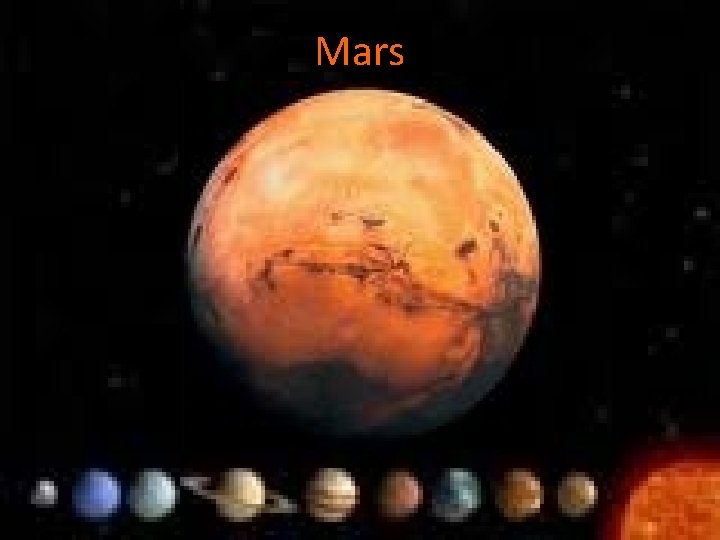
Mars • • • Fourth Planet from the Sun “The Red Planet” = nickname Surface mainly iron oxide dust (Rust) Revolution time: 687 days Rotation: 24. 6 hours Has polar ice caps – Northern: frozen Water (H 2 O) – Southern: frozen Carbon Dioxide (CO 2)
Discoveries on Mars • Mariner 9 (1971– 1972) – Discovered dried riverbeds (ancient floods) – Olympus Mons: Largest known volcano in the Solar System – Rift Zones: Deep crustal tears • Viking 1 & 2 (1976) – Each consisted of Orbiter & Lander – Photographed entire Martian surface (Orbiters)
Discoveries on Mars continued… • Mars’ Atmosphere – Studied meteorological, chemical, & biological aspects • Discovered barren, rocky, windswept surface • Atmosphere: very thin; Carbon Dioxide, Nitrogen & Argon • Surface Temperatures: 70 o. F (day) to -225 o. F (night) • Temperature changes create intense winds & dust storms • NO evidence of life (past or present)
Martian Seasons • Mars’ axis of rotation is tilted 25 degrees, which is close to Earth’s tilt of 23. 5 degrees. – Because of this Mars goes through seasons as it orbits the Sun. • As one ice cap grows smaller, the other grows larger. • The color of the ice caps and other areas of Mars also changes with the seasons. – caused by the movement of dust and sand during dust storms
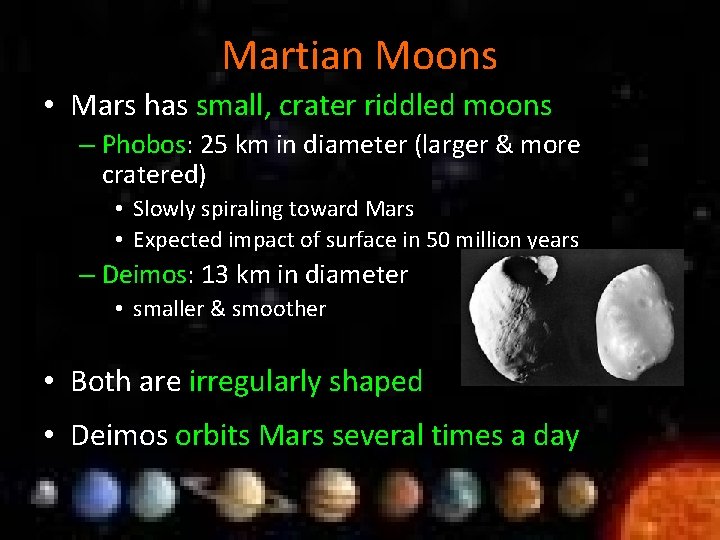
Martian Moons • Mars has small, crater riddled moons – Phobos: 25 km in diameter (larger & more cratered) • Slowly spiraling toward Mars • Expected impact of surface in 50 million years – Deimos: 13 km in diameter • smaller & smoother • Both are irregularly shaped • Deimos orbits Mars several times a day