
Chapter 24 Quality Management Managing the quality of
- Slides: 55
Chapter 24 Quality Management Managing the quality of the software processes and products ©IS&JCH 040325 Software Engineering. Chapter 24 Slide 0 of 54
Objectives l l To introduce the quality management process and key quality management activities To explain the role of standards in quality management To explain the concept of a software metric, predictor metrics and control metrics To explain how measurement may be used in assessing software quality ©IS&JCH 040325 Software Engineering. Chapter 24 Slide 1 of 54
Topics covered l l Quality assurance and standards Quality planning Quality control Software measurement and metrics ©IS&JCH 040325 Software Engineering. Chapter 24 Slide 2 of 54
Software quality management l l l Concerned with ensuring that the required level of quality is achieved in a software product Involves defining appropriate quality standards and procedures and ensuring that these are followed Should aim to develop a ‘quality culture’ where quality is seen as everyone’s responsibility ©IS&JCH 040325 Software Engineering. Chapter 24 Slide 3 of 54
What is quality? l l Quality, simplistically, means that a product should meet its specification This is problematic for software systems • • • Tension between customer quality requirements (efficiency, reliability, etc. ) and developer quality requirements (maintainability, reusability, etc. ) Some quality requirements are difficult to specify in an unambiguous way Software specifications are usually incomplete and often inconsistent ©IS&JCH 040325 Software Engineering. Chapter 24 Slide 4 of 54
The quality compromise l l l We cannot wait for specifications to improve before paying attention to quality management Must put procedures into place to improve quality in spite of imperfect specification Quality management is therefore not just concerned with reducing defects but also with other product qualities ©IS&JCH 040325 Software Engineering. Chapter 24 Slide 5 of 54
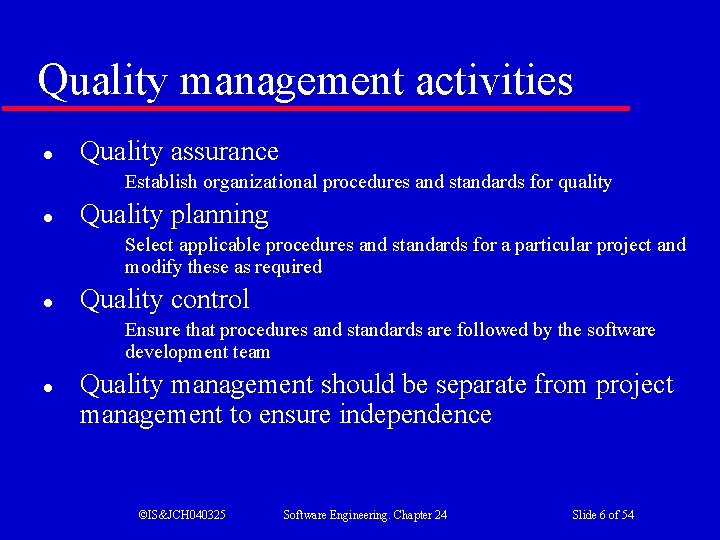
Quality management activities l Quality assurance Establish organizational procedures and standards for quality l Quality planning Select applicable procedures and standards for a particular project and modify these as required l Quality control Ensure that procedures and standards are followed by the software development team l Quality management should be separate from project management to ensure independence ©IS&JCH 040325 Software Engineering. Chapter 24 Slide 6 of 54
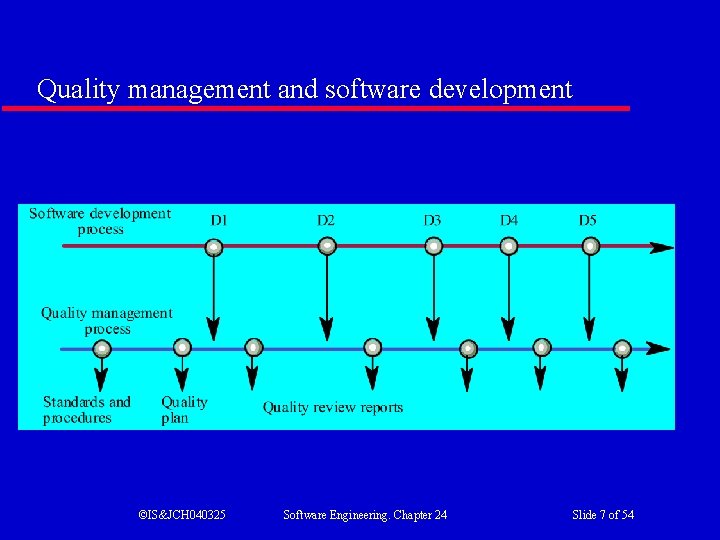
Quality management and software development ©IS&JCH 040325 Software Engineering. Chapter 24 Slide 7 of 54
ISO 9001 ©IS&JCH 040325 Software Engineering. Chapter 24 Slide 8 of 54
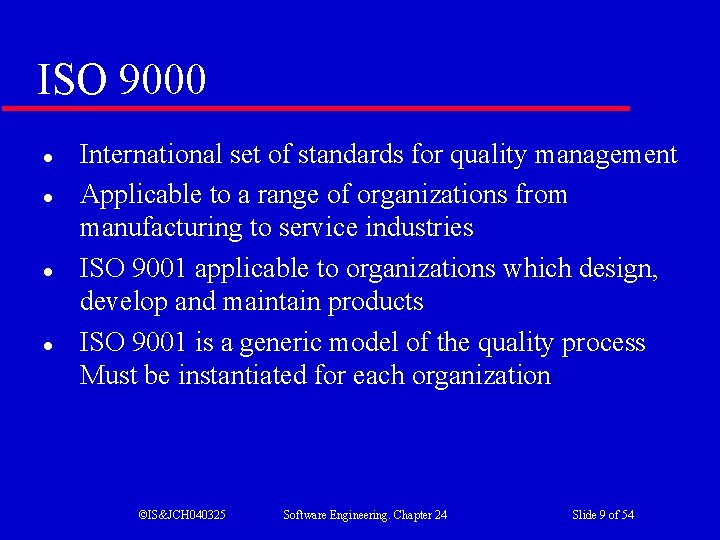
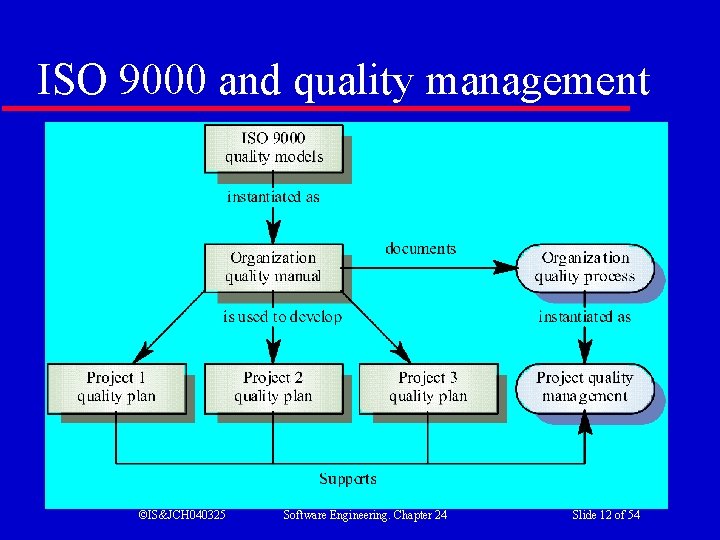
ISO 9000 l l International set of standards for quality management Applicable to a range of organizations from manufacturing to service industries ISO 9001 applicable to organizations which design, develop and maintain products ISO 9001 is a generic model of the quality process Must be instantiated for each organization ©IS&JCH 040325 Software Engineering. Chapter 24 Slide 9 of 54
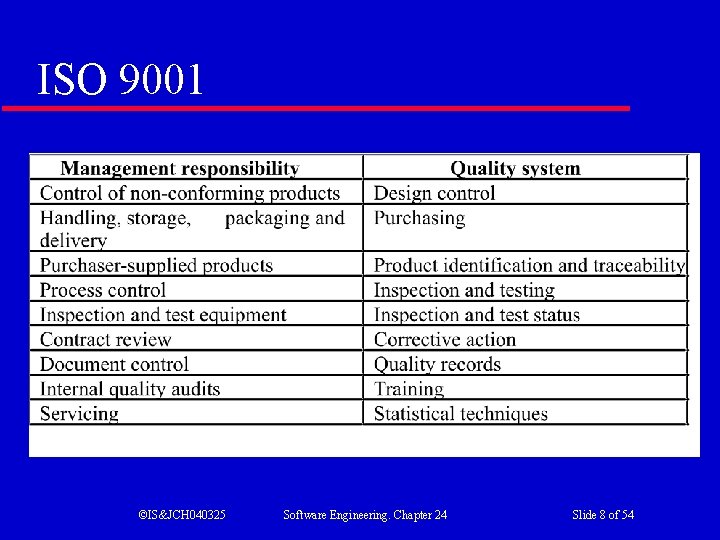
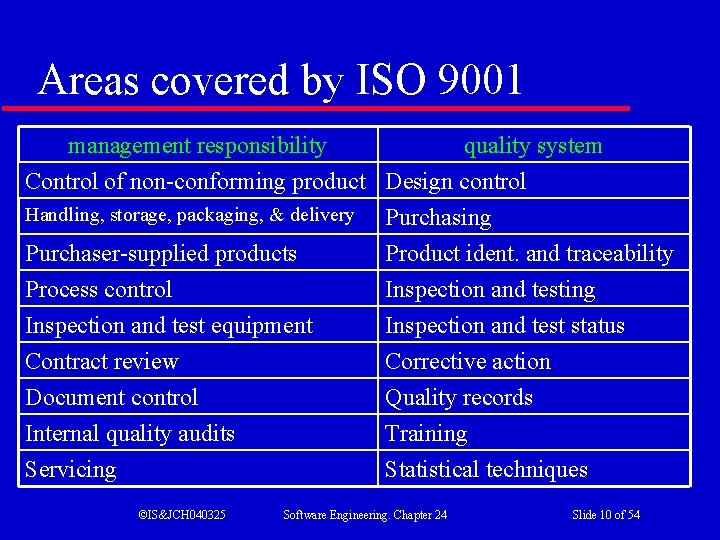
Areas covered by ISO 9001 management responsibility quality system Control of non-conforming product Design control Handling, storage, packaging, & delivery Purchasing Purchaser-supplied products Product ident. and traceability Process control Inspection and test equipment Contract review Document control Internal quality audits Servicing ©IS&JCH 040325 Inspection and testing Inspection and test status Corrective action Quality records Training Statistical techniques Software Engineering. Chapter 24 Slide 10 of 54
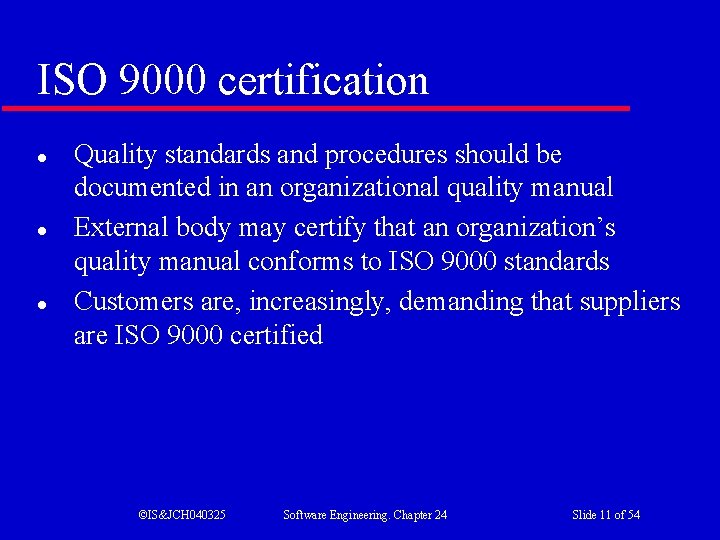
ISO 9000 certification l l l Quality standards and procedures should be documented in an organizational quality manual External body may certify that an organization’s quality manual conforms to ISO 9000 standards Customers are, increasingly, demanding that suppliers are ISO 9000 certified ©IS&JCH 040325 Software Engineering. Chapter 24 Slide 11 of 54
ISO 9000 and quality management ©IS&JCH 040325 Software Engineering. Chapter 24 Slide 12 of 54
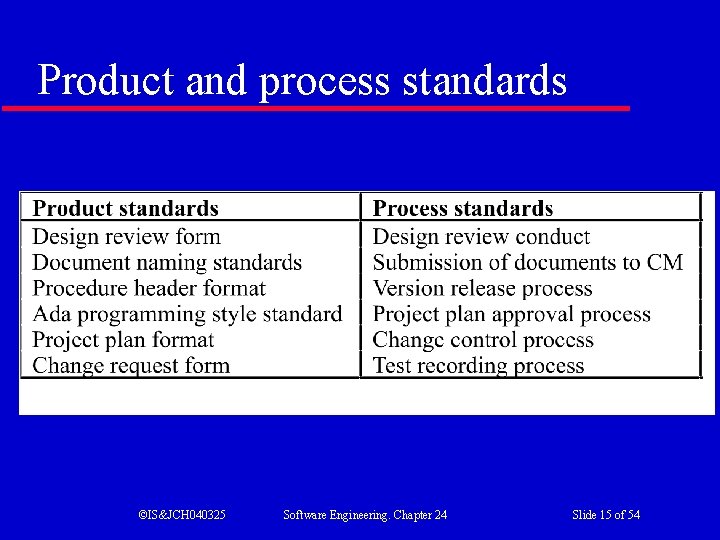
Quality assurance and standards l l Standards are the key to effective quality management They may be international, organizational or project standards Product standards define characteristics that all components should exhibit e. g. a common programming style Process standards define how the software process should be enacted ©IS&JCH 040325 Software Engineering. Chapter 24 Slide 13 of 54
Importance of standards l l l Encapsulation of best practice- avoids repetition of past mistakes Framework for quality assurance process - it involves checking standard compliance Provide continuity - new staff can understand the organization by understand the standards applied ©IS&JCH 040325 Software Engineering. Chapter 24 Slide 14 of 54
Product and process standards ©IS&JCH 040325 Software Engineering. Chapter 24 Slide 15 of 54
Problems with standards l l l Not seen as relevant and up-to-date by software engineers Involve too much bureaucratic form filling Unsupported by software tools so tedious manual work is involved to maintain standards ©IS&JCH 040325 Software Engineering. Chapter 24 Slide 16 of 54
Standards development l l l Involve practitioners in development. Engineers should understand the rationale underlying a standard Review standards and their usage regularly. Standards can quickly become outdated and this reduces their credibility amongst practitioners Detailed standards should have associated tool support. Excessive clerical work is the most significant complaint against standards ©IS&JCH 040325 Software Engineering. Chapter 24 Slide 17 of 54
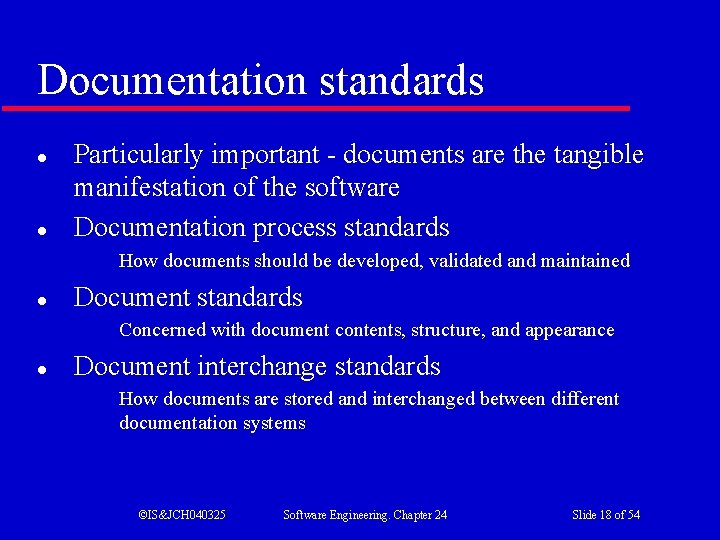
Documentation standards l l Particularly important - documents are the tangible manifestation of the software Documentation process standards How documents should be developed, validated and maintained l Document standards Concerned with document contents, structure, and appearance l Document interchange standards How documents are stored and interchanged between different documentation systems ©IS&JCH 040325 Software Engineering. Chapter 24 Slide 18 of 54
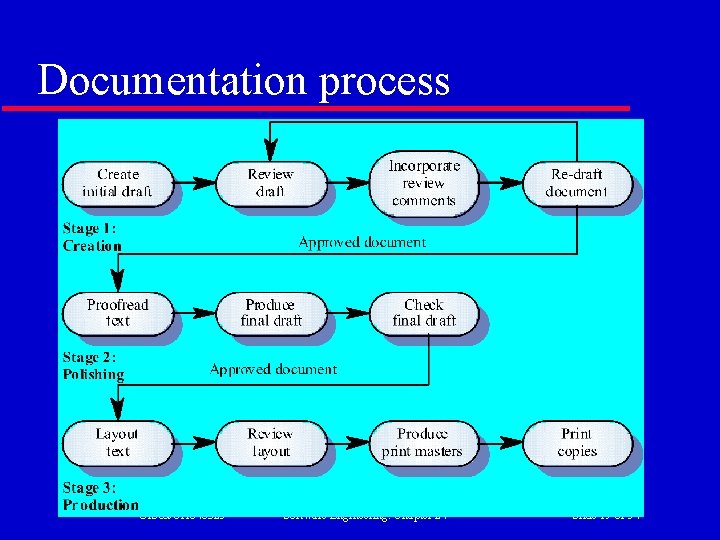
Documentation process ©IS&JCH 040325 Software Engineering. Chapter 24 Slide 19 of 54
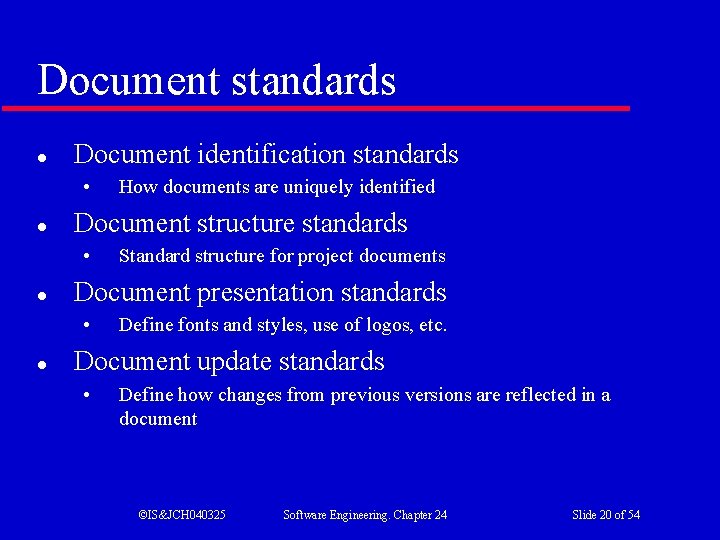
Document standards l Document identification standards • l Document structure standards • l Standard structure for project documents Document presentation standards • l How documents are uniquely identified Define fonts and styles, use of logos, etc. Document update standards • Define how changes from previous versions are reflected in a document ©IS&JCH 040325 Software Engineering. Chapter 24 Slide 20 of 54
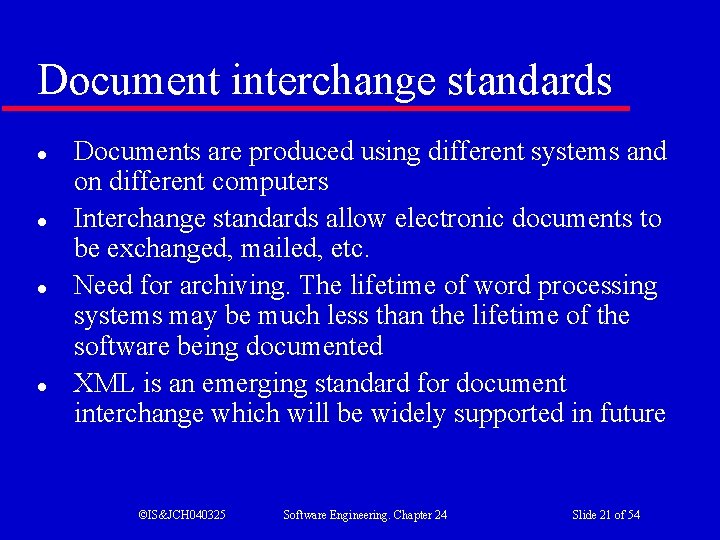
Document interchange standards l l Documents are produced using different systems and on different computers Interchange standards allow electronic documents to be exchanged, mailed, etc. Need for archiving. The lifetime of word processing systems may be much less than the lifetime of the software being documented XML is an emerging standard for document interchange which will be widely supported in future ©IS&JCH 040325 Software Engineering. Chapter 24 Slide 21 of 54
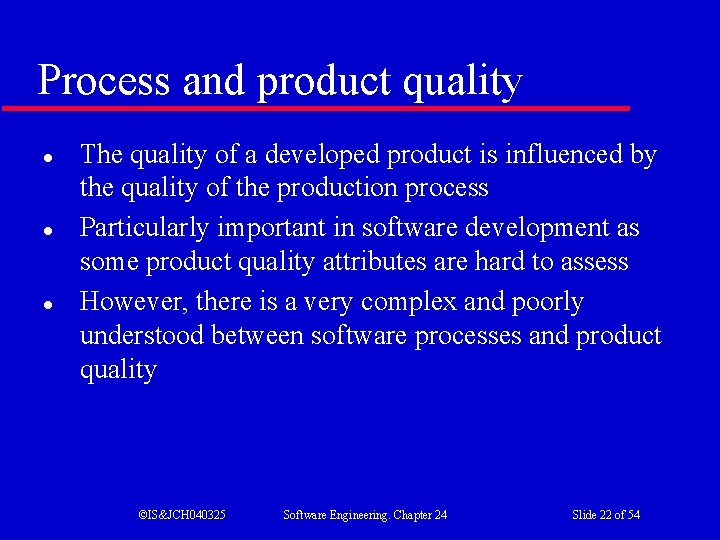
Process and product quality l l l The quality of a developed product is influenced by the quality of the production process Particularly important in software development as some product quality attributes are hard to assess However, there is a very complex and poorly understood between software processes and product quality ©IS&JCH 040325 Software Engineering. Chapter 24 Slide 22 of 54
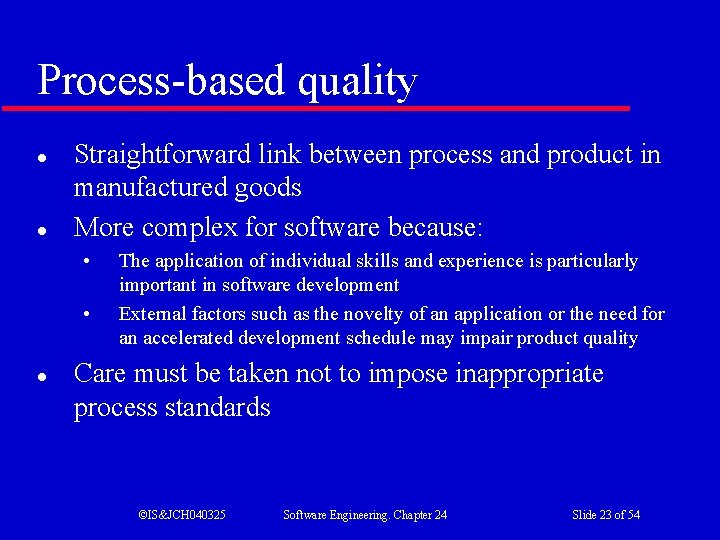
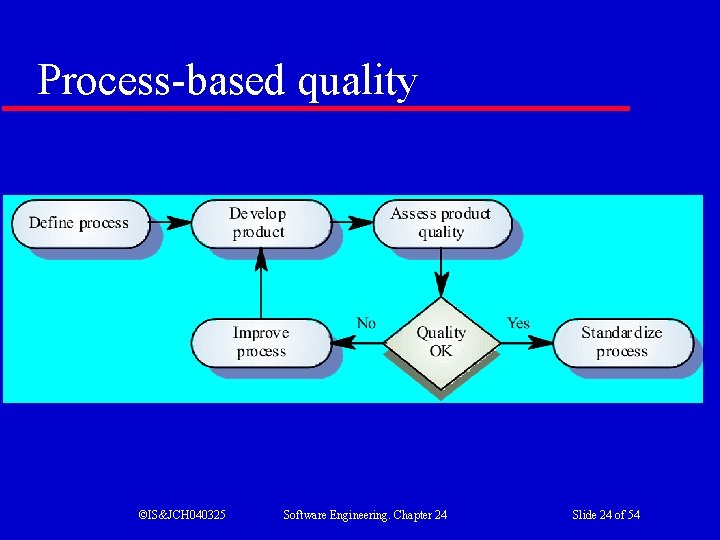
Process-based quality l l Straightforward link between process and product in manufactured goods More complex for software because: • • l The application of individual skills and experience is particularly important in software development External factors such as the novelty of an application or the need for an accelerated development schedule may impair product quality Care must be taken not to impose inappropriate process standards ©IS&JCH 040325 Software Engineering. Chapter 24 Slide 23 of 54
Process-based quality ©IS&JCH 040325 Software Engineering. Chapter 24 Slide 24 of 54
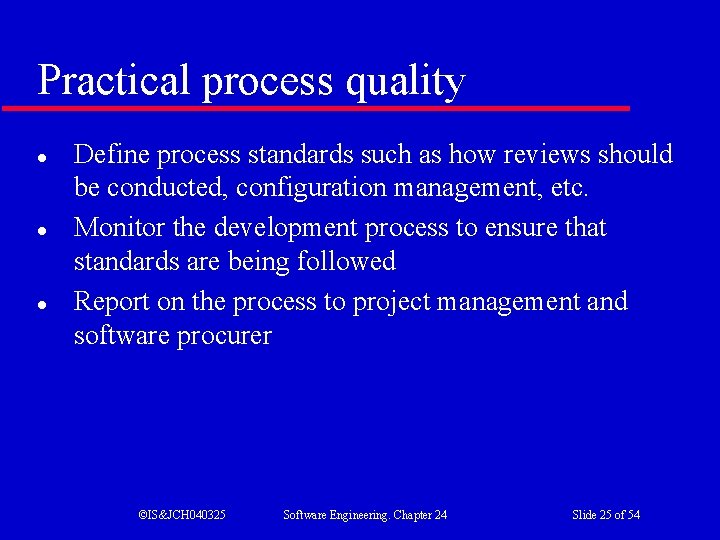
Practical process quality l l l Define process standards such as how reviews should be conducted, configuration management, etc. Monitor the development process to ensure that standards are being followed Report on the process to project management and software procurer ©IS&JCH 040325 Software Engineering. Chapter 24 Slide 25 of 54
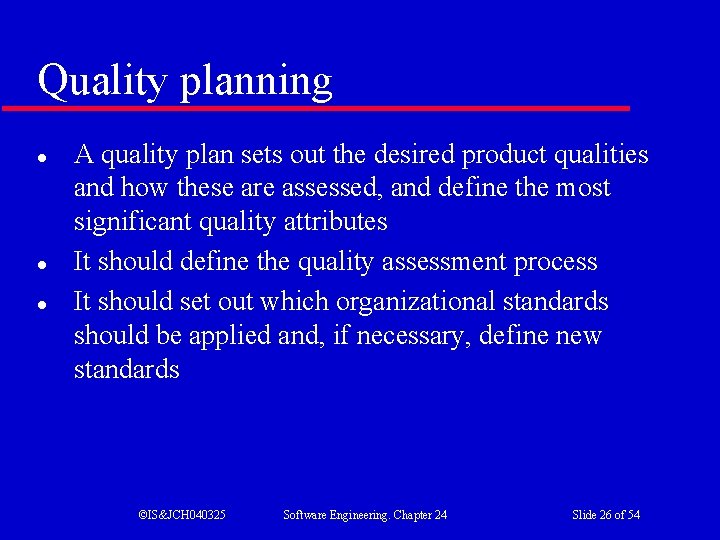
Quality planning l l l A quality plan sets out the desired product qualities and how these are assessed, and define the most significant quality attributes It should define the quality assessment process It should set out which organizational standards should be applied and, if necessary, define new standards ©IS&JCH 040325 Software Engineering. Chapter 24 Slide 26 of 54
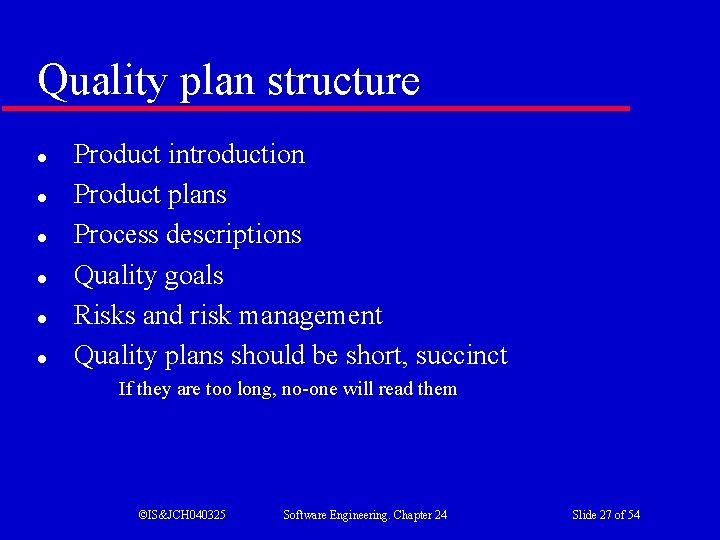
Quality plan structure l l l Product introduction Product plans Process descriptions Quality goals Risks and risk management Quality plans should be short, succinct If they are too long, no-one will read them ©IS&JCH 040325 Software Engineering. Chapter 24 Slide 27 of 54
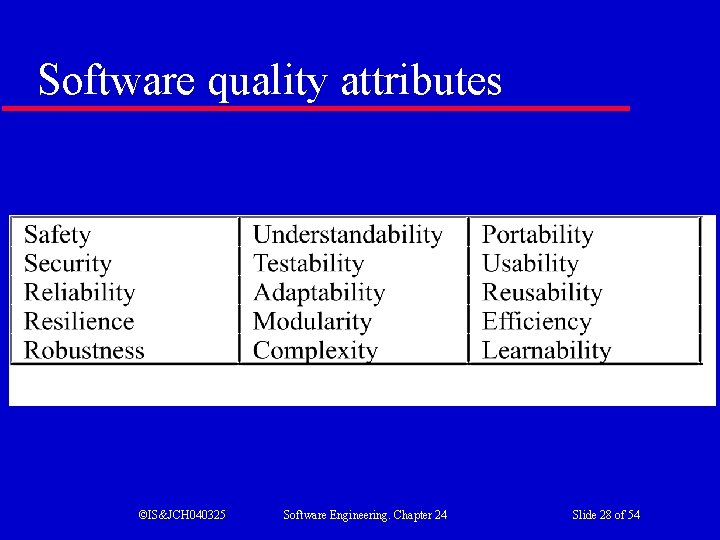
Software quality attributes ©IS&JCH 040325 Software Engineering. Chapter 24 Slide 28 of 54
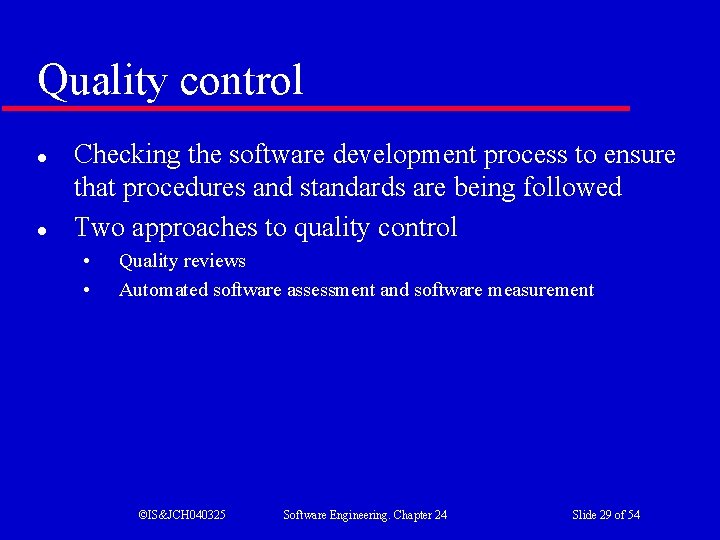
Quality control l l Checking the software development process to ensure that procedures and standards are being followed Two approaches to quality control • • Quality reviews Automated software assessment and software measurement ©IS&JCH 040325 Software Engineering. Chapter 24 Slide 29 of 54
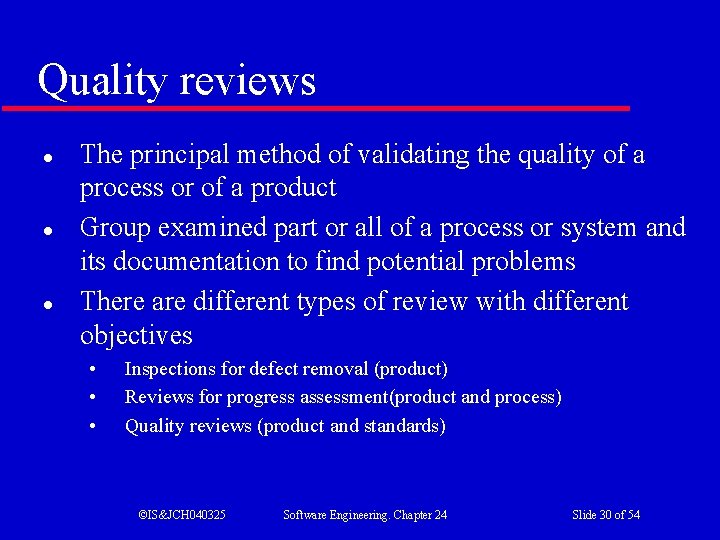
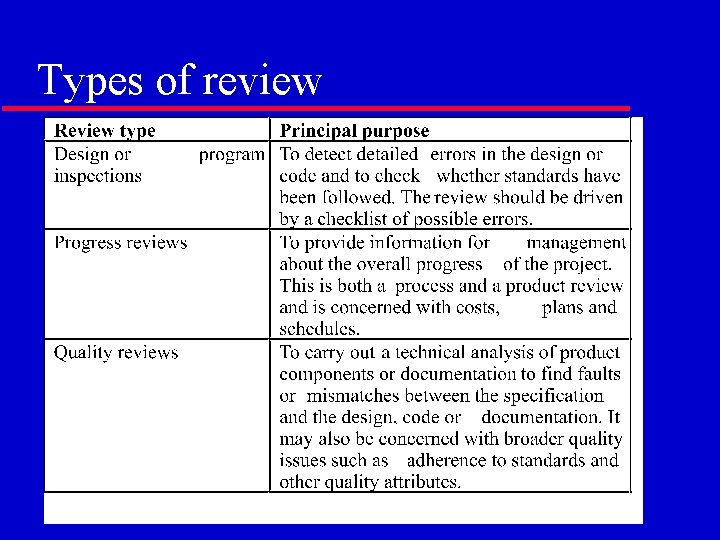
Quality reviews l l l The principal method of validating the quality of a process or of a product Group examined part or all of a process or system and its documentation to find potential problems There are different types of review with different objectives • • • Inspections for defect removal (product) Reviews for progress assessment(product and process) Quality reviews (product and standards) ©IS&JCH 040325 Software Engineering. Chapter 24 Slide 30 of 54
Types of review ©IS&JCH 040325 Software Engineering. Chapter 24 Slide 31 of 54
Quality reviews l l l A group of people carefully examine part or all of a software system and its associated documentation. Code, designs, specifications, test plans, standards, etc. can all be reviewed. Software or documents may be 'signed off' at a review which signifies that progress to the next development stage has been approved by management. ©IS&JCH 040325 Software Engineering. Chapter 24 Slide 32 of 54
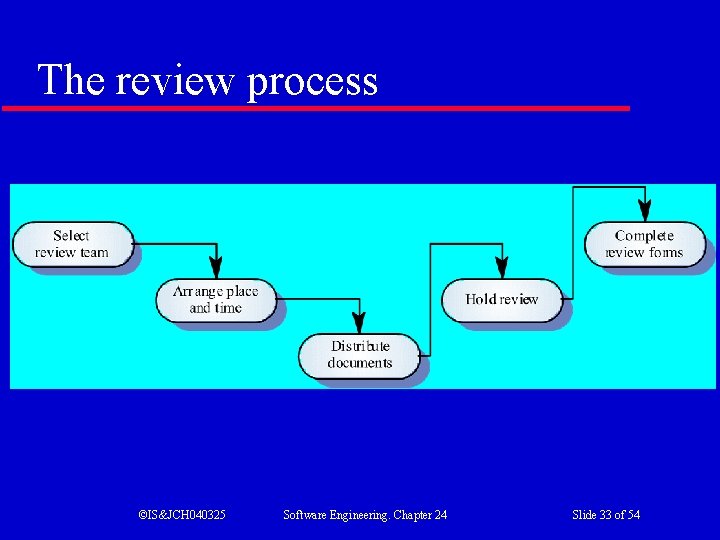
The review process ©IS&JCH 040325 Software Engineering. Chapter 24 Slide 33 of 54
Review functions l l l Quality function - they are part of the general quality management process Project management function - they provide information for project managers Training and communication function - product knowledge is passed between development team members ©IS&JCH 040325 Software Engineering. Chapter 24 Slide 34 of 54
Quality reviews l l Objective is the discovery of system defects and inconsistencies Any documents produced in the process may be reviewed Review teams should be relatively small and reviews should be fairly short Review should be recorded and records maintained ©IS&JCH 040325 Software Engineering. Chapter 24 Slide 35 of 54
Review results l Comments made during the review should be classified. • • • l No action. No change to the software or documentation is required. Refer for repair. Designer or programmer should correct an identified fault. Reconsider overall design. The problem identified in the review impacts other parts of the design. Some overall judgement must be made about the most cost-effective way of solving the problem. Requirements and specification errors may have to be referred to the client. ©IS&JCH 040325 Software Engineering. Chapter 24 Slide 36 of 54
Software measurement and metrics l l Software measurement is concerned with deriving a numeric value for an attribute of a software product or process This allows for objective comparisons between techniques and processes Although some companies have introduced measurement programs, the systematic use of measurement is still uncommon There are few standards in this area ©IS&JCH 040325 Software Engineering. Chapter 24 Slide 37 of 54
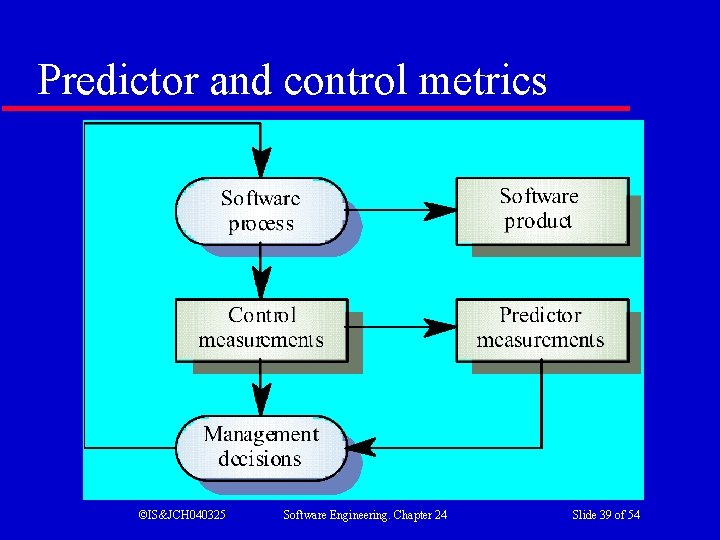
Software metric l Any type of measurement which relates to a software system, process or related documentation Lines of code in a program, the Fog index, number of person-days required to develop a component l l l Allow the software and the software process to be quantified Measures of the software process or product May be used to predict product attributes or to control the software process ©IS&JCH 040325 Software Engineering. Chapter 24 Slide 38 of 54
Predictor and control metrics ©IS&JCH 040325 Software Engineering. Chapter 24 Slide 39 of 54
Metrics assumptions l l A software property can be measured The relationship exists between what we can measure and what we want to know This relationship has been formalized and validated It may be difficult to relate what can be measured to desirable quality attributes ©IS&JCH 040325 Software Engineering. Chapter 24 Slide 40 of 54
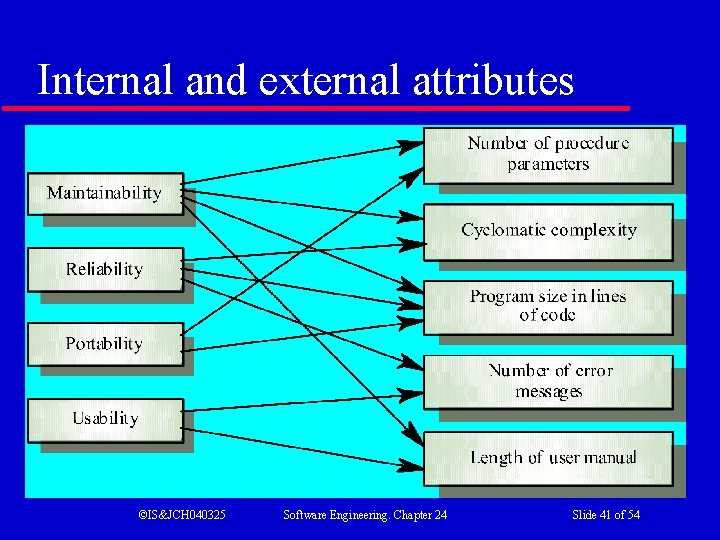
Internal and external attributes ©IS&JCH 040325 Software Engineering. Chapter 24 Slide 41 of 54
The measurement process l l l A software measurement process may be part of a quality control process Data collected during this process should be maintained as an organizational resource Once a measurement database has been established, comparisons across projects become possible ©IS&JCH 040325 Software Engineering. Chapter 24 Slide 42 of 54
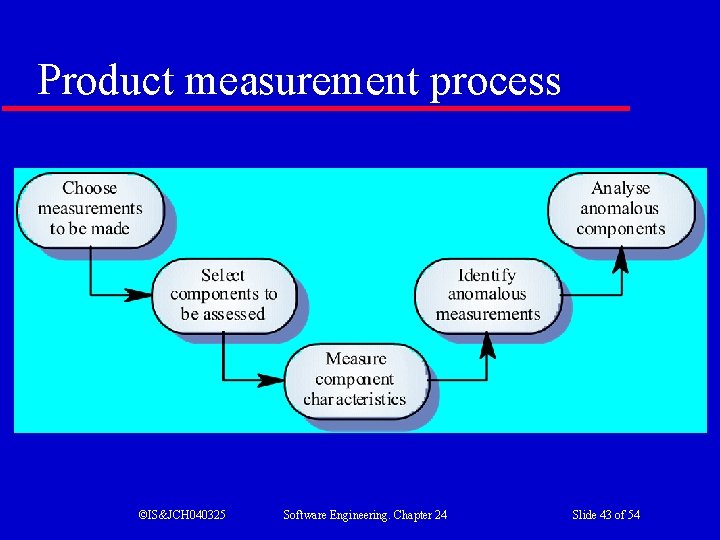
Product measurement process ©IS&JCH 040325 Software Engineering. Chapter 24 Slide 43 of 54
Data collection l l l A metrics programme should be based on a set of product and process data Data should be collected immediately (not in retrospect) and, if possible, automatically Three types of automatic data collection • • • Static product analysis Dynamic product analysis Process data collation ©IS&JCH 040325 Software Engineering. Chapter 24 Slide 44 of 54
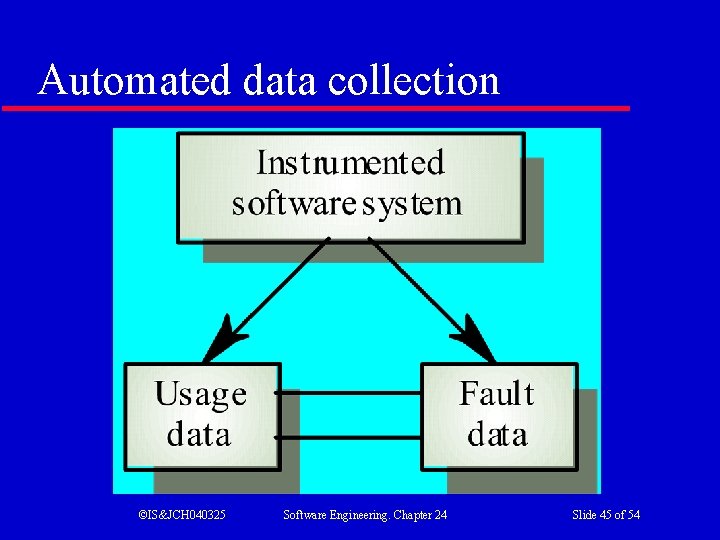
Automated data collection ©IS&JCH 040325 Software Engineering. Chapter 24 Slide 45 of 54
Data accuracy l Don’t collect unnecessary data • l Tell people why the data is being collected • l The questions to be answered should be decided in advance and the required data identified It should not be part of personnel evaluation Don’t rely on memory • Collect data when it is generated not after a project has finished ©IS&JCH 040325 Software Engineering. Chapter 24 Slide 46 of 54
Product metrics l l A quality metric should be a predictor of product quality Classes of product metric • • • Dynamic metrics which are collected by measurements made of a program in execution Static metrics which are collected by measurements made of the system representations Dynamic metrics help assess efficiency and reliability; static metrics help assess complexity, understandability and maintainability ©IS&JCH 040325 Software Engineering. Chapter 24 Slide 47 of 54
Dynamic and static metrics l Dynamic metrics are closely related to software quality attributes • l It is relatively easy to measure the response time of a system (performance attribute) or the number of failures (reliability attribute) Static metrics have an indirect relationship with quality attributes • You need to try and derive a relationship between these metrics and properties such as complexity, understandability and maintainability ©IS&JCH 040325 Software Engineering. Chapter 24 Slide 48 of 54
Software product metrics l l l Fan-in/Fan-out Length of code Cyclomatic complexity Length of identifiers Depth of conditional nesting Fog index: a measure of the average length of words and sentences, the greater the more difficult to understand. ©IS&JCH 040325 Software Engineering. Chapter 24 Slide 49 of 54
Object-oriented metrics l l Depth of inheritance tree: the deeper the more difficult to understand Method fan-in/fan-out Weighted (by complexity) methods per class: indicative of the complexity of the object class Number of overriding operations: a high value indicates that the super-class may not be an appropriate parent ©IS&JCH 040325 Software Engineering. Chapter 24 Slide 50 of 54
Measurement analysis l It is not always obvious what data means Analyzing collected data is very difficult l l Professional statisticians should be consulted if available Data analysis must take local circumstances into account ©IS&JCH 040325 Software Engineering. Chapter 24 Slide 51 of 54
Measurement surprises l Reducing the number of faults in a program leads to an increased number of help desk calls • • The program is now thought of as more reliable and so has a wider and more diverse market. The percentage of users who call the help desk may have decreased but the total may increase A more reliable system is used in a different way from a system where users work around the faults. This leads to more help desk calls. ©IS&JCH 040325 Software Engineering. Chapter 24 Slide 52 of 54
Key points l l Software quality management is concerned with ensuring that software meets its required standards Quality assurance procedures should be documented in an organizational quality manual Software standards are an encapsulation of best practice Reviews are the most widely used approach for assessing software quality ©IS&JCH 040325 Software Engineering. Chapter 24 Slide 53 of 54
Key points (continued) l l l Software measurement gathers information about both the software process and the software product Product quality metrics should be used to identify potentially problematical components There are no standardized and universally applicable software metrics ©IS&JCH 040325 Software Engineering. Chapter 24 Slide 54 of 54