
Chapter 24 Performance Evaluation and Active Portfolio Management

- Slides: 26
Chapter 24 Performance Evaluation and Active Portfolio Management
Introduction • Complicated subject • Theoretically correct measures are difficult to construct • Different statistics or measures are appropriate for different types of investment decisions or portfolios • Many industry and academic measures are different • The nature of active managements leads to measurement problems Mc. Graw-Hill/Irwin © 2004 The Mc. Graw-Hill Companies, Inc. , All Rights Reserved.
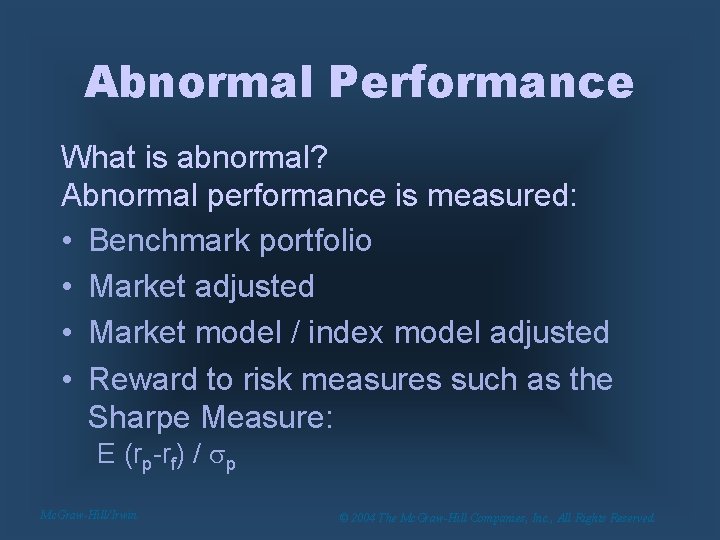
Abnormal Performance What is abnormal? Abnormal performance is measured: • Benchmark portfolio • Market adjusted • Market model / index model adjusted • Reward to risk measures such as the Sharpe Measure: E (rp-rf) / p Mc. Graw-Hill/Irwin © 2004 The Mc. Graw-Hill Companies, Inc. , All Rights Reserved.
Factors That Lead to Abnormal Performance • Market timing • Superior selection • Sectors or industries • Individual companies Mc. Graw-Hill/Irwin © 2004 The Mc. Graw-Hill Companies, Inc. , All Rights Reserved.
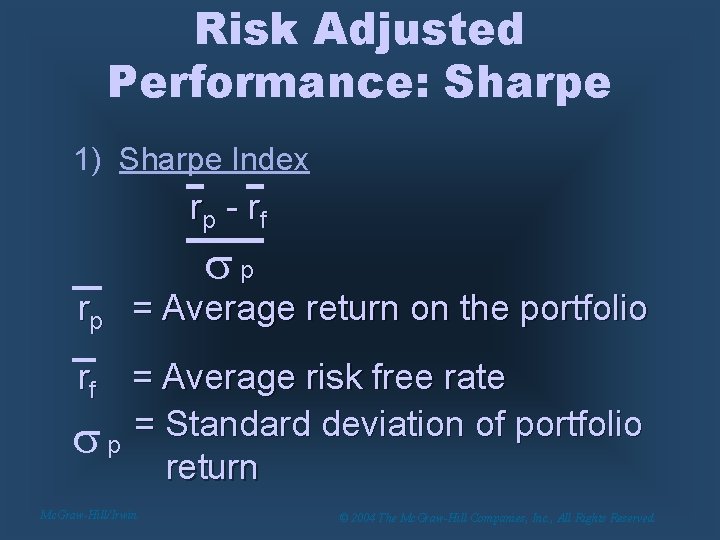
Risk Adjusted Performance: Sharpe 1) Sharpe Index rp - r f p rp = Average return on the portfolio rf = Average risk free rate = Standard deviation of portfolio p return Mc. Graw-Hill/Irwin © 2004 The Mc. Graw-Hill Companies, Inc. , All Rights Reserved.
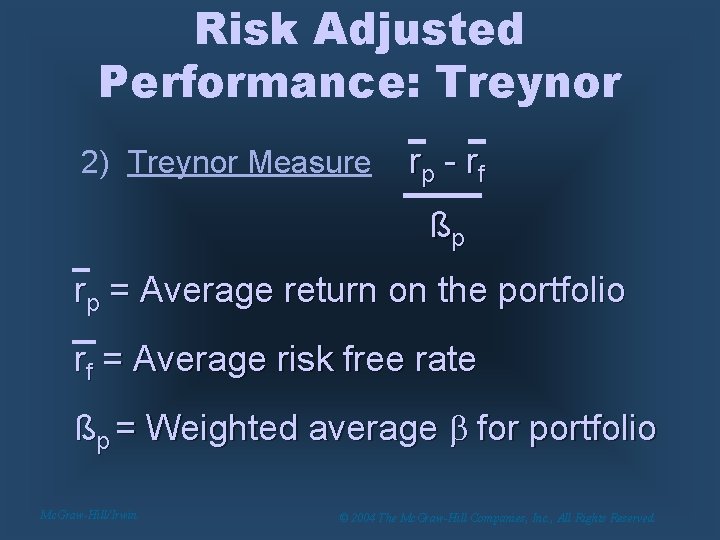
Risk Adjusted Performance: Treynor 2) Treynor Measure rp - r f ßp rp = Average return on the portfolio rf = Average risk free rate ßp = Weighted average b for portfolio Mc. Graw-Hill/Irwin © 2004 The Mc. Graw-Hill Companies, Inc. , All Rights Reserved.
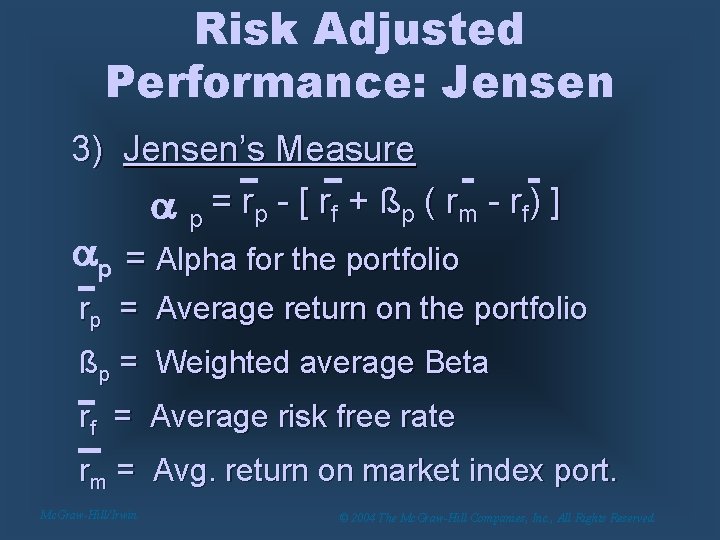
Risk Adjusted Performance: Jensen 3) Jensen’s Measure a p = r p - [ r f + ß p ( r m - r f) ] ap = Alpha for the portfolio rp = Average return on the portfolio ßp = Weighted average Beta rf = Average risk free rate rm = Avg. return on market index port. Mc. Graw-Hill/Irwin © 2004 The Mc. Graw-Hill Companies, Inc. , All Rights Reserved.
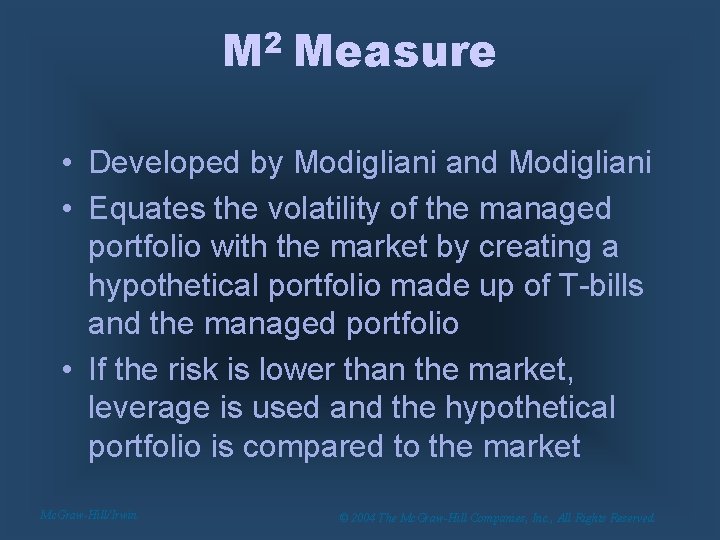
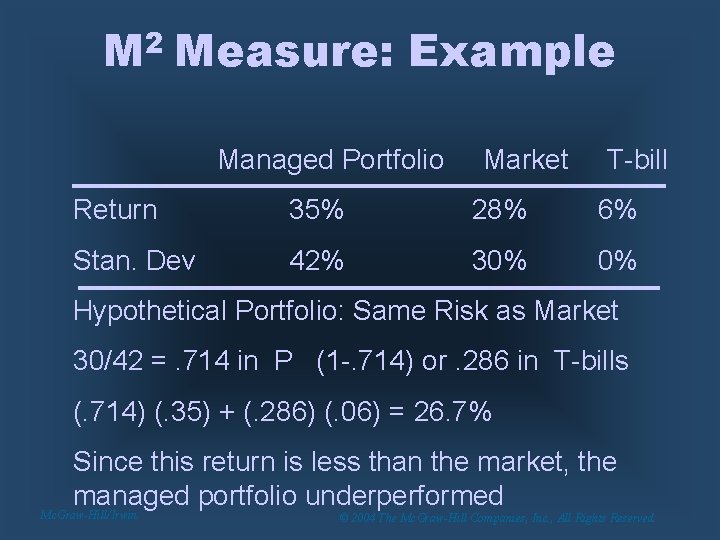
M 2 Measure • Developed by Modigliani and Modigliani • Equates the volatility of the managed portfolio with the market by creating a hypothetical portfolio made up of T-bills and the managed portfolio • If the risk is lower than the market, leverage is used and the hypothetical portfolio is compared to the market Mc. Graw-Hill/Irwin © 2004 The Mc. Graw-Hill Companies, Inc. , All Rights Reserved.
M 2 Measure: Example Managed Portfolio Market T-bill Return 35% 28% 6% Stan. Dev 42% 30% 0% Hypothetical Portfolio: Same Risk as Market 30/42 =. 714 in P (1 -. 714) or. 286 in T-bills (. 714) (. 35) + (. 286) (. 06) = 26. 7% Since this return is less than the market, the managed portfolio underperformed Mc. Graw-Hill/Irwin © 2004 The Mc. Graw-Hill Companies, Inc. , All Rights Reserved.
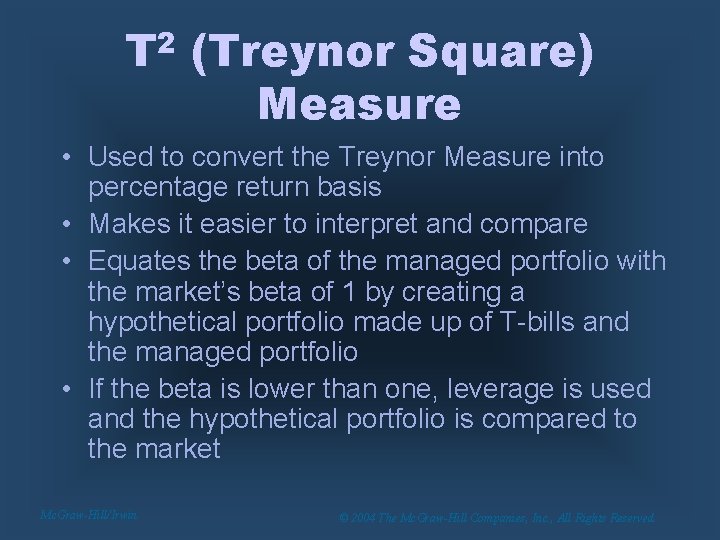
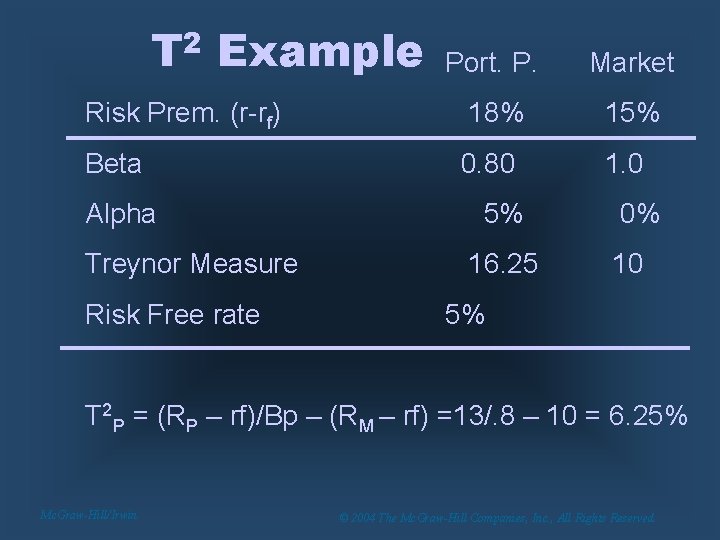
T 2 (Treynor Square) Measure • Used to convert the Treynor Measure into percentage return basis • Makes it easier to interpret and compare • Equates the beta of the managed portfolio with the market’s beta of 1 by creating a hypothetical portfolio made up of T-bills and the managed portfolio • If the beta is lower than one, leverage is used and the hypothetical portfolio is compared to the market Mc. Graw-Hill/Irwin © 2004 The Mc. Graw-Hill Companies, Inc. , All Rights Reserved.
T 2 Example Port. P. Market Risk Prem. (r-rf) 18% 15% Beta 0. 80 1. 0 Alpha Treynor Measure Risk Free rate 5% 16. 25 0% 10 5% T 2 P = (RP – rf)/Bp – (RM – rf) =13/. 8 – 10 = 6. 25% Mc. Graw-Hill/Irwin © 2004 The Mc. Graw-Hill Companies, Inc. , All Rights Reserved.
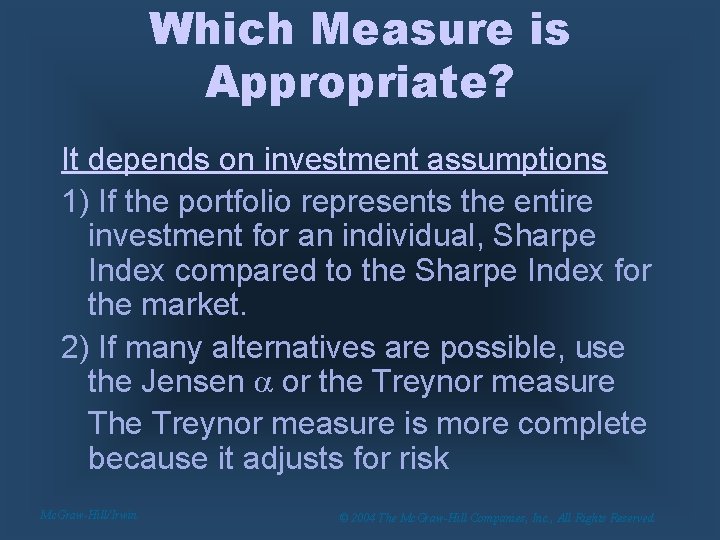
Which Measure is Appropriate? It depends on investment assumptions 1) If the portfolio represents the entire investment for an individual, Sharpe Index compared to the Sharpe Index for the market. 2) If many alternatives are possible, use the Jensen or the Treynor measure The Treynor measure is more complete because it adjusts for risk Mc. Graw-Hill/Irwin © 2004 The Mc. Graw-Hill Companies, Inc. , All Rights Reserved.
Limitations • Assumptions underlying measures limit their usefulness • When the portfolio is being actively managed, basic stability requirements are not met • Practitioners often use benchmark portfolio comparisons to measure performance Mc. Graw-Hill/Irwin © 2004 The Mc. Graw-Hill Companies, Inc. , All Rights Reserved.
Performance Attribution • Decomposing overall performance into components • Components are related to specific elements of performance • Example components • • Broad Allocation Industry Security Choice Up and Down Markets Mc. Graw-Hill/Irwin © 2004 The Mc. Graw-Hill Companies, Inc. , All Rights Reserved.
Process of Attributing Performance to Components Set up a ‘Benchmark’ or ‘Bogey’ portfolio • Use indexes for each component • Use target weight structure Mc. Graw-Hill/Irwin © 2004 The Mc. Graw-Hill Companies, Inc. , All Rights Reserved.
Appropriate Benchmark • • Unambiguous – anyone can reproduce it Investable Measurable Specified in Advance Mc. Graw-Hill/Irwin © 2004 The Mc. Graw-Hill Companies, Inc. , All Rights Reserved.
Process of Attributing Performance to Components • Calculate the return on the ‘Bogey’ and on the managed portfolio • Explain the difference in return based on component weights or selection • Summarize the performance differences into appropriate categories Mc. Graw-Hill/Irwin © 2004 The Mc. Graw-Hill Companies, Inc. , All Rights Reserved.
See Example Mc. Graw-Hill/Irwin © 2004 The Mc. Graw-Hill Companies, Inc. , All Rights Reserved.
Lure of Active Management Are markets totally efficient? • Some managers outperform the market for extended periods • While the abnormal performance may not be too large, it is too large to be attributed solely to noise • Evidence of anomalies such as the turn of the year exist The evidence suggests that there is some role for active management Mc. Graw-Hill/Irwin © 2004 The Mc. Graw-Hill Companies, Inc. , All Rights Reserved.
Market Timing • Adjust the portfolio for movements in the market • Shift between stocks and money market instruments or bonds • Results: higher returns, lower risk (downside is eliminated) • With perfect ability to forecast behaves like an option Mc. Graw-Hill/Irwin © 2004 The Mc. Graw-Hill Companies, Inc. , All Rights Reserved.
Style Analysis • Introduced by Bill Sharpe • Explaining percentage returns by allocation to style • Style Analysis has become popular with the industry Mc. Graw-Hill/Irwin © 2004 The Mc. Graw-Hill Companies, Inc. , All Rights Reserved.
Morning Star’s Risk Adjusted Rating • Similar to mean Standard Deviation rankings • Companies are put into peer groups • Stars are assigned • 1 -lowest • 5 -highest • Highly correlated to Sharpe measures Mc. Graw-Hill/Irwin © 2004 The Mc. Graw-Hill Companies, Inc. , All Rights Reserved.
Superior Selection Ability • Concentrate funds in undervalued stocks or undervalued sectors or industries • Balance funds in an active portfolio and in a passive portfolio • Active selection will mean some unsystematic risk Mc. Graw-Hill/Irwin © 2004 The Mc. Graw-Hill Companies, Inc. , All Rights Reserved.
Treynor-Black Model • Model used to combine actively managed stocks with a passively managed portfolio • Using a reward-to-risk measure that is similar to the Sharpe Measure, the optimal combination of active and passive portfolios can be determined Mc. Graw-Hill/Irwin © 2004 The Mc. Graw-Hill Companies, Inc. , All Rights Reserved.
Treynor-Black Model: Assumptions • Analysts will have a limited ability to find a select number of undervalued securities • Portfolio managers can estimate the expected return and risk, and the abnormal performance for the actively-managed portfolio • Portfolio managers can estimate the expected risk and return parameters for a broad market (passively managed) portfolio Mc. Graw-Hill/Irwin © 2004 The Mc. Graw-Hill Companies, Inc. , All Rights Reserved.
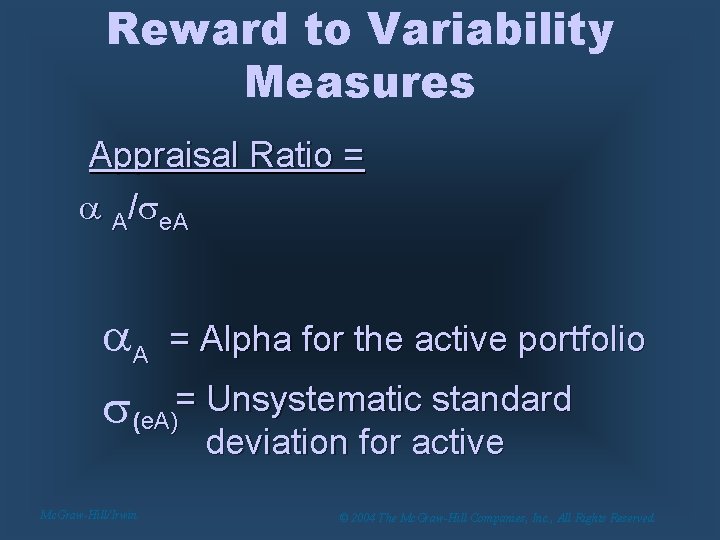
Reward to Variability Measures Appraisal Ratio = A/ e. A A = Alpha for the active portfolio (e. A)= Unsystematic standard deviation for active Mc. Graw-Hill/Irwin © 2004 The Mc. Graw-Hill Companies, Inc. , All Rights Reserved.