
CHAPTER 24 HYPOTHESES TESTS FOR TWOSAMPLE MEANS Objective
CHAPTER 24: HYPOTHESES TESTS FOR TWO-SAMPLE MEANS Objective: To test claims about inferences for two sample means, under specific conditions
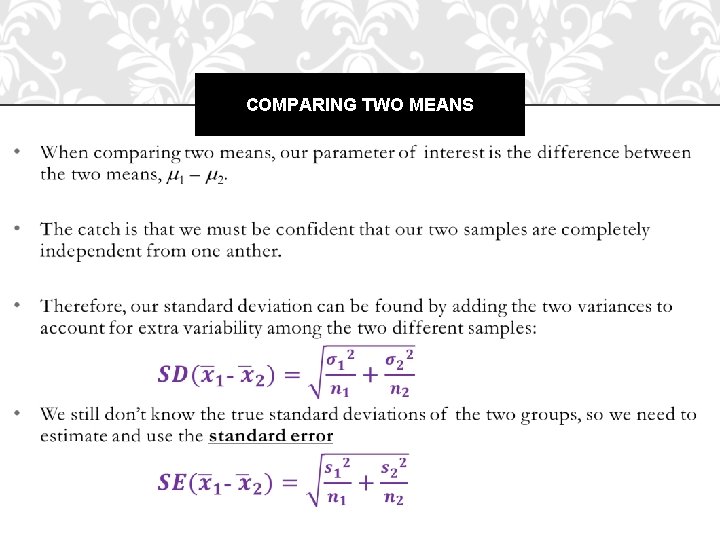
COMPARING TWO MEANS
COMPARING TWO MEANS (CONT. ) • Because we are working with means and estimating the standard error of their difference using the data, we shouldn’t be surprised that the sampling model is a Student’s t. • The confidence interval we build is called a two-sample tinterval (for the difference in means). • The corresponding hypothesis test is called a two-sample t-test
TWO-SAMPLE T-INTERVAL AND TTEST CONDITIONS • Independence Assumption (Each condition needs to be checked for both groups. ): • Randomization Condition: Were the data collected with Condition suitable randomization (representative random samples or a randomized experiment)? • 10% Condition: We don’t usually check this condition for Condition differences of means. We will check it for means only if we have a very small population or an extremely large sample.
TWO-SAMPLE T-INTERVAL AND TTEST CONDITIONS (CONT. ) • Normal Population Assumption: • Nearly Normal Condition: This must be checked for both groups. A violation by either one violates the condition. • Independent Groups Assumption: The two groups we are comparing must be independent of each other. (See 8. 3 if the groups are not independent of one another…)

TWO-SAMPLE T-INTERVAL
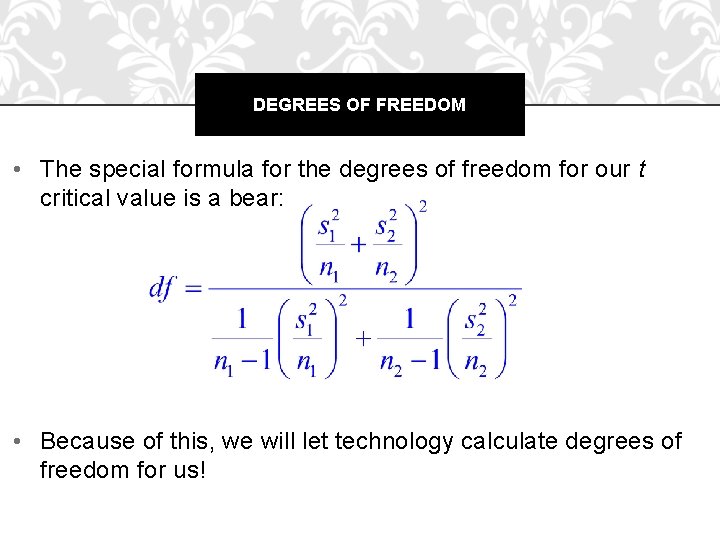
DEGREES OF FREEDOM • The special formula for the degrees of freedom for our t critical value is a bear: • Because of this, we will let technology calculate degrees of freedom for us!
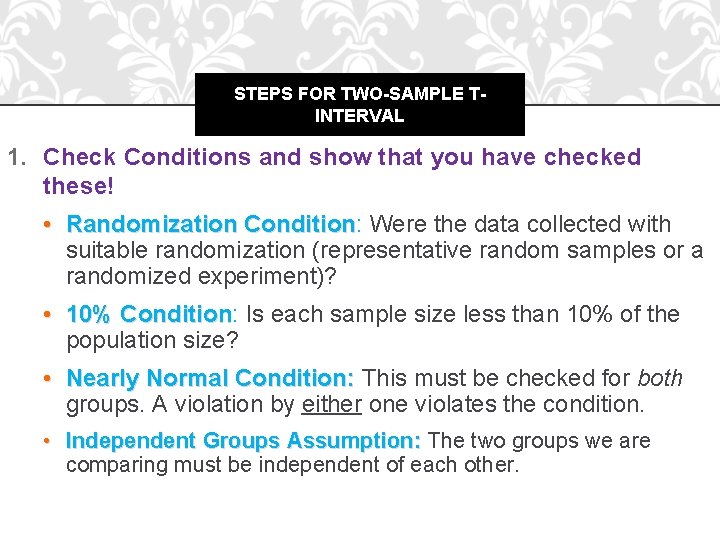
STEPS FOR TWO-SAMPLE TINTERVAL 1. Check Conditions and show that you have checked these! • Randomization Condition: Were the data collected with Condition suitable randomization (representative random samples or a randomized experiment)? • 10% Condition: Is each sample size less than 10% of the Condition population size? • Nearly Normal Condition: This must be checked for both groups. A violation by either one violates the condition. • Independent Groups Assumption: The two groups we are comparing must be independent of each other.
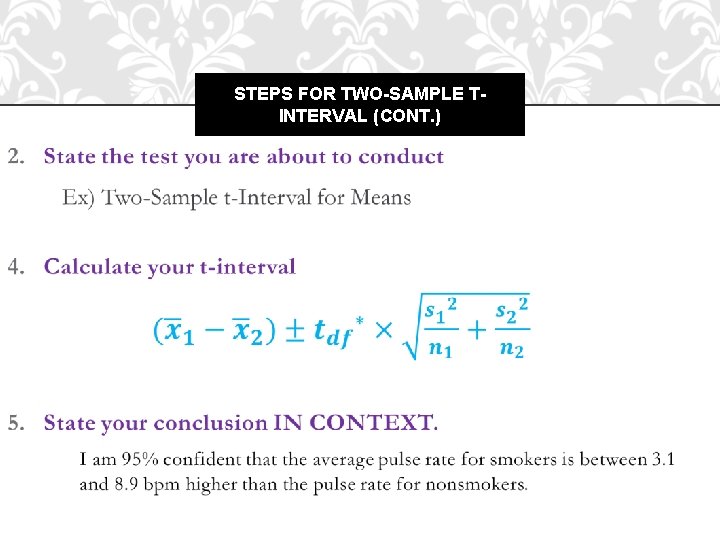
STEPS FOR TWO-SAMPLE TINTERVAL (CONT. )
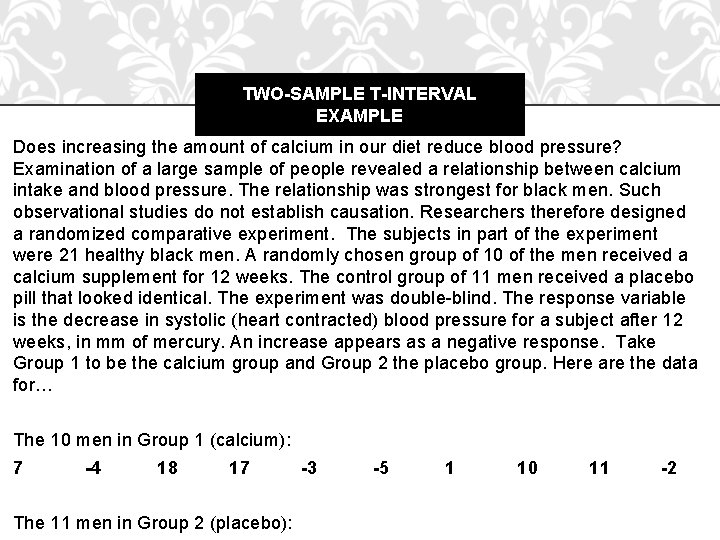
TWO-SAMPLE T-INTERVAL EXAMPLE Does increasing the amount of calcium in our diet reduce blood pressure? Examination of a large sample of people revealed a relationship between calcium intake and blood pressure. The relationship was strongest for black men. Such observational studies do not establish causation. Researchers therefore designed a randomized comparative experiment. The subjects in part of the experiment were 21 healthy black men. A randomly chosen group of 10 of the men received a calcium supplement for 12 weeks. The control group of 11 men received a placebo pill that looked identical. The experiment was double-blind. The response variable is the decrease in systolic (heart contracted) blood pressure for a subject after 12 weeks, in mm of mercury. An increase appears as a negative response. Take Group 1 to be the calcium group and Group 2 the placebo group. Here are the data for… The 10 men in Group 1 (calcium): 7 -4 18 17 The 11 men in Group 2 (placebo): -3 -5 1 10 11 -2
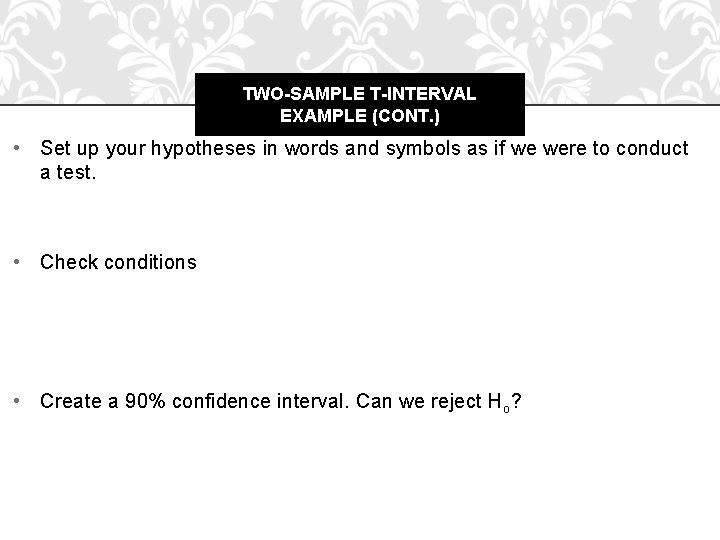
TWO-SAMPLE T-INTERVAL EXAMPLE (CONT. ) • Set up your hypotheses in words and symbols as if we were to conduct a test. • Check conditions • Create a 90% confidence interval. Can we reject Ho?
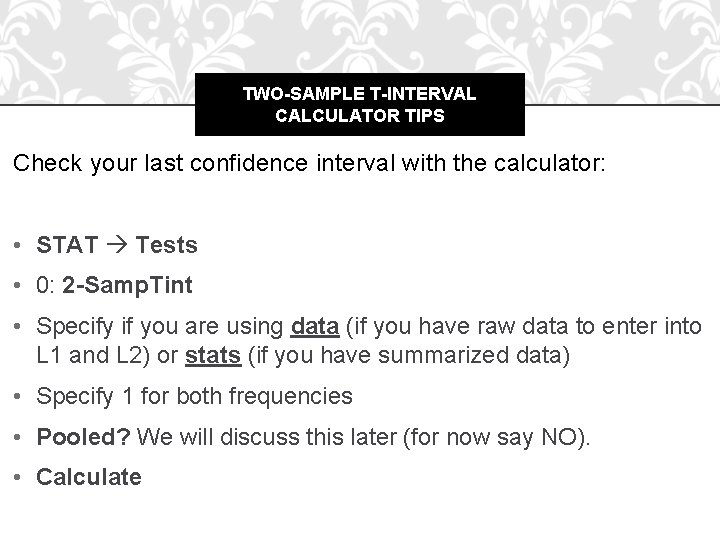
TWO-SAMPLE T-INTERVAL CALCULATOR TIPS Check your last confidence interval with the calculator: • STAT Tests • 0: 2 -Samp. Tint • Specify if you are using data (if you have raw data to enter into L 1 and L 2) or stats (if you have summarized data) • Specify 1 for both frequencies • Pooled? We will discuss this later (for now say NO). • Calculate
TWO-SAMPLE T-TESTS • The hypothesis test we use is the two-sample t-test for means • The conditions for the two-sample t-test for the difference between the means of two independent groups are the same as for the two-sample t-interval.
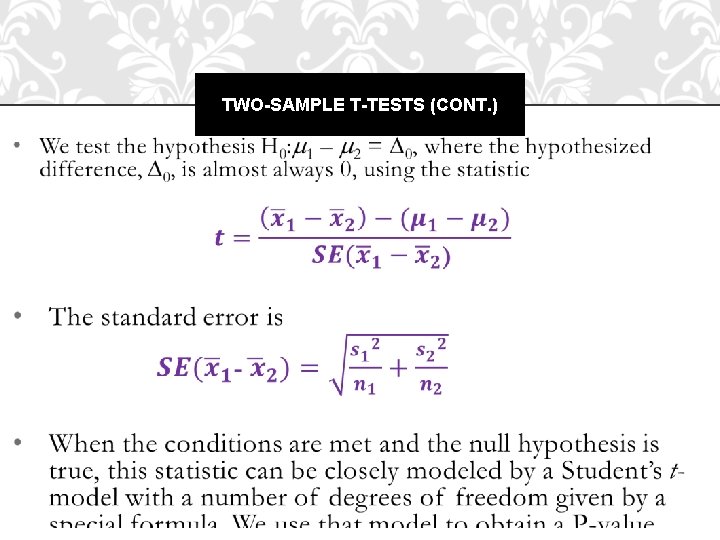
TWO-SAMPLE T-TESTS (CONT. )
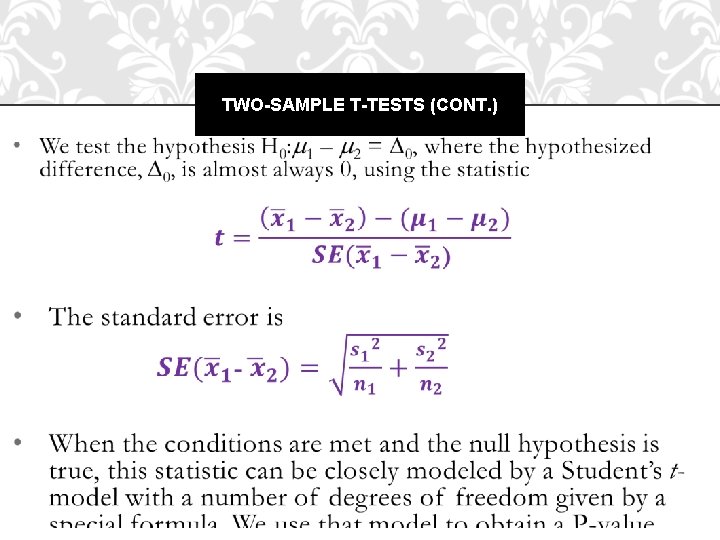
TWO-SAMPLE T-TESTS (CONT. )
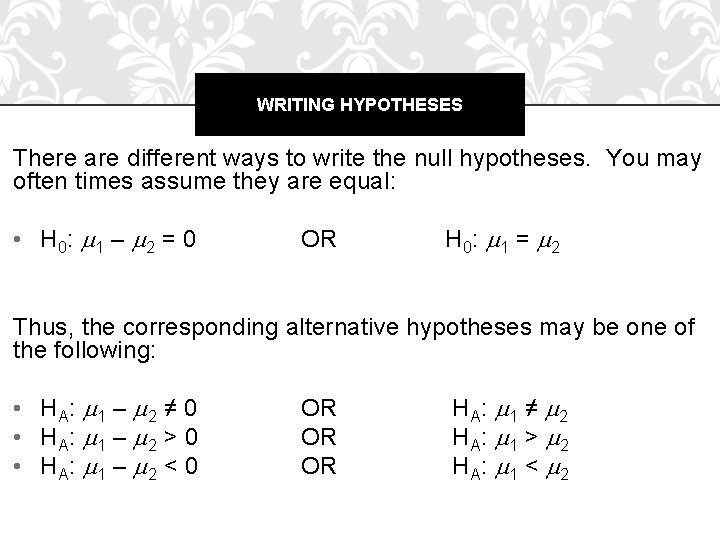
WRITING HYPOTHESES There are different ways to write the null hypotheses. You may often times assume they are equal: • H 0: 1 – 2 = 0 OR H 0: 1 = 2 Thus, the corresponding alternative hypotheses may be one of the following: • HA: 1 – 2 ≠ 0 • HA: 1 – 2 > 0 • HA: 1 – 2 < 0 OR OR OR HA: 1 ≠ 2 HA: 1 > 2 HA: 1 < 2
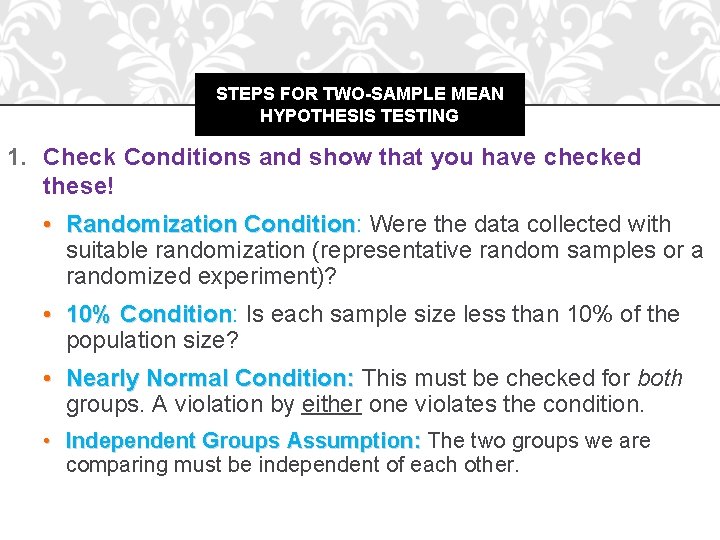
STEPS FOR TWO-SAMPLE MEAN HYPOTHESIS TESTING 1. Check Conditions and show that you have checked these! • Randomization Condition: Were the data collected with Condition suitable randomization (representative random samples or a randomized experiment)? • 10% Condition: Is each sample size less than 10% of the Condition population size? • Nearly Normal Condition: This must be checked for both groups. A violation by either one violates the condition. • Independent Groups Assumption: The two groups we are comparing must be independent of each other.
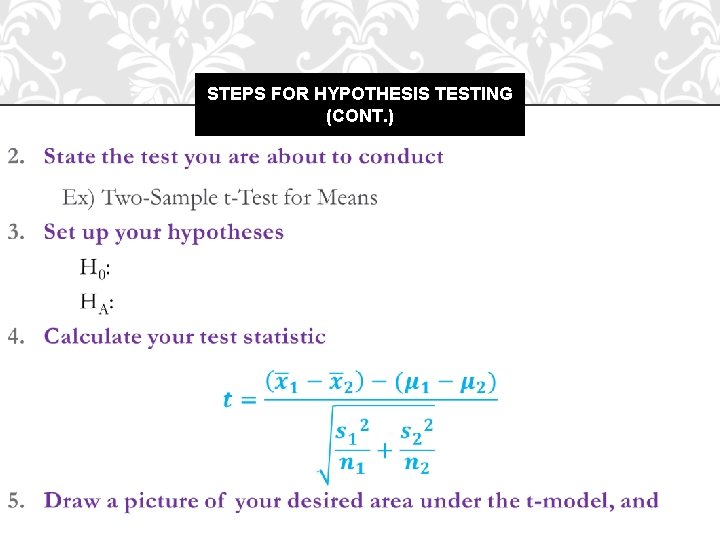
STEPS FOR HYPOTHESIS TESTING (CONT. )
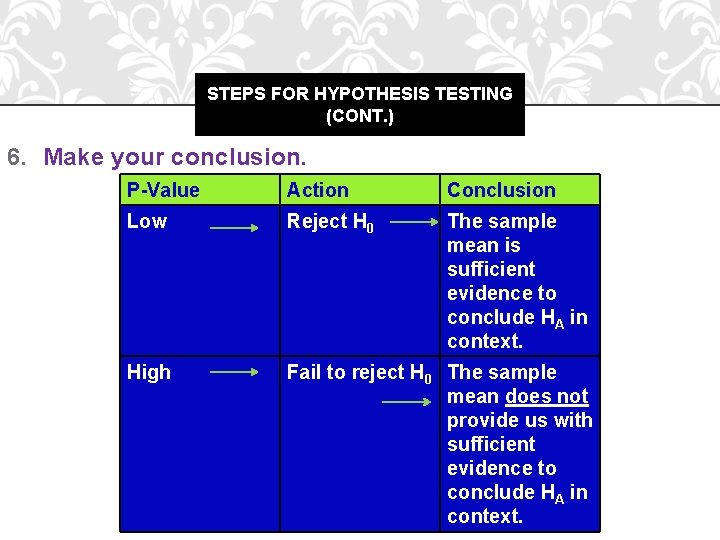
STEPS FOR HYPOTHESIS TESTING (CONT. ) 6. Make your conclusion. P-Value Action Conclusion Low Reject H 0 The sample mean is sufficient evidence to conclude HA in context. High Fail to reject H 0 The sample mean does not provide us with sufficient evidence to conclude HA in context.
TWO-SAMPLE MEAN HYPOTHESIS TEST EXAMPLE Using the previous data to compare the calcium supplement and the placebo, calculate the test statistic and P-value to determine if there is enough evidence that calcium reduces blood pressure.
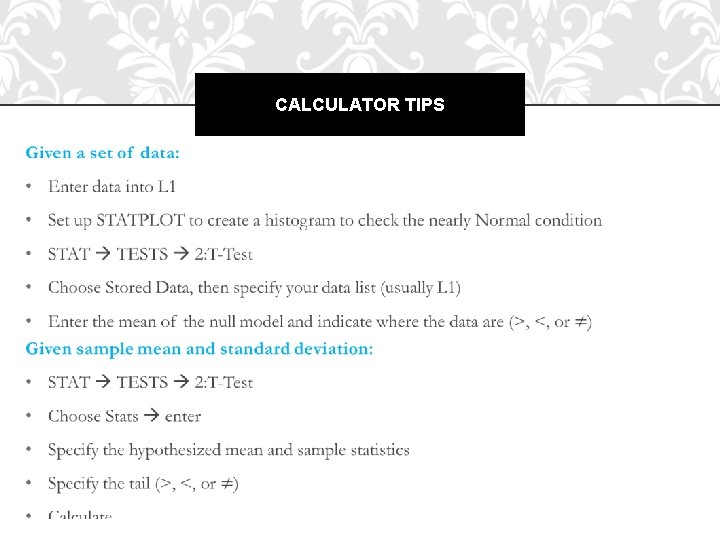
CALCULATOR TIPS
ASSIGNMENTS: PP. 579 – 586 • Day 1: # 2 – 6 EVEN, 7, 9 • Day 2: # 10, 11, 19, 25 • Day 3: # 12, 13, 36
- Slides: 22