
Chapter 24 Design Step 4 The Design Details



- Slides: 13
• Chapter 24 Design Step #4: The Design Details 4 th Edition
What You Will Learn • Use math when you can to pin down operation of your concept • Experimentally model other unknowns • How to prepare detailed drawings of wht you have accomplished. Exploring Engineering
Detailed Design • Analysis of design • Mathematical models as needed • Models of parts of concepts as needed • Detailed drawings Exploring Engineering
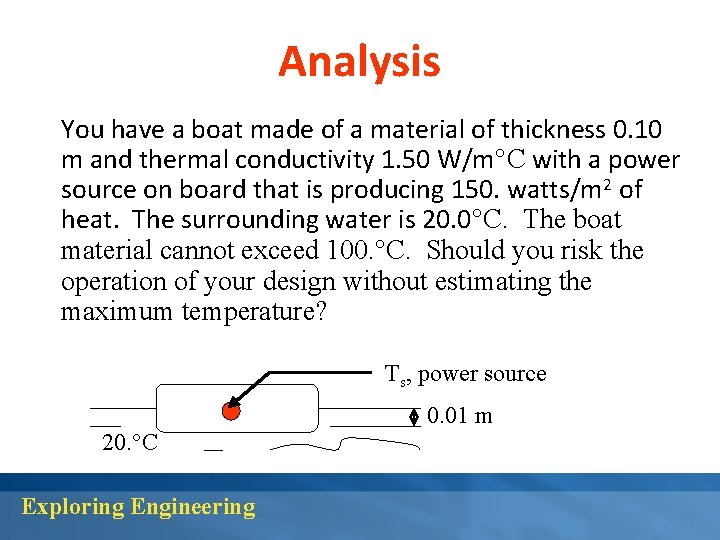
Analysis You have a boat made of a material of thickness 0. 10 m and thermal conductivity 1. 50 W/m°C with a power source on board that is producing 150. watts/m 2 of heat. The surrounding water is 20. 0°C. The boat material cannot exceed 100. °C. Should you risk the operation of your design without estimating the maximum temperature? Ts, power source 0. 01 m 20. °C Exploring Engineering
Analysis • Fourier’s Law of Heat Conduction: • Even if the model is crude in this case the leeway is sufficient to say the material will be OK. Exploring Engineering
Experiments That Remove Uncertainty Often make a crude model of what you want to design and use it to get the bugs out. “Dueling Duffers” device to deposit balls onto a board against an opposing team Exploring Engineering Model used in the experiment to determine how to deliver balls
What Model Experiments Will Help? Sources of Risk and Uncertainty 1. Will all 10 balls fit in the top half of the 2 -liter bottle? What is the optimal height from which to dump the balls? 3. Will all 10 balls drop into the hole when dumped in this manner? 4. Is it important to have the vehicle perfectly positioned before dumping the balls? 5. Will the machine travel slowly enough that its position can be easily controlled? Exploring Engineering
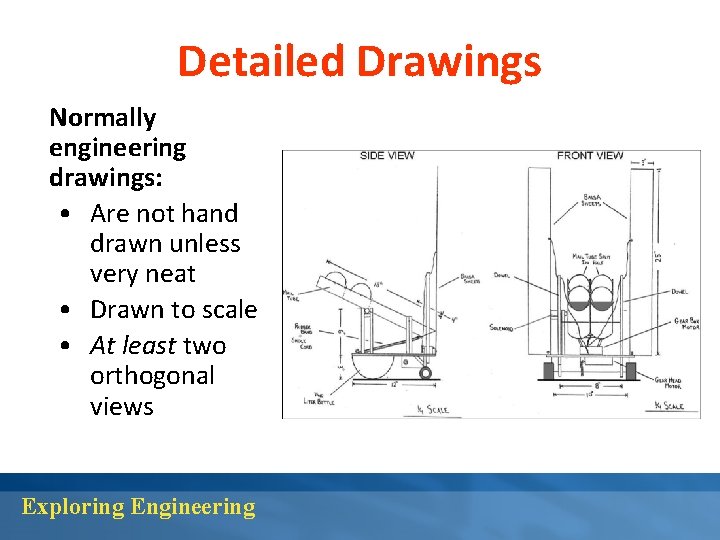
Detailed Drawings Normally engineering drawings: • Are not hand drawn unless very neat • Drawn to scale • At least two orthogonal views Exploring Engineering
Detailed Drawings Concluded • Show hidden lines as dashes when they enhance clarity. • Show only essential dimensions that either have a direct impact on performance or needed to demonstrate geometry constraints are satisfied. • Use notes or labels to indicate material specification, part type, and assembly directions. • It is acceptable if the manufacturing details are incomplete. Students who lack the experience to fully specify them have to discover those details by trial and error during building. • If an electric circuit was designed, show it in the form of a neatly hand-drawn but fully specified circuit diagram. Exploring Engineering
Design Milestone: Detailed Design Assignment • 1. Use analysis, experiments, and models to help establish dimensions and proof of concept. • 2. Prepare detailed drawings of the design concept you selected. Documentation • Write the analysis details in the usual format, stating all assumptions. For each experiment (a) state the purpose of the experiment, (b) describe the experimental procedure, (c) present results, and (d) state conclusions. • Summarize useful information yielded by models and turn in models. Exploring Engineering
Design Milestone: Detailed Design Grading Criteria • From examination of the detailed drawings, does the design have a chance of working? • Have opportunities to reduce the level of risk (through analysis, experiments, and models) been fully exploited? • Is there enough information in the detailed drawings to manufacture the design? • What is the overall quality of the detailed drawings? Exploring Engineering
Design Composition Tips • Time spent upfront on analysis, experiments, models and detailed drawings pays off later in fewer design iterations during manufacturing and testing. • Of the four methods for reducing risk, good detailed drawings reap the most rewards in a freshman design project. Exploring Engineering
Summary • Analyze with numerical answers where possible • Experiment with models to reduce design risk • Computer or carefully hand draw detailed design (Remember someone has to read this to build it!) • Document what you have done