
Chapter 23 The Respiratory System Lecture Presentation by
Chapter 23 The Respiratory System Lecture Presentation by Lee Ann Frederick University of Texas at Arlington © 2015 Pearson Education, Inc.
An Introduction to the Respiratory System • The Respiratory System • Cells produce energy • For maintenance, growth, defense, and division • Through mechanisms that use oxygen and produce carbon dioxide © 2015 Pearson Education, Inc.
An Introduction to the Respiratory System • Oxygen • Is obtained from the air by diffusion across delicate exchange surfaces of lungs • Is carried to cells by the cardiovascular system, which also returns carbon dioxide to the lungs © 2015 Pearson Education, Inc.
23 -1 Components of the Respiratory System • Five Functions of the Respiratory System 1. Provides extensive gas exchange surface area between air and circulating blood 2. Moves air to and from exchange surfaces of lungs 3. Protects respiratory surfaces from outside environment 4. Produces sounds 5. Participates in olfactory sense © 2015 Pearson Education, Inc.
23 -1 Components of the Respiratory System • Organization of the Respiratory System • The respiratory system is divided into: • Upper respiratory system – above the larynx • Lower respiratory system – below the larynx © 2015 Pearson Education, Inc.
23 -1 Components of the Respiratory System • The Respiratory Tract • Consists of a conducting portion • From nasal cavity to terminal bronchioles • Consists of a respiratory portion • The respiratory bronchioles and alveoli • Alveoli • Are air-filled pockets within the lungs • Where all gas exchange takes place © 2015 Pearson Education, Inc.
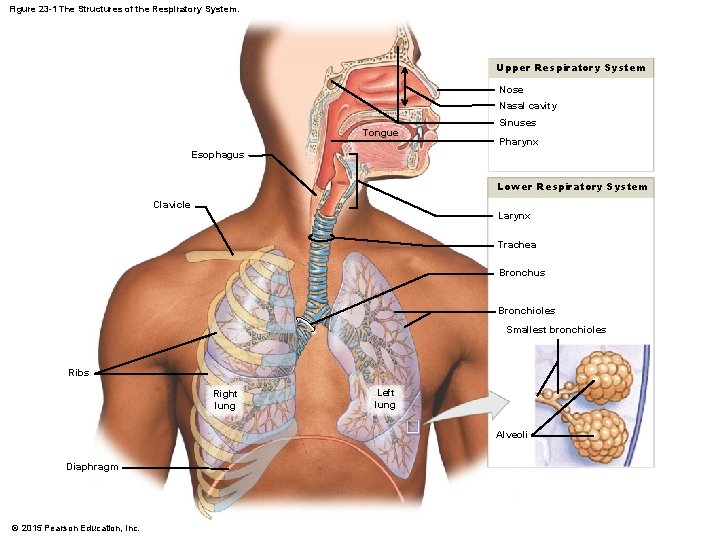
Figure 23 -1 The Structures of the Respiratory System. Upper Respiratory System Nose Nasal cavity Tongue Sinuses Pharynx Esophagus Lower Respiratory System Clavicle Larynx Trachea Bronchus Bronchioles Smallest bronchioles Ribs Right lung Left lung Alveoli Diaphragm © 2015 Pearson Education, Inc.
23 -1 Components of the Respiratory System • The Respiratory Epithelium • For gases to exchange efficiently: • Alveoli walls must be very thin (<1 µm) • Surface area must be very great (about 35 times the surface area of the body) © 2015 Pearson Education, Inc.
23 -1 Components of the Respiratory System • The Respiratory Mucosa • Consists of: • An epithelial layer • An areolar layer called the lamina propria • Lines the conducting portion of respiratory system © 2015 Pearson Education, Inc.
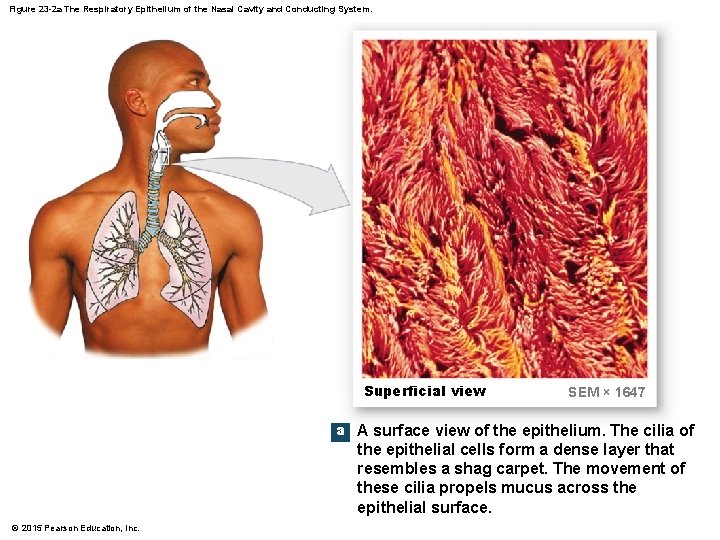
Figure 23 -2 a The Respiratory Epithelium of the Nasal Cavity and Conducting System. Superficial view SEM × 1647 a A surface view of the epithelium. The cilia of the epithelial cells form a dense layer that resembles a shag carpet. The movement of these cilia propels mucus across the epithelial surface. © 2015 Pearson Education, Inc.
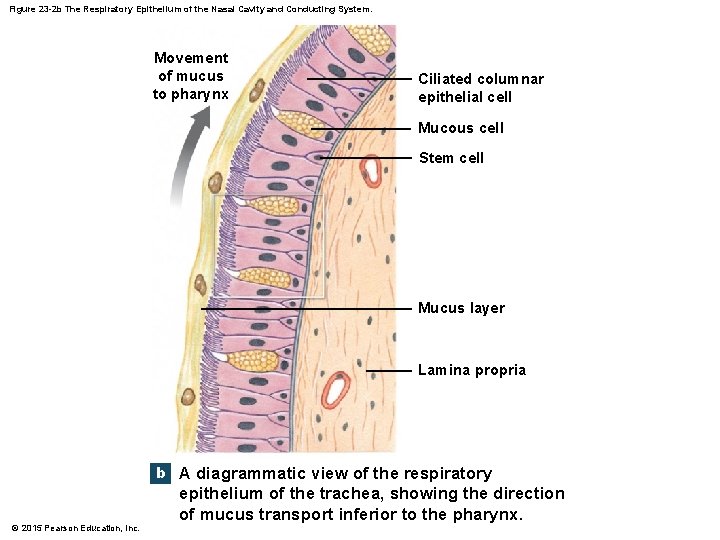
Figure 23 -2 b The Respiratory Epithelium of the Nasal Cavity and Conducting System. Movement of mucus to pharynx Ciliated columnar epithelial cell Mucous cell Stem cell Mucus layer Lamina propria b A diagrammatic view of the respiratory © 2015 Pearson Education, Inc. epithelium of the trachea, showing the direction of mucus transport inferior to the pharynx.
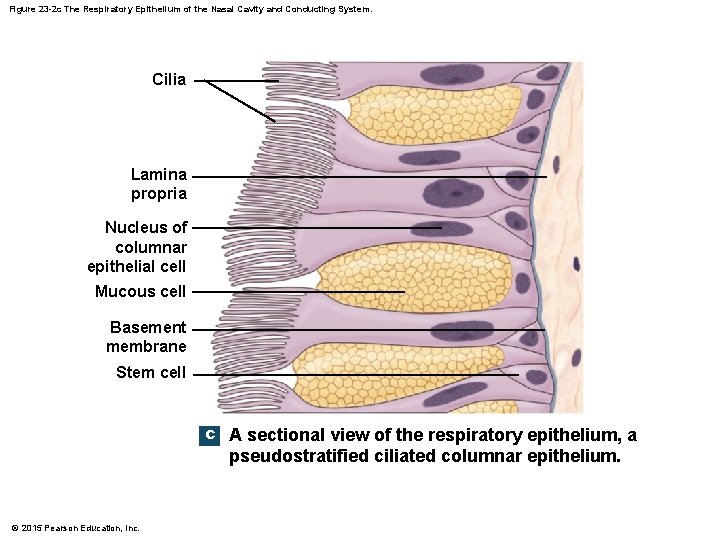
Figure 23 -2 c The Respiratory Epithelium of the Nasal Cavity and Conducting System. Cilia Lamina propria Nucleus of columnar epithelial cell Mucous cell Basement membrane Stem cell c A sectional view of the respiratory epithelium, a pseudostratified ciliated columnar epithelium. © 2015 Pearson Education, Inc.
23 -1 Components of the Respiratory System • Structure of Respiratory Epithelium • Pseudostratified ciliated columnar epithelium with numerous mucous cells • Nasal cavity and superior portion of the pharynx • Stratified squamous epithelium • Inferior portions of the pharynx • Pseudostratified ciliated columnar epithelium • Superior portion of the lower respiratory system • Cuboidal epithelium with scattered cilia • Smaller bronchioles © 2015 Pearson Education, Inc.
23 -1 Components of the Respiratory System • Alveolar Epithelium • Is a very delicate, simple squamous epithelium • Contains scattered and specialized cells • Lines exchange surfaces of alveoli © 2015 Pearson Education, Inc.
23 -1 Components of the Respiratory System • The Respiratory Defense System • Consists of a series of filtration mechanisms • Removes particles and pathogens © 2015 Pearson Education, Inc.
23 -1 Components of the Respiratory System • Components of the Respiratory Defense System • Mucous cells and mucous glands • Produce mucus that bathes exposed surfaces • Cilia • Sweep debris trapped in mucus toward the pharynx (mucus escalator) • Filtration in nasal cavity removes large particles • Alveolar macrophages engulf small particles that reach lungs © 2015 Pearson Education, Inc.
23 -2 Upper Respiratory Tract • The Nose • Air enters the respiratory system • Through nostrils or external nares • Into nasal vestibule • Nasal hairs • Are in nasal vestibule • Are the first particle filtration system © 2015 Pearson Education, Inc.
23 -2 Upper Respiratory Tract • The Nasal Cavity • The nasal septum • Divides nasal cavity into left and right • Superior portion of nasal cavity is the olfactory region • Provides sense of smell • Mucous secretions from paranasal sinus and tears • Clean and moisten the nasal cavity © 2015 Pearson Education, Inc.
23 -2 Upper Respiratory Tract • Air Flow • From vestibule to internal nares • Through superior, middle, and inferior meatuses • Meatuses are constricted passageways that produce air turbulence • Warm and humidify incoming air • Trap particles © 2015 Pearson Education, Inc.
23 -2 Upper Respiratory Tract • The Palates • Hard palate • Forms floor of nasal cavity • Separates nasal and oral cavities • Soft palate • Extends posterior to hard palate • Divides superior nasopharynx from lower pharynx © 2015 Pearson Education, Inc.
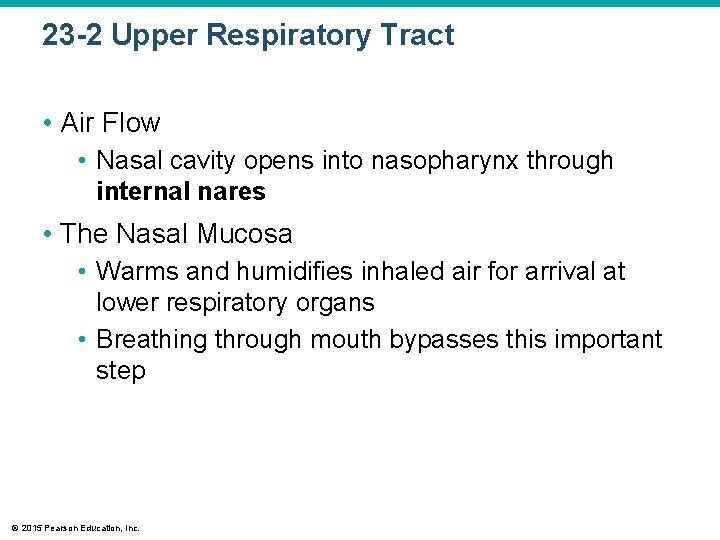
23 -2 Upper Respiratory Tract • Air Flow • Nasal cavity opens into nasopharynx through internal nares • The Nasal Mucosa • Warms and humidifies inhaled air for arrival at lower respiratory organs • Breathing through mouth bypasses this important step © 2015 Pearson Education, Inc.
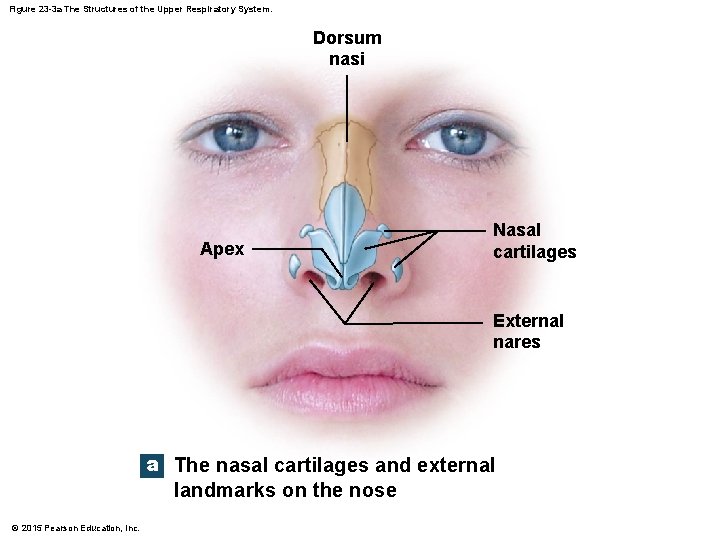
Figure 23 -3 a The Structures of the Upper Respiratory System. Dorsum nasi Apex Nasal cartilages External nares a The nasal cartilages and external landmarks on the nose © 2015 Pearson Education, Inc.
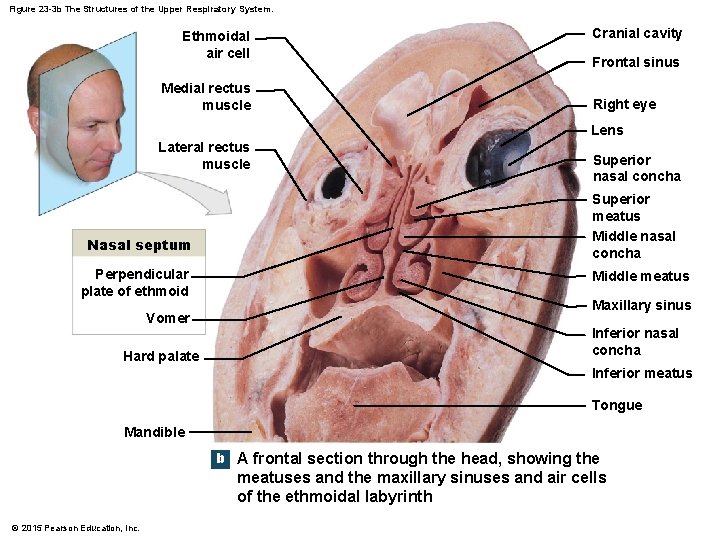
Figure 23 -3 b The Structures of the Upper Respiratory System. Ethmoidal air cell Medial rectus muscle Cranial cavity Frontal sinus Right eye Lens Lateral rectus muscle Nasal septum Perpendicular plate of ethmoid Vomer Hard palate Superior nasal concha Superior meatus Middle nasal concha Middle meatus Maxillary sinus Inferior nasal concha Inferior meatus Tongue Mandible b A frontal section through the head, showing the meatuses and the maxillary sinuses and air cells of the ethmoidal labyrinth © 2015 Pearson Education, Inc.
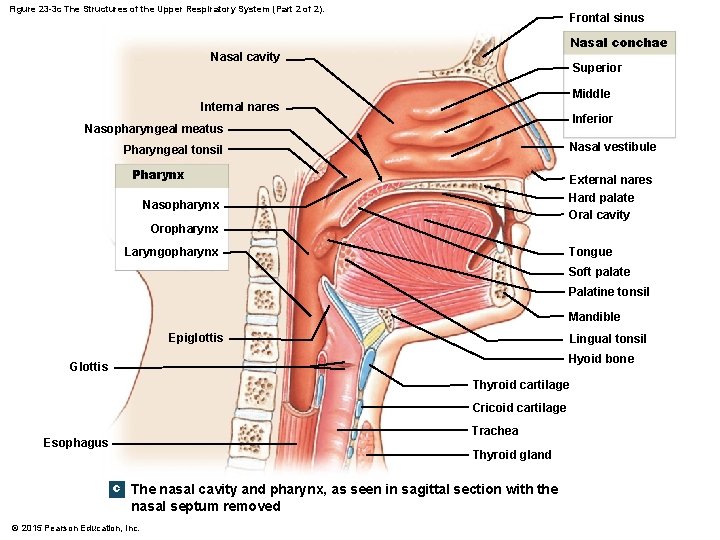
Figure 23 -3 c The Structures of the Upper Respiratory System (Part 2 of 2). Frontal sinus Nasal conchae Nasal cavity Superior Middle Internal nares Inferior Nasopharyngeal meatus Nasal vestibule Pharyngeal tonsil Pharynx External nares Hard palate Oral cavity Nasopharynx Oropharynx Laryngopharynx Tongue Soft palate Palatine tonsil Mandible Epiglottis Lingual tonsil Hyoid bone Glottis Thyroid cartilage Cricoid cartilage Trachea Esophagus Thyroid gland c The nasal cavity and pharynx, as seen in sagittal section with the nasal septum removed © 2015 Pearson Education, Inc.
23 -2 Upper Respiratory Tract • The Pharynx • A chamber shared by digestive and respiratory systems • Extends from internal nares to entrances to larynx and esophagus • Divided into three parts 1. The nasopharynx 2. The oropharynx 3. The laryngopharynx © 2015 Pearson Education, Inc.
23 -2 Upper Respiratory Tract • The Nasopharynx • Superior portion of pharynx • Contains pharyngeal tonsils and openings to left and right auditory tubes • The Oropharynx • Middle portion of pharynx • Communicates with oral cavity • The Laryngopharynx • Inferior portion of pharynx • Extends from hyoid bone to entrance of larynx and esophagus © 2015 Pearson Education, Inc.
23 -3 The Larynx • Air Flow • From the pharynx enters the larynx • A cartilaginous structure that surrounds the glottis, which is a narrow opening © 2015 Pearson Education, Inc.
23 -3 The Larynx • Cartilages of the Larynx • Three large, unpaired cartilages form the larynx 1. Thyroid cartilage 2. Cricoid cartilage 3. Epiglottis © 2015 Pearson Education, Inc.
23 -3 The Larynx • The Thyroid Cartilage • Is hyaline cartilage • Forms anterior and lateral walls of larynx • Anterior surface called laryngeal prominence, or Adam’s apple • Ligaments attach to hyoid bone, epiglottis, and laryngeal cartilages © 2015 Pearson Education, Inc.
23 -3 The Larynx • The Cricoid Cartilage • • Is hyaline cartilage Forms posterior portion of larynx Ligaments attach to first tracheal cartilage Articulates with arytenoid cartilages © 2015 Pearson Education, Inc.
23 -3 The Larynx • The Epiglottis • Composed of elastic cartilage • Ligaments attach to thyroid cartilage and hyoid bone © 2015 Pearson Education, Inc.
23 -3 The Larynx • Cartilage Functions • Thyroid and cricoid cartilages support and protect: • The glottis • The entrance to trachea • During swallowing: • The larynx is elevated • The epiglottis folds back over glottis • Prevents entry of food and liquids into respiratory tract © 2015 Pearson Education, Inc.
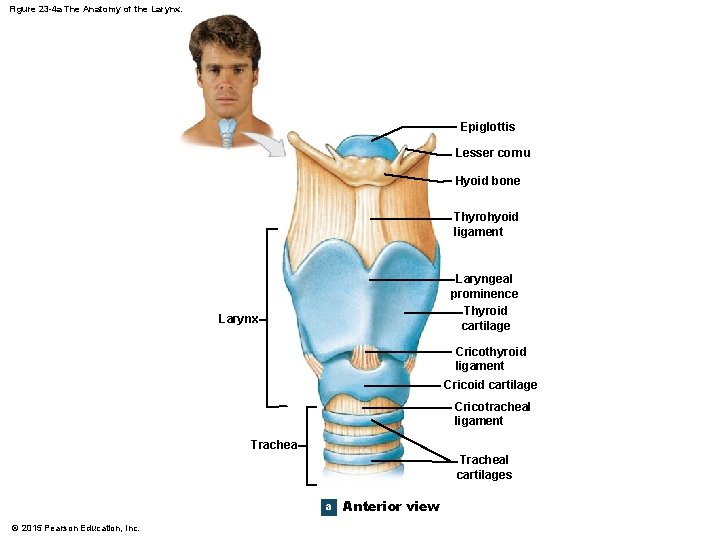
Figure 23 -4 a The Anatomy of the Larynx. Epiglottis Lesser cornu Hyoid bone Thyrohyoid ligament Laryngeal prominence Thyroid cartilage Larynx Cricothyroid ligament Cricoid cartilage Cricotracheal ligament Tracheal cartilages a © 2015 Pearson Education, Inc. Anterior view
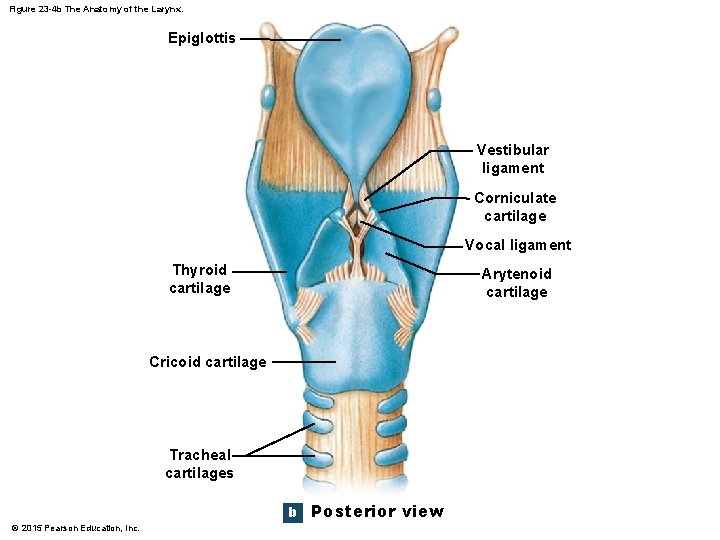
Figure 23 -4 b The Anatomy of the Larynx. Epiglottis Vestibular ligament Corniculate cartilage Vocal ligament Thyroid cartilage Arytenoid cartilage Cricoid cartilage Tracheal cartilages b © 2015 Pearson Education, Inc. Posterior view
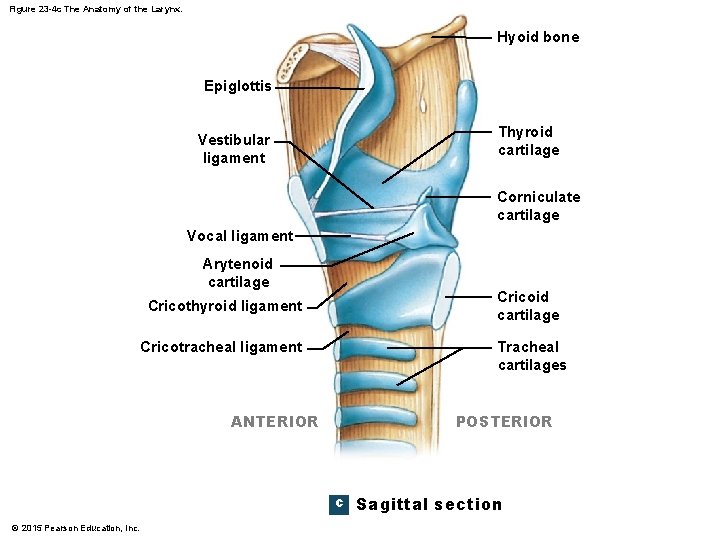
Figure 23 -4 c The Anatomy of the Larynx. Hyoid bone Epiglottis Thyroid cartilage Vestibular ligament Corniculate cartilage Vocal ligament Arytenoid cartilage Cricothyroid ligament Tracheal cartilages Cricotracheal ligament ANTERIOR POSTERIOR c © 2015 Pearson Education, Inc. Sagittal section
23 -3 The Larynx • Cartilage Functions • Corniculate and arytenoid cartilages function in: • Opening and closing of glottis • Production of sound © 2015 Pearson Education, Inc.
23 -3 The Larynx • The Vestibular Ligaments • Lie within vestibular folds • Which protect delicate vocal folds • Sound Production • Air passing through glottis • Vibrates vocal folds • Produces sound waves © 2015 Pearson Education, Inc.
23 -3 The Larynx • Sound Production • Sound is varied by: • Tension on vocal folds • Vocal folds involved with sound are known as vocal cords • Voluntary muscles (position arytenoid cartilage relative to thyroid cartilage) • Speech is produced by: • Phonation • Sound production at the larynx • Articulation • Modification of sound by other structures © 2015 Pearson Education, Inc.
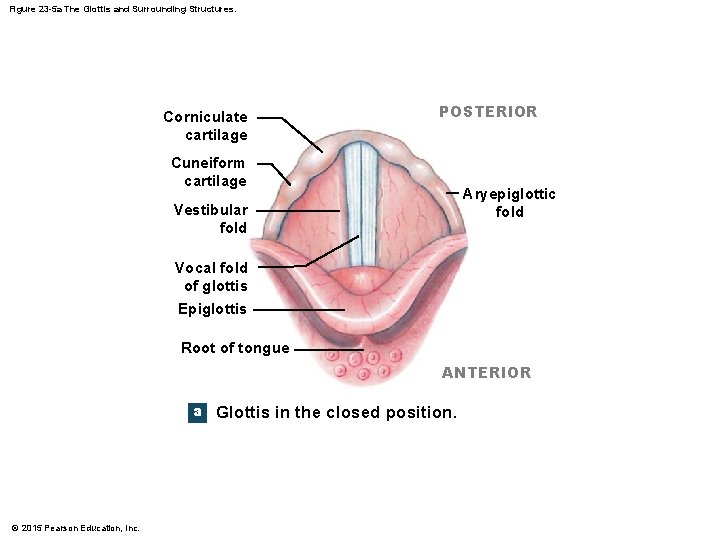
Figure 23 -5 a The Glottis and Surrounding Structures. Corniculate cartilage POSTERIOR Cuneiform cartilage Aryepiglottic fold Vestibular fold Vocal fold of glottis Epiglottis Root of tongue ANTERIOR a © 2015 Pearson Education, Inc. Glottis in the closed position.
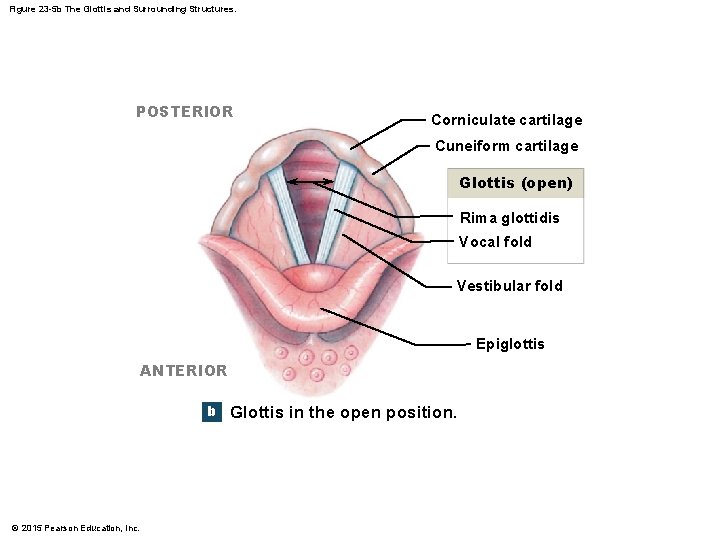
Figure 23 -5 b The Glottis and Surrounding Structures. POSTERIOR Corniculate cartilage Cuneiform cartilage Glottis (open) Rima glottidis Vocal fold Vestibular fold Epiglottis ANTERIOR b © 2015 Pearson Education, Inc. Glottis in the open position.
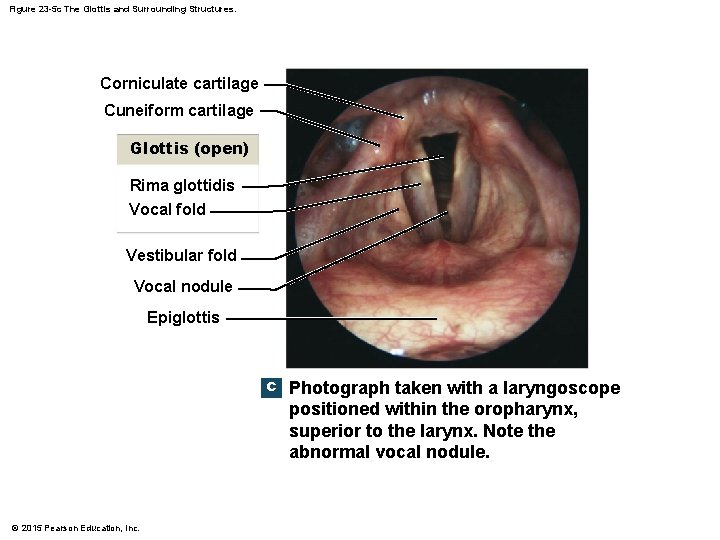
Figure 23 -5 c The Glottis and Surrounding Structures. Corniculate cartilage Cuneiform cartilage Glottis (open) Rima glottidis Vocal fold Vestibular fold Vocal nodule Epiglottis c Photograph taken with a laryngoscope positioned within the oropharynx, superior to the larynx. Note the abnormal vocal nodule. © 2015 Pearson Education, Inc.
23 -4 The Trachea • Also called the windpipe • Extends from the cricoid cartilage into mediastinum • Where it branches into right and left pulmonary bronchi • The submucosa • Beneath mucosa of trachea • Contains mucous glands © 2015 Pearson Education, Inc.
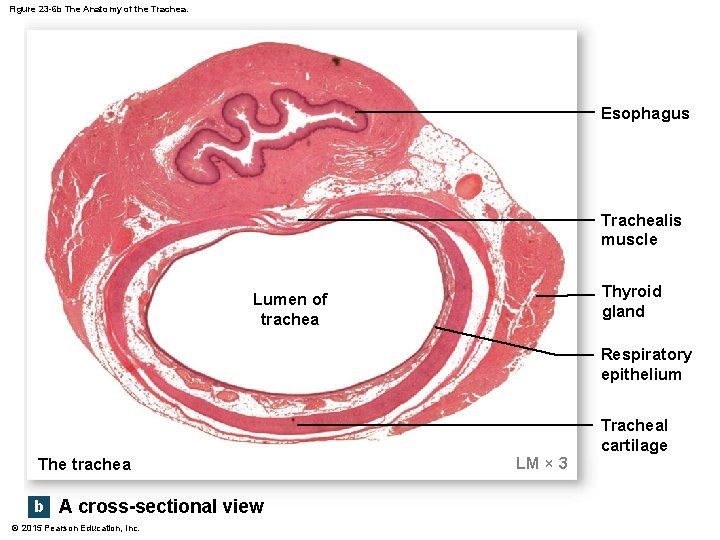
Figure 23 -6 b The Anatomy of the Trachea. Esophagus Trachealis muscle Thyroid gland Lumen of trachea Respiratory epithelium The trachea b A cross-sectional view © 2015 Pearson Education, Inc. LM × 3 Tracheal cartilage
23 -4 The Trachea • The Tracheal Cartilages • 15– 20 tracheal cartilages • Strengthen and protect airway • Discontinuous where trachea contacts esophagus • Ends of each tracheal cartilage are connected by: • An elastic ligament and trachealis muscle © 2015 Pearson Education, Inc.
23 -4 The Trachea • The Primary Bronchi • Right and Left Primary Bronchi • Separated by an internal ridge (the carina) • The Right Primary Bronchus • Is larger in diameter than the left • Descends at a steeper angle © 2015 Pearson Education, Inc.
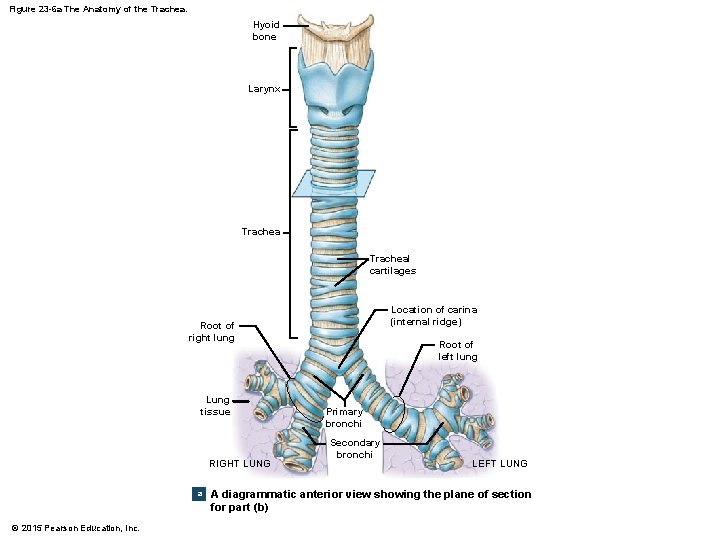
Figure 23 -6 a The Anatomy of the Trachea. Hyoid bone Larynx Tracheal cartilages Location of carina (internal ridge) Root of right lung Lung tissue RIGHT LUNG a © 2015 Pearson Education, Inc. Root of left lung Primary bronchi Secondary bronchi LEFT LUNG A diagrammatic anterior view showing the plane of section for part (b)
23 -4 The Trachea • The Primary Bronchi • Hilum • Where pulmonary nerves, blood vessels, lymphatics enter lung • Anchored in meshwork of connective tissue • The root of the lung • Complex of connective tissues, nerves, and vessels in hilum • Anchored to the mediastinum © 2015 Pearson Education, Inc.
23 -5 The Lungs • Lobes and Surfaces of the Lungs • The right lung has three lobes • Superior, middle, and inferior • Separated by horizontal and oblique fissures • The left lung has two lobes • Superior and inferior • Separated by an oblique fissure © 2015 Pearson Education, Inc.
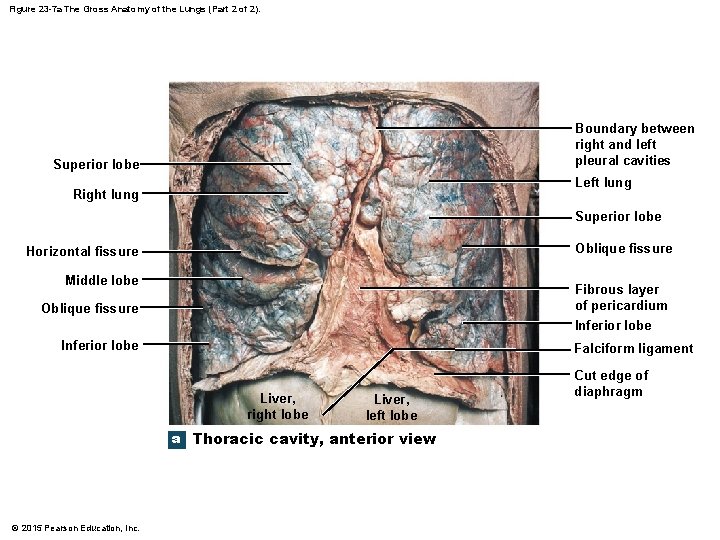
Figure 23 -7 a The Gross Anatomy of the Lungs (Part 2 of 2). Boundary between right and left pleural cavities Superior lobe Left lung Right lung Superior lobe Oblique fissure Horizontal fissure Middle lobe Fibrous layer of pericardium Inferior lobe Oblique fissure Inferior lobe Falciform ligament Liver, right lobe Liver, left lobe a Thoracic cavity, anterior view © 2015 Pearson Education, Inc. Cut edge of diaphragm
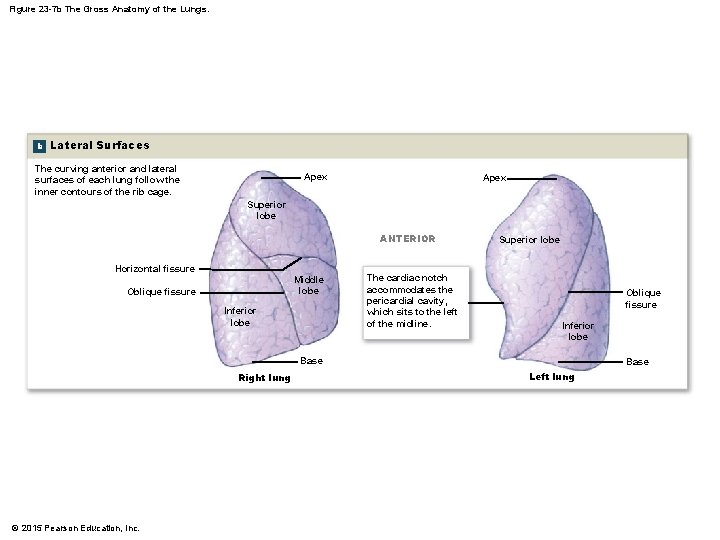
Figure 23 -7 b The Gross Anatomy of the Lungs. b Lateral Surfaces The curving anterior and lateral surfaces of each lung follow the inner contours of the rib cage. Apex Superior lobe ANTERIOR Horizontal fissure Middle lobe Oblique fissure Inferior lobe The cardiac notch accommodates the pericardial cavity, which sits to the left of the midline. Superior lobe Oblique fissure Inferior lobe Base Right lung © 2015 Pearson Education, Inc. Base Left lung
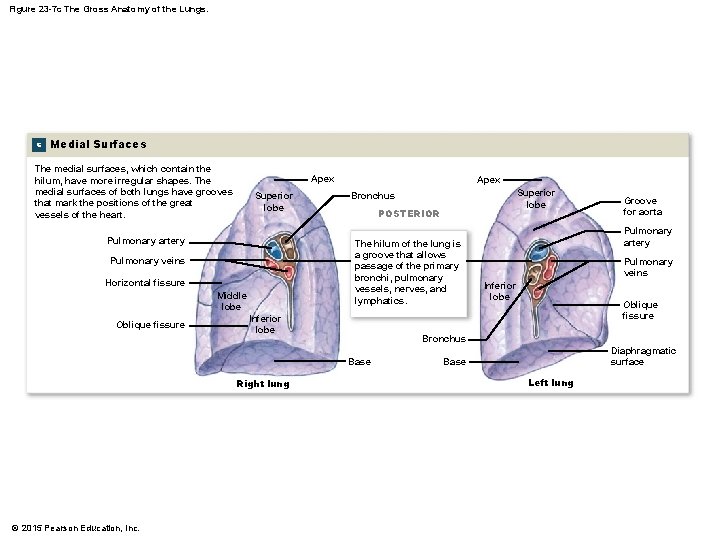
Figure 23 -7 c The Gross Anatomy of the Lungs. c Medial Surfaces The medial surfaces, which contain the hilum, have more irregular shapes. The medial surfaces of both lungs have grooves that mark the positions of the great vessels of the heart. Apex Superior lobe Pulmonary artery Horizontal fissure Middle lobe POSTERIOR Inferior lobe Right lung Groove for aorta Pulmonary artery Pulmonary veins Inferior lobe Oblique fissure Bronchus Base © 2015 Pearson Education, Inc. Superior lobe Bronchus The hilum of the lung is a groove that allows passage of the primary bronchi, pulmonary vessels, nerves, and lymphatics. Pulmonary veins Oblique fissure Apex Diaphragmatic surface Base Left lung
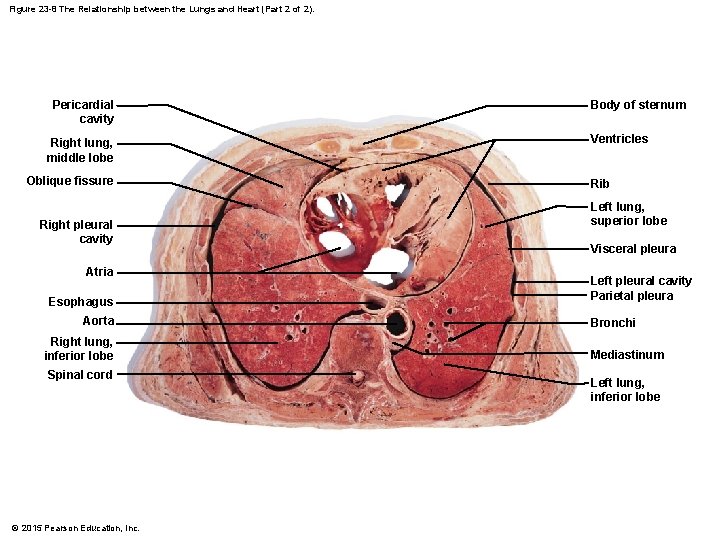
Figure 23 -8 The Relationship between the Lungs and Heart (Part 2 of 2). Pericardial cavity Right lung, middle lobe Oblique fissure Right pleural cavity Atria Esophagus Aorta Right lung, inferior lobe Spinal cord © 2015 Pearson Education, Inc. Body of sternum Ventricles Rib Left lung, superior lobe Visceral pleura Left pleural cavity Parietal pleura Bronchi Mediastinum Left lung, inferior lobe
23 -5 The Lungs • The Bronchial Tree • Is formed by the primary bronchi and their branches • Extrapulmonary Bronchi • The left and right bronchi branches outside the lungs • Intrapulmonary Bronchi • Branches within the lungs © 2015 Pearson Education, Inc.
23 -5 The Lungs • A Primary Bronchus • Branches to form secondary bronchi (lobar bronchi) • One secondary bronchus goes to each lobe • Secondary Bronchi • Branch to form tertiary bronchi (segmental bronchi) • Each segmental bronchus • Supplies air to a single bronchopulmonary segment © 2015 Pearson Education, Inc.
23 -5 The Lungs • Bronchitis • Inflammation of bronchial walls • Causes constriction and breathing difficulty © 2015 Pearson Education, Inc.
23 -5 The Lungs • The Bronchioles • Each tertiary bronchus branches into multiple bronchioles • Bronchioles branch into terminal bronchioles • One tertiary bronchus forms about 6500 terminal bronchioles • Bronchiole Structure • Bronchioles • Have no cartilage • Are dominated by smooth muscle © 2015 Pearson Education, Inc.
23 -5 The Lungs • Autonomic Control • Regulates smooth muscle • Controls diameter of bronchioles • Controls airflow and resistance in lungs © 2015 Pearson Education, Inc.
23 -5 The Lungs • Bronchodilation • Dilation of bronchial airways • Caused by sympathetic ANS activation • Reduces resistance • Bronchoconstriction • Constricts bronchi • Caused by: • Parasympathetic ANS activation • Histamine release (allergic reactions) © 2015 Pearson Education, Inc.
23 -5 The Lungs • Asthma • Excessive stimulation and bronchoconstriction • Stimulation severely restricts airflow © 2015 Pearson Education, Inc.
23 -5 The Lungs • Pulmonary Lobules • Trabeculae • Fibrous connective tissue partitions from root of lung • Contain supportive tissues and lymphatic vessels • Branch repeatedly • Divide lobes into increasingly smaller compartments • Pulmonary lobules are divided by the smallest trabecular partitions (interlobular septa) © 2015 Pearson Education, Inc.
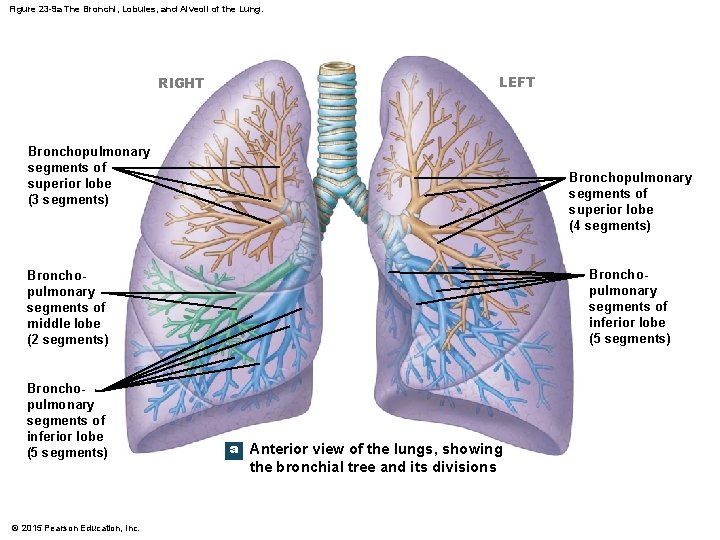
Figure 23 -9 a The Bronchi, Lobules, and Alveoli of the Lung. LEFT RIGHT Bronchopulmonary segments of superior lobe (3 segments) Bronchopulmonary segments of superior lobe (4 segments) Bronchopulmonary segments of inferior lobe (5 segments) Bronchopulmonary segments of middle lobe (2 segments) Bronchopulmonary segments of inferior lobe (5 segments) © 2015 Pearson Education, Inc. a Anterior view of the lungs, showing the bronchial tree and its divisions
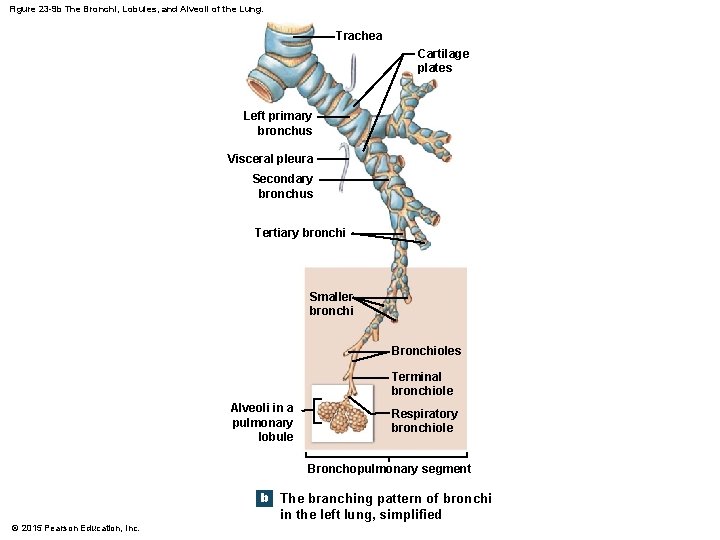
Figure 23 -9 b The Bronchi, Lobules, and Alveoli of the Lung. Trachea Cartilage plates Left primary bronchus Visceral pleura Secondary bronchus Tertiary bronchi Smaller bronchi Bronchioles Terminal bronchiole Alveoli in a pulmonary lobule Respiratory bronchiole Bronchopulmonary segment b The branching pattern of bronchi in the left lung, simplified © 2015 Pearson Education, Inc.
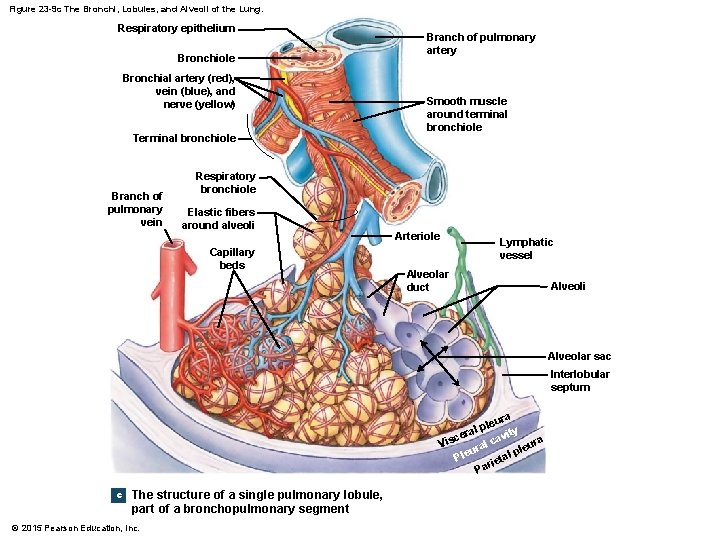
Figure 23 -9 c The Bronchi, Lobules, and Alveoli of the Lung. Respiratory epithelium Bronchiole Bronchial artery (red), vein (blue), and nerve (yellow) Terminal bronchiole Branch of pulmonary vein Branch of pulmonary artery Smooth muscle around terminal bronchiole Respiratory bronchiole Elastic fibers around alveoli Capillary beds Arteriole Lymphatic vessel Alveolar duct Alveoli Alveolar sac Interlobular septum ura ple ty l a i cer cav ra Vis l a leu ur p e l l P ta rie Pa c The structure of a single pulmonary lobule, part of a bronchopulmonary segment © 2015 Pearson Education, Inc.
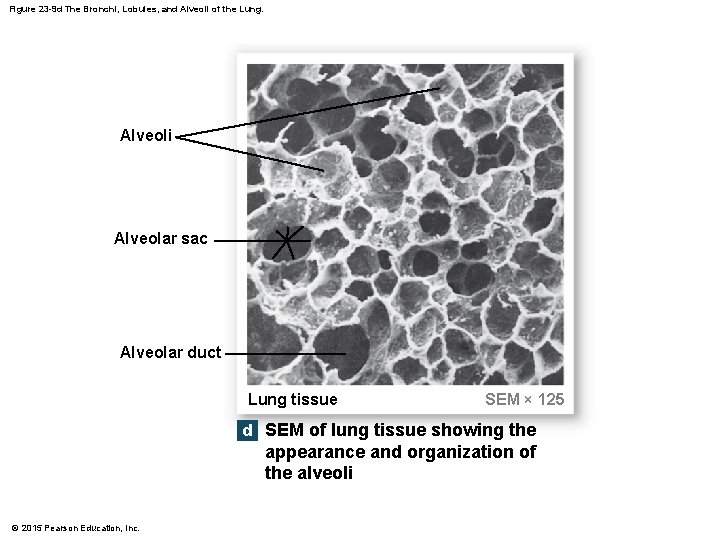
Figure 23 -9 d The Bronchi, Lobules, and Alveoli of the Lung. Alveoli Alveolar sac Alveolar duct Lung tissue SEM × 125 d SEM of lung tissue showing the appearance and organization of the alveoli © 2015 Pearson Education, Inc.
23 -5 The Lungs • Pulmonary Lobules • Each terminal bronchiole delivers air to a single pulmonary lobule • Each pulmonary lobule is supplied by pulmonary arteries and veins • Each terminal bronchiole branches to form several respiratory bronchioles, where gas exchange takes place © 2015 Pearson Education, Inc.
23 -5 The Lungs • Alveolar Ducts and Alveoli • Respiratory bronchioles are connected to alveoli along alveolar ducts • Alveolar ducts end at alveolar sacs • Common chambers connected to many individual alveoli • Each alveolus has an extensive network of capillaries • Surrounded by elastic fibers © 2015 Pearson Education, Inc.
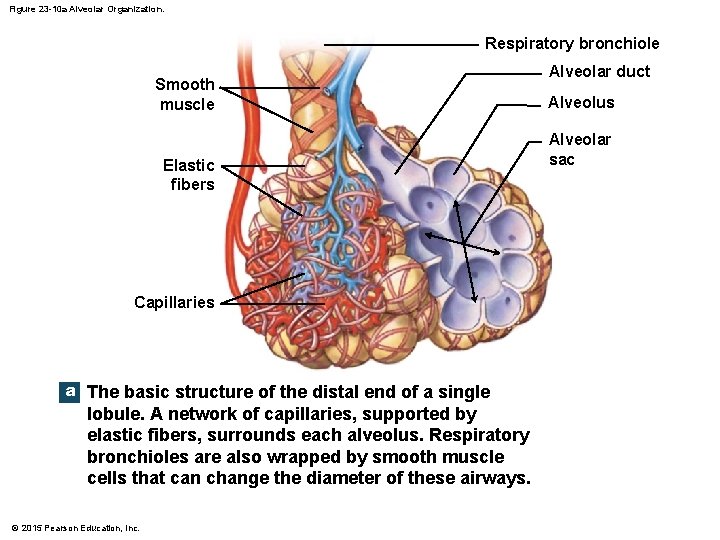
Figure 23 -10 a Alveolar Organization. Respiratory bronchiole Smooth muscle Elastic fibers Capillaries a The basic structure of the distal end of a single lobule. A network of capillaries, supported by elastic fibers, surrounds each alveolus. Respiratory bronchioles are also wrapped by smooth muscle cells that can change the diameter of these airways. © 2015 Pearson Education, Inc. Alveolar duct Alveolus Alveolar sac
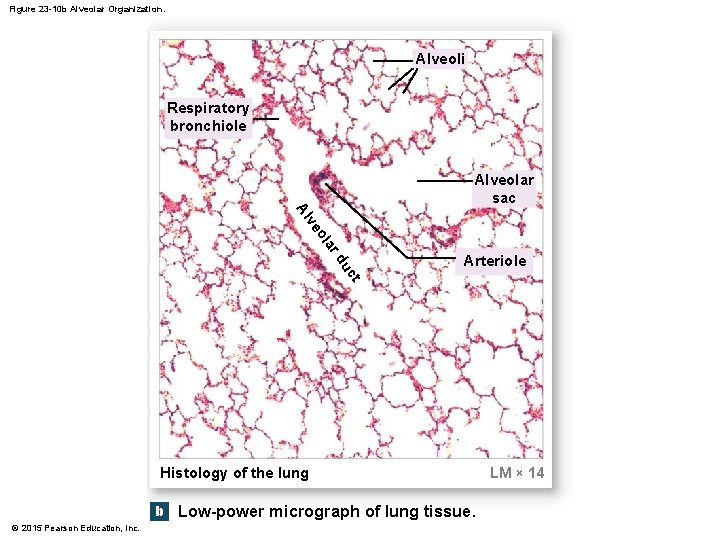
Figure 23 -10 b Alveolar Organization. Alveoli Respiratory bronchiole Alveolar sac a ol ve Al t uc rd Arteriole Histology of the lung b Low-power micrograph of lung tissue. © 2015 Pearson Education, Inc. LM × 14
23 -5 The Lungs • Alveolar Epithelium • Consists of simple squamous epithelium • Consists of thin, delicate type I pneumocytes patrolled by alveolar macrophages (dust cells) • Contains type II pneumocytes (septal cells) that produce surfactant © 2015 Pearson Education, Inc.
23 -5 The Lungs • Surfactant • Is an oily secretion • Contains phospholipids and proteins • Coats alveolar surfaces and reduces surface tension © 2015 Pearson Education, Inc.
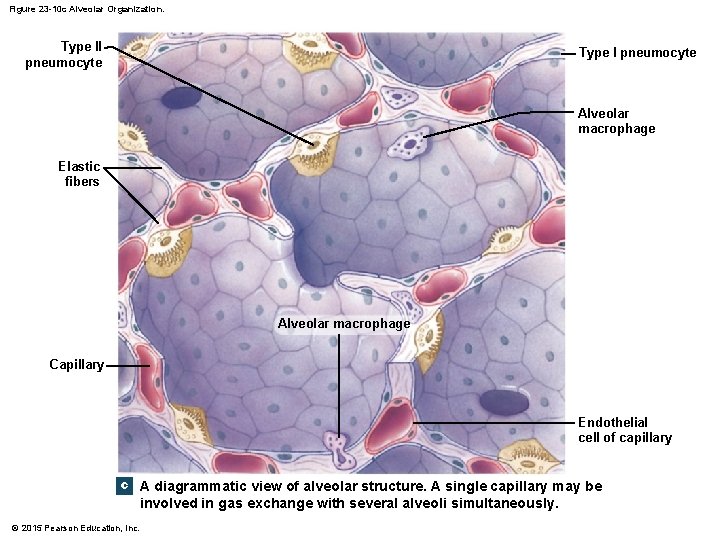
Figure 23 -10 c Alveolar Organization. Type II pneumocyte Type I pneumocyte Alveolar macrophage Elastic fibers Alveolar macrophage Capillary Endothelial cell of capillary c A diagrammatic view of alveolar structure. A single capillary may be involved in gas exchange with several alveoli simultaneously. © 2015 Pearson Education, Inc.
23 -5 The Lungs • Respiratory Distress Syndrome • Difficult respiration • Due to alveolar collapse • Caused when type II pneumocytes do not produce enough surfactant • Respiratory Membrane • The thin membrane of alveoli where gas exchange takes place © 2015 Pearson Education, Inc.
23 -5 The Lungs • Diffusion • Across respiratory membrane is very rapid • Because distance is short • Gases (O 2 and CO 2) are lipid soluble • Inflammation of Lobules • Also called pneumonia • Causes fluid to leak into alveoli • Compromises function of respiratory membrane © 2015 Pearson Education, Inc.
23 -5 The Lungs • Blood Supply to the Lungs • Respiratory exchange surfaces receive blood • From arteries of pulmonary circuit • A capillary network surrounds each alveolus • As part of the respiratory membrane • Blood from alveolar capillaries • Passes through pulmonary venules and veins • Returns to left atrium • Also site of angiotensin-converting enzyme (ACE) © 2015 Pearson Education, Inc.
23 -5 The Lungs • Blood Supply to the Lungs • Capillaries supplied by bronchial arteries • Provide oxygen and nutrients to tissues of conducting passageways of lung • Venous blood bypasses the systemic circuit and flows into pulmonary veins © 2015 Pearson Education, Inc.
23 -5 The Lungs • Blood Pressure • In pulmonary circuit is low (30 mm Hg) • Pulmonary vessels are easily blocked by blood clots, fat, or air bubbles • Causing pulmonary embolism © 2015 Pearson Education, Inc.
23 -5 The Lungs • The Pleural Cavities and Pleural Membranes • Two pleural cavities • Are separated by the mediastinum • Each pleural cavity: • Holds a lung • Is lined with a serous membrane (the pleura) © 2015 Pearson Education, Inc.
23 -5 The Lungs • The Pleura • Consists of two layers 1. Parietal pleura 2. Visceral pleura • Pleural fluid • Lubricates space between two layers © 2015 Pearson Education, Inc.
23 -6 Introduction to Gas Exchange • Respiration • Refers to two integrated processes 1. External respiration • Includes all processes involved in exchanging O 2 and CO 2 with the environment 2. Internal respiration • Result of cellular respiration • Involves the uptake of O 2 and production of CO 2 within individual cells © 2015 Pearson Education, Inc.
23 -6 Introduction to Gas Exchange • Three Processes of External Respiration 1. Pulmonary ventilation (breathing) 2. Gas diffusion • Across membranes and capillaries 3. Transport of O 2 and CO 2 • Between alveolar capillaries • Between capillary beds in other tissues © 2015 Pearson Education, Inc.
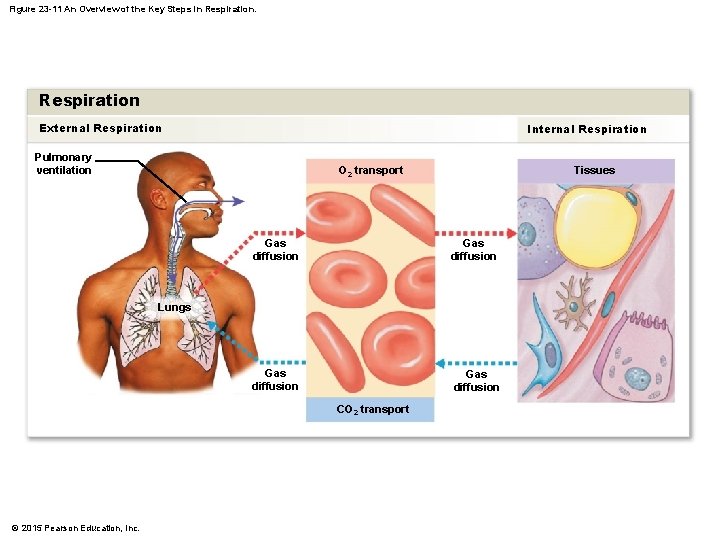
Figure 23 -11 An Overview of the Key Steps in Respiration External Respiration Internal Respiration Pulmonary ventilation O 2 transport Tissues Gas diffusion Lungs CO 2 transport © 2015 Pearson Education, Inc.
23 -6 Introduction to Gas Exchange • Abnormal External Respiration Is Dangerous • Hypoxia • Low tissue oxygen levels • Anoxia • Complete lack of oxygen © 2015 Pearson Education, Inc.
23 -7 Pulmonary Ventilation • Is the physical movement of air in and out of respiratory tract • Provides alveolar ventilation • The Movement of Air • Atmospheric pressure • The weight of air • Has several important physiological effects © 2015 Pearson Education, Inc.
23 -7 Pulmonary Ventilation • Gas Pressure and Volume • Boyle’s Law • Defines the relationship between gas pressure and volume P = 1/V • In a contained gas: • External pressure forces molecules closer together • Movement of gas molecules exerts pressure on container © 2015 Pearson Education, Inc.
23 -7 Pulmonary Ventilation • Pressure and Airflow to the Lungs • Air flows from area of higher pressure to area of lower pressure • A Respiratory Cycle • Consists of: • An inspiration (inhalation) • An expiration (exhalation) © 2015 Pearson Education, Inc.
23 -7 Pulmonary Ventilation • Causes volume changes that create changes in pressure • Volume of thoracic cavity changes • With expansion or contraction of diaphragm or rib cage © 2015 Pearson Education, Inc.
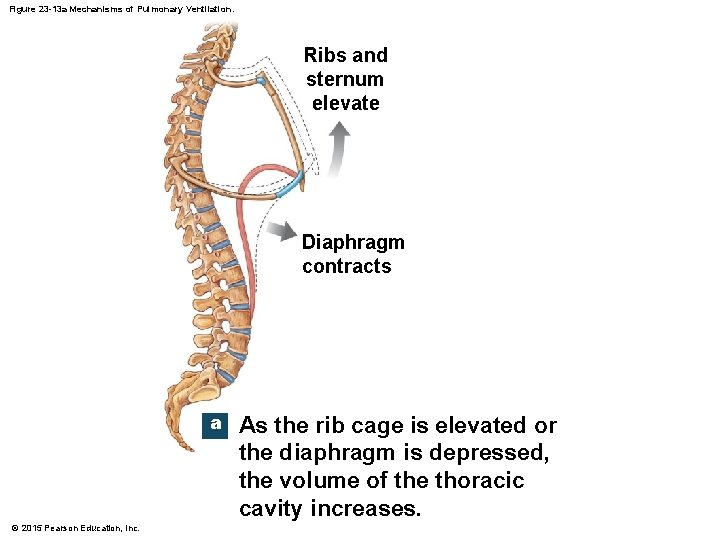
Figure 23 -13 a Mechanisms of Pulmonary Ventilation. Ribs and sternum elevate Diaphragm contracts a © 2015 Pearson Education, Inc. As the rib cage is elevated or the diaphragm is depressed, the volume of the thoracic cavity increases.
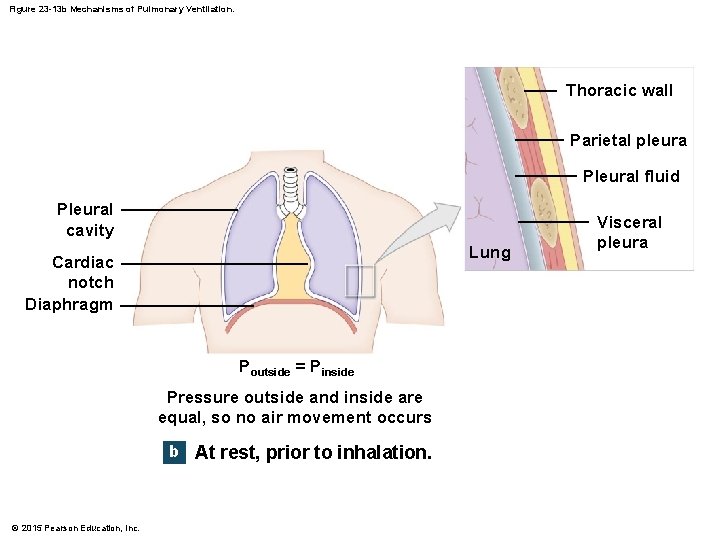
Figure 23 -13 b Mechanisms of Pulmonary Ventilation. Thoracic wall Parietal pleura Pleural fluid Pleural cavity Lung Cardiac notch Diaphragm Poutside = Pinside Pressure outside and inside are equal, so no air movement occurs b At rest, prior to inhalation. © 2015 Pearson Education, Inc. Visceral pleura
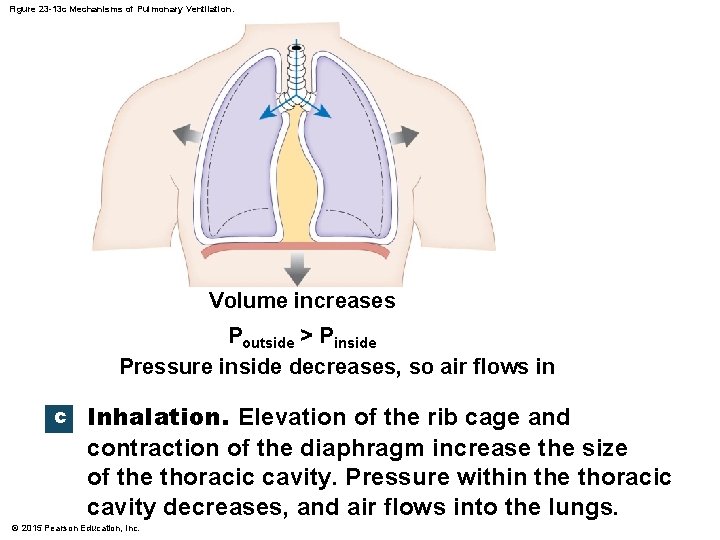
Figure 23 -13 c Mechanisms of Pulmonary Ventilation. Volume increases Poutside > Pinside Pressure inside decreases, so air flows in c Inhalation. Elevation of the rib cage and contraction of the diaphragm increase the size of the thoracic cavity. Pressure within the thoracic cavity decreases, and air flows into the lungs. © 2015 Pearson Education, Inc.
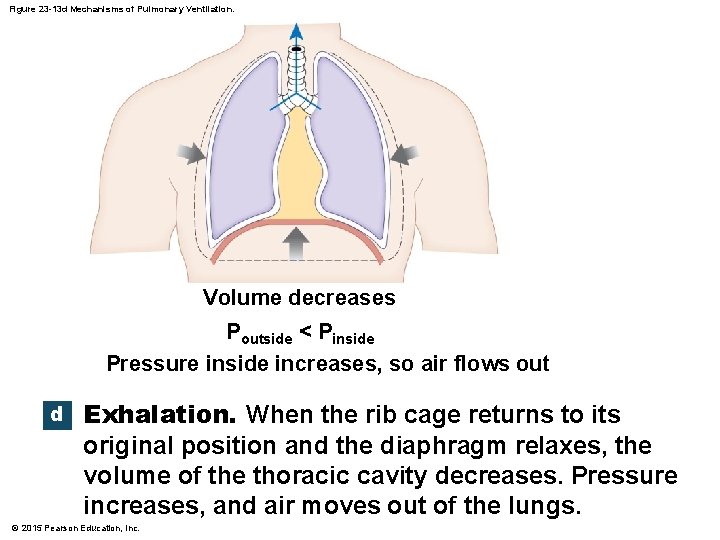
Figure 23 -13 d Mechanisms of Pulmonary Ventilation. Volume decreases Poutside < Pinside Pressure inside increases, so air flows out d Exhalation. When the rib cage returns to its original position and the diaphragm relaxes, the volume of the thoracic cavity decreases. Pressure increases, and air moves out of the lungs. © 2015 Pearson Education, Inc.
23 -7 Pulmonary Ventilation • Pressure Changes during Inhalation and Exhalation • Can be measured inside or outside the lungs • Normal atmospheric pressure • 1 atm = 760 mm Hg © 2015 Pearson Education, Inc.
23 -7 Pulmonary Ventilation • The Intrapulmonary Pressure • Also called intra-alveolar pressure • Is relative to atmospheric pressure • In relaxed breathing, the difference between atmospheric pressure and intrapulmonary pressure is small • About 1 mm Hg on inhalation or 1 mm Hg on exhalation © 2015 Pearson Education, Inc.
23 -7 Pulmonary Ventilation • Maximum Intrapulmonary Pressure • Maximum straining, a dangerous activity, can increase range • From 30 mm Hg to 100 mm Hg © 2015 Pearson Education, Inc.
23 -7 Pulmonary Ventilation • The Intrapleural Pressure • Pressure in space between parietal and visceral pleura • Averages 4 mm Hg • Maximum of 18 mm Hg • Remains below atmospheric pressure throughout respiratory cycle © 2015 Pearson Education, Inc.
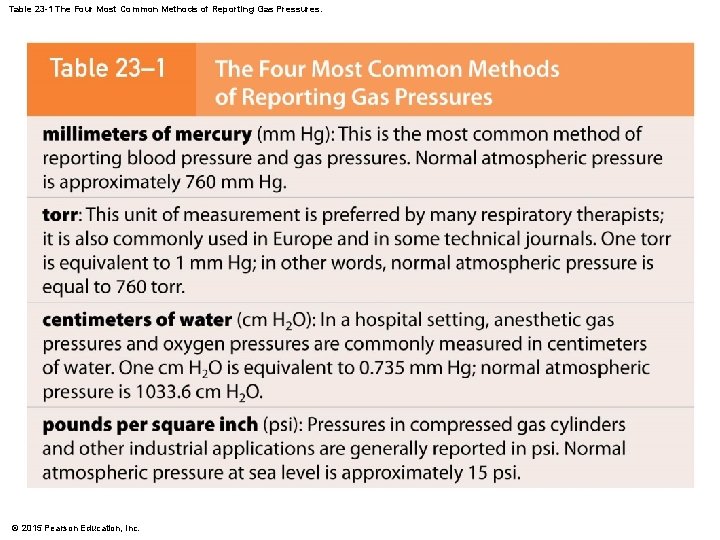
Table 23 -1 The Four Most Common Methods of Reporting Gas Pressures. © 2015 Pearson Education, Inc.
23 -7 Pulmonary Ventilation • The Respiratory Cycle • Cyclical changes in intrapleural pressure operate the respiratory pump • Which aids in venous return to heart • Tidal Volume (VT) • Amount of air moved in and out of lungs in a single respiratory cycle © 2015 Pearson Education, Inc.
23 -7 Pulmonary Ventilation • Injury to the Chest Wall • Pneumothorax allows air into pleural cavity • Atelectasis (also called a collapsed lung) is a result of pneumothorax © 2015 Pearson Education, Inc.
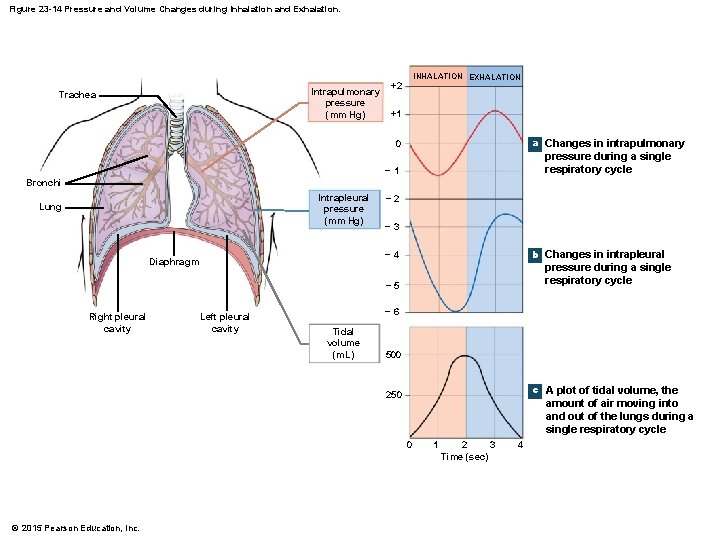
Figure 23 -14 Pressure and Volume Changes during Inhalation and Exhalation. Intrapulmonary pressure (mm Hg) Trachea INHALATION EXHALATION +2 +1 a Changes in intrapulmonary 0 pressure during a single respiratory cycle − 1 Bronchi Intrapleural pressure (mm Hg) Lung − 2 − 3 b Changes in intrapleural − 4 Diaphragm pressure during a single respiratory cycle − 5 Right pleural cavity Left pleural cavity − 6 Tidal volume (m. L) 500 c A plot of tidal volume, the 250 amount of air moving into and out of the lungs during a single respiratory cycle 0 © 2015 Pearson Education, Inc. 1 2 3 Time (sec) 4
23 -7 Pulmonary Ventilation • The Respiratory Muscles • Most important are: • The diaphragm • External intercostal muscles of the ribs • Accessory respiratory muscles • Activated when respiration increases significantly © 2015 Pearson Education, Inc.
23 -7 Pulmonary Ventilation • Muscles Used in Inhalation • Diaphragm • Contraction draws air into lungs • 75 percent of normal air movement • External intercostal muscles • Assist inhalation • 25 percent of normal air movement • Accessory muscles assist in elevating ribs • • Sternocleidomastoid Serratus anterior Pectoralis minor Scalene muscles © 2015 Pearson Education, Inc.
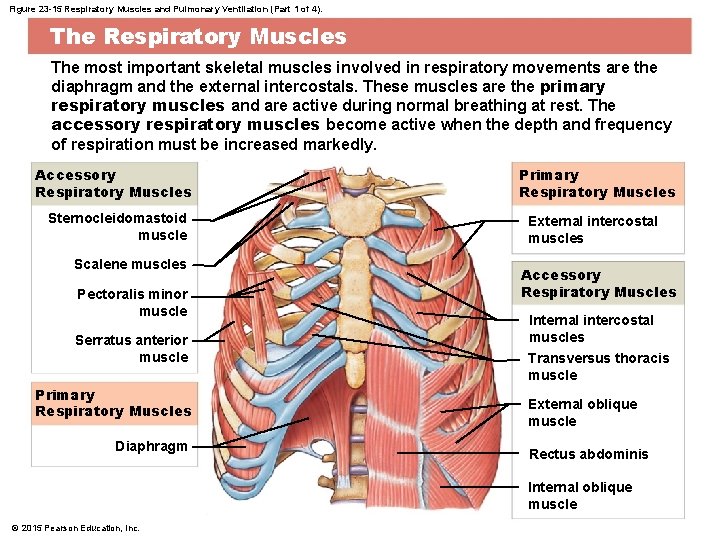
Figure 23 -15 Respiratory Muscles and Pulmonary Ventilation (Part 1 of 4). The Respiratory Muscles The most important skeletal muscles involved in respiratory movements are the diaphragm and the external intercostals. These muscles are the primary respiratory muscles and are active during normal breathing at rest. The accessory respiratory muscles become active when the depth and frequency of respiration must be increased markedly. Accessory Respiratory Muscles Sternocleidomastoid muscle Scalene muscles Pectoralis minor muscle Serratus anterior muscle Primary Respiratory Muscles Diaphragm Primary Respiratory Muscles External intercostal muscles Accessory Respiratory Muscles Internal intercostal muscles Transversus thoracis muscle External oblique muscle Rectus abdominis Internal oblique muscle © 2015 Pearson Education, Inc.
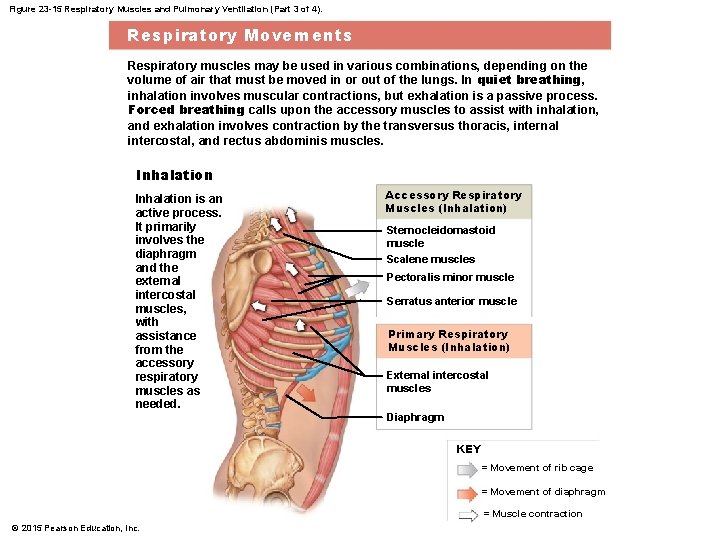
Figure 23 -15 Respiratory Muscles and Pulmonary Ventilation (Part 3 of 4). Respiratory Movements Respiratory muscles may be used in various combinations, depending on the volume of air that must be moved in or out of the lungs. In quiet breathing, inhalation involves muscular contractions, but exhalation is a passive process. Forced breathing calls upon the accessory muscles to assist with inhalation, and exhalation involves contraction by the transversus thoracis, internal intercostal, and rectus abdominis muscles. Inhalation is an active process. It primarily involves the diaphragm and the external intercostal muscles, with assistance from the accessory respiratory muscles as needed. Accessory Respiratory Muscles (Inhalation) Sternocleidomastoid muscle Scalene muscles Pectoralis minor muscle Serratus anterior muscle Primary Respiratory Muscles (Inhalation) External intercostal muscles Diaphragm KEY = Movement of rib cage = Movement of diaphragm = Muscle contraction © 2015 Pearson Education, Inc.
23 -7 Pulmonary Ventilation • Muscles Used in Exhalation • Internal intercostal and transversus thoracis muscles • Depress the ribs • Abdominal muscles • Compress the abdomen • Force diaphragm upward © 2015 Pearson Education, Inc.
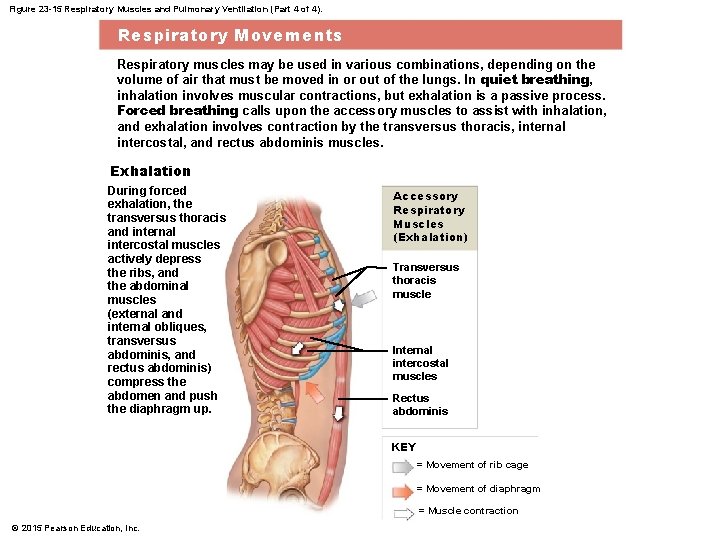
Figure 23 -15 Respiratory Muscles and Pulmonary Ventilation (Part 4 of 4). Respiratory Movements Respiratory muscles may be used in various combinations, depending on the volume of air that must be moved in or out of the lungs. In quiet breathing, inhalation involves muscular contractions, but exhalation is a passive process. Forced breathing calls upon the accessory muscles to assist with inhalation, and exhalation involves contraction by the transversus thoracis, internal intercostal, and rectus abdominis muscles. Exhalation During forced exhalation, the transversus thoracis and internal intercostal muscles actively depress the ribs, and the abdominal muscles (external and internal obliques, transversus abdominis, and rectus abdominis) compress the abdomen and push the diaphragm up. Accessory Respiratory Muscles (Exhalation) Transversus thoracis muscle Internal intercostal muscles Rectus abdominis KEY = Movement of rib cage = Movement of diaphragm = Muscle contraction © 2015 Pearson Education, Inc.
23 -7 Pulmonary Ventilation • Modes of Breathing • Respiratory movements are classified • By pattern of muscle activity • Quiet breathing • Forced breathing © 2015 Pearson Education, Inc.
23 -7 Pulmonary Ventilation • Quiet Breathing (Eupnea) • Involves active inhalation and passive exhalation • Diaphragmatic breathing or deep breathing • Is dominated by diaphragm • Costal breathing or shallow breathing • Is dominated by rib cage movements © 2015 Pearson Education, Inc.
23 -7 Pulmonary Ventilation • Elastic Rebound • When inhalation muscles relax • Elastic components of muscles and lungs recoil • Returning lungs and alveoli to original position © 2015 Pearson Education, Inc.
23 -7 Pulmonary Ventilation • Forced Breathing (Hyperpnea) • Involves active inhalation and exhalation • Assisted by accessory muscles • Maximum levels occur in exhaustion © 2015 Pearson Education, Inc.
23 -7 Pulmonary Ventilation • Respiratory Rates and Volumes • Respiratory system adapts to changing oxygen demands by varying: • The number of breaths per minute (respiratory rate) • The volume of air moved per breath (tidal volume) © 2015 Pearson Education, Inc.
23 -7 Pulmonary Ventilation • The Respiratory Minute Volume (VE) • Amount of air moved per minute • Is calculated by: respiratory rate tidal volume • Measures pulmonary ventilation © 2015 Pearson Education, Inc.
23 -7 Pulmonary Ventilation • Alveolar Ventilation (VA) • Only a part of respiratory minute volume reaches alveolar exchange surfaces • Volume of air remaining in conducting passages is anatomic dead space • Alveolar ventilation is the amount of air reaching alveoli each minute • Calculated as: (tidal volume anatomic dead space) respiratory rate © 2015 Pearson Education, Inc.
23 -7 Pulmonary Ventilation • Alveolar Gas Content • Alveoli contain less O 2, more CO 2 than atmospheric air • Because air mixes with exhaled air © 2015 Pearson Education, Inc.
23 -7 Pulmonary Ventilation • Relationships among VT, VE, and VA • Determined by respiratory rate and tidal volume • For a given respiratory rate: • Increasing tidal volume increases alveolar ventilation rate • For a given tidal volume: • Increasing respiratory rate increases alveolar ventilation © 2015 Pearson Education, Inc.
23 -7 Pulmonary Ventilation • Respiratory Performance and Volume Relationships • Total lung volume is divided into a series of volumes and capacities useful in diagnosing problems • Four Pulmonary Volumes 1. 2. 3. 4. © 2015 Pearson Education, Inc. Resting tidal volume (Vt) Expiratory reserve volume (ERV) Residual volume Inspiratory reserve volume (IRV)
23 -7 Pulmonary Ventilation • Resting Tidal Volume (Vt) • In a normal respiratory cycle • Expiratory Reserve Volume (ERV) • After a normal exhalation • Residual Volume • After maximal exhalation • Minimal volume (in a collapsed lung) • Inspiratory Reserve Volume (IRV) • After a normal inspiration © 2015 Pearson Education, Inc.
23 -7 Pulmonary Ventilation • Four Calculated Respiratory Capacities 1. Inspiratory capacity • Tidal volume + inspiratory reserve volume 2. Functional residual capacity (FRC) • Expiratory reserve volume + residual volume 3. Vital capacity • Expiratory reserve volume + tidal volume + inspiratory reserve volume © 2015 Pearson Education, Inc.
23 -7 Pulmonary Ventilation • Four Calculated Respiratory Capacities 4. Total lung capacity • Vital capacity + residual volume • Pulmonary Function Tests • Measure rates and volumes of air movements © 2015 Pearson Education, Inc.
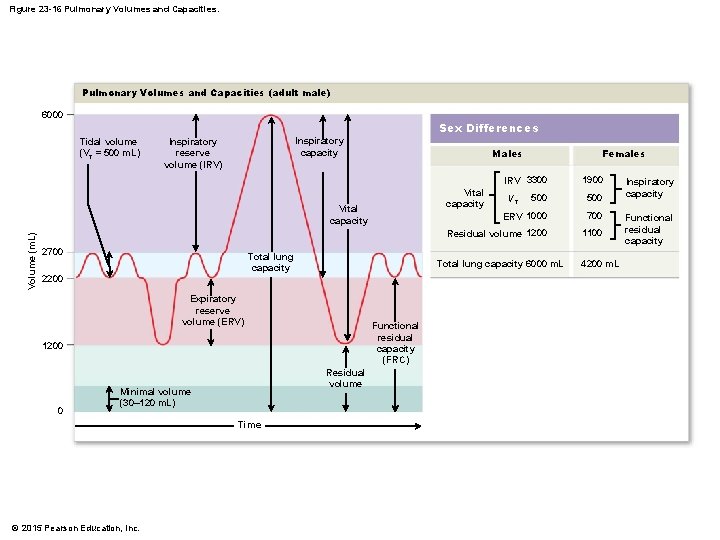
Figure 23 -16 Pulmonary Volumes and Capacities (adult male) 6000 Sex Differences Tidal volume (VT = 500 m. L) Inspiratory capacity Inspiratory reserve volume (IRV) Volume (m. L) Total lung capacity Expiratory reserve volume (ERV) Functional residual capacity (FRC) 1200 0 Residual volume Time © 2015 Pearson Education, Inc. 1900 500 ERV 1000 700 Residual volume 1200 1100 VT Total lung capacity 6000 m. L 2200 Minimal volume (30– 120 m. L) IRV 3300 Vital capacity 2700 Females Males 4200 m. L Inspiratory capacity Functional residual capacity
23 -8 Gas Exchange • Occurs between blood and alveolar air • Across the respiratory membrane • Depends on: 1. Partial pressures of the gases 2. Diffusion of molecules between gas and liquid © 2015 Pearson Education, Inc.
23 -8 Gas Exchange • The Gas Laws • Diffusion occurs in response to concentration gradients • Rate of diffusion depends on physical principles, or gas laws • For example, Boyle’s law © 2015 Pearson Education, Inc.
23 -8 Gas Exchange • Dalton’s Law and Partial Pressures • Composition of Air • • Nitrogen (N 2) is about 78. 6 percent Oxygen (O 2) is about 20. 9 percent Water vapor (H 2 O) is about 0. 5 percent Carbon dioxide (CO 2) is about 0. 04 percent © 2015 Pearson Education, Inc.
23 -8 Gas Exchange • Dalton’s Law and Partial Pressures • Atmospheric pressure (760 mm Hg) • Produced by air molecules bumping into each other • Each gas contributes to the total pressure • In proportion to its number of molecules (Dalton’s law) © 2015 Pearson Education, Inc.
23 -8 Gas Exchange • Diffusion between Liquids and Gases • Henry’s Law • When gas under pressure comes in contact with liquid: • Gas dissolves in liquid until equilibrium is reached • At a given temperature: • Amount of a gas in solution is proportional to partial pressure of that gas • The actual amount of a gas in solution (at given partial pressure and temperature): • Depends on the solubility of that gas in that particular liquid © 2015 Pearson Education, Inc.
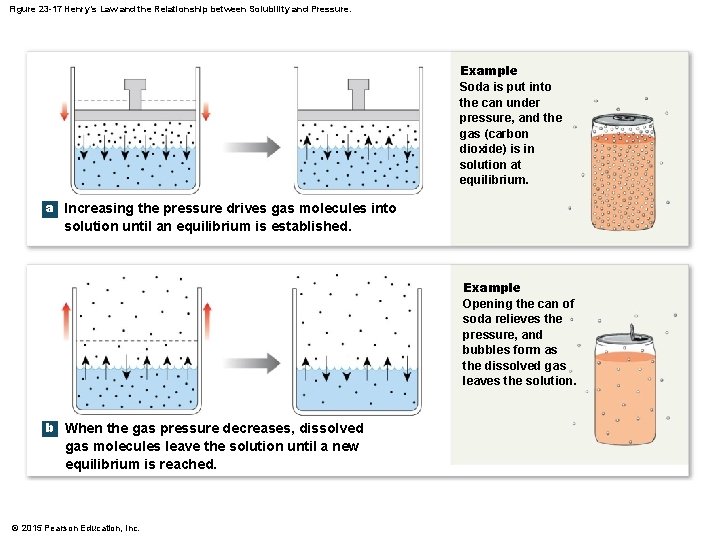
Figure 23 -17 Henry’s Law and the Relationship between Solubility and Pressure. Example Soda is put into the can under pressure, and the gas (carbon dioxide) is in solution at equilibrium. a Increasing the pressure drives gas molecules into solution until an equilibrium is established. Example Opening the can of soda relieves the pressure, and bubbles form as the dissolved gas leaves the solution. b When the gas pressure decreases, dissolved gas molecules leave the solution until a new equilibrium is reached. © 2015 Pearson Education, Inc.
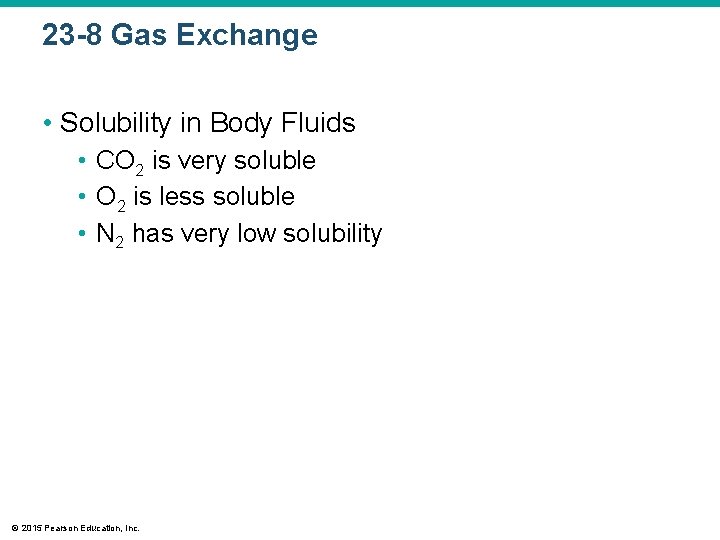
23 -8 Gas Exchange • Solubility in Body Fluids • CO 2 is very soluble • O 2 is less soluble • N 2 has very low solubility © 2015 Pearson Education, Inc.
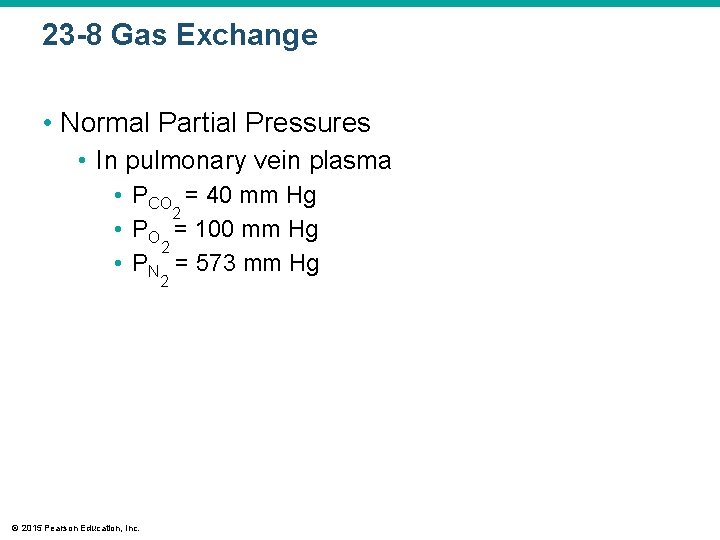
23 -8 Gas Exchange • Normal Partial Pressures • In pulmonary vein plasma • PCO = 40 mm Hg 2 • PO = 100 mm Hg 2 • PN = 573 mm Hg 2 © 2015 Pearson Education, Inc.
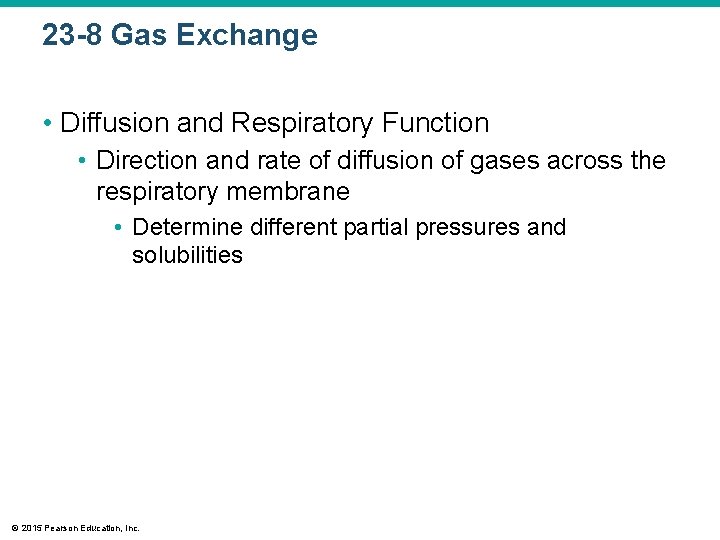
23 -8 Gas Exchange • Diffusion and Respiratory Function • Direction and rate of diffusion of gases across the respiratory membrane • Determine different partial pressures and solubilities © 2015 Pearson Education, Inc.
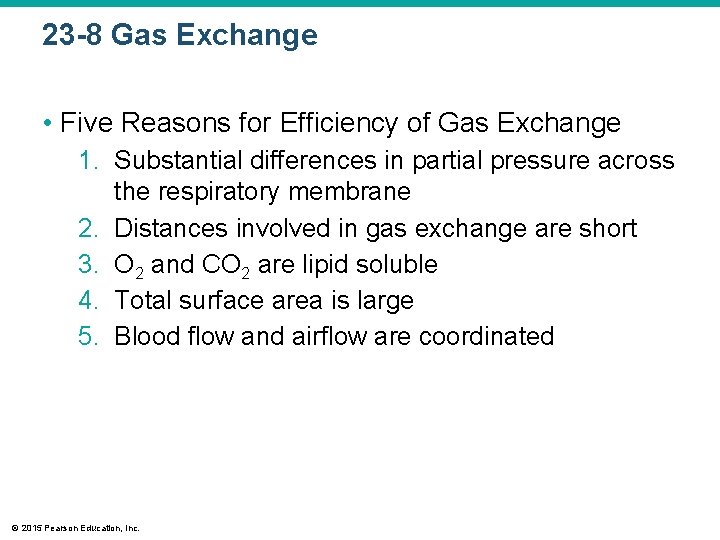
23 -8 Gas Exchange • Five Reasons for Efficiency of Gas Exchange 1. Substantial differences in partial pressure across the respiratory membrane 2. Distances involved in gas exchange are short 3. O 2 and CO 2 are lipid soluble 4. Total surface area is large 5. Blood flow and airflow are coordinated © 2015 Pearson Education, Inc.
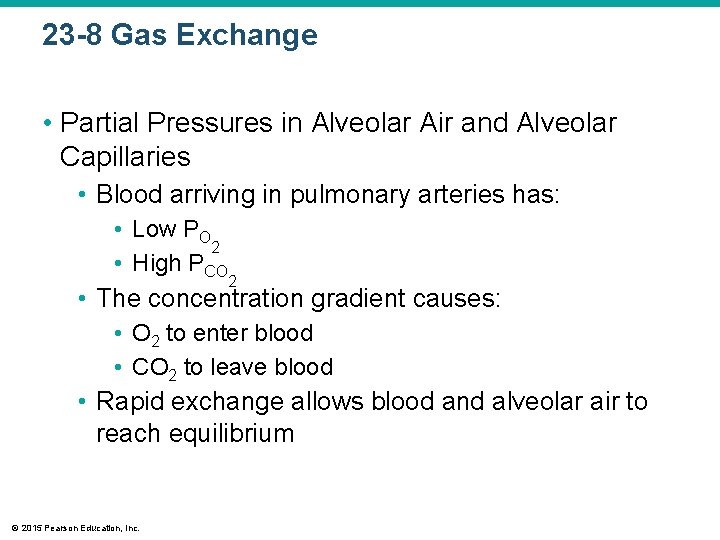
23 -8 Gas Exchange • Partial Pressures in Alveolar Air and Alveolar Capillaries • Blood arriving in pulmonary arteries has: • Low PO 2 • High PCO 2 • The concentration gradient causes: • O 2 to enter blood • CO 2 to leave blood • Rapid exchange allows blood and alveolar air to reach equilibrium © 2015 Pearson Education, Inc.
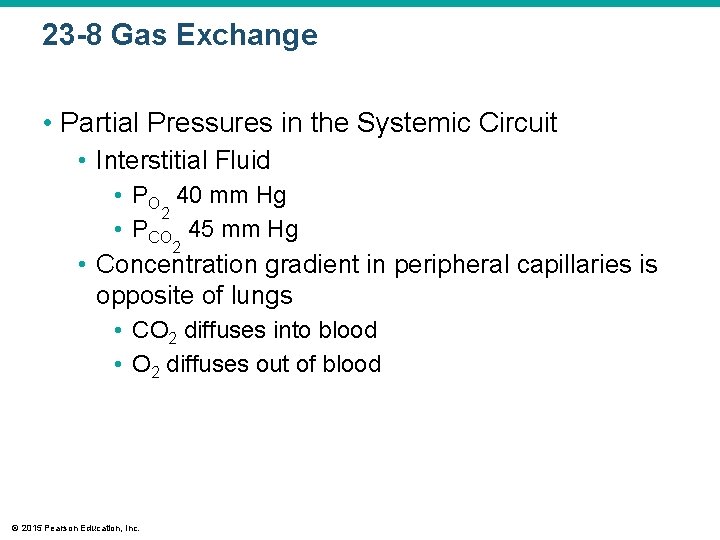
23 -8 Gas Exchange • Partial Pressures in the Systemic Circuit • Interstitial Fluid • PO 40 mm Hg 2 • PCO 45 mm Hg 2 • Concentration gradient in peripheral capillaries is opposite of lungs • CO 2 diffuses into blood • O 2 diffuses out of blood © 2015 Pearson Education, Inc.
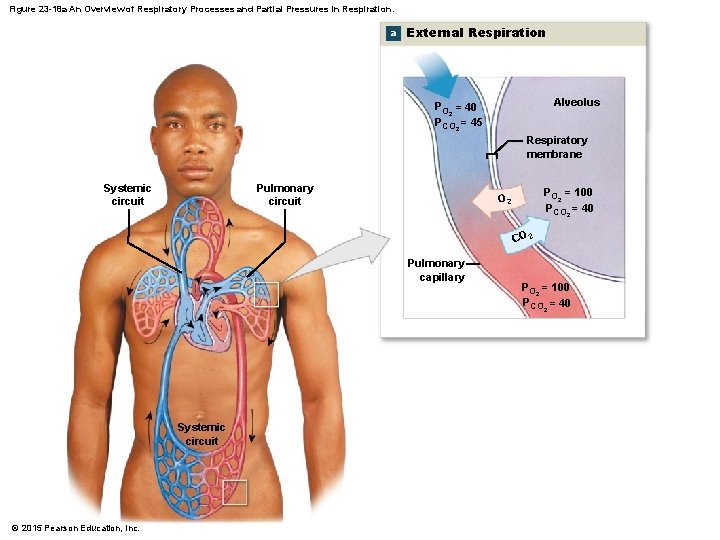
Figure 23 -18 a An Overview of Respiratory Processes and Partial Pressures in Respiration. a External Respiration Alveolus PO = 40 2 PCO 2 = 45 Respiratory membrane Systemic circuit Pulmonary circuit PO = 100 2 PCO 2 = 40 O 2 CO 2 Pulmonary capillary Systemic circuit © 2015 Pearson Education, Inc. PO = 100 2 PCO 2 = 40
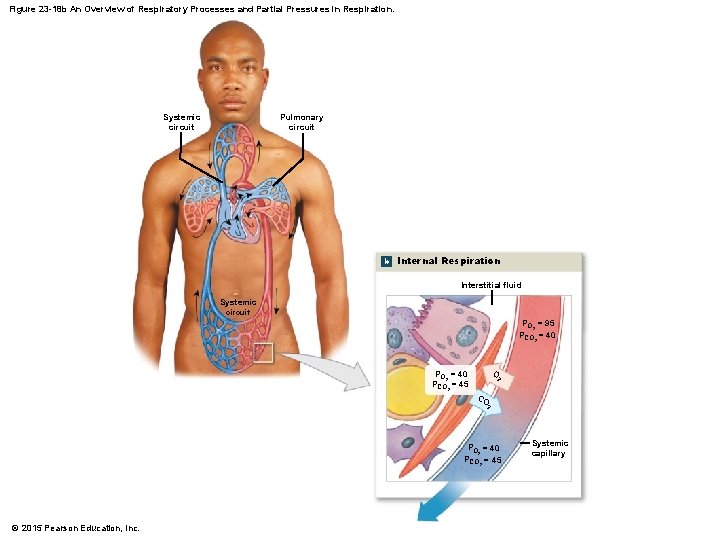
Figure 23 -18 b An Overview of Respiratory Processes and Partial Pressures in Respiration. Systemic circuit Pulmonary circuit b Internal Respiration Interstitial fluid Systemic circuit PO = 95 2 PCO 2 = 40 O PO = 40 2 PCO 2 = 45 2 CO 2 PO = 40 2 PCO 2 = 45 © 2015 Pearson Education, Inc. Systemic capillary
23 -9 Gas Transport • Gas Pickup and Delivery • Blood plasma cannot transport enough O 2 or CO 2 to meet physiological needs • Red Blood Cells (RBCs) • Transport O 2 to, and CO 2 from, peripheral tissues • Remove O 2 and CO 2 from plasma, allowing gases to diffuse into blood © 2015 Pearson Education, Inc.
23 -9 Gas Transport • Oxygen Transport • O 2 binds to iron ions in hemoglobin (Hb) molecules • In a reversible reaction • New molecule is called oxyhemoglobin (Hb. O 2) • Each RBC has about 280 million Hb molecules • Each binds four oxygen molecules © 2015 Pearson Education, Inc.
23 -9 Gas Transport • Hemoglobin Saturation • The percentage of heme units in a hemoglobin molecule that contain bound oxygen • Environmental Factors Affecting Hemoglobin • • PO of blood 2 Blood p. H Temperature Metabolic activity within RBCs © 2015 Pearson Education, Inc.
23 -9 Gas Transport • Oxygen–Hemoglobin Saturation Curve • A graph relating the saturation of hemoglobin to partial pressure of oxygen • Higher PO results in greater Hb saturation 2 • Curve rather than a straight line because Hb changes shape each time a molecule of O 2 is bound • Each O 2 bound makes next O 2 binding easier • Allows Hb to bind O 2 when O 2 levels are low © 2015 Pearson Education, Inc.
23 -9 Gas Transport • Oxygen Reserves • O 2 diffuses • From peripheral capillaries (high PO ) 2 • Into interstitial fluid (low PO ) 2 • Amount of O 2 released depends on interstitial PO 2 • Up to 3/4 may be reserved by RBCs © 2015 Pearson Education, Inc.
23 -9 Gas Transport • Carbon Monoxide • CO from burning fuels • Binds strongly to hemoglobin • Takes the place of O 2 • Can result in carbon monoxide poisoning © 2015 Pearson Education, Inc.
23 -9 Gas Transport • The Oxygen–Hemoglobin Saturation Curve • Is standardized for normal blood (p. H 7. 4, 37 C) • When p. H drops or temperature rises: • More oxygen is released • Curve shifts to right • When p. H rises or temperature drops: • Less oxygen is released • Curve shifts to left © 2015 Pearson Education, Inc.
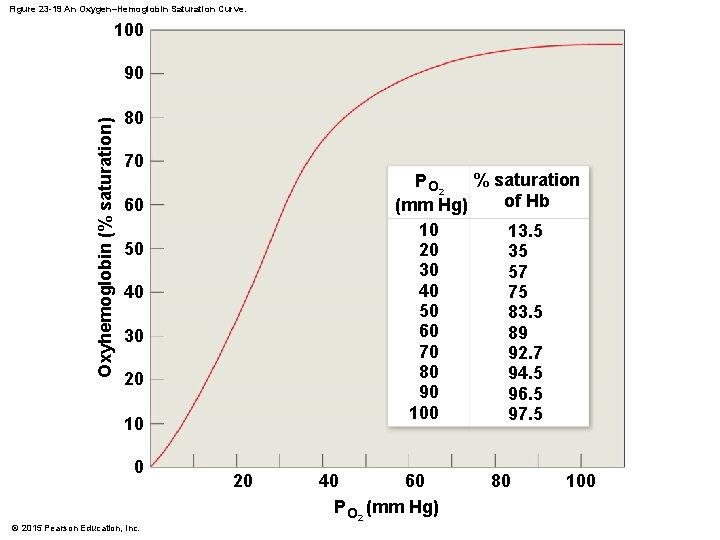
Figure 23 -19 An Oxygen–Hemoglobin Saturation Curve. 100 Oxyhemoglobin (% saturation) 90 80 70 % saturation P O 2 of Hb (mm Hg) 10 13. 5 20 35 30 57 40 75 50 83. 5 60 89 70 92. 7 80 94. 5 90 96. 5 100 97. 5 60 50 40 30 20 10 0 © 2015 Pearson Education, Inc. 20 40 60 P O 2 (mm Hg) 80 100
23 -9 Gas Transport • Hemoglobin and p. H • Bohr effect is the result of p. H on hemoglobinsaturation curve • Caused by CO 2 • CO 2 diffuses into RBC • An enzyme, called carbonic anhydrase, catalyzes reaction with H 2 O • Produces carbonic acid (H 2 CO 3) • Dissociates into hydrogen ion (H+) and bicarbonate ion (HCO 3 ) • Hydrogen ions diffuse out of RBC, lowering p. H © 2015 Pearson Education, Inc.
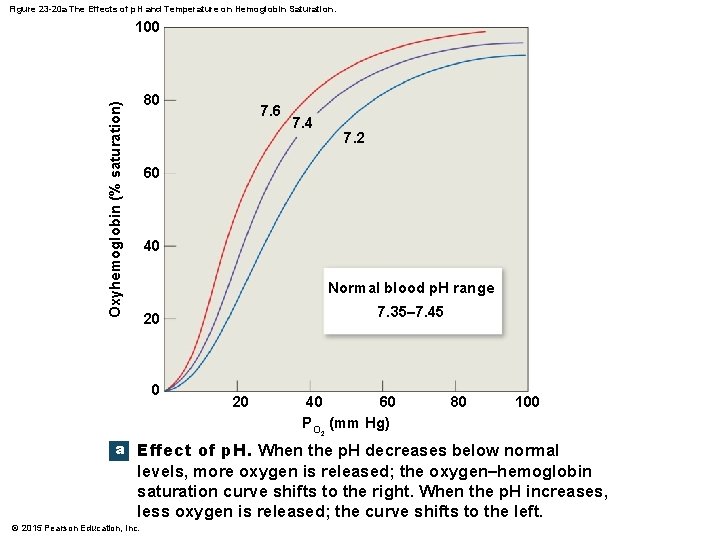
Figure 23 -20 a The Effects of p. H and Temperature on Hemoglobin Saturation. 100 Oxyhemoglobin (% saturation) 80 7. 6 7. 4 7. 2 60 40 Normal blood p. H range 7. 35– 7. 45 20 0 20 40 60 P O 2 (mm Hg) 80 100 a Effect of p. H. When the p. H decreases below normal levels, more oxygen is released; the oxygen–hemoglobin saturation curve shifts to the right. When the p. H increases, less oxygen is released; the curve shifts to the left. © 2015 Pearson Education, Inc.
23 -9 Gas Transport • Hemoglobin and Temperature • Temperature increase = hemoglobin releases more oxygen • Temperature decrease = hemoglobin holds oxygen more tightly • Temperature effects are significant only in active tissues that are generating large amounts of heat • For example, active skeletal muscles © 2015 Pearson Education, Inc.
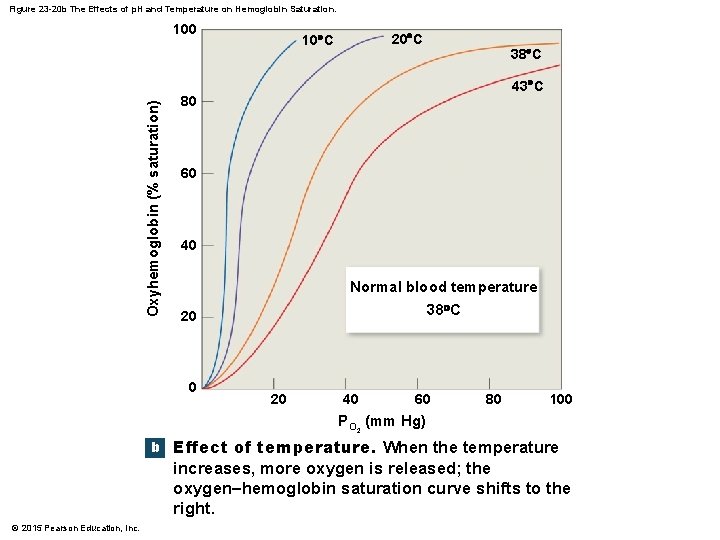
Figure 23 -20 b The Effects of p. H and Temperature on Hemoglobin Saturation. Oxyhemoglobin (% saturation) 100 20 C 10 C 38 C 43 C 80 60 40 Normal blood temperature 38 C 20 0 20 40 60 80 100 P O 2 (mm Hg) b Effect of temperature. When the temperature increases, more oxygen is released; the oxygen–hemoglobin saturation curve shifts to the right. © 2015 Pearson Education, Inc.
23 -9 Gas Transport • Hemoglobin and BPG • 2, 3 -bisphoglycerate (BPG) • RBCs generate ATP by glycolysis • Forming lactic acid and BPG • BPG directly affects O 2 binding and release • More BPG, more oxygen released © 2015 Pearson Education, Inc.
23 -9 Gas Transport • BPG Levels • BPG levels rise: • When p. H increases • When stimulated by certain hormones • If BPG levels are too low: • Hemoglobin will not release oxygen © 2015 Pearson Education, Inc.
23 -9 Gas Transport • Fetal Hemoglobin • The structure of fetal hemoglobin • Differs from that of adult Hb • At the same PO : 2 • Fetal Hb binds more O 2 than adult Hb • Which allows fetus to take O 2 from maternal blood © 2015 Pearson Education, Inc.
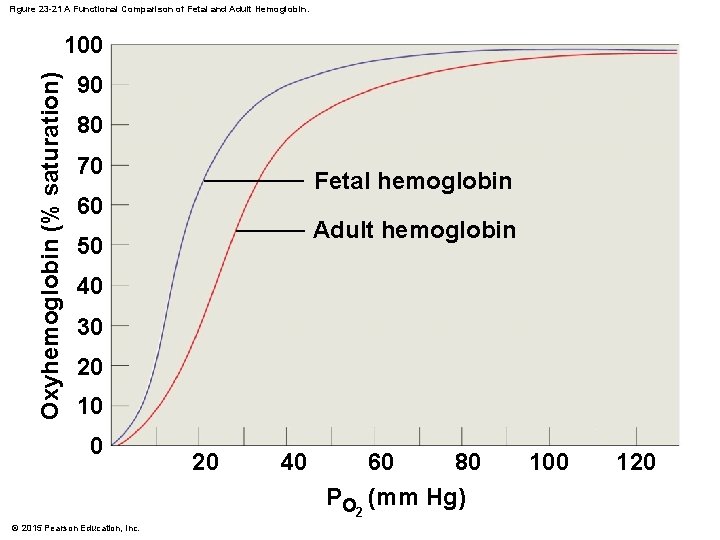
Figure 23 -21 A Functional Comparison of Fetal and Adult Hemoglobin. Oxyhemoglobin (% saturation) 100 90 80 70 Fetal hemoglobin 60 Adult hemoglobin 50 40 30 20 10 0 © 2015 Pearson Education, Inc. 20 40 60 80 PO 2 (mm Hg) 100 120
23 -9 Gas Transport • Carbon Dioxide Transport (CO 2) • Is generated as a by-product of aerobic metabolism (cellular respiration) • CO 2 in the bloodstream can be carried three ways 1. Converted to carbonic acid 2. Bound to hemoglobin within red blood cells 3. Dissolved in plasma © 2015 Pearson Education, Inc.
23 -9 Gas Transport • Carbonic Acid Formation • 70 percent is transported as carbonic acid (H 2 CO 3) • Which dissociates into H+ and bicarbonate (HCO 3 ) • Hydrogen ions bind to hemoglobin • Bicarbonate Ions • Move into plasma by an exchange mechanism (the chloride shift) that takes in Cl ions without using ATP © 2015 Pearson Education, Inc.
23 -9 Gas Transport • CO 2 Binding to Hemoglobin • 23 percent is bound to amino groups of globular proteins in Hb molecule • Forming carbaminohemoglobin • Transport in Plasma • 7 percent is transported as CO 2 dissolved in plasma © 2015 Pearson Education, Inc.
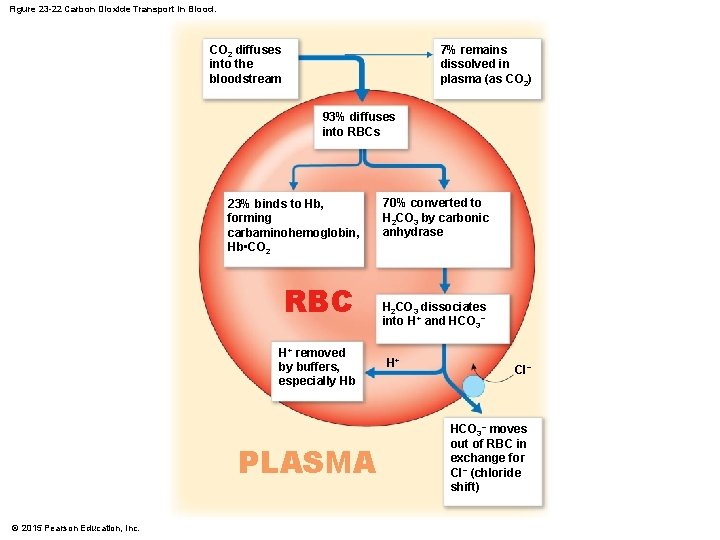
Figure 23 -22 Carbon Dioxide Transport in Blood. CO 2 diffuses into the bloodstream 7% remains dissolved in plasma (as CO 2) 93% diffuses into RBCs 23% binds to Hb, forming carbaminohemoglobin, Hb • CO 2 RBC H+ removed by buffers, especially Hb PLASMA © 2015 Pearson Education, Inc. 70% converted to H 2 CO 3 by carbonic anhydrase H 2 CO 3 dissociates into H+ and HCO 3− H+ Cl− HCO 3− moves out of RBC in exchange for Cl− (chloride shift)
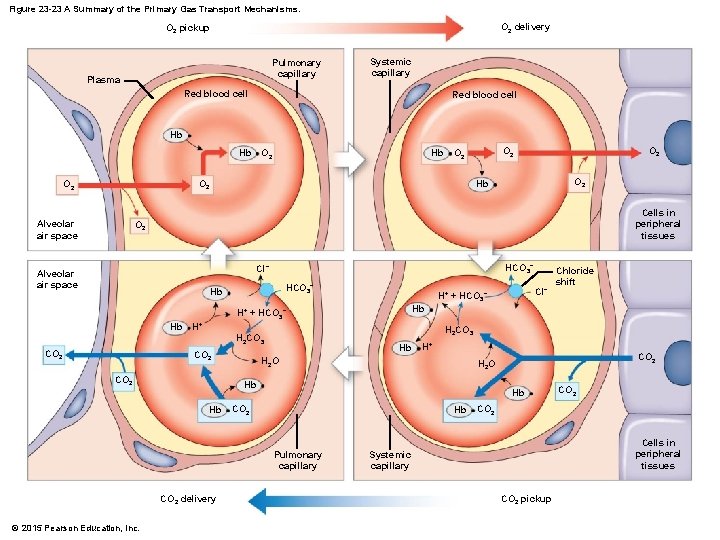
Figure 23 -23 A Summary of the Primary Gas Transport Mechanisms. O 2 delivery O 2 pickup Pulmonary capillary Plasma Systemic capillary Red blood cell Hb Hb Hb O 2 O 2 Alveolar air space O 2 O 2 Hb Cells in peripheral tissues O 2 HCO 3− Cl− Alveolar air space HCO 3 Hb − Hb H+ + HCO 3− Hb H+ H 2 CO 3 CO 2 Hb H 2 O CO 2 delivery CO 2 H 2 O Hb CO 2 Hb Pulmonary capillary © 2015 Pearson Education, Inc. H+ Hb Hb Cl− H+ + HCO 3− Chloride shift CO 2 Cells in peripheral tissues Systemic capillary CO 2 pickup
23 -10 Control of Respiration • Peripheral and Alveolar Capillaries • Maintain balance during gas diffusion by: 1. Changes in blood flow and oxygen delivery 2. Changes in depth and rate of respiration © 2015 Pearson Education, Inc.
23 -10 Control of Respiration • Local Regulation of Gas Transport and Alveolar Function • Rising PCO 2 levels • Relax smooth muscle in arterioles and capillaries • Increase blood flow • Coordination of lung perfusion and alveolar ventilation • Shifting blood flow • PCO 2 levels • Control bronchoconstriction and bronchodilation © 2015 Pearson Education, Inc.
23 -10 Control of Respiration • The Respiratory Centers of the Brain • When oxygen demand rises: • Cardiac output and respiratory rates increase under neural control • Have both voluntary and involuntary components © 2015 Pearson Education, Inc.
23 -10 Control of Respiration • The Respiratory Centers of the Brain • Voluntary centers in cerebral cortex affect: • Respiratory centers of pons and medulla oblongata • Motor neurons that control respiratory muscles • The Respiratory Centers • Three pairs of nuclei in the reticular formation of medulla oblongata and pons • Regulate respiratory muscles • In response to sensory information via respiratory reflexes © 2015 Pearson Education, Inc.
23 -10 Control of Respiration • Respiratory Centers of the Medulla Oblongata • Set the pace of respiration • Can be divided into two groups 1. Dorsal respiratory group (DRG) 2. Ventral respiratory group (VRG) © 2015 Pearson Education, Inc.
23 -10 Control of Respiration • Dorsal Respiratory Group (DRG) • Inspiratory center • Functions in quiet and forced breathing • Ventral Respiratory Group (VRG) • Inspiratory and expiratory center • Functions only in forced breathing © 2015 Pearson Education, Inc.
23 -10 Control of Respiration • Quiet Breathing • Brief activity in the DRG • Stimulates inspiratory muscles • DRG neurons become inactive • Allowing passive exhalation © 2015 Pearson Education, Inc.
23 -10 Control of Respiration • Respiratory Centers and Reflex Controls • Interactions between VRG and DRG • Establish basic pace and depth of respiration • The pneumotaxic center • Modifies the pace © 2015 Pearson Education, Inc.
23 -10 Control of Respiration • Sudden Infant Death Syndrome (SIDS) • Disrupts normal respiratory reflex pattern • May result from connection problems between pacemaker complex and respiratory centers © 2015 Pearson Education, Inc.
23 -10 Control of Respiration • Respiratory Reflexes • Chemoreceptors are sensitive to PCO 2, PO 2, or p. H of blood or cerebrospinal fluid • Baroreceptors in aortic or carotid sinuses are sensitive to changes in blood pressure • Stretch receptors respond to changes in lung volume • Irritating physical or chemical stimuli in nasal cavity, larynx, or bronchial tree • Other sensations including pain, changes in body temperature, abnormal visceral sensations © 2015 Pearson Education, Inc.
23 -10 Control of Respiration • The Chemoreceptor Reflexes • The glossopharyngeal nerve • From carotid bodies • Stimulated by changes in blood p. H or PO • The vagus nerve • From aortic bodies • Stimulated by changes in blood p. H or PO © 2015 Pearson Education, Inc. 2 2
23 -10 Control of Respiration • The Chemoreceptor Reflexes • Central chemoreceptors that monitor cerebrospinal fluid • Are on ventrolateral surface of medulla oblongata • Respond to PCO and p. H of CSF 2 © 2015 Pearson Education, Inc.
23 -10 Control of Respiration • Chemoreceptor Stimulation • Leads to increased depth and rate of respiration • Is subject to adaptation • Decreased sensitivity due to chronic stimulation © 2015 Pearson Education, Inc.
23 -10 Control of Respiration • Hypercapnia • An increase in arterial PCO 2 • Stimulates chemoreceptors in the medulla oblongata • To restore homeostasis © 2015 Pearson Education, Inc.
23 -10 Control of Respiration • Hypercapnia and Hypocapnia • Hypoventilation is a common cause of hypercapnia • Abnormally low respiration rate • Allows CO 2 buildup in blood • Excessive ventilation, hyperventilation, results in abnormally low PCO (hypocapnia) 2 • Stimulates chemoreceptors to decrease respiratory rate © 2015 Pearson Education, Inc.
23 -10 Control of Respiration • The Baroreceptor Reflexes • Carotid and aortic baroreceptor stimulation • Affects blood pressure and respiratory centers • When blood pressure falls: • Respiration increases • When blood pressure increases: • Respiration decreases © 2015 Pearson Education, Inc.
23 -10 Control of Respiration • The Hering Breuer Reflexes • Two baroreceptor reflexes involved in forced breathing 1. Inflation reflex • Prevents overexpansion of lungs 2. Deflation reflex • Inhibits expiratory centers • Stimulates inspiratory centers during lung deflation © 2015 Pearson Education, Inc.
23 -10 Control of Respiration • Protective Reflexes • Triggered by receptors in epithelium of respiratory tract when lungs are exposed to: • Toxic vapors • Chemical irritants • Mechanical stimulation • Cause sneezing, coughing, and laryngeal spasm © 2015 Pearson Education, Inc.
23 -10 Control of Respiration • Apnea • A period of suspended respiration • Normally followed by explosive exhalation to clear airways • Sneezing and coughing • Laryngeal Spasm • Temporarily closes airway • To prevent foreign substances from entering © 2015 Pearson Education, Inc.
23 -10 Control of Respiration • Voluntary Control of Respiration • Strong emotions can stimulate respiratory centers in hypothalamus • Emotional stress can activate sympathetic or parasympathetic division of ANS • Causing bronchodilation or bronchoconstriction • Anticipation of strenuous exercise can increase respiratory rate and cardiac output by sympathetic stimulation © 2015 Pearson Education, Inc.
23 -10 Control of Respiration • Changes in the Respiratory System at Birth • Before birth • Pulmonary vessels are collapsed • Lungs contain no air • During delivery • Placental connection is lost • Blood PO 2 falls • PCO 2 rises © 2015 Pearson Education, Inc.
23 -10 Control of Respiration • Changes in the Respiratory System at Birth • At birth • Newborn overcomes force of surface tension to inflate bronchial tree and alveoli and take first breath • Large drop in pressure at first breath • Pulls blood into pulmonary circulation • Closing foramen ovale and ductus arteriosus • Redirecting fetal blood circulation patterns • Subsequent breaths fully inflate alveoli © 2015 Pearson Education, Inc.
23 -11 Effects of Aging on the Respiratory System • Three Effects of Aging on the Respiratory System 1. Elastic tissues deteriorate • Altering lung compliance and lowering vital capacity 2. Arthritic changes • Restrict chest movements • Limit respiratory minute volume 3. Emphysema • Affects individuals over age 50 • Depending on exposure to respiratory irritants (e. g. , cigarette smoke) © 2015 Pearson Education, Inc.
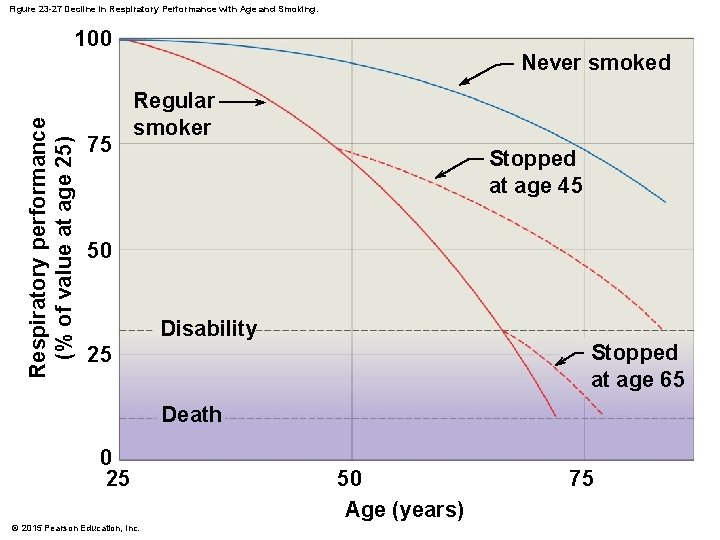
Figure 23 -27 Decline in Respiratory Performance with Age and Smoking. Respiratory performance (% of value at age 25) 100 75 Never smoked Regular smoker Stopped at age 45 50 Disability Stopped at age 65 25 Death 0 25 © 2015 Pearson Education, Inc. 50 Age (years) 75
23 -12 Respiratory System Integration • Respiratory Activity • Maintaining homeostatic O 2 and CO 2 levels in peripheral tissues requires coordination between several systems • Particularly the respiratory and cardiovascular systems © 2015 Pearson Education, Inc.
23 -12 Respiratory System Integration • Coordination of Respiratory and Cardiovascular Systems • Improves efficiency of gas exchange by controlling lung perfusion • Increases respiratory drive through chemoreceptor stimulation • Raises cardiac output and blood flow through baroreceptor stimulation © 2015 Pearson Education, Inc.
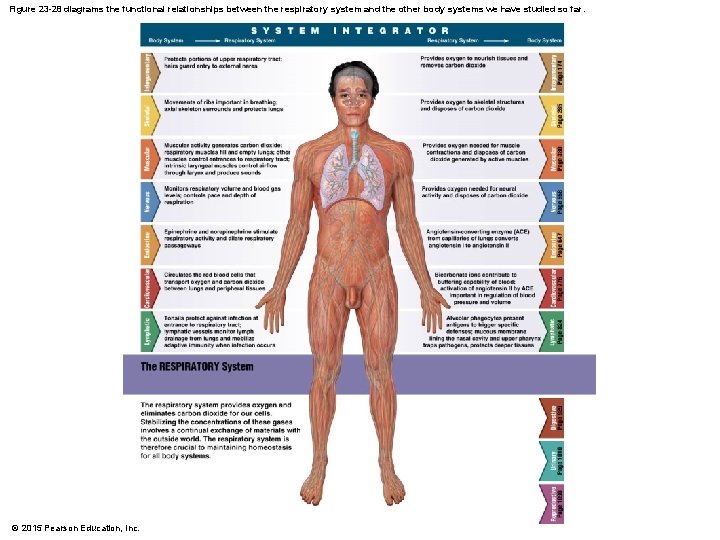
Figure 23 -28 diagrams the functional relationships between the respiratory system and the other body systems we have studied so far. © 2015 Pearson Education, Inc.
- Slides: 180