
Chapter 23 The Evolution of Populations Must Know
- Slides: 37
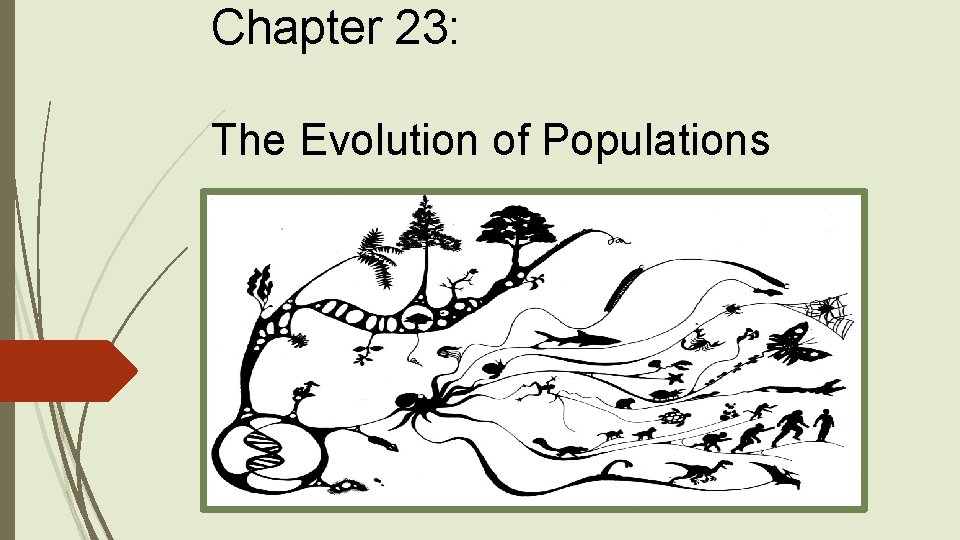
Chapter 23: The Evolution of Populations
Must Know: How mutation and sexual reproduction each produce genetic variation. the conditions for Hardy-Weinberg equilibrium. How to use the Hardy Weinberg equation to calculate allele frequencies to test whether a population is evolving. What effects genetic drift migration or selection may have on population, and analyze data to justify your prediction.
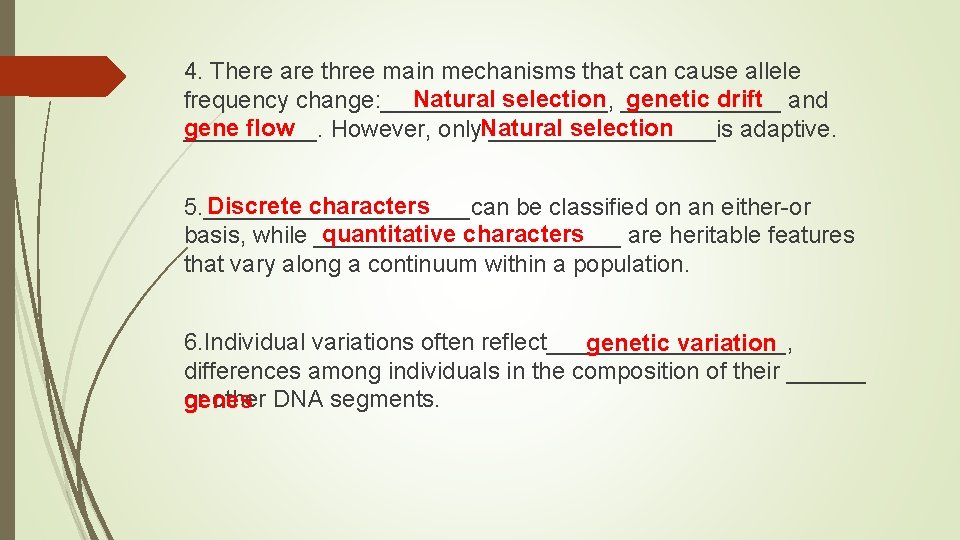
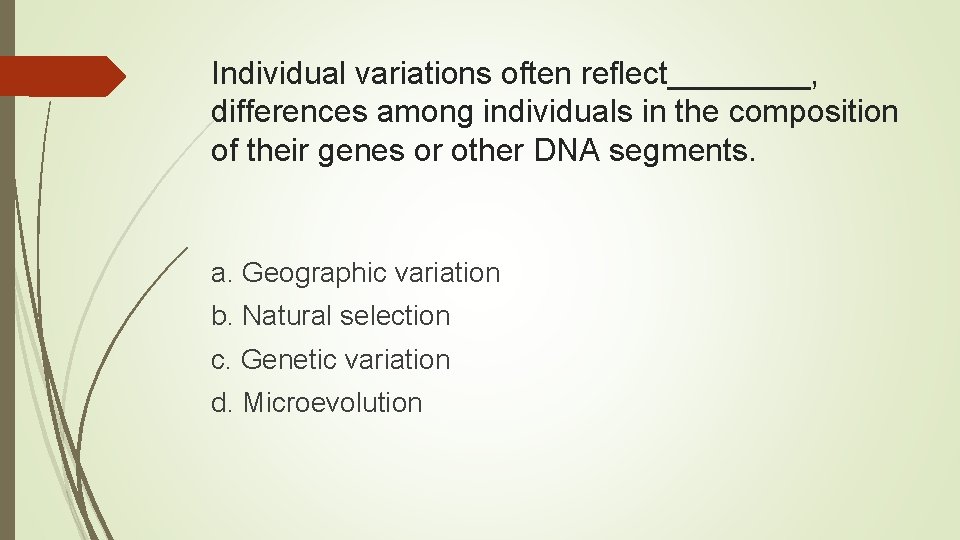
1. Individual variations often reflect____, differences among individuals in the composition of their genes or other DNA segments. a. Geographic variation b. Natural selection c. Genetic variation d. Microevolution
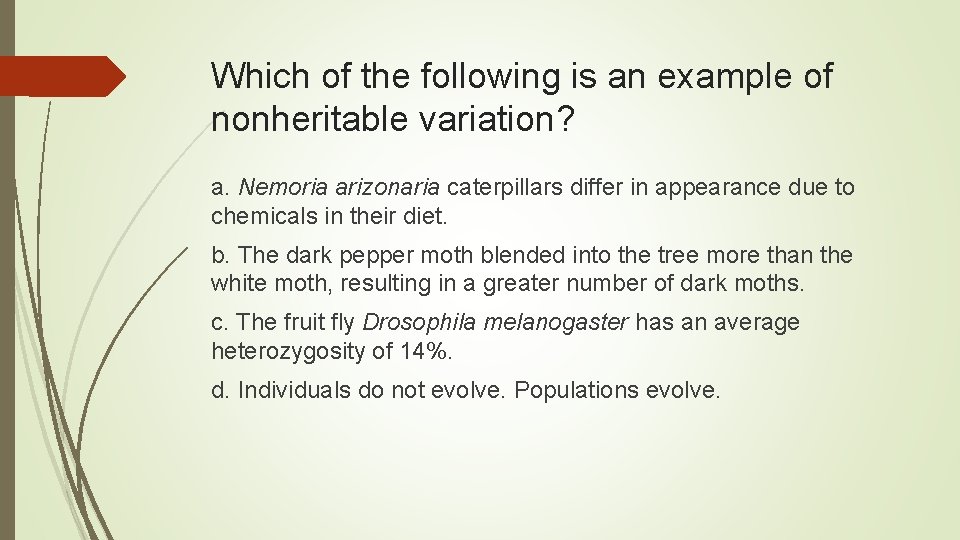
2. Which of the following is an example of nonheritable variation? a. Nemoria arizonaria caterpillars differ in appearance due to chemicals in their diet. b. The dark pepper moth blended into the tree more than the white moth, resulting in a greater number of dark moths. c. The fruit fly Drosophila melanogaster has an average heterozygosity of 14%. d. Individuals do not evolve. Populations evolve.
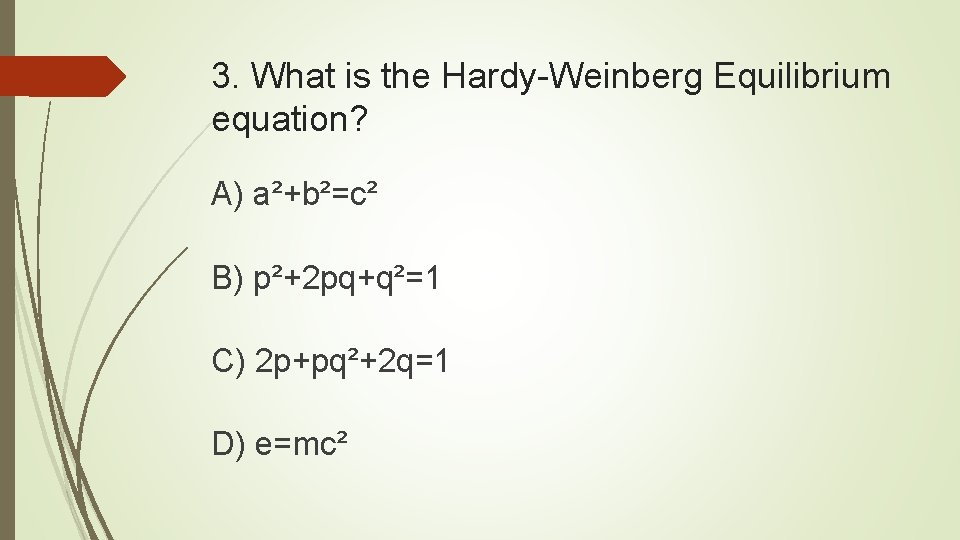
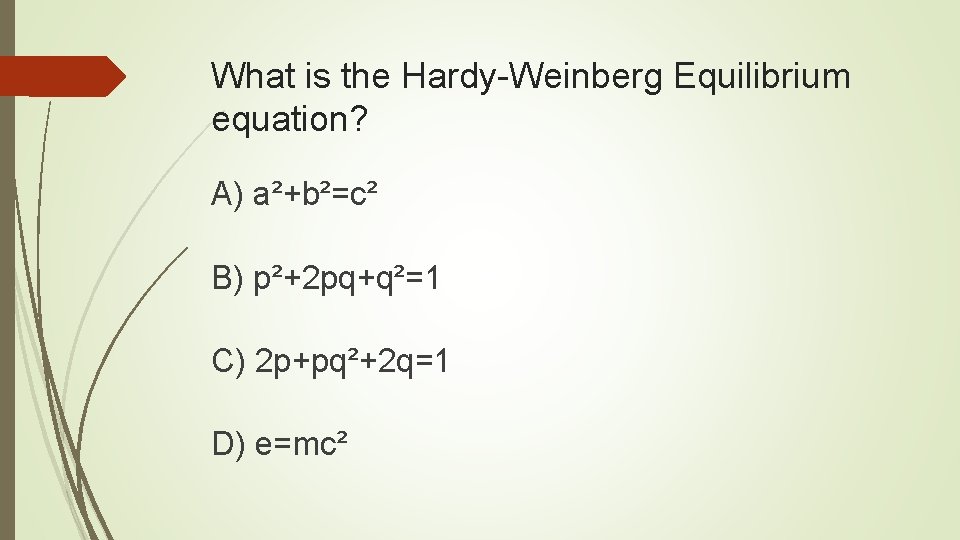
3. What is the Hardy-Weinberg Equilibrium equation? A) a²+b²=c² B) p²+2 pq+q²=1 C) 2 p+pq²+2 q=1 D) e=mc²
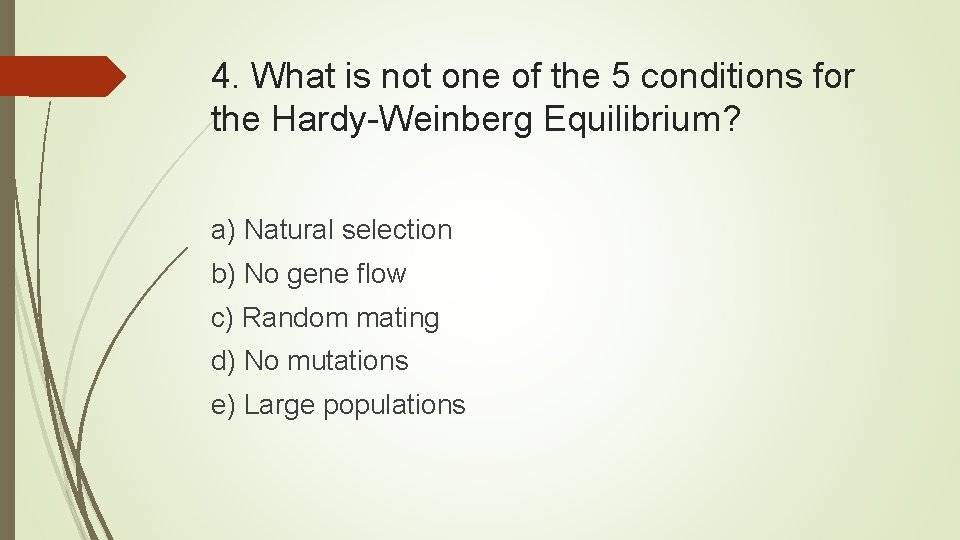
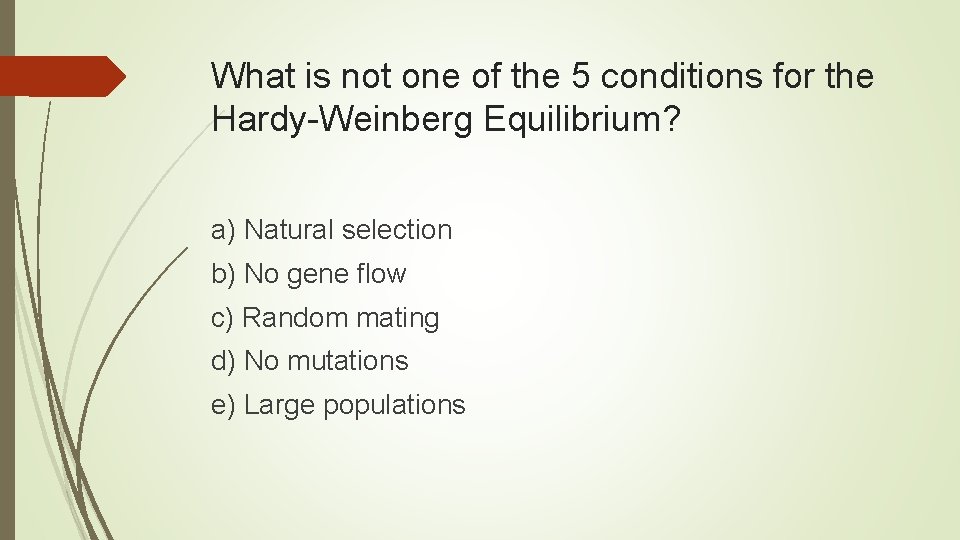
4. What is not one of the 5 conditions for the Hardy-Weinberg Equilibrium? a) Natural selection b) No gene flow c) Random mating d) No mutations e) Large populations
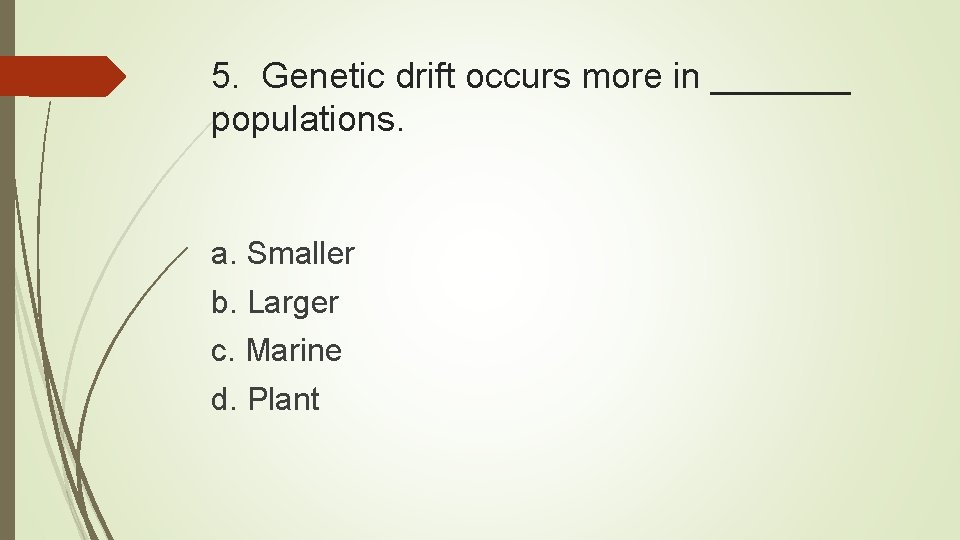
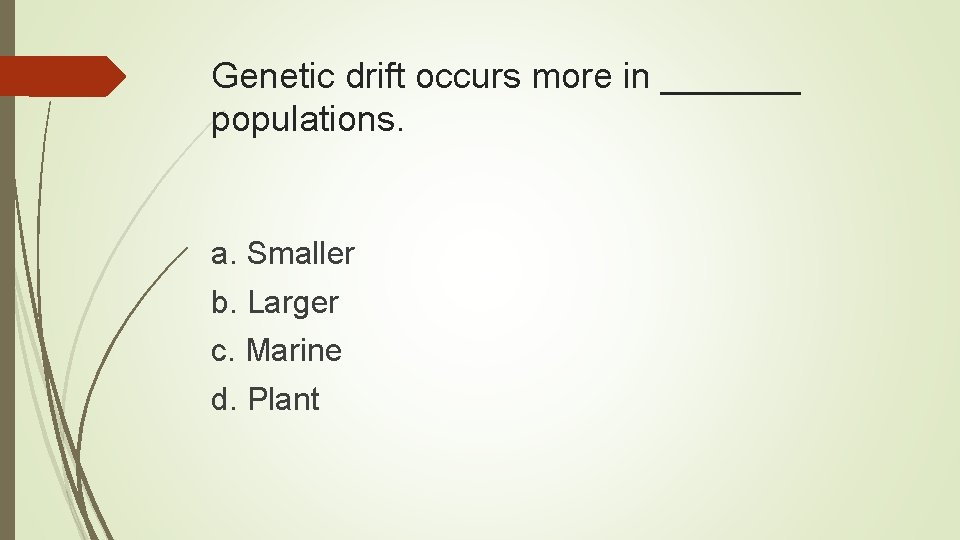
5. Genetic drift occurs more in _______ populations. a. Smaller b. Larger c. Marine d. Plant
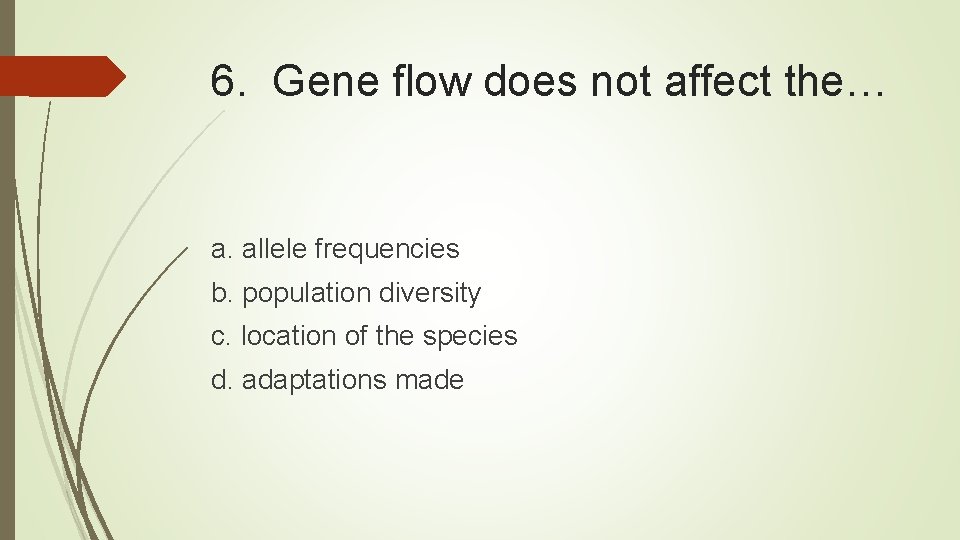
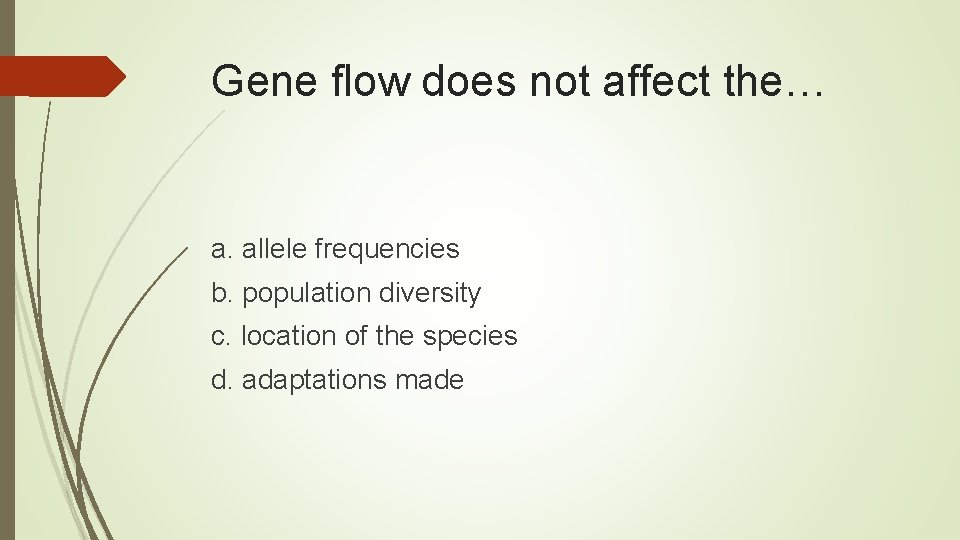
6. Gene flow does not affect the… a. allele frequencies b. population diversity c. location of the species d. adaptations made
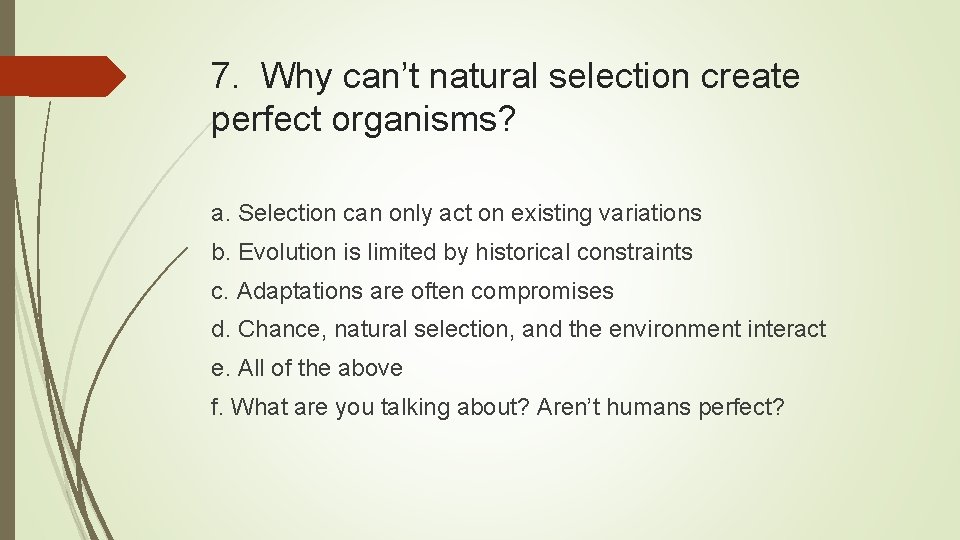
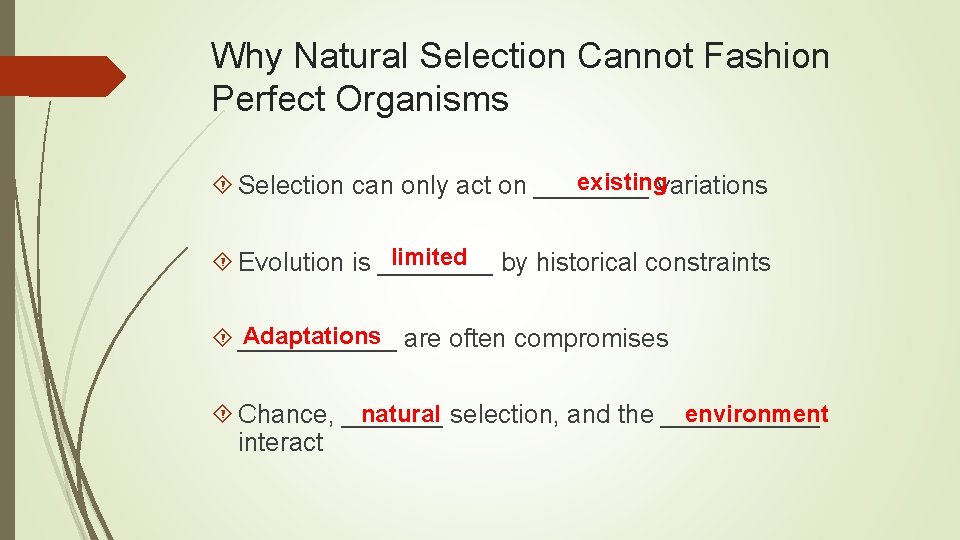
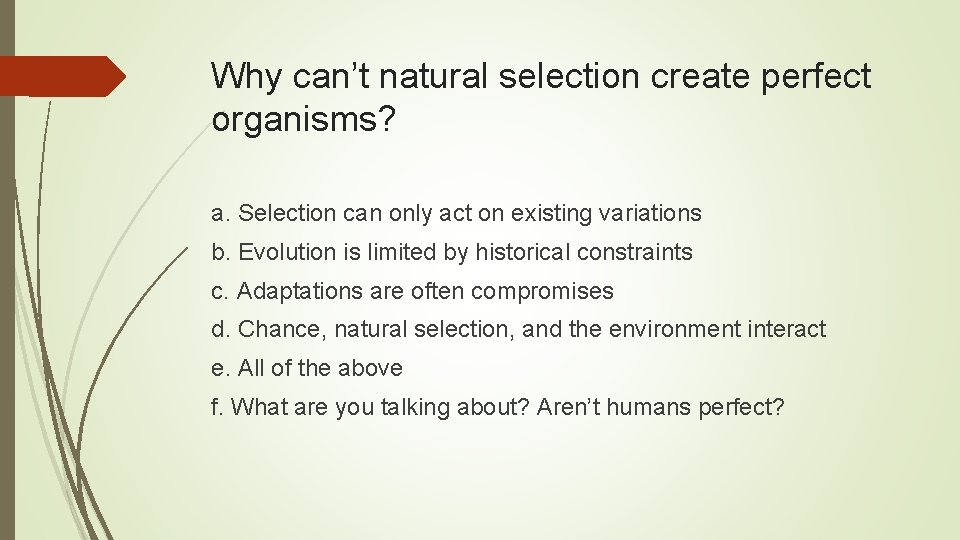
7. Why can’t natural selection create perfect organisms? a. Selection can only act on existing variations b. Evolution is limited by historical constraints c. Adaptations are often compromises d. Chance, natural selection, and the environment interact e. All of the above f. What are you talking about? Aren’t humans perfect?
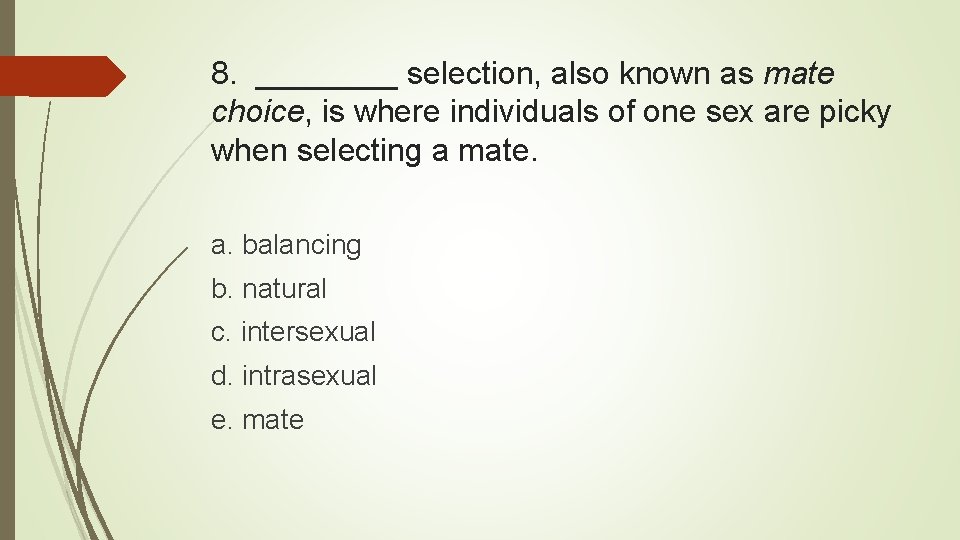
8. ____ selection, also known as mate choice, is where individuals of one sex are picky when selecting a mate. a. balancing b. natural c. intersexual d. intrasexual e. mate
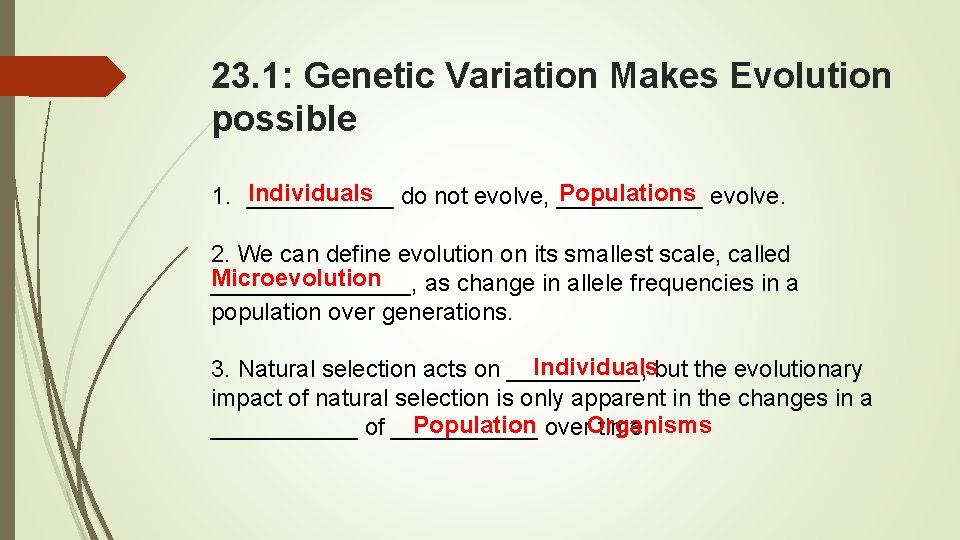
23. 1: Genetic Variation Makes Evolution possible Individuals Populations evolve. 1. ______ do not evolve, ______ 2. We can define evolution on its smallest scale, called Microevolution ________, as change in allele frequencies in a population over generations. Individuals 3. Natural selection acts on _____, but the evolutionary impact of natural selection is only apparent in the changes in a Population Organisms ______ of ______ over time.
4. There are three main mechanisms that can cause allele Natural selection genetic drift frequency change: _________, ______ and gene flow Natural selection _____. However, only _________is adaptive. Discrete characters 5. __________can be classified on an either-or quantitative characters basis, while ____________ are heritable features that vary along a continuum within a population. 6. Individual variations often reflect_________, genetic variation differences among individuals in the composition of their ______ or other DNA segments. genes
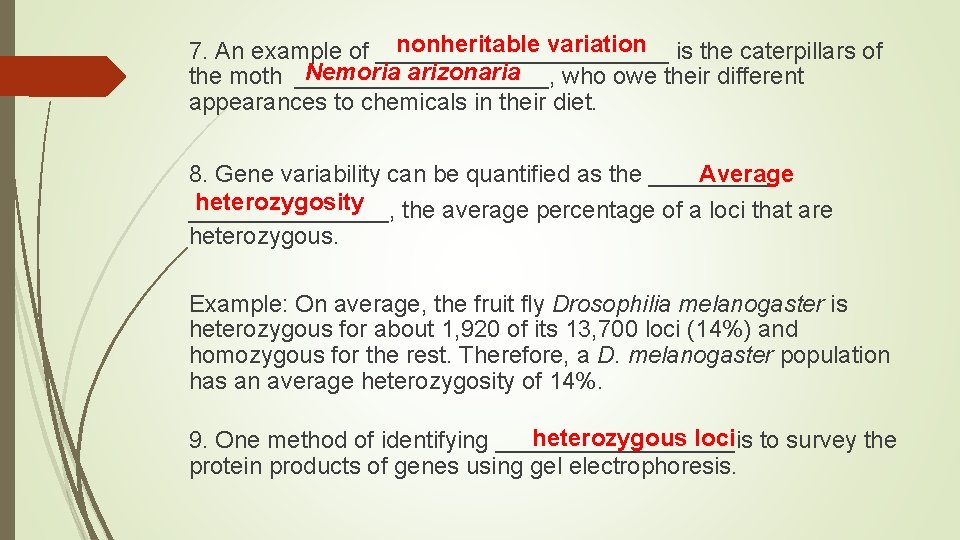
nonheritable variation 7. An example of ___________ is the caterpillars of Nemoria arizonaria the moth __________, who owe their different appearances to chemicals in their diet. Average 8. Gene variability can be quantified as the _____ heterozygosity ________, the average percentage of a loci that are heterozygous. Example: On average, the fruit fly Drosophilia melanogaster is heterozygous for about 1, 920 of its 13, 700 loci (14%) and homozygous for the rest. Therefore, a D. melanogaster population has an average heterozygosity of 14%. heterozygous loci 9. One method of identifying _________is to survey the protein products of genes using gel electrophoresis.
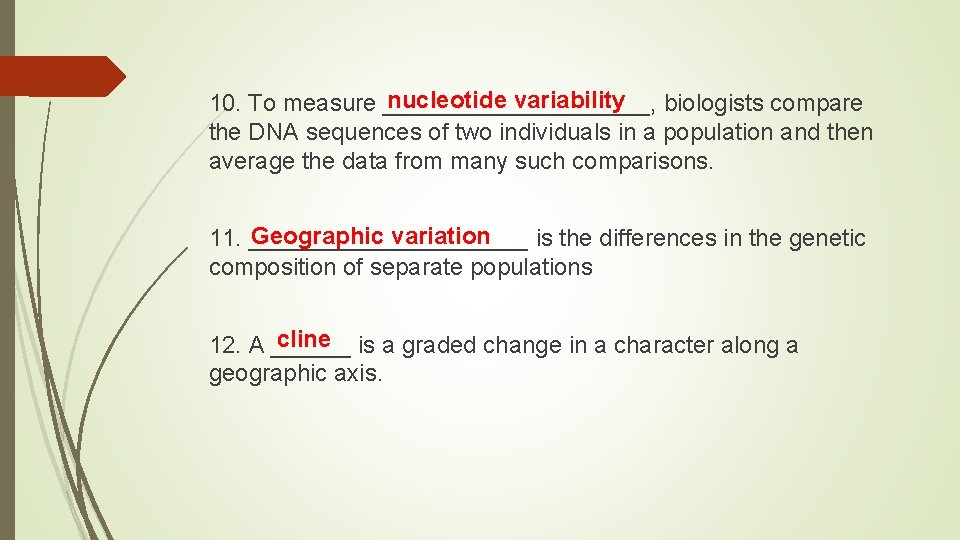
nucleotide variability 10. To measure __________, biologists compare the DNA sequences of two individuals in a population and then average the data from many such comparisons. Geographic variation 11. ___________ is the differences in the genetic composition of separate populations cline 12. A ______ is a graded change in a character along a geographic axis.
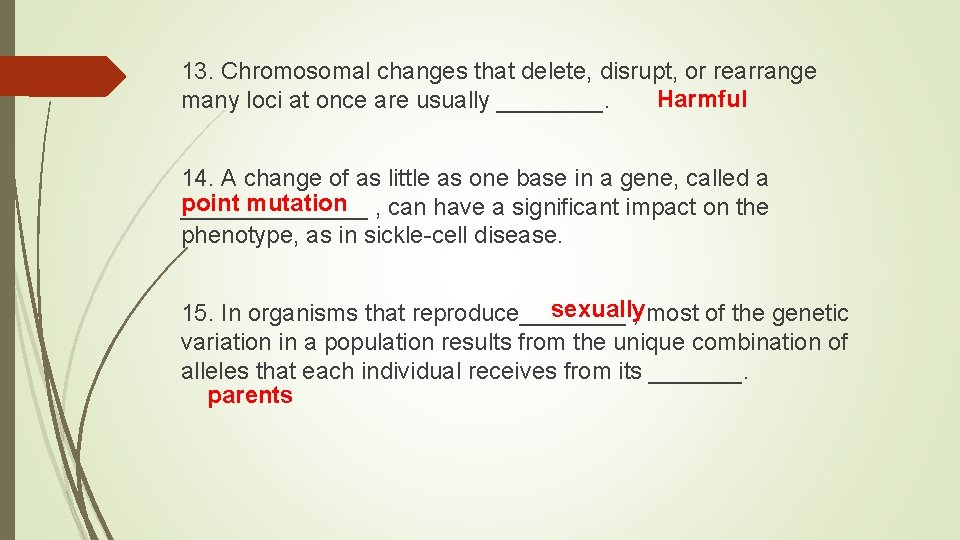
13. Chromosomal changes that delete, disrupt, or rearrange Harmful many loci at once are usually ____. 14. A change of as little as one base in a gene, called a point mutation _______ , can have a significant impact on the phenotype, as in sickle-cell disease. sexually 15. In organisms that reproduce____ , most of the genetic variation in a population results from the unique combination of alleles that each individual receives from its _______. parents
23. 2: The Hardy-Weinberg Equilibrium Key Ideas: The frequency of each allele in a population that is not effected by evolution. Conditions for Hardy. Weinberg Equilibrium
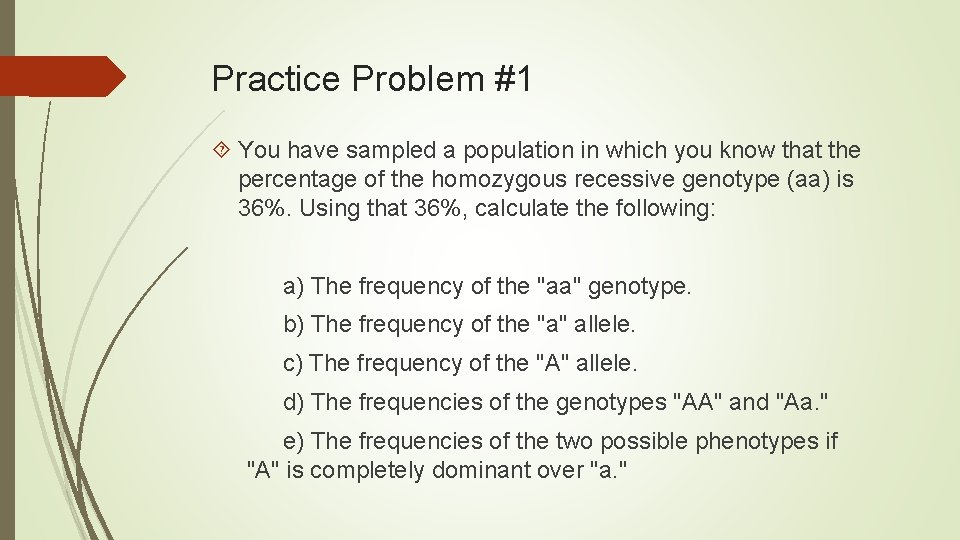
Practice Problem #1 You have sampled a population in which you know that the percentage of the homozygous recessive genotype (aa) is 36%. Using that 36%, calculate the following: a) The frequency of the "aa" genotype. b) The frequency of the "a" allele. c) The frequency of the "A" allele. d) The frequencies of the genotypes "AA" and "Aa. " e) The frequencies of the two possible phenotypes if "A" is completely dominant over "a. "
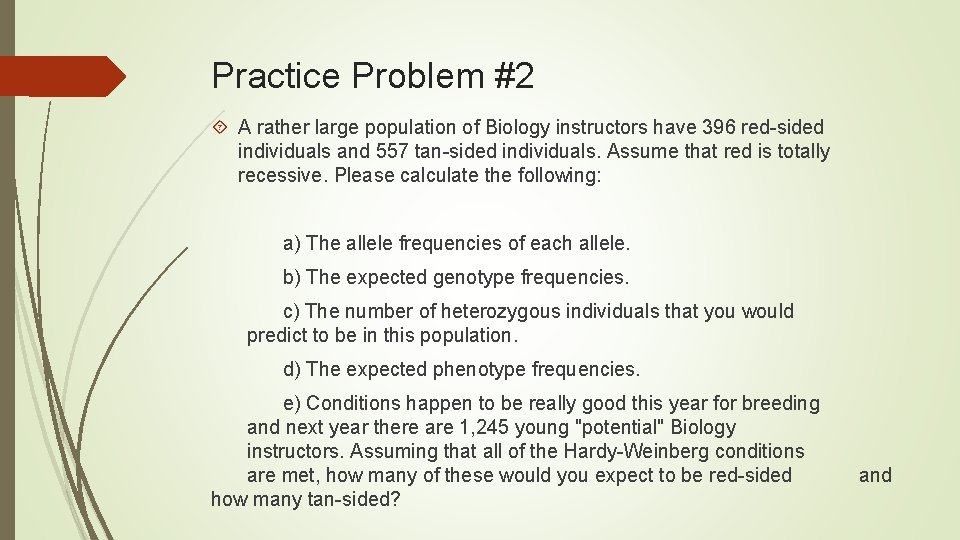
Practice Problem #2 A rather large population of Biology instructors have 396 red-sided individuals and 557 tan-sided individuals. Assume that red is totally recessive. Please calculate the following: a) The allele frequencies of each allele. b) The expected genotype frequencies. c) The number of heterozygous individuals that you would predict to be in this population. d) The expected phenotype frequencies. e) Conditions happen to be really good this year for breeding and next year there are 1, 245 young "potential" Biology instructors. Assuming that all of the Hardy-Weinberg conditions are met, how many of these would you expect to be red-sided how many tan-sided? and
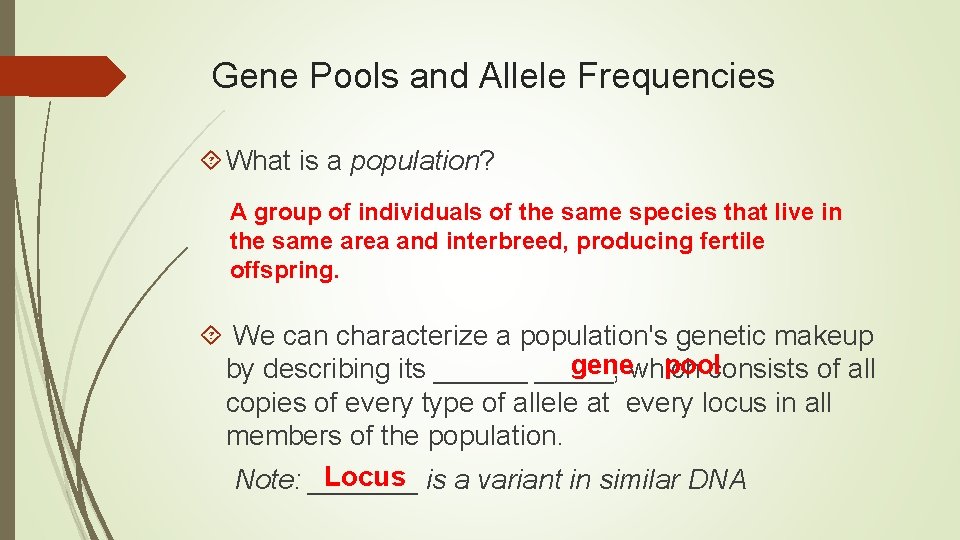
Gene Pools and Allele Frequencies What is a population? A group of individuals of the same species that live in the same area and interbreed, producing fertile offspring. We can characterize a population's genetic makeup gene pool by describing its ______, which consists of all copies of every type of allele at every locus in all members of the population. Locus is a variant in similar DNA Note: _______
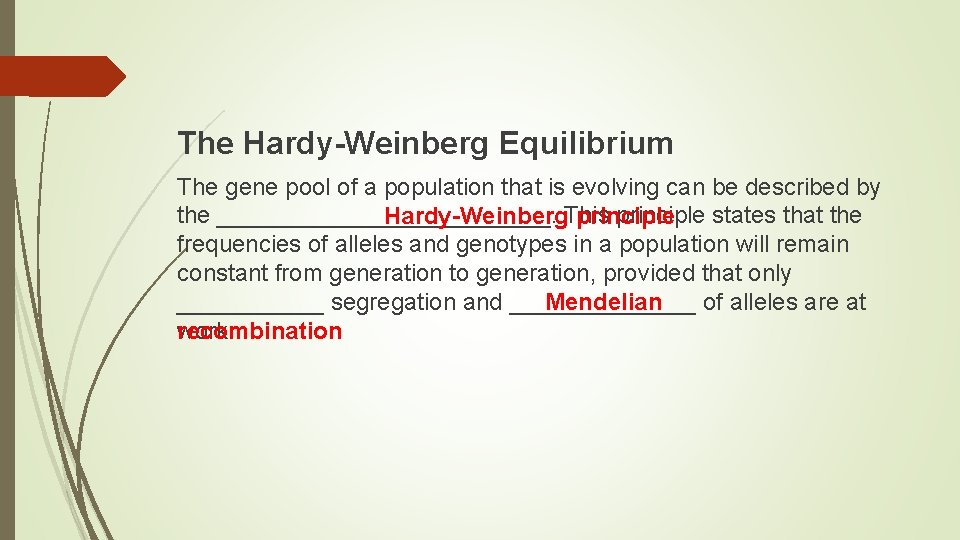
The Hardy-Weinberg Equilibrium The gene pool of a population that is evolving can be described by the _____________. This principle states that the Hardy-Weinberg principle frequencies of alleles and genotypes in a population will remain constant from generation to generation, provided that only ______ segregation and _______ of alleles are at Mendelian work. recombination
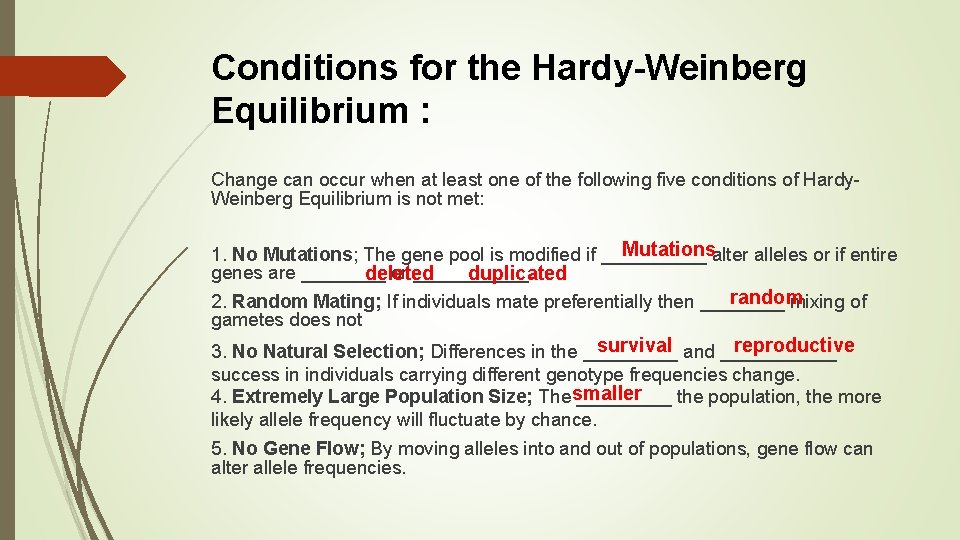
Conditions for the Hardy-Weinberg Equilibrium : Change can occur when at least one of the following five conditions of Hardy. Weinberg Equilibrium is not met: Mutations 1. No Mutations; The gene pool is modified if _____ alter alleles or if entire genes are ____ or ______. deleted duplicated random 2. Random Mating; If individuals mate preferentially then ____ mixing of gametes does not survival reproductive 3. No Natural Selection; Differences in the _____ and ______ success in individuals carrying different genotype frequencies change. smaller 4. Extremely Large Population Size; The _____ the population, the more likely allele frequency will fluctuate by chance. 5. No Gene Flow; By moving alleles into and out of populations, gene flow can alter allele frequencies.
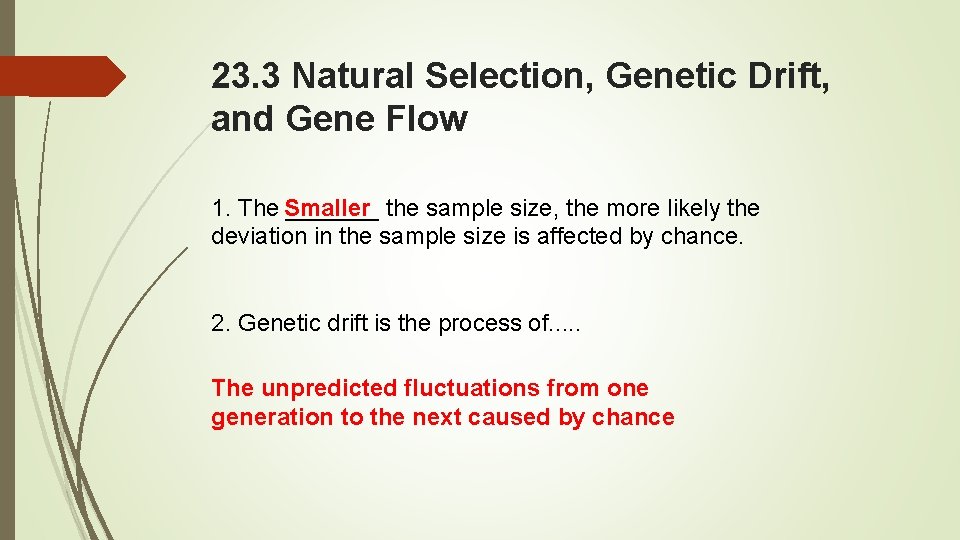
23. 3 Natural Selection, Genetic Drift, and Gene Flow Smaller 1. The _______ the sample size, the more likely the deviation in the sample size is affected by chance. 2. Genetic drift is the process of. . . The unpredicted fluctuations from one generation to the next caused by chance
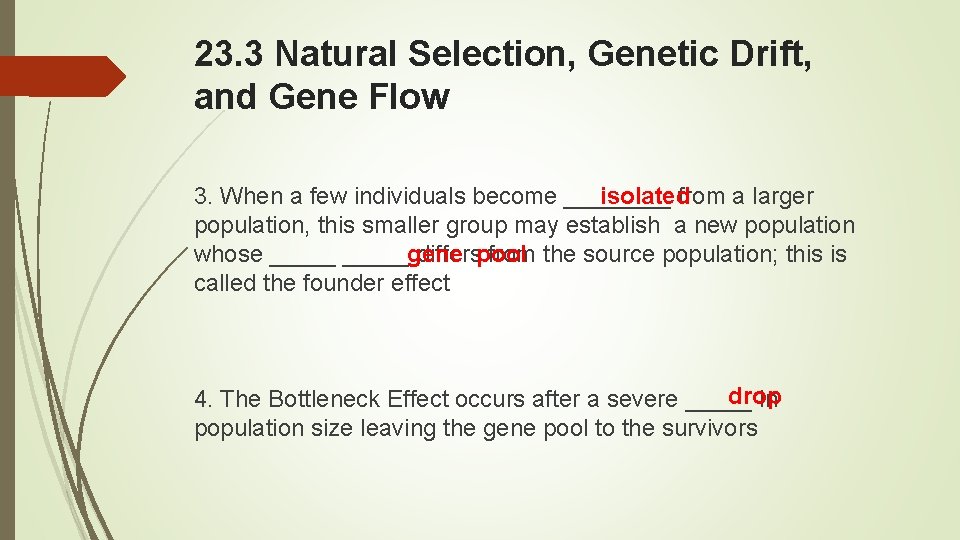
23. 3 Natural Selection, Genetic Drift, and Gene Flow 3. When a few individuals become ____ from a larger isolated population, this smaller group may establish a new population whose _____ differs from the source population; this is gene pool called the founder effect drop 4. The Bottleneck Effect occurs after a severe _____ in population size leaving the gene pool to the survivors
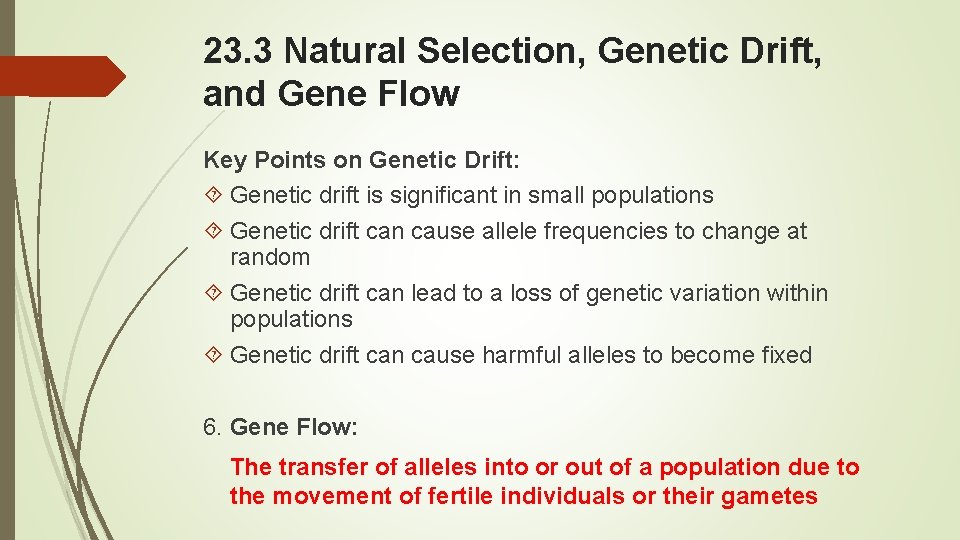
23. 3 Natural Selection, Genetic Drift, and Gene Flow Key Points on Genetic Drift: Genetic drift is significant in small populations Genetic drift can cause allele frequencies to change at random Genetic drift can lead to a loss of genetic variation within populations Genetic drift can cause harmful alleles to become fixed 6. Gene Flow: The transfer of alleles into or out of a population due to the movement of fertile individuals or their gametes
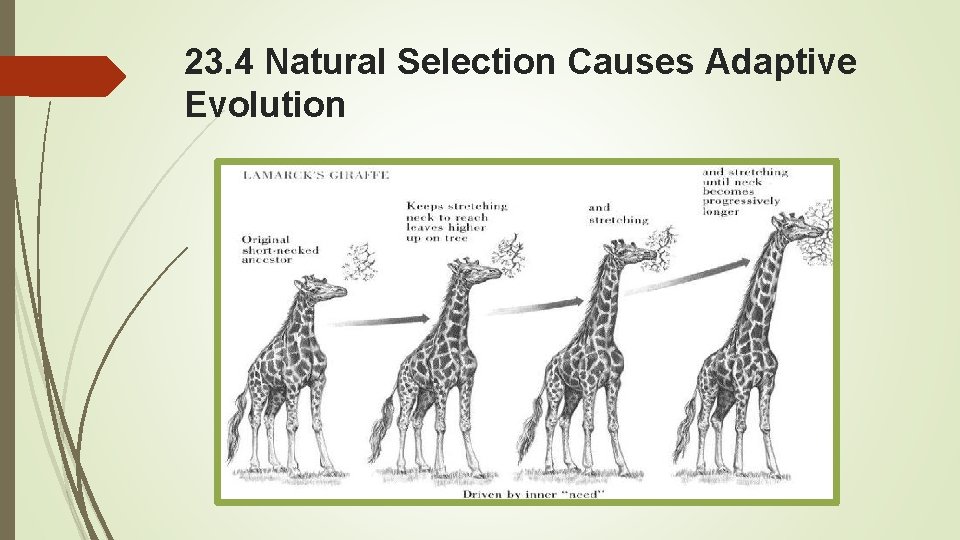
23. 4 Natural Selection Causes Adaptive Evolution
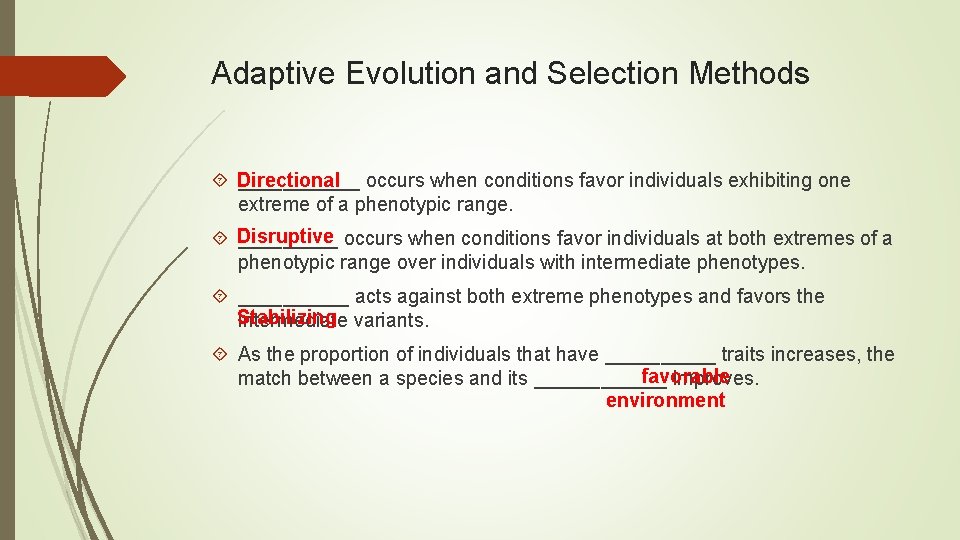
Adaptive Evolution and Selection Methods Directional ______ occurs when conditions favor individuals exhibiting one extreme of a phenotypic range. Disruptive _____ occurs when conditions favor individuals at both extremes of a phenotypic range over individuals with intermediate phenotypes. _____ acts against both extreme phenotypes and favors the Stabilizing intermediate variants. As the proportion of individuals that have _____ traits increases, the favorable match between a species and its ______ improves. environment
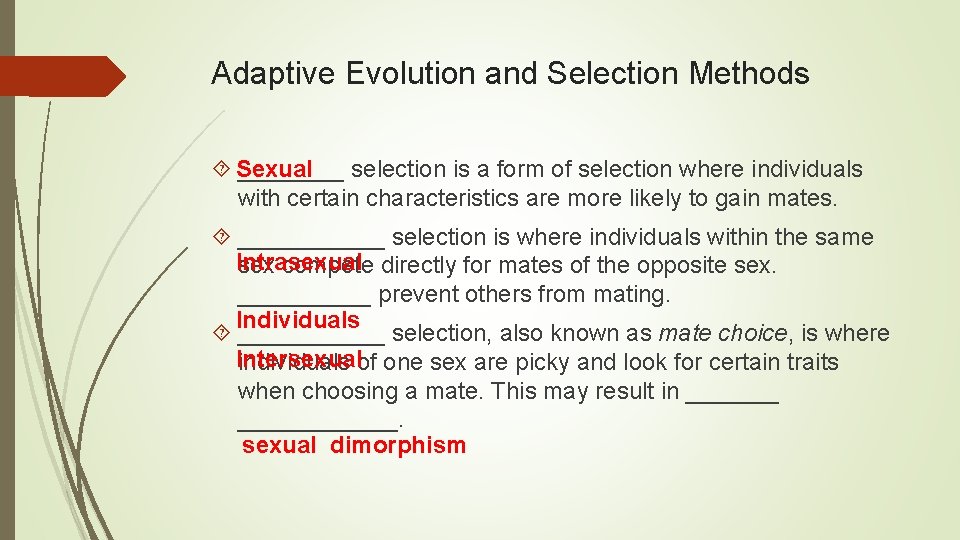
Adaptive Evolution and Selection Methods Sexual ____ selection is a form of selection where individuals with certain characteristics are more likely to gain mates. ______ selection is where individuals within the same Intrasexual sex compete directly for mates of the opposite sex. _____ prevent others from mating. Individuals ______ selection, also known as mate choice, is where Intersexual individuals of one sex are picky and look for certain traits when choosing a mate. This may result in ____________. sexual dimorphism
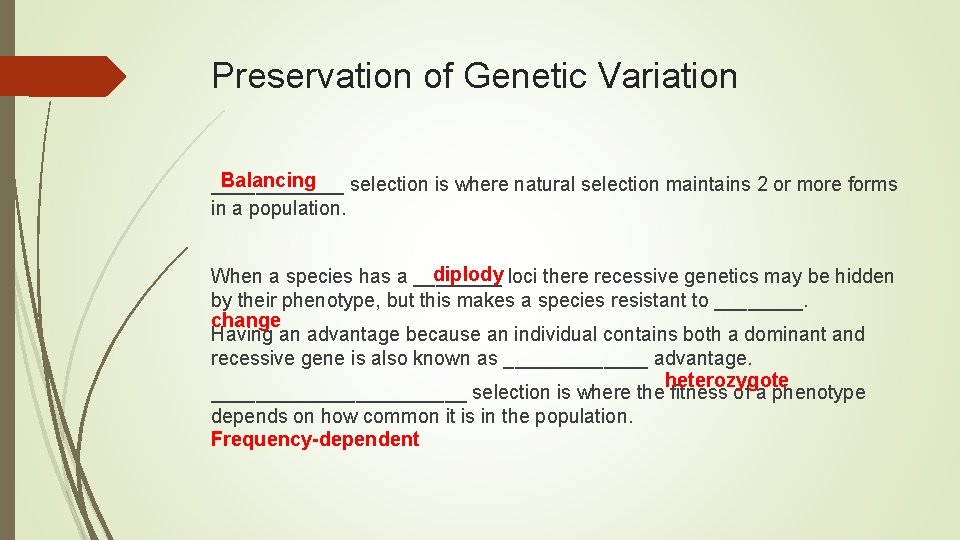
Preservation of Genetic Variation Balancing ______ selection is where natural selection maintains 2 or more forms in a population. diplody When a species has a ____ loci there recessive genetics may be hidden by their phenotype, but this makes a species resistant to ____. change Having an advantage because an individual contains both a dominant and recessive gene is also known as _______ advantage. heterozygote ____________ selection is where the fitness of a phenotype depends on how common it is in the population. Frequency-dependent
Why Natural Selection Cannot Fashion Perfect Organisms existing Selection can only act on ____ variations limited Evolution is ____ by historical constraints Adaptations ______ are often compromises natural environment Chance, _______ selection, and the ______ interact
Individual variations often reflect____, differences among individuals in the composition of their genes or other DNA segments. a. Geographic variation b. Natural selection c. Genetic variation d. Microevolution
Which of the following is an example of nonheritable variation? a. Nemoria arizonaria caterpillars differ in appearance due to chemicals in their diet. b. The dark pepper moth blended into the tree more than the white moth, resulting in a greater number of dark moths. c. The fruit fly Drosophila melanogaster has an average heterozygosity of 14%. d. Individuals do not evolve. Populations evolve.
What is the Hardy-Weinberg Equilibrium equation? A) a²+b²=c² B) p²+2 pq+q²=1 C) 2 p+pq²+2 q=1 D) e=mc²
What is not one of the 5 conditions for the Hardy-Weinberg Equilibrium? a) Natural selection b) No gene flow c) Random mating d) No mutations e) Large populations
Genetic drift occurs more in _______ populations. a. Smaller b. Larger c. Marine d. Plant
Gene flow does not affect the… a. allele frequencies b. population diversity c. location of the species d. adaptations made
Why can’t natural selection create perfect organisms? a. Selection can only act on existing variations b. Evolution is limited by historical constraints c. Adaptations are often compromises d. Chance, natural selection, and the environment interact e. All of the above f. What are you talking about? Aren’t humans perfect?
____ selection, also known as mate choice, is where individuals of one sex are picky when selecting a mate. a. balancing b. natural c. intersexual d. intrasexual e. mate