
Chapter 23 The Evolution of Populations Introduction One




- Slides: 46
Chapter 23 The Evolution of Populations
Introduction • One misconception is that organisms evolve, in the Darwinian sense, during their lifetimes • Natural selection acts on individuals, but only populations evolve • Genetic variations in populations contribute to evolution
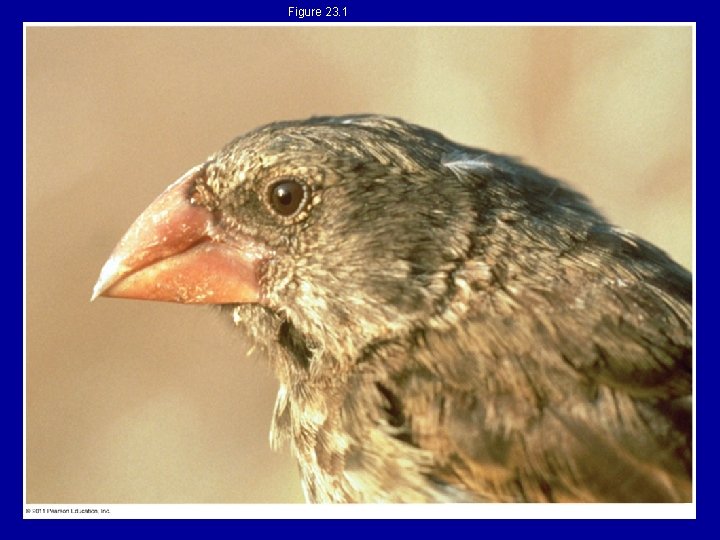
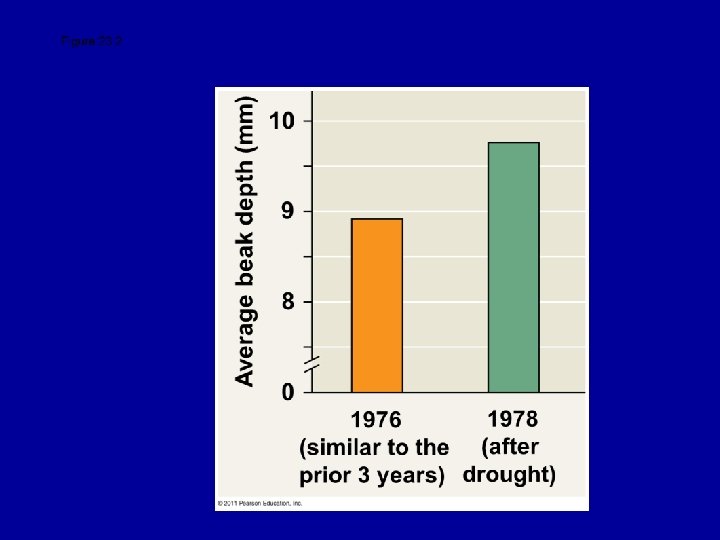
• Consider, for example, a population of medium ground finches on Daphne Major Island – During a drought, large-beaked birds were more likely to crack large seeds and survive – The finch population evolved by natural selection
Figure 23. 1
Microevolution • We can define microevolution as generation-to-generation change in a population’s frequencies of alleles. – Changes in the gene frequency from parents to offspring – Microevolution occurs even if the frequencies of alleles are changing for only a single gene in a population while the others remain constant.
• Three mechanisms cause allele frequency change: – Natural selection – Genetic drift – Gene flow • Only natural selection causes adaptive evolution
Genetic variation makes evolution possible • Variation in heritable traits is a prerequisite for evolution • Mendel’s work on pea plants provided evidence of discrete heritable units (genes)
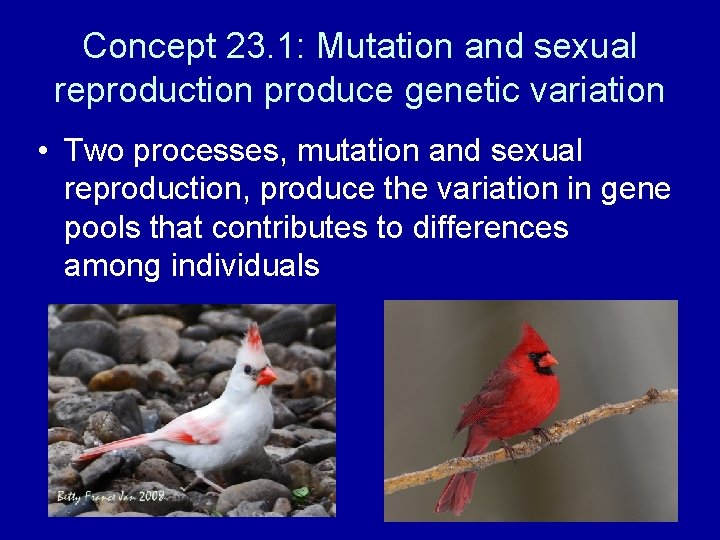
Concept 23. 1: Mutation and sexual reproduction produce genetic variation • Two processes, mutation and sexual reproduction, produce the variation in gene pools that contributes to differences among individuals
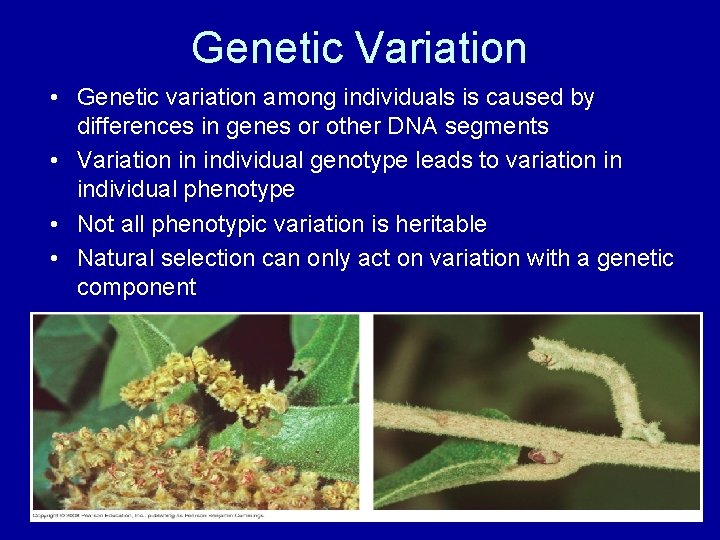
Genetic Variation • Genetic variation among individuals is caused by differences in genes or other DNA segments • Variation in individual genotype leads to variation in individual phenotype • Not all phenotypic variation is heritable • Natural selection can only act on variation with a genetic component
Variation Within a Population • Both discrete and quantitative characters contribute to variation within a population • Discrete characters can be classified on an either-or basis – Purple or white flowers • Quantitative characters vary along a continuum within a population – Height or skin pigmentation
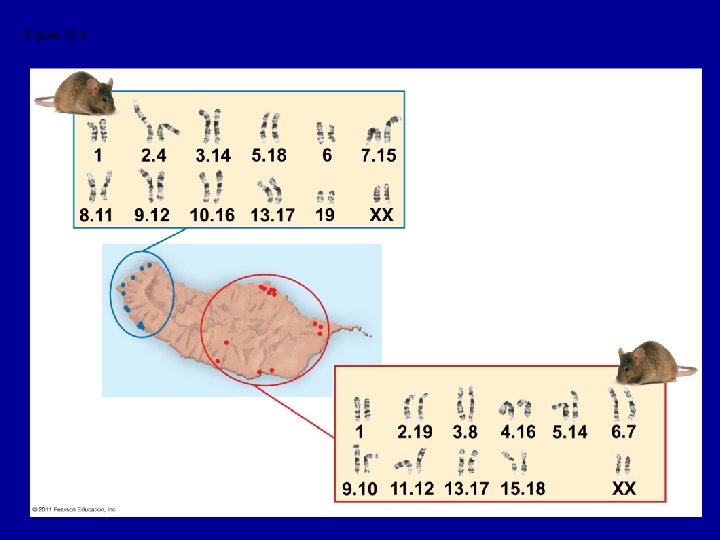
Variation Between Populations • Most species exhibit geographic variation, differences between gene pools of separate populations • For example, Madeira is home to several isolated populations of mice – Chromosomal variation among populations is due to drift, not natural selection
Sources of Genetic Variation • New genes and alleles can arise by mutation or gene duplication
Mutation • Mutations are changes in the nucleotide sequence of DNA • “Mutations are the ultimate source of new alleles” • Only mutations in cells that produce gametes can be passed to offspring
• The effects of point mutations can vary: – Mutations in noncoding regions of DNA are often harmless – Mutations might not affect protein production because of redundancy in the genetic code – Mutations that result in a change in protein production are often harmful – Mutations that result in a change in protein production benefit organism might
Altering Gene Number or Position • Chromosomal mutations that delete, disrupt, or rearrange many loci are typically harmful • Duplication of small pieces of DNA increases genome size and is usually less harmful • Duplicated genes can take on new functions by further mutation • An ancestral odor-detecting gene has been duplicated many times: humans have 1, 000 copies of the gene, mice have 1, 300
Rapid Reproduction • Mutation rates are low in animals and plants • The average is about one mutation in every 100, 000 genes per generation • Mutation rates are often lower in prokaryotes and higher in viruses
Sexual Reproduction • Sexual reproduction can shuffle existing alleles into new combinations • In organisms that reproduce sexually, recombination of alleles is more important than mutation in producing the genetic differences that make adaptation possible
The Hardy-Weinberg equation can be used to test whether a population is evolving • The first step in testing whether evolution is occurring in a population is to clarify what we mean by a population
Gene Pools and Allele Frequencies • A population is a localized group of individuals capable of interbreeding and producing fertile offspring • A gene pool consists of all the alleles for all loci in a population • A locus is fixed if all individuals in a population are homozygous for the same allele
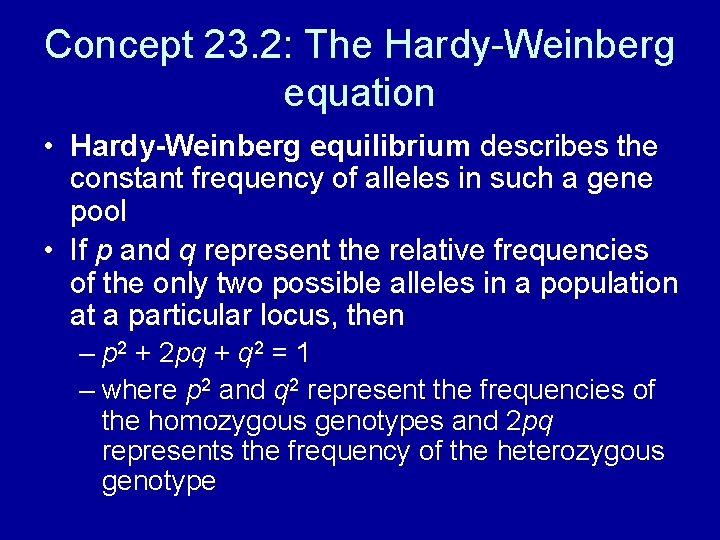
Concept 23. 2: The Hardy-Weinberg equation • Hardy-Weinberg equilibrium describes the constant frequency of alleles in such a gene pool • If p and q represent the relative frequencies of the only two possible alleles in a population at a particular locus, then – p 2 + 2 pq + q 2 = 1 – where p 2 and q 2 represent the frequencies of the homozygous genotypes and 2 pq represents the frequency of the heterozygous genotype
The Hardy-Weinberg Principle • The Hardy-Weinberg principle describes a population that is not evolving • If a population does not meet the criteria of the Hardy-Weinberg principle, it can be concluded that the population is evolving
Hardy-Weinberg Equilibrium • The Hardy-Weinberg principle states that frequencies of alleles and genotypes in a population remain constant from generation to generation • In a given population where gametes contribute to the next generation randomly, allele frequencies will not change • Mendelian inheritance preserves genetic variation in a population
Conditions for Hardy-Weinberg Equilibrium • The Hardy-Weinberg theorem describes a hypothetical population that is not evolving • In real populations, allele and genotype frequencies do change over time
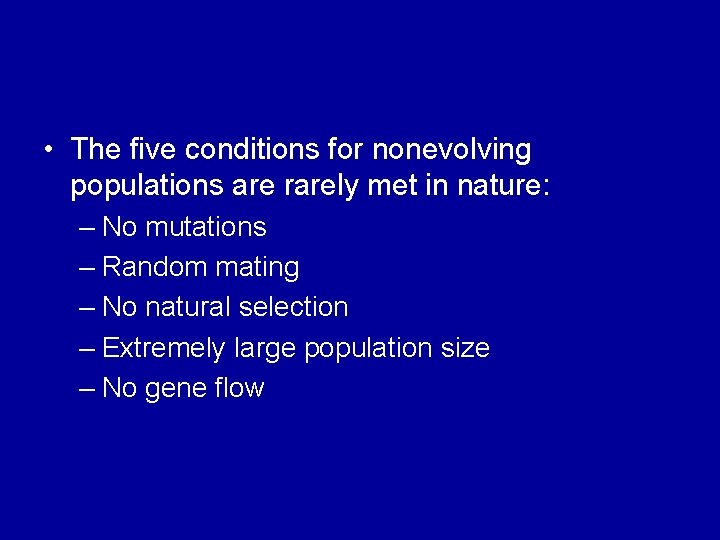
• The five conditions for nonevolving populations are rarely met in nature: – No mutations – Random mating – No natural selection – Extremely large population size – No gene flow
• Natural populations can evolve at some loci, while being in Hardy-Weinberg equilibrium at other loci
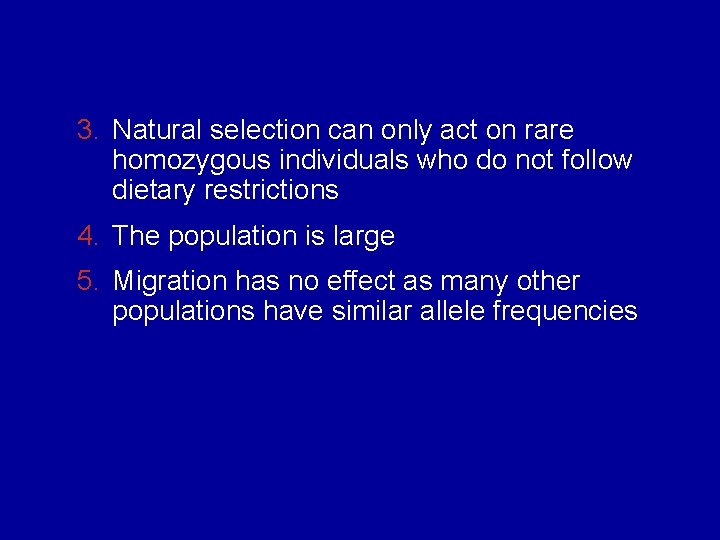
Applying the Hardy-Weinberg Principle • We can assume the locus that causes phenylketonuria (PKU) is in Hardy-Weinberg equilibrium given that: 1. The PKU gene mutation rate is low 2. Mate selection is random with respect to whether or not an individual is a carrier for the PKU allele
3. Natural selection can only act on rare homozygous individuals who do not follow dietary restrictions 4. The population is large 5. Migration has no effect as many other populations have similar allele frequencies
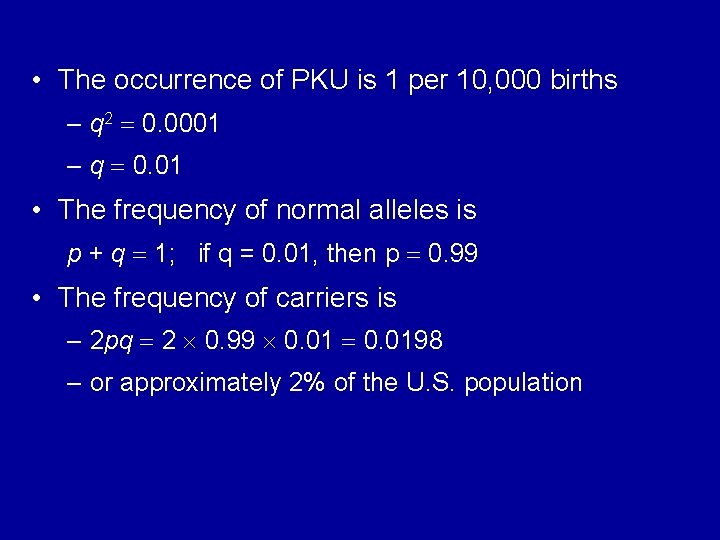
• The occurrence of PKU is 1 per 10, 000 births – q 2 0. 0001 – q 0. 01 • The frequency of normal alleles is p + q 1; if q = 0. 01, then p 0. 99 • The frequency of carriers is – 2 pq 2 0. 99 0. 0198 – or approximately 2% of the U. S. population
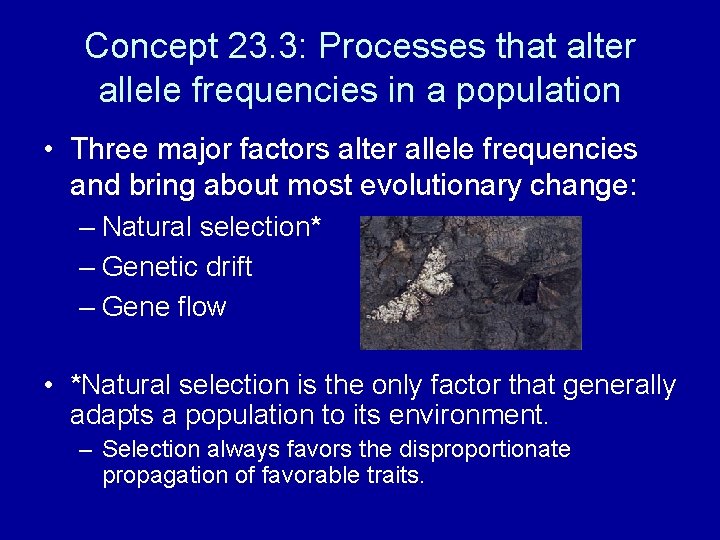
Concept 23. 3: Processes that alter allele frequencies in a population • Three major factors alter allele frequencies and bring about most evolutionary change: – Natural selection* – Genetic drift – Gene flow • *Natural selection is the only factor that generally adapts a population to its environment. – Selection always favors the disproportionate propagation of favorable traits.
Natural Selection • Natural selection will lead some individuals to leave more offspring than others – Selection results in some alleles being passed along to the next generation disproportionate to their frequencies in the present generation • Ultimately natural selection leads to: – Differential survival – Differential reproduction • Natural selection accumulates and maintains favorable genotypes in a population
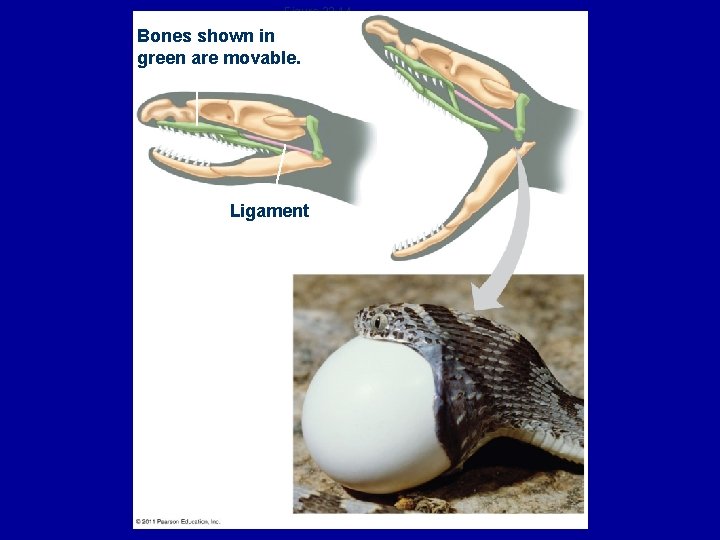
The Key Role of Natural Selection in Adaptive Evolution • Striking adaptations have arisen by natural selection – For example, cuttlefish can change color rapidly for camouflage – For example, the jaws of snakes allow them to swallow prey larger than their heads
Figure 23. 14 Bones shown in green are movable. Ligament
• Natural selection increases the frequencies of alleles that enhance survival and reproduction • Adaptive evolution occurs as the match between an organism and its environment increases • Because the environment can change, adaptive evolution is a continuous process
• Genetic drift and gene flow do not consistently lead to adaptive evolution as they can increase or decrease the match between an organism and its environment © 2011 Pearson Education, Inc.
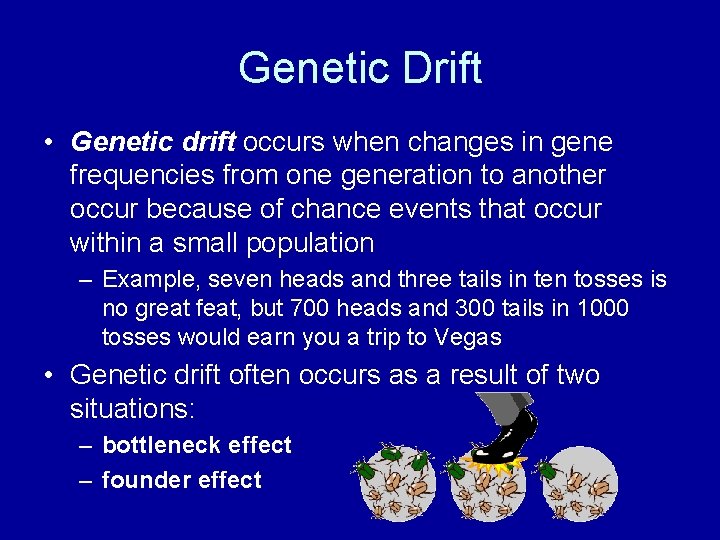
Genetic Drift • Genetic drift occurs when changes in gene frequencies from one generation to another occur because of chance events that occur within a small population – Example, seven heads and three tails in ten tosses is no great feat, but 700 heads and 300 tails in 1000 tosses would earn you a trip to Vegas • Genetic drift often occurs as a result of two situations: – bottleneck effect – founder effect
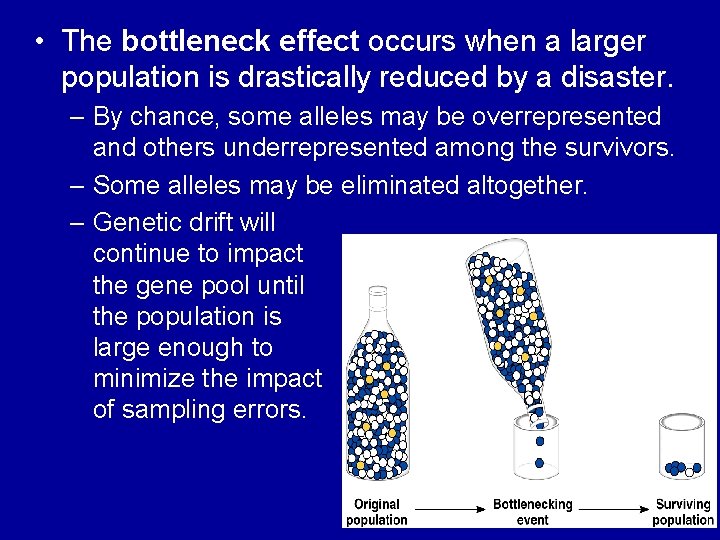
• The bottleneck effect occurs when a larger population is drastically reduced by a disaster. – By chance, some alleles may be overrepresented and others underrepresented among the survivors. – Some alleles may be eliminated altogether. – Genetic drift will continue to impact the gene pool until the population is large enough to minimize the impact of sampling errors.
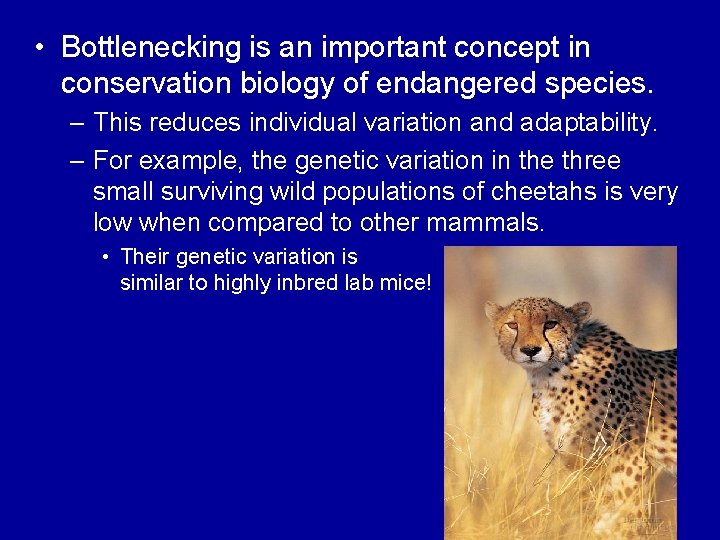
• Bottlenecking is an important concept in conservation biology of endangered species. – This reduces individual variation and adaptability. – For example, the genetic variation in the three small surviving wild populations of cheetahs is very low when compared to other mammals. • Their genetic variation is similar to highly inbred lab mice!
• The founder effect occurs when a new population is started by only a few individuals. – They do not represent the gene pool of the larger population. – Potentially, a population could be started by single pregnant female or single seed. • Genetic drift would continue from generation to generation until the population grew large enough for sampling errors to be minimal. – Founder effects have been demonstrated in human populations that started from a small group of colonists.
• Gene flow is genetic exchange due to movement of individuals or gametes between populations. – If a wildflower population consisted entirely of white flowers (yy alleles only) could be carried into a new population that is all yellow, (Y alleles only) this would increase the frequency of y alleles in the second population in the next generation.
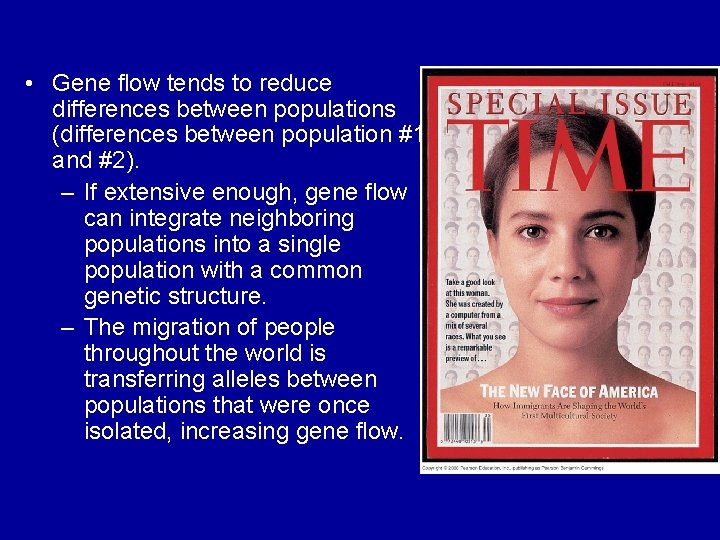
• Gene flow tends to reduce differences between populations (differences between population #1 and #2). – If extensive enough, gene flow can integrate neighboring populations into a single population with a common genetic structure. – The migration of people throughout the world is transferring alleles between populations that were once isolated, increasing gene flow.
Concept 23. 4: Natural selection = adaptive evolution • Only natural selection consistently results in adaptive evolution • The phrases “struggle for existence” and “survival of the fittest” are misleading as they imply direct competition among individuals • Reproductive success is generally more subtle and depends on many factors
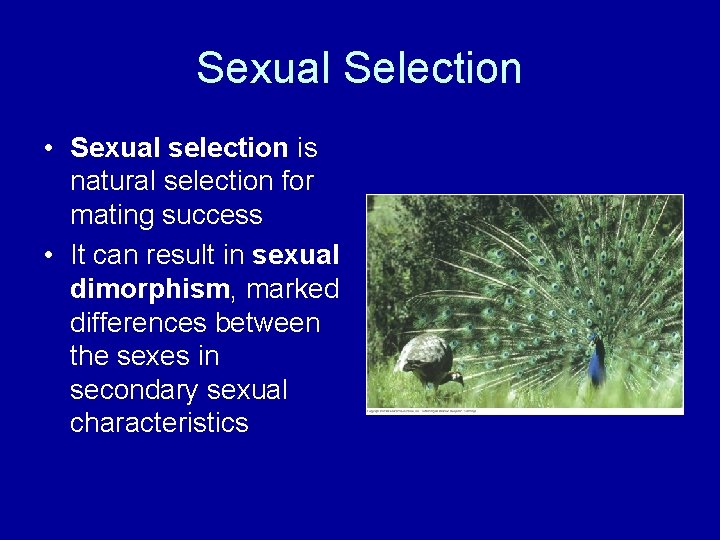
Sexual Selection • Sexual selection is natural selection for mating success • It can result in sexual dimorphism, marked differences between the sexes in secondary sexual characteristics
• Intrasexual selection is competition among individuals of one sex (often males) for mates of the opposite sex • Intersexual selection, often called mate choice, occurs when individuals of one sex (usually females) are choosy in selecting their mates
• What is the basis for female choice? • The underlying bases of female choice is probably not aesthetic. – Recent research is investigating the hypothesis that females use these sexual advertisements to measure the general health of a male (Good Genes Hypothesis). – Individuals with infections or disease are likely to have a relatively dull, disheveled plumage. – For the female that chooses a healthy mate the benefit is a greater probability of having healthy offspring.