
Chapter 23 Potentiometer 1 Principles Measuring concentration using
- Slides: 19
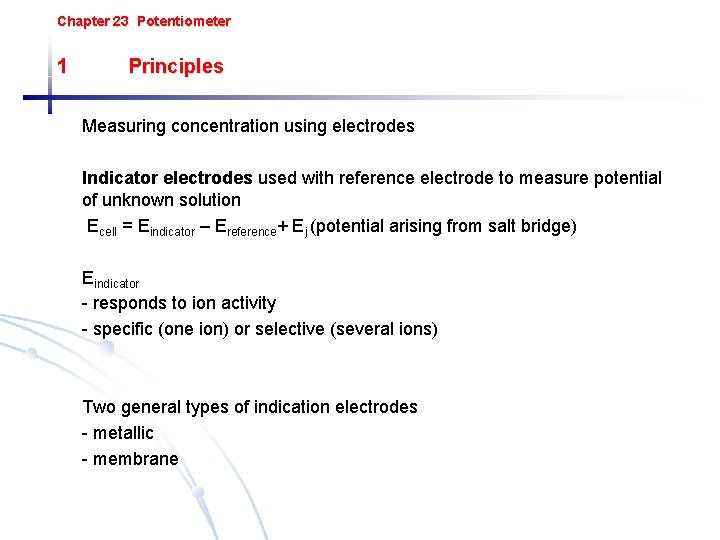
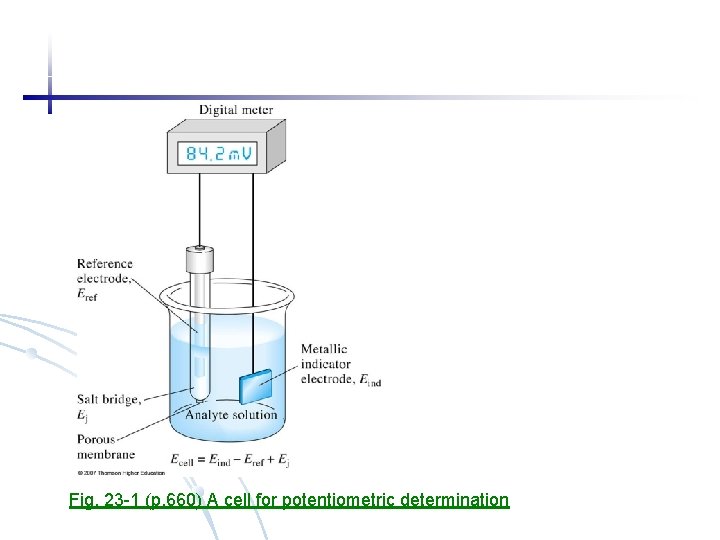
Chapter 23 Potentiometer 1 Principles Measuring concentration using electrodes Indicator electrodes used with reference electrode to measure potential of unknown solution Ecell = Eindicator – Ereference+ Ej (potential arising from salt bridge) Eindicator - responds to ion activity - specific (one ion) or selective (several ions) Two general types of indication electrodes - metallic - membrane
Fig. 23 -1 (p. 660) A cell for potentiometric determination
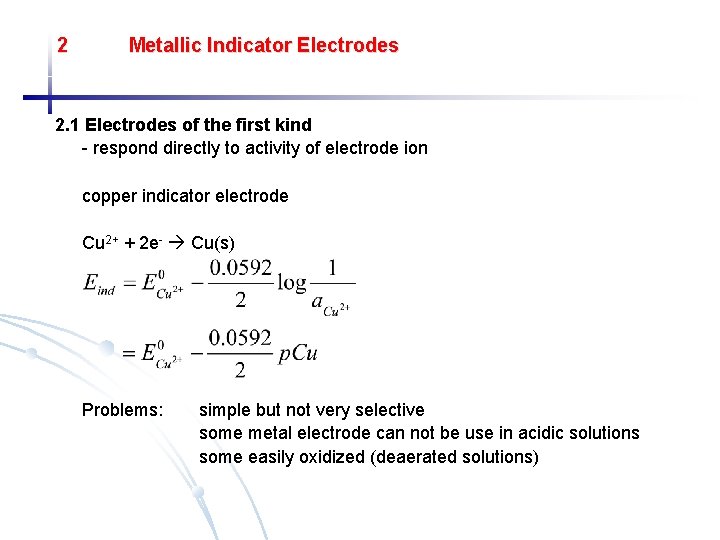
2 Metallic Indicator Electrodes 2. 1 Electrodes of the first kind - respond directly to activity of electrode ion copper indicator electrode Cu 2+ + 2 e- Cu(s) Problems: simple but not very selective some metal electrode can not be use in acidic solutions some easily oxidized (deaerated solutions)
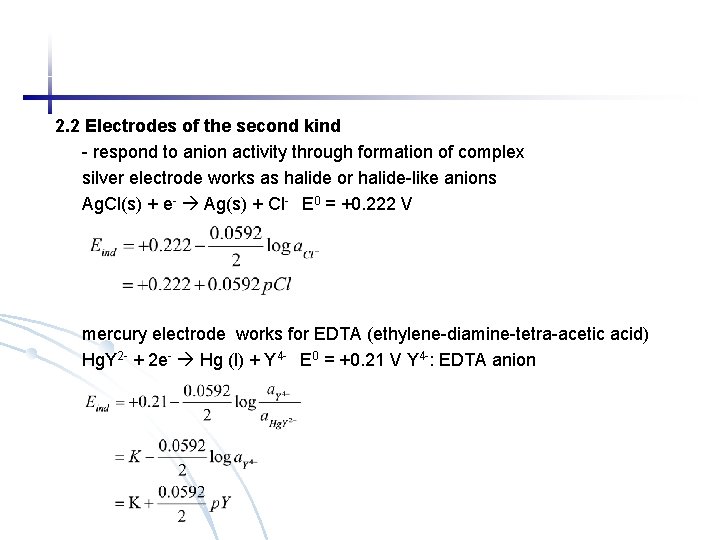
2. 2 Electrodes of the second kind - respond to anion activity through formation of complex silver electrode works as halide or halide-like anions Ag. Cl(s) + e- Ag(s) + Cl- E 0 = +0. 222 V mercury electrode works for EDTA (ethylene-diamine-tetra-acetic acid) Hg. Y 2 - + 2 e- Hg (l) + Y 4 - E 0 = +0. 21 V Y 4 -: EDTA anion
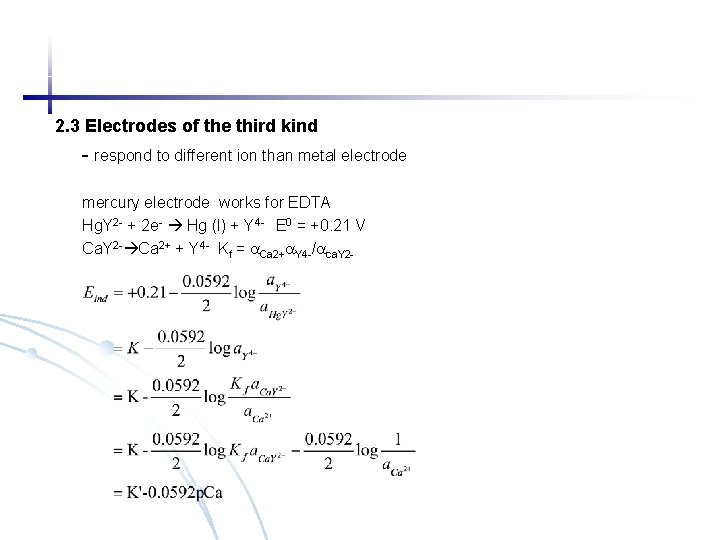
2. 3 Electrodes of the third kind - respond to different ion than metal electrode mercury electrode works for EDTA Hg. Y 2 - + 2 e- Hg (l) + Y 4 - E 0 = +0. 21 V Ca. Y 2 - Ca 2+ + Y 4 - Kf = Ca 2+ Y 4 -/ ca. Y 2 -
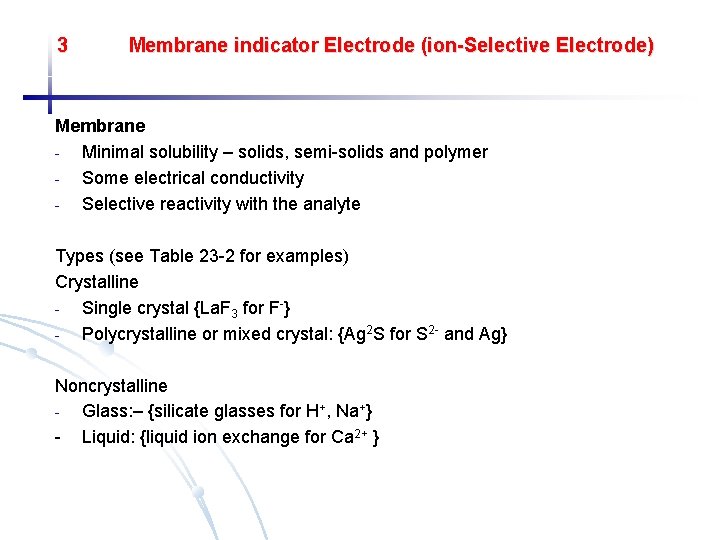
3 Membrane indicator Electrode (ion-Selective Electrode) Membrane Minimal solubility – solids, semi-solids and polymer Some electrical conductivity Selective reactivity with the analyte Types (see Table 23 -2 for examples) Crystalline Single crystal {La. F 3 for F-} Polycrystalline or mixed crystal: {Ag 2 S for S 2 - and Ag} Noncrystalline Glass: – {silicate glasses for H+, Na+} - Liquid: {liquid ion exchange for Ca 2+ }
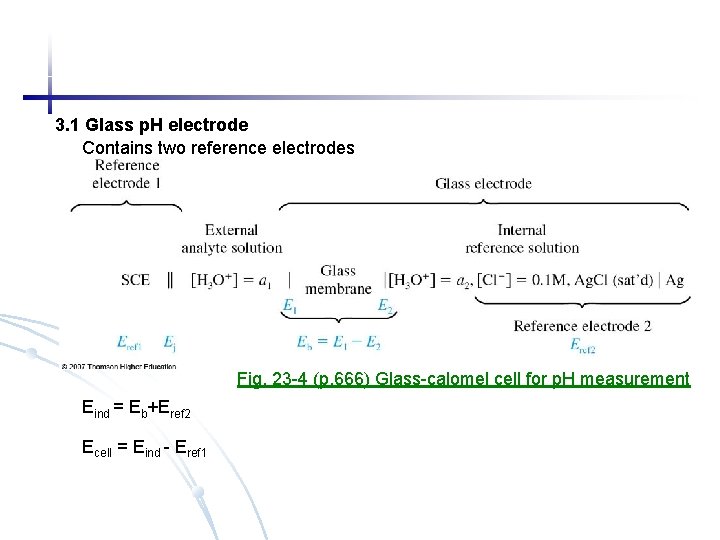
3. 1 Glass p. H electrode Contains two reference electrodes Fig. 23 -4 (p. 666) Glass-calomel cell for p. H measurement Eind = Eb+Eref 2 Ecell = Eind - Eref 1
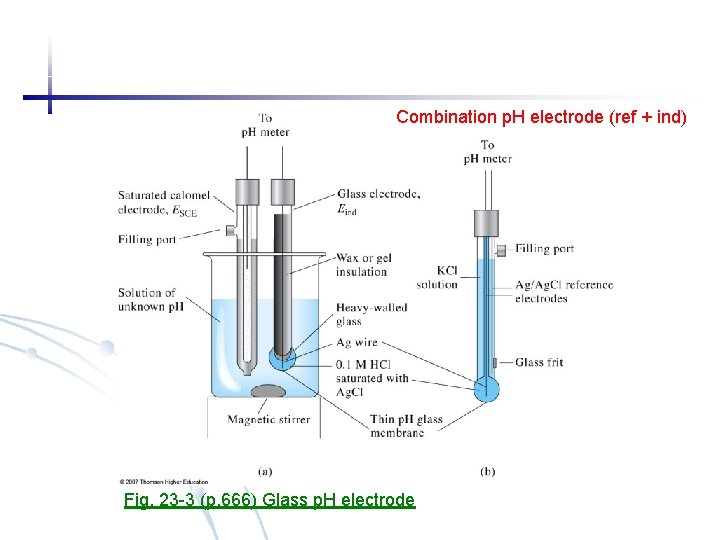
Combination p. H electrode (ref + ind) Fig. 23 -3 (p. 666) Glass p. H electrode
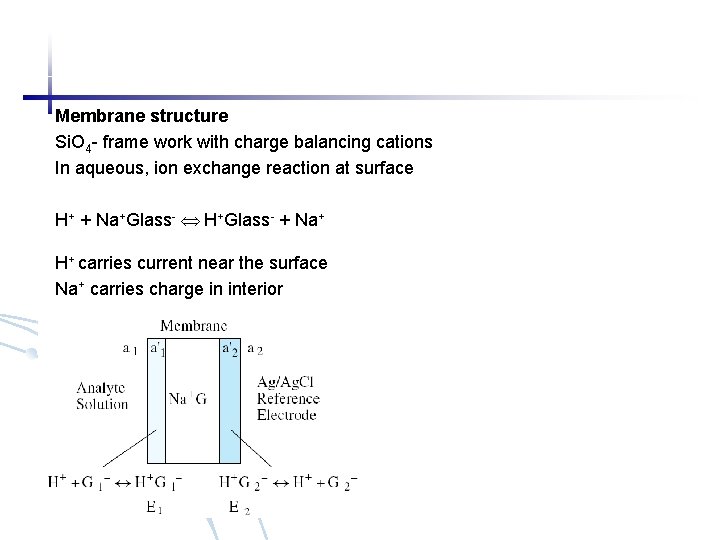
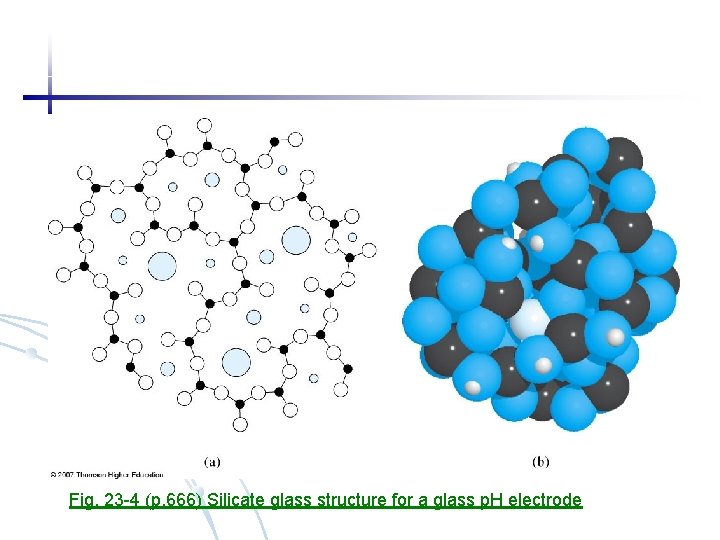
Membrane structure Si. O 4 - frame work with charge balancing cations In aqueous, ion exchange reaction at surface H+ + Na+Glass- H+Glass- + Na+ H+ carries current near the surface Na+ carries charge in interior
Fig. 23 -4 (p. 666) Silicate glass structure for a glass p. H electrode
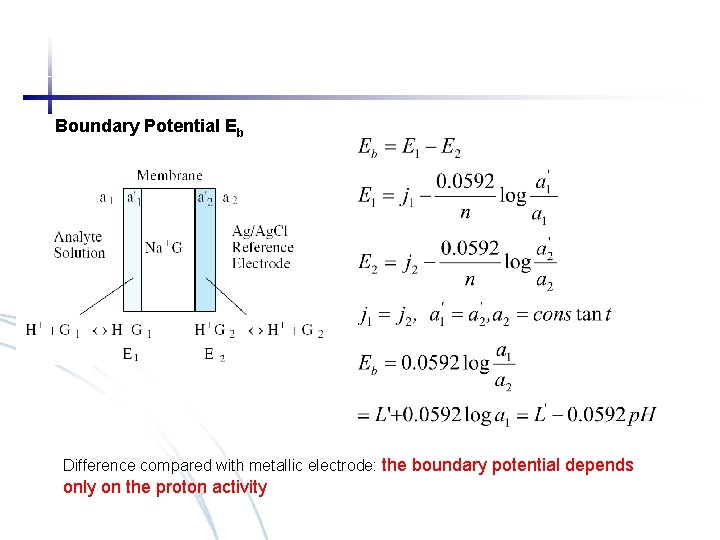
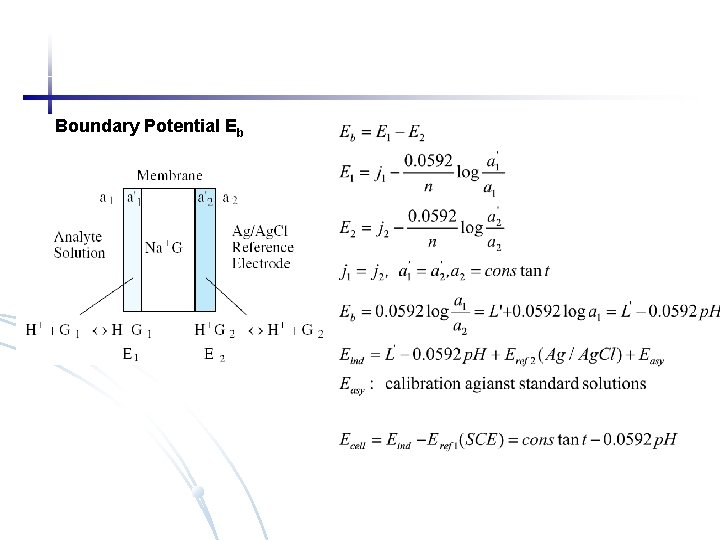
Boundary Potential Eb Difference compared with metallic electrode: the boundary potential depends only on the proton activity
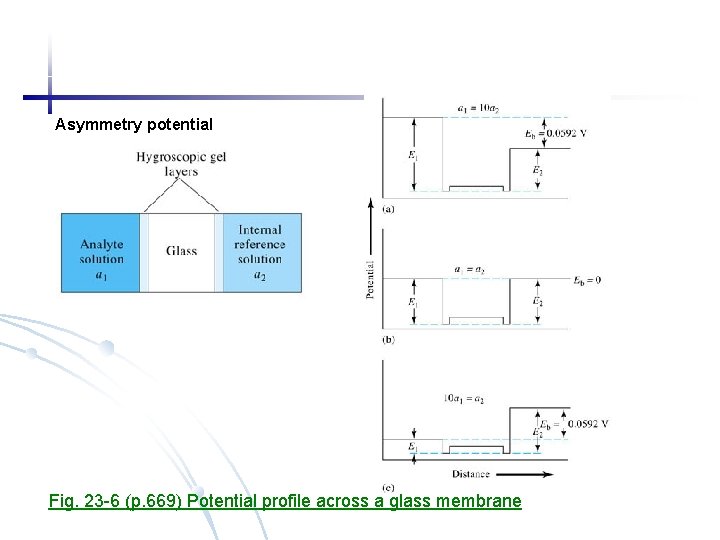
Asymmetry potential Fig. 23 -6 (p. 669) Potential profile across a glass membrane
Boundary Potential Eb
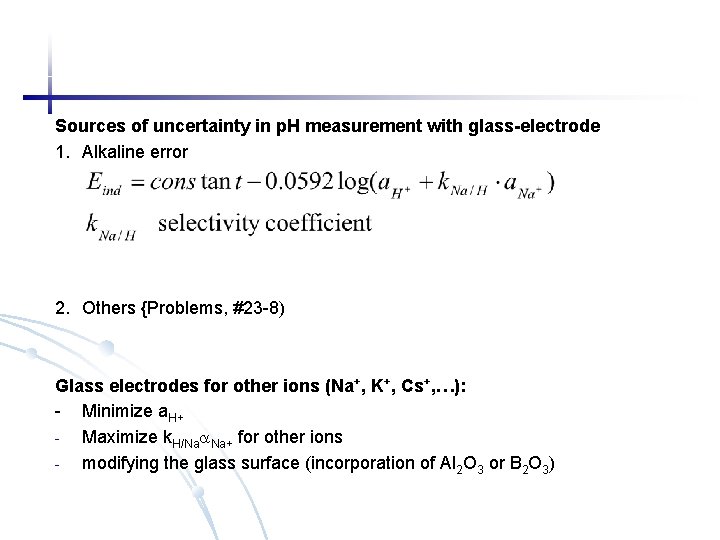
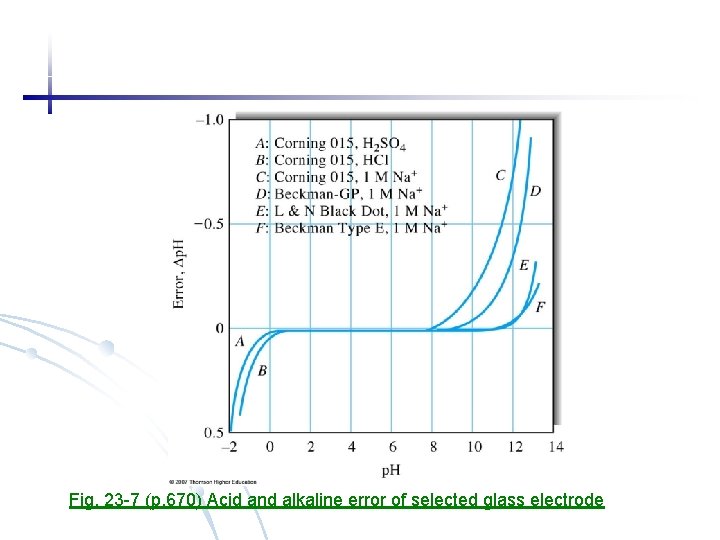
Sources of uncertainty in p. H measurement with glass-electrode 1. Alkaline error 2. Others {Problems, #23 -8) Glass electrodes for other ions (Na+, K+, Cs+, …): - Minimize a. H+ Maximize k. H/Na Na+ for other ions modifying the glass surface (incorporation of Al 2 O 3 or B 2 O 3)
Fig. 23 -7 (p. 670) Acid and alkaline error of selected glass electrode
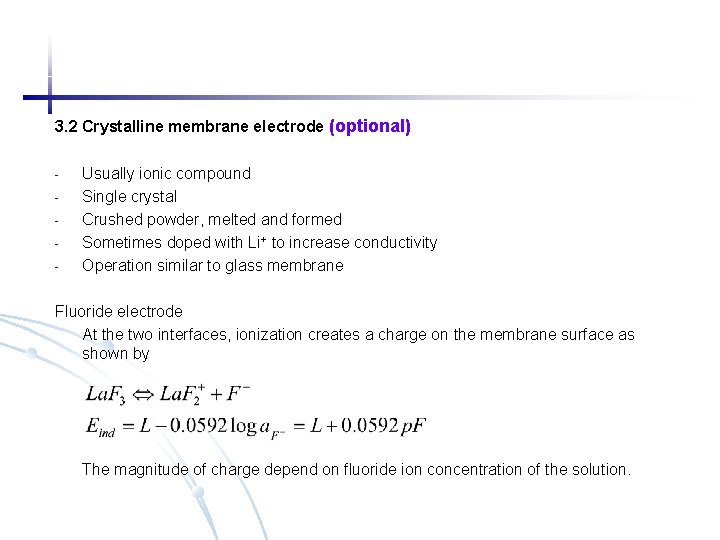
3. 2 Crystalline membrane electrode (optional) - Usually ionic compound Single crystal Crushed powder, melted and formed Sometimes doped with Li+ to increase conductivity Operation similar to glass membrane Fluoride electrode At the two interfaces, ionization creates a charge on the membrane surface as shown by The magnitude of charge depend on fluoride ion concentration of the solution.
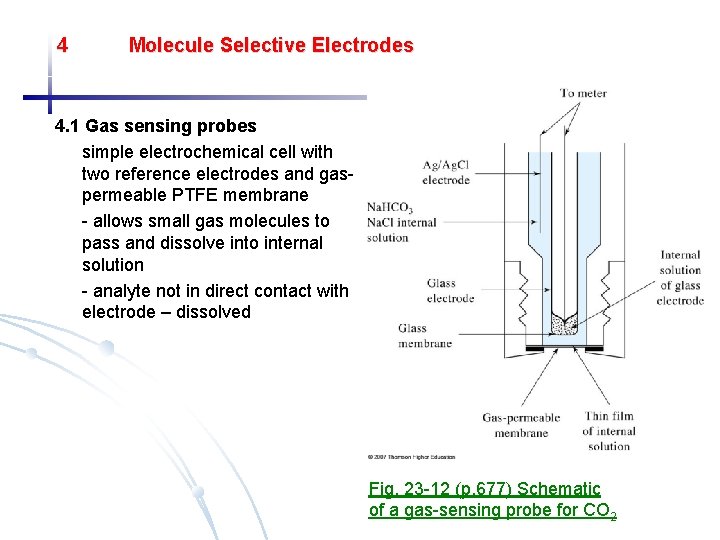
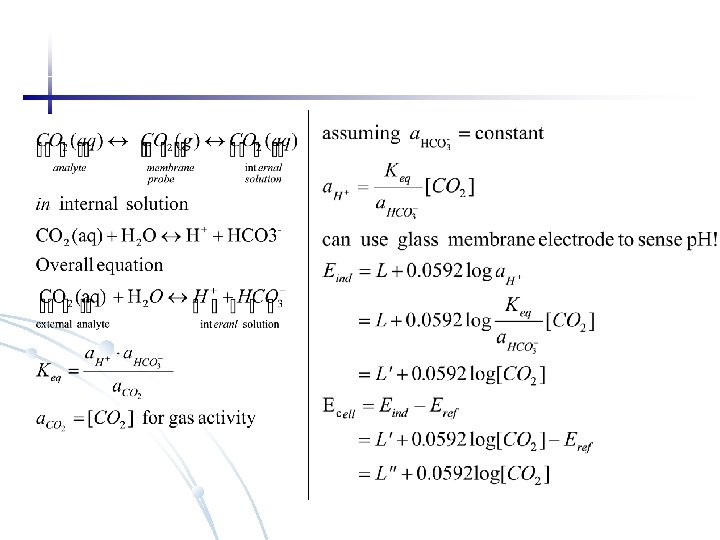
4 Molecule Selective Electrodes 4. 1 Gas sensing probes simple electrochemical cell with two reference electrodes and gaspermeable PTFE membrane - allows small gas molecules to pass and dissolve into internal solution - analyte not in direct contact with electrode – dissolved Fig. 23 -12 (p. 677) Schematic of a gas-sensing probe for CO 2
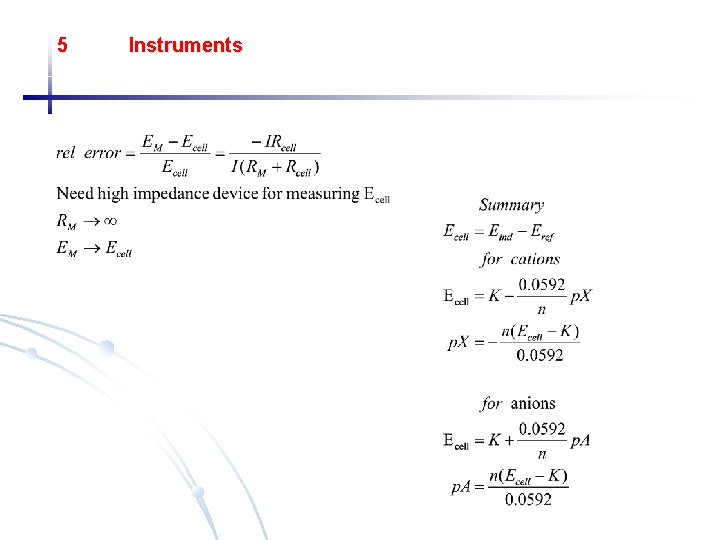
5 Instruments