
Chapter 23 Electric Potential September 10 Electric Potential
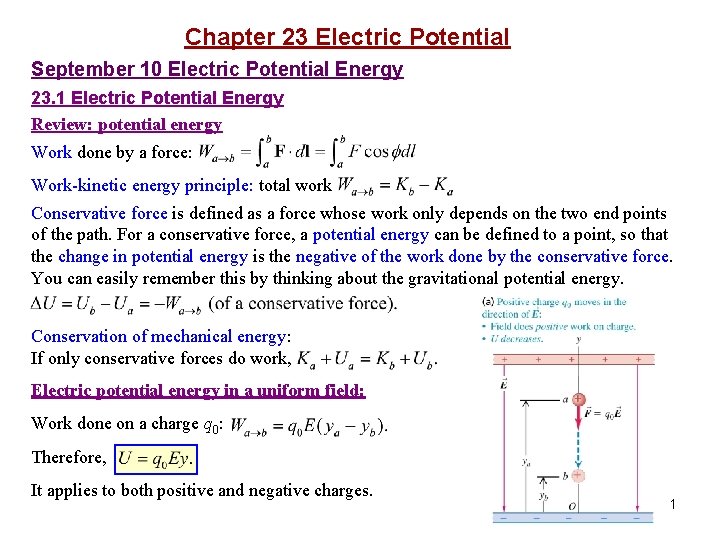
Chapter 23 Electric Potential September 10 Electric Potential Energy 23. 1 Electric Potential Energy Review: potential energy Work done by a force: Work-kinetic energy principle: total work Conservative force is defined as a force whose work only depends on the two end points of the path. For a conservative force, a potential energy can be defined to a point, so that the change in potential energy is the negative of the work done by the conservative force. You can easily remember this by thinking about the gravitational potential energy. Conservation of mechanical energy: If only conservative forces do work, Electric potential energy in a uniform field: Work done on a charge q 0: Therefore, It applies to both positive and negative charges. 1
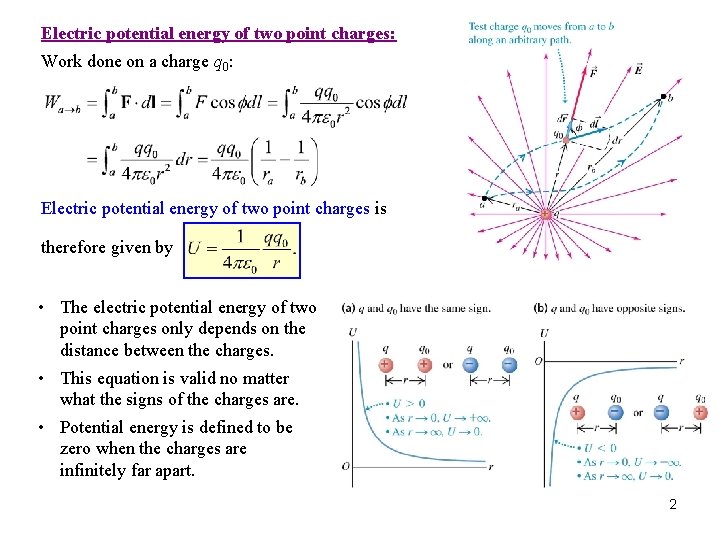
Electric potential energy of two point charges: Work done on a charge q 0: Electric potential energy of two point charges is therefore given by • The electric potential energy of two point charges only depends on the distance between the charges. • This equation is valid no matter what the signs of the charges are. • Potential energy is defined to be zero when the charges are infinitely far apart. 2
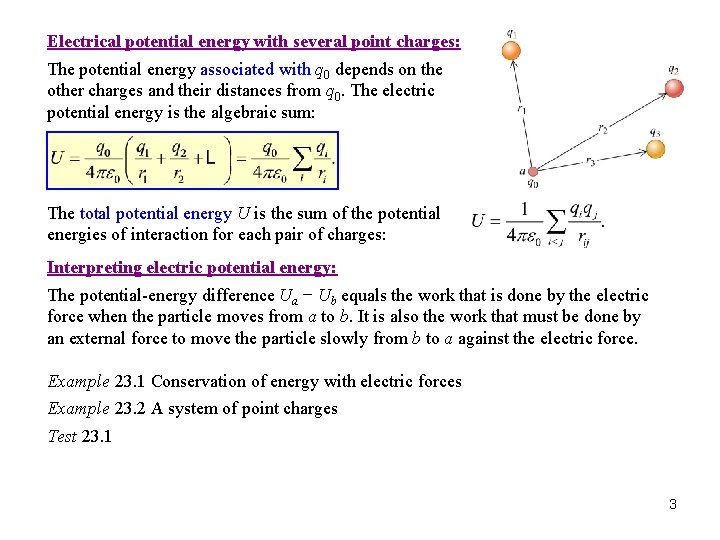
Electrical potential energy with several point charges: The potential energy associated with q 0 depends on the other charges and their distances from q 0. The electric potential energy is the algebraic sum: The total potential energy U is the sum of the potential energies of interaction for each pair of charges: Interpreting electric potential energy: The potential-energy difference Ua − Ub equals the work that is done by the electric force when the particle moves from a to b. It is also the work that must be done by an external force to move the particle slowly from b to a against the electric force. Example 23. 1 Conservation of energy with electric forces Example 23. 2 A system of point charges Test 23. 1 3

Read: Ch 23: 1 Homework: Ch 23: 4, 7, 11 Due: September 18 4

September 11 Electric Potential 23. 2 Electric Potential Electric potential (potential) is the potential energy per unit charge: V = U/q 0. The SI unit of potential is volt, V: 1 V=1 J/C. In terms of work done by electric force, The potential of point a with respect to point b, Vab, equals the work done by the electric force when a unit charge moves from a to b. It also equals the work that must be done to move a unit charge slowly from b to a against the electric force. Calculating electric potential: The potential due to a single point charge q: This is valid for both positive and negative charges. V= 0 at r = infinity. For a collection of point charges, For a continuous distribution of charges, 5
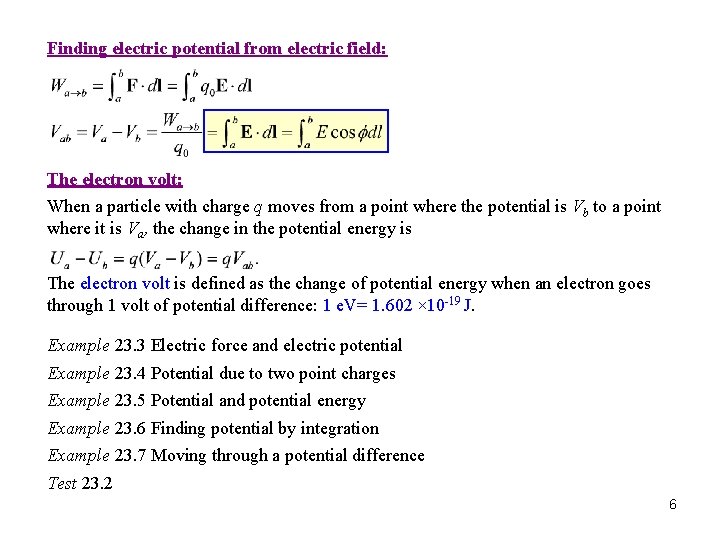
Finding electric potential from electric field: The electron volt: When a particle with charge q moves from a point where the potential is Vb to a point where it is Va, the change in the potential energy is The electron volt is defined as the change of potential energy when an electron goes through 1 volt of potential difference: 1 e. V= 1. 602 × 10 -19 J. Example 23. 3 Electric force and electric potential Example 23. 4 Potential due to two point charges Example 23. 5 Potential and potential energy Example 23. 6 Finding potential by integration Example 23. 7 Moving through a potential difference Test 23. 2 6

Read: Ch 23: 2 Homework: Ch 23: 12, 19, 23 Due: September 18 7
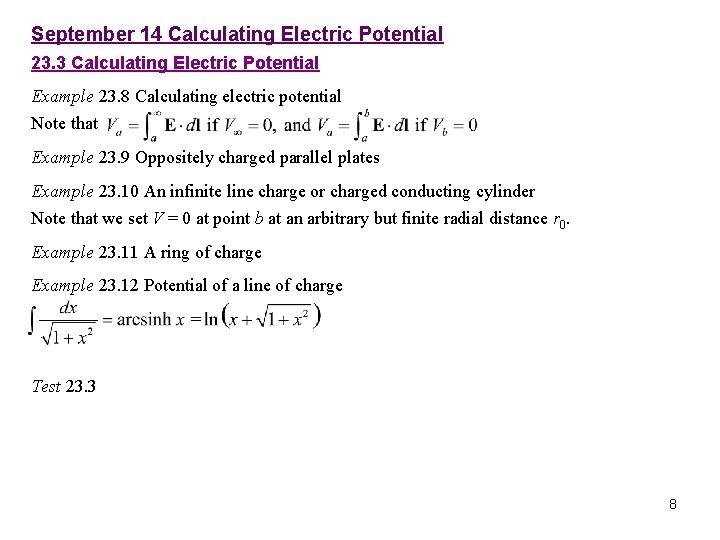
September 14 Calculating Electric Potential 23. 3 Calculating Electric Potential Example 23. 8 Calculating electric potential Note that Example 23. 9 Oppositely charged parallel plates Example 23. 10 An infinite line charge or charged conducting cylinder Note that we set V = 0 at point b at an arbitrary but finite radial distance r 0. Example 23. 11 A ring of charge Example 23. 12 Potential of a line of charge Test 23. 3 8

Read: Ch 23: 3 Homework: Ch 23: 26, 33, 34, 36 Due: September 25 9
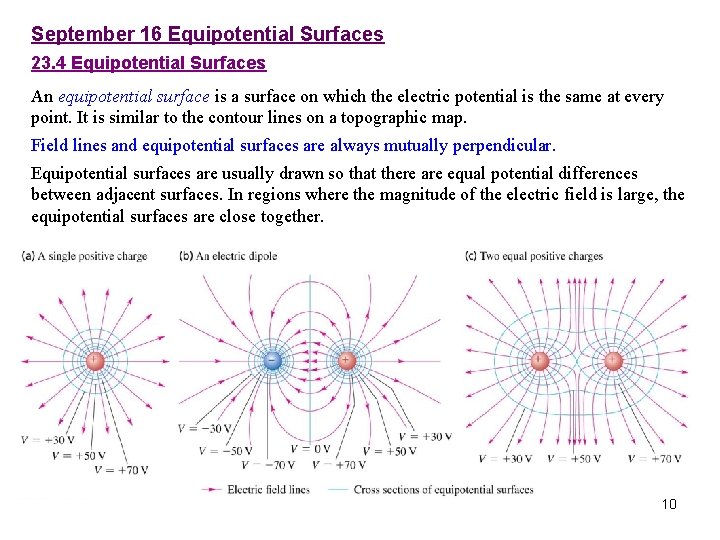
September 16 Equipotential Surfaces 23. 4 Equipotential Surfaces An equipotential surface is a surface on which the electric potential is the same at every point. It is similar to the contour lines on a topographic map. Field lines and equipotential surfaces are always mutually perpendicular. Equipotential surfaces are usually drawn so that there are equal potential differences between adjacent surfaces. In regions where the magnitude of the electric field is large, the equipotential surfaces are close together. 10
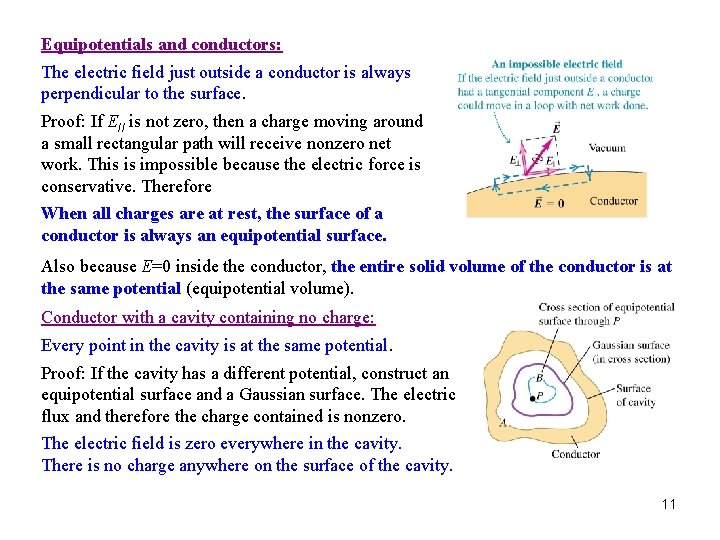
Equipotentials and conductors: The electric field just outside a conductor is always perpendicular to the surface. Proof: If E// is not zero, then a charge moving around a small rectangular path will receive nonzero net work. This is impossible because the electric force is conservative. Therefore When all charges are at rest, the surface of a conductor is always an equipotential surface. Also because E=0 inside the conductor, the entire solid volume of the conductor is at the same potential (equipotential volume). Conductor with a cavity containing no charge: Every point in the cavity is at the same potential. Proof: If the cavity has a different potential, construct an equipotential surface and a Gaussian surface. The electric flux and therefore the charge contained is nonzero. The electric field is zero everywhere in the cavity. There is no charge anywhere on the surface of the cavity. 11
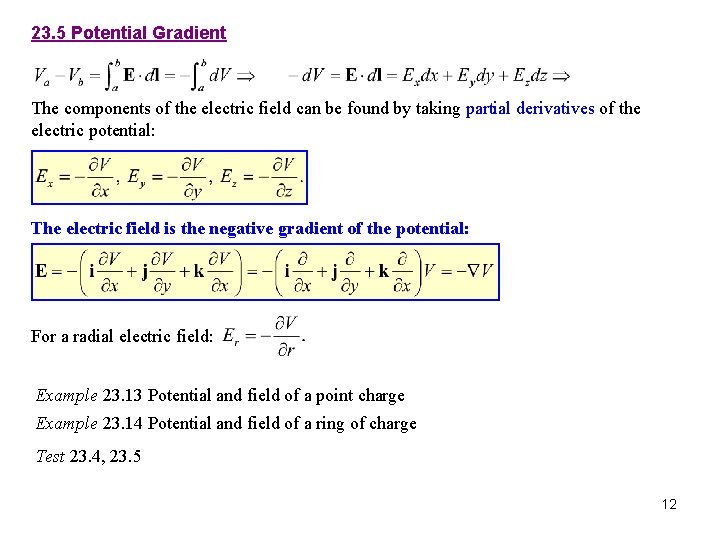
23. 5 Potential Gradient The components of the electric field can be found by taking partial derivatives of the electric potential: The electric field is the negative gradient of the potential: For a radial electric field: Example 23. 13 Potential and field of a point charge Example 23. 14 Potential and field of a ring of charge Test 23. 4, 23. 5 12

Read: Ch 23: 4 -5 Homework: Ch 23: 41, 43 Due: September 25 13
- Slides: 13