
Chapter 23 Electric Potential Problem I Problem II
Chapter 23 Electric Potential

Problem I •
Problem II 2. (I) How much work does the electric field do in moving a proton from a point with a potential of +185 V to a point where it is -55 V?
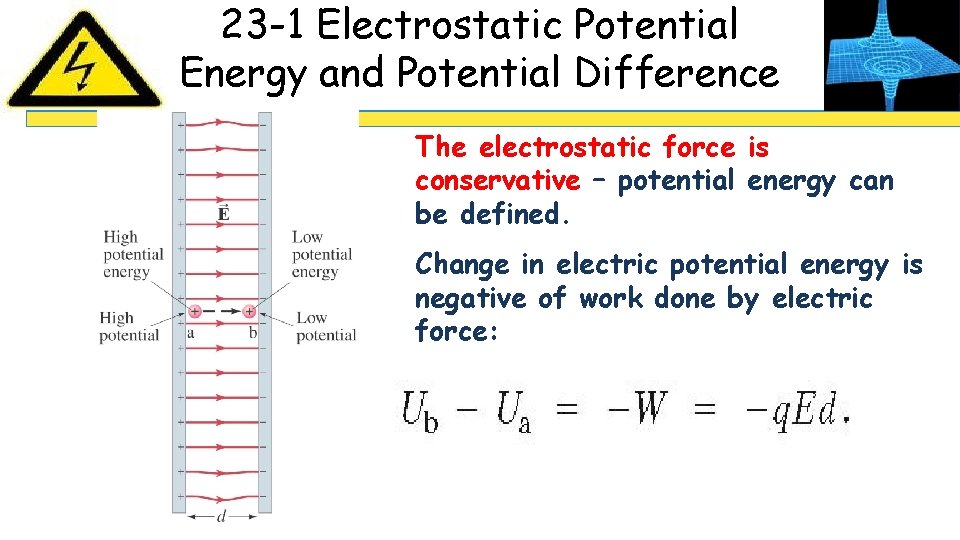
23 -1 Electrostatic Potential Energy and Potential Difference The electrostatic force is conservative – potential energy can be defined. Change in electric potential energy is negative of work done by electric force:

23 -1 Electrostatic Potential Energy and Potential Difference Example 23 -2: Electron in CRT. Suppose an electron in a cathode ray tube is accelerated from rest through a potential difference Vb – Va = Vba = +5000 V. (a) What is the change in electric potential energy of the electron? (b) What is the speed of the electron (m = 9. 11 × 10 -31 kg) as a result of this acceleration?
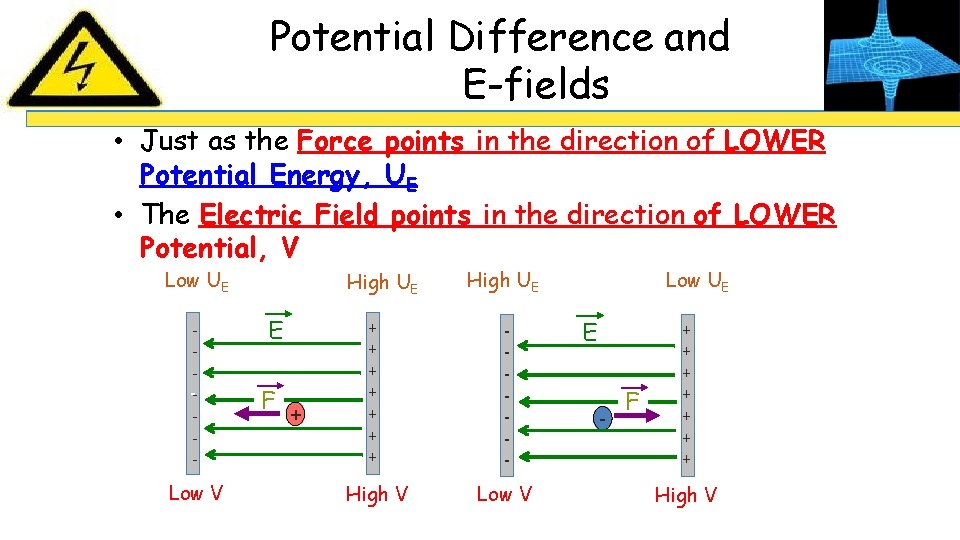
Potential Difference and E-fields • Just as the Force points in the direction of LOWER Potential Energy, UE • The Electric Field points in the direction of LOWER Potential, V Low UE - Low V High UE E F + High UE + + + + - High V Low UE E - F + + + + High V
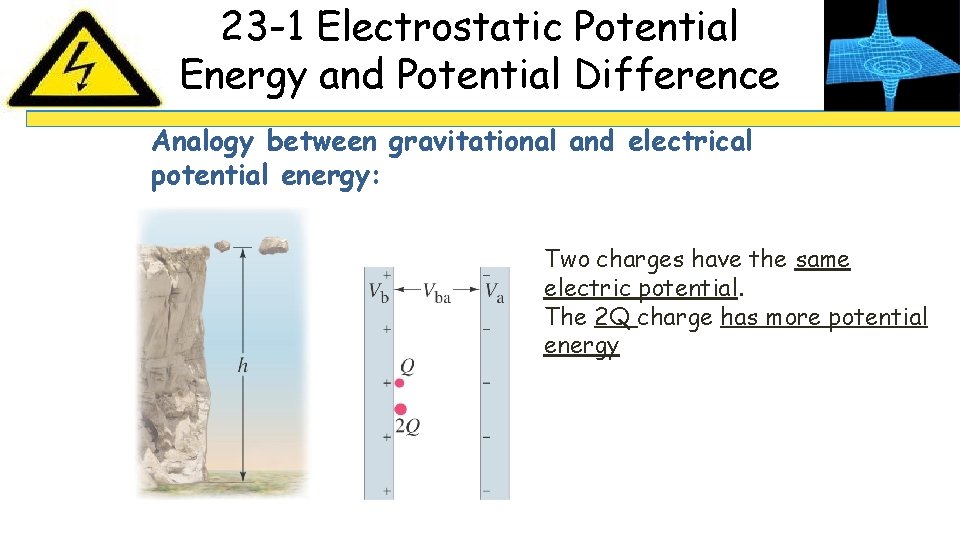
23 -1 Electrostatic Potential Energy and Potential Difference Analogy between gravitational and electrical potential energy: Two charges have the same electric potential. The 2 Q charge has more potential energy
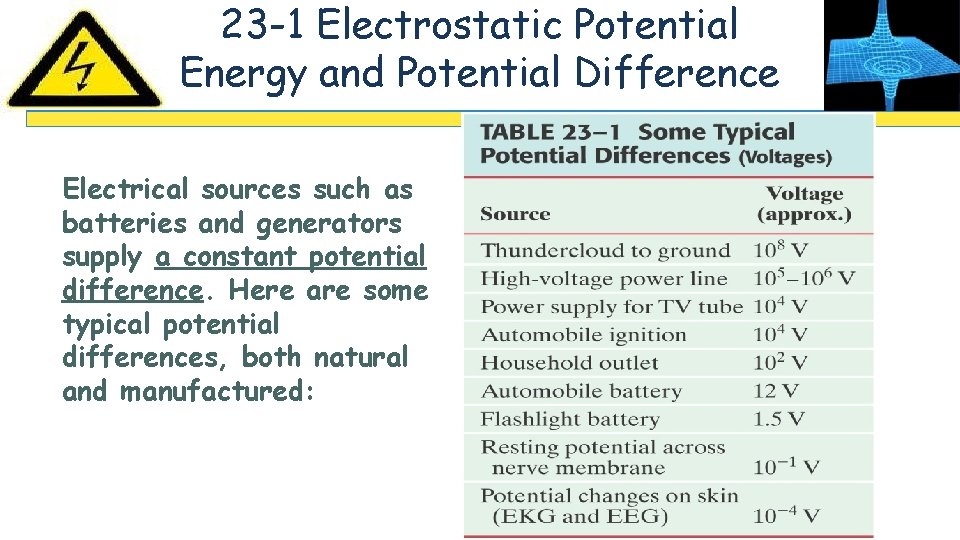
23 -1 Electrostatic Potential Energy and Potential Difference Electrical sources such as batteries and generators supply a constant potential difference. Here are some typical potential differences, both natural and manufactured:
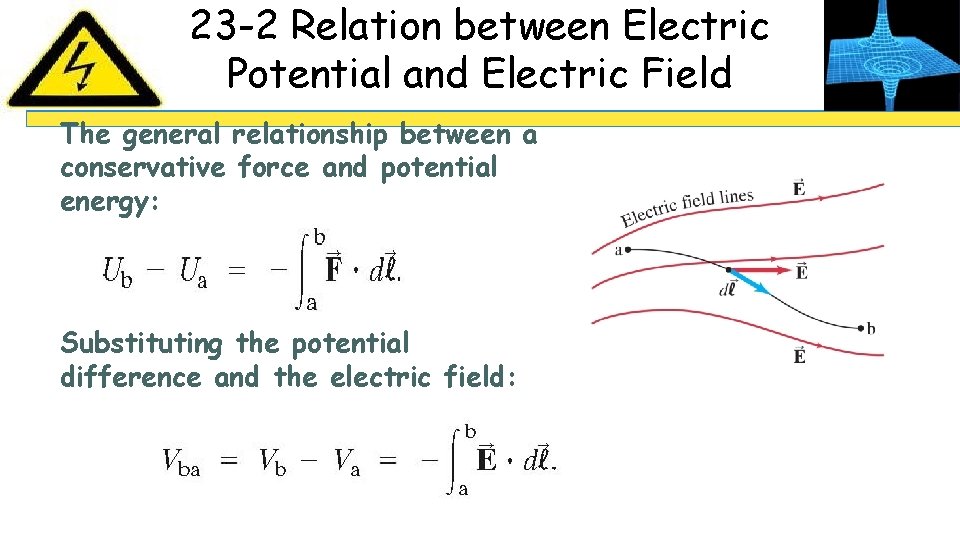
23 -2 Relation between Electric Potential and Electric Field The general relationship between a conservative force and potential energy: Substituting the potential difference and the electric field:
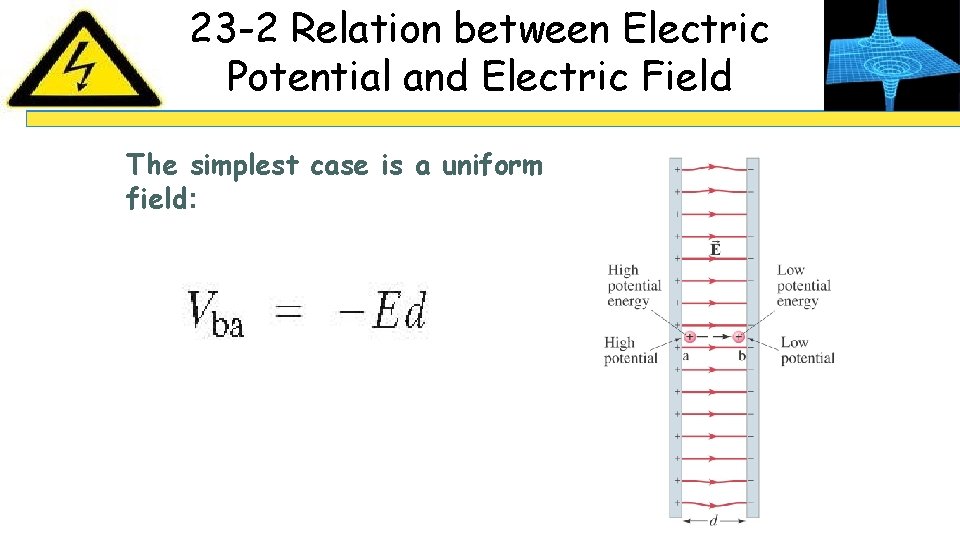
23 -2 Relation between Electric Potential and Electric Field The simplest case is a uniform field:
Points to remember • Potential Energy U is NOT a vector • The potential energy is a scalar—no direction • Force always points in the direction of LOWER potential energy • The signs of the charges give the sign on the electric potential energy • Only changes in electric potential are important
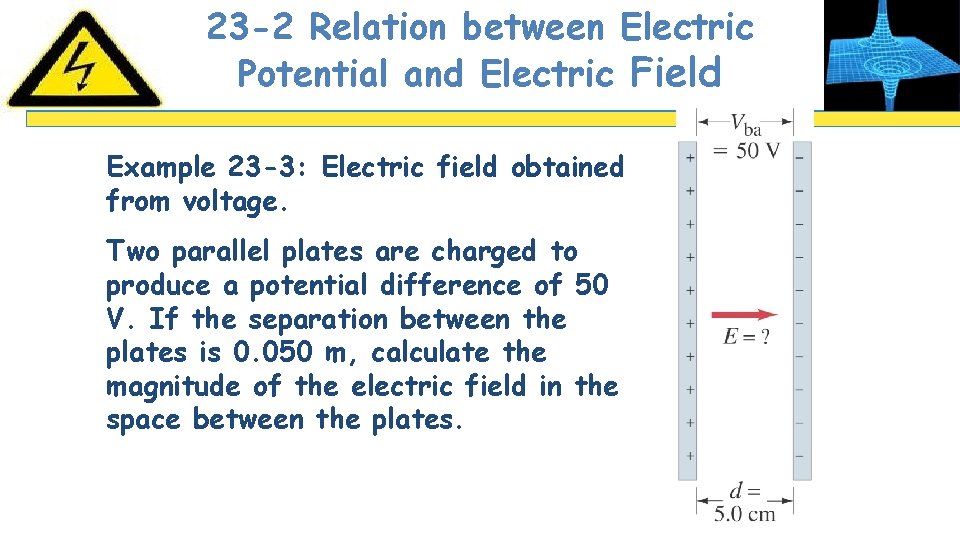
23 -2 Relation between Electric Potential and Electric Field Example 23 -3: Electric field obtained from voltage. Two parallel plates are charged to produce a potential difference of 50 V. If the separation between the plates is 0. 050 m, calculate the magnitude of the electric field in the space between the plates.
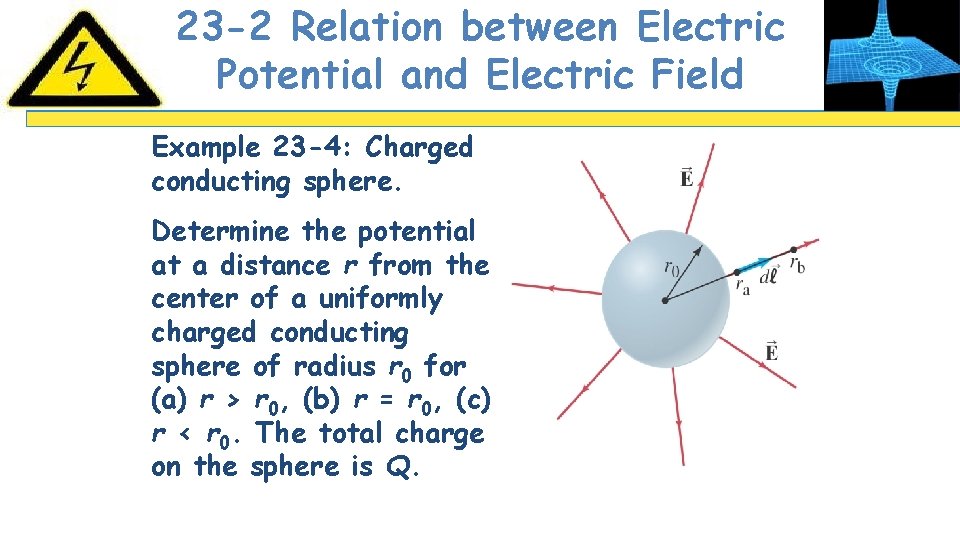
23 -2 Relation between Electric Potential and Electric Field Example 23 -4: Charged conducting sphere. Determine the potential at a distance r from the center of a uniformly charged conducting sphere of radius r 0 for (a) r > r 0, (b) r = r 0, (c) r < r 0. The total charge on the sphere is Q.
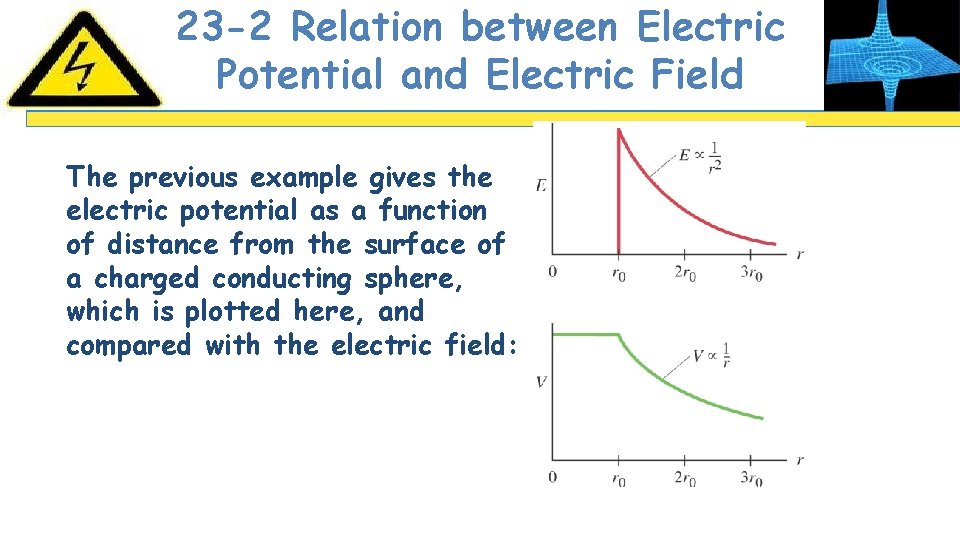
23 -2 Relation between Electric Potential and Electric Field The previous example gives the electric potential as a function of distance from the surface of a charged conducting sphere, which is plotted here, and compared with the electric field:
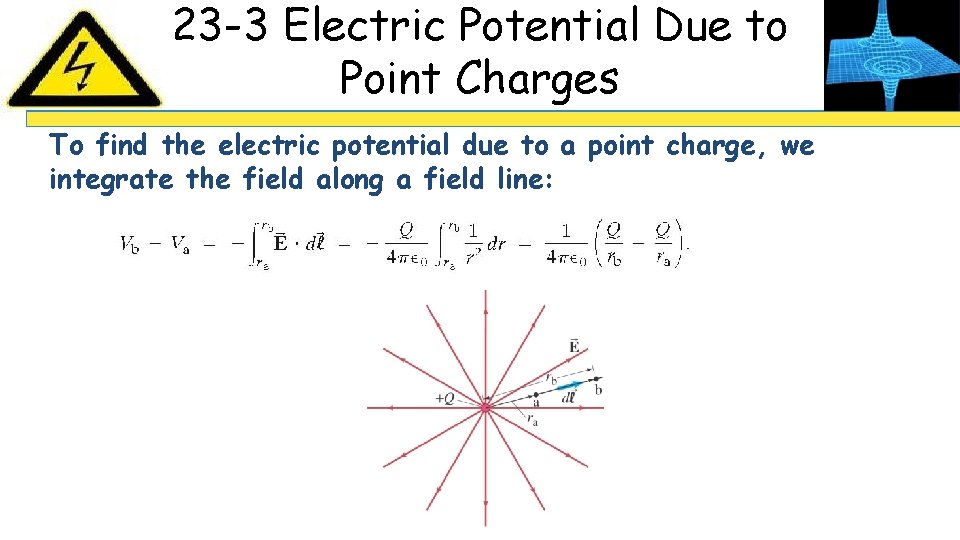
23 -3 Electric Potential Due to Point Charges To find the electric potential due to a point charge, we integrate the field along a field line:
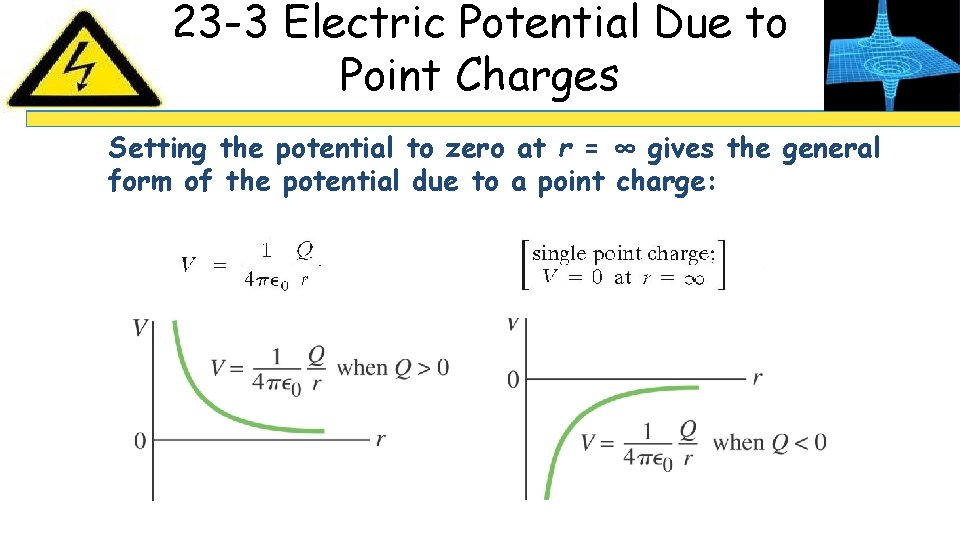
23 -3 Electric Potential Due to Point Charges Setting the potential to zero at r = ∞ gives the general form of the potential due to a point charge:
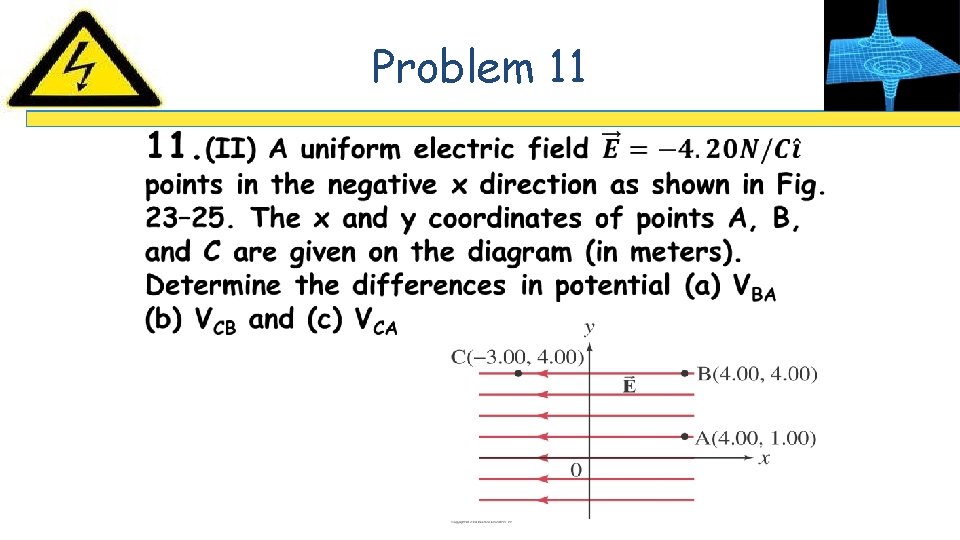
Problem 11
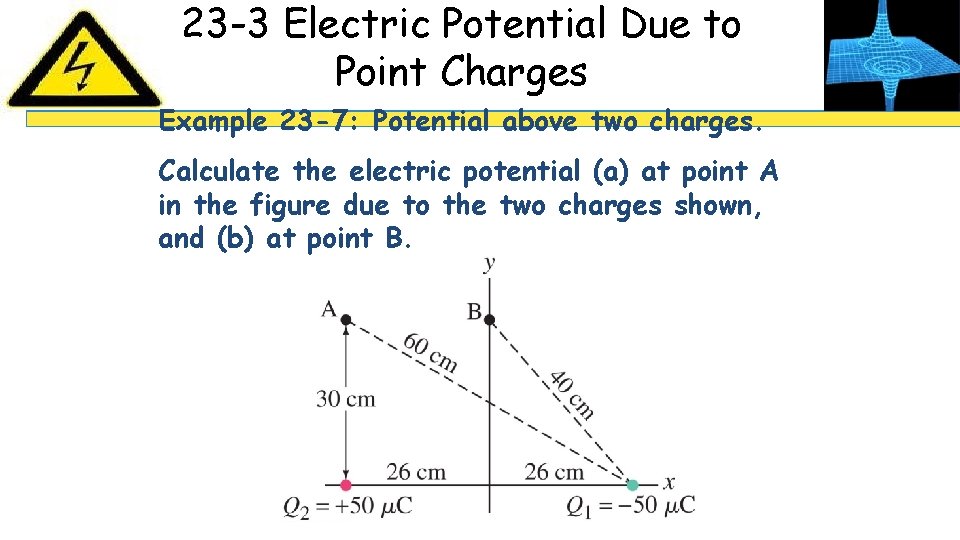
23 -3 Electric Potential Due to Point Charges Example 23 -7: Potential above two charges. Calculate the electric potential (a) at point A in the figure due to the two charges shown, and (b) at point B.
- Slides: 18