
Chapter 23 Circulation Power Point Lectures for Biology
Chapter 23 Circulation Power. Point Lectures for Biology: Concepts & Connections, Sixth Edition Campbell, Reece, Taylor, Simon, and Dickey Copyright © 2009 Pearson Education, Inc. Lecture by Richard L. Myers Translated by Nabih A. Baeshen
MECHANISMS OF INTERNAL TRANSPORT Copyright © 2009 Pearson Education, Inc.
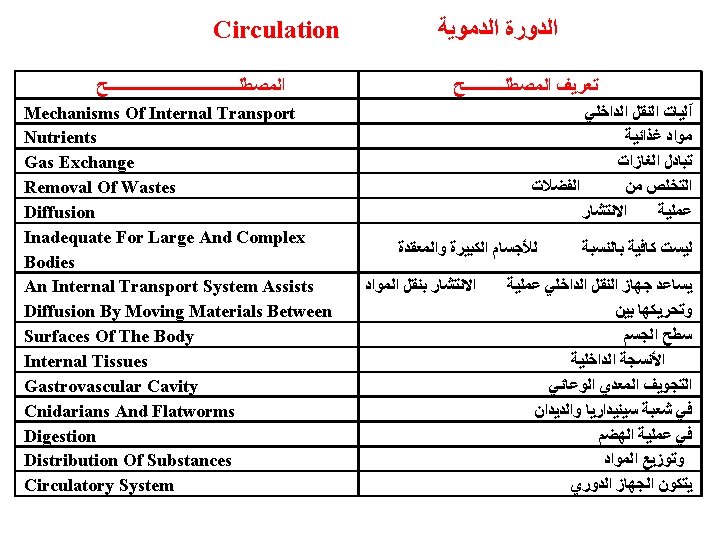
23. 1 Circulatory systems facilitate exchange with all body tissues § All cells need – Nutrients – Gas exchange – Removal of wastes § Diffusion alone is inadequate for large and complex bodies § An internal transport system assists diffusion by moving materials between – Surfaces of the body – Internal tissues Copyright © 2009 Pearson Education, Inc.
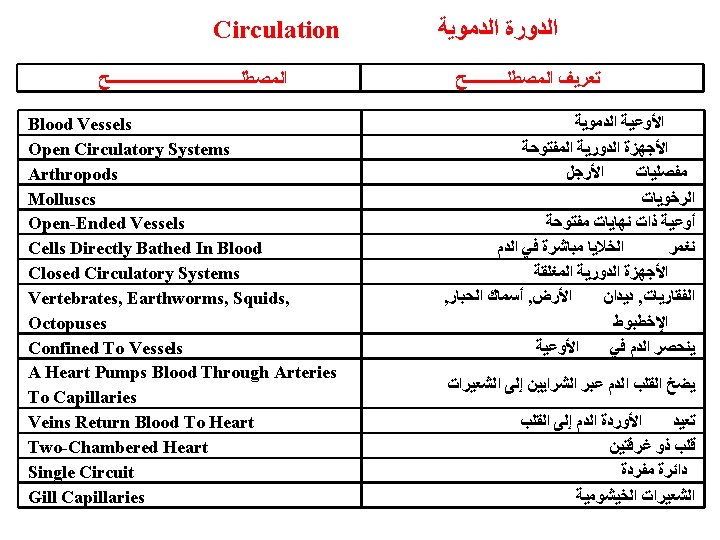
23. 1 Circulatory systems facilitate exchange with all body tissues § A gastrovascular cavity in cnidarians and flatworms serves in Digestion and Distribution of substances § Circulatory system in most animals consists of Blood, Heart and Blood vessels § Open circulatory systems in Arthropods and many molluscs – Heart pumps blood through open-ended vessels – Cells directly bathed in blood Copyright © 2009 Pearson Education, Inc.
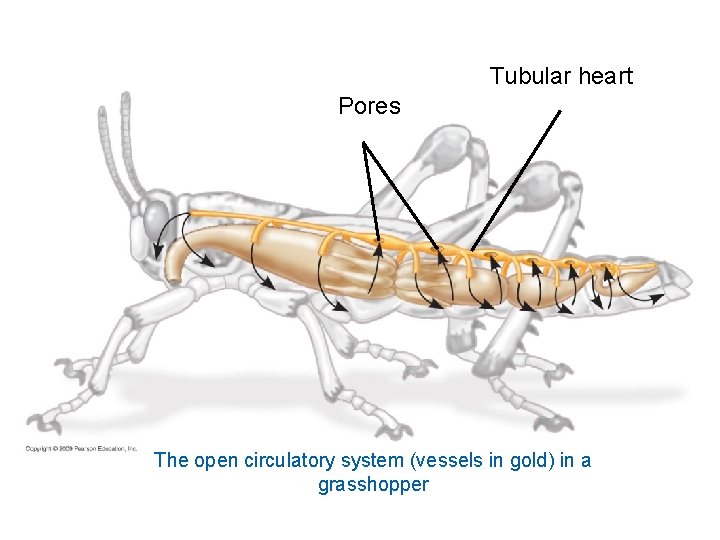
Tubular heart Pores The open circulatory system (vessels in gold) in a grasshopper
23. 1 Circulatory systems facilitate exchange with all body tissues § Closed circulatory systems – Vertebrates, earthworms, squids, octopuses – Blood stays confined to vessels – A heart pumps blood through arteries to capillaries – Veins return blood to heart Copyright © 2009 Pearson Education, Inc.
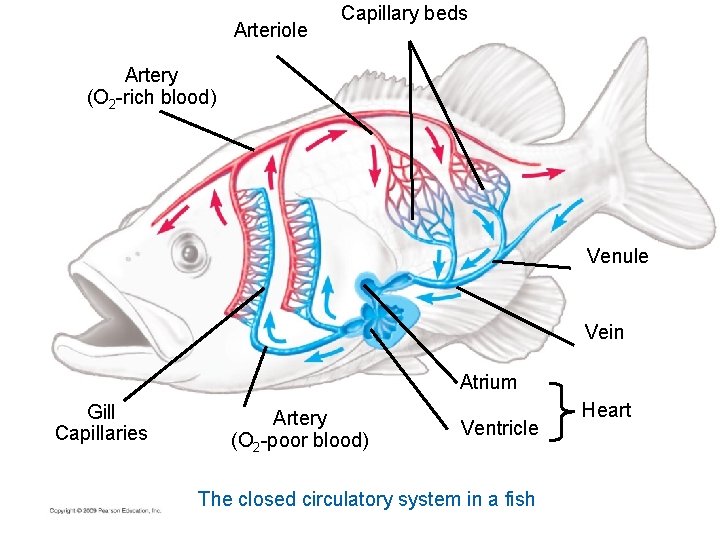
Arteriole Capillary beds Artery (O 2 -rich blood) Venule Vein Atrium Gill Capillaries Artery (O 2 -poor blood) Ventricle The closed circulatory system in a fish Heart
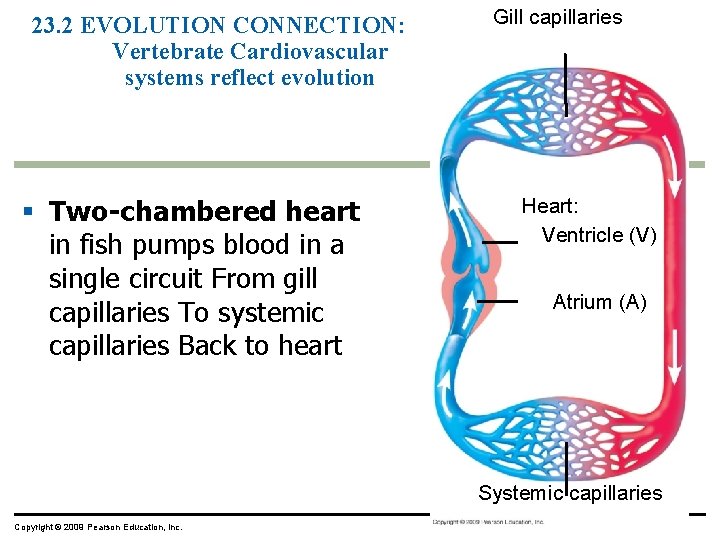
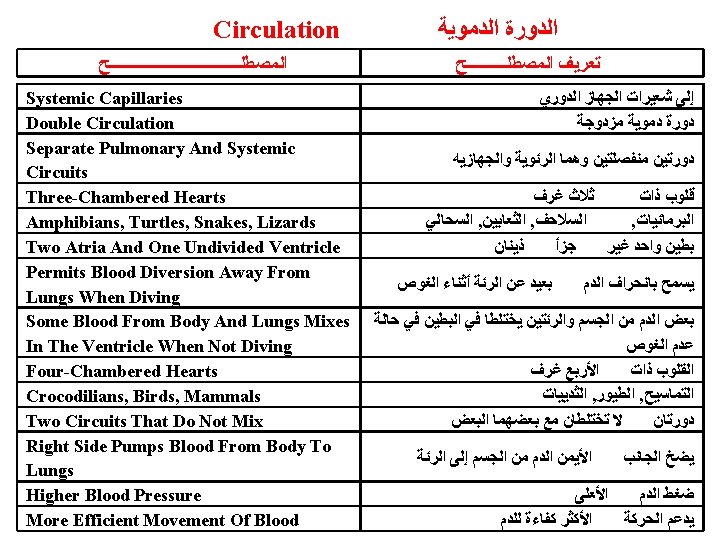
23. 2 EVOLUTION CONNECTION: Vertebrate Cardiovascular systems reflect evolution § Two-chambered heart in fish pumps blood in a single circuit From gill capillaries To systemic capillaries Back to heart Gill capillaries Heart: Ventricle (V) Atrium (A) Systemic capillaries Copyright © 2009 Pearson Education, Inc.
23. 2 EVOLUTION CONNECTION: Vertebrate Cardiovascular systems reflect evolution § Double circulation in land vertebrates have Separate pulmonary and systemic circuits § Three-chambered hearts –Amphibians, turtles, snakes, lizards –Two atria and one undivided ventricle –Permits blood diversion away from lungs when diving –But some blood from body and lungs mixes in the ventricle when not diving Copyright © 2009 Pearson Education, Inc.
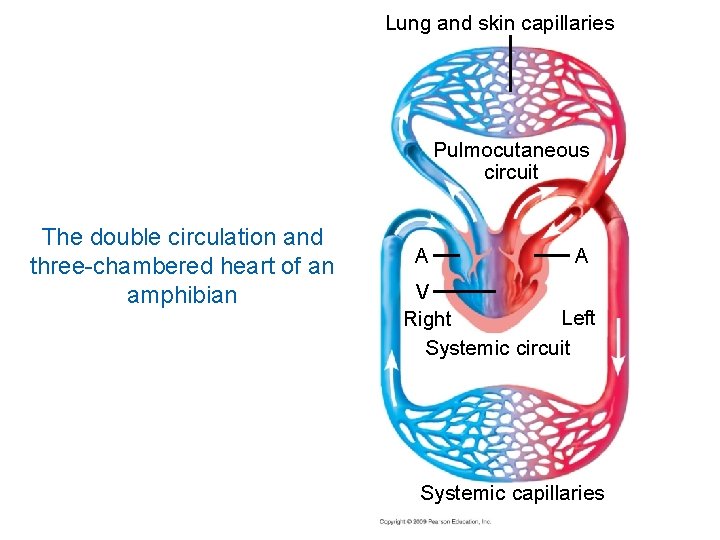
Lung and skin capillaries Pulmocutaneous circuit The double circulation and three-chambered heart of an amphibian A A V Left Right Systemic circuit Systemic capillaries
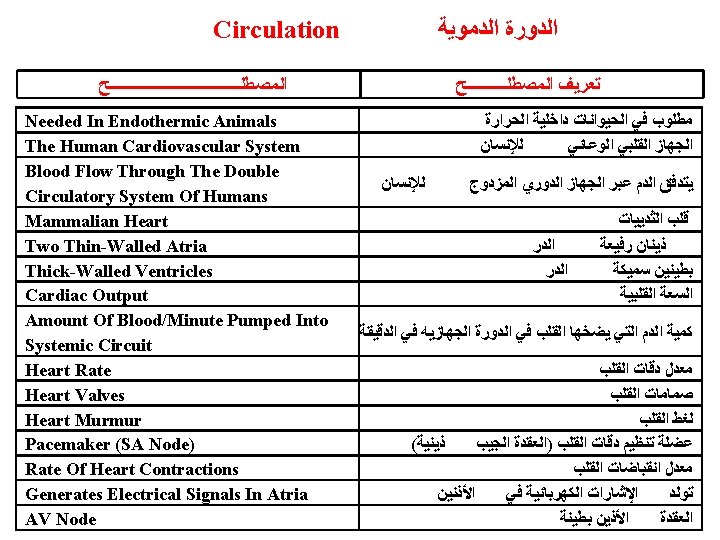
23. 2 EVOLUTION CONNECTION: Vertebrate Cardiovascular systems reflect evolution § Four-chambered hearts – Crocodilians, birds, mammals – Two atria and two ventricles – Two circuits that do not mix – Right side pumps blood from body to lungs – Left side pumps blood from lungs to body – Higher blood pressure – Supports more efficient movement of blood – Needed in endothermic animals Copyright © 2009 Pearson Education, Inc.
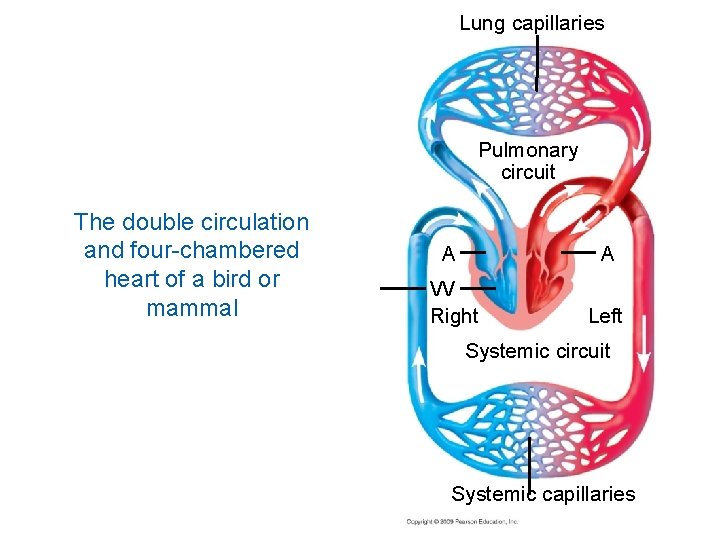
Lung capillaries Pulmonary circuit The double circulation and four-chambered heart of a bird or mammal A A VV Right Left Systemic circuit Systemic capillaries
THE HUMAN CARDIOVASCULAR SYSTEM Copyright © 2009 Pearson Education, Inc.
23. 3 The human cardiovascular system illustrates the double circulation of mammals § Blood flow through the double circulatory system of humans § The mammalian heart consists of – Two thin-walled atria that move blood to ventricles – Thick-walled ventricles that Pump blood to lungs and all other body regions Copyright © 2009 Pearson Education, Inc.
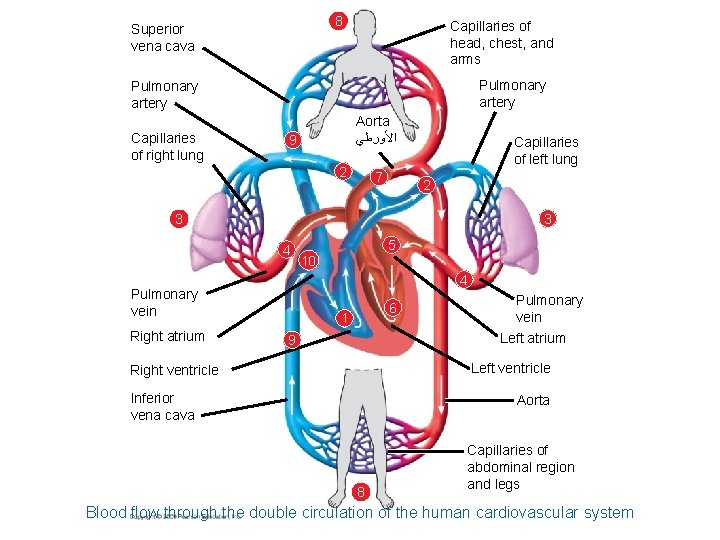
8 Superior vena cava Capillaries of head, chest, and arms Pulmonary artery Capillaries of right lung Aorta ﺍﻷﻮﺭﻃﻲ 9 2 7 Capillaries of left lung 2 3 3 4 10 4 Pulmonary vein Right atrium 5 6 1 9 Pulmonary vein Left atrium Left ventricle Right ventricle Inferior vena cava Aorta 8 Capillaries of abdominal region and legs Blood flow through the double circulation of the human cardiovascular system
23. 4 The heart contracts and relaxes rhythmically § Cardiac output: Amount of blood/minute pumped into systemic circuit § Heart rate: Number of beats/minute § Heart valves: Prevent the backflow of blood § Heart murmur: A defect in one or more heart valves Copyright © 2009 Pearson Education, Inc.
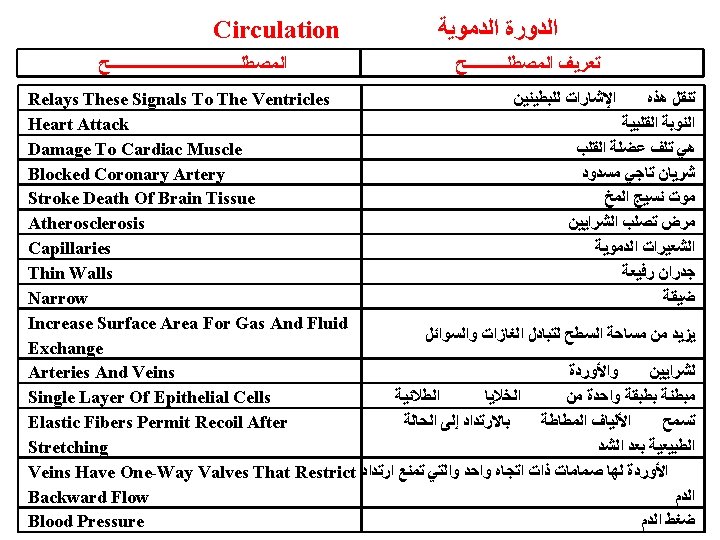
23. 5 The pacemaker sets the tempo of the heartbeat § The pacemaker (SA node in upper wall of right atrium) – Sets the rate of heart contractions – Generates electrical signals in atria § The AV node – Relays these signals to the ventricles Copyright © 2009 Pearson Education, Inc.
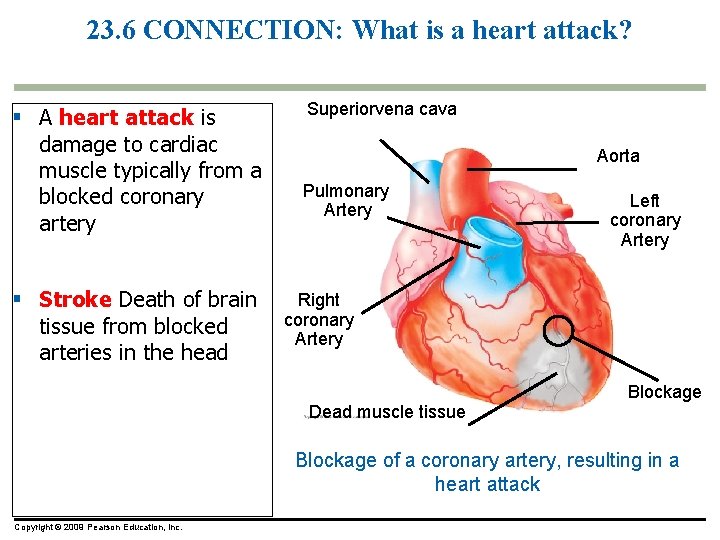
23. 6 CONNECTION: What is a heart attack? § A heart attack is damage to cardiac muscle typically from a blocked coronary artery § Stroke Death of brain tissue from blocked arteries in the head Superiorvena cava Aorta Pulmonary Artery Left coronary Artery Right coronary Artery Dead muscle tissue Blockage of a coronary artery, resulting in a heart attack Copyright © 2009 Pearson Education, Inc.
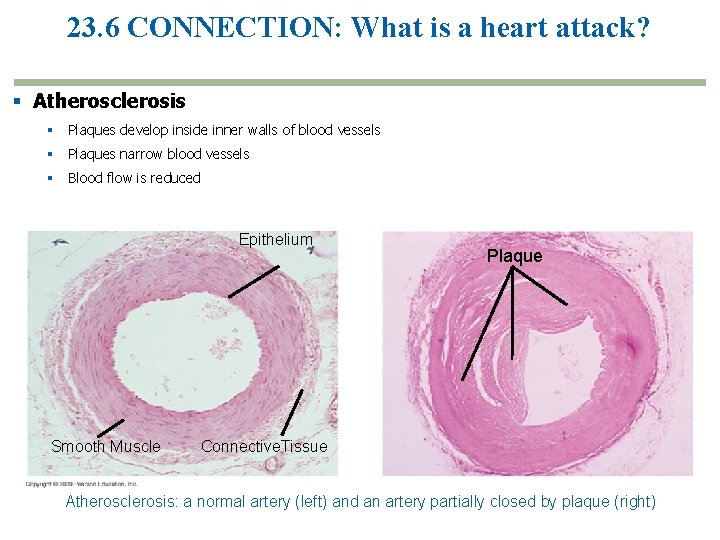
23. 6 CONNECTION: What is a heart attack? § Atherosclerosis § Plaques develop inside inner walls of blood vessels § Plaques narrow blood vessels § Blood flow is reduced Epithelium Smooth Muscle Plaque Connective. Tissue Atherosclerosis: a normal artery (left) and an artery partially closed by plaque (right)
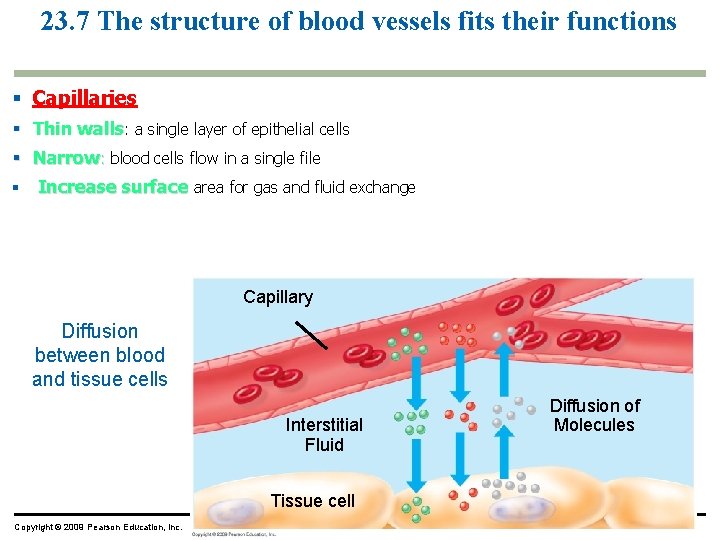
23. 7 The structure of blood vessels fits their functions § Capillaries § Thin walls: a single layer of epithelial cells § Narrow: blood cells flow in a single file § Increase surface area for gas and fluid exchange Capillary Diffusion between blood and tissue cells Interstitial Fluid Tissue cell Copyright © 2009 Pearson Education, Inc. Diffusion of Molecules
23. 7 The structure of blood vessels fits their functions § Arteries and veins – Lined by single layer of epithelial cells – Smooth muscle in walls can reduce blood flow – Elastic fibers permit recoil after stretching – Veins have one-way valves that restrict backward flow Copyright © 2009 Pearson Education, Inc.
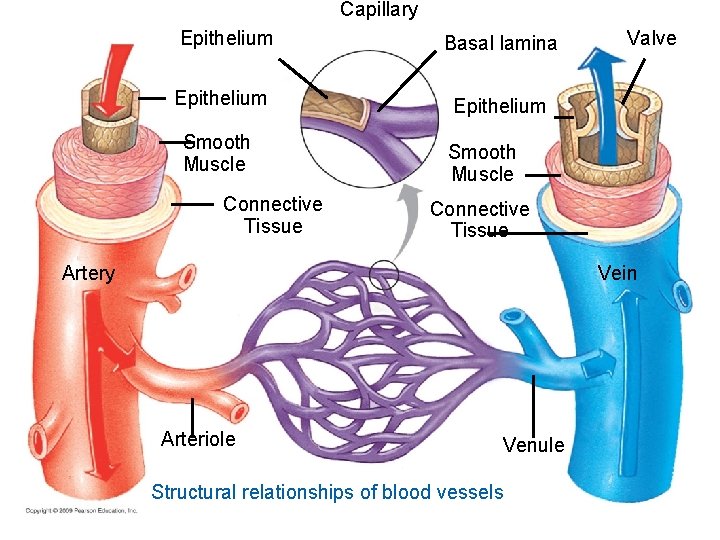
Capillary Epithelium Basal lamina Epithelium Smooth Muscle Connective Tissue Valve Smooth Muscle Connective Tissue Artery Vein Arteriole Venule Structural relationships of blood vessels
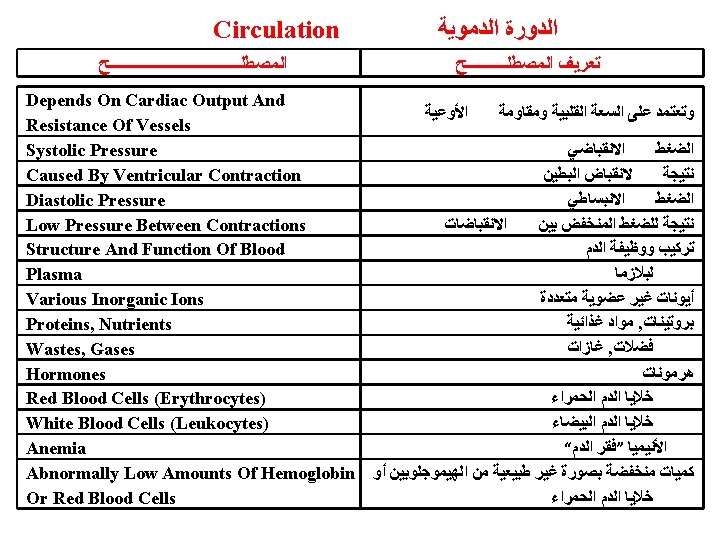
23. 8 Blood pressure and velocity reflect the structure and arrangement of blood vessels § Blood pressure: The force blood exerts on vessel walls – Depends on cardiac output and resistance of vessels – Decreases as blood moves away from heart – highest in arteries & lowest in veins – It is measured as – Systolic pressure: caused by ventricular contraction – Diastolic pressure: low pressure between contractions Copyright © 2009 Pearson Education, Inc.
STRUCTURE AND FUNCTION OF BLOOD Copyright © 2009 Pearson Education, Inc.
23. 12 Blood consists of red and white blood cells suspended in plasma § Plasma is about 90% water § Plasma contains – Various inorganic ions – Proteins, nutrients – Wastes, gases – Hormones Copyright © 2009 Pearson Education, Inc.
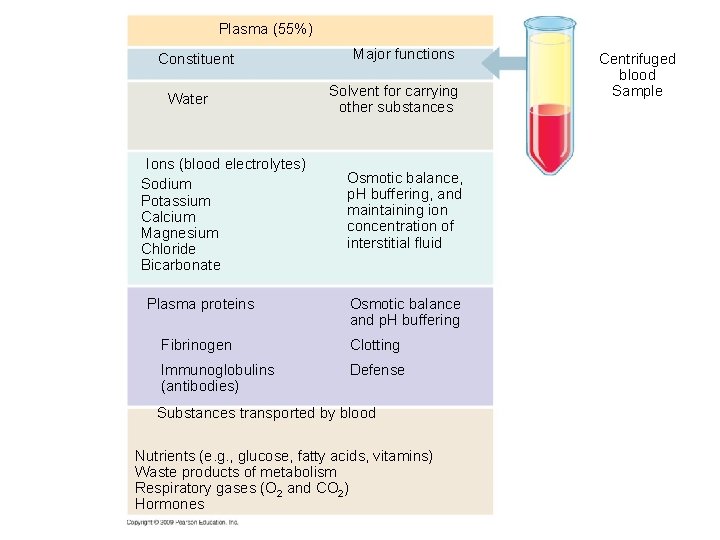
Plasma (55%) Constituent Water Ions (blood electrolytes) Sodium Potassium Calcium Magnesium Chloride Bicarbonate Plasma proteins Major functions Solvent for carrying other substances Osmotic balance, p. H buffering, and maintaining ion concentration of interstitial fluid Osmotic balance and p. H buffering Fibrinogen Clotting Immunoglobulins (antibodies) Defense Substances transported by blood Nutrients (e. g. , glucose, fatty acids, vitamins) Waste products of metabolism Respiratory gases (O 2 and CO 2) Hormones Centrifuged blood Sample
23. 12 Blood consists of red and white blood cells suspended in plasma § Red blood cells (erythrocytes) – Transport O 2 bound to hemoglobin § White blood cells (leukocytes) – Function inside and outside the circulatory system – Fight infections and cancer Copyright © 2009 Pearson Education, Inc.
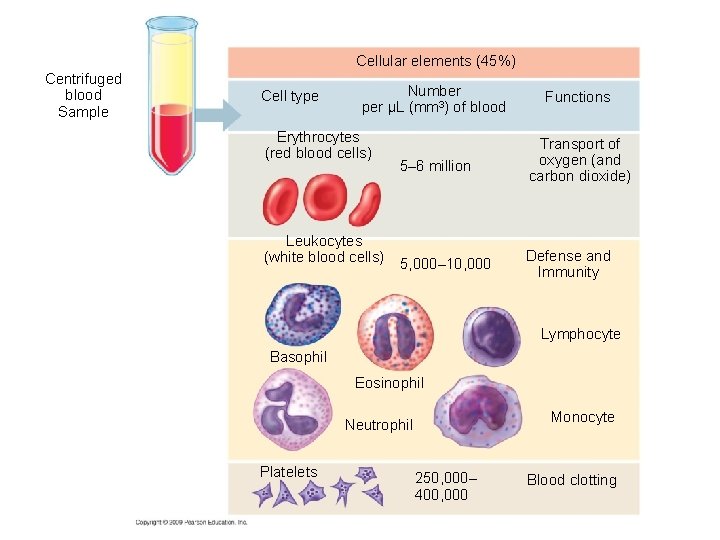
Cellular elements (45%) Centrifuged blood Sample Cell type Number per µL (mm 3) of blood Erythrocytes (red blood cells) Leukocytes (white blood cells) Functions 5– 6 million Transport of oxygen (and carbon dioxide) 5, 000– 10, 000 Defense and Immunity Lymphocyte Basophil Eosinophil Monocyte Neutrophil Platelets 250, 000– 400, 000 Blood clotting
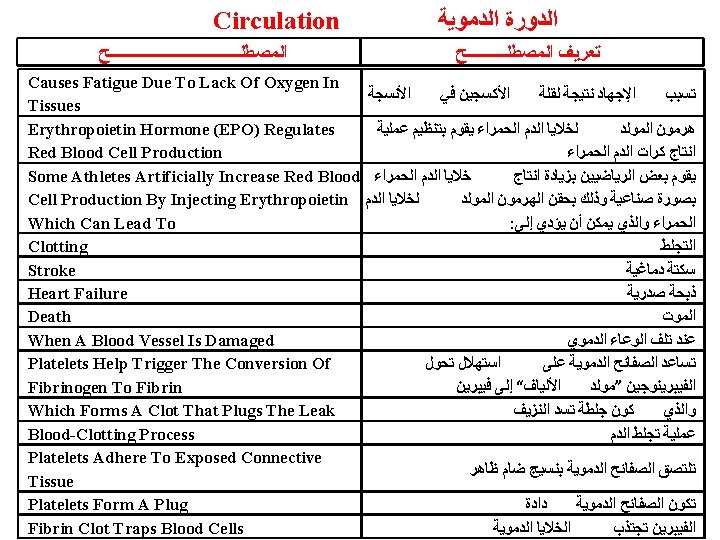
23. 13 CONNECTION: Too few or too many red blood cells can be unhealthy § Anemia – Abnormally low amounts of hemoglobin or red blood cells – Causes fatigue due to lack of oxygen in tissues § Erythropoietin hormone (EPO) Regulates red blood cell production § Some athletes artificially increase red blood cell production by injecting erythropoietin which can lead to ü ü Clotting Stroke Heart failure Death Copyright © 2009 Pearson Education, Inc.
23. 14 Blood clots plug leaks when blood vessels are injured § When a blood vessel is damaged – Platelets help trigger the conversion of fibrinogen to fibrin – Which forms a clot that plugs the leak § The blood-clotting process – Platelets adhere to exposed connective tissue – Platelets form a plug – A fibrin clot traps blood cells Copyright © 2009 Pearson Education, Inc.
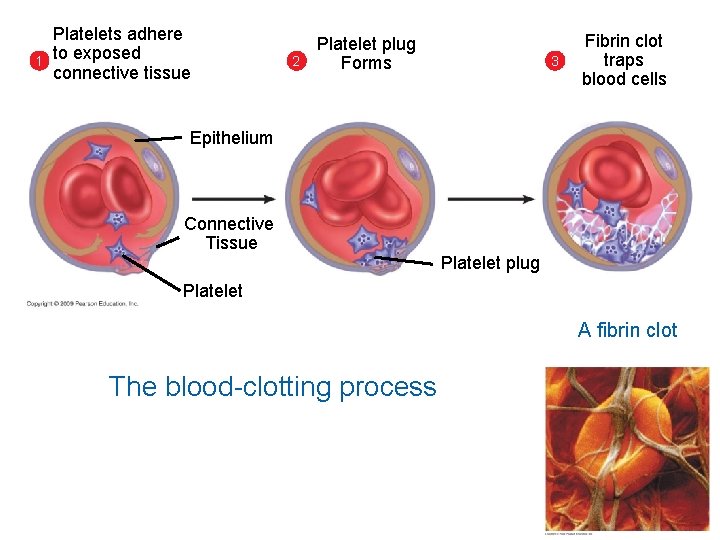
1 Platelets adhere to exposed connective tissue 2 Platelet plug Forms 3 Fibrin clot traps blood cells Epithelium Connective Tissue Platelet plug Platelet A fibrin clot The blood-clotting process
You should now be able to 1 - Explain how geese can fly at altitudes higher than Mount Everest 2 - Describe three main phases of gas exchange in a human 3 - Describe four types of respiratory surfaces and the types of animals that use them 4 - Explain how breathing air compares to using water for gas exchange Describe the parts and functions of the human respiratory system 6 - Describe the impact of smoking on human health 7 - Explain how blood transports gases between the lungs and tissues of the body 8 - Describe the functions of hemoglobin 9 - Explain how a fetus obtains oxygen before and after birth Copyright © 2009 Pearson Education, Inc.
You should now be able to 1. Explain how the circulatory systems of a giraffe and snake resist gravity 2. 2. Describe the general need for and functions of a circulatory system 3. Compare the structures and functions of gastrovascular cavities, open circulatory systems, and closed circulatory systems 4. Compare the circulatory systems of a fish, frog, and mammal 5. Explain how heartbeats are controlled 6. Describe the causes and consequences of a heart attack and cardiovascular disease 7. Relate the structure of blood vessels to their functions 8. Describe the components of blood and their functions 9. Describe the process of blood clotting 10. Describe the causes and treatments for leukemia Copyright © 2009 Pearson Education, Inc.
- Slides: 40