
Chapter 23 Circulation Power Point Lectures for Biology
Chapter 23 Circulation Power. Point Lectures for Biology: Concepts and Connections, Fifth Edition – Campbell, Reece, Taylor, and Simon Lectures by Chris Romero Copyright © 2005 Pearson Education, Inc. Publishing as Benjamin Cummings
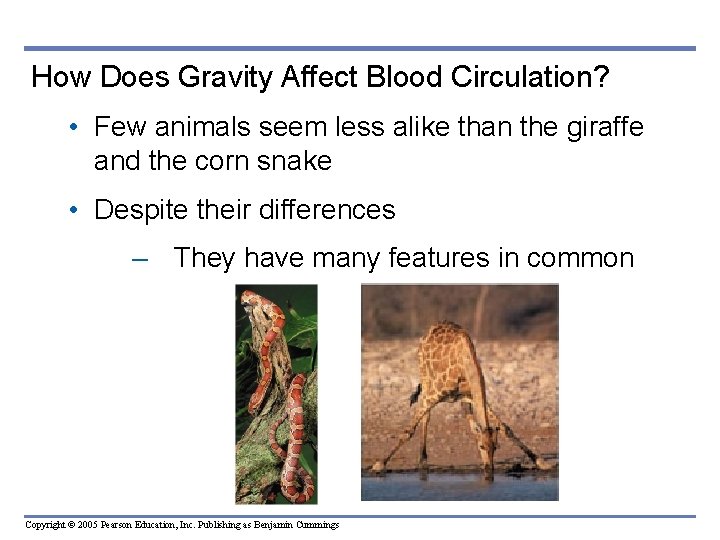
How Does Gravity Affect Blood Circulation? • Few animals seem less alike than the giraffe and the corn snake • Despite their differences – They have many features in common Copyright © 2005 Pearson Education, Inc. Publishing as Benjamin Cummings
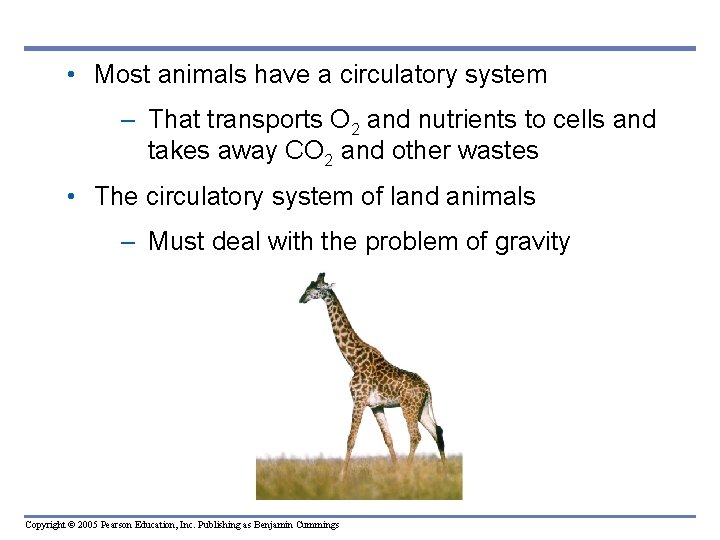
• Most animals have a circulatory system – That transports O 2 and nutrients to cells and takes away CO 2 and other wastes • The circulatory system of land animals – Must deal with the problem of gravity Copyright © 2005 Pearson Education, Inc. Publishing as Benjamin Cummings
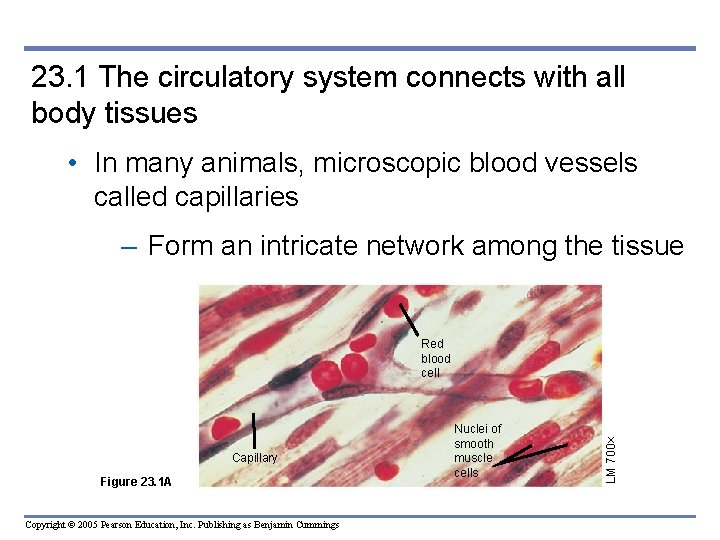
23. 1 The circulatory system connects with all body tissues • In many animals, microscopic blood vessels called capillaries – Form an intricate network among the tissue Capillary Figure 23. 1 A Copyright © 2005 Pearson Education, Inc. Publishing as Benjamin Cummings Nuclei of smooth muscle cells LM 700 Red blood cell

• Capillaries – Are the sites of exchange between blood and interstitial fluid Capillary Interstitial fluid Tissue cell Figure 23. 1 B Copyright © 2005 Pearson Education, Inc. Publishing as Benjamin Cummings Diffusion of molecules
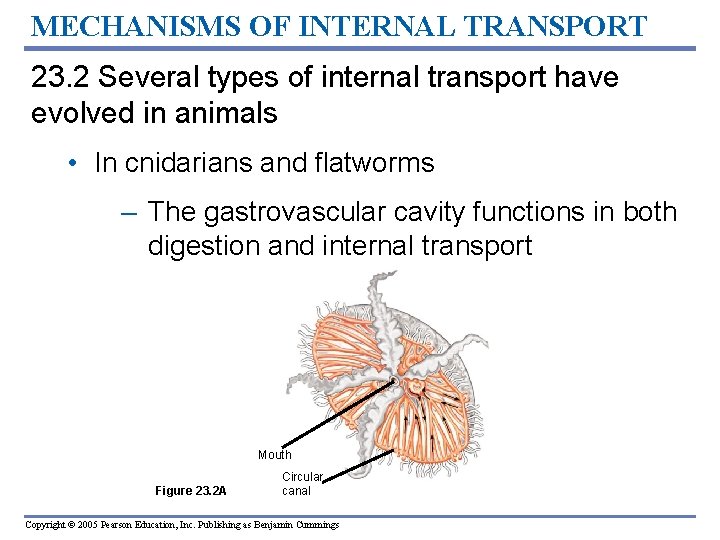
MECHANISMS OF INTERNAL TRANSPORT 23. 2 Several types of internal transport have evolved in animals • In cnidarians and flatworms – The gastrovascular cavity functions in both digestion and internal transport Mouth Figure 23. 2 A Circular canal Copyright © 2005 Pearson Education, Inc. Publishing as Benjamin Cummings
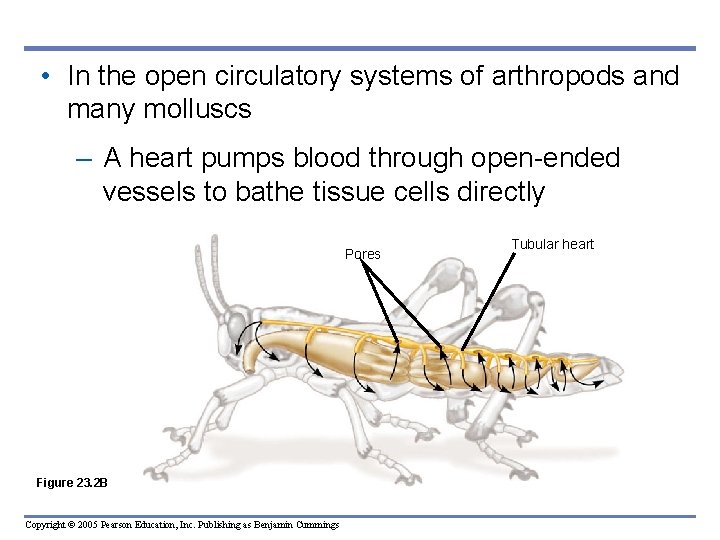
• In the open circulatory systems of arthropods and many molluscs – A heart pumps blood through open-ended vessels to bathe tissue cells directly Pores Figure 23. 2 B Copyright © 2005 Pearson Education, Inc. Publishing as Benjamin Cummings Tubular heart
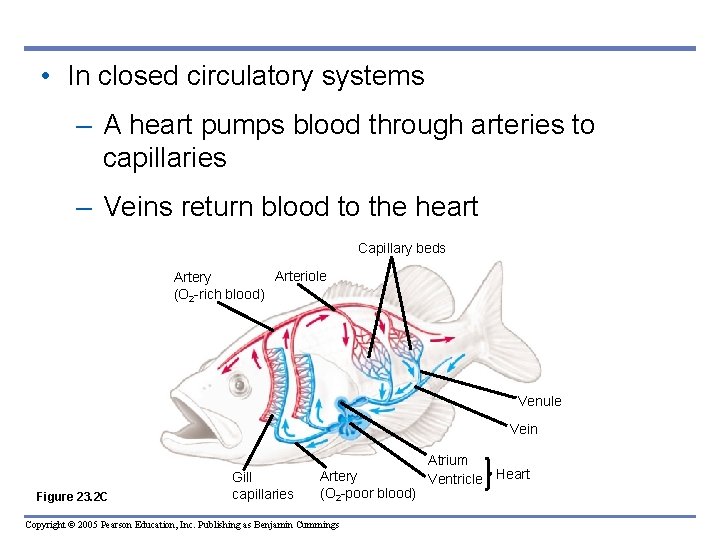
• In closed circulatory systems – A heart pumps blood through arteries to capillaries – Veins return blood to the heart Capillary beds Arteriole Artery (O 2 -rich blood) Venule Vein Figure 23. 2 C Gill capillaries Artery (O 2 -poor blood) Copyright © 2005 Pearson Education, Inc. Publishing as Benjamin Cummings Atrium Ventricle Heart
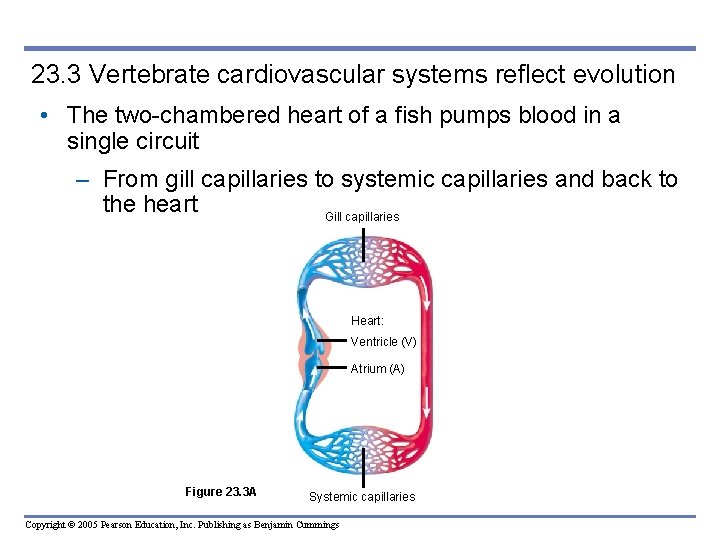
23. 3 Vertebrate cardiovascular systems reflect evolution • The two-chambered heart of a fish pumps blood in a single circuit – From gill capillaries to systemic capillaries and back to the heart Gill capillaries Heart: Ventricle (V) Atrium (A) Figure 23. 3 A Systemic capillaries Copyright © 2005 Pearson Education, Inc. Publishing as Benjamin Cummings
• Land vertebrates have double circulation – With separate pulmonary and systemic circuits Copyright © 2005 Pearson Education, Inc. Publishing as Benjamin Cummings
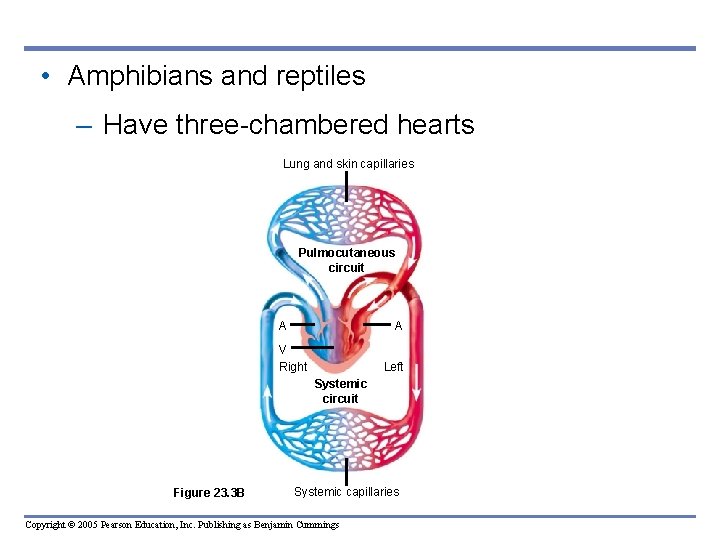
• Amphibians and reptiles – Have three-chambered hearts Lung and skin capillaries Pulmocutaneous circuit A A V Right Left Systemic circuit Figure 23. 3 B Systemic capillaries Copyright © 2005 Pearson Education, Inc. Publishing as Benjamin Cummings

• Birds and mammals – Have four-chambered hearts Lung capillaries Pulmonary circuit A A V Right V Left Systemic circuit Figure 23. 3 C Systemic capillaries Copyright © 2005 Pearson Education, Inc. Publishing as Benjamin Cummings
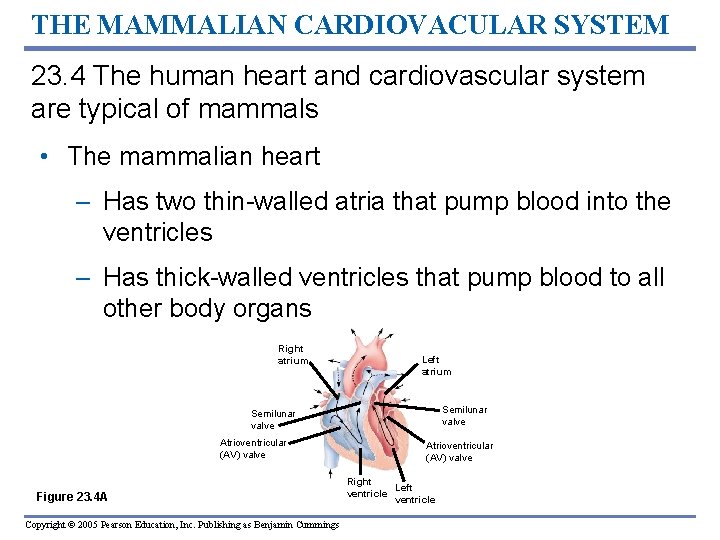
THE MAMMALIAN CARDIOVACULAR SYSTEM 23. 4 The human heart and cardiovascular system are typical of mammals • The mammalian heart – Has two thin-walled atria that pump blood into the ventricles – Has thick-walled ventricles that pump blood to all other body organs Right atrium Left atrium Semilunar valve Atrioventricular (AV) valve Figure 23. 4 A Copyright © 2005 Pearson Education, Inc. Publishing as Benjamin Cummings Atrioventricular (AV) valve Right Left ventricle
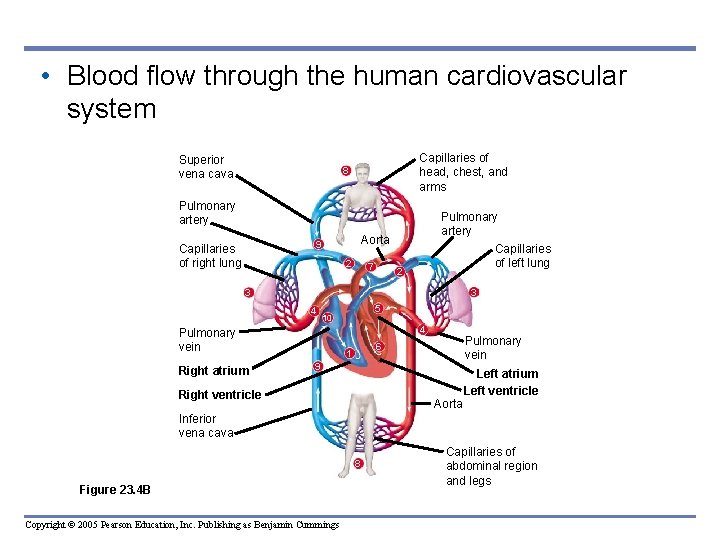
• Blood flow through the human cardiovascular system Superior vena cava Capillaries of head, chest, and arms 8 Pulmonary artery Aorta 9 Capillaries of right lung Pulmonary artery Capillaries of left lung 2 7 2 3 3 4 10 4 Pulmonary vein Right atrium 5 Pulmonary vein 6 1 9 Right ventricle Aorta Left atrium Left ventricle Inferior vena cava 8 Figure 23. 4 B Copyright © 2005 Pearson Education, Inc. Publishing as Benjamin Cummings Capillaries of abdominal region and legs
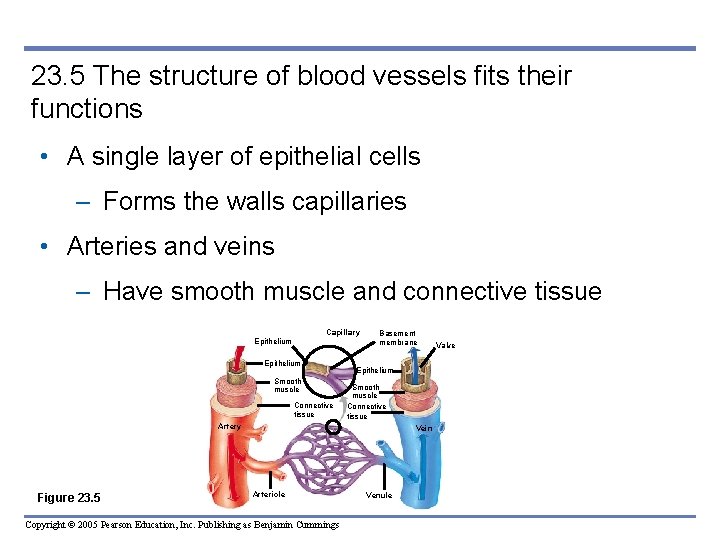
23. 5 The structure of blood vessels fits their functions • A single layer of epithelial cells – Forms the walls capillaries • Arteries and veins – Have smooth muscle and connective tissue Capillary Epithelium Smooth muscle Connective tissue Basement membrane Epithelium Smooth muscle Connective tissue Artery Figure 23. 5 Vein Arteriole Copyright © 2005 Pearson Education, Inc. Publishing as Benjamin Cummings Venule Valve
23. 6 The heart contracts and relaxes rhythmically • During diastole – Blood flows from the veins into the heart chambers • During systole – Contractions of the atria push blood into the ventricles – Stronger contractions of the ventricles propel blood into the large arteries Copyright © 2005 Pearson Education, Inc. Publishing as Benjamin Cummings
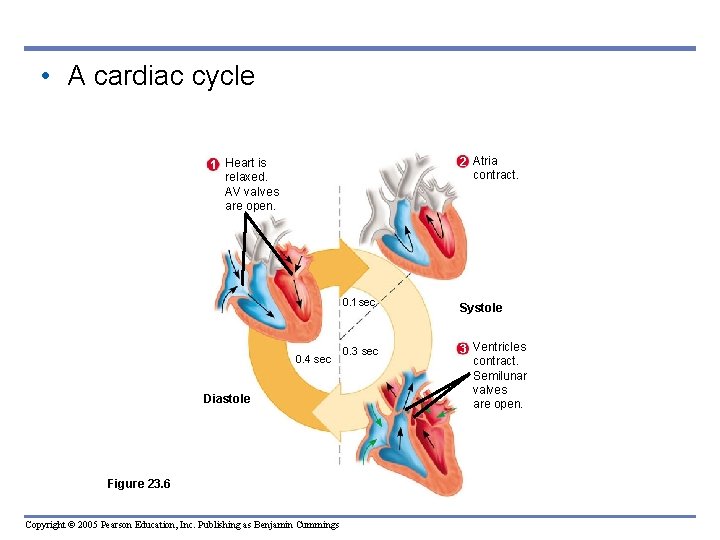
• A cardiac cycle 2 Atria contract. 1 Heart is relaxed. AV valves are open. 0. 4 sec Diastole Figure 23. 6 Copyright © 2005 Pearson Education, Inc. Publishing as Benjamin Cummings 0. 1 sec Systole 0. 3 sec 3 Ventricles contract. Semilunar valves are open.
• Cardiac output – Is the amount of blood/minute pumped into the systemic circuit • Heart valves – Prevent the backflow of blood Copyright © 2005 Pearson Education, Inc. Publishing as Benjamin Cummings
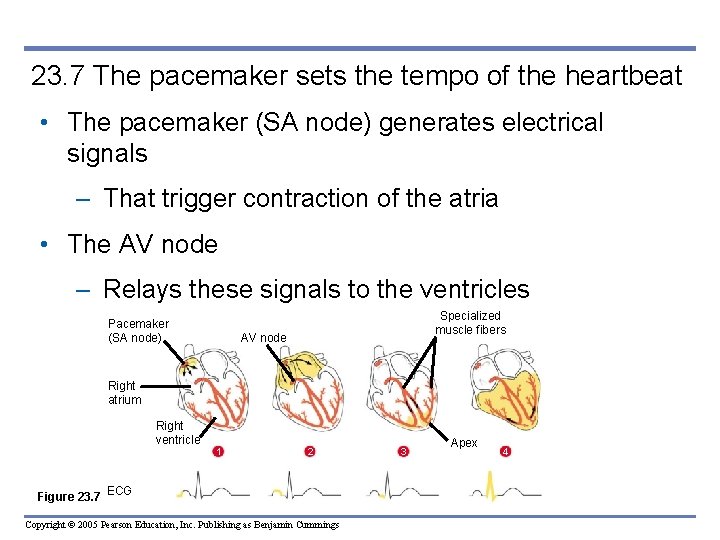
23. 7 The pacemaker sets the tempo of the heartbeat • The pacemaker (SA node) generates electrical signals – That trigger contraction of the atria • The AV node – Relays these signals to the ventricles Pacemaker (SA node) Specialized muscle fibers AV node Right atrium Right ventricle 1 2 Figure 23. 7 ECG Copyright © 2005 Pearson Education, Inc. Publishing as Benjamin Cummings 3 Apex 4
• An electrocardiogram (ECG) – Records the electrical changes in the heart • Heart rate – Adjusts to body needs Copyright © 2005 Pearson Education, Inc. Publishing as Benjamin Cummings
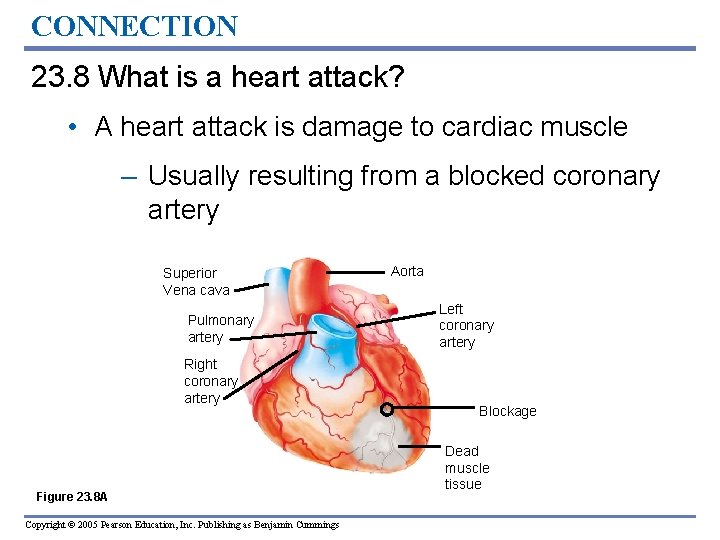
CONNECTION 23. 8 What is a heart attack? • A heart attack is damage to cardiac muscle – Usually resulting from a blocked coronary artery Superior Vena cava Pulmonary artery Right coronary artery Figure 23. 8 A Copyright © 2005 Pearson Education, Inc. Publishing as Benjamin Cummings Aorta Left coronary artery Blockage Dead muscle tissue
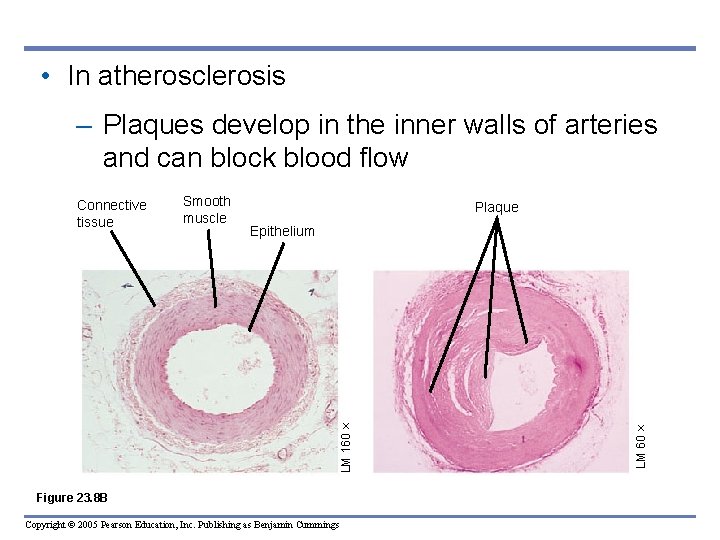
• In atherosclerosis – Plaques develop in the inner walls of arteries and can block blood flow Plaque Epithelium Figure 23. 8 B Copyright © 2005 Pearson Education, Inc. Publishing as Benjamin Cummings LM 60 Smooth muscle LM 160 Connective tissue
23. 9 Blood exerts pressure on vessel walls • Blood pressure – Is the force blood exerts on vessel walls – Depends on cardiac output and the resistance of vessels Copyright © 2005 Pearson Education, Inc. Publishing as Benjamin Cummings
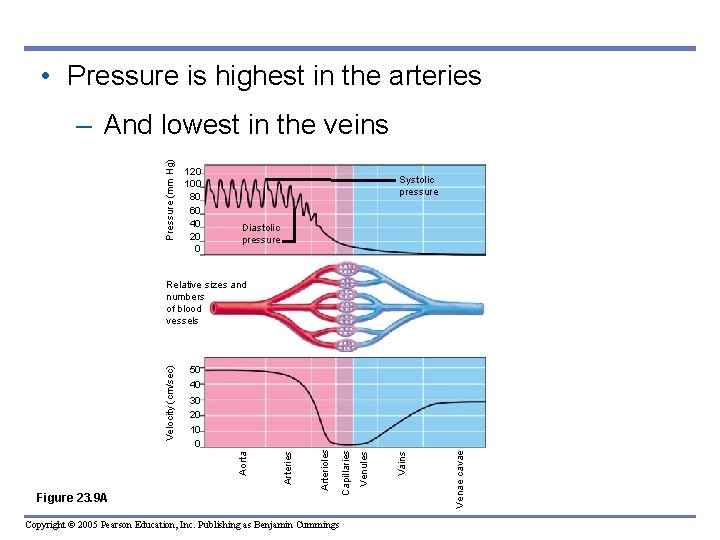
• Pressure is highest in the arteries Pressure (mm Hg) – And lowest in the veins 120 100 80 60 40 20 0 Systolic pressure Diastolic pressure 50 Copyright © 2005 Pearson Education, Inc. Publishing as Benjamin Cummings Vains Venules Venae cavae Figure 23. 9 A Capillaries Arteries 30 20 10 0 Arterioles 40 Aorta Velocity (cm/sec) Relative sizes and numbers of blood vessels
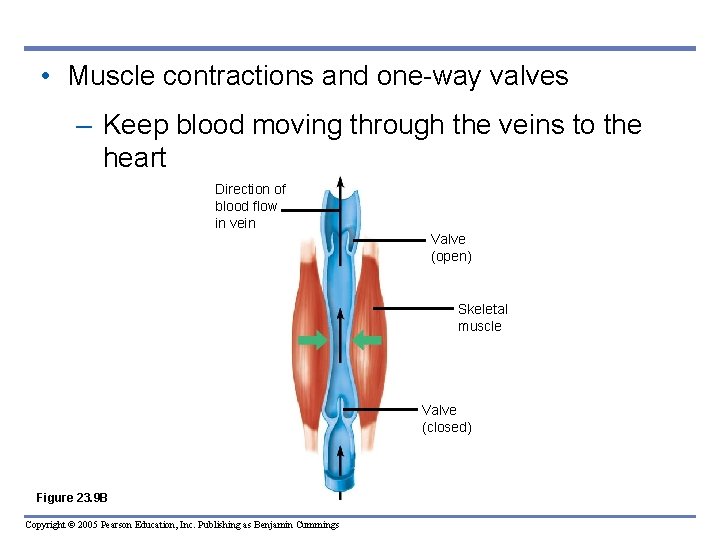
• Muscle contractions and one-way valves – Keep blood moving through the veins to the heart Direction of blood flow in vein Valve (open) Skeletal muscle Valve (closed) Figure 23. 9 B Copyright © 2005 Pearson Education, Inc. Publishing as Benjamin Cummings
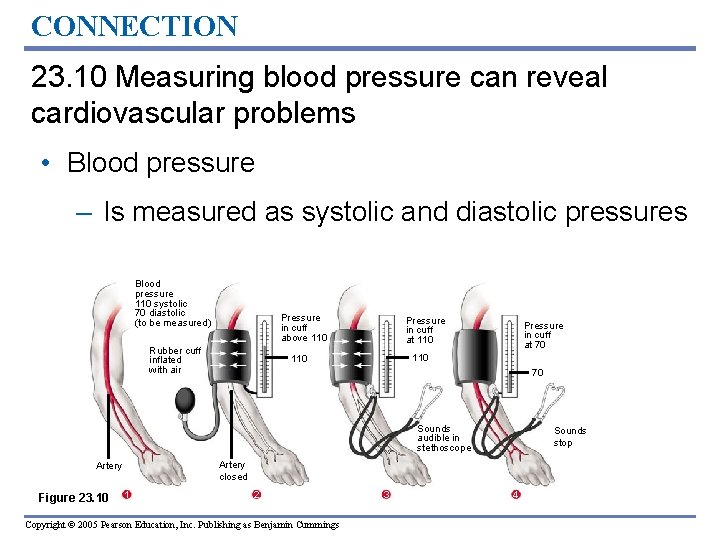
CONNECTION 23. 10 Measuring blood pressure can reveal cardiovascular problems • Blood pressure – Is measured as systolic and diastolic pressures Blood pressure 110 systolic 70 diastolic (to be measured) Pressure in cuff above 110 Rubber cuff inflated with air Pressure in cuff at 110 Pressure in cuff at 70 110 70 Sounds audible in stethoscope Artery closed Artery Figure 23. 10 Sounds stop 1 2 Copyright © 2005 Pearson Education, Inc. Publishing as Benjamin Cummings 3 4
• Hypertension – Is a serious cardiovascular problem Copyright © 2005 Pearson Education, Inc. Publishing as Benjamin Cummings
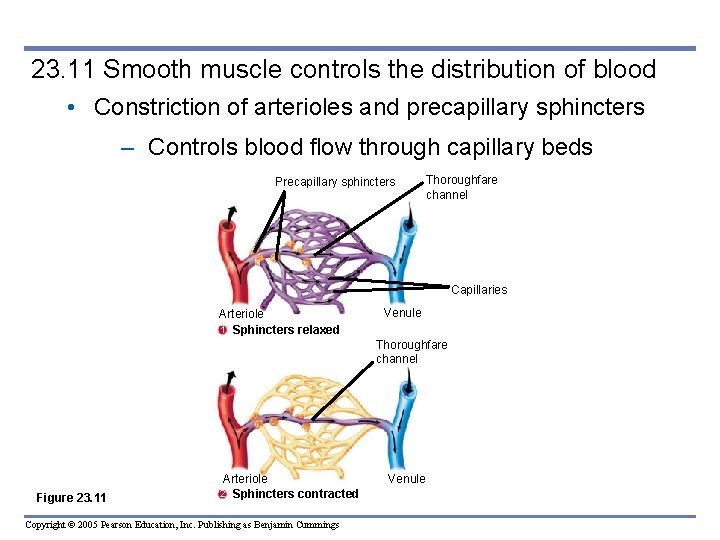
23. 11 Smooth muscle controls the distribution of blood • Constriction of arterioles and precapillary sphincters – Controls blood flow through capillary beds Precapillary sphincters Thoroughfare channel Capillaries Arteriole 1 Sphincters relaxed Venule Thoroughfare channel Figure 23. 11 Arteriole 2 Sphincters contracted Copyright © 2005 Pearson Education, Inc. Publishing as Benjamin Cummings Venule
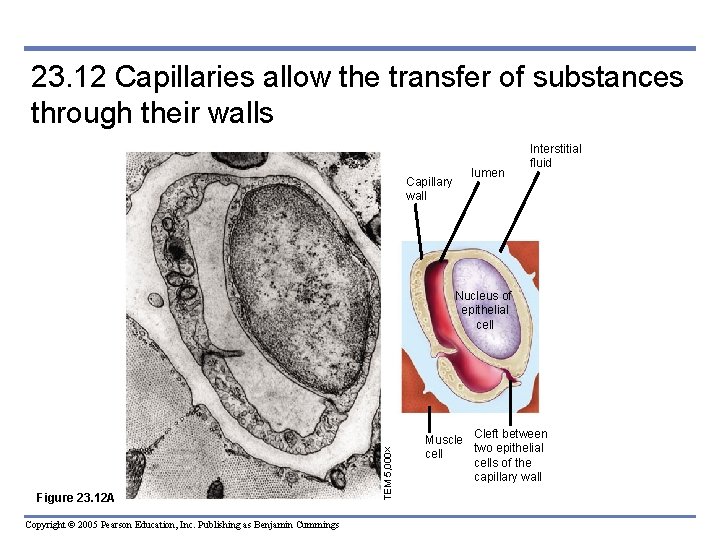
23. 12 Capillaries allow the transfer of substances through their walls Capillary wall Iumen Interstitial fluid Figure 23. 12 A Copyright © 2005 Pearson Education, Inc. Publishing as Benjamin Cummings TEM 5, 000 Nucleus of epithelial cell Cleft between Muscle two epithelial cells of the capillary wall
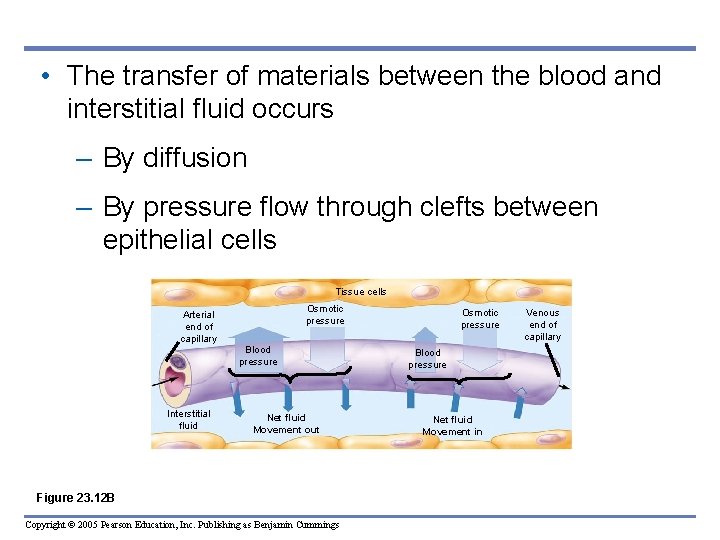
• The transfer of materials between the blood and interstitial fluid occurs – By diffusion – By pressure flow through clefts between epithelial cells Tissue cells Osmotic pressure Arterial end of capillary Blood pressure Interstitial fluid Net fluid Movement out Figure 23. 12 B Copyright © 2005 Pearson Education, Inc. Publishing as Benjamin Cummings Osmotic pressure Blood pressure Net fluid Movement in Venous end of capillary
• Blood pressure forces fluid out of the capillary at the arterial end – And osmotic pressure draws fluid at the venous end Copyright © 2005 Pearson Education, Inc. Publishing as Benjamin Cummings
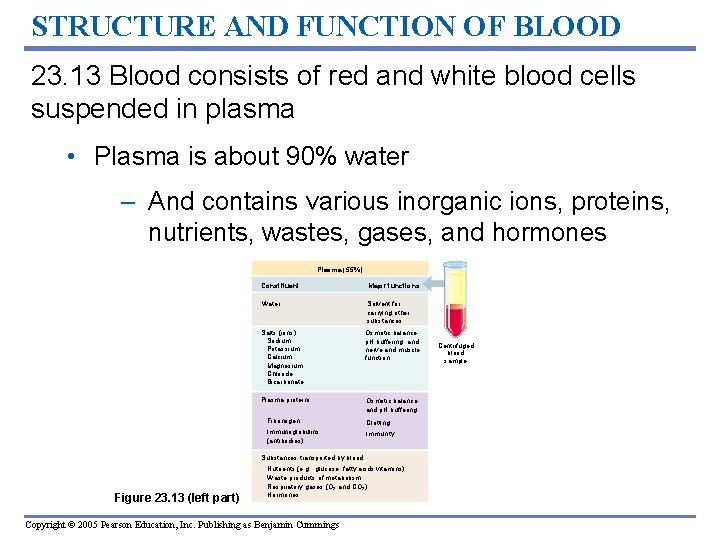
STRUCTURE AND FUNCTION OF BLOOD 23. 13 Blood consists of red and white blood cells suspended in plasma • Plasma is about 90% water – And contains various inorganic ions, proteins, nutrients, wastes, gases, and hormones Plasma (55%) Constituent Major functions Water Solvent for carrying other substances Salts (ions) Sodium Potassium Calcium Magnesium Chloride Bicarbonate Osmotic balance, p. H buffering, and nerve and muscle function Plasma proteins Osmotic balance and p. H buffering Fibrinogen Immunoglobulins (antibodies) Clotting Immunity Substances transported by blood Figure 23. 13 (left part) Nutrients (e. g. , glucose, fatty acids, vitamins) Waste products of metabolism Respiratory gases (O 2 and CO 2) Hormones Copyright © 2005 Pearson Education, Inc. Publishing as Benjamin Cummings Centrifuged blood sample
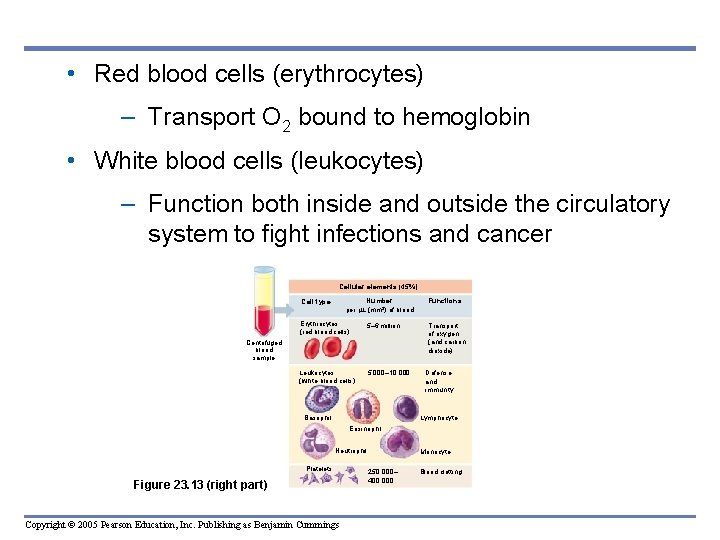
• Red blood cells (erythrocytes) – Transport O 2 bound to hemoglobin • White blood cells (leukocytes) – Function both inside and outside the circulatory system to fight infections and cancer Cellular elements (45%) Number per L (mm 3) of blood Cell type Erythrocytes (red blood cells) 5– 6 million Leukocytes (white blood cells) 5, 000– 10, 000 Centrifuged blood sample Functions Transport of oxygen (and carbon dioxide) Defense and immunity Lymphocyte Basophil Eosinophil Neutrophil Platelets Figure 23. 13 (right part) Copyright © 2005 Pearson Education, Inc. Publishing as Benjamin Cummings Monocyte 250, 000– 400, 000 Blood clotting
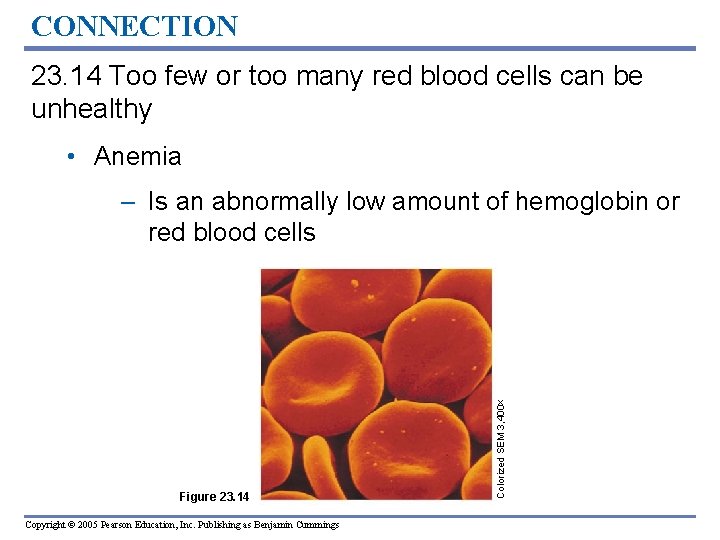
CONNECTION 23. 14 Too few or too many red blood cells can be unhealthy • Anemia Figure 23. 14 Copyright © 2005 Pearson Education, Inc. Publishing as Benjamin Cummings Colorized SEM 3, 400 – Is an abnormally low amount of hemoglobin or red blood cells
• The hormone erythropoietin – Regulates red blood cell production • Some athletes – Artificially increase their red blood cell production, a dangerous practice Copyright © 2005 Pearson Education, Inc. Publishing as Benjamin Cummings
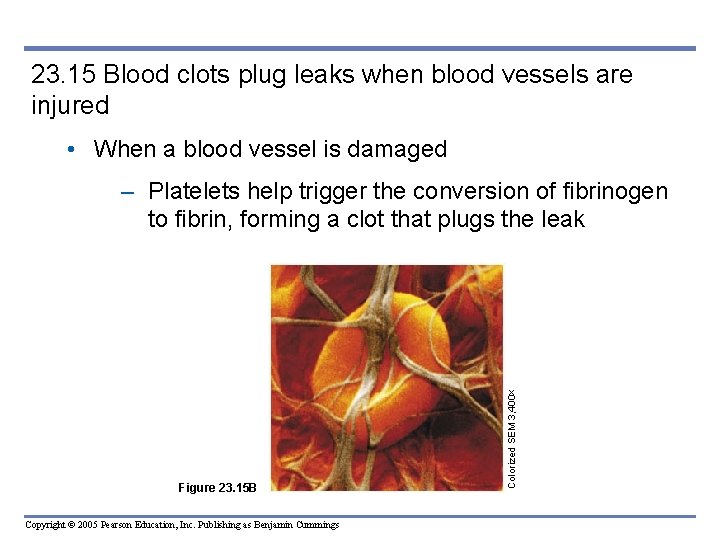
23. 15 Blood clots plug leaks when blood vessels are injured • When a blood vessel is damaged Figure 23. 15 B Copyright © 2005 Pearson Education, Inc. Publishing as Benjamin Cummings Colorized SEM 3, 400 – Platelets help trigger the conversion of fibrinogen to fibrin, forming a clot that plugs the leak
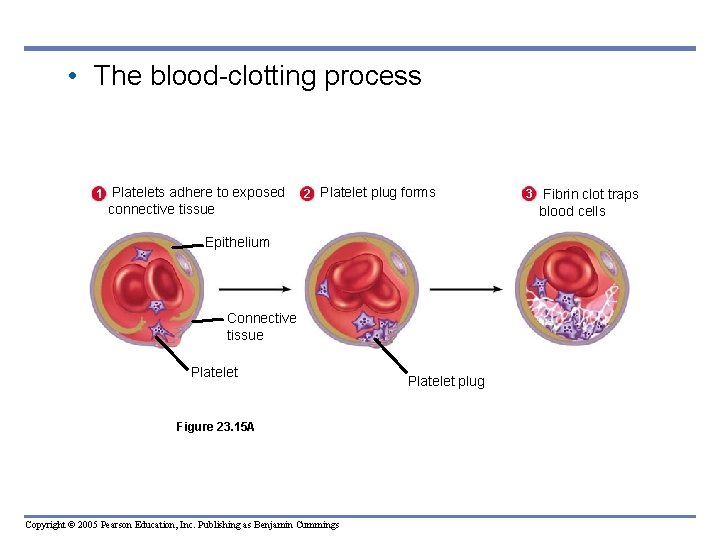
• The blood-clotting process 1 Platelets adhere to exposed 2 Platelet plug forms connective tissue 3 Fibrin clot traps blood cells Epithelium Connective tissue Platelet Figure 23. 15 A Copyright © 2005 Pearson Education, Inc. Publishing as Benjamin Cummings Platelet plug
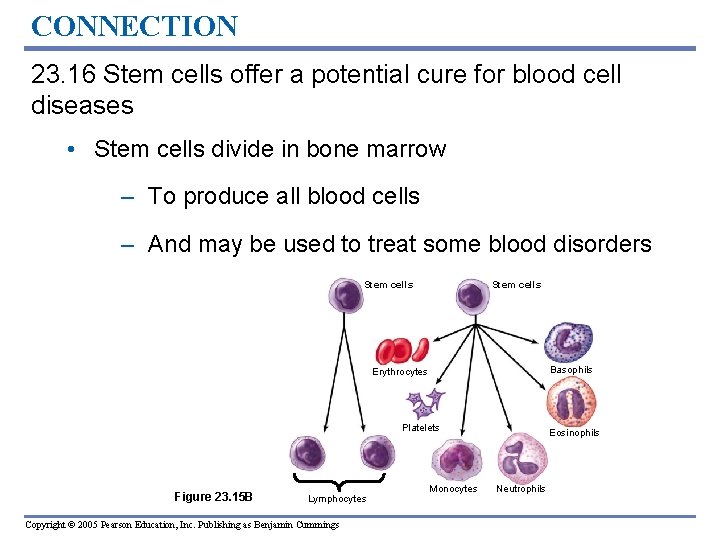
CONNECTION 23. 16 Stem cells offer a potential cure for blood cell diseases • Stem cells divide in bone marrow – To produce all blood cells – And may be used to treat some blood disorders Stem cells Basophils Erythrocytes Platelets Figure 23. 15 B Lymphocytes Copyright © 2005 Pearson Education, Inc. Publishing as Benjamin Cummings Monocytes Eosinophils Neutrophils
- Slides: 38