
Chapter 23 Antecedent Interventions Cooper Heron and Heward
- Slides: 43
Chapter 23: Antecedent Interventions Cooper, Heron, and Heward Applied Behavior Analysis, Second Edition 1
Conceptual Understanding of Antecedent Interventions • Literature has classified all antecedentbased behavior change strategies under single terms – e. g. antecedent procedures, antecedent control, antecedent manipulations, antecedent interventions – Using the same terms may cause confusion or fail to recognize the different functions Cooper, Heron, and Heward Applied Behavior Analysis, Second Edition 2
Conceptual Understanding of Antecedent Interventions • SD’s – evoke behavior due to past correlation with increased availability of reinforcement • MO’s – increase current frequency of behavior when an effective reinforcer is not available • Each has different implications for how behavior change strategies should be implemented and manipulated Cooper, Heron, and Heward Applied Behavior Analysis, Second Edition 3
Classifying Functions of Antecedent Stimuli • Categories for functions of antecedent stimuli – Contingency dependent – Contingency independent Cooper, Heron, and Heward Applied Behavior Analysis, Second Edition 4
Classifying Functions of Antecedent Stimuli • Contingency dependent – Antecedent event is dependent on the consequences of behavior for developing evocative & abative effects – All stimulus control functions – Referred to as antecedent control Cooper, Heron, and Heward Applied Behavior Analysis, Second Edition 5
Classifying Functions of Antecedent Stimuli • Contingency independent – Antecedent event is not dependent on the consequences of behavior for developing evocative & abative effects – Antecedent itself affects behaviorconsequence relations – MO’s are contingency independent – Referred to as antecedent intervention Cooper, Heron, and Heward Applied Behavior Analysis, Second Edition 6
Antecedent Intervention • Antecedent interventions serve to have abolishing operations – Used in isolation or in combination (i. e. treatment packages – Decrease the effectiveness of reinforcers that maintain problem behavior • Effects of MO’s are temporary (Smith & Iwata, 1997) – Will not produce permanent improvements in behavior – Can be used simultaneously to reduce problem behavior – Most often antecedent interventions serve as a component of treatment package • Produce more maintaining effects Cooper, Heron, and Heward Applied Behavior Analysis, Second Edition 7
Antecedent Intervention • Interventions with established experimental results – Noncontingent reinforcement (NCR) – High-probability request sequence – Functional communication training (FCT) Cooper, Heron, and Heward Applied Behavior Analysis, Second Edition 8
Noncontingent Reinforcement • NCR is an antecedent intervention • Stimuli with known reinforcing properties are delivered on a fixed-time (FT) or variable-time (VT) schedule independent of the learner’s behavior (Vollmer et al. , 1993) Cooper, Heron, and Heward Applied Behavior Analysis, Second Edition 9
Noncontingent Reinforcement • May effectively decrease problem behavior because reinforcers that maintain the problem behavior are available freely & frequently • Functions as an abolishing operation (AO) • Referred to as presenting stimuli with known reinforcing properties Cooper, Heron, and Heward Applied Behavior Analysis, Second Edition 10
Noncontingent Reinforcement • Uses three distinct procedures that identify & deliver stimuli with known reinforcing properties – Positive reinforcement – Negative reinforcement – Automatic reinforcement Cooper, Heron, and Heward Applied Behavior Analysis, Second Edition 11
Noncontingent Reinforcement • NCR with positive reinforcement – Kahng, Iwata, Thompson, and Hanley (2000) – Study demonstrated the use of positive reinforcement (i. e. attention & food) for three individuals with developmental disabilities as an antecedent intervention to decrease problem behaviors found during analysis to be maintained by the positive reinforcement Cooper, Heron, and Heward Applied Behavior Analysis, Second Edition 12
Noncontingent Reinforcement • NCR with negative reinforcement – Kodak, Miltenberger, and Romaniuk (2003) – Study demonstrated the use of negative reinforcment (i. e. break from instructional requests) for two individuals with autism as an antecedent intervention t decrease problem behaviors found during analysis to be maintained by negative reinforcement – Increased participants’ compliance & decreased problem behaviors Cooper, Heron, and Heward Applied Behavior Analysis, Second Edition 13
Noncontingent Reinforcement • NCR with automatic reinforcement – Lindberg, Iwata, Roscoe, Worsdell, and Hanley (2003) – Study demonstrated the use of automatic reinforcement (i. e. physical manipulation of highly preferred leisure items) for two individuals with profound mental retardation to decrease SIB found during analysis to be maintained by automatic reinforcement – Demonstrated that NCR object manipulation could compete with automatic reinforcement to reduce SIB Cooper, Heron, and Heward Applied Behavior Analysis, Second Edition 14
Noncontingent Reinforcement • Using NCR effectively – Three key elements to enhance effectiveness • Amount & quality of stimuli with known reinforcing effectiveness of NCR • Inclusion of extinction with NCR interventions • Vary the available stimuli with NCR intervention to reduce problems of changing preferences – Proper utilization of information obtained through FBA • Correct identification of maintaining contingencies of reinforcement Cooper, Heron, and Heward Applied Behavior Analysis, Second Edition 15
Noncontingent Reinforcement • Ringdahl, Vollmer, Borrero, and Connell (2001) – Study demonstrates the importance of the schedule under which reinforcement is delivered in NCR – Similarities between baseline and initial NCR may be ineffective – Denser reinforcement (than during baseline) during initial NCR ensures discrepancy & better chances for intervention to be successful Cooper, Heron, and Heward Applied Behavior Analysis, Second Edition 16
Noncontingent Reinforcement • Ringdahl et al. (2001) suggest three procedures for emphasizing reinforcement during NCR intervention – Increase the delivery of stimuli with known reinforcing properties – Use an obviously different schedule of reinforcement at treatment onset – Combine DRO with the NCR treatment package Cooper, Heron, and Heward Applied Behavior Analysis, Second Edition 17
Noncontingent Reinforcment • Time schedules for NCR – Typically most applications use a FT schedule – Also can be done using a VT schedule – Establishing the initial schedule is crucial & can impact the overall effectiveness of the intervention – Recommendation is to start with a dense FT or VT schedule • Can be done arbitrarily • More effective to base it on the number of occurrences of problem behavior Cooper, Heron, and Heward Applied Behavior Analysis, Second Edition 18
Noncontingent Reinforcement • To determine the initial NCR schedule – Divide the total duration of all baseline sessions by the total number of occurrences of the problem behavior (during baseline) – Set the initial interval at or slightly below the quotient Cooper, Heron, and Heward Applied Behavior Analysis, Second Edition 19
Noncontingent Reinforcement • Thinning the time-based schedules – Completed by adding small time increments to the NCR interval – Best done after the initial NCR interval has produced reduction in problem behavior – Can be accomplished using three procedures • Constant time increases • Proportional time increases • Session-to-session time increase or decrease Cooper, Heron, and Heward Applied Behavior Analysis, Second Edition 20
Noncontingent Reinforcement • Constant time increases – Increase the FT or VT schedule intervals by using a constant duration of time – Decrease the amount of time the individual has access to the SCR stimuli by a constant duration of time Cooper, Heron, and Heward Applied Behavior Analysis, Second Edition 21
Noncontingent Reinforcement • Proportional time increase – Increase the FT or VT schedule interval proportionately • Each time the schedule is increased by the same amount of time Cooper, Heron, and Heward Applied Behavior Analysis, Second Edition 22
Noncontingent Reinforcement • Session-to-session time increase or decrease – Use the individual’s performance to change the schedule interval on a session-to-session basis Cooper, Heron, and Heward Applied Behavior Analysis, Second Edition 23
Noncontingent Reinforcement • Additional considerations for NCR – Establish a terminal criteria – Weigh the possible advantages against possible disadvantages before deciding to utilize NCR with any indivdual Cooper, Heron, and Heward Applied Behavior Analysis, Second Edition 24
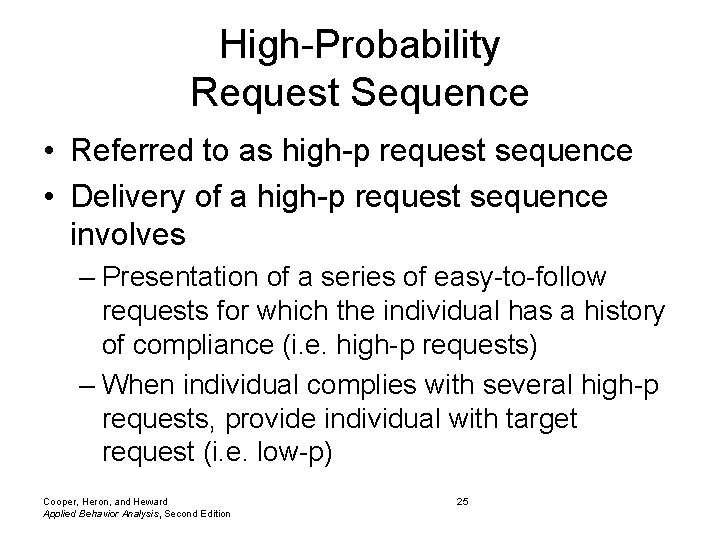
High-Probability Request Sequence • Referred to as high-p request sequence • Delivery of a high-p request sequence involves – Presentation of a series of easy-to-follow requests for which the individual has a history of compliance (i. e. high-p requests) – When individual complies with several high-p requests, provide individual with target request (i. e. low-p) Cooper, Heron, and Heward Applied Behavior Analysis, Second Edition 25
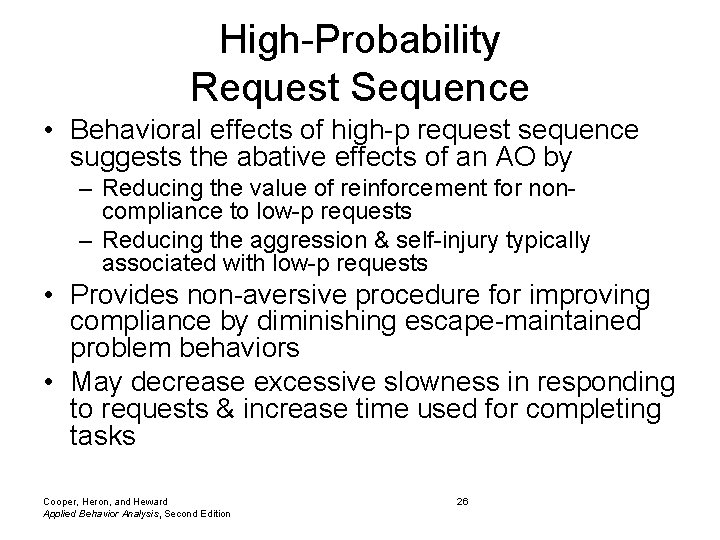
High-Probability Request Sequence • Behavioral effects of high-p request sequence suggests the abative effects of an AO by – Reducing the value of reinforcement for noncompliance to low-p requests – Reducing the aggression & self-injury typically associated with low-p requests • Provides non-aversive procedure for improving compliance by diminishing escape-maintained problem behaviors • May decrease excessive slowness in responding to requests & increase time used for completing tasks Cooper, Heron, and Heward Applied Behavior Analysis, Second Edition 26
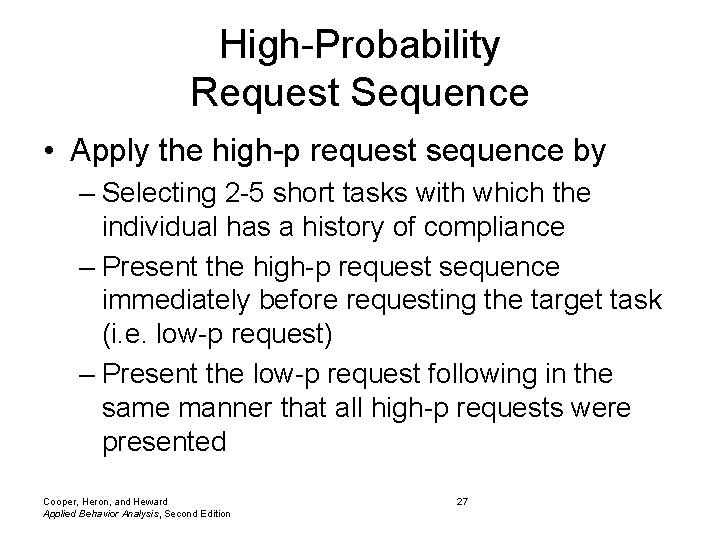
High-Probability Request Sequence • Apply the high-p request sequence by – Selecting 2 -5 short tasks with which the individual has a history of compliance – Present the high-p request sequence immediately before requesting the target task (i. e. low-p request) – Present the low-p request following in the same manner that all high-p requests were presented Cooper, Heron, and Heward Applied Behavior Analysis, Second Edition 27
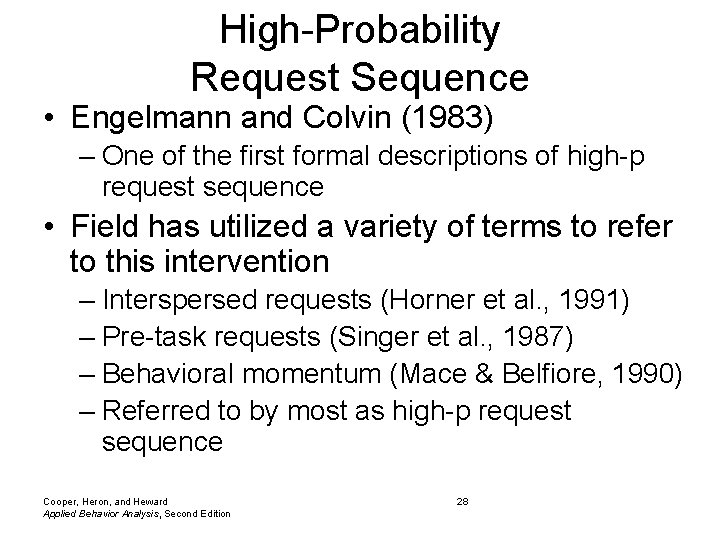
High-Probability Request Sequence • Engelmann and Colvin (1983) – One of the first formal descriptions of high-p request sequence • Field has utilized a variety of terms to refer to this intervention – Interspersed requests (Horner et al. , 1991) – Pre-task requests (Singer et al. , 1987) – Behavioral momentum (Mace & Belfiore, 1990) – Referred to by most as high-p request sequence Cooper, Heron, and Heward Applied Behavior Analysis, Second Edition 28
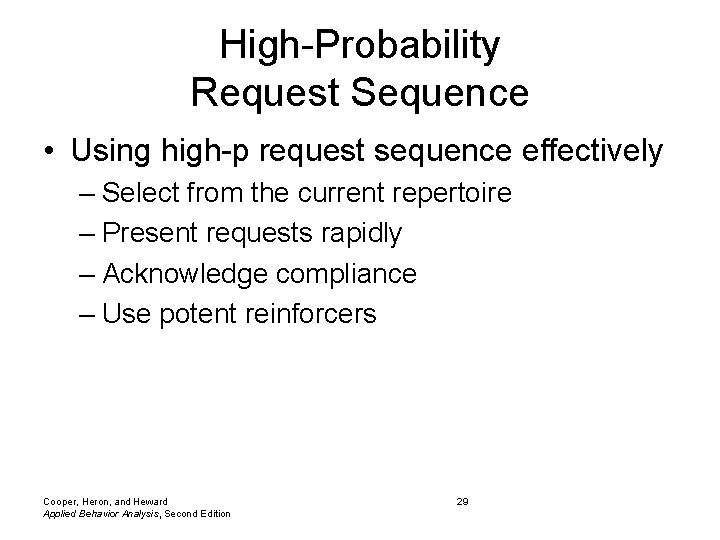
High-Probability Request Sequence • Using high-p request sequence effectively – Select from the current repertoire – Present requests rapidly – Acknowledge compliance – Use potent reinforcers Cooper, Heron, and Heward Applied Behavior Analysis, Second Edition 29
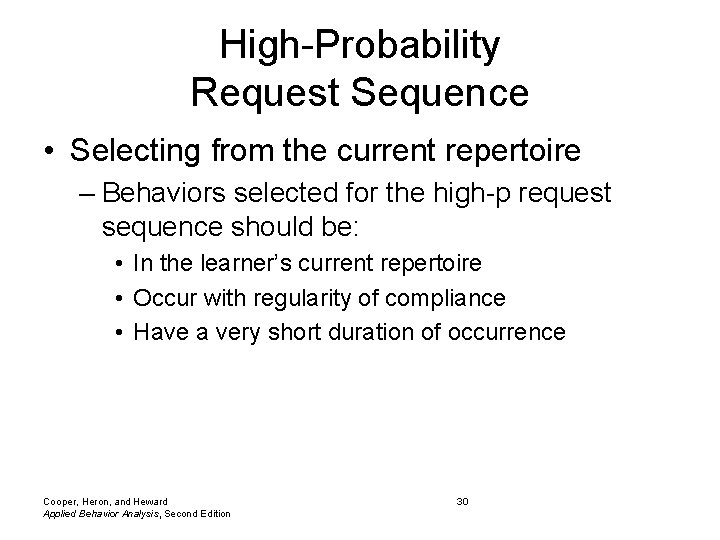
High-Probability Request Sequence • Selecting from the current repertoire – Behaviors selected for the high-p request sequence should be: • In the learner’s current repertoire • Occur with regularity of compliance • Have a very short duration of occurrence Cooper, Heron, and Heward Applied Behavior Analysis, Second Edition 30
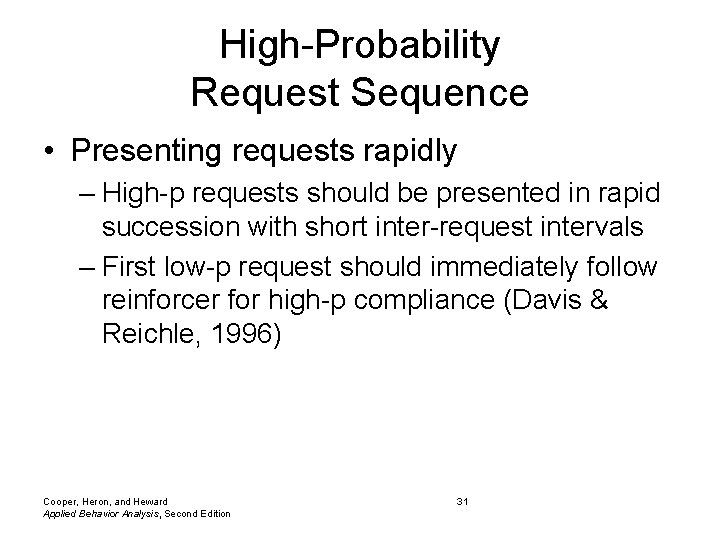
High-Probability Request Sequence • Presenting requests rapidly – High-p requests should be presented in rapid succession with short inter-request intervals – First low-p request should immediately follow reinforcer for high-p compliance (Davis & Reichle, 1996) Cooper, Heron, and Heward Applied Behavior Analysis, Second Edition 31
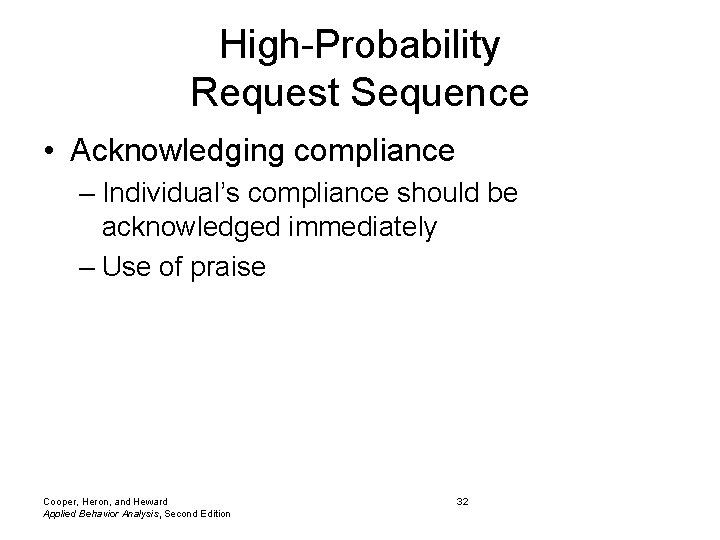
High-Probability Request Sequence • Acknowledging compliance – Individual’s compliance should be acknowledged immediately – Use of praise Cooper, Heron, and Heward Applied Behavior Analysis, Second Edition 32
High-Probability Request Sequence • Use potent reinforcers – Social praise may not be enough to increase compliance if motivation for escape behavior is high – Use of high-quality positive stimuli immediately following compliance may increase effectiveness of the intervention Cooper, Heron, and Heward Applied Behavior Analysis, Second Edition 33
Functional Communication Training • FCT establishes an appropriate communication behavior to compete with problem behaviors evoked by an EO • Develops alternative behaviors that are sensitive to the EO’s (in contrast to NCR and high-p request sequence) Cooper, Heron, and Heward Applied Behavior Analysis, Second Edition 34
Functional Communication Training • Application of DRA – Develops alternative communication response an antecedent to diminish problem behavior (Fisher et al. , 1998) • Alternative response produces the reinforcer that has maintained problem behavior (Durand & Carr, 1992) • Alternative response can take a variety of forms – – – Vocalizations Signs Communication boards Words or picture cards Vocal output systems Gestures Cooper, Heron, and Heward Applied Behavior Analysis, Second Edition 35
Functional Communication Training • Carr and Durand (1985) defined FCT as a two-step process – Completing a functional behavior assessment to identify the stimuli with known reinforcing properties that maintain problem behavior – Using those stimuli as reinforcers to develop an alternative behavior to replace the problem behavior • Very effective for problem behavior maintained by social attention Cooper, Heron, and Heward Applied Behavior Analysis, Second Edition 36
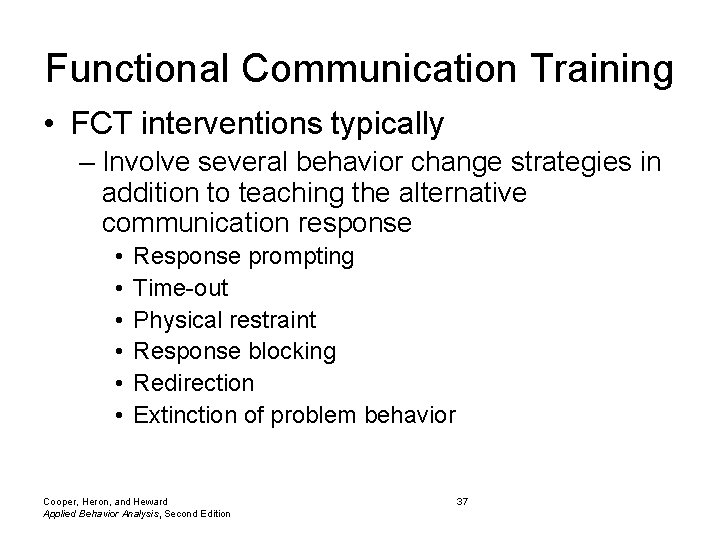
Functional Communication Training • FCT interventions typically – Involve several behavior change strategies in addition to teaching the alternative communication response • • • Response prompting Time-out Physical restraint Response blocking Redirection Extinction of problem behavior Cooper, Heron, and Heward Applied Behavior Analysis, Second Edition 37
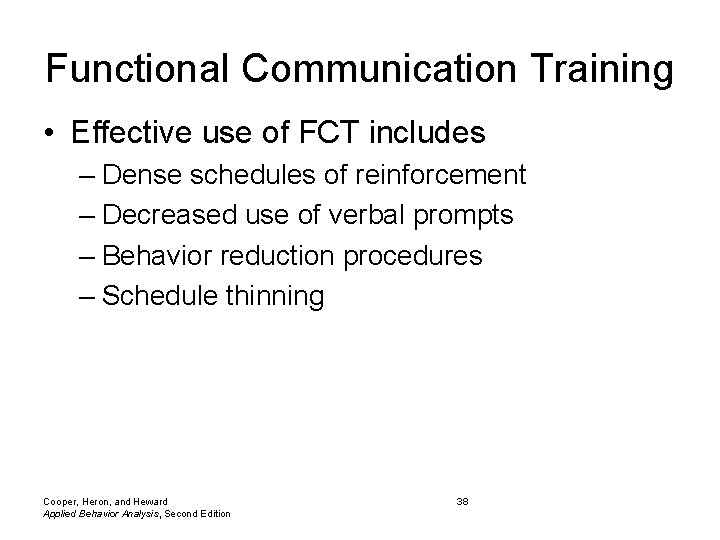
Functional Communication Training • Effective use of FCT includes – Dense schedules of reinforcement – Decreased use of verbal prompts – Behavior reduction procedures – Schedule thinning Cooper, Heron, and Heward Applied Behavior Analysis, Second Edition 38
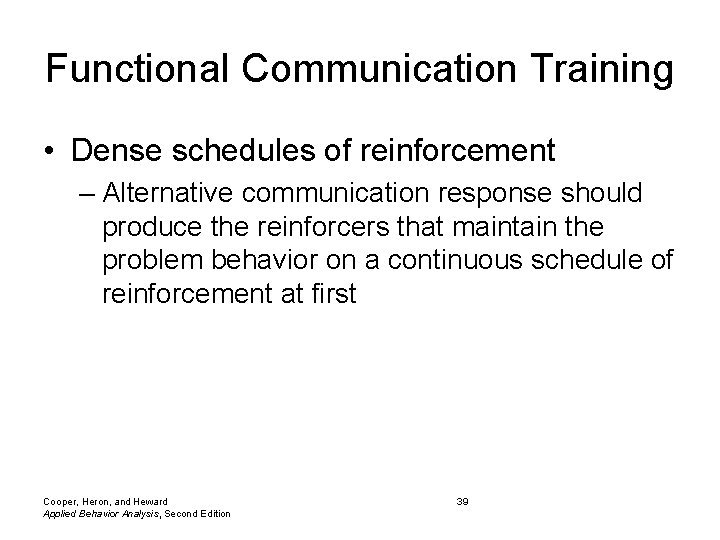
Functional Communication Training • Dense schedules of reinforcement – Alternative communication response should produce the reinforcers that maintain the problem behavior on a continuous schedule of reinforcement at first Cooper, Heron, and Heward Applied Behavior Analysis, Second Edition 39
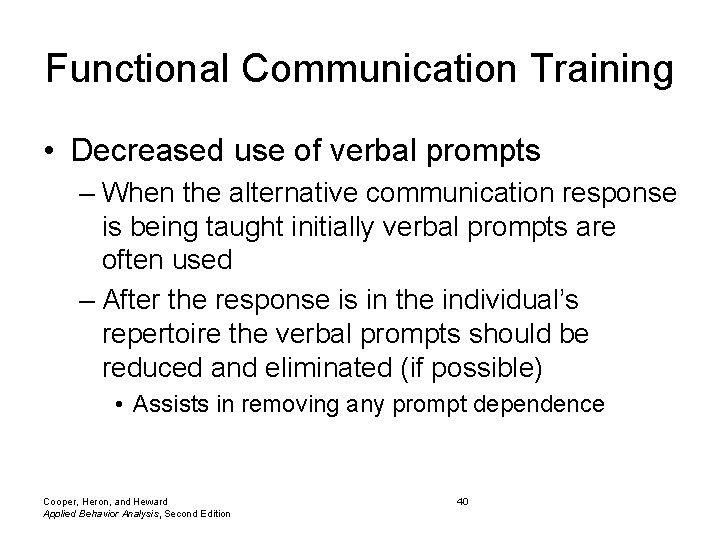
Functional Communication Training • Decreased use of verbal prompts – When the alternative communication response is being taught initially verbal prompts are often used – After the response is in the individual’s repertoire the verbal prompts should be reduced and eliminated (if possible) • Assists in removing any prompt dependence Cooper, Heron, and Heward Applied Behavior Analysis, Second Edition 40
Functional Communication Training • Behavior reduction procedures – Effectiveness of FCT can be increased with the use of other procedures (in a treatment package to enhance the reduction of the undesired (problem) behaviors • Extinction procedure • Time-out procedure Cooper, Heron, and Heward Applied Behavior Analysis, Second Edition 41
Functional Communication Training • Schedule thinning – Thinning of the schedule on which the established communication response is reinforced is an important part of FCT – Should only be done after the alternative communication response is firmly in the individual’s repertoire Cooper, Heron, and Heward Applied Behavior Analysis, Second Edition 42
Functional Communication Training • Schedule thinning (continued) – Guidelines for schedule thinning are NOT the same as those for NCR • Alternative communication response must remain sensitive to evocative function of the EO to compete with problem behavior • Recovery of problem behavior could occur – Hanley et al. (2001) recommended using a procedure for schedule thinning • Used dense FI schedule of reinforcement during initial teaching of alternative communication response • After the response is established, gradually thin the FI schedule • Suggest use of external cues to indicate when reinforcement is available Cooper, Heron, and Heward Applied Behavior Analysis, Second Edition 43