
Chapter 22 Verification and Validation Ian Sommerville 2000
- Slides: 41
Chapter 22 Verification and Validation ©Ian Sommerville 2000 Software Engineering. Chapter 22 Slide 1
Objectives l l To introduce software verification and validation and to discuss the distinction between them. To describe the program inspection / review process and its role in V&V. To describe the role of formal methods in V&V. To describe the Cleanroom software development process. ©Ian Sommerville 2000 Software Engineering. Chapter 22 Slide 2
Topics covered l V&V l Software inspections / reviews l Verification and formal methods l Cleanroom software development ©Ian Sommerville 2000 Software Engineering. Chapter 22 Slide 3
Topics / sections we will skip l 22. 1 Planning verification and validation l 22. 3 Automated static analysis ©Ian Sommerville 2000 Software Engineering. Chapter 22 Slide 4
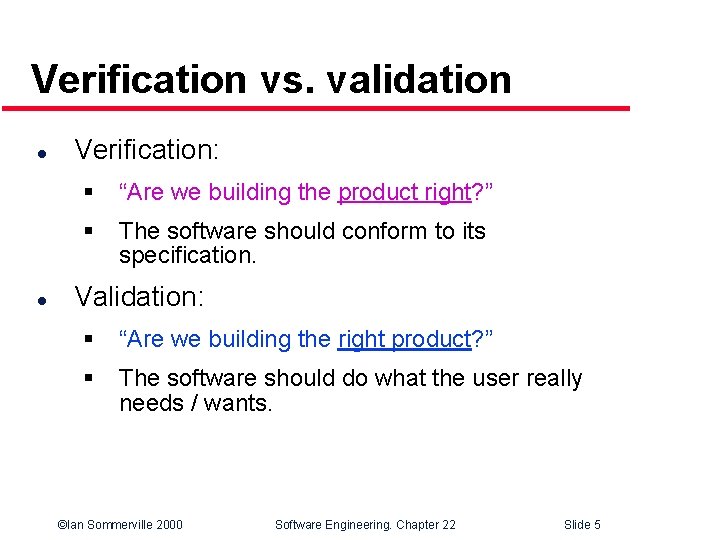
Verification vs. validation l l Verification: § “Are we building the product right? ” § The software should conform to its specification. Validation: § “Are we building the right product? ” § The software should do what the user really needs / wants. ©Ian Sommerville 2000 Software Engineering. Chapter 22 Slide 5
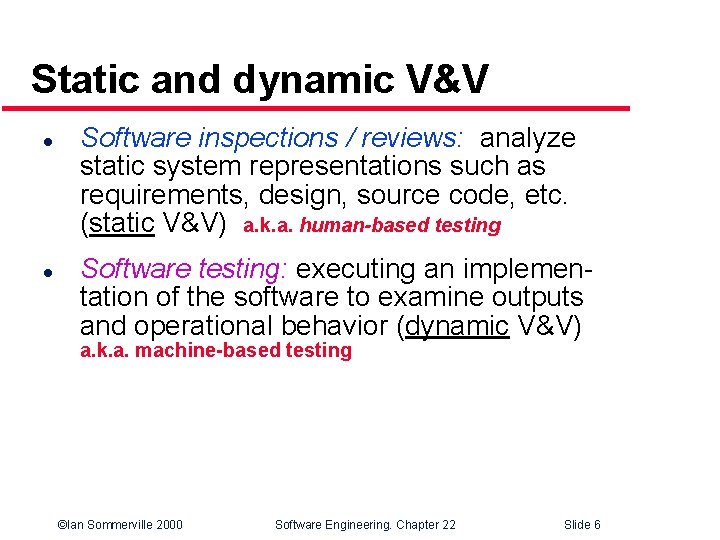
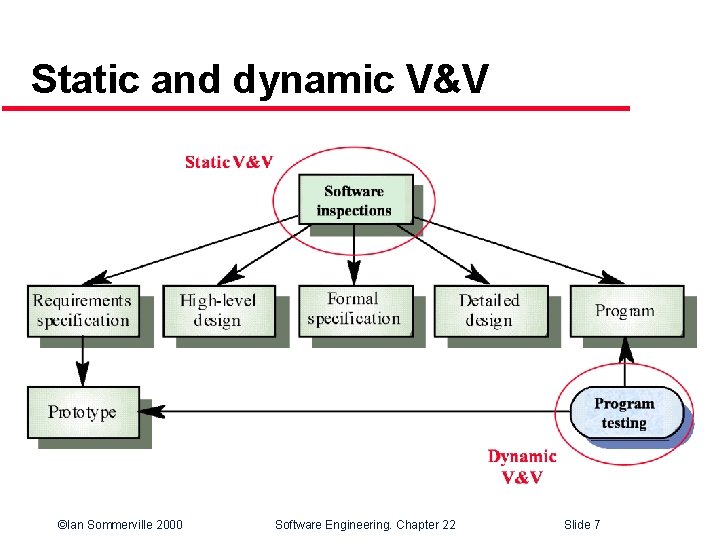
Static and dynamic V&V l l Software inspections / reviews: analyze static system representations such as requirements, design, source code, etc. (static V&V) a. k. a. human-based testing Software testing: executing an implementation of the software to examine outputs and operational behavior (dynamic V&V) a. k. a. machine-based testing ©Ian Sommerville 2000 Software Engineering. Chapter 22 Slide 6
Static and dynamic V&V ©Ian Sommerville 2000 Software Engineering. Chapter 22 Slide 7
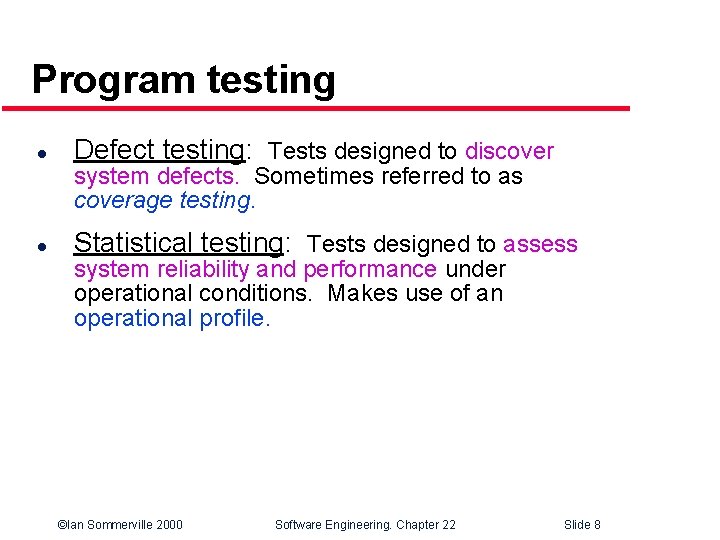
Program testing l Defect testing: Tests designed to discover system defects. Sometimes referred to as coverage testing. l Statistical testing: Tests designed to assess system reliability and performance under operational conditions. Makes use of an operational profile. ©Ian Sommerville 2000 Software Engineering. Chapter 22 Slide 8
V&V goals l l l Verification and validation should establish confidence that the software is “fit for purpose”. This does NOT usually mean that the software must be completely free of defects. The level of confidence required depends on at least three factors… ©Ian Sommerville 2000 Software Engineering. Chapter 22 Slide 9
Factors affecting level of confidence required 1. Software function / purpose: Safety- critical systems, for example, require a much higher level of confidence than demonstration-of -concept prototypes. 2. User expectations: Users may tolerate shortcomings when the benefits of use are high. 3. Marketing environment: Getting a product to market early may be more important than finding additional defects. ©Ian Sommerville 2000 Software Engineering. Chapter 22 Slide 10
V&V versus debugging l l V&V and debugging are distinct processes. § V&V is concerned with establishing the existence of defects in a program. § Debugging is concerned with locating and repairing these defects. Defect locating is analogous to detective work and medical diagnosis. ©Ian Sommerville 2000 Software Engineering. Chapter 22 Slide 11
Topics covered l V&V l Software inspections / reviews l Verification and formal methods l Cleanroom software development ©Ian Sommerville 2000 Software Engineering. Chapter 22 Slide 12
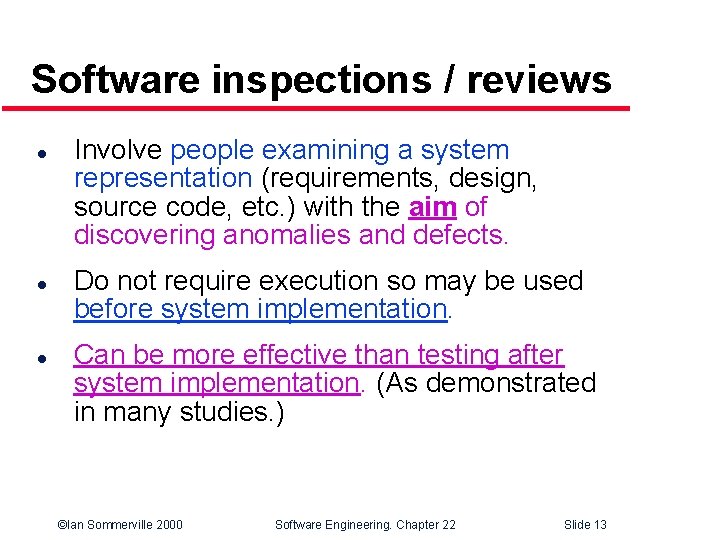
Software inspections / reviews l l l Involve people examining a system representation (requirements, design, source code, etc. ) with the aim of discovering anomalies and defects. Do not require execution so may be used before system implementation. Can be more effective than testing after system implementation. (As demonstrated in many studies. ) ©Ian Sommerville 2000 Software Engineering. Chapter 22 Slide 13
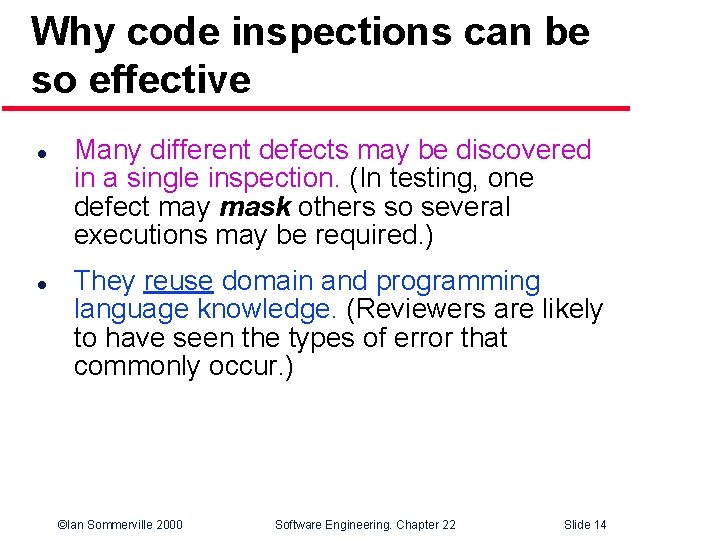
Why code inspections can be so effective l l Many different defects may be discovered in a single inspection. (In testing, one defect may mask others so several executions may be required. ) They reuse domain and programming language knowledge. (Reviewers are likely to have seen the types of error that commonly occur. ) ©Ian Sommerville 2000 Software Engineering. Chapter 22 Slide 14
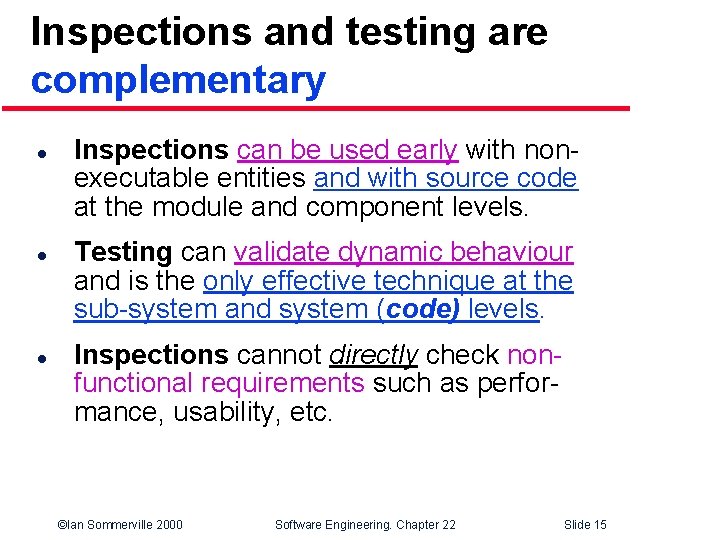
Inspections and testing are complementary l l l Inspections can be used early with nonexecutable entities and with source code at the module and component levels. Testing can validate dynamic behaviour and is the only effective technique at the sub-system and system (code) levels. Inspections cannot directly check nonfunctional requirements such as performance, usability, etc. ©Ian Sommerville 2000 Software Engineering. Chapter 22 Slide 15
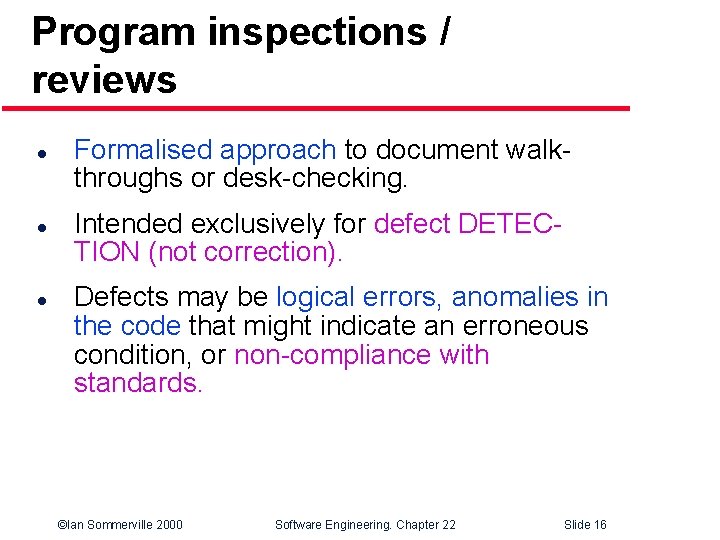
Program inspections / reviews l l l Formalised approach to document walkthroughs or desk-checking. Intended exclusively for defect DETECTION (not correction). Defects may be logical errors, anomalies in the code that might indicate an erroneous condition, or non-compliance with standards. ©Ian Sommerville 2000 Software Engineering. Chapter 22 Slide 16
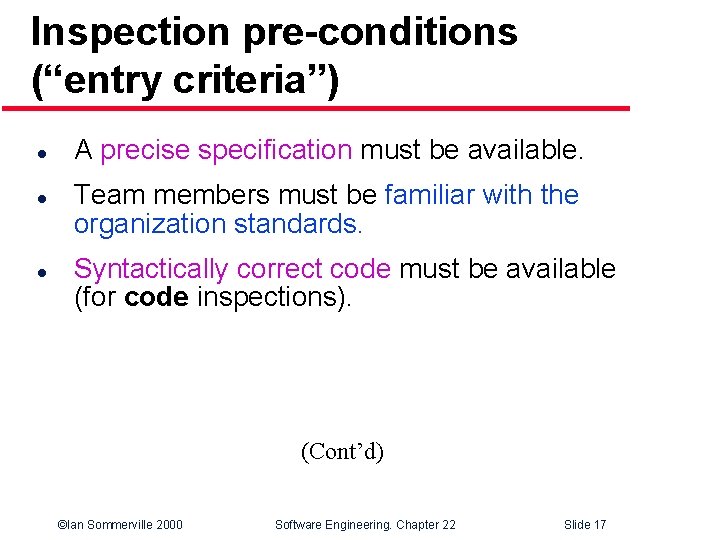
Inspection pre-conditions (“entry criteria”) l l l A precise specification must be available. Team members must be familiar with the organization standards. Syntactically correct code must be available (for code inspections). (Cont’d) ©Ian Sommerville 2000 Software Engineering. Chapter 22 Slide 17
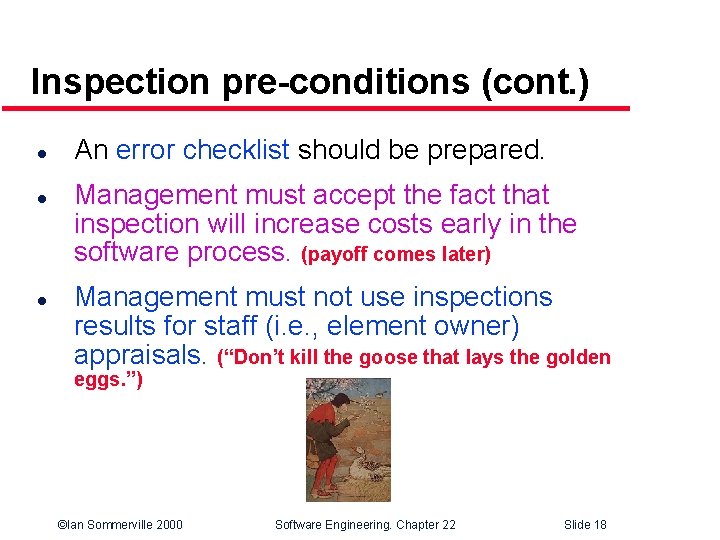
Inspection pre-conditions (cont. ) l l l An error checklist should be prepared. Management must accept the fact that inspection will increase costs early in the software process. (payoff comes later) Management must not use inspections results for staff (i. e. , element owner) appraisals. (“Don’t kill the goose that lays the golden eggs. ”) ©Ian Sommerville 2000 Software Engineering. Chapter 22 Slide 18
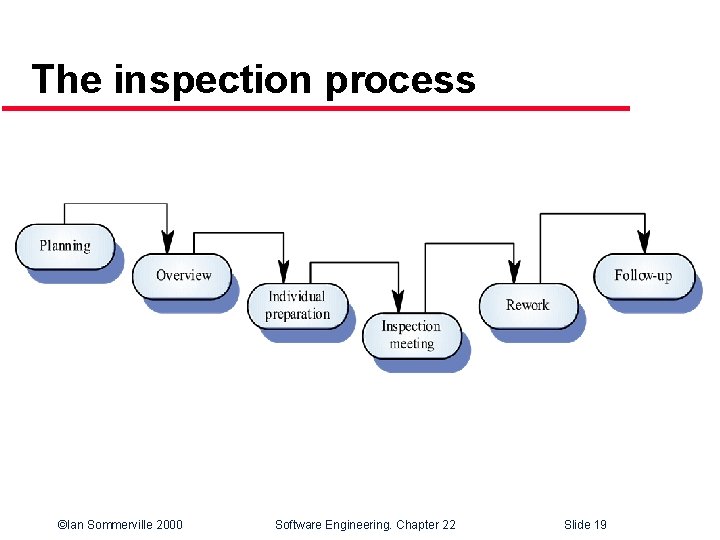
The inspection process ©Ian Sommerville 2000 Software Engineering. Chapter 22 Slide 19
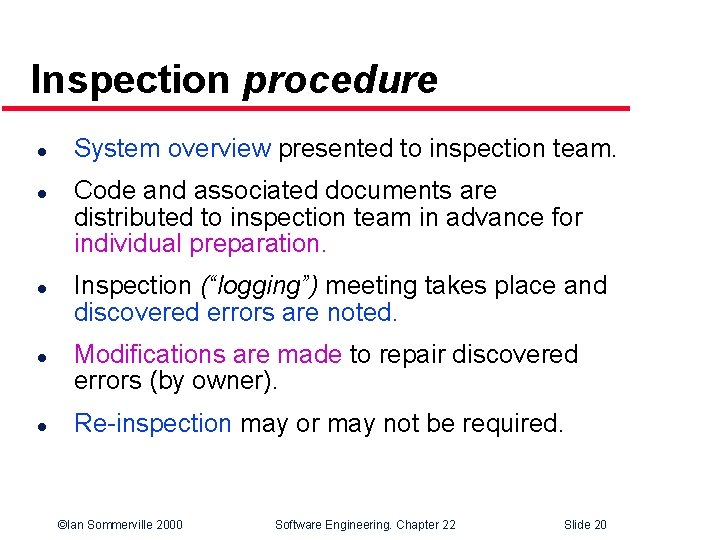
Inspection procedure l l l System overview presented to inspection team. Code and associated documents are distributed to inspection team in advance for individual preparation. Inspection (“logging”) meeting takes place and discovered errors are noted. Modifications are made to repair discovered errors (by owner). Re-inspection may or may not be required. ©Ian Sommerville 2000 Software Engineering. Chapter 22 Slide 20
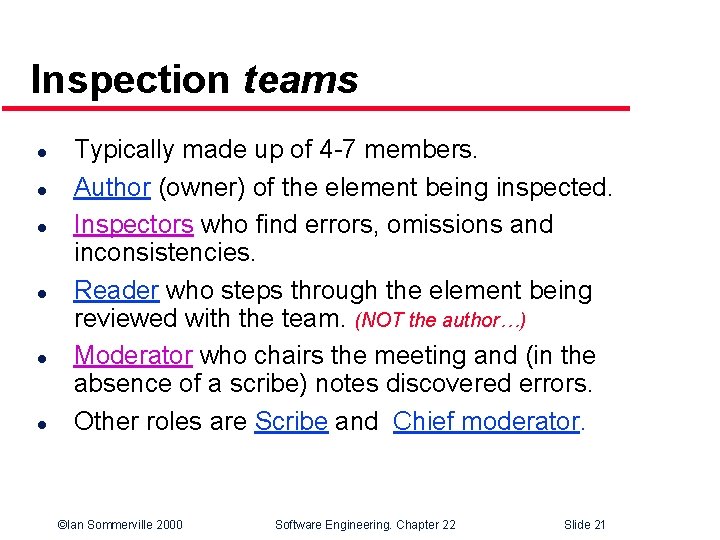
Inspection teams l l l Typically made up of 4 -7 members. Author (owner) of the element being inspected. Inspectors who find errors, omissions and inconsistencies. Reader who steps through the element being reviewed with the team. (NOT the author…) Moderator who chairs the meeting and (in the absence of a scribe) notes discovered errors. Other roles are Scribe and Chief moderator. ©Ian Sommerville 2000 Software Engineering. Chapter 22 Slide 21
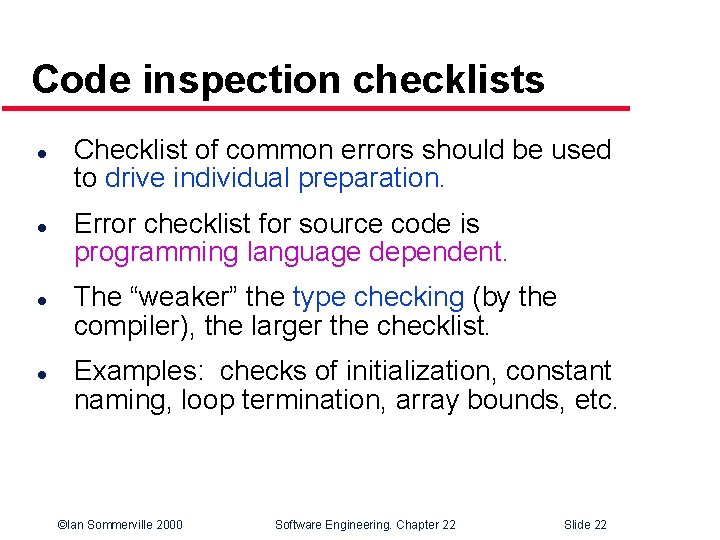
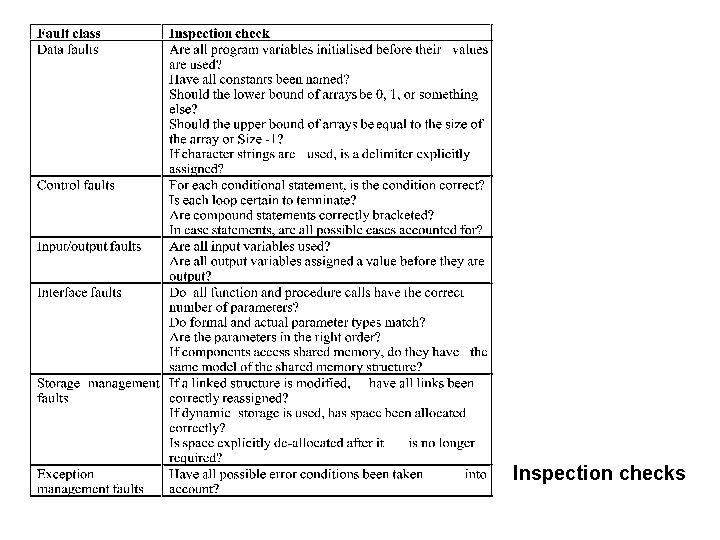
Code inspection checklists l l Checklist of common errors should be used to drive individual preparation. Error checklist for source code is programming language dependent. The “weaker” the type checking (by the compiler), the larger the checklist. Examples: checks of initialization, constant naming, loop termination, array bounds, etc. ©Ian Sommerville 2000 Software Engineering. Chapter 22 Slide 22
Inspection checks
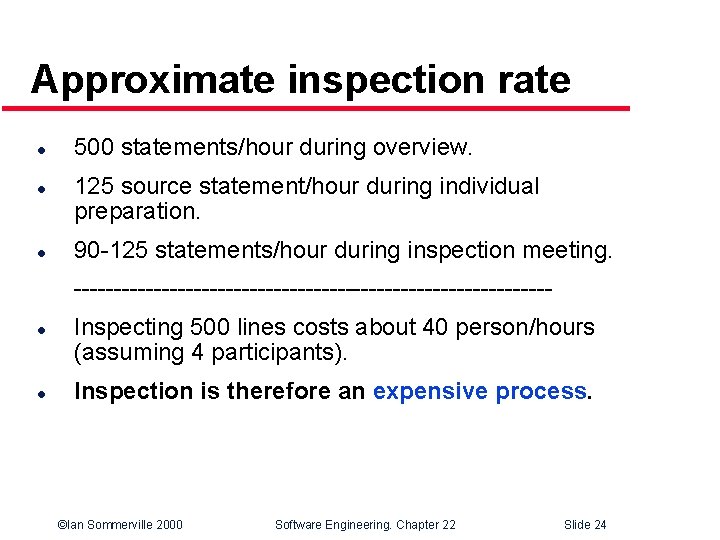
Approximate inspection rate l l l 500 statements/hour during overview. 125 source statement/hour during individual preparation. 90 -125 statements/hour during inspection meeting. ------------------------------ l l Inspecting 500 lines costs about 40 person/hours (assuming 4 participants). Inspection is therefore an expensive process. ©Ian Sommerville 2000 Software Engineering. Chapter 22 Slide 24
Topics covered l V&V l Software inspections / reviews l Verification and formal methods l Cleanroom software development ©Ian Sommerville 2000 Software Engineering. Chapter 22 Slide 25
Verification and formal methods l l The development of critical systems is one of the “success stories” formal methods. Formal methods are mandated in Britain for the development of some types of safetycritical defence applications. ©Ian Sommerville 2000 Software Engineering. Chapter 22 Slide 26
Formal methods may be used at two levels 1. Specification analysis and validation: developing a formal model of a system requirements specification § Forces a rigorous analysis of the specification § Facilitates discovery of specification problems ©Ian Sommerville 2000 Software Engineering. Chapter 22 Slide 27
Formal methods may be used at two levels 2. Formal verification: mathematical arguments (at varying degrees of rigour) are used to demonstrate that a program or a design is consistent with its formal specification. ©Ian Sommerville 2000 Software Engineering. Chapter 22 Slide 28
Problems with formal V&V l Many developers are not convinced that formal methods are cost effective, and even feel they may reduce dependability. § The argument is that formal specification models cannot be understood by most domain experts. § Thus, problems with requirements may be concealed by formality. § A mathematically consistent but wrong specification is not very useful! (Cont’d) ©Ian Sommerville 2000 Software Engineering. Chapter 22 Slide 29
Problems with formal V&V (cont’d) l Others point out that verification does not scale-up. They claim: § Verification is complex, error-prone, and requires the use of systems such as theorem provers. § The cost of verification increases disproportionately as system size increases. ©Ian Sommerville 2000 Software Engineering. Chapter 22 Slide 30
Sommerville’s conclusions l l There is no doubt that a formal system specification is less likely to contain anomalies that must be resolved by the system designer. But formal specification and proof cannot guarantee reliability because: § The specification may not reflect the real requirements; § The proof may contain errors; and § An incorrect usage pattern may be assumed. (Cont’d) ©Ian Sommerville 2000 Software Engineering. Chapter 22 Slide 31
Sommerville’s conclusions (cont’d) l l Formality does not provide guarantees, but it helps to increase confidence in a system by demonstrating that some classes of error are not present. Formal verification is only likely to be used for small, critical system components. (About 5 -6 K lines of code seems to be the upper limit for practical verification. ) ©Ian Sommerville 2000 Software Engineering. Chapter 22 Slide 32
Topics covered l V&V l Software inspections / reviews l Verification and formal methods l Cleanroom software development ©Ian Sommerville 2000 Software Engineering. Chapter 22 Slide 33
Cleanroom software development l l The name is derived from the “Cleanroom” process in semiconductor fabrication. The philosophy is: defect avoidance rather than defect removal. ©Ian Sommerville 2000 Software Engineering. Chapter 22 Slide 34
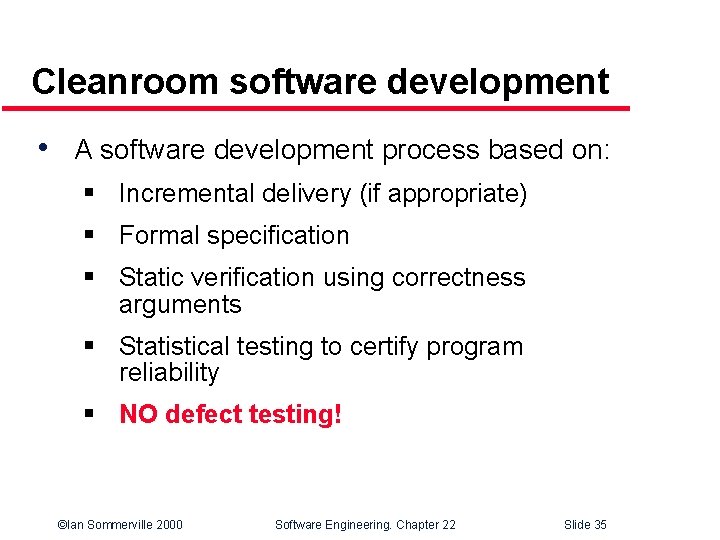
Cleanroom software development • A software development process based on: § Incremental delivery (if appropriate) § Formal specification § Static verification using correctness arguments § Statistical testing to certify program reliability § NO defect testing! ©Ian Sommerville 2000 Software Engineering. Chapter 22 Slide 35
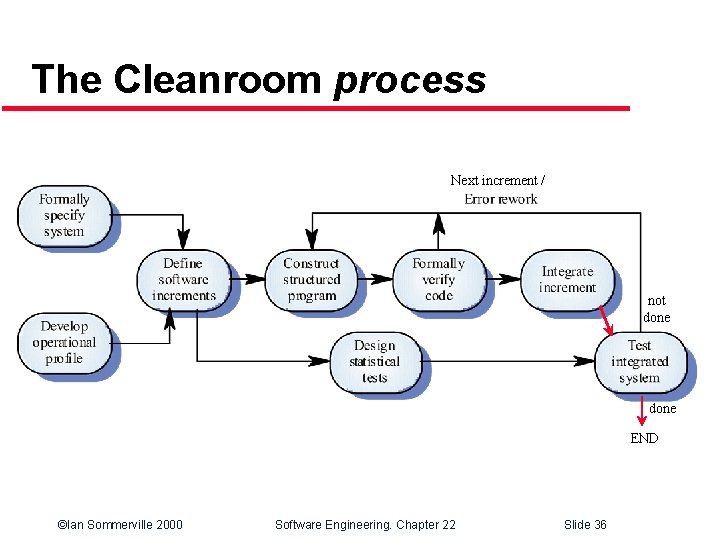
The Cleanroom process Next increment / not done END ©Ian Sommerville 2000 Software Engineering. Chapter 22 Slide 36
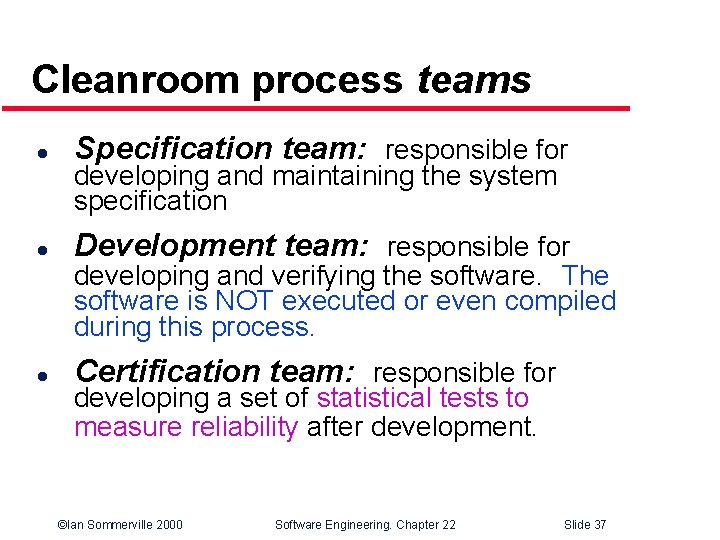
Cleanroom process teams l Specification team: responsible for l Development team: responsible for l Certification team: responsible for developing and maintaining the system specification developing and verifying the software. The software is NOT executed or even compiled during this process. developing a set of statistical tests to measure reliability after development. ©Ian Sommerville 2000 Software Engineering. Chapter 22 Slide 37
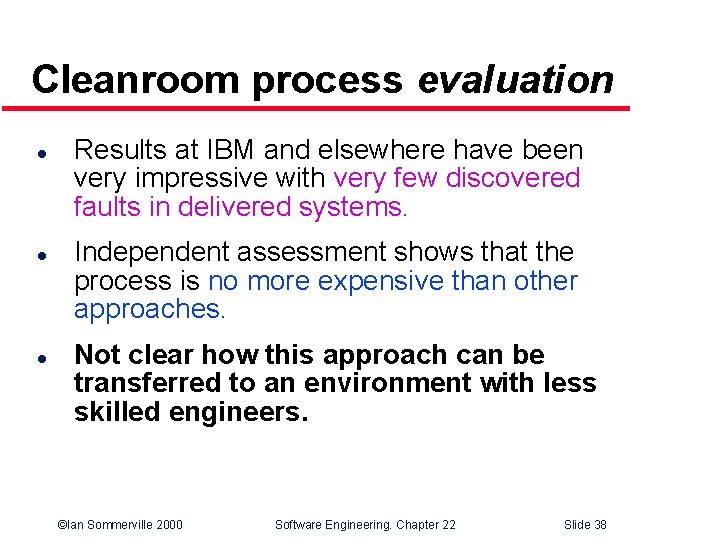
Cleanroom process evaluation l l l Results at IBM and elsewhere have been very impressive with very few discovered faults in delivered systems. Independent assessment shows that the process is no more expensive than other approaches. Not clear how this approach can be transferred to an environment with less skilled engineers. ©Ian Sommerville 2000 Software Engineering. Chapter 22 Slide 38
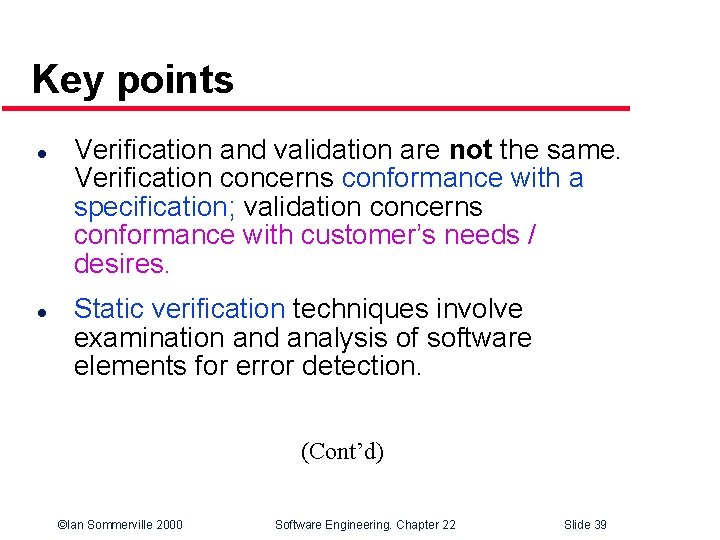
Key points l l Verification and validation are not the same. Verification concerns conformance with a specification; validation concerns conformance with customer’s needs / desires. Static verification techniques involve examination and analysis of software elements for error detection. (Cont’d) ©Ian Sommerville 2000 Software Engineering. Chapter 22 Slide 39
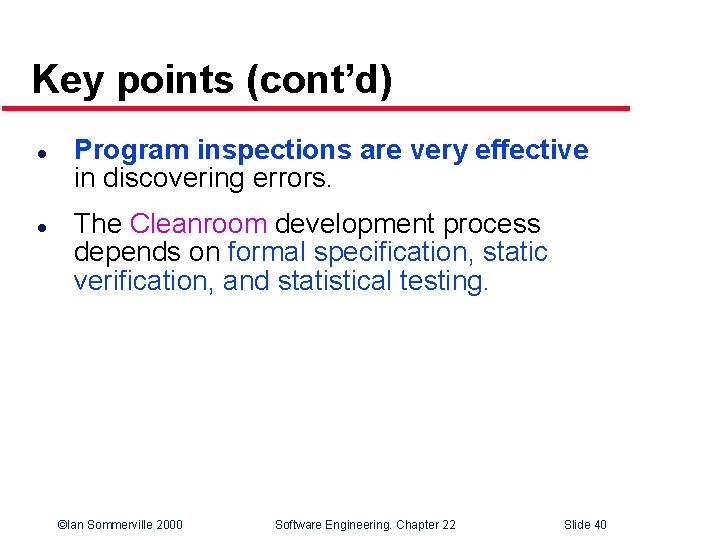
Key points (cont’d) l l Program inspections are very effective in discovering errors. The Cleanroom development process depends on formal specification, static verification, and statistical testing. ©Ian Sommerville 2000 Software Engineering. Chapter 22 Slide 40
Chapter 22 Verification and Validation ©Ian Sommerville 2000 Software Engineering. Chapter 22 Slide 41