
Chapter 22 Using Inferential Statistics to Test Hypotheses
- Slides: 27
Chapter 22 Using Inferential Statistics to Test Hypotheses Copyright © 2008 Wolters Kluwer Health | Lippincott Williams & Wilkins
Inferential Statistics • A means of drawing conclusions about a population (i. e. , estimating population parameters), given data from a sample • Based on laws of probability Copyright © 2008 Wolters Kluwer Health | Lippincott Williams & Wilkins
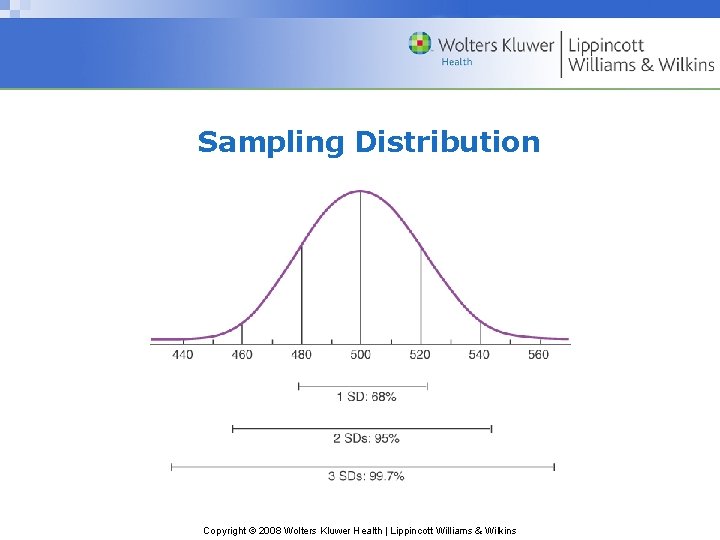
Sampling Distribution of the Mean • A theoretical distribution of means for an infinite number of samples drawn from the same population • Is always normally distributed • Has a mean that equals the population mean • Has a standard deviation (SD) called the standard error of the mean (SEM) • SEM is estimated from a sample SD and the sample size Copyright © 2008 Wolters Kluwer Health | Lippincott Williams & Wilkins
Sampling Distribution Copyright © 2008 Wolters Kluwer Health | Lippincott Williams & Wilkins
Statistical Inference—Two Forms • Estimation of parameters • Hypothesis testing (more common) Copyright © 2008 Wolters Kluwer Health | Lippincott Williams & Wilkins
Estimation of Parameters • Used to estimate a single parameter (e. g. , a population mean) • Two forms of estimation: – Point estimation – Interval estimation Copyright © 2008 Wolters Kluwer Health | Lippincott Williams & Wilkins
Point Estimation Calculating a single statistic to estimate the population parameter (e. g. , the mean birth weight of infants born in the U. S. ) Copyright © 2008 Wolters Kluwer Health | Lippincott Williams & Wilkins
Interval Estimation • Calculating a range of values within which the parameter has a specified probability of lying – A confidence interval (CI) is constructed around the point estimate – The upper and lower limits are confidence limits Copyright © 2008 Wolters Kluwer Health | Lippincott Williams & Wilkins
Hypothesis Testing • Based on rules of negative inference: research hypotheses are supported if null hypotheses can be rejected • Involves statistical decision making to either: – accept the null hypothesis, or – reject the null hypothesis Copyright © 2008 Wolters Kluwer Health | Lippincott Williams & Wilkins
Hypothesis Testing (cont’d) • Researchers compute a test statistic with their data, then determine whether the statistic falls beyond the critical region in the relevant theoretical distribution • If the value of the test statistic indicates that the null hypothesis is “improbable, ” the result is statistically significant • A nonsignificant result means that any observed difference or relationship could have resulted from chance fluctuations Copyright © 2008 Wolters Kluwer Health | Lippincott Williams & Wilkins
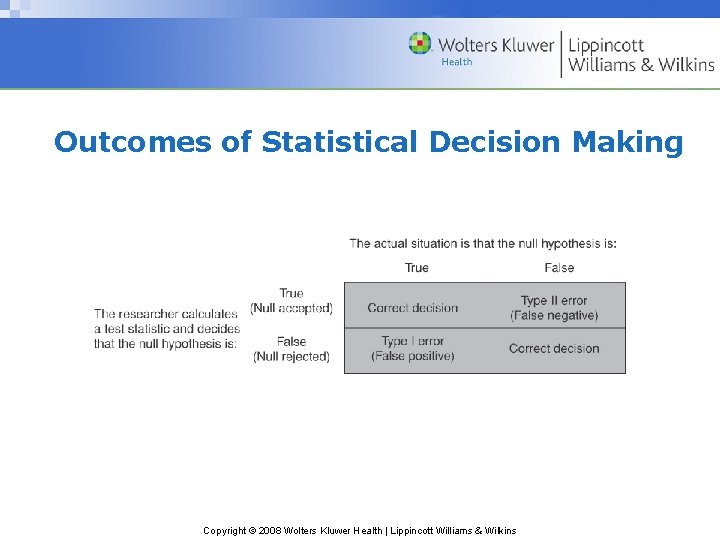
Statistical Decisions are Either Correct or Incorrect Two types of incorrect decisions: • Type I error: a null hypothesis is rejected when it should not be rejected – Risk of a Type I error is controlled by the level of significance (alpha), e. g. , =. 05 or. 01. • Type II error: failure to reject a null hypothesis when it should be rejected Copyright © 2008 Wolters Kluwer Health | Lippincott Williams & Wilkins
Outcomes of Statistical Decision Making Copyright © 2008 Wolters Kluwer Health | Lippincott Williams & Wilkins
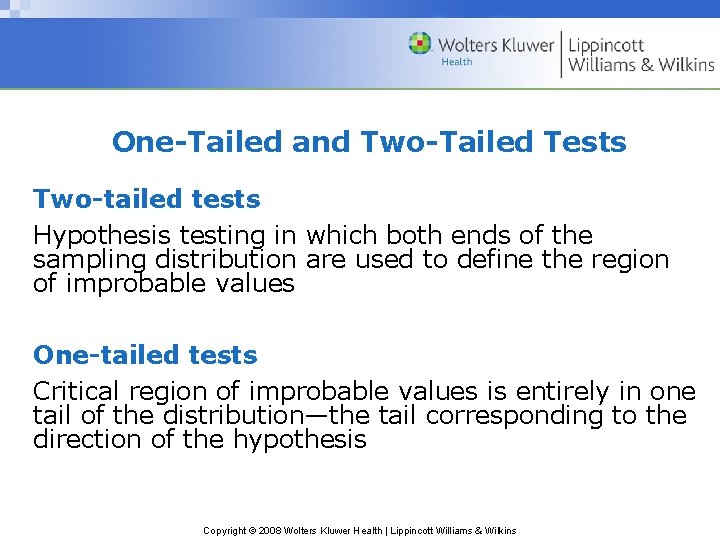
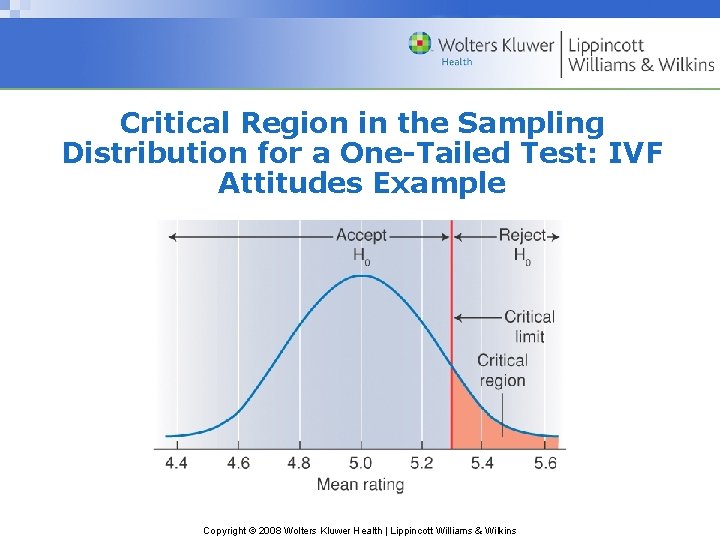
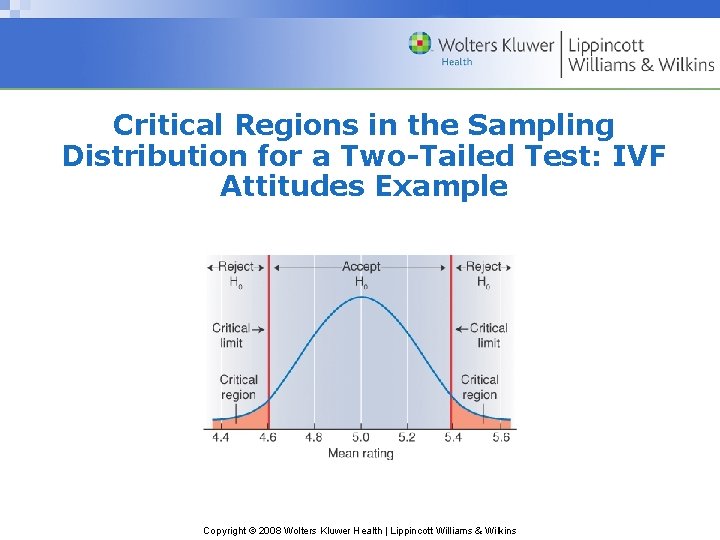
One-Tailed and Two-Tailed Tests Two-tailed tests Hypothesis testing in which both ends of the sampling distribution are used to define the region of improbable values One-tailed tests Critical region of improbable values is entirely in one tail of the distribution—the tail corresponding to the direction of the hypothesis Copyright © 2008 Wolters Kluwer Health | Lippincott Williams & Wilkins
Critical Region in the Sampling Distribution for a One-Tailed Test: IVF Attitudes Example Copyright © 2008 Wolters Kluwer Health | Lippincott Williams & Wilkins
Critical Regions in the Sampling Distribution for a Two-Tailed Test: IVF Attitudes Example Copyright © 2008 Wolters Kluwer Health | Lippincott Williams & Wilkins
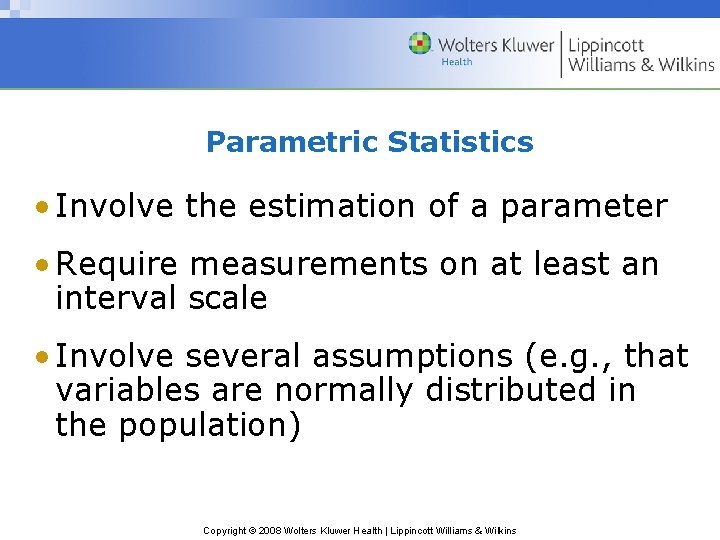
Parametric Statistics • Involve the estimation of a parameter • Require measurements on at least an interval scale • Involve several assumptions (e. g. , that variables are normally distributed in the population) Copyright © 2008 Wolters Kluwer Health | Lippincott Williams & Wilkins
Nonparametric Statistics (Distribution. Free Statistics) • Do not estimate parameters • Involve variables measured on a nominal or ordinal scale • Have less restrictive assumptions about the shape of the variables’ distribution than parametric tests Copyright © 2008 Wolters Kluwer Health | Lippincott Williams & Wilkins
Overview of Hypothesis-Testing Procedures • Select an appropriate test statistic • Establish the level of significance (e. g. , =. 05) • Select a one-tailed or a two-tailed test • Compute test statistic with actual data • Calculate degrees of freedom (df) for the test statistic Copyright © 2008 Wolters Kluwer Health | Lippincott Williams & Wilkins
Overview of Hypothesis-Testing Procedures (cont’d) • Obtain a tabled value for the statistical test • Compare the test statistic to the tabled value • Make decision to accept or reject null hypothesis Copyright © 2008 Wolters Kluwer Health | Lippincott Williams & Wilkins
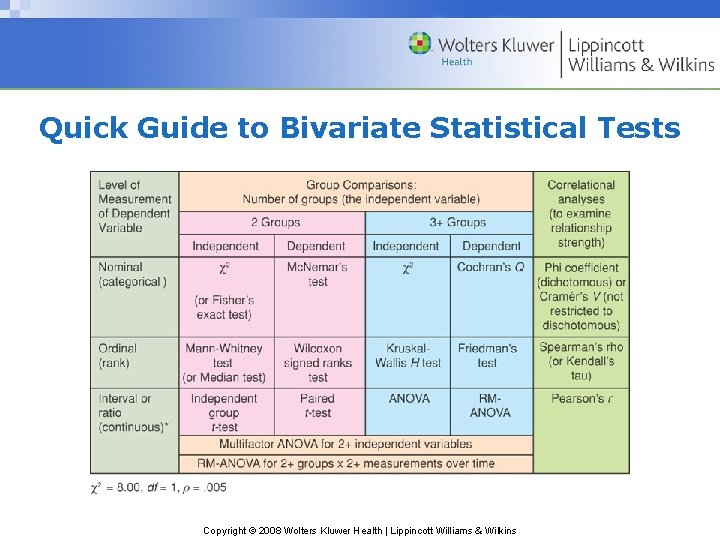
Commonly Used Bivariate Statistical Tests 1. t-Test 2. Analysis of variance (ANOVA) 3. Pearson’s r 4. Chi-square test Copyright © 2008 Wolters Kluwer Health | Lippincott Williams & Wilkins
Quick Guide to Bivariate Statistical Tests Copyright © 2008 Wolters Kluwer Health | Lippincott Williams & Wilkins
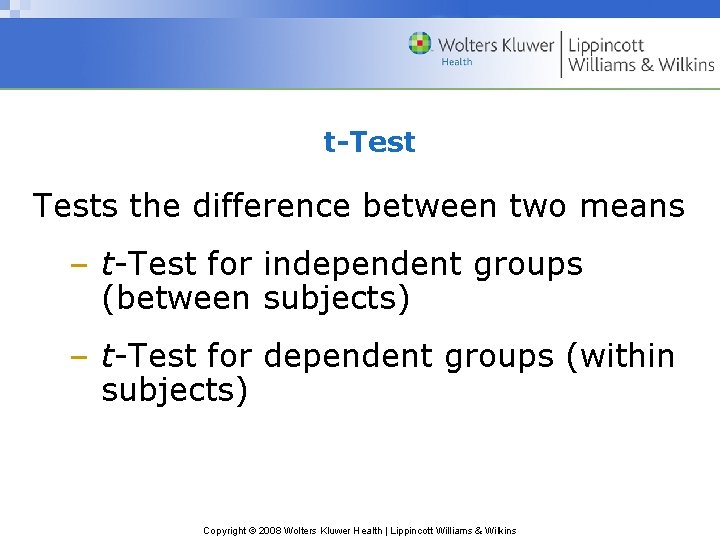
t-Tests the difference between two means – t-Test for independent groups (between subjects) – t-Test for dependent groups (within subjects) Copyright © 2008 Wolters Kluwer Health | Lippincott Williams & Wilkins
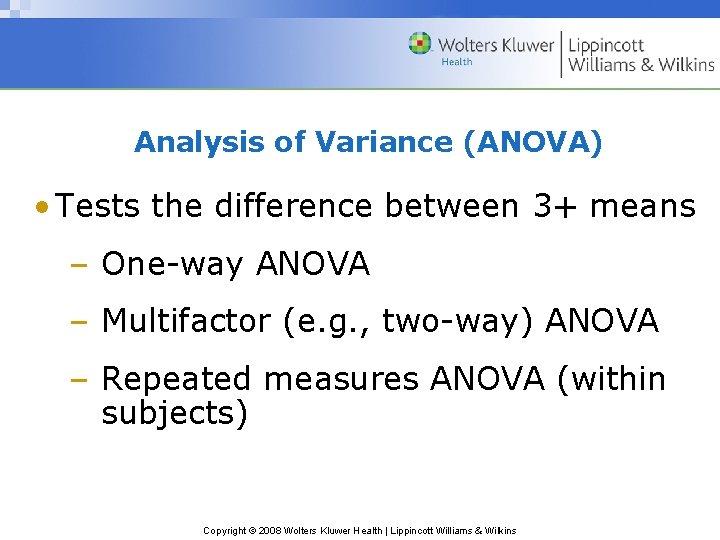
Analysis of Variance (ANOVA) • Tests the difference between 3+ means – One-way ANOVA – Multifactor (e. g. , two-way) ANOVA – Repeated measures ANOVA (within subjects) Copyright © 2008 Wolters Kluwer Health | Lippincott Williams & Wilkins
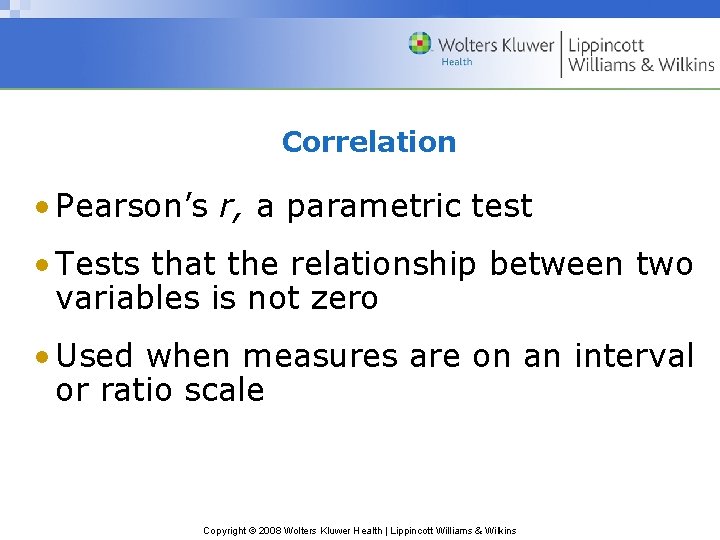
Correlation • Pearson’s r, a parametric test • Tests that the relationship between two variables is not zero • Used when measures are on an interval or ratio scale Copyright © 2008 Wolters Kluwer Health | Lippincott Williams & Wilkins
Chi-Square Test • Tests the difference in proportions in categories within a contingency table • A nonparametric test Copyright © 2008 Wolters Kluwer Health | Lippincott Williams & Wilkins
Power Analysis • A method of reducing the risk of Type II errors and estimating their occurrence • With power =. 80, the risk of a Type II error ( ) is 20% • Method is frequently used to estimate how large a sample is needed to reliably test hypotheses Copyright © 2008 Wolters Kluwer Health | Lippincott Williams & Wilkins
Power Analysis (cont’d) Four components in a power analysis: 1. Significance criterion (α) 2. Sample size (N) 3. Population effect size—the magnitude of the relationship between research variables (γ) 4. Power—the probability of obtaining a significant result (1 -β) Copyright © 2008 Wolters Kluwer Health | Lippincott Williams & Wilkins