
Chapter 22 Trauma Overview 1 Kinematics of Trauma

- Slides: 31
Chapter 22 Trauma Overview 1
Kinematics of Trauma l Injuries are the leading cause of death among children and young adults. l Kinematics introduces the basic physical concepts that dictate how injuries occur and affect the human body. 2
Energy and Trauma l Work – Force acting over distance l Kinetic energy – Energy of moving object l Potential energy – Product of weight, gravity, and height 3
Kinetic Energy l KE =Mass/2 X Velocity² l Double the speed = quadruple the KE l Energy cannot be created or destroyed, only converted 4
Newton’s First Law Objects at rest tend to stay at rest, and objects in motion tend to stay in motion, unless they are acted upon by some force. 5
Newton’s Second Law Force (F) equals Mass (M) times Acceleration (A) F=MA 6
Newton’s Third Law l For every action, there is an equal and opposite reaction 7
Traumatic Injuries l Blunt trauma – Caused by a force to the body – Injuries do not penetrate soft tissue or organs l Penetrating trauma – Caused by objects such as knives and bullets – Injuries pierce the surface of the body 8
Mechanism of Injury (MOI) l MOI is the way in which traumatic injuries occur. l Different MOIs produce many types of injuries. – Isolated to one body system – Injuries to many body systems 9
Vehicular Crashes and Mechanisms of Injury (MOI) l By assessing the crash, the MOI may be determined. l By determining the MOI, you may be able to predict the types of injuries that may have happened at the time of impact. 10
Vehicular Collisions Three types of crashes: 1) Collision of car against another car or object 2) Collision of passenger(s) against interior of car 3) Collision of passenger’s internal organs against the solid structures of the body l 11
Significant Mechanisms of Injury (MOI) l Severe deformities to the frontal part of the vehicle l Moderate intrusion from a T-bone accident l Severe damage from the rear l Collisions in which rotation is involved 12
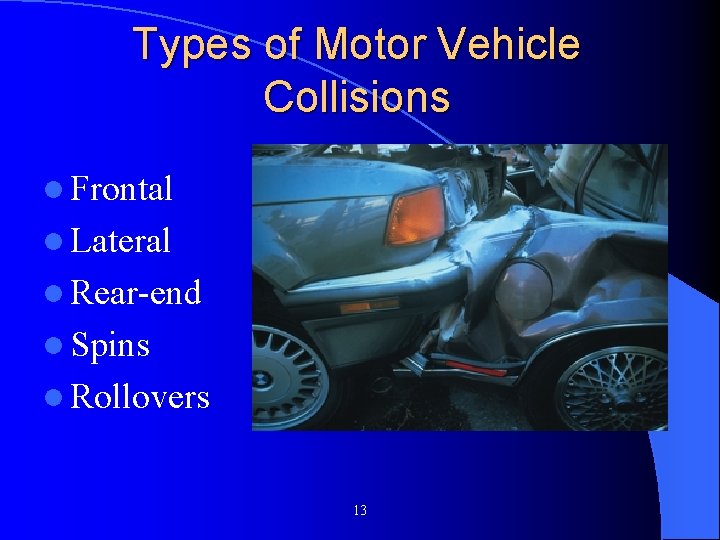
Types of Motor Vehicle Collisions l Frontal l Lateral l Rear-end l Spins l Rollovers 13
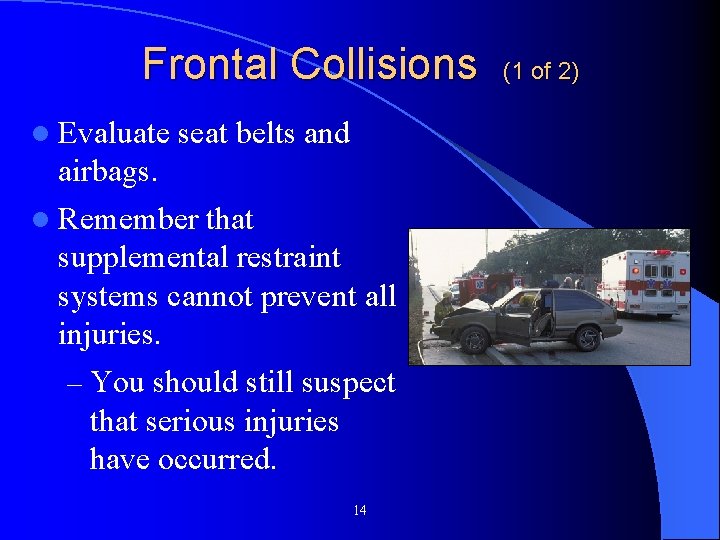
Frontal Collisions l Evaluate seat belts and airbags. l Remember that supplemental restraint systems cannot prevent all injuries. – You should still suspect that serious injuries have occurred. 14 (1 of 2)
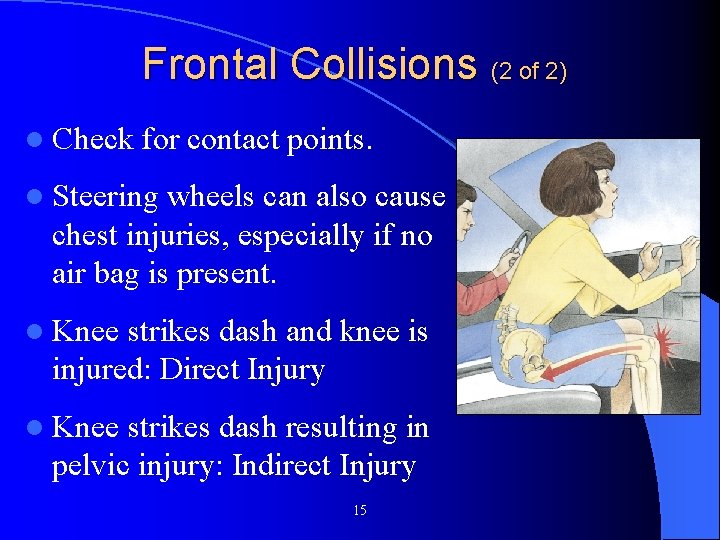
Frontal Collisions (2 of 2) l Check for contact points. l Steering wheels can also cause chest injuries, especially if no air bag is present. l Knee strikes dash and knee is injured: Direct Injury l Knee strikes dash resulting in pelvic injury: Indirect Injury 15
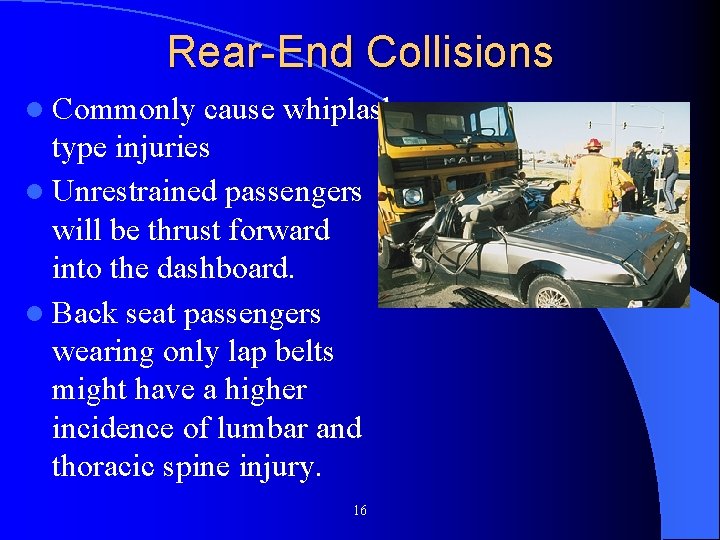
Rear-End Collisions l Commonly cause whiplashtype injuries l Unrestrained passengers will be thrust forward into the dashboard. l Back seat passengers wearing only lap belts might have a higher incidence of lumbar and thoracic spine injury. 16
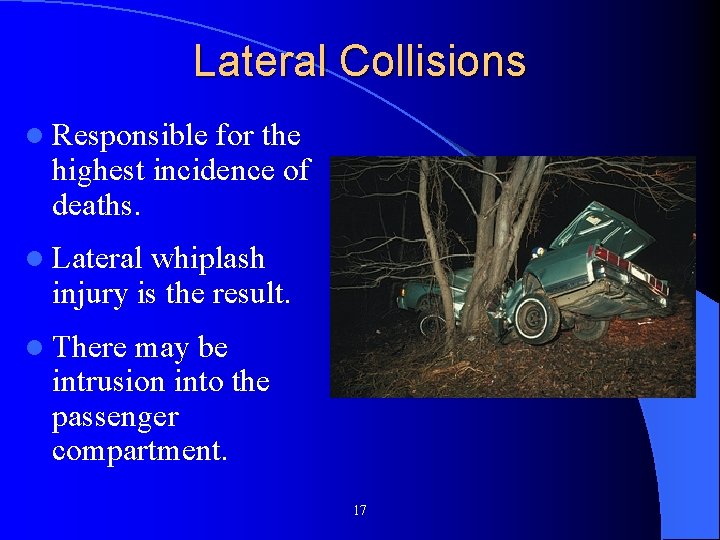
Lateral Collisions l Responsible for the highest incidence of deaths. l Lateral whiplash injury is the result. l There may be intrusion into the passenger compartment. 17
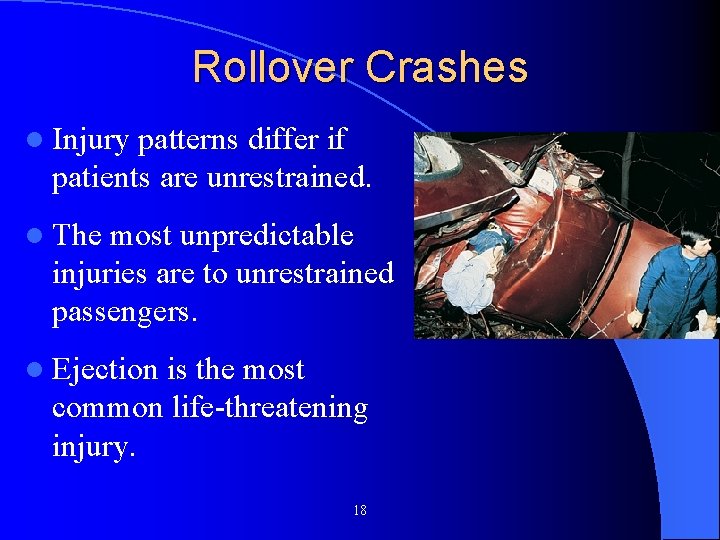
Rollover Crashes l Injury patterns differ if patients are unrestrained. l The most unpredictable injuries are to unrestrained passengers. l Ejection is the most common life-threatening injury. 18
Spins l Vehicle is put into rotational motion. l Vehicle often strikes a fixed object, combining forces of rotation with lateral impact. 19
Car-Versus-Pedestrian Collisions l Often cause serious injuries to body systems l Evaluate MOI to determine: – Whether patient was thrown and how far. – Whether patient was struck and pulled under car. l Presume injury to the spinal cord and maintain immobilization. 20
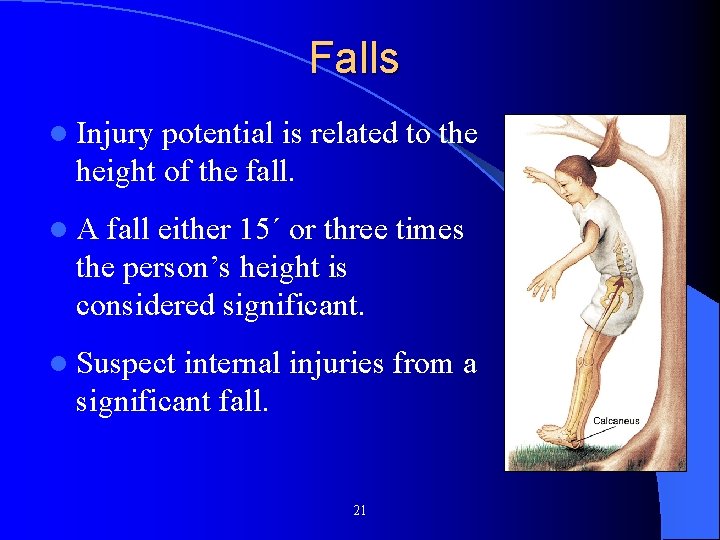
Falls l Injury potential is related to the height of the fall. l. A fall either 15´ or three times the person’s height is considered significant. l Suspect internal injuries from a significant fall. 21
Considerations for Falls l The height of the fall l The surface struck l The part of the body that hit first, followed by the path of energy displacement 22
Penetrating Trauma l Second largest cause of death in the United States after blunt trauma l Penetration can be low-energy, or medium- or high-velocity l The greater the speed of penetration, the greater the injuries 23
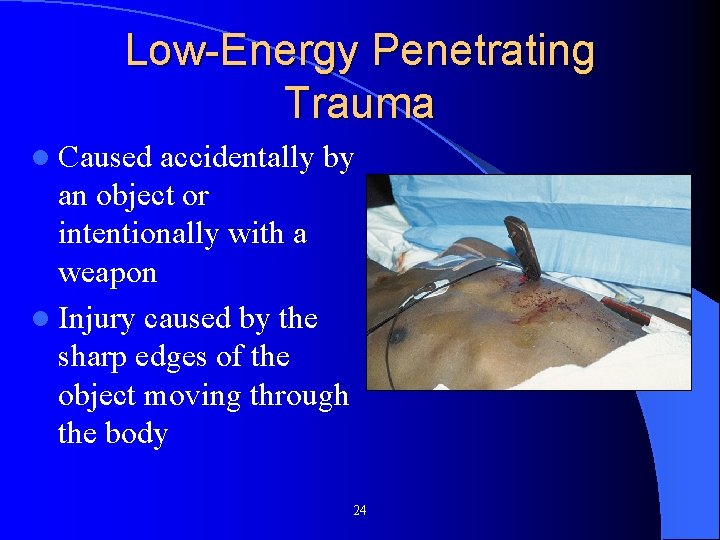
Low-Energy Penetrating Trauma l Caused accidentally by an object or intentionally with a weapon l Injury caused by the sharp edges of the object moving through the body 24
Medium-Velocity and High. Velocity Penetrating Trauma l Usually caused by bullets l Bullets can change shape and ricochet within the body. l Pressure waves cause cavitation. l If possible, identify weapon caliber and shooting distance. 25
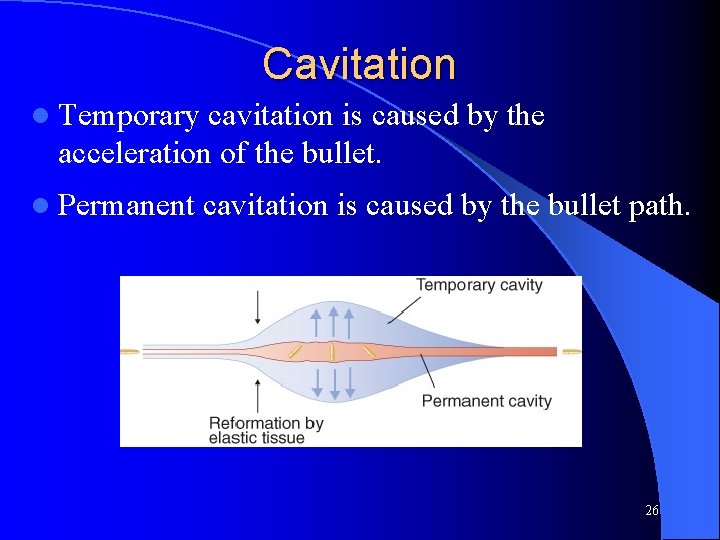
Cavitation l Temporary cavitation is caused by the acceleration of the bullet. l Permanent cavitation is caused by the bullet path. 26
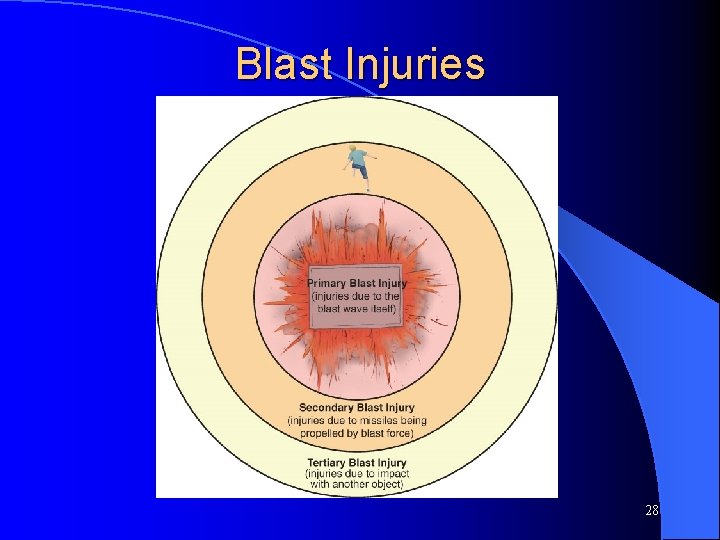
Blast Injuries l Primary blast injuries – Due entirely to the blast itself l Secondary blast injuries – Damage to the body results from being struck by flying debris. l Tertiary blast injuries – Victim is hurled by the force of the explosion. 27
Blast Injuries 28
Other Blast Injuries l Burns from hot gases or fires started by the blast l Respiratory l Crush injury from inhaling toxic gases injury from the collapse of buildings l Most patients will have some combination of the types of injury. 29
Organs Most Affected l Organs that contain air are most susceptible to pressure changes. – Middle ear – Lung – Gastrointestinal tract l The ear is most sensitive to blast injuries. 30
Blast Injuries l Solid organs are relatively protected from shock wave injury. – May be injured by secondary missiles or a hurled body l Neurologic injuries and head trauma are the most common causes of death. l Traumatic amputations are common 31