
Chapter 22 Touring Our Solar System SOLAR SYSTEM


- Slides: 47
Chapter 22 -Touring Our Solar System
SOLAR SYSTEM BASICS �The sun is at the center of our solar system, with 8 planets revolving around it �The sun accounts for 99. 85% of the mass of our solar system �All planets orbit the sun due to the sun’s gravitational pull in an elliptical pattern and all travel in the same direction �The closer the planet is to the sun, the faster it revolves around the sun
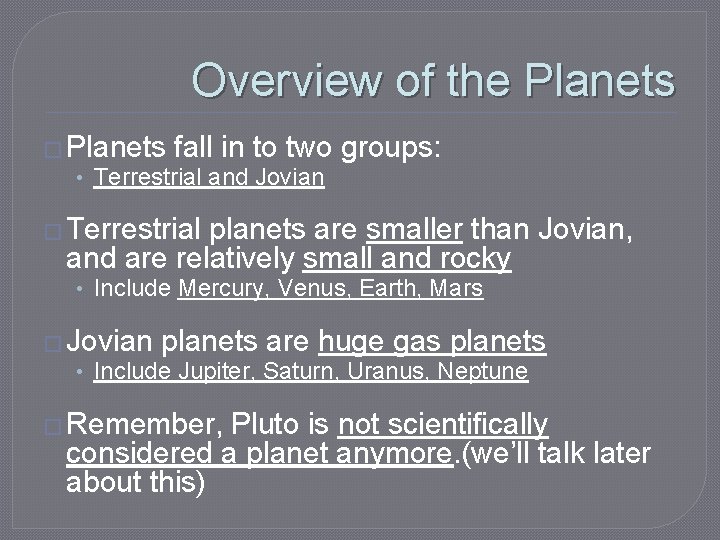
Overview of the Planets � Planets fall in to two • Terrestrial and Jovian groups: � Terrestrial planets are smaller than Jovian, and are relatively small and rocky • Include Mercury, Venus, Earth, Mars � Jovian planets are huge gas planets • Include Jupiter, Saturn, Uranus, Neptune � Remember, Pluto is not scientifically considered a planet anymore. (we’ll talk later about this)
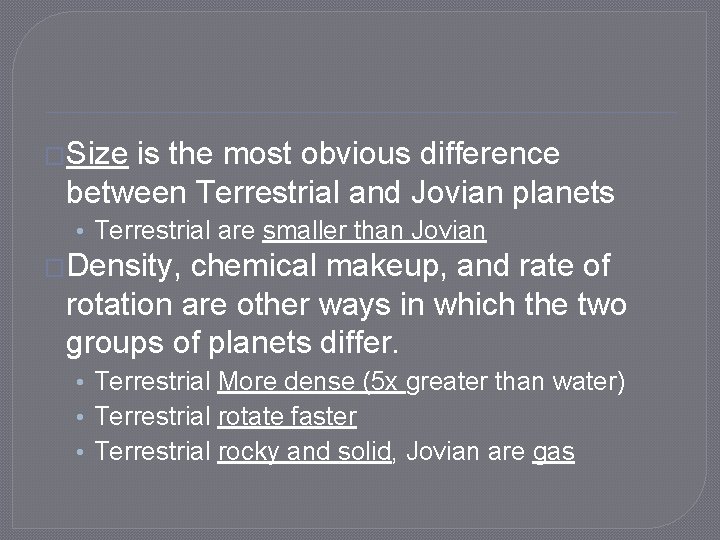
�Size is the most obvious difference between Terrestrial and Jovian planets • Terrestrial are smaller than Jovian �Density, chemical makeup, and rate of rotation are other ways in which the two groups of planets differ. • Terrestrial More dense (5 x greater than water) • Terrestrial rotate faster • Terrestrial rocky and solid, Jovian are gas
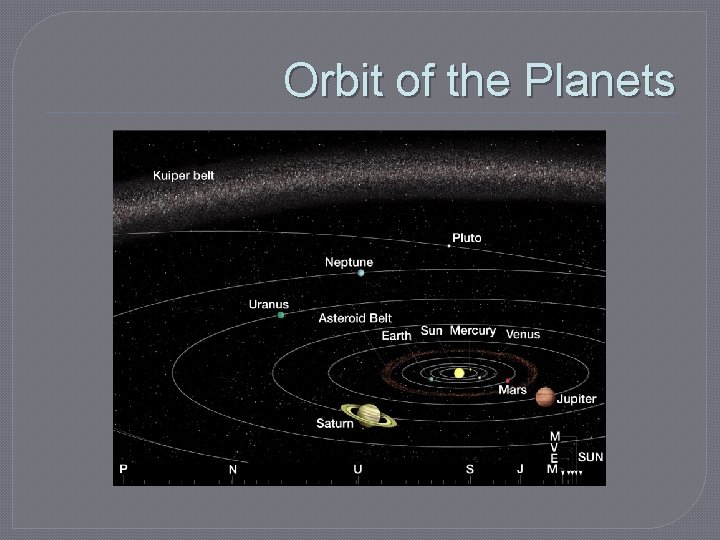
Orbit of the Planets
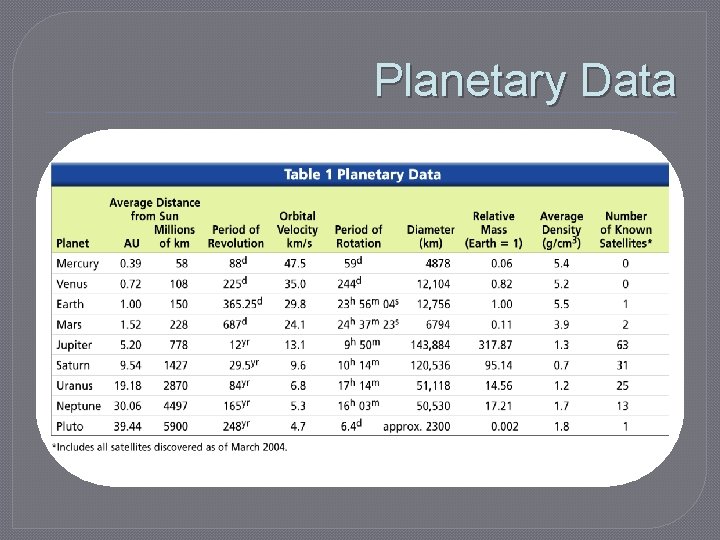
Planetary Data
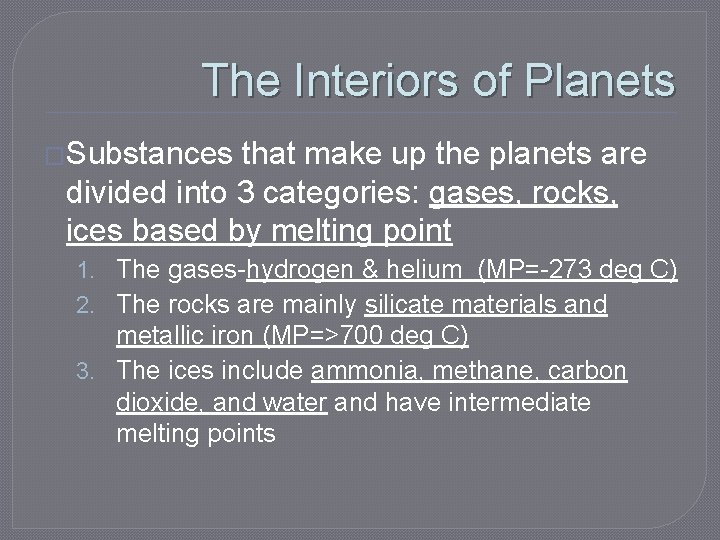
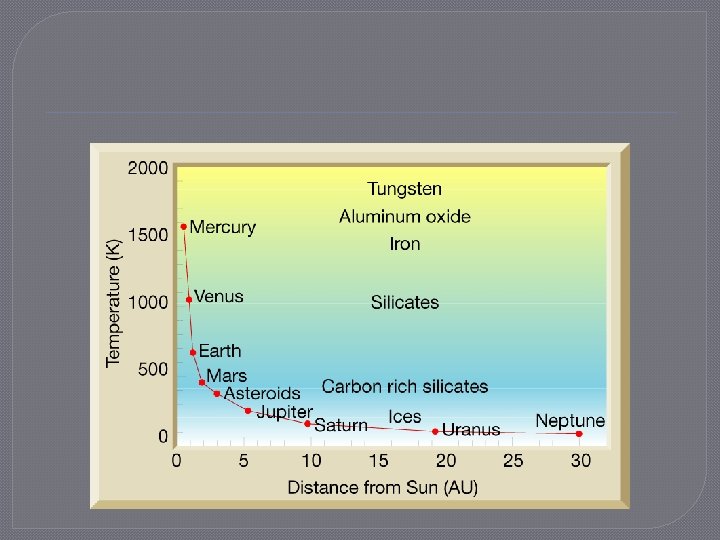
The Interiors of Planets �Substances that make up the planets are divided into 3 categories: gases, rocks, ices based by melting point 1. The gases-hydrogen & helium (MP=-273 deg C) 2. The rocks are mainly silicate materials and metallic iron (MP=>700 deg C) 3. The ices include ammonia, methane, carbon dioxide, and water and have intermediate melting points
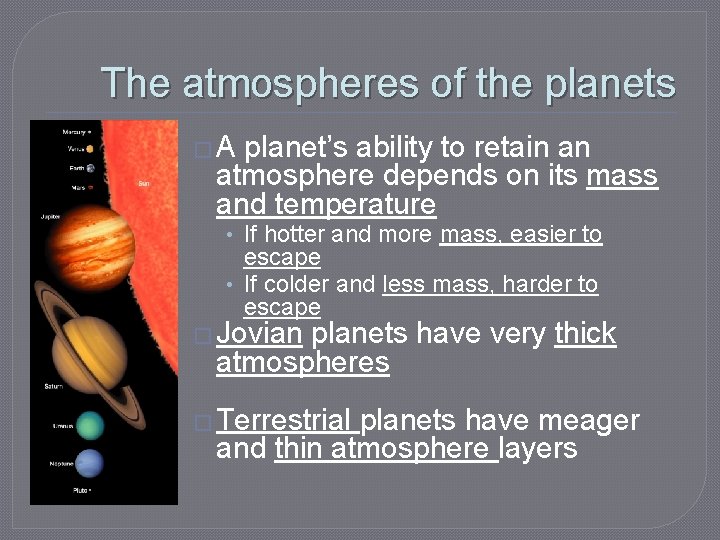
The atmospheres of the planets �A planet’s ability to retain an atmosphere depends on its mass and temperature • If hotter and more mass, easier to escape • If colder and less mass, harder to escape � Jovian planets have very thick atmospheres � Terrestrial planets have meager and thin atmosphere layers
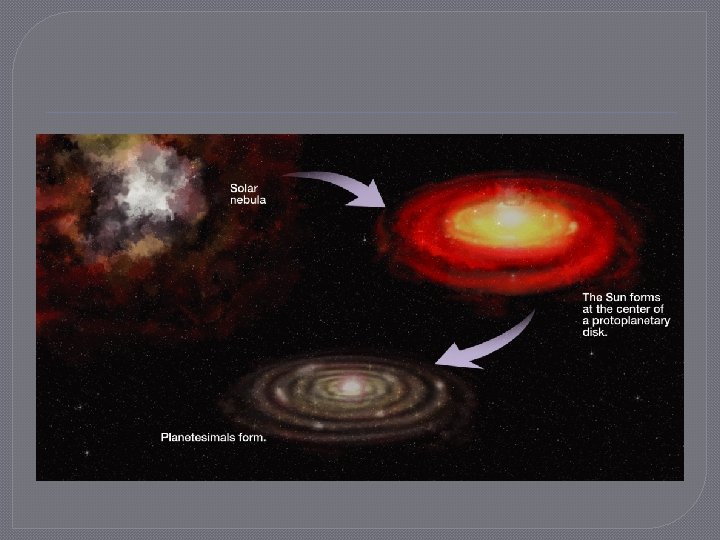
Formation of the Solar System �Nebula=cloud of dust and gas • Usually 92% hydrogen, 7% Helium, and 1% other �For some reason, these thin clouds begin to rotate slowly and contract gravitationally �As they contract, they spin faster
Nebular Theory �According to the nebular theory, the sun and planets formed from a rotating disk of dust and gases (a nebula) �As the speed of rotation increased, the center of the disk began to flatten out. �Matter began more concentrated at the center where the sun eventually formed
Nebular Theory � The planets began to form through a process called accretion, where solid material collides and eventually clumps together � With terrestrial planets, temperatures were so high that only metals and silicate materials could form solid grains � With Jovian planets, temperatures were so low that ices of water and other substances could form.
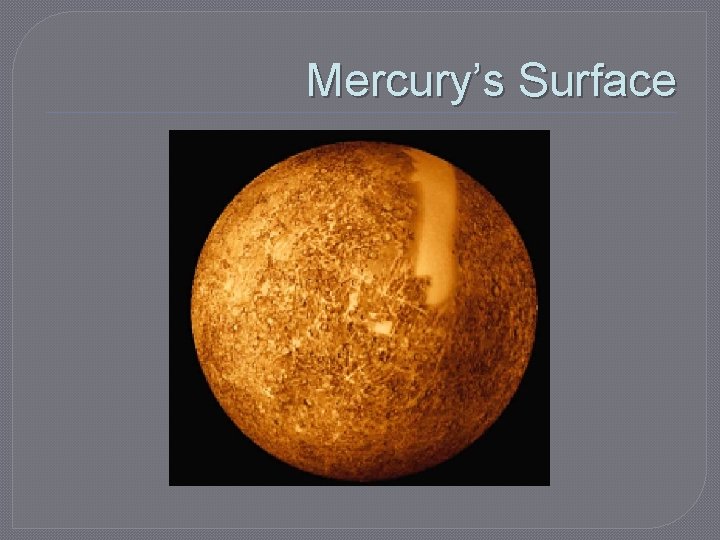
23. 2 -The Terrestrial Planets � Mercury, Venus, Earth, Mars � Mercury • Mercury is the innermost and smallest planet; it is hardly larger than Earth’s moon. • Mercury takes 59 days to rotate on its axis (takes 24 hours on earth) • Has no atmosphere • Mercury’s surface has cratered highlands, much like the moon, and vast smooth terrains that resemble maria. • Temperatures- Mercury has the greatest temperature extremes of any planet. �Can range from -173°C at night and 427°C during the day • Mercury has no moons
Mercury’s Surface
�Venus • Venus is similar to Earth in size, density, mass, and location in the solar system. Thus, it has been referred to as “Earth’s twin. ” • Revolves around the sun in 255 days (365 on earth) � Surface Features • Venus is covered in thick clouds that visible light cannot penetrate. • About 80% of Venus’s surface consists of plains covered by volcanic flow. • Only 8% of venus’s surface consists of highlands
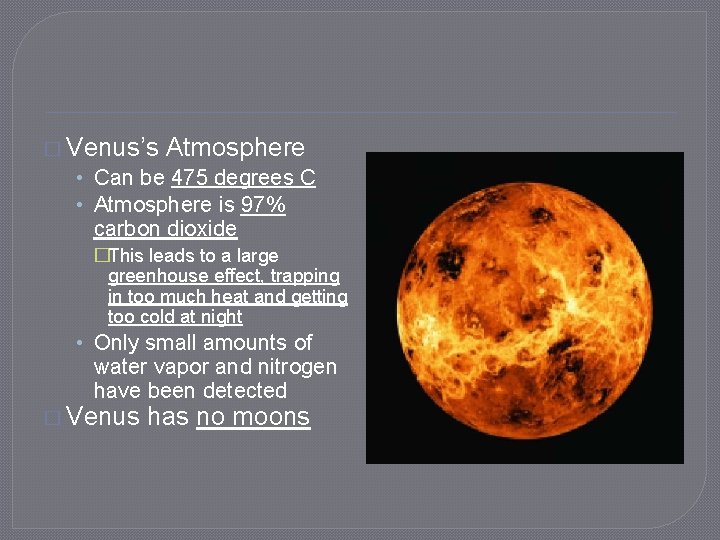
� Venus’s Atmosphere • Can be 475 degrees C • Atmosphere is 97% carbon dioxide �This leads to a large greenhouse effect, trapping in too much heat and getting too cold at night • Only small amounts of water vapor and nitrogen have been detected � Venus has no moons
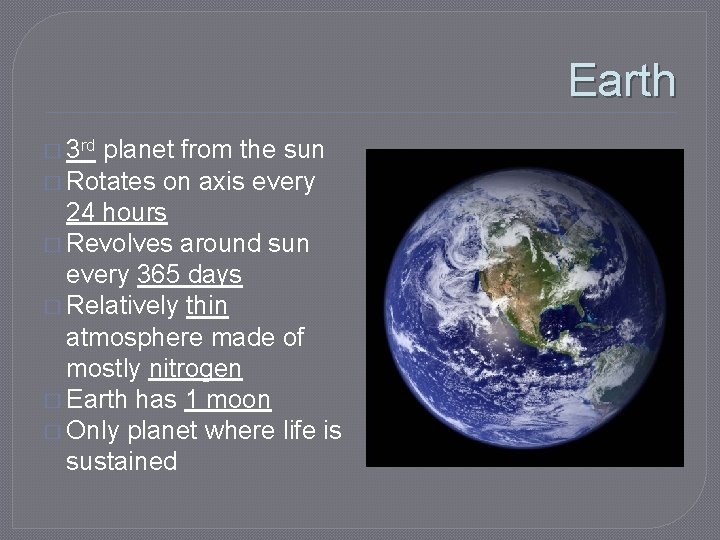
Earth � 3 rd planet from the sun � Rotates on axis every 24 hours � Revolves around sun every 365 days � Relatively thin atmosphere made of mostly nitrogen � Earth has 1 moon � Only planet where life is sustained
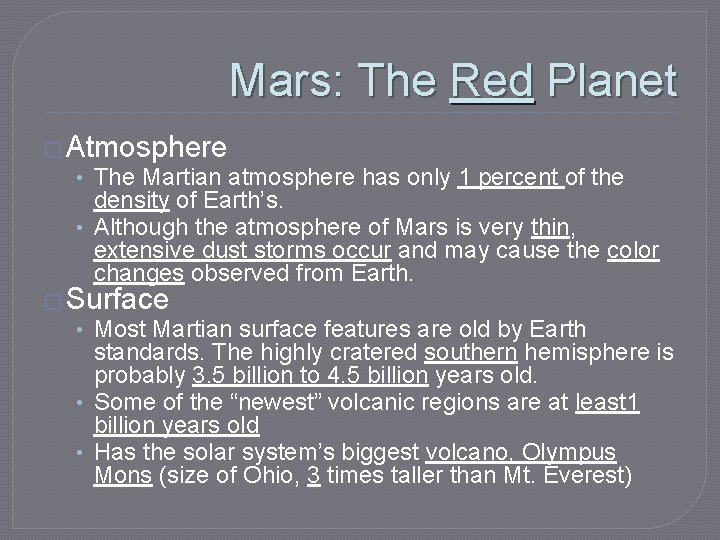
Mars: The Red Planet � Atmosphere • The Martian atmosphere has only 1 percent of the density of Earth’s. • Although the atmosphere of Mars is very thin, extensive dust storms occur and may cause the color changes observed from Earth. � Surface • Most Martian surface features are old by Earth standards. The highly cratered southern hemisphere is probably 3. 5 billion to 4. 5 billion years old. • Some of the “newest” volcanic regions are at least 1 billion years old • Has the solar system’s biggest volcano, Olympus Mons (size of Ohio, 3 times taller than Mt. Everest)
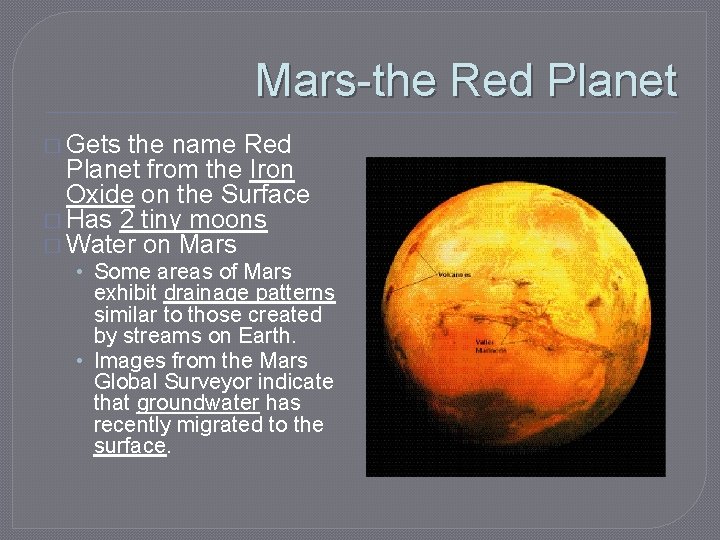
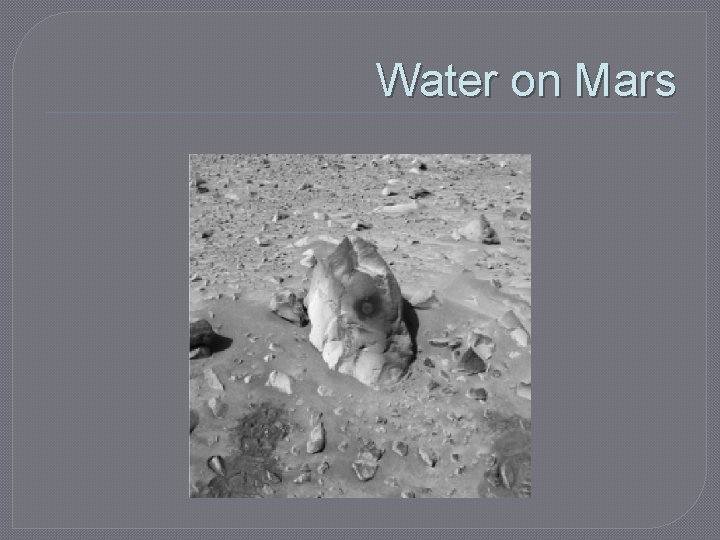
Mars-the Red Planet � Gets the name Red Planet from the Iron Oxide on the Surface � Has 2 tiny moons � Water on Mars • Some areas of Mars exhibit drainage patterns similar to those created by streams on Earth. • Images from the Mars Global Surveyor indicate that groundwater has recently migrated to the surface.
Water on Mars
23. 3 The Jovian Planets �Consists of Jupiter, Saturn, Uranus, and Neptune �Separated by the Terrestrial Planets by the Asteroid Belt
Jupiter �Jupiter 5 th planet from sun �Largest planet �Has a mass that is 2. 5 times greater than the mass of all the other planets and moons combined �No solid Surface �Known for Great Red Spot, a big hurricane that is 3 times the size of earth
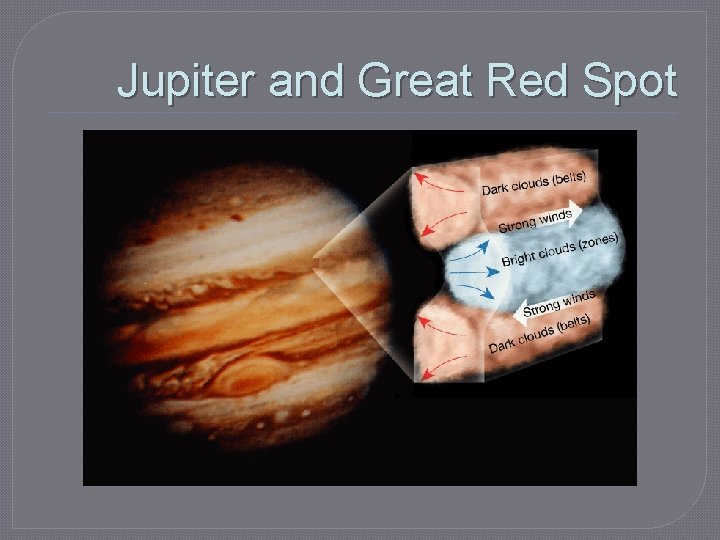
Jupiter �Atmosphere • Made of mostly hydrogen, helium, and also contains small amounts of methane, ammonia, water, and sulfur compounds • The bands you see on Jupiter are huge wind systems • Gives off twice as much heat as it receives from sun
Jupiter and Great Red Spot
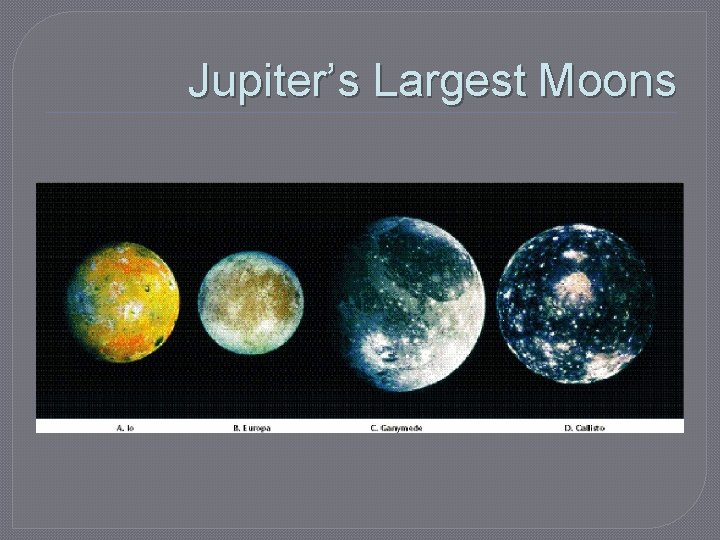
Jupiter � Jupiter’s Moons • Jupiter has 63 moons, including the 4 -Galilean Moons 1. Io-violent sulfur and silica volcanoes 2. Europa-Believed to have liquid water ocean under solid ice covering 3. Ganymede-Largest moon in the solar system (bigger than Mercury) 4. Callisto-Most heavily cratered moon in solar system � Jupiter’s Rings • Jupiter’s ring system was one of the most unexpected discoveries made by the Voyager 1
Jupiter’s Largest Moons
Saturn �The most prominent feature of Saturn is its system of rings �Features of Saturn • 6 th planet from sun • Takes 29. 46 earth years to make one revolution around the sun • Saturn is almost twice as far from the sun as Jupiter • No solid surface
Saturn �Features of Saturn • Saturn’s atmosphere is very active, with winds roaring up to 1500 km per hour • Large cyclonic storms similar to Jupiter’s Great Red Spot, but much smaller, occur on the surface • Rings of Saturn are very complex • Saturn has many moons-31 total
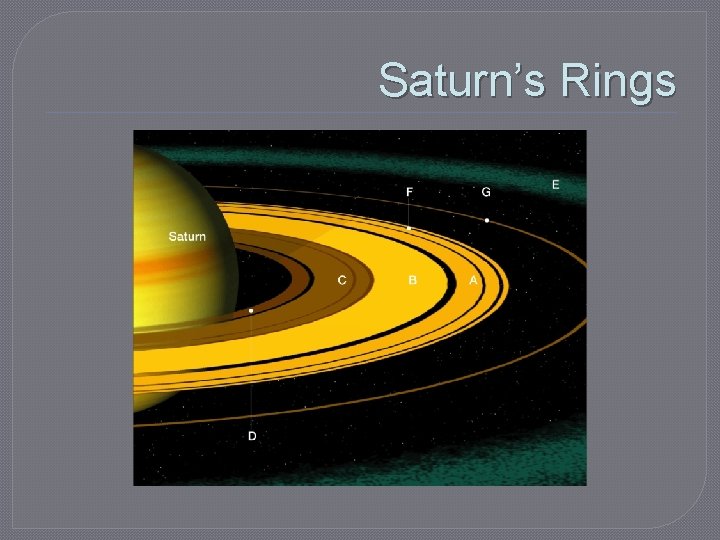
Saturn �Saturn’s Rings • Until the discovery that Jupiter, Uranus and Neptune have ring systems, we thought it was just Saturn • Most rings fall into one of two categories based on particle density �Main rings, A & B are densely packed �The outer rings are composed of widely dispersed particles
Saturn’s Rings
Saturn �Saturn’s Moons • Saturn’s satellite system consists of 31 moons • Titan is the largest moon �Titan is planet-sized �Has a thick nitrogen atmosphere with methane and photochemical smog �It may have liquid methane or ethane oceans, rivers, and rain
Uranus �The sideways planet �Instead of being generally perpendicular to the plane of its orbit like the other planets, Uranus’s axis of rotation lies nearly parallel with the plane of its orbit. �This causes it to look like its rolling instead of spinning, which could have been caused from a giant impact
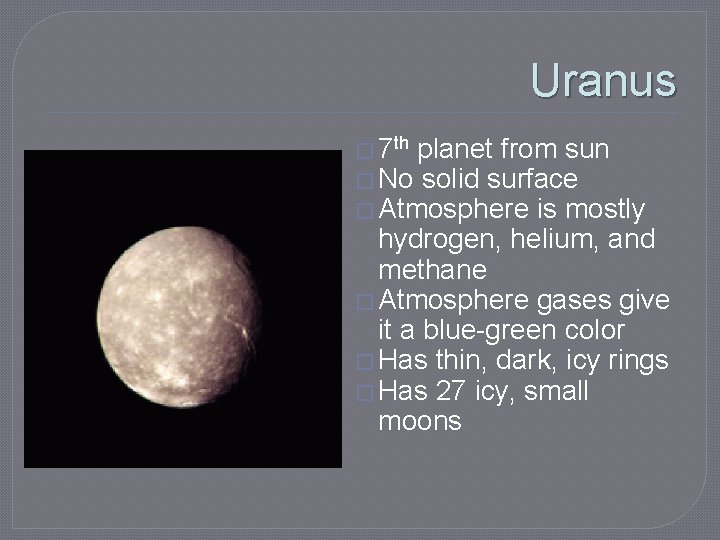
Uranus � 7 th planet from sun � No solid surface � Atmosphere is mostly hydrogen, helium, and methane � Atmosphere gases give it a blue-green color � Has thin, dark, icy rings � Has 27 icy, small moons
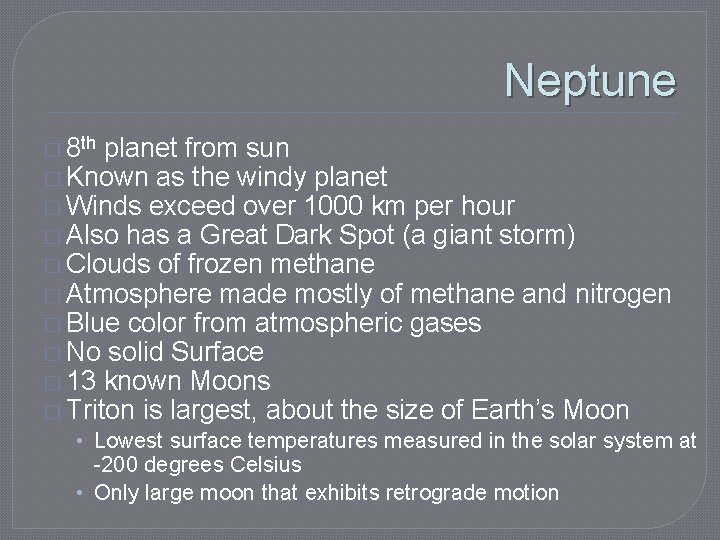
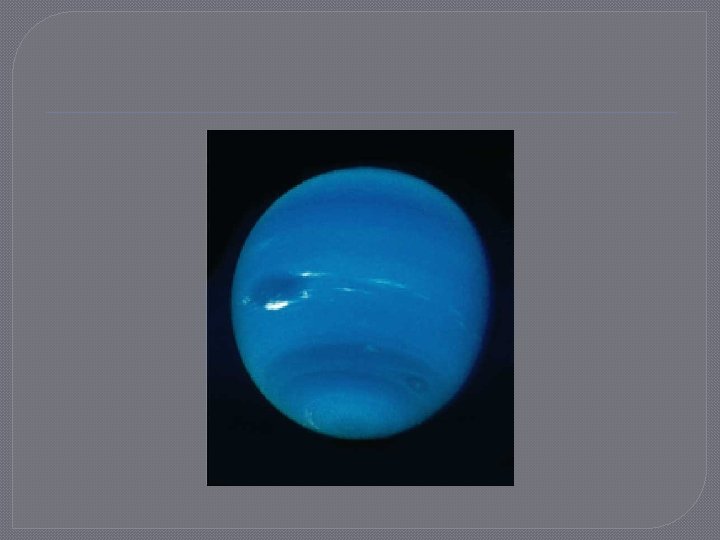
Neptune � 8 th planet from sun � Known as the windy planet � Winds exceed over 1000 km per hour � Also has a Great Dark Spot (a giant storm) � Clouds of frozen methane � Atmosphere made mostly of methane and nitrogen � Blue color from atmospheric gases � No solid Surface � 13 known Moons � Triton is largest, about the size of Earth’s Moon • Lowest surface temperatures measured in the solar system at -200 degrees Celsius • Only large moon that exhibits retrograde motion
Pluto �Pluto was decommissioned as planet in 2006, now classified as dwarf planet �We will get into what it is classified later �Pluto does not follow the trends of other Jovian Planets • • No rings Not large “moon” is too large compared to parent Pluto Very thin atmosphere
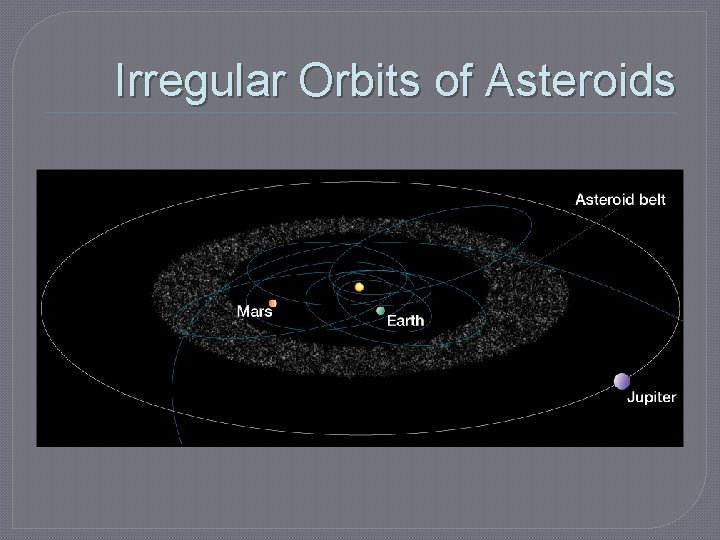
23. 4 Minor Members of the Solar System �Asteroids: Microplanets • An asteroid is a small, rocky body whose diameter can range from a few hundred kilometers to less than a kilometer • Most asteroids lie between the orbits of Mars and Jupiter. They have orbital periods of three to six years
Irregular Orbits of Asteroids
Comets �Comets are bodies made of rocky and metallic pieces held together by frozen gases. Comets generally revolve about the sun in elongated orbits.
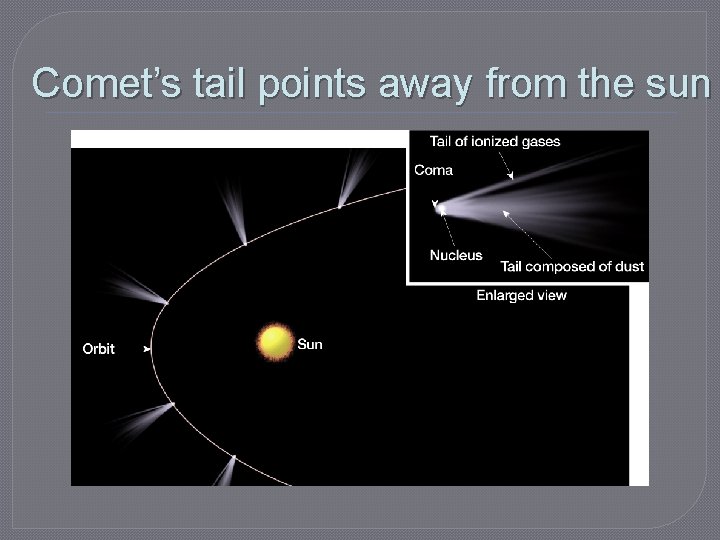
�Coma • Fuzzy gaseous component of a comet’s head • A small growing nucleus with a diameter of only a few kilometers can sometimes be detected with a coma. As comets approach the sun, some, but not all, develop a tail that extends for millions of kilometers
Comet’s tail points away from the sun
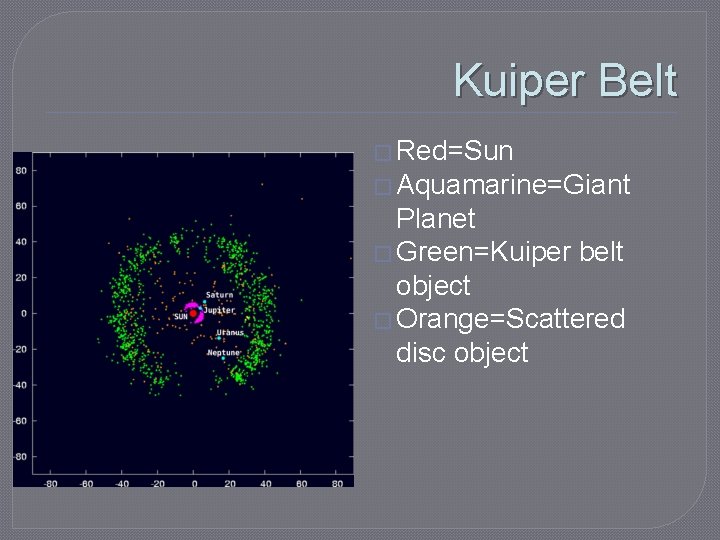
Kuiper Belt �Kuiper Belt • Encompasses the region of the solar system past • • Neptune Pluto is the largest member The belt was discovered in 1992 Known KBO are over 1, 000 but believed to be over 70, 000 total Orbits are close to the same plane as the planets
Kuiper Belt � Red=Sun � Aquamarine=Giant Planet � Green=Kuiper belt object � Orange=Scattered disc object
� Oort Cloud � Halley’s comet • Comets with long • Most famous short orbital periods appear to be distributed in all directions from the sun, forming a spherical shell around the solar system • This is 1000 times more distant than the Kuiper Belt period comet • Orbital period is 76 years • The next time we will be able to get a good look at it is July 2061
�Meteoroids, meteors, meteorites • Meteroid=Small solid particle that travels through space • Meteor=luminous phenomenon observed when a meteoroid enters earth’s atmosphere and burns up, popularly called a shooting star • Meteorite= any portion of a meteoroid that reaches earth’s surface
Meteoroids �Most meteoroids originate from any one of the following three sources: 1. Interplanetary debris that was not gravitationally swept up by the planets during the formation of the solar system 2. Material from the asteroid belt 3. The solid remains of comets that once traveled near Earth’s orbit