
Chapter 22 The Respiratory System Copyright 2010 Pearson
























- Slides: 66
Chapter 22 The Respiratory System: Copyright © 2010 Pearson Education, Inc.
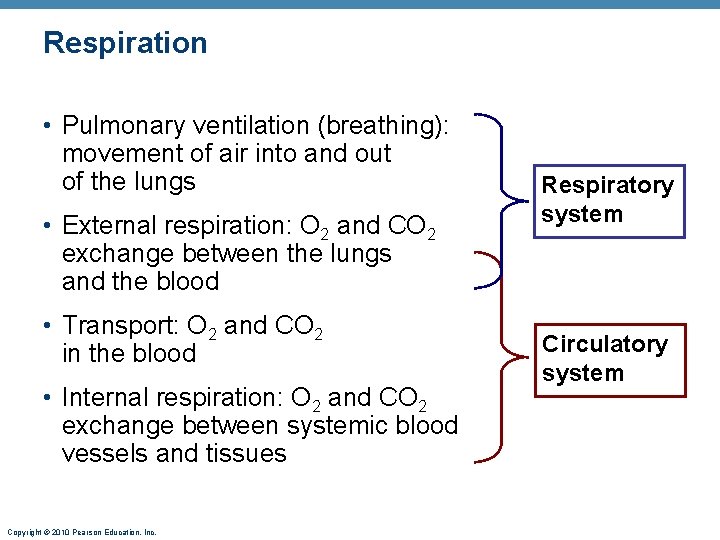
Respiration • Pulmonary ventilation (breathing): movement of air into and out of the lungs • External respiration: O 2 and CO 2 exchange between the lungs and the blood • Transport: O 2 and CO 2 in the blood • Internal respiration: O 2 and CO 2 exchange between systemic blood vessels and tissues Copyright © 2010 Pearson Education, Inc. Respiratory system Circulatory system
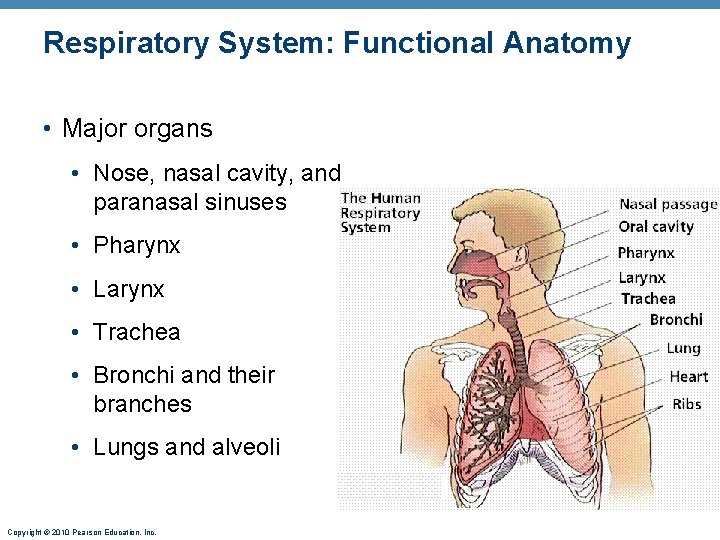
Respiratory System: Functional Anatomy • Major organs • Nose, nasal cavity, and paranasal sinuses • Pharynx • Larynx • Trachea • Bronchi and their branches • Lungs and alveoli Copyright © 2010 Pearson Education, Inc.
Functional Anatomy • Respiratory zone: site of gas exchange • Respiratory bronchioles, alveolar ducts, and alveoli • Conducting zone: conduits to gas exchange sites • Includes all other respiratory structures • Respiratory muscles: diaphragm and other muscles that promote ventilation Copyright © 2010 Pearson Education, Inc.
The Nose • Functions • Provides an airway for respiration • Moistens and warms the entering air • Filters and cleans inspired air • Serves as a resonating chamber for speech • Houses olfactory receptors Copyright © 2010 Pearson Education, Inc.
Nasal Cavity • Vestibule: nasal cavity superior to the nostrils • Vibrissae filter coarse particles from inspired air • Olfactory mucosa • Lines the superior nasal cavity • Contains smell receptors Copyright © 2010 Pearson Education, Inc.
Nasal Cavity • Respiratory mucosa • Pseudostratified ciliated columnar epithelium • Mucous and serous secretions contain lysozyme and defensins • Cilia move contaminated mucus posteriorly to throat • Inspired air is warmed by plexuses of capillaries and veins • Sensory nerve endings triggers sneezing Copyright © 2010 Pearson Education, Inc.
Nasal Cavity • Superior, middle, and inferior nasal conchae • Protrude from the lateral walls • Increase mucosal area • Enhance air turbulence Copyright © 2010 Pearson Education, Inc.
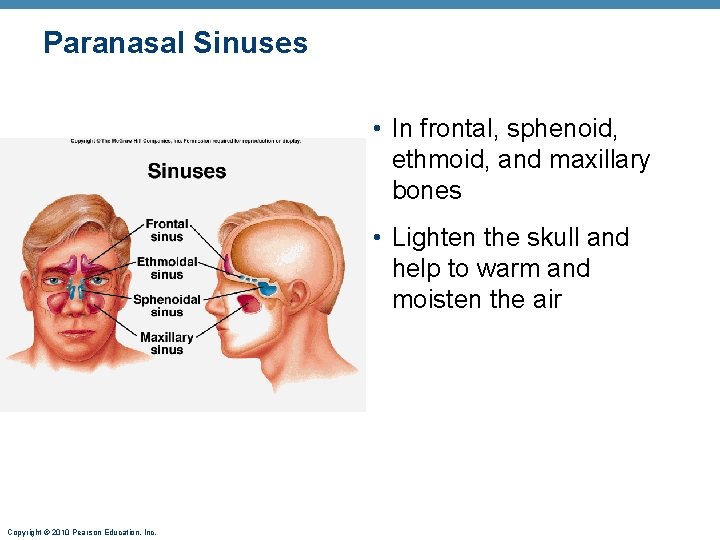
Paranasal Sinuses • In frontal, sphenoid, ethmoid, and maxillary bones • Lighten the skull and help to warm and moisten the air Copyright © 2010 Pearson Education, Inc.
Pharynx • Muscular tube that connects to the • Nasal cavity and mouth superiorly • Larynx and esophagus inferiorly • From the base of the skull to the level of the sixth cervical vertebra Copyright © 2010 Pearson Education, Inc.
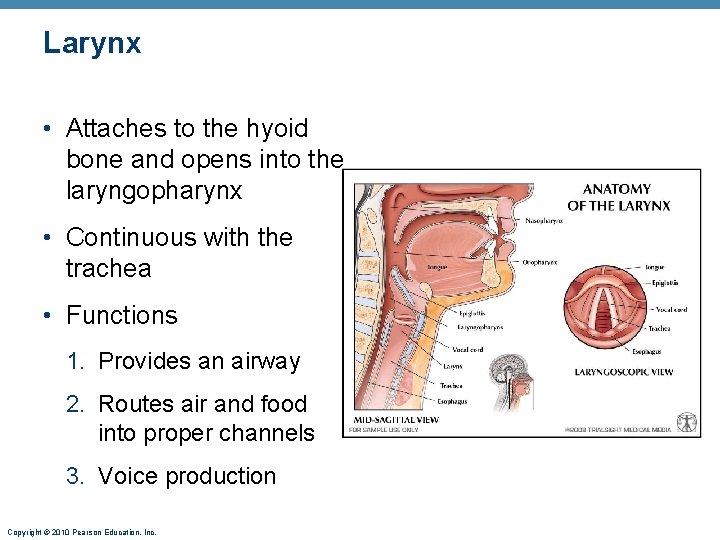
Larynx • Attaches to the hyoid bone and opens into the laryngopharynx • Continuous with the trachea • Functions 1. Provides an airway 2. Routes air and food into proper channels 3. Voice production Copyright © 2010 Pearson Education, Inc.
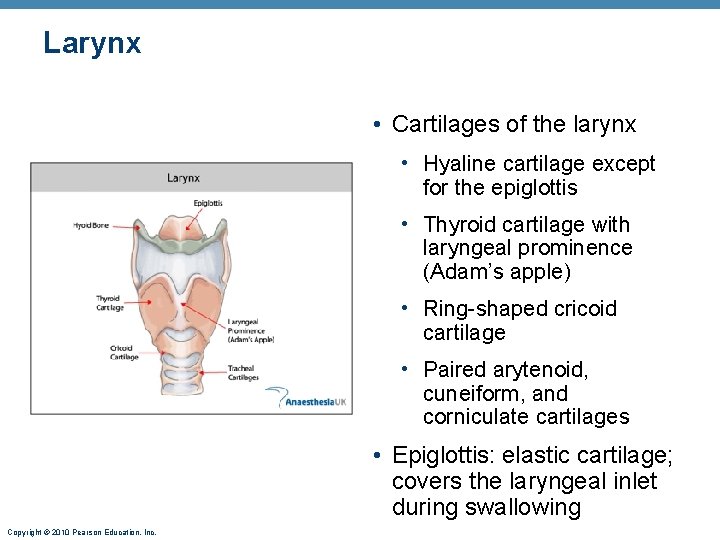
Larynx • Cartilages of the larynx • Hyaline cartilage except for the epiglottis • Thyroid cartilage with laryngeal prominence (Adam’s apple) • Ring-shaped cricoid cartilage • Paired arytenoid, cuneiform, and corniculate cartilages • Epiglottis: elastic cartilage; covers the laryngeal inlet during swallowing Copyright © 2010 Pearson Education, Inc.
Larynx • Vocal ligaments • Attach the arytenoid cartilages to the thyroid cartilage • Contain elastic fibers • Form core of vocal folds (true vocal cords) • Opening between them is the glottis • Folds vibrate to produce sound as air rushes up from the lungs Copyright © 2010 Pearson Education, Inc.
Larynx • Vestibular folds (false vocal cords) • Superior to the vocal folds • No part in sound production • Help to close the glottis during swallowing Copyright © 2010 Pearson Education, Inc.
Voice Production • Speech: intermittent release of expired air while opening and closing the glottis • Pitch is determined by the length and tension of the vocal cords • Loudness depends upon the force of air • Chambers of pharynx, oral, nasal, and sinus cavities amplify and enhance sound quality • Sound is “shaped” into language by muscles of the pharynx, tongue, soft palate, and lips Copyright © 2010 Pearson Education, Inc.
Larynx • Vocal folds may act as a sphincter to prevent air passage • Example: Valsalva’s maneuver • Glottis closes to prevent exhalation • Abdominal muscles contract • Intra-abdominal pressure rises • Helps to empty the rectum or stabilizes the trunk during heavy lifting Copyright © 2010 Pearson Education, Inc.
Trachea • Windpipe: from the larynx into the mediastinum • Wall composed of three layers 1. Mucosa: ciliated pseudostratified epithelium with goblet cells 2. Submucosa: connective tissue with seromucous glands 3. Adventitia: outermost layer made of connective tissue that encases the C-shaped rings of hyaline cartilage Copyright © 2010 Pearson Education, Inc.
Trachea • Trachealis muscle • Connects posterior parts of cartilage rings • Contracts during coughing to expel mucus • Carina • Last tracheal cartilage • Point where trachea branches into two bronchi Copyright © 2010 Pearson Education, Inc.
Bronchi and Subdivisions • Air passages undergo 23 orders of branching • Branching pattern called the bronchial (respiratory) tree Copyright © 2010 Pearson Education, Inc.
Conducting Zone Structures • Trachea right and left main (primary) bronchi • Each main bronchus enters the hilum of one lung • Right main bronchus is wider, shorter, and more vertical than the left • Each main bronchus branches into lobar (secondary) bronchi (three right, two left) • Each lobar bronchus supplies one lobe Copyright © 2010 Pearson Education, Inc.
Conducting Zone Structures • Each lobar bronchus branches into segmental (tertiary) bronchi • Segmental bronchi divide repeatedly • Bronchioles are less than 1 mm in diameter • Terminal bronchioles are the smallest, less than 0. 5 mm diameter Copyright © 2010 Pearson Education, Inc.
Respiratory Zone • Respiratory bronchioles, alveolar ducts, alveolar sacs (clusters of alveoli) • ~300 million alveoli account for most of the lungs’ volume and are the main site for gas exchange Copyright © 2010 Pearson Education, Inc.
Alveoli • Surrounded by fine elastic fibers • Open aveolar pores • House alveolar macrophages that keep alveolar surfaces sterile Copyright © 2010 Pearson Education, Inc.
Lungs • Occupy all of the thoracic cavity except the mediastinum • Root: site of vascular and bronchial attachments • Costal surface: anterior, lateral, and posterior surfaces Copyright © 2010 Pearson Education, Inc.
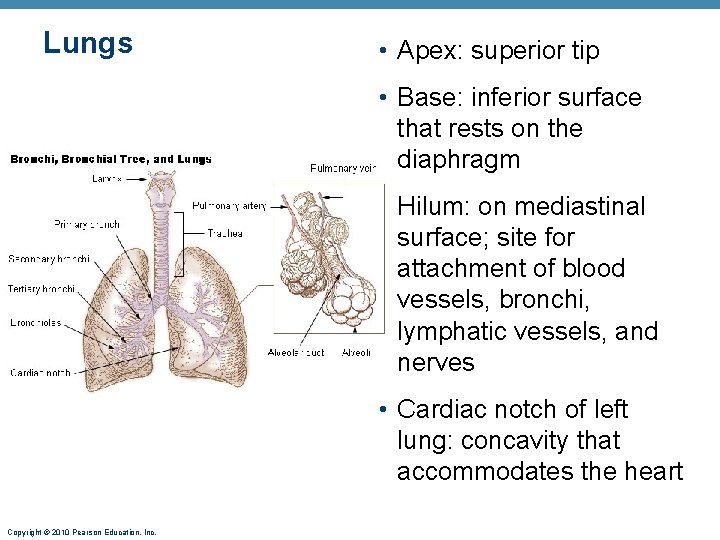
Lungs • Apex: superior tip • Base: inferior surface that rests on the diaphragm • Hilum: on mediastinal surface; site for attachment of blood vessels, bronchi, lymphatic vessels, and nerves • Cardiac notch of left lung: concavity that accommodates the heart Copyright © 2010 Pearson Education, Inc.
Lungs • Left lung is smaller, separated into two lobes by an oblique fissure • Right lung has three lobes separated by oblique and horizontal fissures • Bronchopulmonary segments (10 right, 8– 9 left) • Lobules are the smallest subdivisions; served by bronchioles and their branches Copyright © 2010 Pearson Education, Inc.
Pleurae • Thin, double-layered serosa • Parietal pleura on thoracic wall and superior face of diaphragm • Visceral pleura on external lung surface • Pleural fluid fills the slitlike pleural cavity • Provides lubrication and surface tension Copyright © 2010 Pearson Education, Inc.
Mechanics of Breathing • Pulmonary ventilation consists of two phases 1. Inspiration: gases flow into the lungs 2. Expiration: gases exit the lungs Copyright © 2010 Pearson Education, Inc.
Pressure Relationships in the Thoracic Cavity • Atmospheric pressure (Patm) • Pressure exerted by the air surrounding the body • 760 mm Hg at sea level • Respiratory pressures are described relative to Patm • Negative respiratory pressure = less than Patm • Positive respiratory pressure = greater than Patm • Zero respiratory pressure = Patm Copyright © 2010 Pearson Education, Inc.
Intrapulmonary Pressure and Intrapleural Pressure • Intrapulmonary (intra-alveolar) pressure (Ppul) • Pressure in the alveoli • Fluctuates with breathing • Always eventually equalizes with Patm • Intrapleural pressure (Pip): • Pressure in the pleural cavity • Fluctuates with breathing • Always a negative pressure (<Patm and <Ppul) Copyright © 2010 Pearson Education, Inc.
Intrapleural Pressure • Negative Pip is caused by opposing forces • Two inward forces promote lung collapse • Elastic recoil of lungs decreases lung size • Surface tension of alveolar fluid • One outward force tends to enlarge the lungs • Elasticity of the chest wall pulls the thorax outward Copyright © 2010 Pearson Education, Inc.
Pressure Relationships • If Pip = Ppul the lungs collapse (atelectasis) • (Ppul – Pip) = transpulmonary pressure • Keeps the airways open • The greater the transpulmonary pressure, the larger the lungs Copyright © 2010 Pearson Education, Inc.
Pulmonary Ventilation • Inspiration and expiration • Mechanical processes that depend on volume changes in the thoracic cavity • Volume changes pressure changes • Pressure changes gases flow to equalize pressure Copyright © 2010 Pearson Education, Inc.
Inspiration • An active process • Inspiratory muscles contract • Thoracic volume increases • Lungs are stretched and intrapulmonary volume increases • Intrapulmonary pressure drops (to 1 mm Hg) • Air flows into the lungs, down its pressure gradient, until Ppul = Patm Copyright © 2010 Pearson Education, Inc.
Expiration • Quiet expiration is normally a passive process • Inspiratory muscles relax • Thoracic cavity volume decreases • Elastic lungs recoil and intrapulmonary volume decreases • Ppul rises (to +1 mm Hg) • Air flows out of the lungs down its pressure gradient until Ppul = 0 • Note: forced expiration is an active process: it uses abdominal and internal intercostal muscles Copyright © 2010 Pearson Education, Inc.
Physical Factors Influencing Pulmonary Ventilation • Inspiratory muscles consume energy to overcome three factors that hinder air passage and pulmonary ventilation 1. Airway resistance 2. Alveolar surface tension 3. Lung compliance Copyright © 2010 Pearson Education, Inc.
Alveolar Surface Tension • Surfactant • Detergent-like lipid and protein complex produced by type II alveolar cells • Reduces surface tension of alveolar fluid and discourages alveolar collapse • Insufficient quantity in premature infants causes infant respiratory distress syndrome Copyright © 2010 Pearson Education, Inc.
Respiratory Volumes • Used to assess a person’s respiratory status • Tidal volume (TV) • Inspiratory reserve volume (IRV) • Expiratory reserve volume (ERV) • Residual volume (RV) Copyright © 2010 Pearson Education, Inc.
Respiratory Capacities • Inspiratory capacity (IC) • Functional residual capacity (FRC) • Vital capacity (VC) • Total lung capacity (TLC) Copyright © 2010 Pearson Education, Inc.
Dead Space • Some inspired air never contributes to gas exchange • Anatomical dead space: volume of the conducting zone conduits (~150 ml) • Alveolar dead space: alveoli that cease to act in gas exchange due to collapse or obstruction • Total dead space: sum of above nonuseful volumes Copyright © 2010 Pearson Education, Inc.
Pulmonary Function Tests • Spirometer: instrument used to measure respiratory volumes and capacities • Spirometry can distinguish between • Obstructive pulmonary disease—increased airway resistance (e. g. , bronchitis) • Restrictive disorders—reduction in total lung capacity due to structural or functional lung changes (e. g. , fibrosis or TB) Copyright © 2010 Pearson Education, Inc.
Pulmonary Function Tests • Minute ventilation: total amount of gas flow into or out of the respiratory tract in one minute • Forced vital capacity (FVC): gas forcibly expelled after taking a deep breath • Forced expiratory volume (FEV): the amount of gas expelled during specific time intervals of the FVC Copyright © 2010 Pearson Education, Inc.
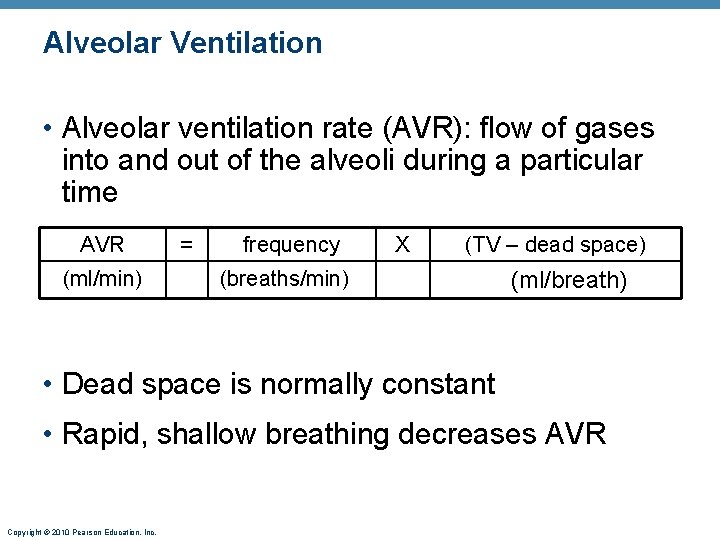
Alveolar Ventilation • Alveolar ventilation rate (AVR): flow of gases into and out of the alveoli during a particular time AVR (ml/min) = frequency X (TV – dead space) (breaths/min) (ml/breath) • Dead space is normally constant • Rapid, shallow breathing decreases AVR Copyright © 2010 Pearson Education, Inc.
Nonrespiratory Air Movements • Most result from reflex action • Examples include: cough, sneeze, crying, laughing, hiccups, and yawns Copyright © 2010 Pearson Education, Inc.
Gas Pressures • With respiration, the amount of gas that moves across membranes is in regards to it’s partial pressure • This is why at higher altitudes it becomes more difficult to breathe • At sea level – PO 2 is 159 mm Hg (760 atm) • At 10, 000 ft - PO 2 is 110 mm Hg (523 atm) • Less pressure being exerted – more difficulty moving O 2 across membranes Copyright © 2010 Pearson Education, Inc.
Composition of Alveolar Gas • Alveoli contain more CO 2 and water vapor than atmospheric air, due to • Gas exchanges in the lungs • Humidification of air • Mixing of alveolar gas that occurs with each breath Copyright © 2010 Pearson Education, Inc.
External Respiration • Exchange of O 2 and CO 2 across the respiratory membrane • Influenced by • Partial pressure gradients and gas solubilities • Ventilation-perfusion coupling • Structural characteristics of the respiratory membrane Copyright © 2010 Pearson Education, Inc.
Transport of Respiratory Gases by Blood • Oxygen (O 2) transport • Molecular O 2 is carried in the blood • 1. 5% dissolved in plasma • 98. 5% loosely bound to each Fe of hemoglobin (Hb) in RBCs • 4 O 2 per Hb Copyright © 2010 Pearson Education, Inc.
O 2 and Hemoglobin • Oxyhemoglobin (Hb. O 2): hemoglobin-O 2 combination • Reduced hemoglobin (HHb): hemoglobin that has released O 2 Copyright © 2010 Pearson Education, Inc.
O 2 and Hemoglobin • Rate of loading and unloading of O 2 is regulated by • Po 2 • Temperature • Blood p. H • Pco 2 • Concentration of BPG-organic chemical in RBC’s that effects affinity for O 2 Copyright © 2010 Pearson Education, Inc.
Factors that Increase Release of O 2 by Hemoglobin • As cells metabolize glucose • Pco 2 and H+ increase in concentration in capillary blood • Heat production increases • Increasing temperature directly and indirectly decreases Hb affinity for O 2 Copyright © 2010 Pearson Education, Inc.
Homeostatic Imbalance • Hypoxia • Inadequate O 2 delivery to tissues • Due to a variety of causes • Too few RBCs (Anemia) • Abnormal or too little Hb • Blocked circulation (Ischemic) • Metabolic poisons (Histotoxic) • Pulmonary disease • Carbon monoxide Copyright © 2010 Pearson Education, Inc.
CO 2 Transport • CO 2 is transported in the blood in three forms • 7 to 10% dissolved in plasma • 20% bound to globin of hemoglobin (carbaminohemoglobin) • 70% transported as bicarbonate ions (HCO 3–) in plasma Copyright © 2010 Pearson Education, Inc.
Haldane Effect • The amount of CO 2 transported is affected by the Po 2 • The lower the Po 2 and hemoglobin saturation with O 2, the more CO 2 can be carried in the blood Copyright © 2010 Pearson Education, Inc.
Haldane Effect • At the tissues, as more carbon dioxide enters the blood • More oxygen dissociates from hemoglobin (Bohr effect) • As Hb. O 2 releases O 2, it more readily forms bonds with CO 2 to form carbaminohemoglobin • Promotes CO 2 exchange in the lungs and tissues Copyright © 2010 Pearson Education, Inc.
Depth and Rate of Breathing • Hyperventilation: increased depth and rate of breathing that exceeds the body’s need to remove CO 2 • Causes CO 2 levels to decline (hypocapnia) • May cause cerebral vasoconstriction and cerebral ischemia • Apnea: period of breathing cessation that occurs when Pco 2 is abnormally low Copyright © 2010 Pearson Education, Inc.
Pulmonary Irritant Reflexes • Receptors in the bronchioles respond to irritants • Promote reflexive constriction of air passages • Receptors in the larger airways mediate the cough and sneeze reflexes Copyright © 2010 Pearson Education, Inc.
Respiratory Adjustments: Exercise • Adjustments are geared to both the intensity and duration of exercise • Hyperpnea • Increase in ventilation (10 to 20 fold) in response to metabolic needs • Pco 2, Po 2, and p. H remain surprisingly constant during exercise Copyright © 2010 Pearson Education, Inc.
Respiratory Adjustments: Exercise • Three neural factors cause increase in ventilation as exercise begins • Psychological stimuli—anticipation of exercise • Simultaneous cortical motor activation of skeletal muscles and respiratory centers • Exictatory impulses reaching respiratory centers from • As exercise ends • Ventilation declines suddenly as the three neural factors shut off Copyright © 2010 Pearson Education, Inc.
Respiratory Adjustments: High Altitude • Quick travel to altitudes above 8000 feet may produce symptoms of acute mountain sickness (AMS) • Headaches, shortness of breath, nausea, and dizziness • In severe cases, lethal cerebral and pulmonary edema Copyright © 2010 Pearson Education, Inc.
Acclimatization to High Altitude • Acclimatization: respiratory and hematopoietic adjustments to altitude • Chemoreceptors become more responsive to Pco 2 when Po 2 declines • Substantial decline in Po 2 directly stimulates peripheral chemoreceptors • Result: minute ventilation increases and stabilizes in a few days to 2– 3 L/min higher than at sea level Copyright © 2010 Pearson Education, Inc.
Acclimatization to High Altitude • Decline in blood O 2 stimulates the kidneys to accelerate production of EPO • RBC numbers increase slowly to provide longterm compensation Copyright © 2010 Pearson Education, Inc.
Homeostatic Imbalances • Chronic obstructive pulmonary disease (COPD) • Exemplified by chronic bronchitis and emphysema • Irreversible decrease in the ability to force air out of the lungs • Other common features • History of smoking in 80% of patients • Dyspnea: labored breathing (“air hunger”) • Coughing and frequent pulmonary infections • Most victims develop respiratory failure (hypoventilation) accompanied by respiratory acidosis Copyright © 2010 Pearson Education, Inc.
Homeostatic Imbalances • Asthma • Characterized by coughing, dyspnea, wheezing, and chest tightness • Active inflammation of the airways precedes bronchospasms • Airway inflammation is an immune response caused by release of interleukins, production of Ig. E, and recruitment of inflammatory cells • Airways thickened with inflammatory exudate magnify the effect of bronchospasms Copyright © 2010 Pearson Education, Inc.
Homeostatic Imbalances • Tuberculosis • Infectious disease caused by the bacterium Mycobacterium tuberculosis • Symptoms include fever, night sweats, weight loss, a racking cough, and spitting up blood • Treatment entails a 12 -month course of antibiotics Copyright © 2010 Pearson Education, Inc.
Homeostatic Imbalances • Lung cancer • Leading cause of cancer deaths in North America • 90% of all cases are the result of smoking • The three most common types 1. Squamous cell carcinoma (20– 40% of cases) in bronchial epithelium 2. Adenocarcinoma (~40% of cases) originates in peripheral lung areas 3. Small cell carcinoma (~20% of cases) contains lymphocyte-like cells that originate in the primary bronchi and subsequently metastasize Copyright © 2010 Pearson Education, Inc.