
Chapter 22 The Monetary and Portfolio Balance Approaches
Chapter 22 The Monetary and Portfolio Balance Approaches to External Balance Mc. Graw-Hill/Irwin Copyright © 2010 by The Mc. Graw-Hill Companies, Inc. All rights reserved. 22 -1
Learning Objectives • Show the supply and demand for money can affect a country’s balance of payments and exchange rate. • Describe how other financial assets besides money can influence exchange rates and international payments positions. • Explain how a changing exchange rate can overshoot its new equilibrium value. 22 -2
The Monetary Approach to the Balance of Payments § The monetary approach to the balance of payments argues that the BOP is mainly a monetary phenomenon. § This approach requires us to consider a country’s supply of and demand for money. 22 -3
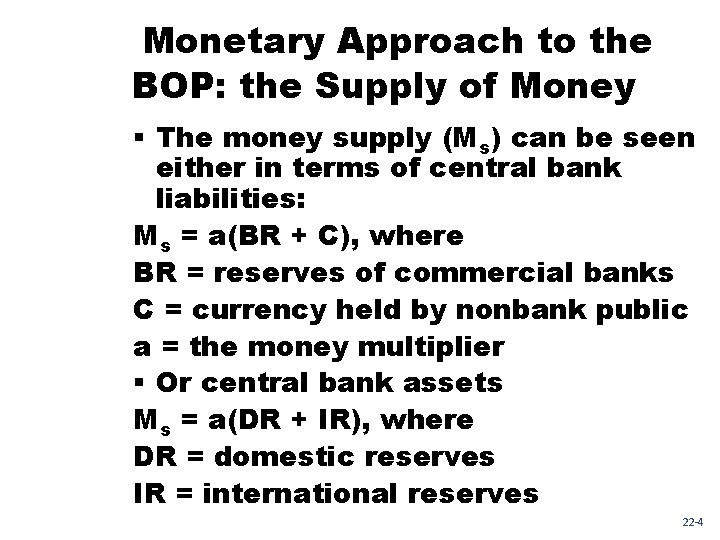
Monetary Approach to the BOP: the Supply of Money § The money supply (Ms) can be seen either in terms of central bank liabilities: Ms = a(BR + C), where BR = reserves of commercial banks C = currency held by nonbank public a = the money multiplier § Or central bank assets Ms = a(DR + IR), where DR = domestic reserves IR = international reserves 22 -4
Monetary Approach to the BOP: the Supply of Money § The money multiplier refers to the notion of multiple deposit creation. § If the reserve requirement is 10%, a new deposit of $1, 000 creates $900 of excess reserves, which can be lent out. § The loan recipient deposits the $900 in her bank; this creates $810 of excess reserves which can be lent, etc. § The money multiplier is 1/r or 10. 22 -5
Monetary Approach to the BOP: the Supply of Money § Anything that increases the assets of the central bank (or equivalently, its liabilities) allows the money supply to expand via the multiplier process. § Suppose the central bank buys government securities or foreign exchange – in either case the money supply is expanded. 22 -6
Monetary Approach to BOP: the Demand for Money § Money demand (L) is a function of several variables: L = f[Y, P, i, W, E(p), O], where Y = level of real income in economy P = price level i = interest rate W = level of real wealth E(p) = expected % Δ in price level O = other variables that may affect L 22 -7
Monetary Approach to BOP: the Demand for Money § L is a positive function of Y, due to the transactions demand for money. § L is a positive function of P, since more cash is needed to make purchases when P rises. § L is a negative function of I; i is the opportunity cost of holding money. § L is a positive function of W; as a person’s wealth rises she will want to hold more money. § L is a negative function of E(p); if a person expects inflation he will hold less money. 22 -8
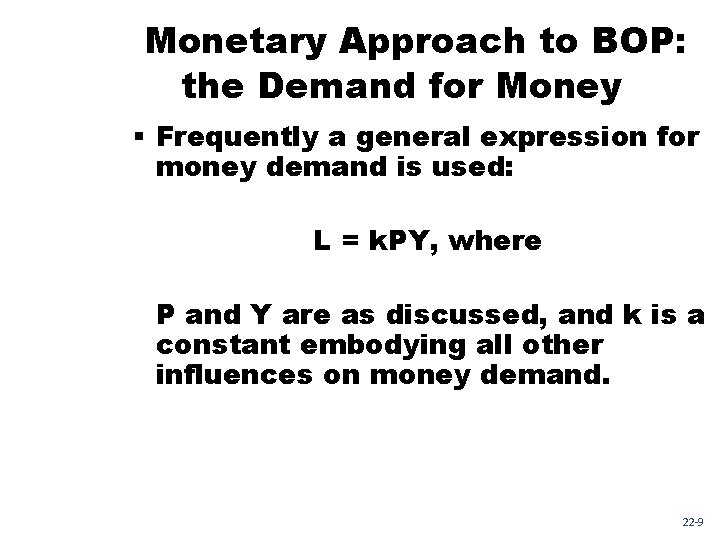
Monetary Approach to BOP: the Demand for Money § Frequently a general expression for money demand is used: L = k. PY, where P and Y are as discussed, and k is a constant embodying all other influences on money demand. 22 -9
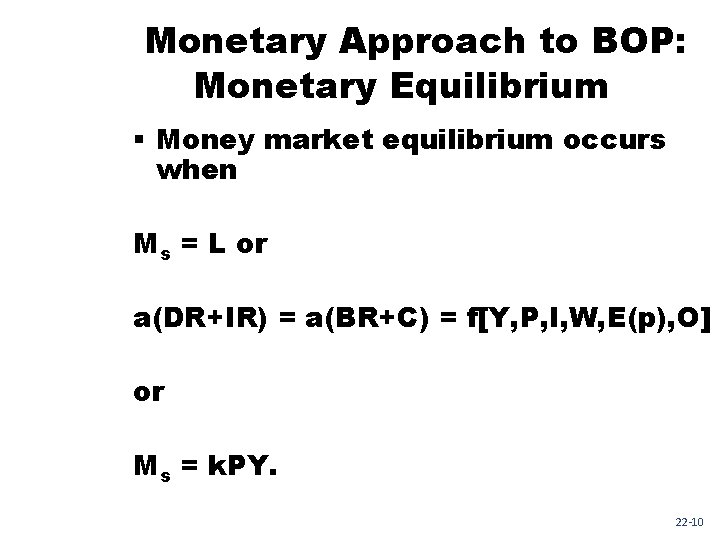
Monetary Approach to BOP: Monetary Equilibrium § Money market equilibrium occurs when Ms = L or a(DR+IR) = a(BR+C) = f[Y, P, I, W, E(p), O] or Ms = k. PY. 22 -10
Monetary Approach to BOP: Monetary Equilibrium § How can we understand balance of payments adjustments using money supply and demand? § Let us assume a fixed exchange rate system. § What happens when the central bank increases Ms, perhaps by purchasing government securities (increasing DR)? § BR and/or C will increase, and there will now be an excess supply of money. 22 -11
Monetary Approach to BOP: Monetary Equilibrium § Current account § excess cash balances imply individuals spend more, bidding up P. § Y and W may rise. § Higher P and Y will lead to lower exports (X) and higher imports (M). § Therefore, the excess supply of money leads to a current account deficit. § Private capital account § excess cash causes individual to bid up price of financial assets; this drives down i. § In the end, this causes a deficit in the private capital account. 22 -12
Monetary Approach to BOP: Monetary Equilibrium § Together, these effects indicate that a money supply increase leads to a balance of payments deficit. § To summarize: § Increase in Ms causes individuals to shift to non-money assets, including foreign goods and assets. § This creates a BOP deficit. 22 -13

Monetary Approach to the Exchange Rate § When exchange rates are fixed, an increase in Ms leads to a BOP deficit. § If the exchange rate is not fixed, BOP deficits and surpluses will be eliminated by exchange rate adjustments. § Let’s look at exchange rate changes in terms of money demand supply § What happens if Ms is increased? 22 -14
Monetary Approach to the Exchange Rate § If Ms is increased § Individuals wish to purchase non-money assets, including foreign goods and assets. § This creates an “incipient” BOP deficit. § The home country’s currency will depreciate to eliminate the BOP deficit. § If Ms is decreased § Individuals wish to sell non-money assets, including foreign goods and assets. § This creates an “incipient” BOP surplus. § The home country’s currency will appreciate to eliminate the BOP surplus. 22 -15
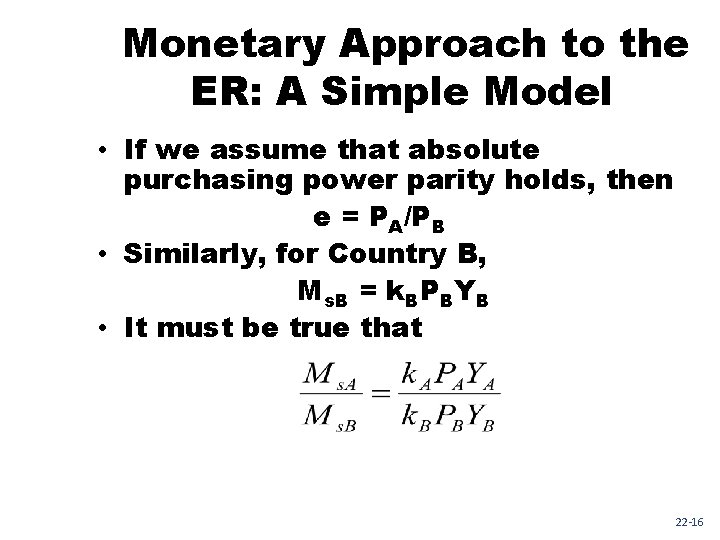
Monetary Approach to the ER: A Simple Model • If we assume that absolute purchasing power parity holds, then e = PA/PB • Similarly, for Country B, Ms. B = k. BPBYB • It must be true that 22 -16
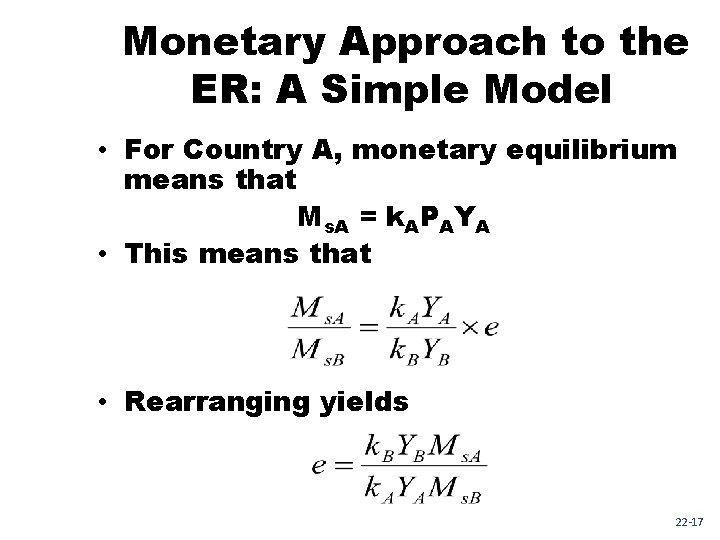
Monetary Approach to the ER: A Simple Model • For Country A, monetary equilibrium means that Ms. A = k. APAYA • This means that • Rearranging yields 22 -17
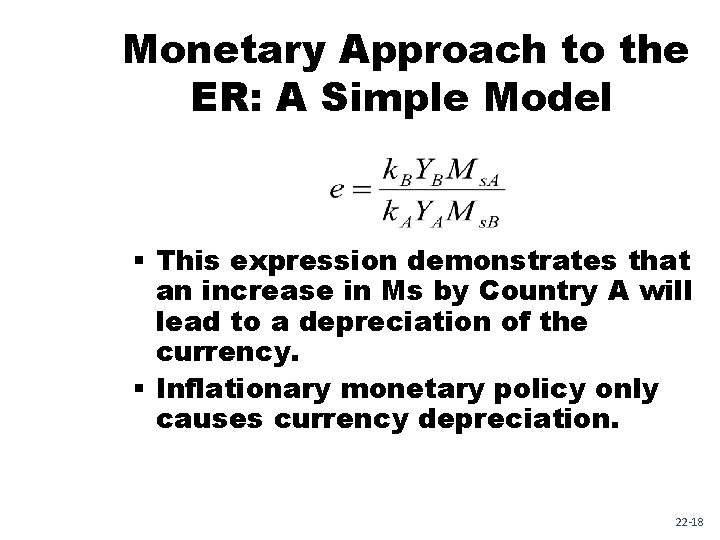
Monetary Approach to the ER: A Simple Model § This expression demonstrates that an increase in Ms by Country A will lead to a depreciation of the currency. § Inflationary monetary policy only causes currency depreciation. 22 -18
Portfolio Balance Approach to the BOP and the Exchange Rate § The approach extends the monetary approach to include other financial assets besides money. § In a two country model there will continue to be demand for money by each country’s citizens. § Now there will also be demand for home-country bonds (Bd) and foreign bonds (Bf). § Bd yields interest return of id; Bf yields a return of if. 22 -19
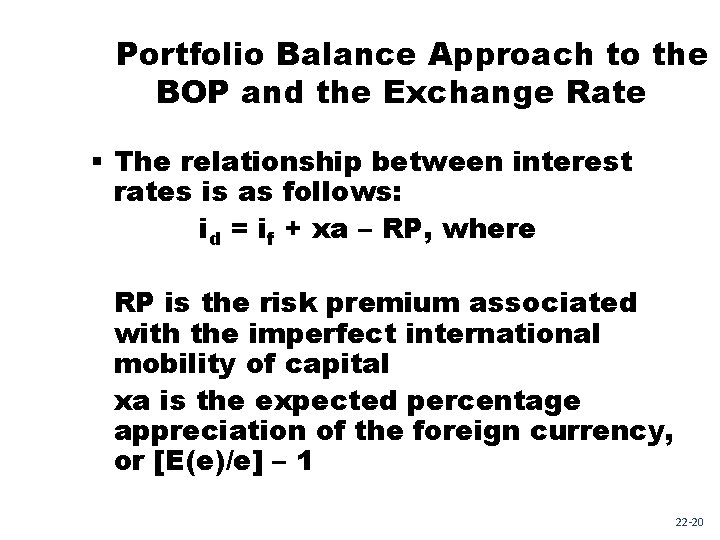
Portfolio Balance Approach to the BOP and the Exchange Rate § The relationship between interest rates is as follows: id = if + xa – RP, where RP is the risk premium associated with the imperfect international mobility of capital xa is the expected percentage appreciation of the foreign currency, or [E(e)/e] – 1 22 -20
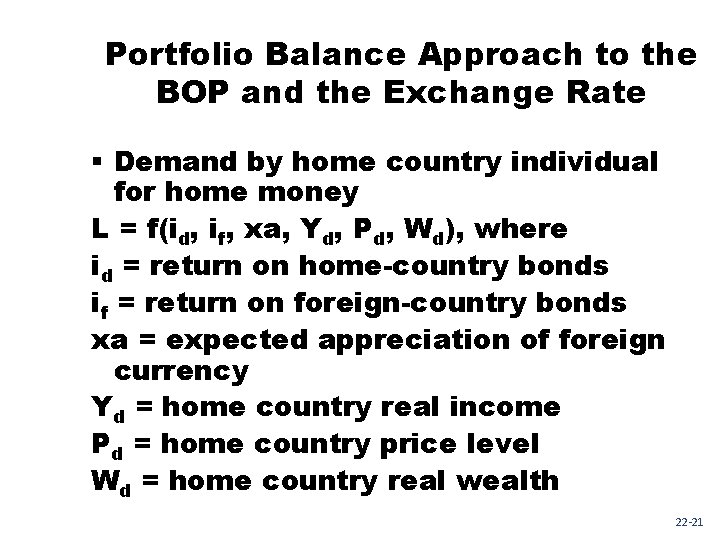
Portfolio Balance Approach to the BOP and the Exchange Rate § Demand by home country individual for home money L = f(id, if, xa, Yd, Pd, Wd), where id = return on home-country bonds if = return on foreign-country bonds xa = expected appreciation of foreign currency Yd = home country real income Pd = home country price level Wd = home country real wealth 22 -21
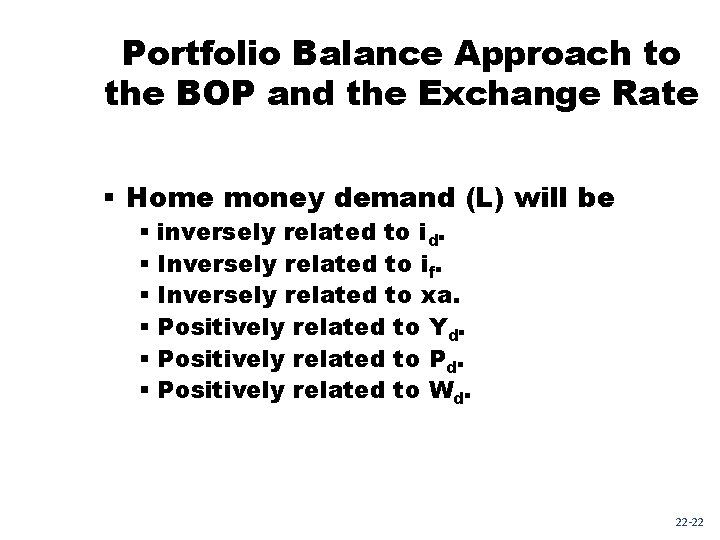
Portfolio Balance Approach to the BOP and the Exchange Rate § Home money demand (L) will be § inversely related to id. § Inversely related to if. § Inversely related to xa. § Positively related to Yd. § Positively related to Pd. § Positively related to Wd. 22 -22
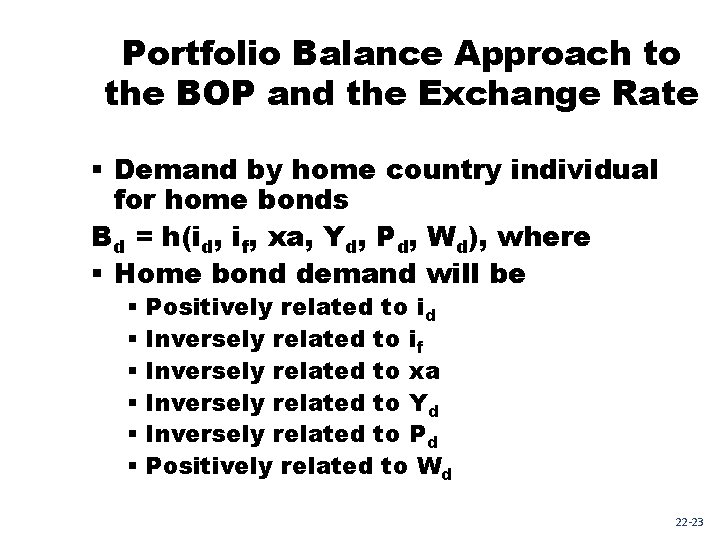
Portfolio Balance Approach to the BOP and the Exchange Rate § Demand by home country individual for home bonds Bd = h(id, if, xa, Yd, Pd, Wd), where § Home bond demand will be § Positively related to id § Inversely related to if § Inversely related to xa § Inversely related to Yd § Inversely related to Pd § Positively related to Wd 22 -23
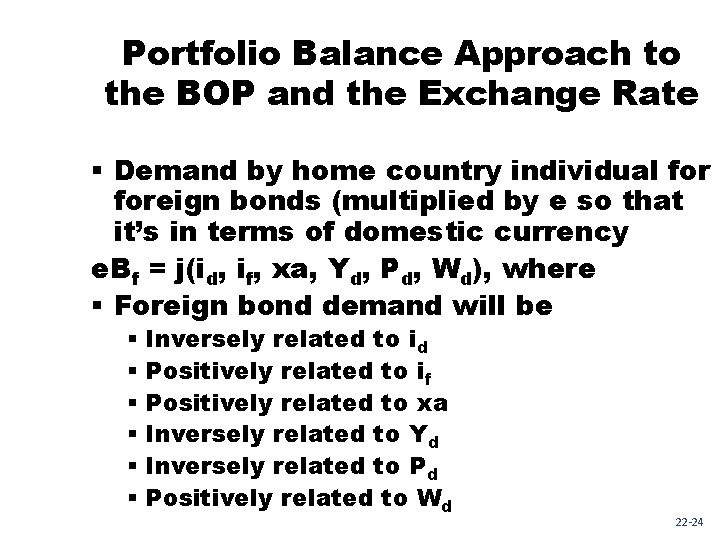
Portfolio Balance Approach to the BOP and the Exchange Rate § Demand by home country individual foreign bonds (multiplied by e so that it’s in terms of domestic currency e. Bf = j(id, if, xa, Yd, Pd, Wd), where § Foreign bond demand will be § Inversely related to id § Positively related to if § Positively related to xa § Inversely related to Yd § Inversely related to Pd § Positively related to Wd 22 -24
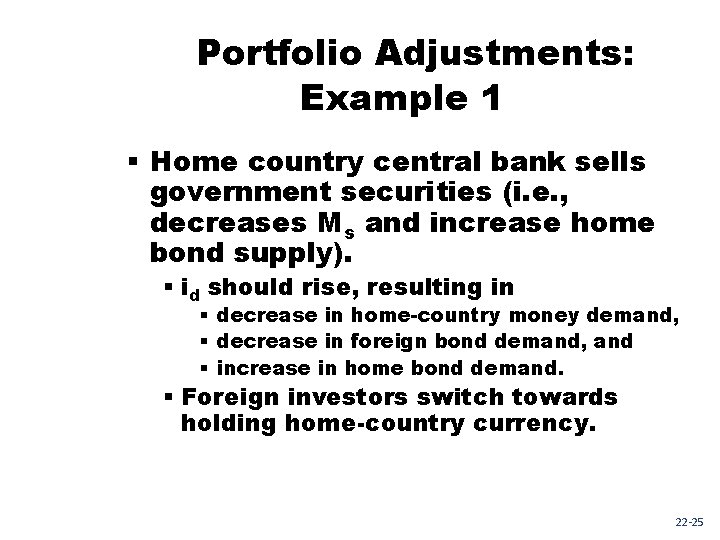
Portfolio Adjustments: Example 1 § Home country central bank sells government securities (i. e. , decreases Ms and increase home bond supply). § id should rise, resulting in § decrease in home-country money demand, § decrease in foreign bond demand, and § increase in home bond demand. § Foreign investors switch towards holding home-country currency. 22 -25
Portfolio Adjustments: Example 1 § Home country central bank sells government securities (i. e. , decreases Ms and increase home bond supply). § if should rise. § The foreign currency depreciates (e falls), assuming flexible exchange rates. § xa rises. § There are therefore second-round effects, continuing until a new portfolio balance is attained. 22 -26
Portfolio Adjustments: Example 2 § Home country individual believe home inflation is likely in the future. § Assume flexible exchange rates, xa should rise (that is, home citizens will expect a depreciation of the home currency), resulting in § decrease in home-country money demand, § decrease in home bond demand, and § increase in foreign bond demand. § The home country currency depreciates. § So: the expectation of a depreciation leads to a depreciation. 22 -27
Portfolio Adjustments: Example 3 § An increase in home country real income, leading to a § increase in home-country money demand. § decrease in home bond demand. § decrease in foreign bond demand. § The home country currency appreciates under a flexible exchange rate system; a BOP surplus occurs under a fixed exchange rate regime. 22 -28
Portfolio Adjustments: Example 4 § An increase in home country bond supply causes § increase in id, which causes a capital inflow and an appreciation of the home country currency. § increase in wealth, which (among other things) causes an increased demand foreign bonds and an depreciation of the home currency. § On net, it is likely that the home currency appreciates. 22 -29
Portfolio Adjustments: Example 5 § An increase in home country wealth because of home-country current account surplus § increase in money demand, leading to an increase in id. § increase in demand foreign bonds and for domestic bonds, both of which lead to a decrease in id. § On net, it is not clear what will happen to the exchange rate. 22 -30
Portfolio Adjustments: Example 6 § An increase in supply of foreign bonds because of foreign government budget deficit § causes an increase in the risk premium, and § an appreciation of the home country currency. 22 -31
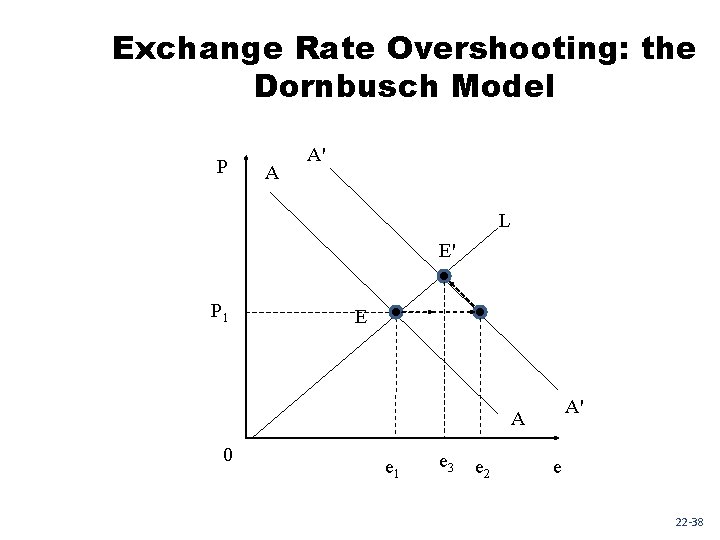
Exchange Rate Overshooting § Exchange rate overshooting occurs when, in moving from one equilibrium to another, the exchange rate goes beyond the new equilibrium before eventually returning to it. § Assume: § Country is small. § Perfect capital mobility exists. § Essentially, uncovered interest parity applies. 22 -32
Exchange Rate Overshooting § The relationship between the price level (P) and the exchange rate (e) should be negative because § a higher price increases demand for money, so id will rise. § The result is an appreciation. 22 -33
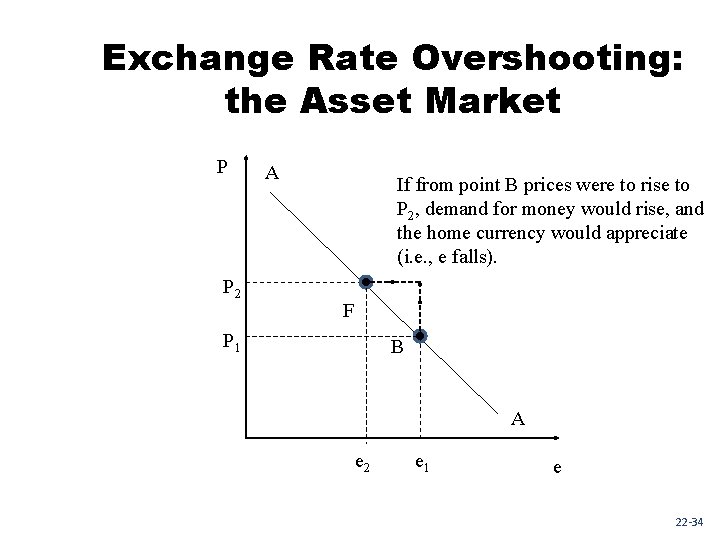
Exchange Rate Overshooting: the Asset Market P P 2 A If from point B prices were to rise to P 2, demand for money would rise, and the home currency would appreciate (i. e. , e falls). F P 1 B A e 2 e 1 e 22 -34
Exchange Rate Overshooting § According to purchasing power parity, in the long run when a country’s currency depreciates its price level will increase proportionately. § That is, there is a long run positive relationship between e and P. § Let’s put this relationship together with the short run asset market relationship in a single graph. 22 -35
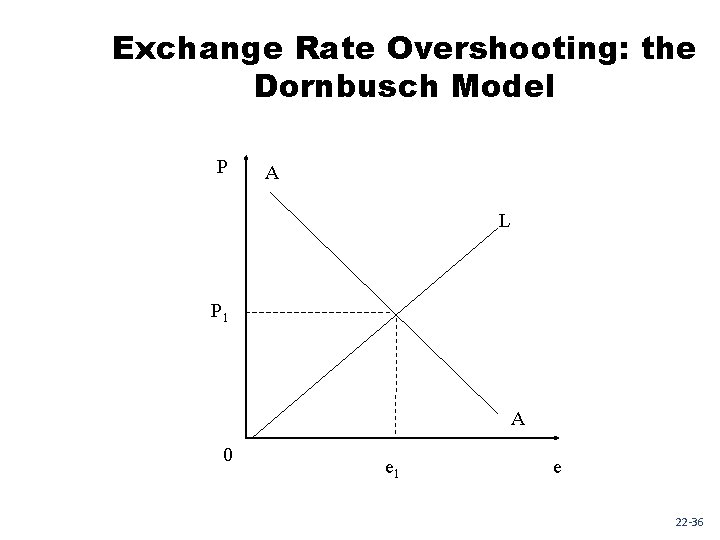
Exchange Rate Overshooting: the Dornbusch Model P A L P 1 A 0 e 1 e 22 -36
Exchange Rate Overshooting § An increase in the money supply shifts the asset curve from AA to A'A' § This causes a relatively rapid depreciation of the home currency, from e 1 to e 2. § Prices eventually will begin to rise due to excess demand for goods caused by the currency depreciation. § Eventually, we reach a new equilibrium at E' 22 -37
Exchange Rate Overshooting: the Dornbusch Model P A A' L E' P 1 E A' A 0 e 1 e 3 e 22 -38
- Slides: 38