
Chapter 22 Sheep Breed Identification and Production Management

Chapter 22 Sheep Breed Identification and Production Management © 2011 Cengage Learning. All Rights Reserved. May not be scanned, copied or duplicated, or posted to a publicly accessible website, in whole or in part.

Veterinary Terminology • Ovine – veterinary term for sheep • Ewe – adult female • Ram – adult male • Lamb – young sheep under a year old © 2011 Cengage Learning. All Rights Reserved. May not be scanned, copied or duplicated, or posted to a publicly accessible website, in whole or in part.

Veterinary Terminology • Lambing – labor process of sheep • Wether – castrated male sheep • Mutton – sheep meat from an animal over a year old © 2011 Cengage Learning. All Rights Reserved. May not be scanned, copied or duplicated, or posted to a publicly accessible website, in whole or in part.
Biology • • • Ruminants Cloven hooves Bovine family Range in size from 100 -225 lbs. Average life span: 7 -13 years Wool may weigh 15 lbs. or more © 2011 Cengage Learning. All Rights Reserved. May not be scanned, copied or duplicated, or posted to a publicly accessible website, in whole or in part.

Breeds • The 6 major sheep breeds are: – – – Dorset Suffolk Hampshire Rambouillet Border Leicester Columbia © 2011 Cengage Learning. All Rights Reserved. May not be scanned, copied or duplicated, or posted to a publicly accessible website, in whole or in part.

Breed Selection • Sheep used for several purposes, mainly for meat and wool products • Lamb – a popular delicate meat • Mutton – a tougher meat • Chammy – by-product of sheep skin used for polishing cars © 2011 Cengage Learning. All Rights Reserved. May not be scanned, copied or duplicated, or posted to a publicly accessible website, in whole or in part.
Nutrition • Carbohydrates and fats for energy – pasture, hay, silage, and grains • Protein – alfalfa, clover, linseed, and peanut oil • Vitamins – A, D, E, K (B is produced by rumen bacteria) • Minerals – salt, phosphorus, calcium, and potassium • Water – one gallon per day per sheep © 2011 Cengage Learning. All Rights Reserved. May not be scanned, copied or duplicated, or posted to a publicly accessible website, in whole or in part.

Behavior • Flock instinct • Several defense mechanisms: – stomping feet – butting heads – moving into the flock © 2011 Cengage Learning. All Rights Reserved. May not be scanned, copied or duplicated, or posted to a publicly accessible website, in whole or in part.
Equipment and Housing Needs • • Barns or sheds open to the south Protection from weather Well-bedded and dry Ventilation Electricity Water Troughs or feeders © 2011 Cengage Learning. All Rights Reserved. May not be scanned, copied or duplicated, or posted to a publicly accessible website, in whole or in part.
Equipment and Housing Needs • Free stalls for does • Loose housing for young • Goats kept inside should be dehorned to prevent injury • Fencing - 60 inches or higher with 4 -5 inches between strands © 2011 Cengage Learning. All Rights Reserved. May not be scanned, copied or duplicated, or posted to a publicly accessible website, in whole or in part.
Restraint and Handling • • Important to stay calm, quiet, and gentle Sheep can be easily injured Wool coat can be easily overheated Capturing a sheep – best done within herd – “Rump” method © 2011 Cengage Learning. All Rights Reserved. May not be scanned, copied or duplicated, or posted to a publicly accessible website, in whole or in part.
Grooming • Most breeds require regular shearing – Carefully done with clippers or shears – Usually done several times a year – Involves electric shears, shearing blades, trimmer disinfectant, shearing tables or chutes, blankets, and hoods © 2011 Cengage Learning. All Rights Reserved. May not be scanned, copied or duplicated, or posted to a publicly accessible website, in whole or in part.

Basic Health Care and Maintenance • Signs of unhealthy sheep: – Poor wool or coat quality, loss of wool, discharge from eyes and nose, pale mucous membranes, anorexia, diarrhea, and standing alone from flock • Important to quarantine new sheep for 30 days • Yearly physical exams; updated vaccines • Dewormers every 3 months © 2011 Cengage Learning. All Rights Reserved. May not be scanned, copied or duplicated, or posted to a publicly accessible website, in whole or in part.

Vaccinations • Programs will vary based on location and veterinarian recommendations • Lambs should begin program between 68 weeks old • Breeding programs may require boosters every 6 months – year or yearly © 2011 Cengage Learning. All Rights Reserved. May not be scanned, copied or duplicated, or posted to a publicly accessible website, in whole or in part.
Breeding and Reproduction • • Ewes reach maturity at 8 -10 months Rams reach maturity at 5 -7 months Breeding begins at 2 -years-old Estrus last 30 hours and cycles every 1617 days • Gestation length: 148 -150 days • Show no signs of heat © 2011 Cengage Learning. All Rights Reserved. May not be scanned, copied or duplicated, or posted to a publicly accessible website, in whole or in part.
Foot Rot • Also called an abscess • Cause – Germ that gets in a scrape or cut – Infection results in lameness, limping • Treatment/Prevention – Trim away decaying area – Apply antiseptic – Keep pen clean and dry © 2011 Cengage Learning. All Rights Reserved. May not be scanned, copied or duplicated, or posted to a publicly accessible website, in whole or in part.
Mastitis • Udder infection • Bacteria enters end of teat • Udder may feel hard and be hard to the touch • Treat with antibiotics and consult a veterinarian © 2011 Cengage Learning. All Rights Reserved. May not be scanned, copied or duplicated, or posted to a publicly accessible website, in whole or in part.
Actinobacillosis • “Lumpy jaw” • Affects the head and jaw • Causes tumor like lumps of yellow pus to build up within jaw • Infection spreads to muscles, organs, and tissues • CANNOT be used for human consumption • Not fatal but can spread to other animals © 2011 Cengage Learning. All Rights Reserved. May not be scanned, copied or duplicated, or posted to a publicly accessible website, in whole or in part.
Actinomycosis • “Wooden tongue” • Lesions on head and swelling at lymph nodes on neck • Hard lesions on tongue • Difficult to eat • Loss of weight • Death • Isolate from herd • Contamination through feed and water © 2011 Cengage Learning. All Rights Reserved. May not be scanned, copied or duplicated, or posted to a publicly accessible website, in whole or in part.
Blue Tongue • • Viral disease spread by gnats Weakens immune system Death due to secondary infection Signs: fever, loss of appetite, sluggish behavior, swelling on mouth and ears, ulcers in mouth, and trouble eating • No treatments • Vaccinate at shearing © 2011 Cengage Learning. All Rights Reserved. May not be scanned, copied or duplicated, or posted to a publicly accessible website, in whole or in part.
Enterotoxemia • Bacterial disease affecting lambs/show animals • Known as “overeating disease” • Affects show animals due to increased gains © 2011 Cengage Learning. All Rights Reserved. May not be scanned, copied or duplicated, or posted to a publicly accessible website, in whole or in part.
Enterotoxemia • Bacteria produce toxins • Death with heads arched due to convulsions • No treatment • Vaccines and good management – 2 and 6 weeks prior to labor © 2011 Cengage Learning. All Rights Reserved. May not be scanned, copied or duplicated, or posted to a publicly accessible website, in whole or in part.
Johne’s Disease • • • Digestive and intestinal condition Intestinal walls thicken Signs: diarrhea, weight loss, or death No treatment Check history before purchase © 2011 Cengage Learning. All Rights Reserved. May not be scanned, copied or duplicated, or posted to a publicly accessible website, in whole or in part.
Soremouth • • • Viral disease Scabs in mouth and lips of lambs Contagious and zoonotic Handle with gloves Healing can be done by removing scabs and rubbing iodine into sores • Vaccinate © 2011 Cengage Learning. All Rights Reserved. May not be scanned, copied or duplicated, or posted to a publicly accessible website, in whole or in part.
Lamb Dysentery • Bacteria that affects lambs at 1 -5 days old • Signs: appetite loss, depression, diarrhea, or sudden death • Spreads rapidly • Sanitation and good management © 2011 Cengage Learning. All Rights Reserved. May not be scanned, copied or duplicated, or posted to a publicly accessible website, in whole or in part.
Polyarthritis • Lambs 3 to 5 -weeks-old • Signs: inactive, weight loss, no weight gain, and reluctant to move • Painful • Treat with tetracycline antibiotics © 2011 Cengage Learning. All Rights Reserved. May not be scanned, copied or duplicated, or posted to a publicly accessible website, in whole or in part.
Common Parasites • Common external parasites: – Lice, mange mites, ear mites, ringworm – All severely affect wool quality of coat • Common internal parasites: – Lungworms, whipworms, tapeworms, coccidian, liver flukes, stomach worms – Treat with topical dips, insecticide sprays, anthelmintics, waste control and removal, and pasture rotations © 2011 Cengage Learning. All Rights Reserved. May not be scanned, copied or duplicated, or posted to a publicly accessible website, in whole or in part.
Sheep Production • Advantages: – – – – Best suited livestock for grazing Excellent scavengers More efficient at converting food to meat Dual purpose breeds (meat and hair) Fast market return Low amount of waste Easy to raise Require minimal space © 2011 Cengage Learning. All Rights Reserved. May not be scanned, copied or duplicated, or posted to a publicly accessible website, in whole or in part.
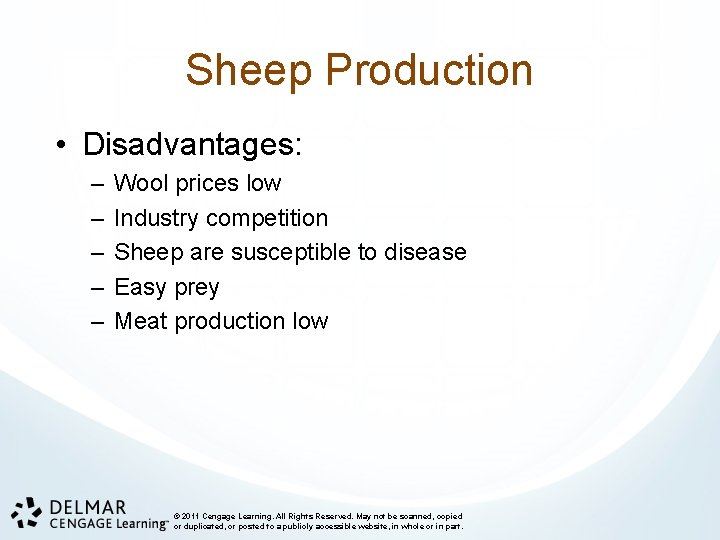
Sheep Production • Disadvantages: – – – Wool prices low Industry competition Sheep are susceptible to disease Easy prey Meat production low © 2011 Cengage Learning. All Rights Reserved. May not be scanned, copied or duplicated, or posted to a publicly accessible website, in whole or in part.
- Slides: 29