
Chapter 22 Metabolic Pathways for Carbohydrates 22 1
Chapter 22 Metabolic Pathways for Carbohydrates 22. 1 Metabolism and Cell Structure 22. 2 ATP and Energy Copyright © 2007 by Pearson Education, Inc. Publishing as Benjamin Cummings 1
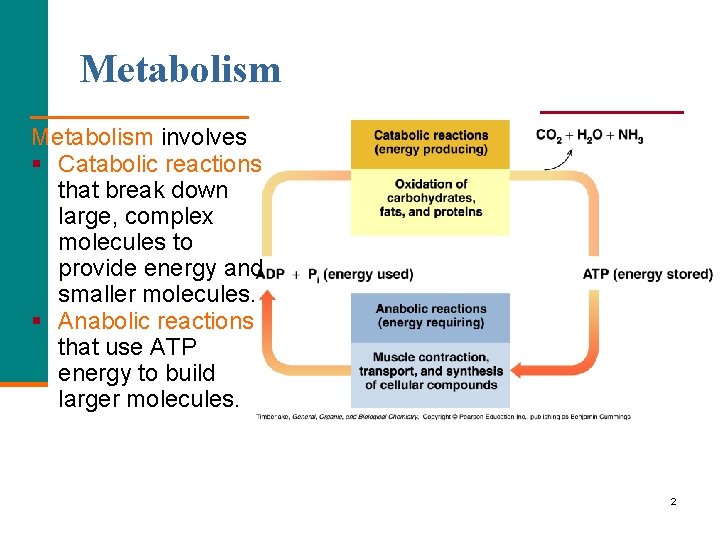
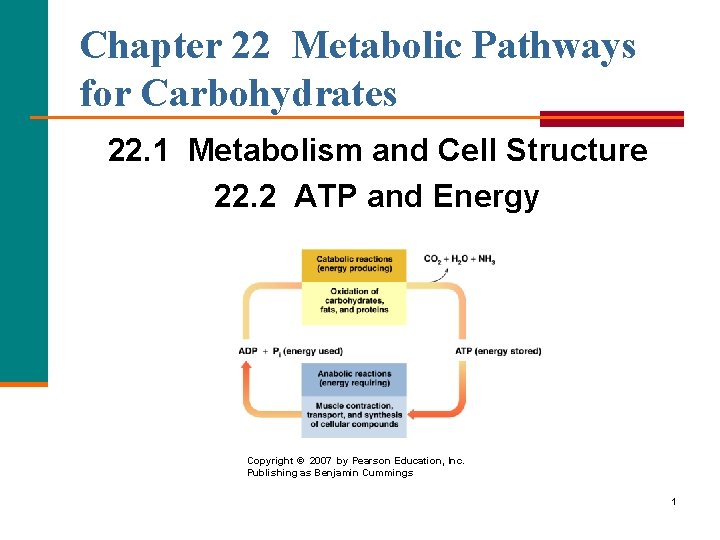
Metabolism involves § Catabolic reactions that break down large, complex molecules to provide energy and smaller molecules. § Anabolic reactions that use ATP energy to build larger molecules. 2
Stages of Metabolism Catabolic reactions are organized as Stage 1: Digestion and hydrolysis break down large molecules to smaller ones that enter the bloodstream. Stage 2: Degradation breaks down molecules to two- and three-carbon compounds. Stage 3: Oxidation of small molecules in the citric acid cycle and electron transport provide ATP energy. 3
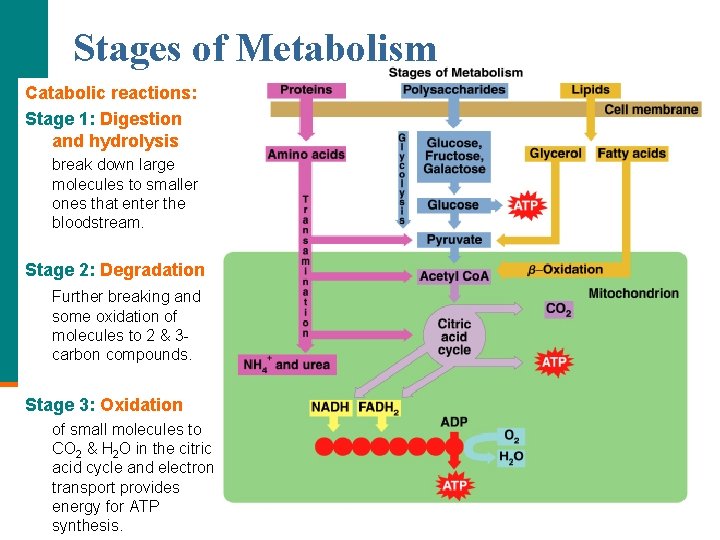
Stages of Metabolism Catabolic reactions: Stage 1: Digestion and hydrolysis break down large molecules to smaller ones that enter the bloodstream. Stage 2: Degradation Further breaking and some oxidation of molecules to 2 & 3 carbon compounds. Stage 3: Oxidation of small molecules to CO 2 & H 2 O in the citric acid cycle and electron transport provides energy for ATP synthesis. 4
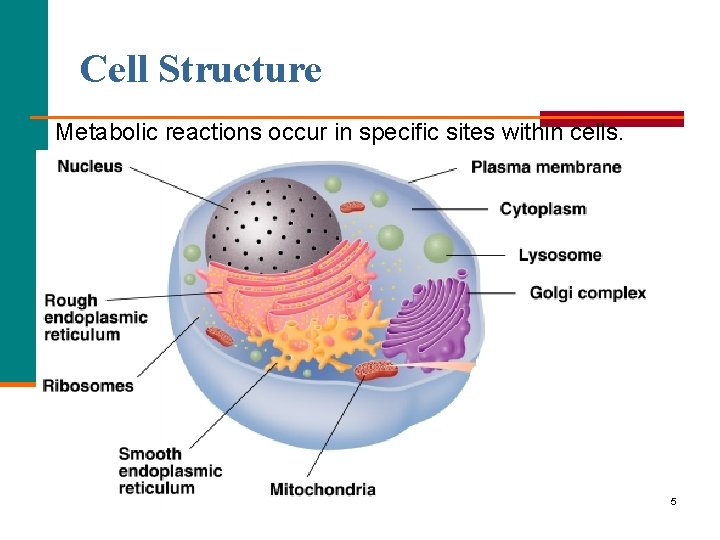
Cell Structure Metabolic reactions occur in specific sites within cells. 5
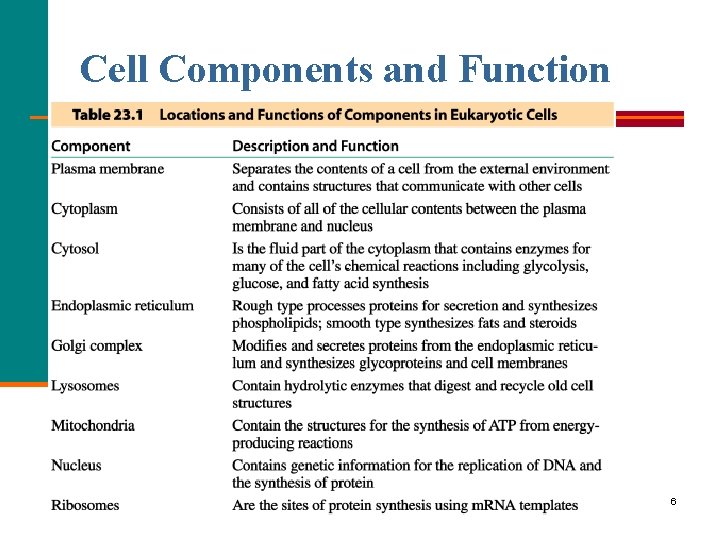
Cell Components and Function 6
ATP and Energy Adenosine triphosphate (ATP) § Is the energy form stored in cells. § Is obtained from the oxidation of food. § Consists of adenine (nitrogen base), a ribose sugar, and three phosphate groups. § Requires 7. 3 (31 k. J) per mole to convert ADP + Pi to ATP. 7
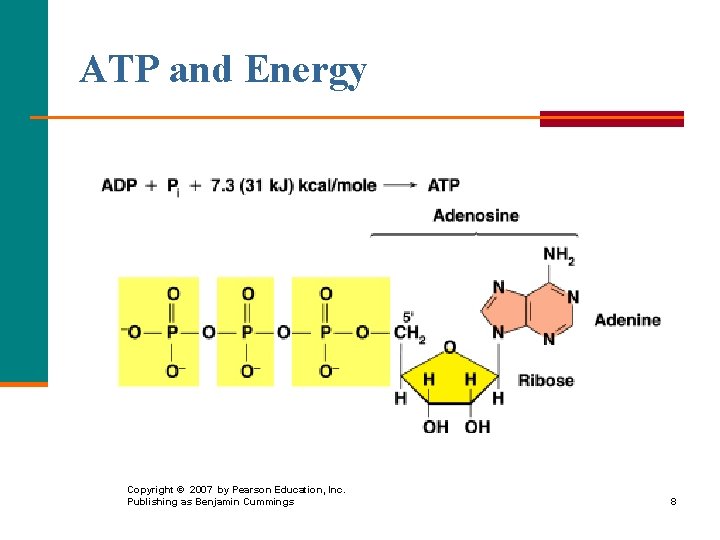
ATP and Energy Copyright © 2007 by Pearson Education, Inc. Publishing as Benjamin Cummings 8
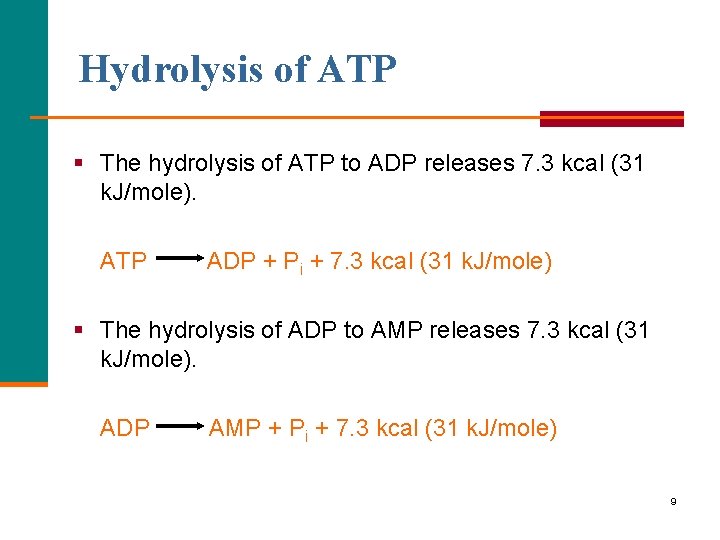
Hydrolysis of ATP § The hydrolysis of ATP to ADP releases 7. 3 kcal (31 k. J/mole). ATP ADP + Pi + 7. 3 kcal (31 k. J/mole) § The hydrolysis of ADP to AMP releases 7. 3 kcal (31 k. J/mole). ADP AMP + Pi + 7. 3 kcal (31 k. J/mole) 9
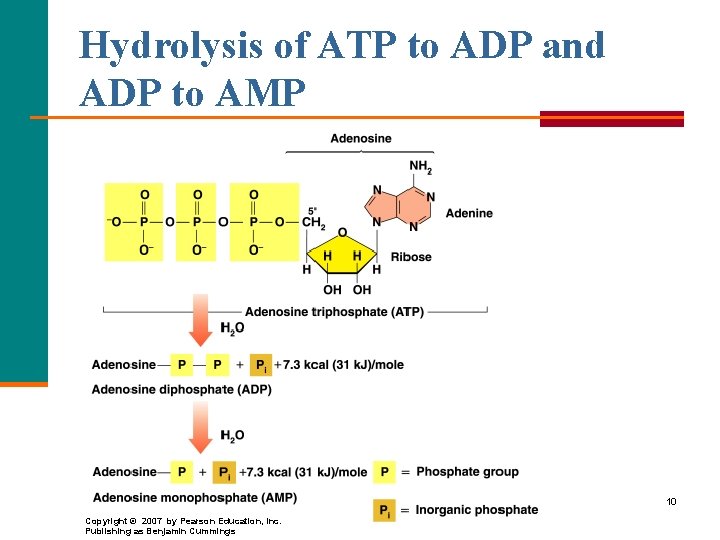
Hydrolysis of ATP to ADP and ADP to AMP 10 Copyright © 2007 by Pearson Education, Inc. Publishing as Benjamin Cummings
ATP and Muscle Contraction Muscle fibers § Contain the protein fibers actin and myosin. § Contract (slide closer together) when a nerve impulse increases Ca 2+. § Obtain the energy for contraction from the hydrolysis of ATP. § Return to the relaxed position as Ca 2+ and ATP decrease. 11
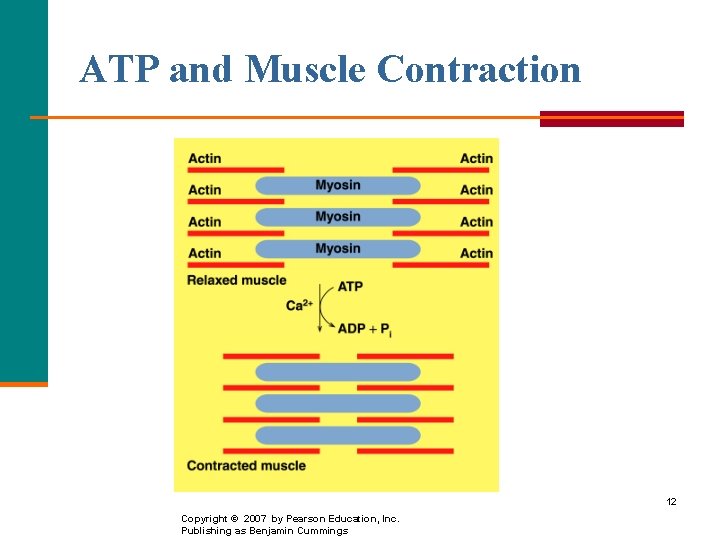
ATP and Muscle Contraction 12 Copyright © 2007 by Pearson Education, Inc. Publishing as Benjamin Cummings
Learning Check Match the following: 1) ATP 2) ADP + Pi A. B. C. D. Used in anabolic reactions. The energy-storage molecule. Coupled with energy-requiring reactions. Hydrolysis products. 13
Solution Match the following: 1) ATP 2) ADP + Pi A. B. C. D. 1 1 1 2 Used in anabolic reactions The energy-storage molecule. Coupled with energy-requiring reactions. Hydrolysis products. 14
Chapter 22 Metabolic Pathways for Carbohydrates 22. 3 Important Coenzymes in Metabolic Pathways Copyright © 2007 by Pearson Education, Inc. Publishing as Benjamin Cummings 15
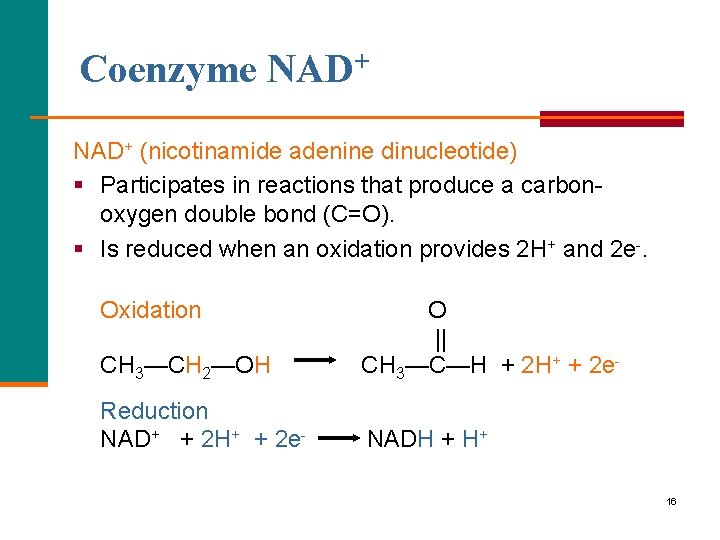
Coenzyme NAD+ (nicotinamide adenine dinucleotide) § Participates in reactions that produce a carbonoxygen double bond (C=O). § Is reduced when an oxidation provides 2 H+ and 2 e-. Oxidation CH 3—CH 2—OH O || CH 3—C—H + 2 H+ + 2 e- Reduction NAD+ + 2 H+ + 2 e- NADH + H+ 16
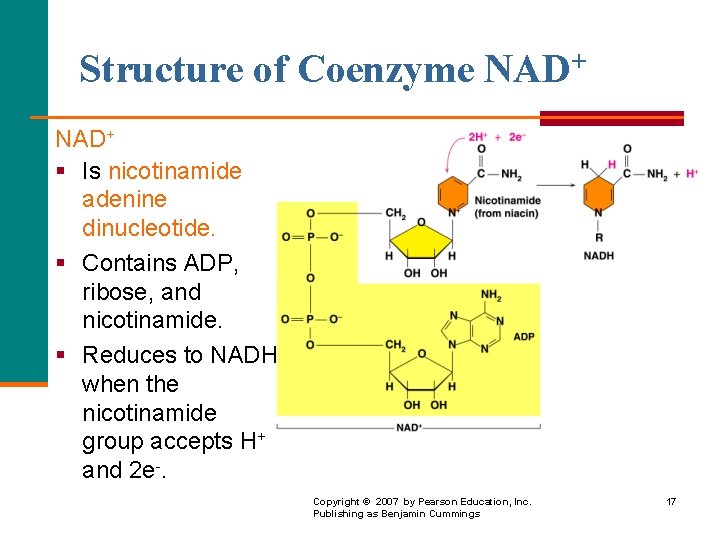
Structure of Coenzyme NAD+ § Is nicotinamide adenine dinucleotide. § Contains ADP, ribose, and nicotinamide. § Reduces to NADH when the nicotinamide group accepts H+ and 2 e-. Copyright © 2007 by Pearson Education, Inc. Publishing as Benjamin Cummings 17
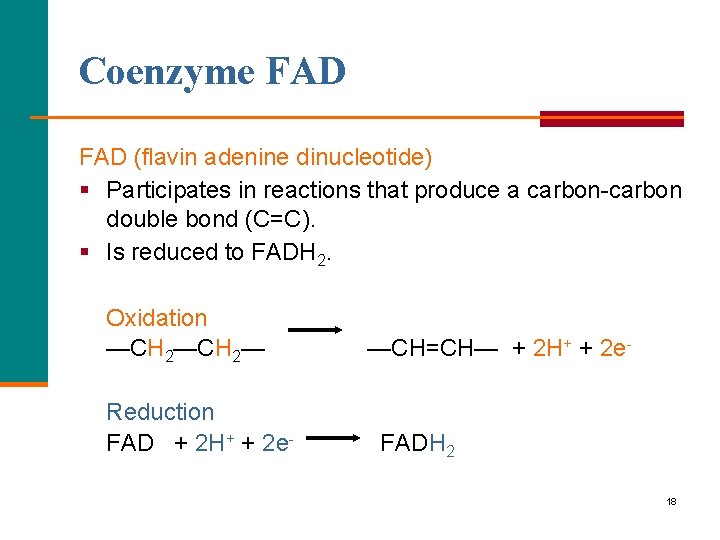
Coenzyme FAD (flavin adenine dinucleotide) § Participates in reactions that produce a carbon-carbon double bond (C=C). § Is reduced to FADH 2. Oxidation —CH 2— Reduction FAD + 2 H+ + 2 e- —CH=CH— + 2 H+ + 2 e- FADH 2 18
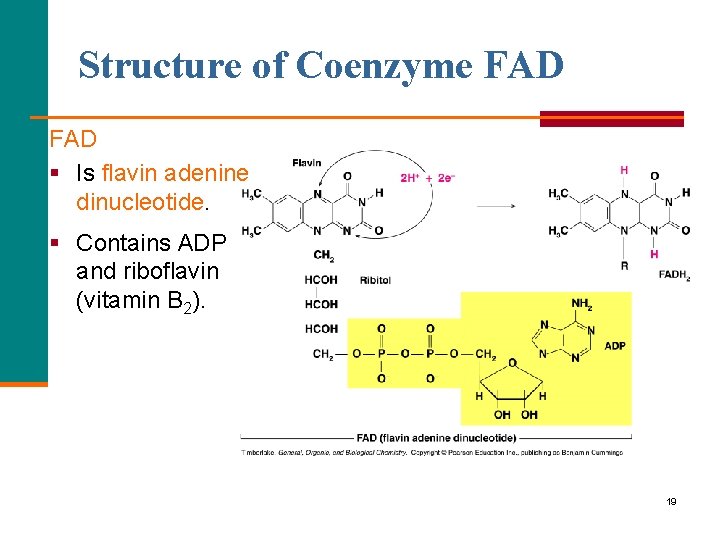
Structure of Coenzyme FAD § Is flavin adenine dinucleotide. § Contains ADP and riboflavin (vitamin B 2). 19

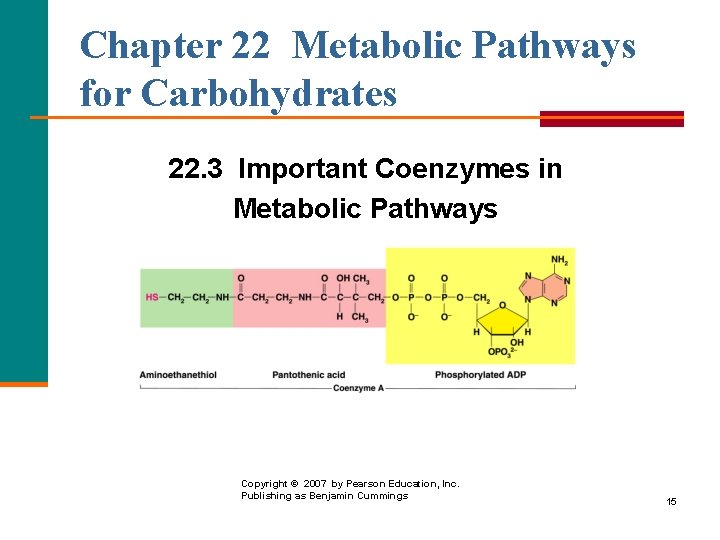
Coenzyme A. § Consists of vitamins B 3, pantothenic acid, and ADP. § Activates acyl groups such as the two-carbon acetyl group for transfer. O || CH 3—C— + HS—Co. A acetyl group O || CH 3—C—S—Co. A acetyl Co. A 20
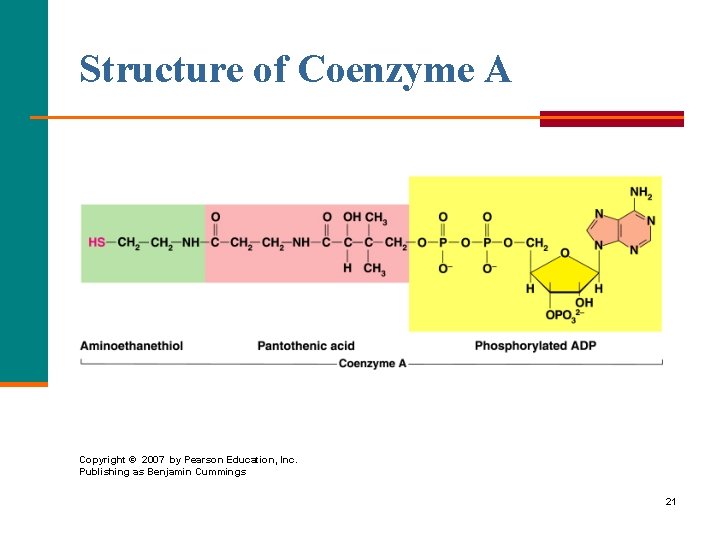
Structure of Coenzyme A Copyright © 2007 by Pearson Education, Inc. Publishing as Benjamin Cummings 21
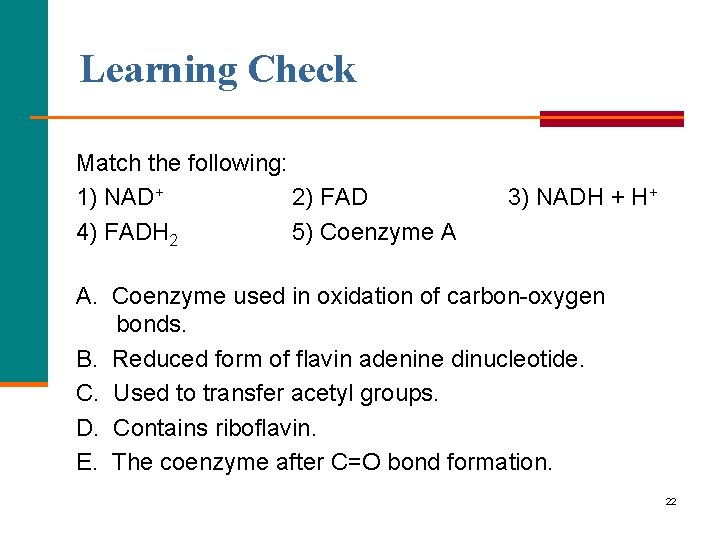
Learning Check Match the following: 1) NAD+ 2) FAD 4) FADH 2 5) Coenzyme A 3) NADH + H+ A. Coenzyme used in oxidation of carbon-oxygen bonds. B. Reduced form of flavin adenine dinucleotide. C. Used to transfer acetyl groups. D. Contains riboflavin. E. The coenzyme after C=O bond formation. 22
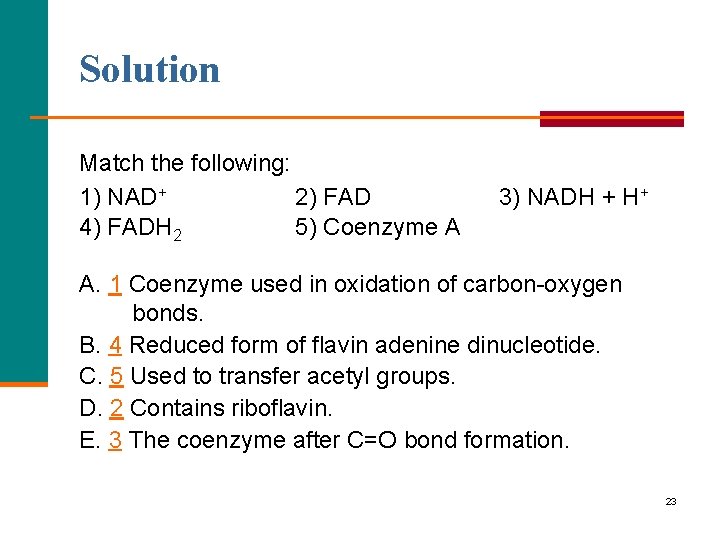
Solution Match the following: 1) NAD+ 2) FAD 4) FADH 2 5) Coenzyme A 3) NADH + H+ A. 1 Coenzyme used in oxidation of carbon-oxygen bonds. B. 4 Reduced form of flavin adenine dinucleotide. C. 5 Used to transfer acetyl groups. D. 2 Contains riboflavin. E. 3 The coenzyme after C=O bond formation. 23
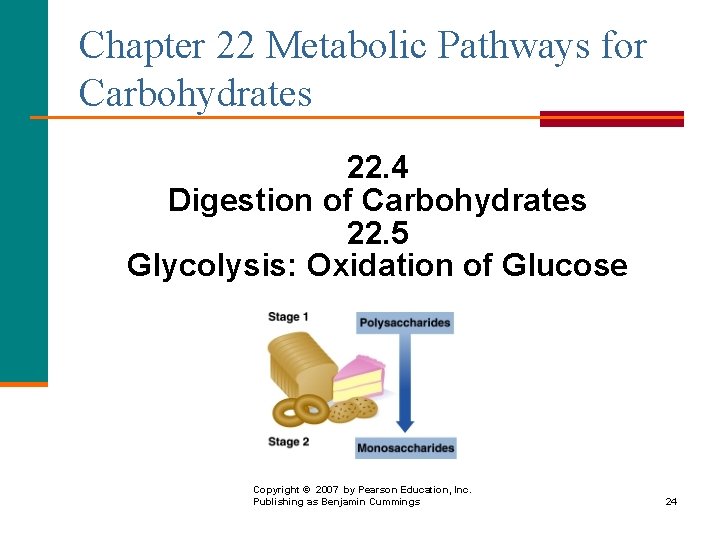
Chapter 22 Metabolic Pathways for Carbohydrates 22. 4 Digestion of Carbohydrates 22. 5 Glycolysis: Oxidation of Glucose Copyright © 2007 by Pearson Education, Inc. Publishing as Benjamin Cummings 24
Stage 1: Digestion of Carbohydrates In Stage 1, the digestion of carbohydrates § Begins in the mouth where salivary amylase breaks down polysaccharides to smaller polysaccharides (dextrins), maltose, and some glucose. § Continues in the small intestine where pancreatic amylase hydrolyzes dextrins to maltose and glucose. § Hydrolyzes maltose, lactose, and sucrose to monosaccharides, mostly glucose, which enter the bloodstream for transport to the cells. 25
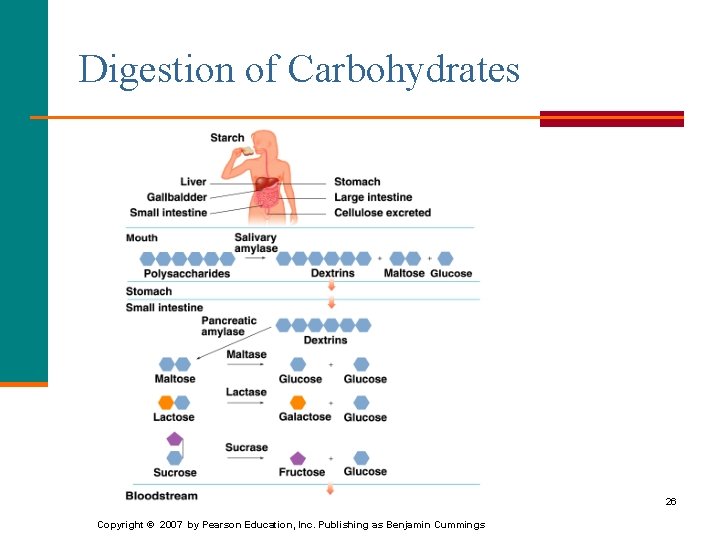
Digestion of Carbohydrates 26 Copyright © 2007 by Pearson Education, Inc. Publishing as Benjamin Cummings
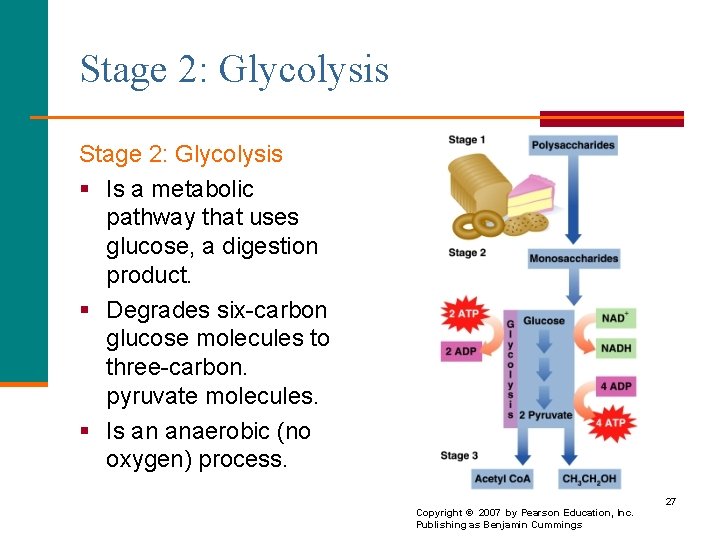
Stage 2: Glycolysis § Is a metabolic pathway that uses glucose, a digestion product. § Degrades six-carbon glucose molecules to three-carbon. pyruvate molecules. § Is an anaerobic (no oxygen) process. Copyright © 2007 by Pearson Education, Inc. Publishing as Benjamin Cummings 27
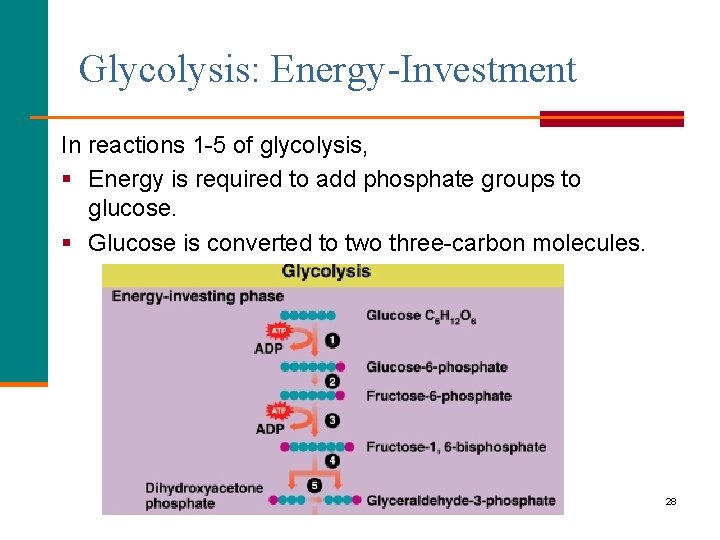
Glycolysis: Energy-Investment In reactions 1 -5 of glycolysis, § Energy is required to add phosphate groups to glucose. § Glucose is converted to two three-carbon molecules. 28
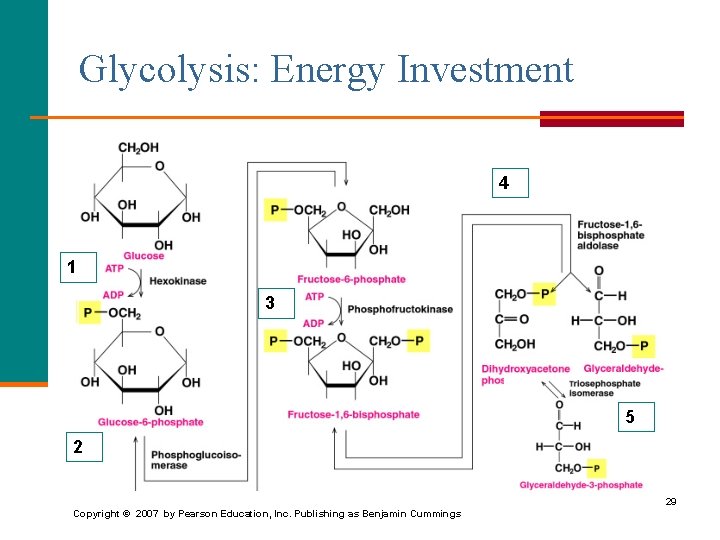
Glycolysis: Energy Investment 4 1 3 5 5 2 29 Copyright © 2007 by Pearson Education, Inc. Publishing as Benjamin Cummings
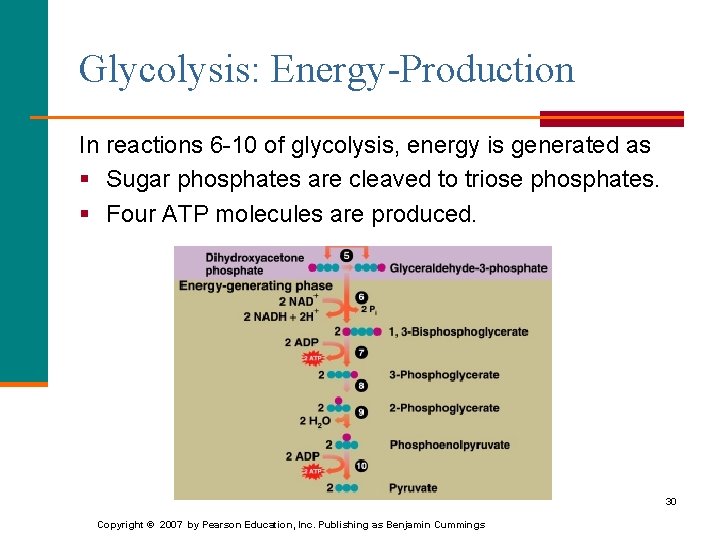
Glycolysis: Energy-Production In reactions 6 -10 of glycolysis, energy is generated as § Sugar phosphates are cleaved to triose phosphates. § Four ATP molecules are produced. 30 Copyright © 2007 by Pearson Education, Inc. Publishing as Benjamin Cummings
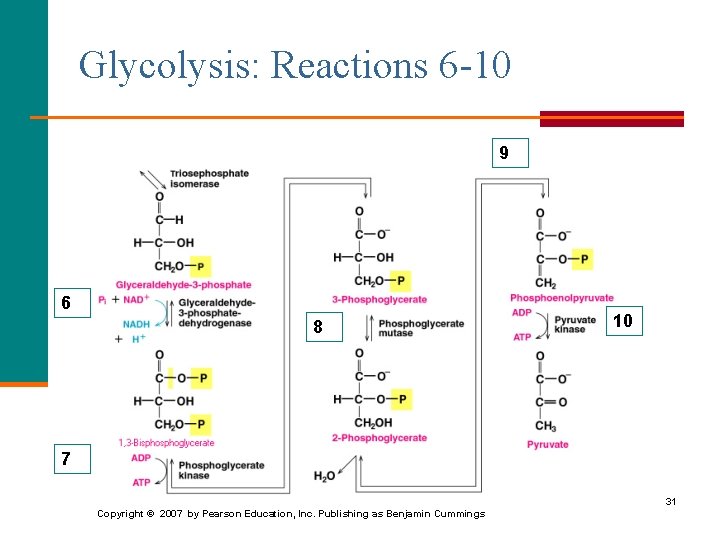
Glycolysis: Reactions 6 -10 9 6 8 10 7 31 Copyright © 2007 by Pearson Education, Inc. Publishing as Benjamin Cummings
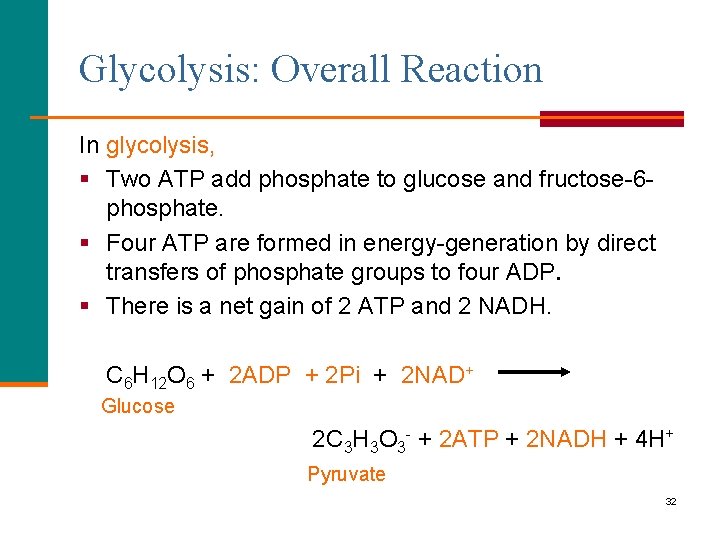
Glycolysis: Overall Reaction In glycolysis, § Two ATP add phosphate to glucose and fructose-6 phosphate. § Four ATP are formed in energy-generation by direct transfers of phosphate groups to four ADP. § There is a net gain of 2 ATP and 2 NADH. C 6 H 12 O 6 + 2 ADP + 2 Pi + 2 NAD+ Glucose 2 C 3 H 3 O 3 - + 2 ATP + 2 NADH + 4 H+ Pyruvate 32
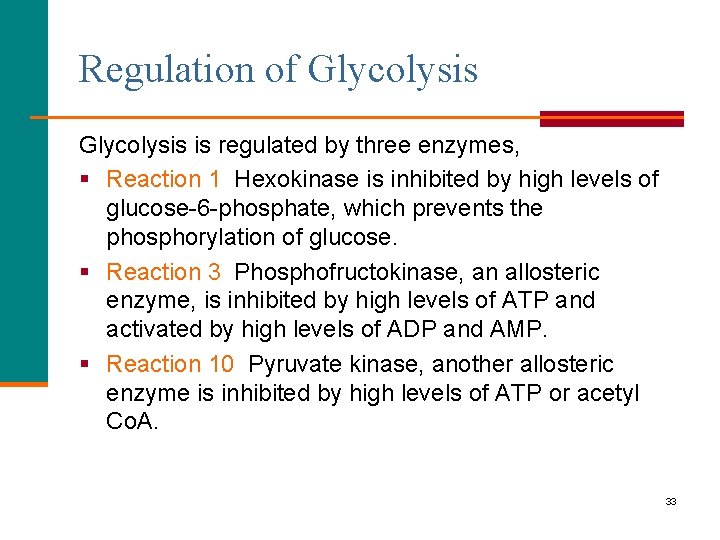
Regulation of Glycolysis is regulated by three enzymes, § Reaction 1 Hexokinase is inhibited by high levels of glucose-6 -phosphate, which prevents the phosphorylation of glucose. § Reaction 3 Phosphofructokinase, an allosteric enzyme, is inhibited by high levels of ATP and activated by high levels of ADP and AMP. § Reaction 10 Pyruvate kinase, another allosteric enzyme is inhibited by high levels of ATP or acetyl Co. A. 33
Learning Check In glycolysis, what compounds provide phosphate groups for the production of ATP? 34
Solution In glycolysis, what compounds provide phosphate groups for the production of ATP? In reaction 7, phosphate groups from two 1, 3 -bisphoglycerate molecules are transferred to ADP to form two ATP. In reaction 10, phosphate groups from two phosphoenolpyruvate molecules are used to form two more ATP. 35
Chapter 22 Metabolic Pathways for Carbohydrates 22. 6 Pathways for Pyruvate Copyright © 2007 by Pearson Education, Inc. Publishing as Benjamin Cummings 36
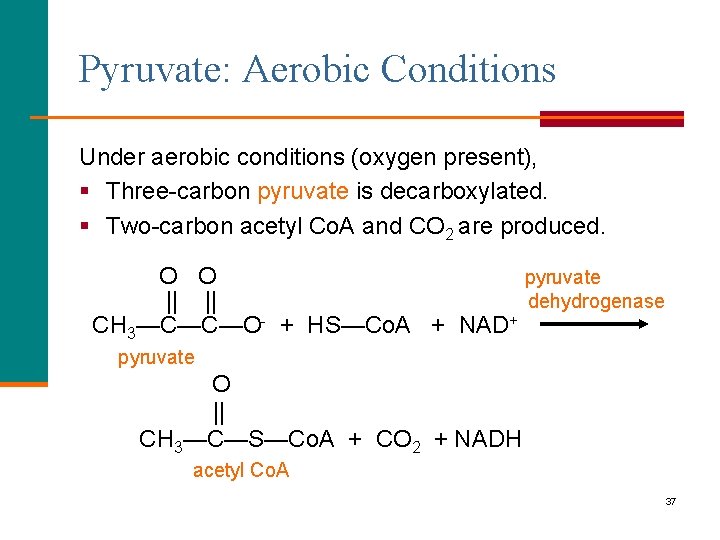
Pyruvate: Aerobic Conditions Under aerobic conditions (oxygen present), § Three-carbon pyruvate is decarboxylated. § Two-carbon acetyl Co. A and CO 2 are produced. O O pyruvate || || dehydrogenase CH 3—C—C—O- + HS—Co. A + NAD+ pyruvate O || CH 3—C—S—Co. A + CO 2 + NADH acetyl Co. A 37
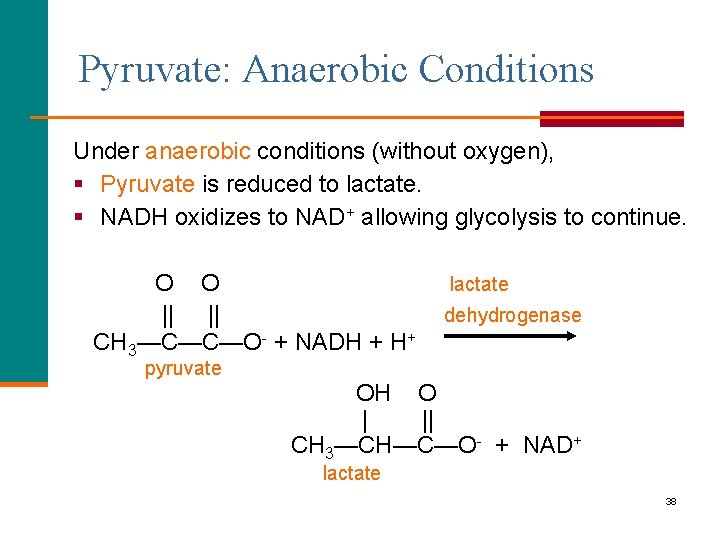
Pyruvate: Anaerobic Conditions Under anaerobic conditions (without oxygen), § Pyruvate is reduced to lactate. § NADH oxidizes to NAD+ allowing glycolysis to continue. O O || || CH 3—C—C—O- + NADH + H+ pyruvate lactate dehydrogenase OH O | || CH 3—CH—C—O- + NAD+ lactate 38
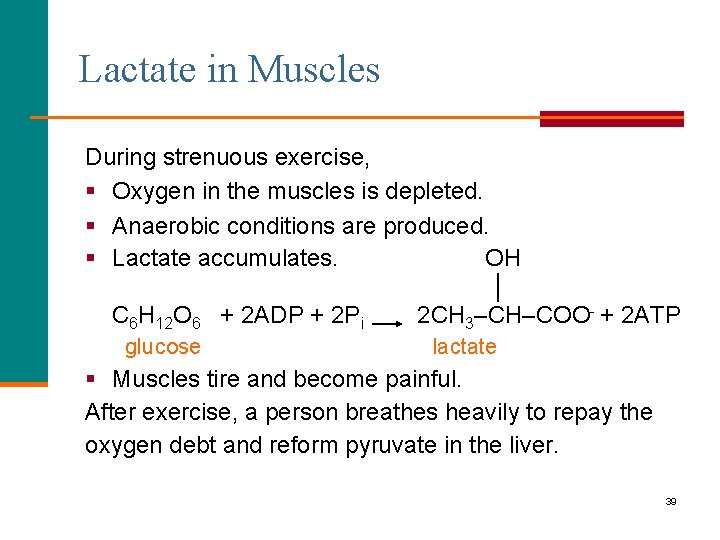
Lactate in Muscles During strenuous exercise, § Oxygen in the muscles is depleted. § Anaerobic conditions are produced. § Lactate accumulates. OH │ C 6 H 12 O 6 + 2 ADP + 2 Pi 2 CH 3–CH–COO- + 2 ATP glucose lactate § Muscles tire and become painful. After exercise, a person breathes heavily to repay the oxygen debt and reform pyruvate in the liver. 39
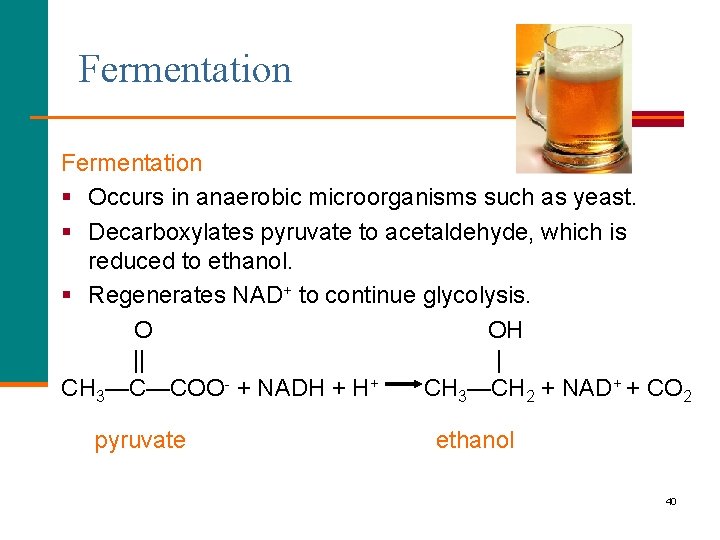
Fermentation § Occurs in anaerobic microorganisms such as yeast. § Decarboxylates pyruvate to acetaldehyde, which is reduced to ethanol. § Regenerates NAD+ to continue glycolysis. O OH || | CH 3—C—COO- + NADH + H+ CH 3—CH 2 + NAD+ + CO 2 pyruvate ethanol 40
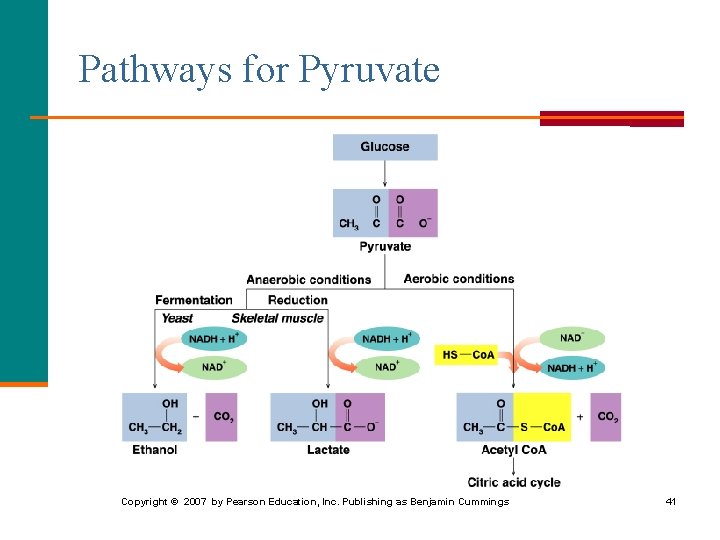
Pathways for Pyruvate Copyright © 2007 by Pearson Education, Inc. Publishing as Benjamin Cummings 41
Learning Check Match the following terms with the descriptions 1) Catabolic reactions 2) Coenzymes 3) Glycolysis 4) Lactate A. Produced during anaerobic conditions. B. Reaction series that converts glucose to pyruvate. C. Metabolic reactions that break down large molecules to smaller molecules + energy. D. Substances that remove or add H atoms in oxidation and reduction reactions. 42
Solution Match the following terms with the descriptions: 1) Catabolic reactions 2) Coenzymes 3) Glycolysis 4) Lactate A. 4 Produced during anaerobic conditions. B. 3 Reaction series that converts glucose to pyruvate. C. 1 Metabolic reactions that break down large molecules to smaller molecules + energy. D. 2 Substances that remove or add H atoms in oxidation and reduction reactions. 43
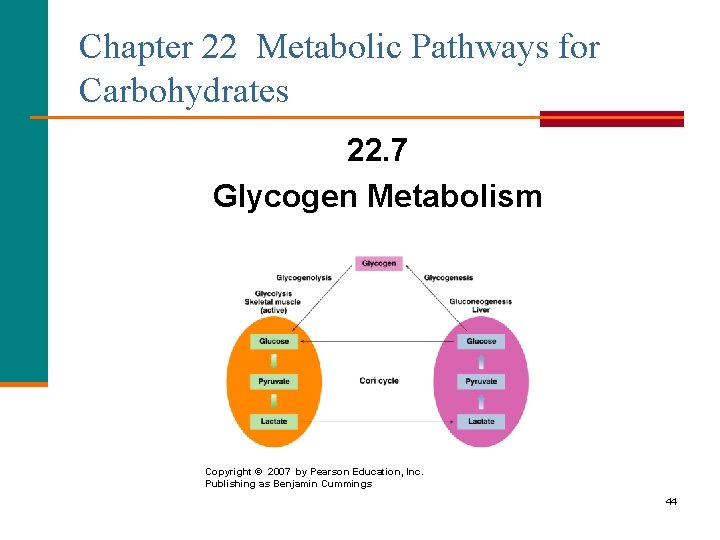
Chapter 22 Metabolic Pathways for Carbohydrates 22. 7 Glycogen Metabolism Copyright © 2007 by Pearson Education, Inc. Publishing as Benjamin Cummings 44
Glycogenesis § Stores glucose by converting glucose to glycogen. § Operates when high levels of glucose-6 -phosphate are formed in the first reaction of glycolysis. § Does not operate when energy stores (glycogen) are full, which means that additional glucose is converted to body fat. 45
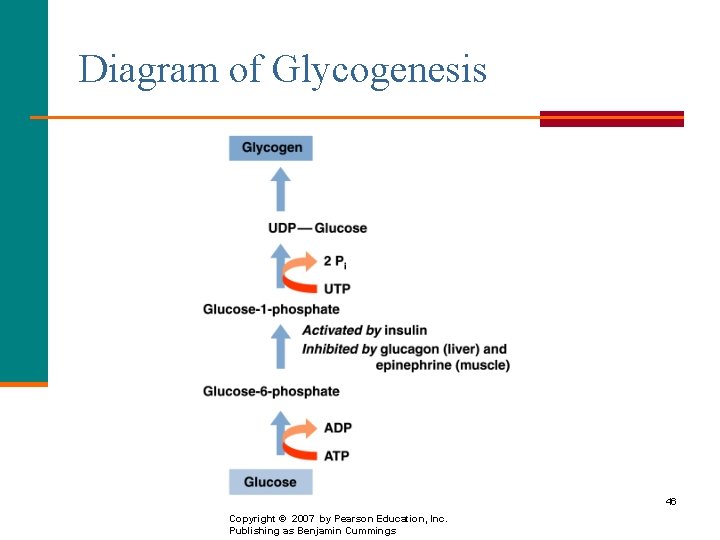
Diagram of Glycogenesis 46 Copyright © 2007 by Pearson Education, Inc. Publishing as Benjamin Cummings
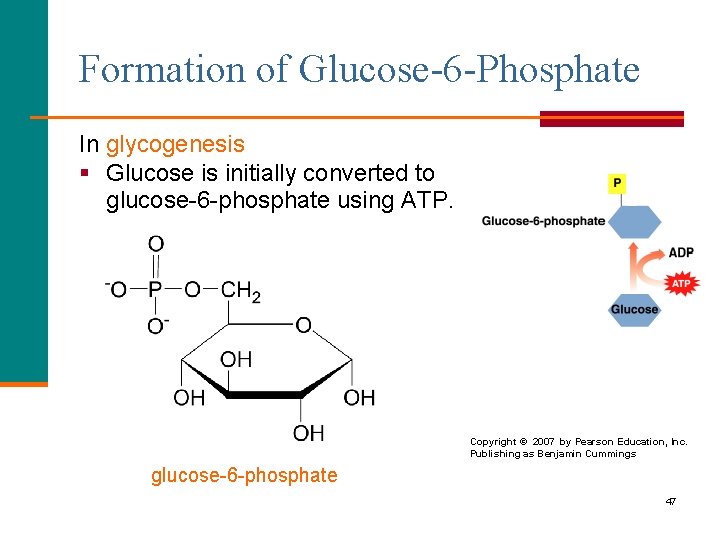
Formation of Glucose-6 -Phosphate In glycogenesis § Glucose is initially converted to glucose-6 -phosphate using ATP. Copyright © 2007 by Pearson Education, Inc. Publishing as Benjamin Cummings glucose-6 -phosphate 47
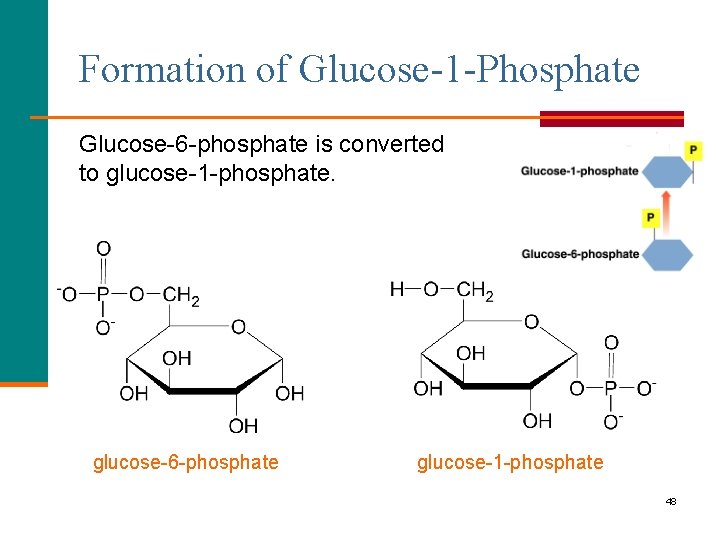
Formation of Glucose-1 -Phosphate Glucose-6 -phosphate is converted to glucose-1 -phosphate. glucose-6 -phosphate glucose-1 -phosphate 48
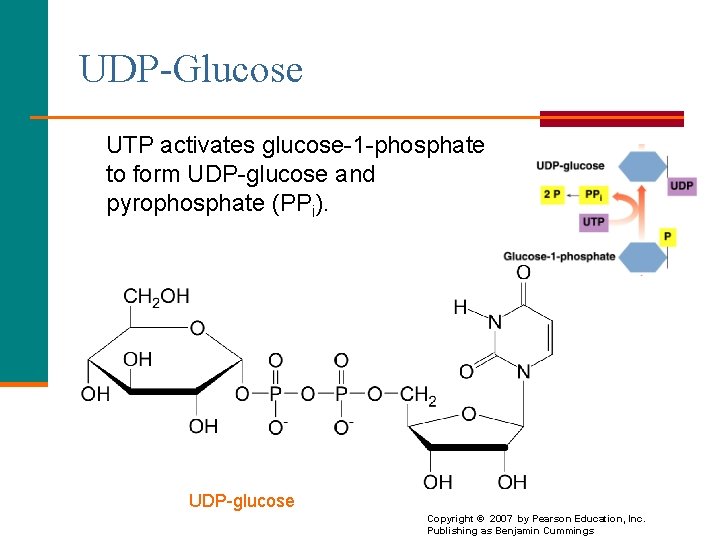
UDP-Glucose UTP activates glucose-1 -phosphate to form UDP-glucose and pyrophosphate (PPi). UDP-glucose 49 Copyright © 2007 by Pearson Education, Inc. Publishing as Benjamin Cummings
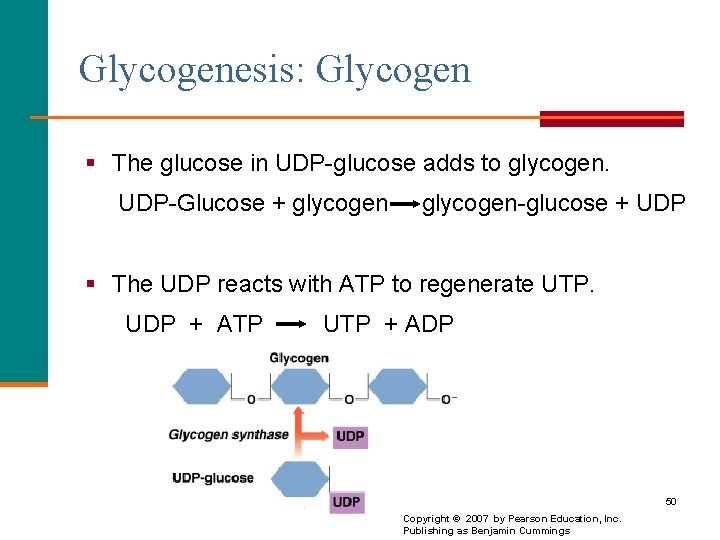
Glycogenesis: Glycogen § The glucose in UDP-glucose adds to glycogen. UDP-Glucose + glycogen-glucose + UDP § The UDP reacts with ATP to regenerate UTP. UDP + ATP UTP + ADP 50 Copyright © 2007 by Pearson Education, Inc. Publishing as Benjamin Cummings
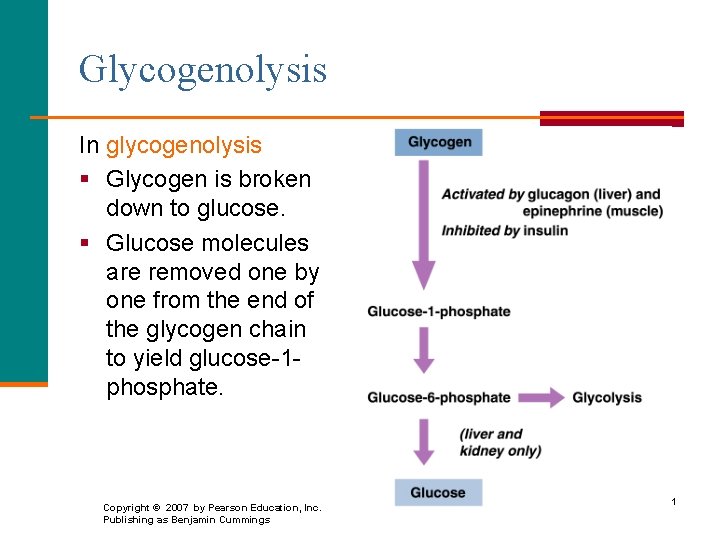
Glycogenolysis In glycogenolysis § Glycogen is broken down to glucose. § Glucose molecules are removed one by one from the end of the glycogen chain to yield glucose-1 phosphate. Copyright © 2007 by Pearson Education, Inc. Publishing as Benjamin Cummings 51
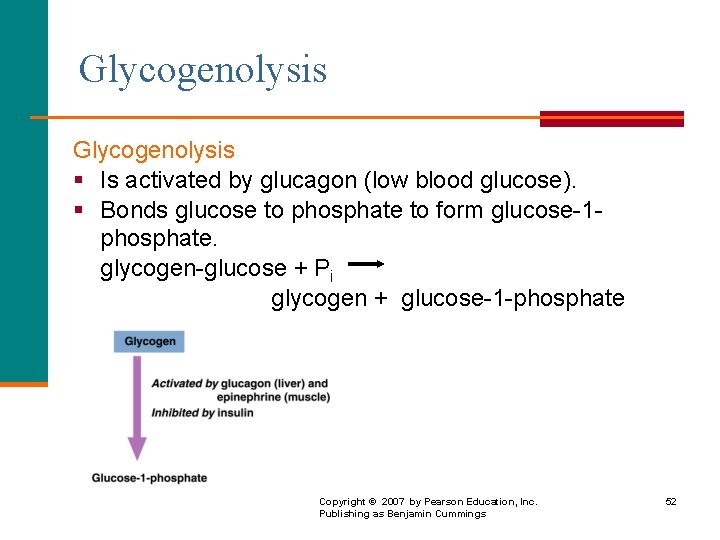
Glycogenolysis § Is activated by glucagon (low blood glucose). § Bonds glucose to phosphate to form glucose-1 phosphate. glycogen-glucose + Pi glycogen + glucose-1 -phosphate Copyright © 2007 by Pearson Education, Inc. Publishing as Benjamin Cummings 52
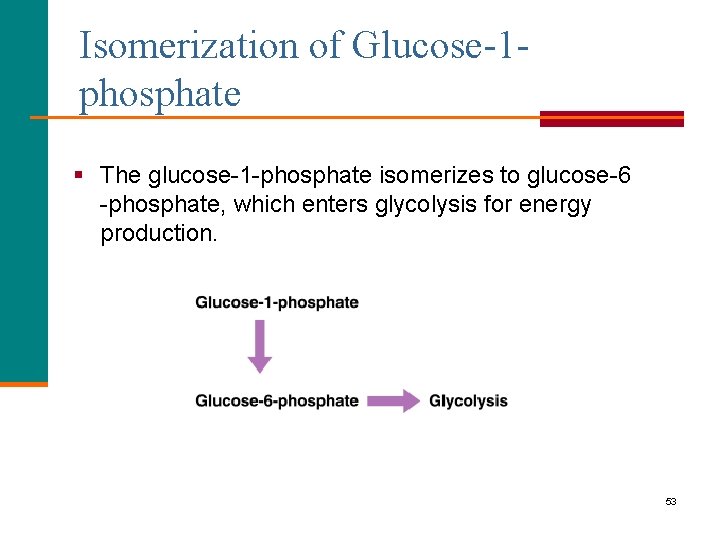
Isomerization of Glucose-1 phosphate § The glucose-1 -phosphate isomerizes to glucose-6 -phosphate, which enters glycolysis for energy production. 53
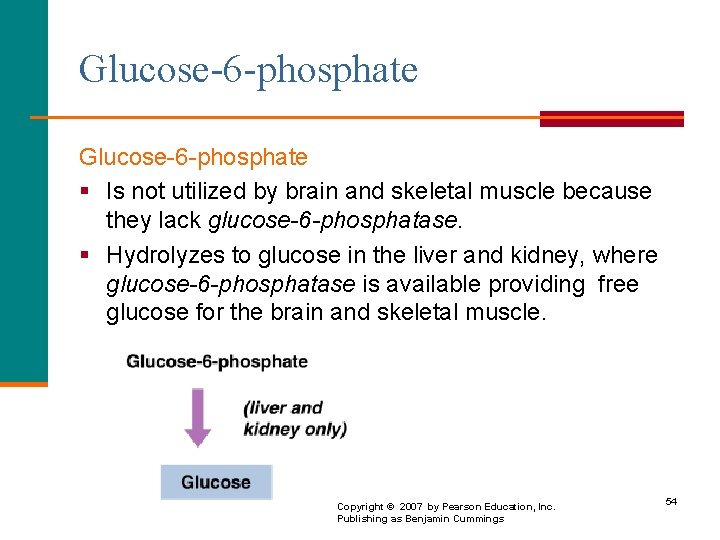
Glucose-6 -phosphate § Is not utilized by brain and skeletal muscle because they lack glucose-6 -phosphatase. § Hydrolyzes to glucose in the liver and kidney, where glucose-6 -phosphatase is available providing free glucose for the brain and skeletal muscle. Copyright © 2007 by Pearson Education, Inc. Publishing as Benjamin Cummings 54
Learning Check Match each description with 1) Glycogenesis 2) Glycogenolysis A. Activated by low levels of blood glucose. B. Converts glucose-1 -phosphate to glucose-6 phosphate. C. Activated by high levels of glucose-6 -phosphate. D. Glucose + UTP UDP-glucose + PPi 55
Solution Match each description with: 1) Glycogenesis 2) Glycogenolysis A. 2 Activated by low levels of blood glucose. B. 2 Converts glucose-1 -phosphate to glucose-6 phosphate. C. 1 Activated by high levels of glucose-6 -phosphate. D. 1 Glucose + UTP UDP-glucose + PPi 56
Chapter 22 Metabolic Pathways for Carbohydrates 22. 8 Gluconeogenesis: Glucose Synthesis Copyright © 2007 by Pearson Education, Inc. Publishing as Benjamin Cummings 57
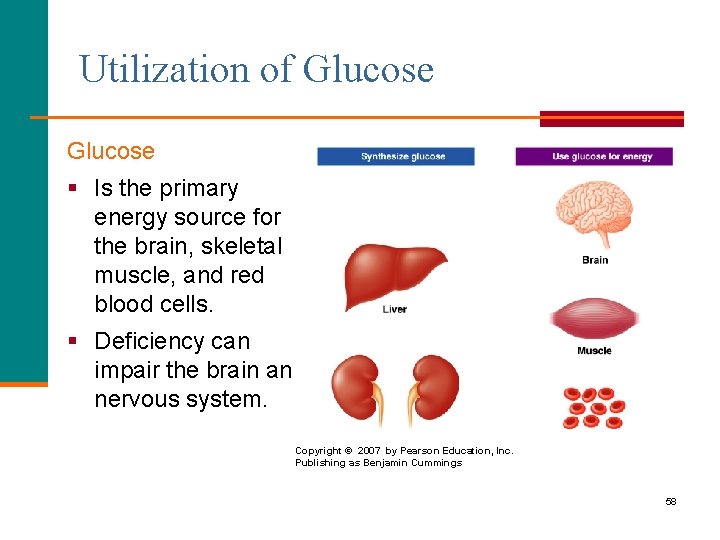
Utilization of Glucose § Is the primary energy source for the brain, skeletal muscle, and red blood cells. § Deficiency can impair the brain and nervous system. Copyright © 2007 by Pearson Education, Inc. Publishing as Benjamin Cummings 58
Gluconeogenesis: Glucose Synthesis Gluconeogenesis is § The synthesis of glucose from carbon atoms of noncarbohydrate compounds. § Required when glycogen stores are depleted. 59
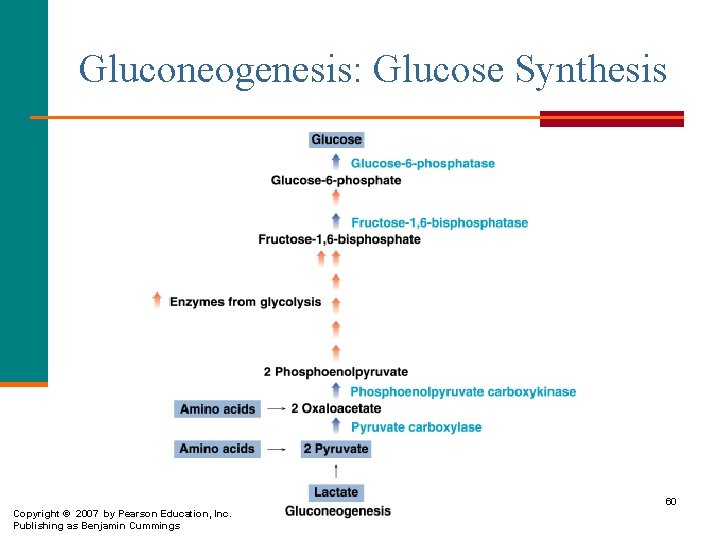
Gluconeogenesis: Glucose Synthesis 60 Copyright © 2007 by Pearson Education, Inc. Publishing as Benjamin Cummings

Gluconeogenesis: Glucose Synthesis In gluconeogenesis, § Glucose is synthesized from noncarbohydrates such as lactate, some amino acids, and glycerol after they are converted to pyruvate or other intermediates. § Seven reactions are the reverse of glycolysis and use the same enzymes. § Three reactions are not reversible. Reaction 1 Hexokinase Reaction 3 Phosphofructokinase Reaction 10 Pyruvate kinase 61
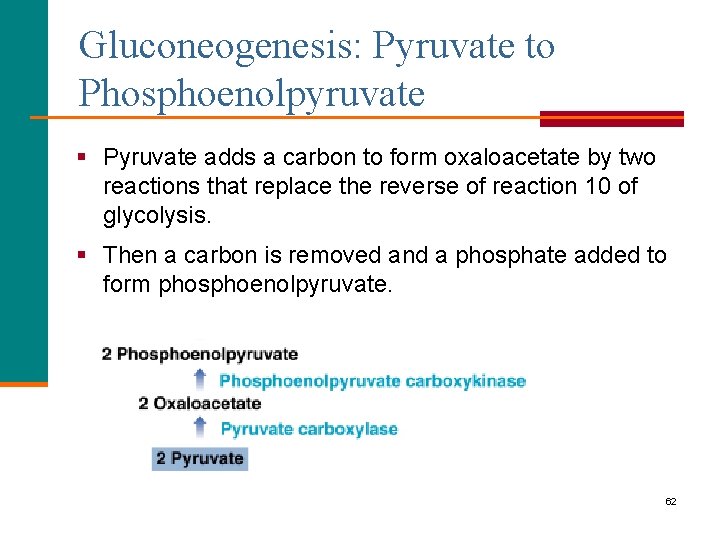
Gluconeogenesis: Pyruvate to Phosphoenolpyruvate § Pyruvate adds a carbon to form oxaloacetate by two reactions that replace the reverse of reaction 10 of glycolysis. § Then a carbon is removed and a phosphate added to form phosphoenolpyruvate. 62
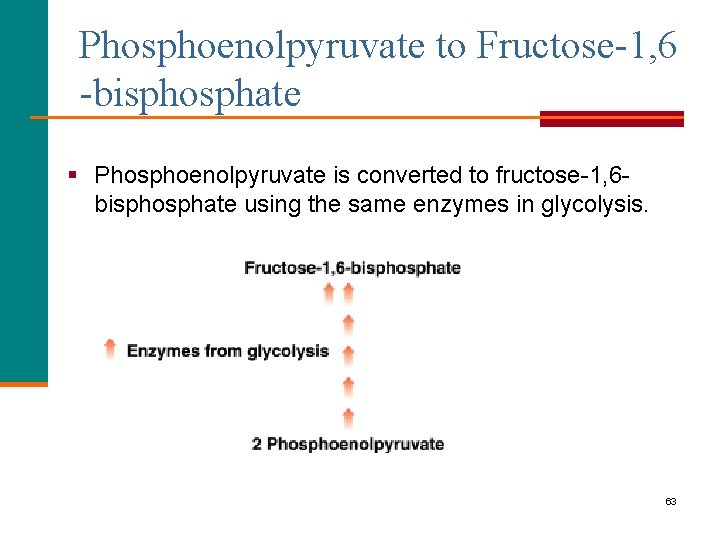
Phosphoenolpyruvate to Fructose-1, 6 -bisphosphate § Phosphoenolpyruvate is converted to fructose-1, 6 bisphosphate using the same enzymes in glycolysis. 63
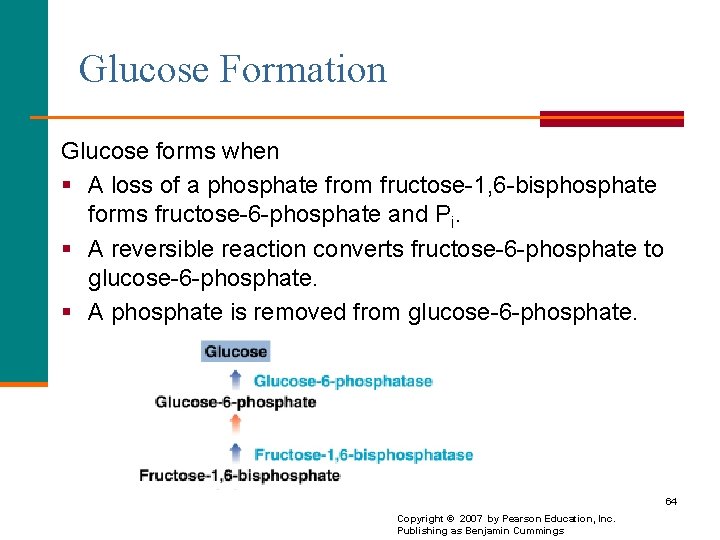
Glucose Formation Glucose forms when § A loss of a phosphate from fructose-1, 6 -bisphosphate forms fructose-6 -phosphate and Pi. § A reversible reaction converts fructose-6 -phosphate to glucose-6 -phosphate. § A phosphate is removed from glucose-6 -phosphate. 64 Copyright © 2007 by Pearson Education, Inc. Publishing as Benjamin Cummings
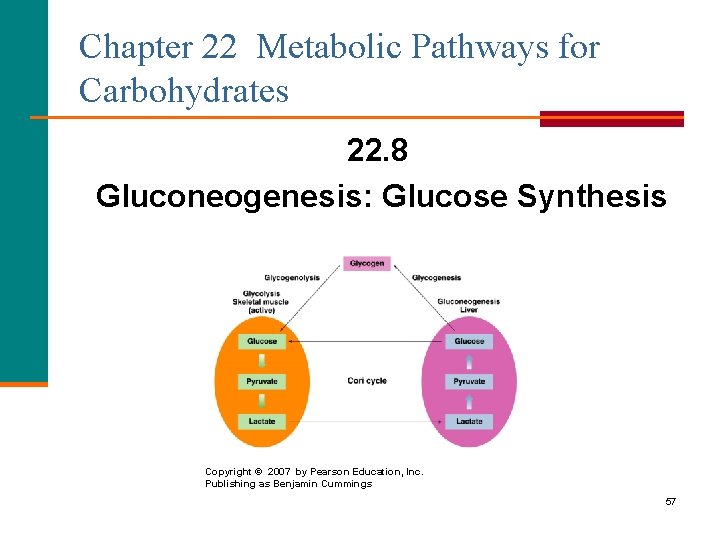
Cori Cycle The Cori cycle § Is the flow of lactate and glucose between the muscles and the liver. § Occurs when anaerobic conditions occur in active muscle and glycolysis produces lactate. § Operates when lactate moves through the blood stream to the liver, where it is oxidized back to pyruvate. § Converts pyruvate to glucose, which is carried back to the muscles. 65
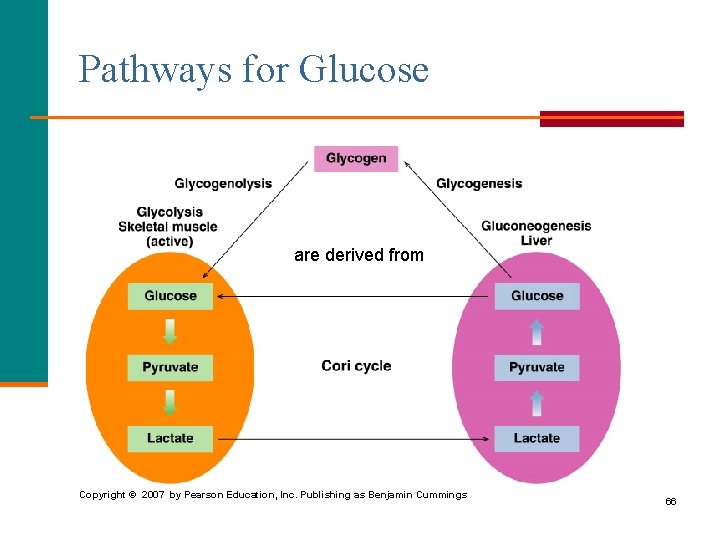
Pathways for Glucose are derived from Copyright © 2007 by Pearson Education, Inc. Publishing as Benjamin Cummings 66
Regulation of Glycolysis and Gluconeogenesis Regulation occurs as § High glucose levels and insulin promote glycolysis. § Low glucose levels and glucagon promote gluconeogenesis. 67
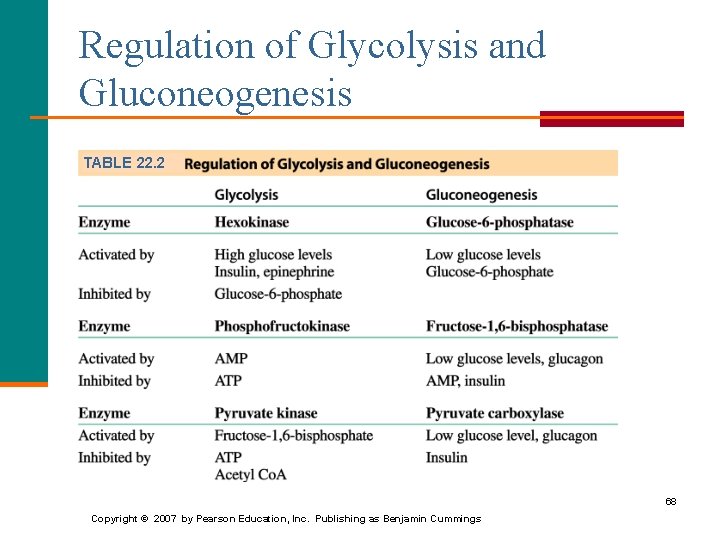
Regulation of Glycolysis and Gluconeogenesis TABLE 22. 2 68 Copyright © 2007 by Pearson Education, Inc. Publishing as Benjamin Cummings
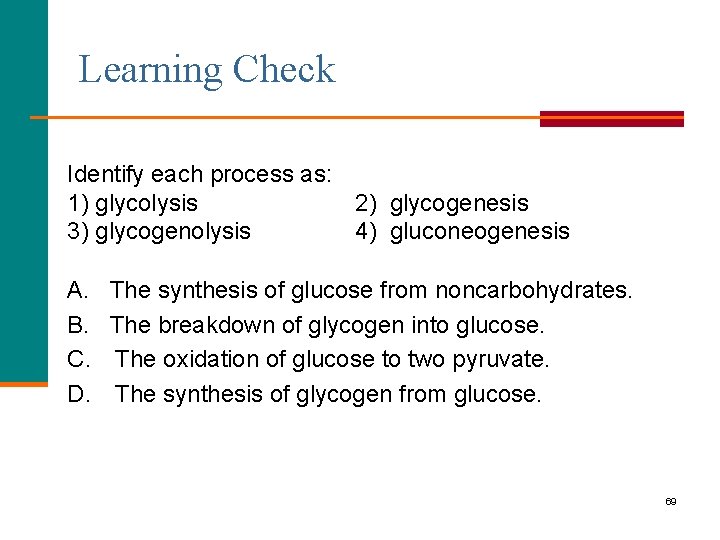
Learning Check Identify each process as: 1) glycolysis 2) glycogenesis 3) glycogenolysis 4) gluconeogenesis A. The synthesis of glucose from noncarbohydrates. B. The breakdown of glycogen into glucose. C. The oxidation of glucose to two pyruvate. D. The synthesis of glycogen from glucose. 69
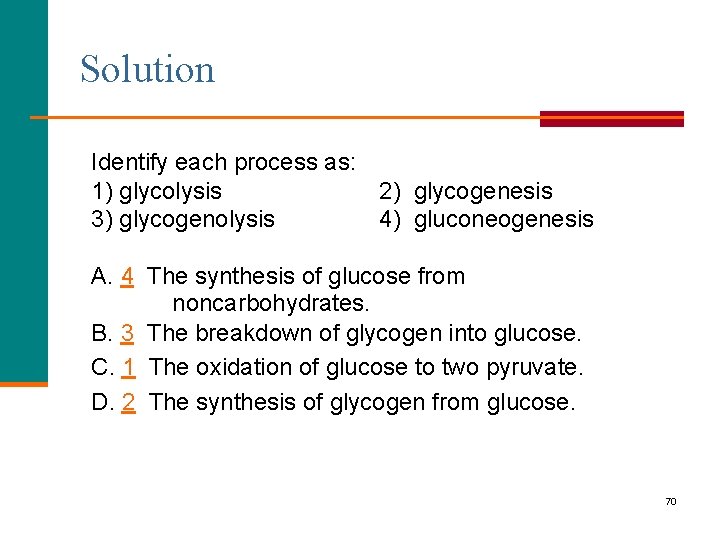
Solution Identify each process as: 1) glycolysis 2) glycogenesis 3) glycogenolysis 4) gluconeogenesis A. 4 The synthesis of glucose from noncarbohydrates. B. 3 The breakdown of glycogen into glucose. C. 1 The oxidation of glucose to two pyruvate. D. 2 The synthesis of glycogen from glucose. 70
- Slides: 70