
Chapter 22 Magnetism MAGNETISM Arguable the oldest subject
Chapter 22 Magnetism
MAGNETISM Arguable the oldest subject in Physics: ancient Greeks (near the City of Magnesia) and Chinese realized certain strange stones attracted iron. Around 1600, William Gilbert proposed that the Earth itself is A gigantic magnet. For a long time, people knew only one source of magnetism from Iron. In 1821, a Danish physicist, Oersted noticed that an electrical wire carrying current made the near-by compass reorient. First clue of inter-relation between electricity and Magnetism. Ampere, Faraday established the nature of electricity and magnetism (all from their experimental observations).
Magnets n Poles of a magnet are the ends where objects are most strongly attracted • Two poles, called north and south n Like poles repel each other and unlike poles attract each other • Similar to electric charges n Magnetic poles cannot be isolated • If a permanent magnetic is cut in half repeatedly, you will still have a north and a south pole • This differs from electric charges • There is some theoretical basis for monopoles, but none have been detected
More About Magnetism n An unmagnetized piece of iron can be magnetized by stroking it with a magnet • Somewhat like stroking an object to charge an object n Magnetism can be induced • If a piece of iron, for example, is placed near a strong permanent magnet, it will become magnetized
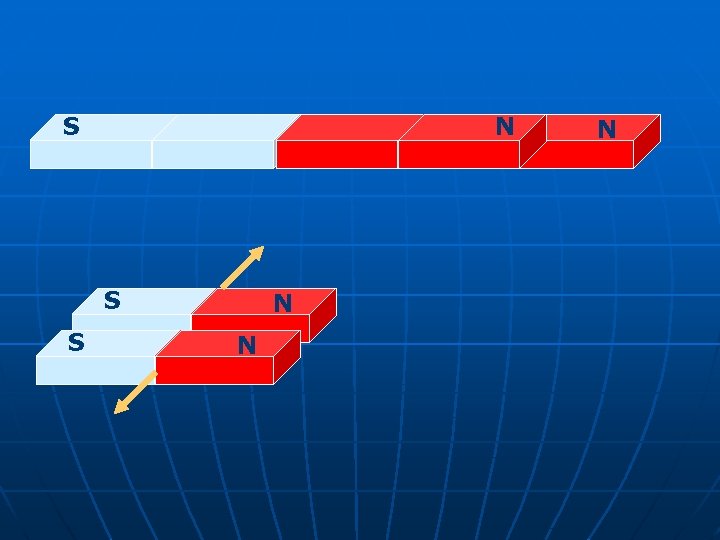
S S N N N
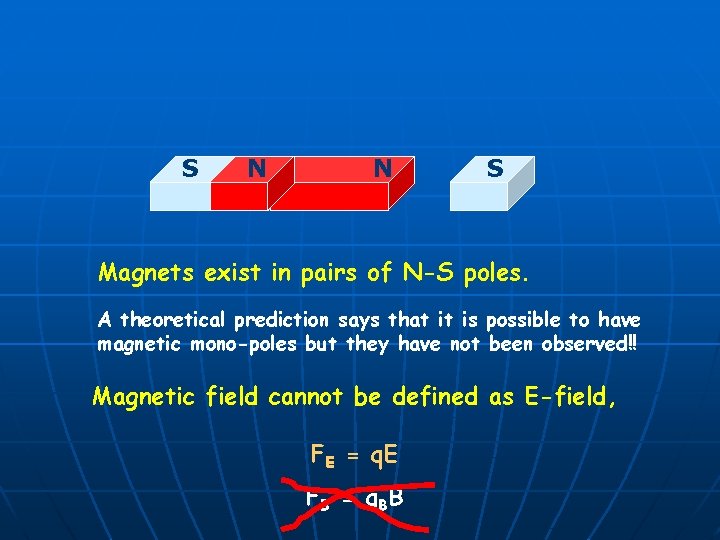
S N N S Magnets exist in pairs of N-S poles. A theoretical prediction says that it is possible to have magnetic mono-poles but they have not been observed!! Magnetic field cannot be defined as E-field, FE = q. E F B = q BB
Magnetic Fields n n A vector quantity Symbolized by B Direction is given by the direction a north pole of a compass needle points in that location Magnetic field lines can be used to show the field lines, as traced out by a compass, would look
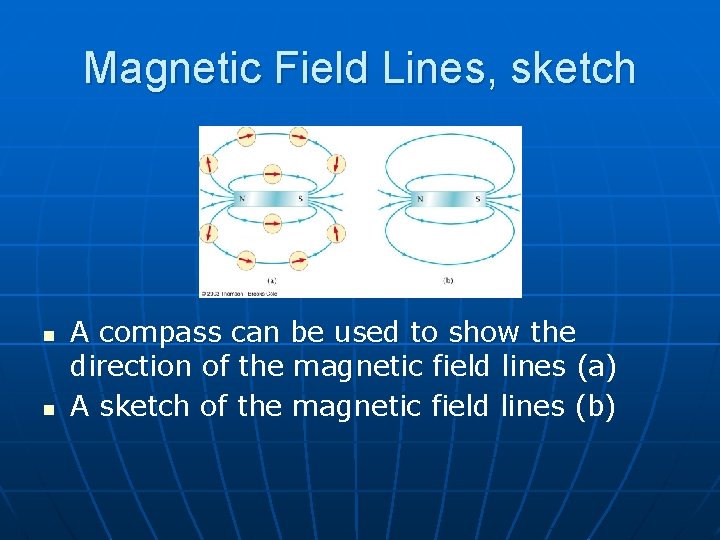
Magnetic Field Lines, sketch n n A compass can be used to show the direction of the magnetic field lines (a) A sketch of the magnetic field lines (b)
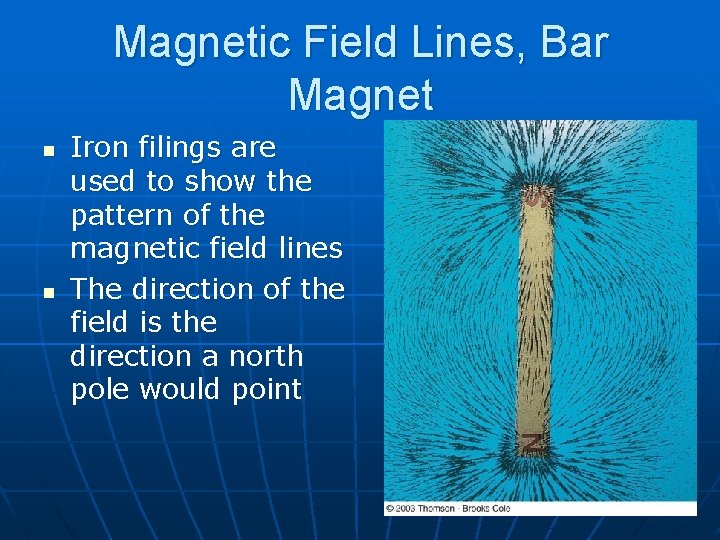
Magnetic Field Lines, Bar Magnet n n Iron filings are used to show the pattern of the magnetic field lines The direction of the field is the direction a north pole would point
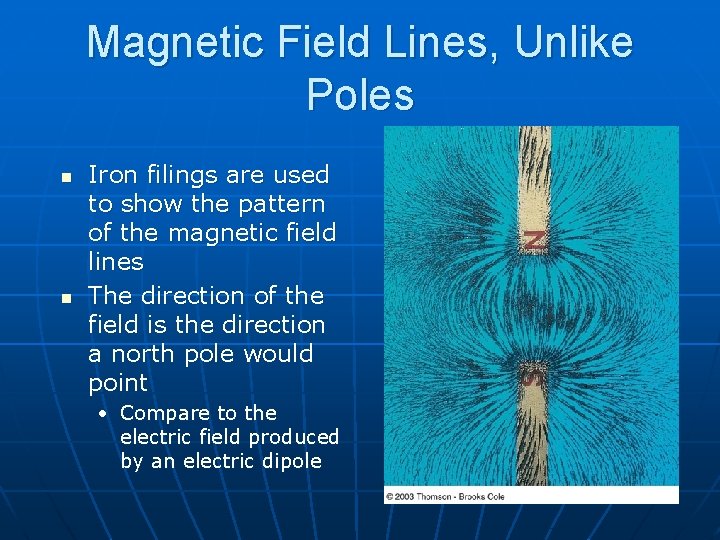
Magnetic Field Lines, Unlike Poles n n Iron filings are used to show the pattern of the magnetic field lines The direction of the field is the direction a north pole would point • Compare to the electric field produced by an electric dipole
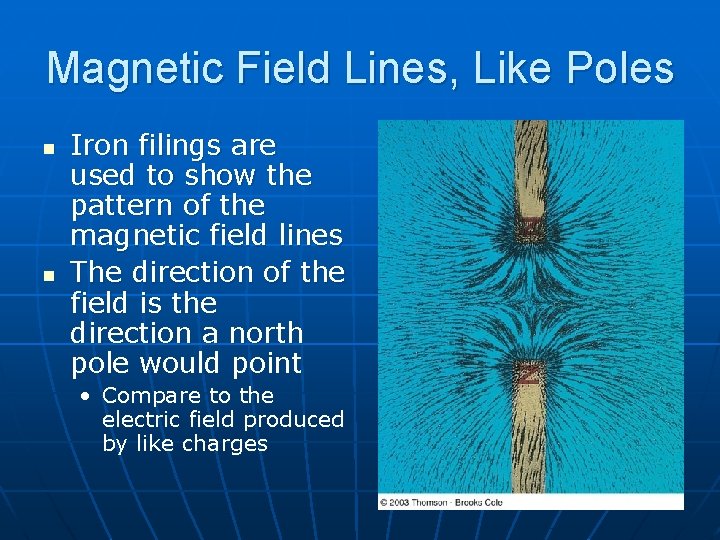
Magnetic Field Lines, Like Poles n n Iron filings are used to show the pattern of the magnetic field lines The direction of the field is the direction a north pole would point • Compare to the electric field produced by like charges
Magnetic and Electric Fields n n n An electric field surrounds any stationary electric charge A magnetic field surrounds any moving electric charge A magnetic field surrounds any magnetic material
Earth’s Magnetic Field n n The Earth’s geographic north pole corresponds to a magnetic south pole The Earth’s geographic south pole corresponds to a magnetic north pole • Strictly speaking, a north pole should be a “north-seeking” pole and a south pole a “south-seeking” pole
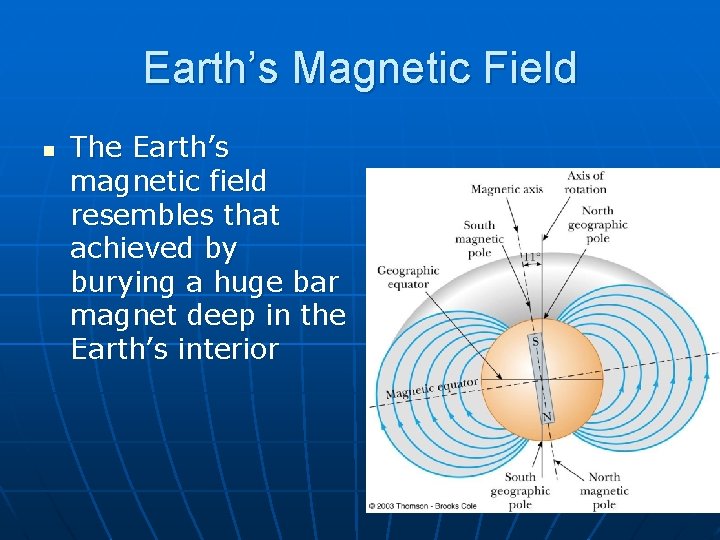
Earth’s Magnetic Field n The Earth’s magnetic field resembles that achieved by burying a huge bar magnet deep in the Earth’s interior
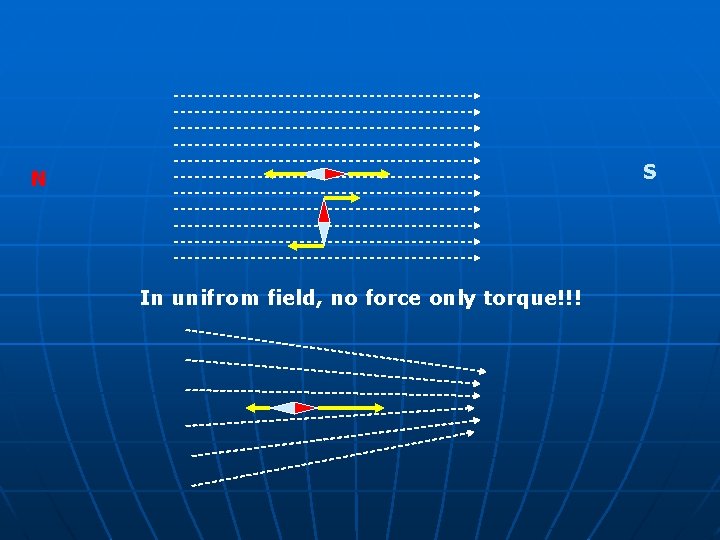
S N In unifrom field, no force only torque!!!
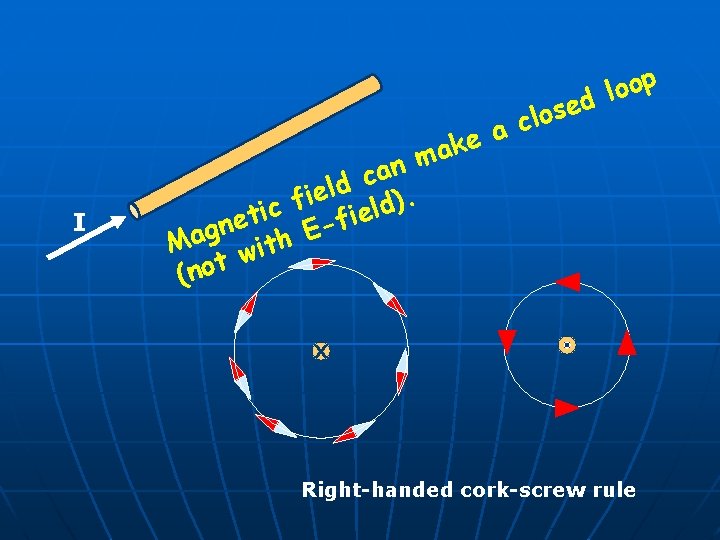
I op o l d e s o l c a e k a m n a c d el i. f ) d l c ti ie f e n g E a h M t i w t (no X Right-handed cork-screw rule
Magnetic Fields n In a magnetic field, a current carrying wire experiences a magnetic force • This force has a maximum value when the wire is perpendicularly to the magnetic field lines • This force is zero when the wire is along the field lines
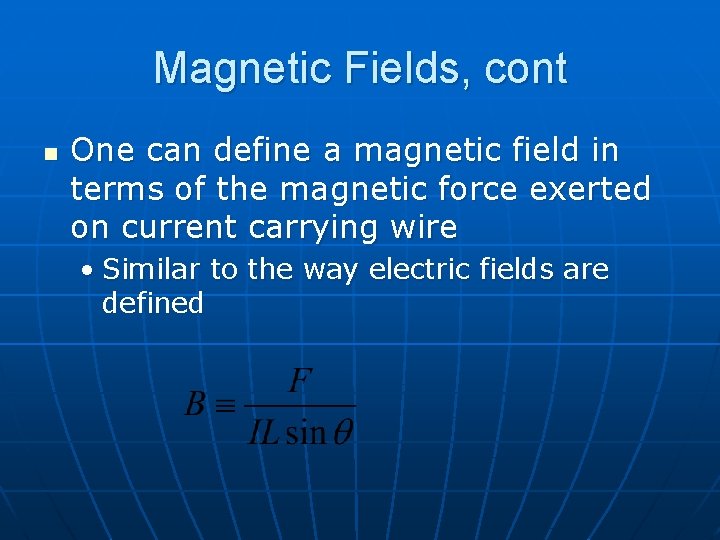
Magnetic Fields, cont n One can define a magnetic field in terms of the magnetic force exerted on current carrying wire • Similar to the way electric fields are defined
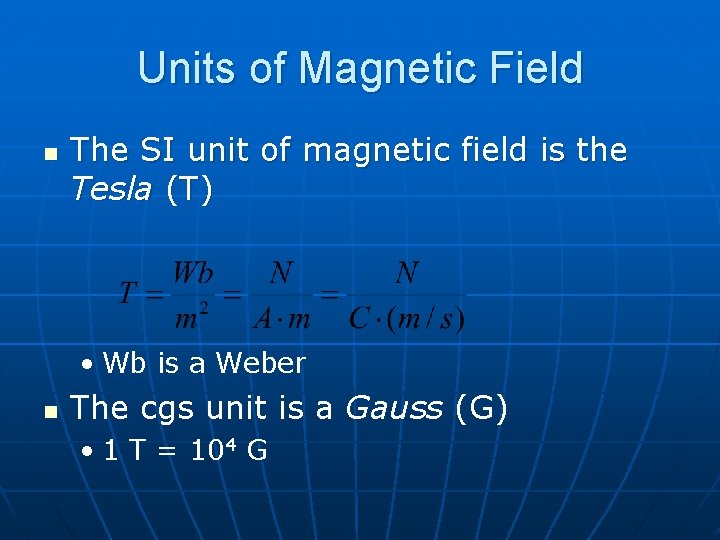
Units of Magnetic Field n The SI unit of magnetic field is the Tesla (T) • Wb is a Weber n The cgs unit is a Gauss (G) • 1 T = 104 G
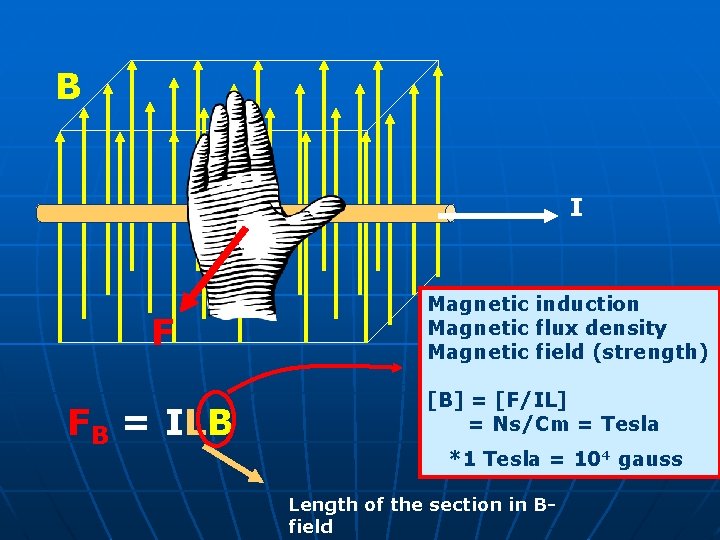
B I F FB = ILB Magnetic induction Magnetic flux density Magnetic field (strength) [B] = [F/IL] = Ns/Cm = Tesla *1 Tesla = 104 gauss Length of the section in Bfield
- Slides: 20