
Chapter 22 Life in the Industrial Age 1800






- Slides: 32
Chapter 22: Life in the Industrial Age (1800– 1914)
SECTION 1: The Industrial Revolution Spreads • What industrial powers emerged in the 1800 s? • What impact did new technology have on industry, transportation, and communication? • How did big business emerge in the late 1800 s?
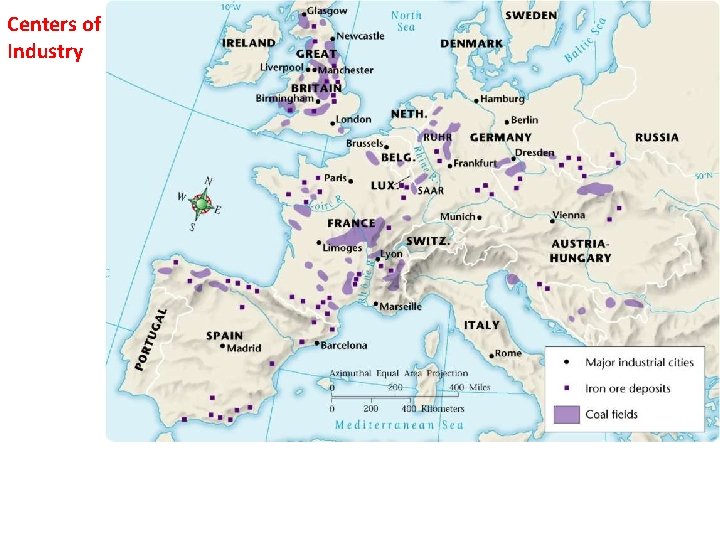
1 New Industrial Powers By the mid-1800 s, other nations began to challenge Britain’s industrial supremacy. • Belgium became the first European nation outside Britain to industrialize. • Germany united into a powerful nation in 1871. Within a few decades, it became Europe’s leading industrial power. • The United States made rapid technological advances, especially after the Civil War. By 1900, American industry led the world in production. • Eastern and southern Europe industrialized more slowly. These nations lacked natural resources or the capital to invest.
Centers of Industry 1
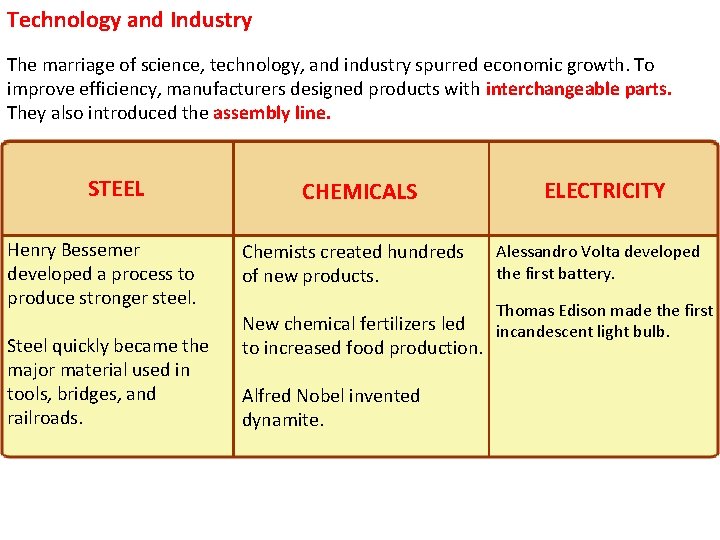
Technology and Industry The marriage of science, technology, and industry spurred economic growth. To improve efficiency, manufacturers designed products with interchangeable parts. They also introduced the assembly line. STEEL Henry Bessemer developed a process to produce stronger steel. Steel quickly became the major material used in tools, bridges, and railroads. CHEMICALS Chemists created hundreds of new products. New chemical fertilizers led to increased food production. Alfred Nobel invented dynamite. ELECTRICITY Alessandro Volta developed the first battery. Thomas Edison made the first incandescent light bulb.
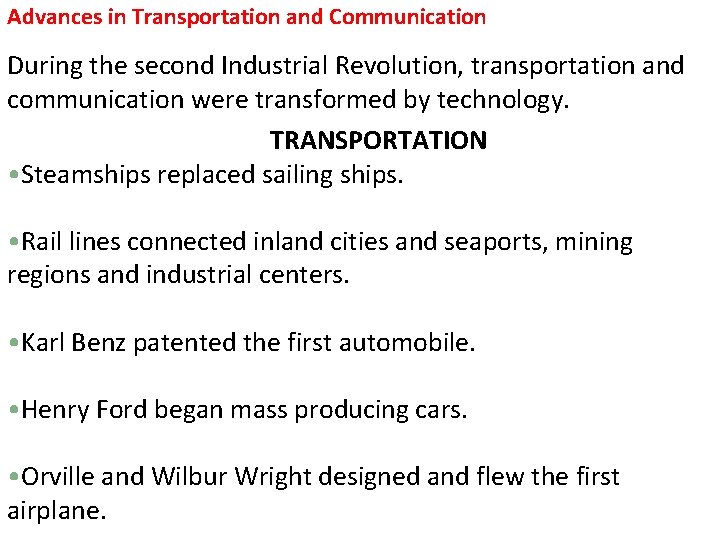
Advances in Transportation and Communication During the second Industrial Revolution, transportation and communication were transformed by technology. TRANSPORTATION • Steamships replaced sailing ships. • Rail lines connected inland cities and seaports, mining regions and industrial centers. • Karl Benz patented the first automobile. • Henry Ford began mass producing cars. • Orville and Wilbur Wright designed and flew the first airplane.
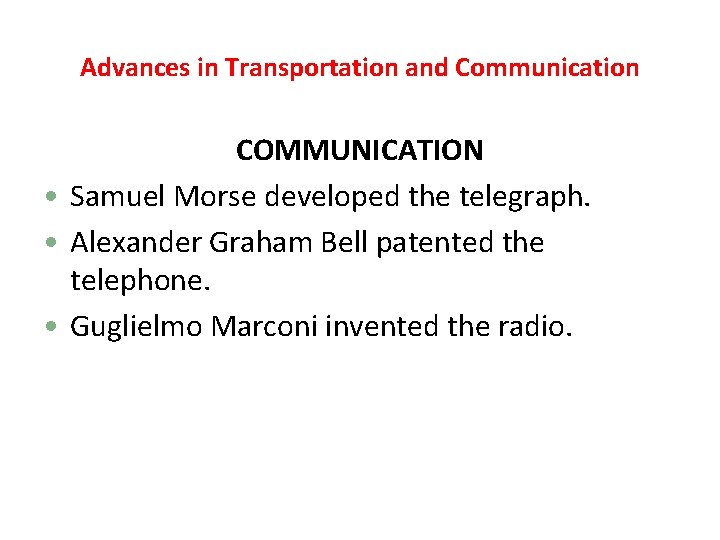
Advances in Transportation and Communication COMMUNICATION • Samuel Morse developed the telegraph. • Alexander Graham Bell patented the telephone. • Guglielmo Marconi invented the radio.
Mr. Lozano’s Airplane factory All of you work for me. I am a big proponent of the factory system. I have created an assembly line because I want as many quality paper planes that I can get. Everyone on the assembly line must work together in order to achieve maximum efficiency. Easy Paper Airplane Glider Instructions (Nakamura? Lock) - You. Tube
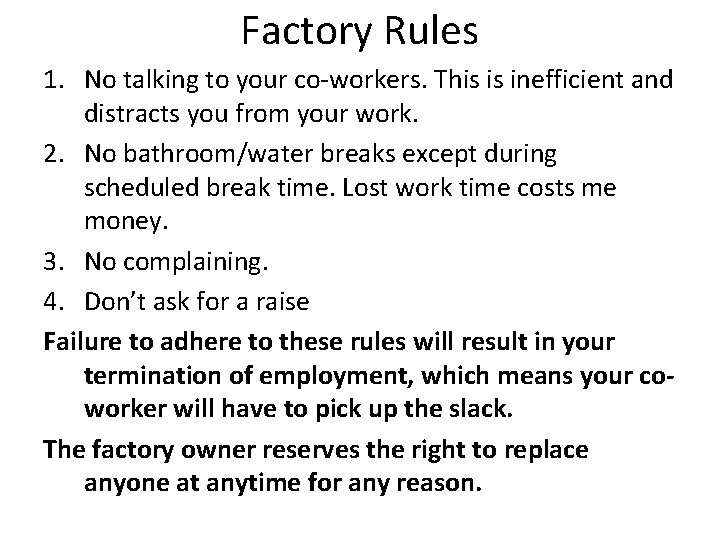
Factory Rules 1. No talking to your co-workers. This is inefficient and distracts you from your work. 2. No bathroom/water breaks except during scheduled break time. Lost work time costs me money. 3. No complaining. 4. Don’t ask for a raise Failure to adhere to these rules will result in your termination of employment, which means your coworker will have to pick up the slack. The factory owner reserves the right to replace anyone at anytime for any reason.
Goal 150 planes In 10 minutes
Reflection Describe your experience on the assembly line. Things to consider: 1. Was the job monotonous or boring? 2. Did you feel like you were under pressure? 3. Did it bother you when your co-workers made mistakes or could not keep up? (no names please) 4. Was your boss fair?
The Rise of Big Business New technologies required the investment of large amounts of money. To obtain capital, entrepreneurs sold stock, or shares in their companies, to investors. Large-scale companies formed corporations, businesses that are owned by many investors who buy shares of stock. Powerful business leaders created monopolies and trusts, huge corporate structures that controlled entire industries or areas of the economy. Sometimes a group of businesses joined forces and formed a cartel, an association to fix prices, set production quotas, or control markets.
SECTION 2: The World of Cities • What was the impact of medical advances in the late 1800 s? • How had cities changed by 1900? • How did working-class struggles lead to improved conditions for workers?
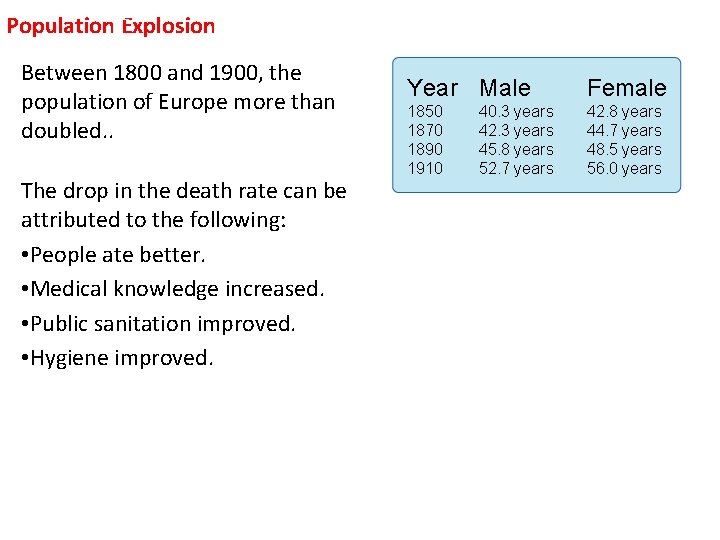
2 Population Explosion Between 1800 and 1900, the population of Europe more than doubled. . The drop in the death rate can be attributed to the following: • People ate better. • Medical knowledge increased. • Public sanitation improved. • Hygiene improved. Year Male Female 1850 1870 1890 1910 42. 8 years 44. 7 years 48. 5 years 56. 0 years 40. 3 years 42. 3 years 45. 8 years 52. 7 years
Advances in 2 Medicine Improved medicine and hygiene played a major role in increasing life expectancy in the industrialized world. LOUIS PASTEUR proved the link between microbes and disease, developed vaccines against rabies and anthrax, and discovered the process of pasteurization ROBERT KOCH identified the bacteria that caused tuberculosis. FLORENCE NIGHTINGALE insisted on better hygiene in wartime field hospitals JOSEPH LISTER discovered how antiseptic prevented infection.
City Life 2 As industrialization progressed, cities came to dominate the West. At the same time, city life underwent dramatic changes. • Settlement patterns shifted: the rich lived in pleasant neighborhoods on the outskirts of the city, while the poor crowded into slums near the city center. • Paved streets, gas lamps, organized police forces, and expanded fire protection made cities safer and more livable. • Sewage systems improved public health.
Working-Class Struggles Workers protested to improve the harsh conditions of industrial life. At first, business owners tried to silence protesters, strikes and unions were illegal, and demonstrations were crushed. By mid-century, workers slowly began to make progress: • Workers won the right to organize unions. • Governments passed laws to regulate working conditions. • Governments established old-age pensions and disability insurance. • The standard of living improved.
Writing a Letter • You have moved from a rural village to London or Paris in the late 1800 s. Write a letter home describing your feelings about city life. Suggest both positive and negative aspects.
The Industrial Revolution: Cause and Effect Causes • Increased agricultural productivity. • Growing population. • New sources of energy, such as steam and coal. • Growing demand for textiles and other massproduced goods. • Improved technology. • Available natural resources, labor, and money. • Strong, stable governments that promoted economic growth.
The Industrial Revolution: Cause and Effect Immediate Effects • Rise of factories. • Changes in transportation and communication. • Urbanization. • Rise of urban working class. • Growth of reform movements. The Worst Jobs in History - The Victorian Age - Part 4 You. Tube • • Long-Term Effects Growth of labor unions. Inexpensive new products. Spread of industrialization. Rise of big business. Expansion of public education. Expansion of middle class. Progress in medical care.
Bell Work What were the long term effects of the Industrial Revolution?
SECTION 3: Changing Attitudes and Values • What values shaped the new social order? • How did women and educators seek change? • How did science challenge existing beliefs? • What role did religion play in urban society?
3 What Values Shaped the New Social Order? • A strict code of etiquette governed social behavior. • Children were supposed to be “seen but not heard. ” • Middle-class parents had a large say in choosing whom their children married. At the same time, the notion of “falling in love” was more accepted than ever before. • Men worked while women stayed at home. Books, magazines, and popular songs supported a cult of domesticity that idealized women and the home.
Rights for Women • Across Europe and the United States, politically active women campaigned for fairness in marriage, divorce, and property laws. • Women’s groups supported the temperance movement, a campaign to limit or ban the use of alcoholic beverages. • Before 1850, some women had become leaders in the union movement.
Rights for Women • Some women campaigned to abolish slavery. • Many women broke the barriers that kept them out of universities and professions. • In the mid- to late 1800 s, groups dedicated to women’s suffrage emerged.
3 New Directions in Science In the late 1800 s, researchers advanced startling theories about the natural world. These new ideas challenged long-held beliefs. • John Dalton developed modern atomic theory. He showed how different kinds of atoms combine to make all chemical substances. • Dmitri Mendeleyev grouped the elements according to their atomic weights. • Charles Darwin put forward theory of natural selection. Darwin’s theory ignited a furious debate between scientists and theologians.
3 Religion in an Urban Age Despite the challenge of new ideas, religion continued to be a major force in western society. • Christian churches and Jewish synagogues remained at the center of communities. • Religious leaders influenced political, social, and educational developments. • Religious organizations provided social services to the poor. • The social gospel was a movement that urged Christians to social service.
SECTION 4: A New Culture • What themes shaped romantic art, literature, and music? • How did realists respond to the industrialized, urban world? • How did the visual arts change?
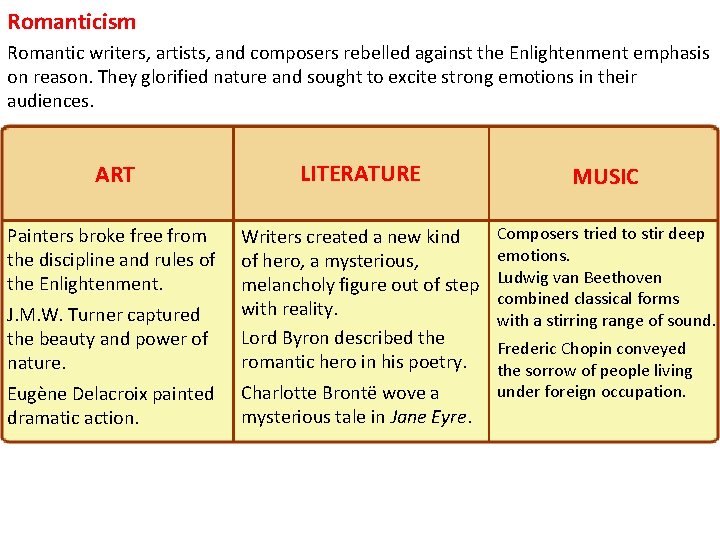
Romanticism Romantic writers, artists, and composers rebelled against the Enlightenment emphasis on reason. They glorified nature and sought to excite strong emotions in their audiences. ART LITERATURE MUSIC Painters broke free from the discipline and rules of the Enlightenment. J. M. W. Turner captured the beauty and power of nature. Writers created a new kind of hero, a mysterious, melancholy figure out of step with reality. Lord Byron described the romantic hero in his poetry. Composers tried to stir deep emotions. Ludwig van Beethoven combined classical forms with a stirring range of sound. Eugène Delacroix painted dramatic action. Charlotte Brontë wove a mysterious tale in Jane Eyre. Frederic Chopin conveyed the sorrow of people living under foreign occupation.
Realism 4 By the mid-1800 s, a new artistic movement, realism, took hold in the West. Realism was an attempt to represent the world as it was. Realists often focused their work on the harsh side of life in cities or villages. Many writers and artists were committed to improving the lot of the unfortunates whose lives they depicted. • The English novelist Charles Dickens vividly portrayed the lives of slum dwellers and factory workers. • The Norwegian dramatist Henrik Ibsen wrote plays that attacked the hypocrisy he observed around him. • The French painter Gustave Courbet focused on ordinary subjects.
4 The Visual Arts • By the 1840 s, a new art form, photography, was emerging. The first photos were stiff, posed portraits. In time, photographers used the camera to present the grim realities of life. • Photography posed a challenge to painters. Why try for realism, they asked, when a camera could do the same thing better? • By the 1870 s, a group of painters sought to capture the first fleeting impression made by a scene or an object on the viewer’s eye. This new movement was known as impressionism. • Later painters, called postimpressionists, developed a variety of styles.