
Chapter 22 Joanne Duffys Quality Caring Model Developed







- Slides: 31
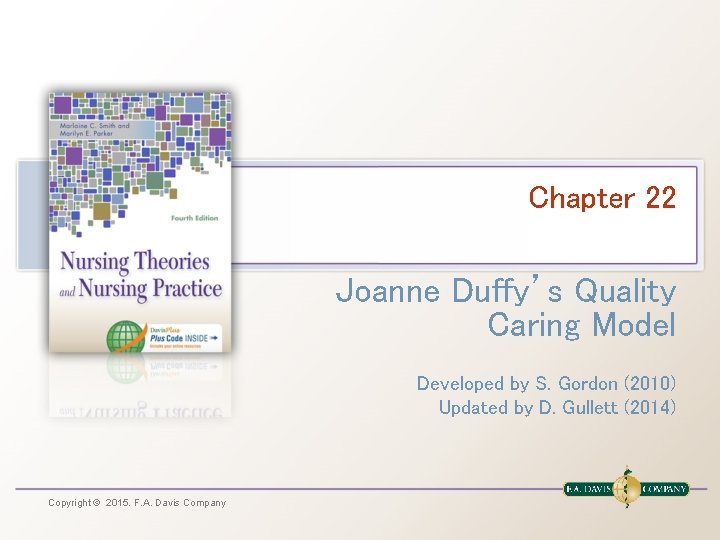
Chapter 22 Joanne Duffy’s Quality Caring Model Developed by S. Gordon (2010) Updated by D. Gullett (2014) Copyright © 2015. F. A. Davis Company
On completion of this chapter, students will be able to: 1. Describe Duffy’s Quality-Caring Model. 2. Discuss the progression of the development of the Quality-Caring Model. 3. Discuss the role of the nurse in providing quality care using the Quality-Caring Model. 4. Identify caring-based nursing interventions. 5. Discuss the importance of caring relationships in nursing. 6. Describe Duffy’s used of the term “feeling cared for. ” 7. Explain recent changes in the model. 8. Describe how the model is being used in nursing practice and research. Copyright © 2015. F. A. Davis Company
About the Theorist § Joanne R. Duffy Ph. D, RN, FAAN § St. Joseph’s Hospital School of Nursing, Providence, RI § BSN Salve Regina College, Newport, RI § Master’s and Ph. D Catholic University in Washington, DC § Professor at Indiana University School of Nursing § Associate Director of Nursing § George Washington University Medical Center § Georgetown University Medical Center § Developed Cardiovascular Center for Outcome Analysis § Administer the Transplant Center at INOVA Fairfax Hospital in Virginia Copyright © 2015. F. A. Davis Company
About the Theorist (Continued) § First to examine the link between nurse caring behaviors and patient outcomes § Developed the Caring Assessment Tool § Interested in the hidden value of nursing work § Developed the Quality-Caring Model § Explores approaches to relationship building Copyright © 2015. F. A. Davis Company
Quality–Caring Model (2003) § Purpose § To guide practice and research § Prompted during discussions concerning nursing interventions § Informed from earlier work on caring § Patient perceptions that “nurses just don’t seem to care” Copyright © 2015. F. A. Davis Company
Quality Caring Model § The model has been revised twice (once in 2009 and again in this most recent 2013 version) to meet the demands of the multifaceted, interdependent and global health system. § In this revised version, the link between caring relationships and quality care is even more explicit, challenging the nursing profession to use caring relationships as the basis for daily practice Copyright © 2015. F. A. Davis Company
Quality–Caring Model Background § Few nursing theories that could guide § Development of caring-based nursing interventions § Speak to the relationship between nurse caring and quality § Initial testing with a group of patients with heart failure Copyright © 2015. F. A. Davis Company
Core Concept § Caring relationships § Hidden in the daily work of nursing § Nurse caring different from caring between relatives and friends § Nurse caring requires § Specialized knowledge, attitudes, and behaviors directed toward health and healing Copyright © 2015. F. A. Davis Company
Nurse Caring § Assists recipients to feel “cared for” § Freeing recipients to: § Take risks § Learn new healthy behaviors § Participate in evidence-based decisions Copyright © 2015. F. A. Davis Company
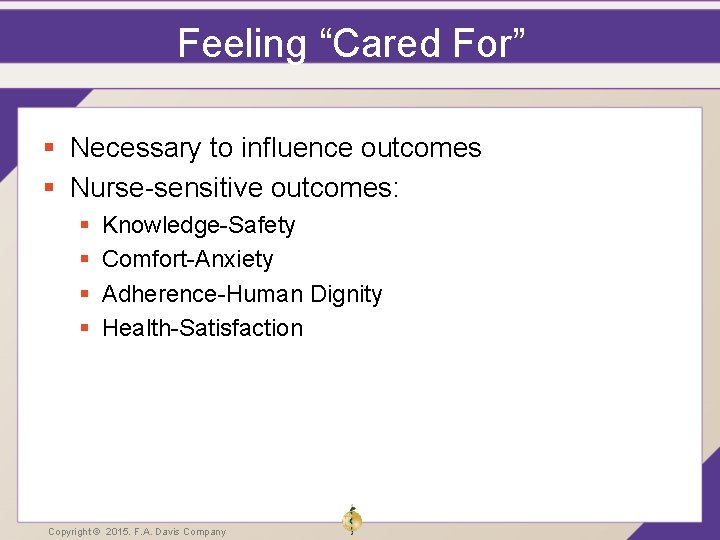
Feeling “Cared For” § Necessary to influence outcomes § Nurse-sensitive outcomes: § § Knowledge-Safety Comfort-Anxiety Adherence-Human Dignity Health-Satisfaction Copyright © 2015. F. A. Davis Company
Major Purposes of Quality-Caring Model § Guide professional practice § Describe linkages between quality of care and human caring § Foundation for nursing research Copyright © 2015. F. A. Davis Company
Quality-Caring Model § Duffy considers the model Middle Range § Views quality as: § Dynamic § Nonlinear § Enhanced by caring relationships Copyright © 2015. F. A. Davis Company
Main Concepts § Humans in relationship § Humans are unique, multidimensional beings § Important to recognized how humans are different and the same § Social beings connected to others § Humans mature, enhance community, and advance through human connections Copyright © 2015. F. A. Davis Company
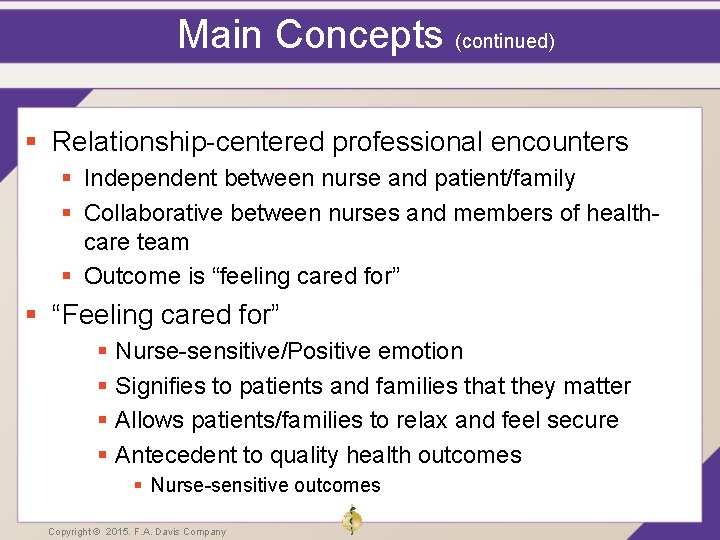
Main Concepts (continued) § Relationship-centered professional encounters § Independent between nurse and patient/family § Collaborative between nurses and members of healthcare team § Outcome is “feeling cared for” § “Feeling cared for” § Nurse-sensitive/Positive emotion § Signifies to patients and families that they matter § Allows patients/families to relax and feel secure § Antecedent to quality health outcomes § Nurse-sensitive outcomes Copyright © 2015. F. A. Davis Company
Main Concepts (continued) Self-advancing systems § It is a phenomenon that emerges gradually over time and in space reflecting dynamic positive progress that enhances the systems’ well-being. § Self-advancing systems are stimulated by caring relationships, but the forward movement itself cannot be controlled directly; rather, it emerges over time, driven by caring connections. Copyright © 2015. F. A. Davis Company
Assumptions § Humans are: § Multidimensional beings capable of growth and change § Exist in relationship to themselves, others, communities or groups, and nature § Evolve over time § Inherently worthy § Caring is: § Embedded in the daily work of nursing § A tangible concept that can be measured § Done in relationship § Consists of processes that are used individually or in combination and often concurrently Copyright © 2015. F. A. Davis Company
Assumptions (continued) § Caring relationships: § Benefit both the carer and the one being cared for § Benefit society § Professional nursing work is done in the context of human relationships § Feeling cared for is a positive emotion Copyright © 2015. F. A. Davis Company
Propositions § Human caring capacity can be developed § Caring relationships: § Are composed of process or factors that can be observed § Require intent, choice, specialized knowledge and skills, and time § Engagement in communities through caring relationships enhances self-caring § Independent caring relationships between patients and nurses influence feeling “cared for” Copyright © 2015. F. A. Davis Company
Propositions (continued) § Collaborative caring relationships among nurses and health-care team members influence feeling “cared for” § Caring relationships facilitate growth and change § Feeling “cared for”: § Is an antecedent to self-advancing systems § Influence is the attainment of immediate and terminal health outcomes Copyright © 2015. F. A. Davis Company
Propositions (continued) § Self-advancement is a: § Nonlinear, complex process that emerges over time and in space § Self-advancing systems are: § Naturally self-caring or self-healing § Caring relationships contribute to: § Individual, group, and system self-advancement Copyright © 2015. F. A. Davis Company
Role of the Nurse § Attain and continuously advance knowledge and expertise in caring processes. § Initiate, cultivate, and sustain caring relationships with patients and families. § Initiate, cultivate, and sustain caring relationships with other nurses and all members of the health care team. § Maintain an ongoing awareness of the patient/family point of view. Copyright © 2015. F. A. Davis Company § Carry on self-caring activities, including personal and professional development. § Integrate caring relationships with specific evidenced-based nursing interventions to positively influence health outcomes. § Engage in continuous learning and practice-based research. § Use the expertise of caring relationships embedded in nursing, to actively participate in community groups.
Role of the nurse (cont) § Contribute to the knowledge of caring and, ultimately, the profession of nursing using all forms of knowing. § Maintain an open, flexible approach. § Use measures of caring to evaluate nursing care Copyright © 2015. F. A. Davis Company
Caring Relationships § § Relationship with self Relationships with patients and families Collaborative relationships Caring for the communities nurses live Copyright © 2015. F. A. Davis Company
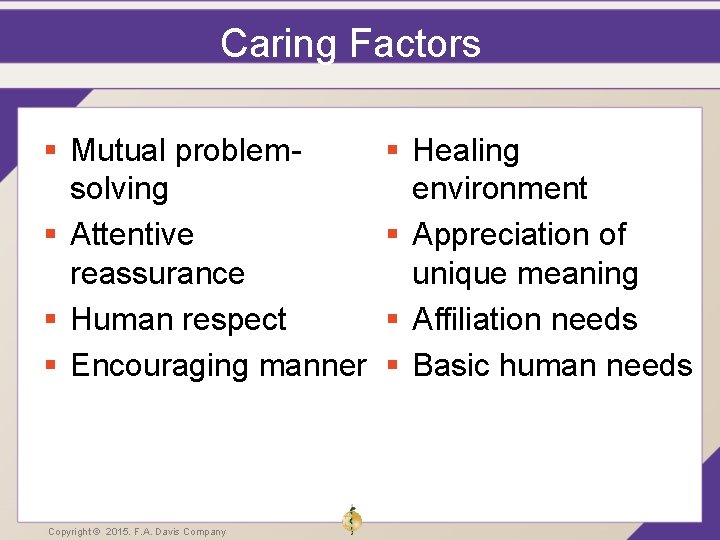
Caring Factors § Mutual problemsolving § Attentive reassurance § Human respect § Encouraging manner Copyright © 2015. F. A. Davis Company § Healing environment § Appreciation of unique meaning § Affiliation needs § Basic human needs
Caring Factors (cont) § The caring factors are used “in relationship” with others and comprise the basis for the “knowledge and skills” required to practice according to the Quality-Caring Model. © Copyright © 2015. F. A. Davis Company
Applications to Practice § The Quality-Caring Model© provides individual clinicians, teams of health professionals, educators, and leaders with a relationship-centric approach to healthcare. In doing so, it honors the interdependencies necessary for human advancement. Copyright © 2015. F. A. Davis Company
Many health systems are using the Quality-Caring Model© to: § provide a foundation for patient -centered care § enhance interprofessional practice § facilitate staff-directed practice changes § re-design professional workflow § generate guiding principles for human resource practices § guide nurse residency programs § improve collective relational capacity Copyright © 2015. F. A. Davis Company § renew the meaning of nursing work § extend caring to others FIRST § build relationships with community groups § create a legacy of caring § sustain professionalism § revise nursing curricula § balance “doing” with “being”
Practice Improvement (Tools) § The revised Caring Assessment Tool© (CAT) (Duffy, Hoskins, & Seifert, 2007; Duffy, Brewer & Weaver, 2012), a 27 -item instrument designed to capture patients’ perceptions of nurse caring, has been used with success in several health care institutions (Duffy, 2013). Copyright © 2015. F. A. Davis Company
Practice Improvement (Tools, cont) § Another instrument that was adapted from the CAT© is the Caring Assessment Tool for Administration (CAT-adm) (Duffy, 2002). This tool is a 39 -item questionnaire that assesses how nurses perceive nurse manager caring behaviors and has become important in the assessment of caring practice environments. Copyright © 2015. F. A. Davis Company
Researching Caring Relationships § Because the Quality-Caring Model© provides a set of concepts, assumptions, and propositions, questions generated from these theoretical ideas can provide the basis for research. For example, the proposition, “feeling ‘cared for’ influences the attainment of intermediate and terminal health outcomes” (Duffy, 2013, p. 38) could be tested by linking the results of an instrument measuring caring with a set of specific patient outcome. Copyright © 2015. F. A. Davis Company
References Duffy, J. (2002). The Caring Assessment Tool – Adm version. In: J. Watson (Ed. ), Instruments for assessing and measuring caring in nursing and health sciences. New York: Springer. Duffy, J. , Hoskins, L. M. , & Seifert, R. F. (2007). Dimensions of caring: Psychometric properties of the caring assessment tool. Advances in Nursing Science, 30(3), 235– 245. Duffy, J. (2009). Quality caring in nursing: Applying theory to clinical practice, education, and leadership. New York: Springer Publishing. Duffy, J, Brewer, B. , & Weaver, M. (2010). Revision and Psychometric Properties of the Caring Assessment Tool Clinical Nursing Research. May 17, published ahead of print. Duffy, J. (2013). Quality caring in nursing and health systems: Implications for clinicians, educators, and leaders. New York, NY: Springer Publishing. Copyright © 2015. F. A. Davis Company