
Chapter 22 Current Electricity A flow of charged

- Slides: 34
Chapter 22 Current Electricity A flow of charged particles is an _____ _electric current___________ Charges flow from higher potential difference to lower potential difference. This flow of positive charge is called ______conventional current__. Actually is electrons moving away from positive to negative so it seems like positive is in opposite direction. Developed before they understood how easily electrons move.
To maintain the flow the electric potential difference has to be maintained by adding energy to the system by doing Work W = q. V or rearrangement of V = W/q Examples: a battery converts chemical energy to electric energy; Photovoltaic cells – solar changes light energy to electric energy Generators – using water, wind, steam convert kinetic energy to electric energy
Charge moving through a closed loop make an electric circuit. Charges are conserved and total charge doesn’t change. Power is the measure of the rate at which energy is transferred, The energy carried by current depends on the charge transferred and the potential difference. First we need to know how to find current The rate of flow of electric charge or electric current is; Current = I =q/t = C/s Where I = current q = charge (coulombs) and t = time in seconds Current or I is in or called ___amperes_. It is measured by an ammeter So what is the current if 20 coulombs pass through the wire in 10 seconds? I =q/t so
The formula for calculating Power is P = IV = (C/s) (J/C) = J/s = watts Also P = W/t P = Power; I = Current in Amperes(C/s); V = Potential difference in Volts(J/C) Problem: A 6. 0 V battery delivers 0. 050 A current to an electric motor that is connected across its terminals. • What power is consumed by the motor? • If the motor runs for 5 minutes (change to seconds), how much energy is consumed? • Don’t forget our old formulas – P = W/t
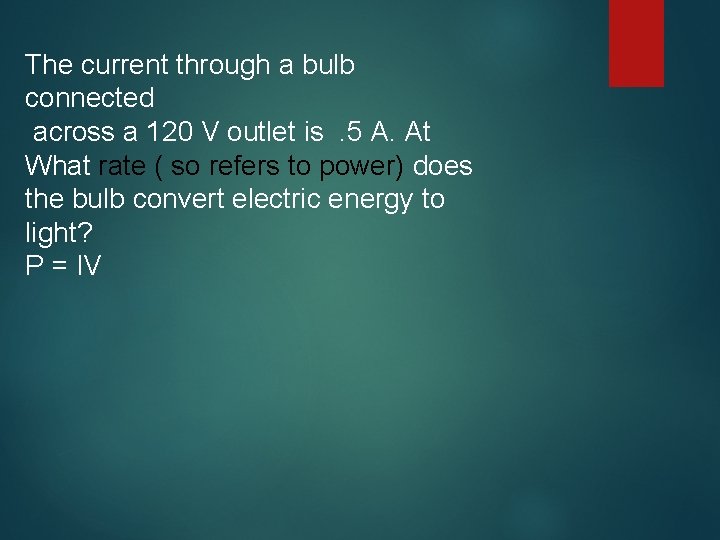
The current through a bulb connected across a 120 V outlet is. 5 A. At What rate ( so refers to power) does the bulb convert electric energy to light? P = IV
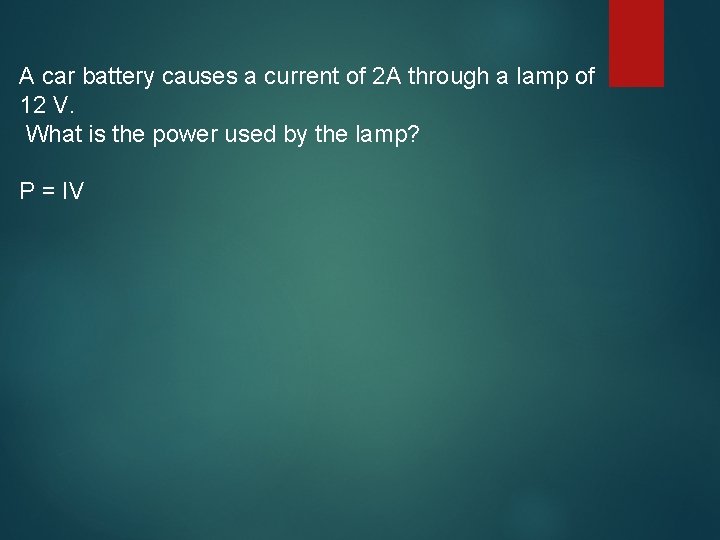
A car battery causes a current of 2 A through a lamp of 12 V. What is the power used by the lamp? P = IV
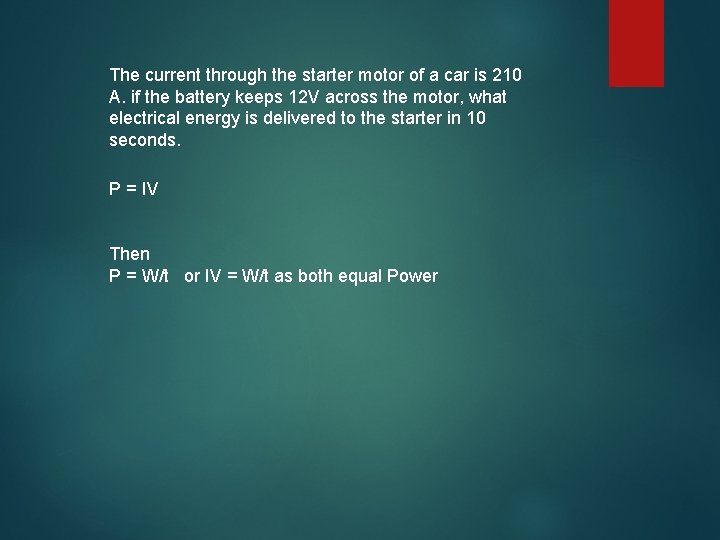
The current through the starter motor of a car is 210 A. if the battery keeps 12 V across the motor, what electrical energy is delivered to the starter in 10 seconds. P = IV Then P = W/t or IV = W/t as both equal Power
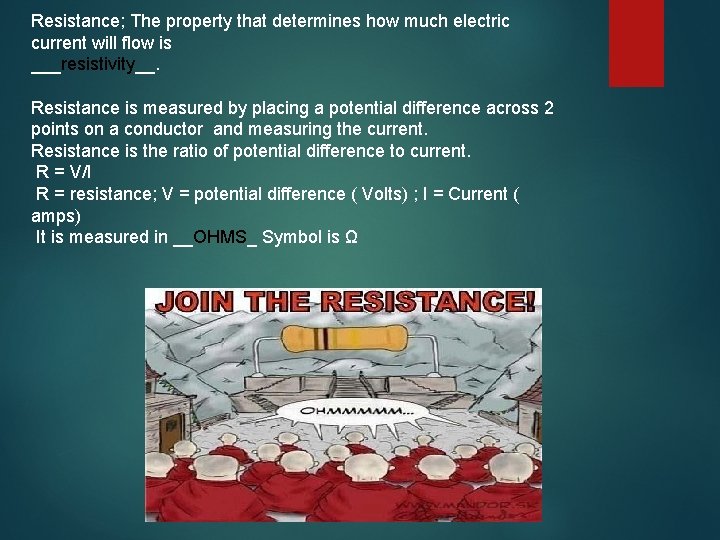
Resistance; The property that determines how much electric current will flow is ___resistivity__. Resistance is measured by placing a potential difference across 2 points on a conductor and measuring the current. Resistance is the ratio of potential difference to current. R = V/I R = resistance; V = potential difference ( Volts) ; I = Current ( amps) It is measured in __OHMS_ Symbol is Ω
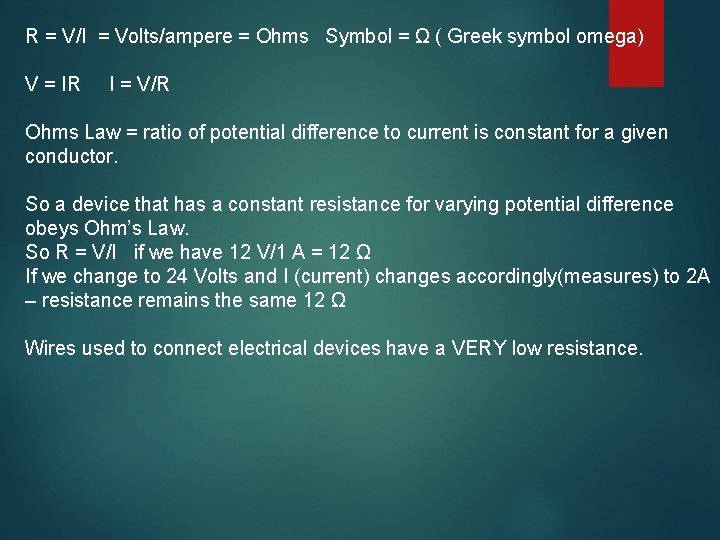
R = V/I = Volts/ampere = Ohms Symbol = Ω ( Greek symbol omega) V = IR I = V/R Ohms Law = ratio of potential difference to current is constant for a given conductor. So a device that has a constant resistance for varying potential difference obeys Ohm’s Law. So R = V/I if we have 12 V/1 A = 12 Ω If we change to 24 Volts and I (current) changes accordingly(measures) to 2 A – resistance remains the same 12 Ω Wires used to connect electrical devices have a VERY low resistance.
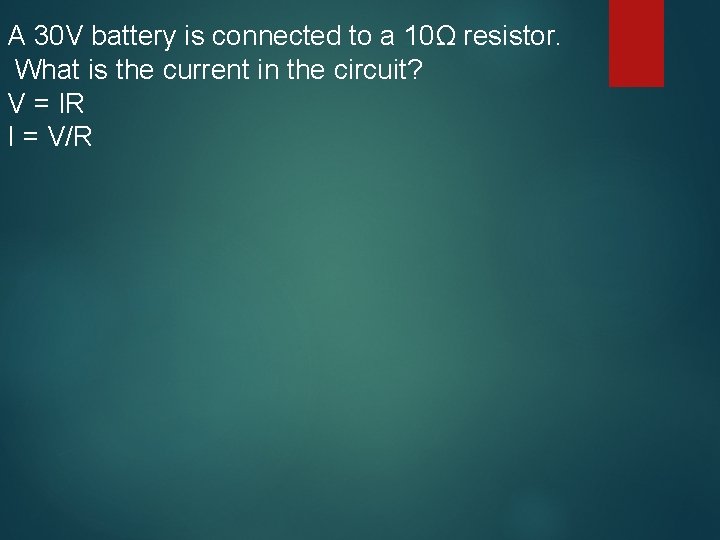
A 30 V battery is connected to a 10Ω resistor. What is the current in the circuit? V = IR I = V/R
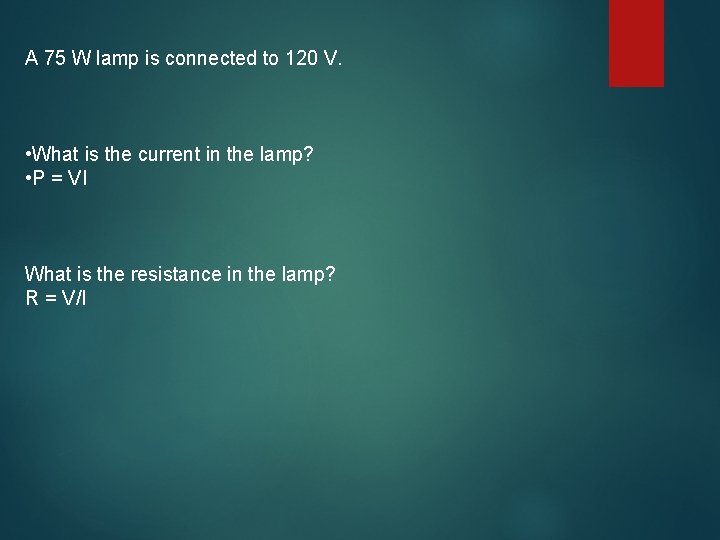
A 75 W lamp is connected to 120 V. • What is the current in the lamp? • P = VI What is the resistance in the lamp? R = V/I
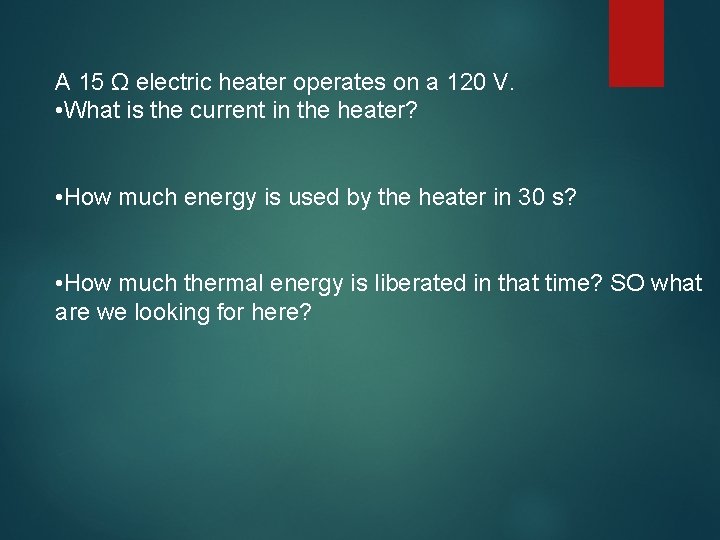
A 15 Ω electric heater operates on a 120 V. • What is the current in the heater? • How much energy is used by the heater in 30 s? • How much thermal energy is liberated in that time? SO what are we looking for here?
A 30Ω resistor is connected across 60 v battery. • What is the current in the circuit? • How much energy is used by the resistor in 5 minutes? What unit are we looking for and how do we get to it?
A 4000 W clothes dryer is connected to a 220 V circuit. How much current does the dryer draw? A 12 V battery is connected to a device and 24 m. A ( milliamps are what power of 10? ) of current is measured. If the device obeys Ohm’s law, how much current is present when a 24 V battery is used?
SYMBOLS – Follow along with your reference table Voltmeter ammeter resistor Lamp cell switch Battery variable resistor
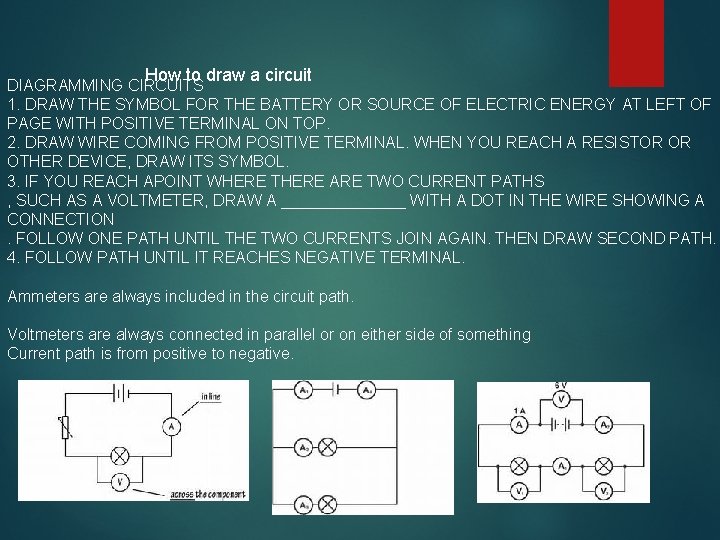
How to draw a circuit DIAGRAMMING CIRCUITS 1. DRAW THE SYMBOL FOR THE BATTERY OR SOURCE OF ELECTRIC ENERGY AT LEFT OF PAGE WITH POSITIVE TERMINAL ON TOP. 2. DRAW WIRE COMING FROM POSITIVE TERMINAL. WHEN YOU REACH A RESISTOR OR OTHER DEVICE, DRAW ITS SYMBOL. 3. IF YOU REACH APOINT WHERE THERE ARE TWO CURRENT PATHS , SUCH AS A VOLTMETER, DRAW A _______ WITH A DOT IN THE WIRE SHOWING A CONNECTION. FOLLOW ONE PATH UNTIL THE TWO CURRENTS JOIN AGAIN. THEN DRAW SECOND PATH. 4. FOLLOW PATH UNTIL IT REACHES NEGATIVE TERMINAL. Ammeters are always included in the circuit path. Voltmeters are always connected in parallel or on either side of something Current path is from positive to negative.
Example
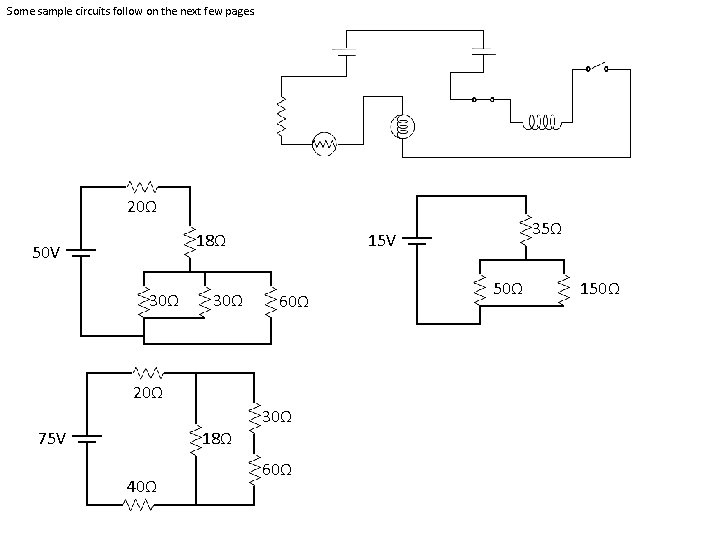
Some sample circuits follow on the next few pages. 20Ω 18Ω 50 V 30Ω 60Ω 20Ω 75 V 18Ω 40Ω 35Ω 15 V 30Ω 60Ω 50Ω 150Ω
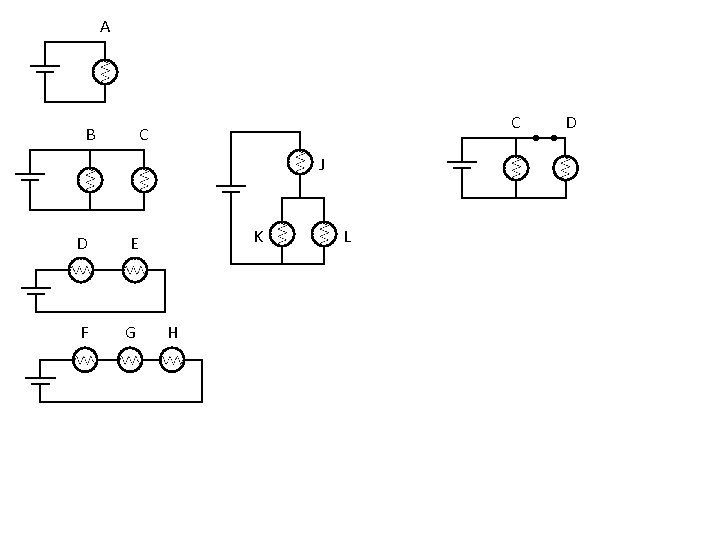
A B C C J D E F G K H L D
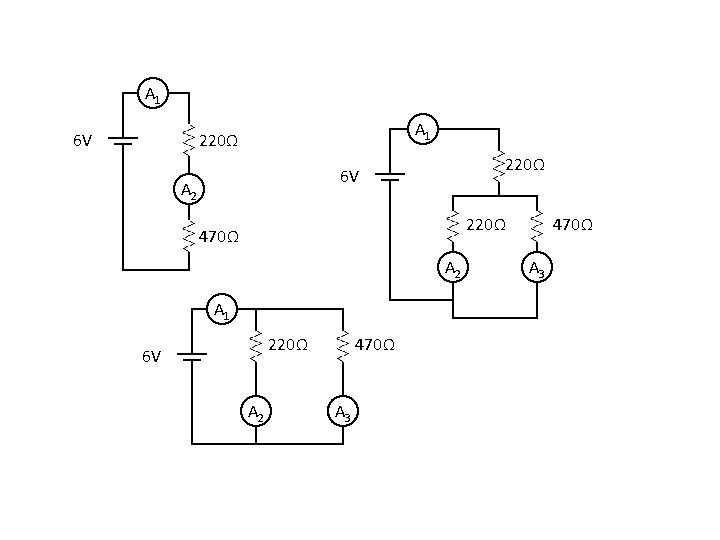
A 1 6 V A 1 220Ω 6 V A 2 220Ω 470Ω A 2 A 1 220Ω 6 V A 2 470Ω A 3
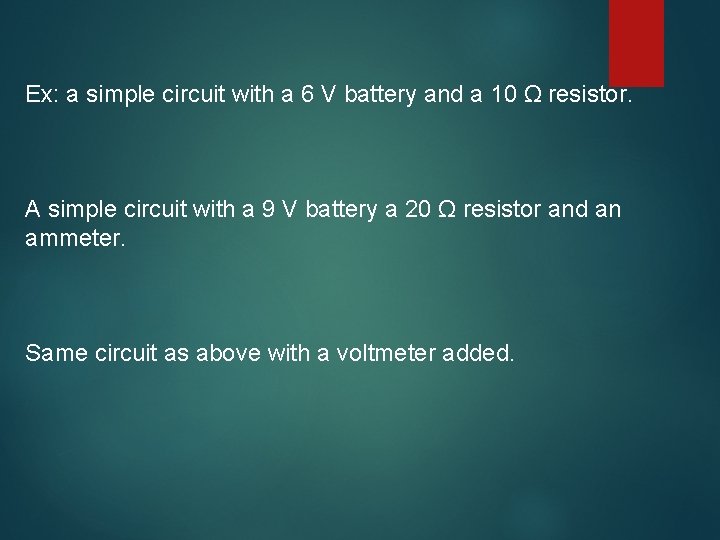
Ex: a simple circuit with a 6 V battery and a 10 Ω resistor. A simple circuit with a 9 V battery a 20 Ω resistor and an ammeter. Same circuit as above with a voltmeter added.
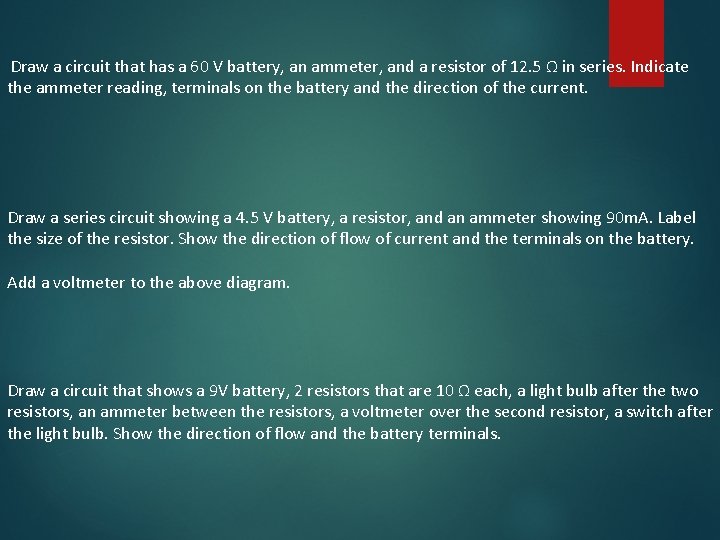
Draw a circuit that has a 60 V battery, an ammeter, and a resistor of 12. 5 Ω in series. Indicate the ammeter reading, terminals on the battery and the direction of the current. Draw a series circuit showing a 4. 5 V battery, a resistor, and an ammeter showing 90 m. A. Label the size of the resistor. Show the direction of flow of current and the terminals on the battery. Add a voltmeter to the above diagram. Draw a circuit that shows a 9 V battery, 2 resistors that are 10 Ω each, a light bulb after the two resistors, an ammeter between the resistors, a voltmeter over the second resistor, a switch after the light bulb. Show the direction of flow and the battery terminals.
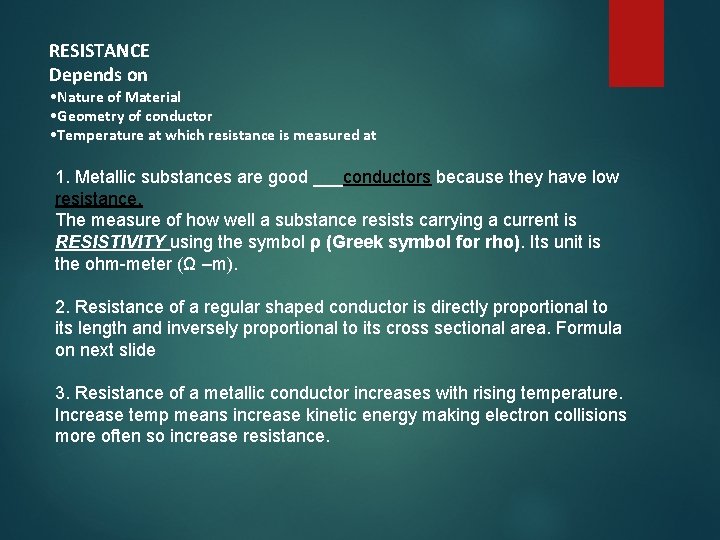
RESISTANCE Depends on • Nature of Material • Geometry of conductor • Temperature at which resistance is measured at 1. Metallic substances are good ___conductors because they have low resistance. The measure of how well a substance resists carrying a current is RESISTIVITY using the symbol ρ (Greek symbol for rho). Its unit is the ohm-meter (Ω –m). 2. Resistance of a regular shaped conductor is directly proportional to its length and inversely proportional to its cross sectional area. Formula on next slide 3. Resistance of a metallic conductor increases with rising temperature. Increase temp means increase kinetic energy making electron collisions more often so increase resistance.
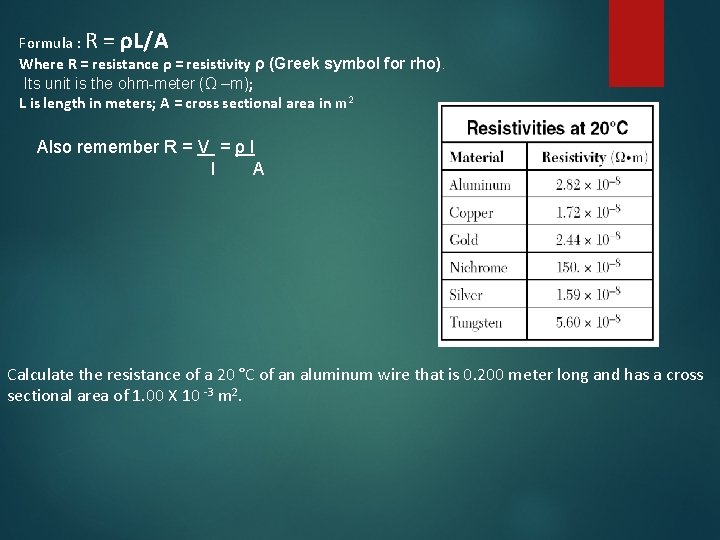
Formula : R = ρL/A Where R = resistance ρ = resistivity ρ (Greek symbol for rho). Its unit is the ohm-meter (Ω –m); L is length in meters; A = cross sectional area in m 2 Also remember R = V = ρ l I A Calculate the resistance of a 20 °C of an aluminum wire that is 0. 200 meter long and has a cross sectional area of 1. 00 X 10 -3 m 2.
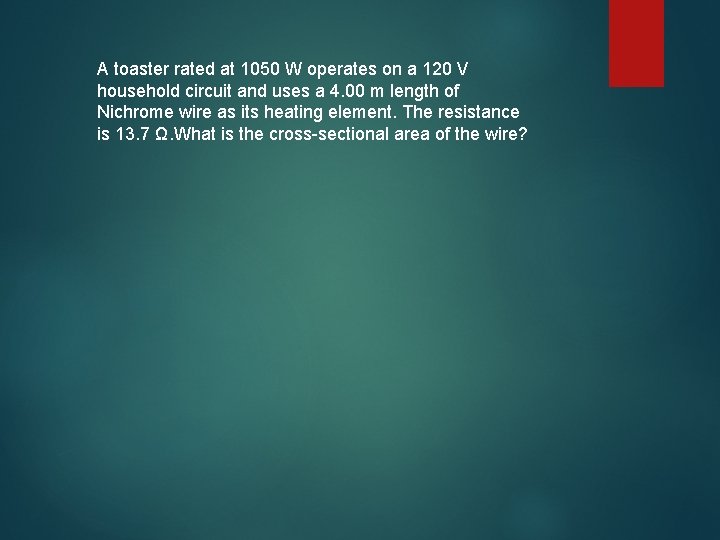
A toaster rated at 1050 W operates on a 120 V household circuit and uses a 4. 00 m length of Nichrome wire as its heating element. The resistance is 13. 7 Ω. What is the cross-sectional area of the wire?
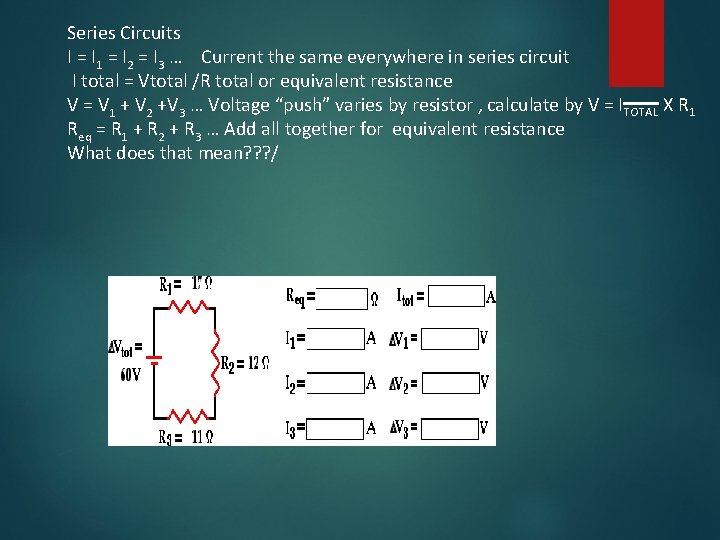
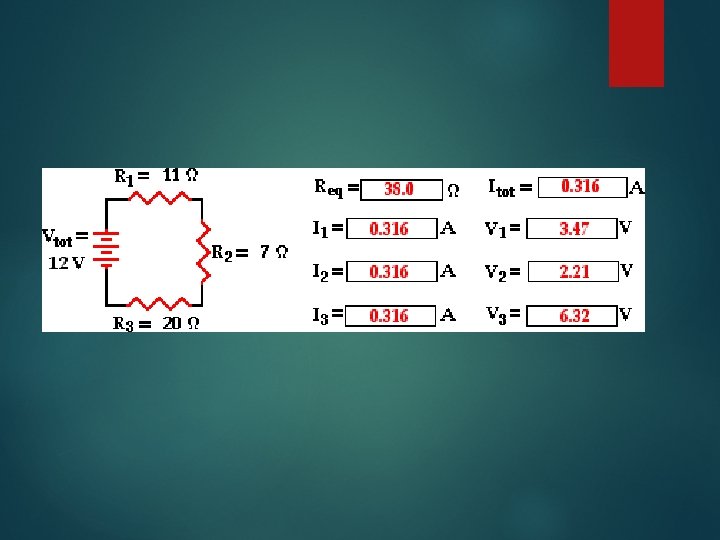
Series Circuits I = I 1 = I 2 = I 3 … Current the same everywhere in series circuit I total = Vtotal /R total or equivalent resistance V = V 1 + V 2 +V 3 … Voltage “push” varies by resistor , calculate by V = ITOTAL X R 1 Req = R 1 + R 2 + R 3 … Add all together for equivalent resistance What does that mean? ? ? /
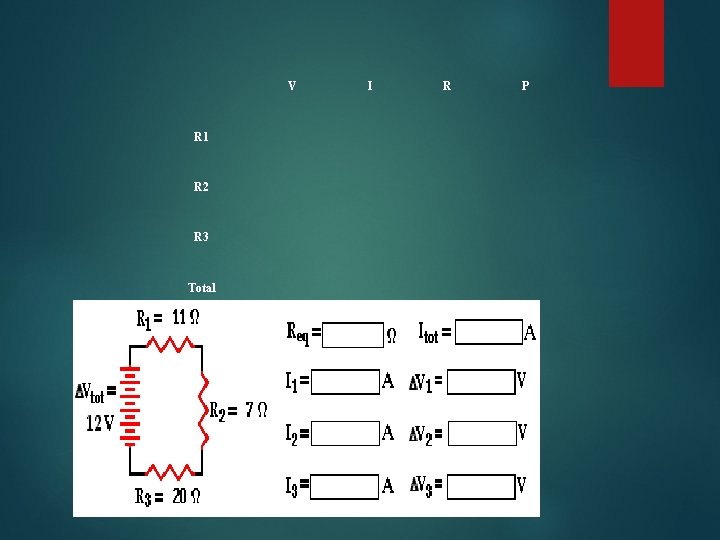
V R 1 R 2 R 3 Total I R P
1. Which of the following will cause the current through an electrical circuit to decrease? Choose all that apply. a. decrease the voltage b. decrease the resistance c. increase the voltage d. increase the resistance
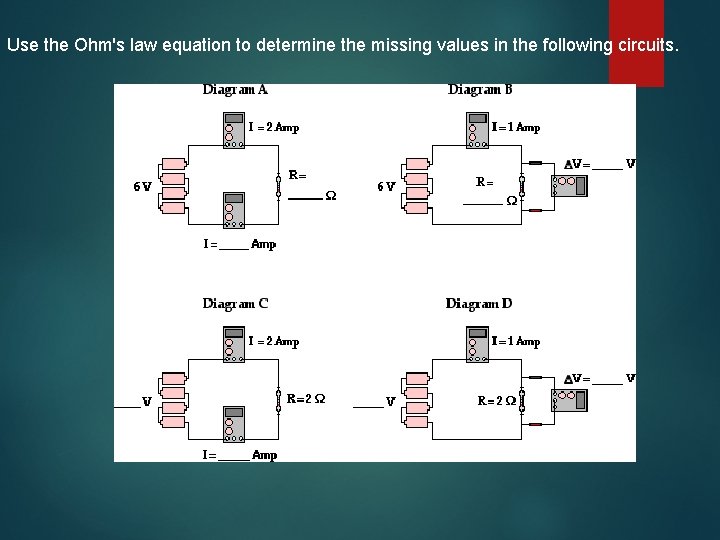
Use the Ohm's law equation to determine the missing values in the following circuits.
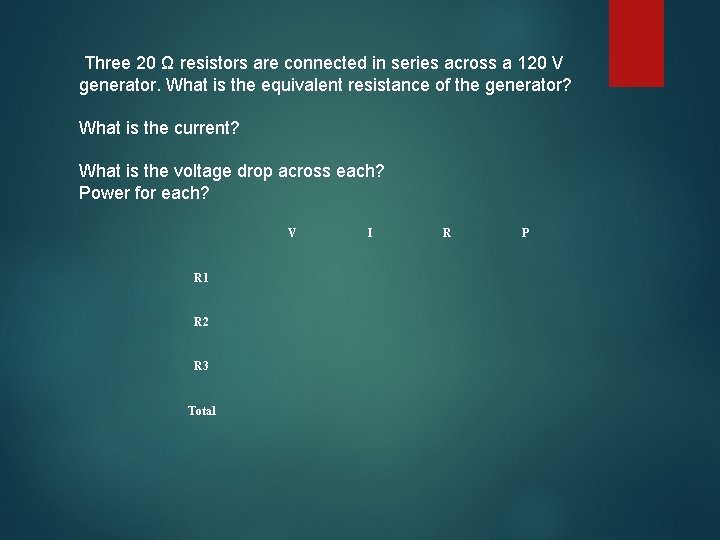
Three 20 Ω resistors are connected in series across a 120 V generator. What is the equivalent resistance of the generator? What is the current? What is the voltage drop across each? Power for each? V R 1 R 2 R 3 Total I R P
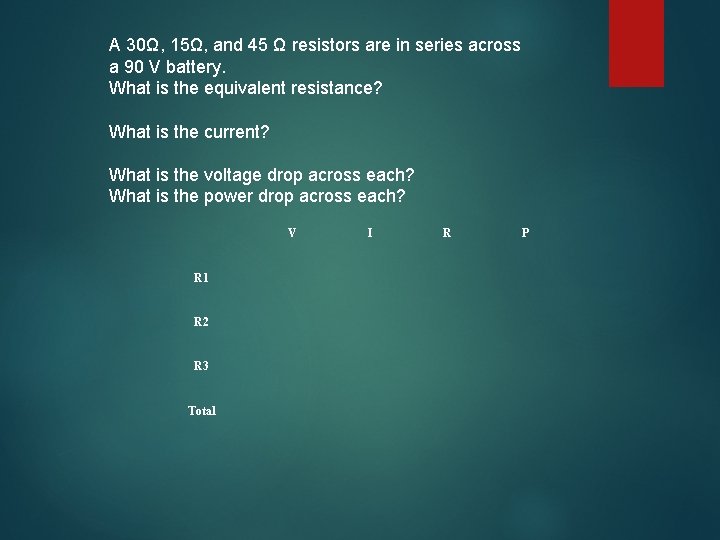
A 30Ω, 15Ω, and 45 Ω resistors are in series across a 90 V battery. What is the equivalent resistance? What is the current? What is the voltage drop across each? What is the power drop across each? V R 1 R 2 R 3 Total I R P
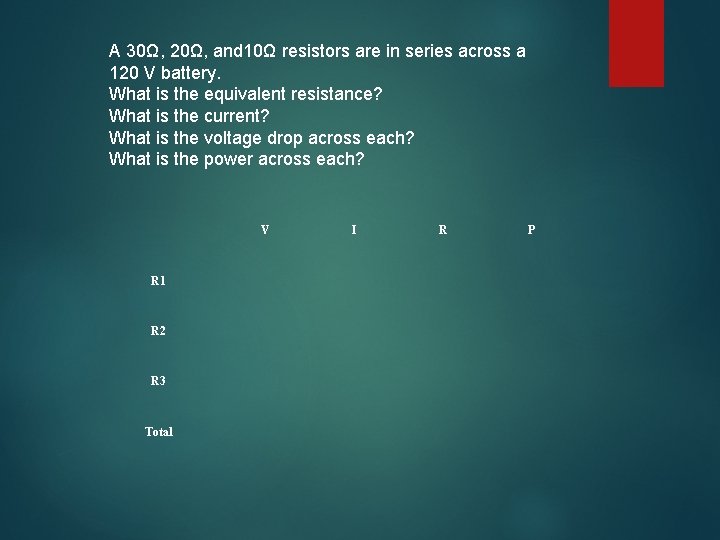
A 30Ω, 20Ω, and 10Ω resistors are in series across a 120 V battery. What is the equivalent resistance? What is the current? What is the voltage drop across each? What is the power across each? V R 1 R 2 R 3 Total I R P