
Chapter 22 B Acoustics A Power Point Presentation
Chapter 22 B: Acoustics A Power. Point Presentation by Paul E. Tippens, Professor of Physics Southern Polytechnic State University © 2007
Objectives: After completing this module, you should be able to: • Compute intensity and intensity levels of sounds and correlate with the distance to a source. • Apply the Doppler effect to predict apparent changes in frequency due to relative velocities of a source and a listener.
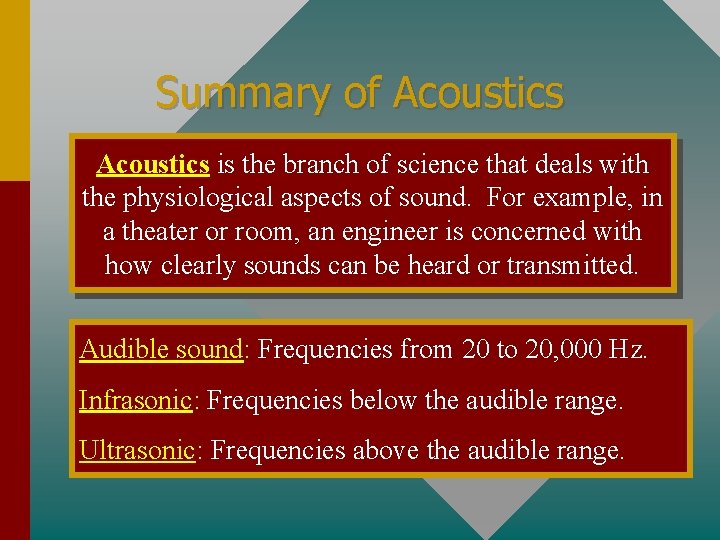
Acoustics Defined Acoustics is the branch of science that deals with the physiological aspects of sound. For example, in a theater or room, an engineer is concerned with how clearly sounds can be heard or transmitted.
Audible Sound Waves Sometimes it is useful to narrow the classification of sound to those that are audible (those that can be heard). The following definitions are used: • Audible sound: Frequencies from 20 to 20, 000 Hz. • Infrasonic: Frequencies below the audible range. • Ultrasonic: Frequencies above the audible range.
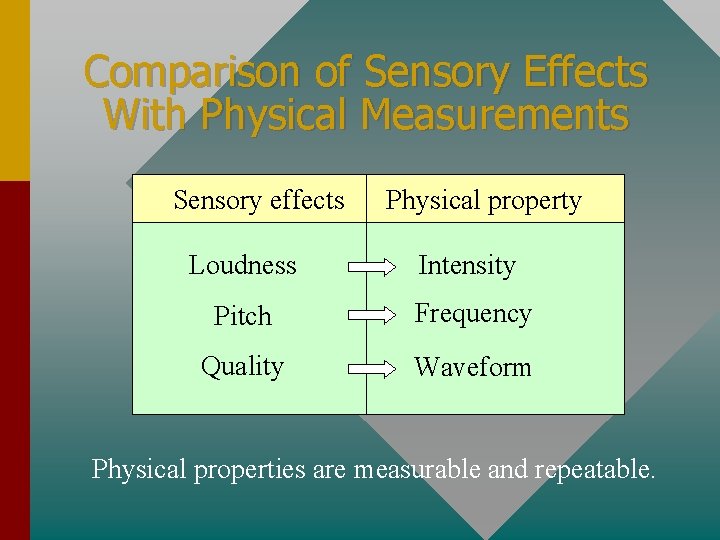
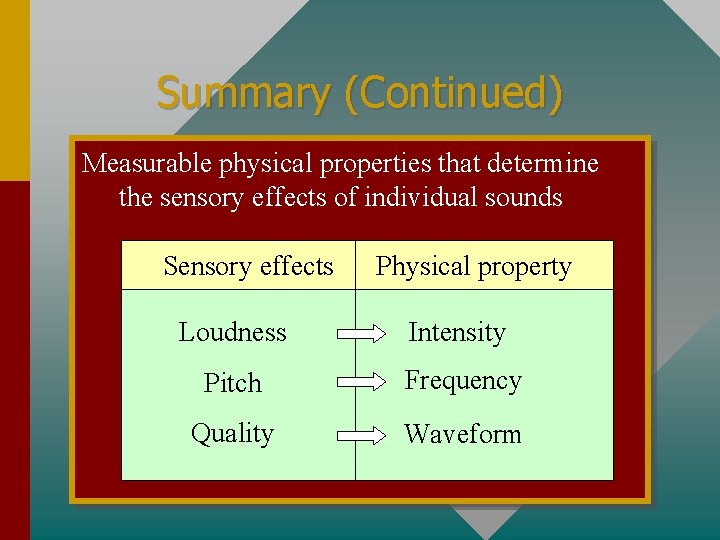
Comparison of Sensory Effects With Physical Measurements Sensory effects Physical property Loudness Intensity Pitch Frequency Quality Waveform Physical properties are measurable and repeatable.
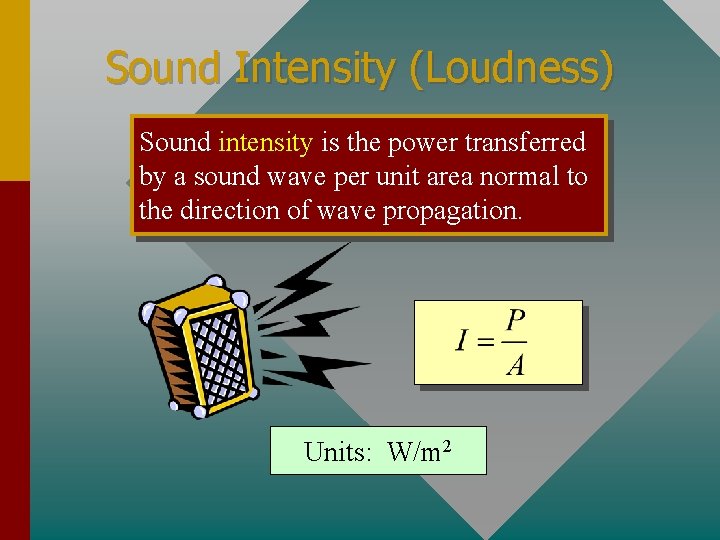
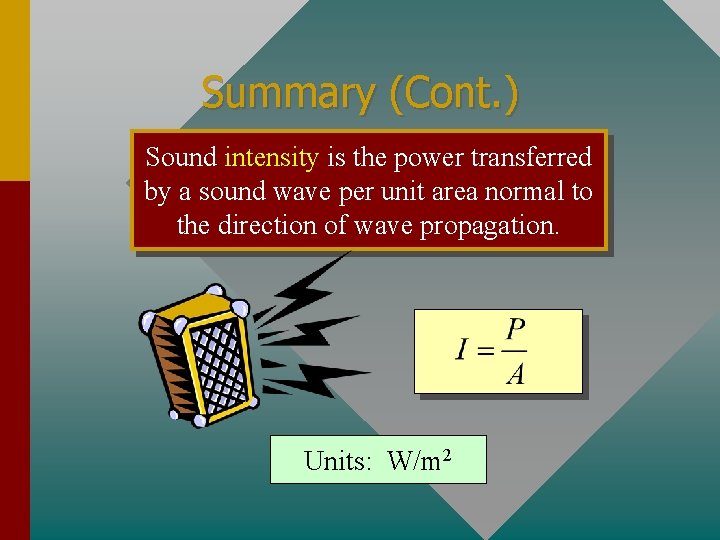
Sound Intensity (Loudness) Sound intensity is the power transferred by a sound wave per unit area normal to the direction of wave propagation. Units: W/m 2
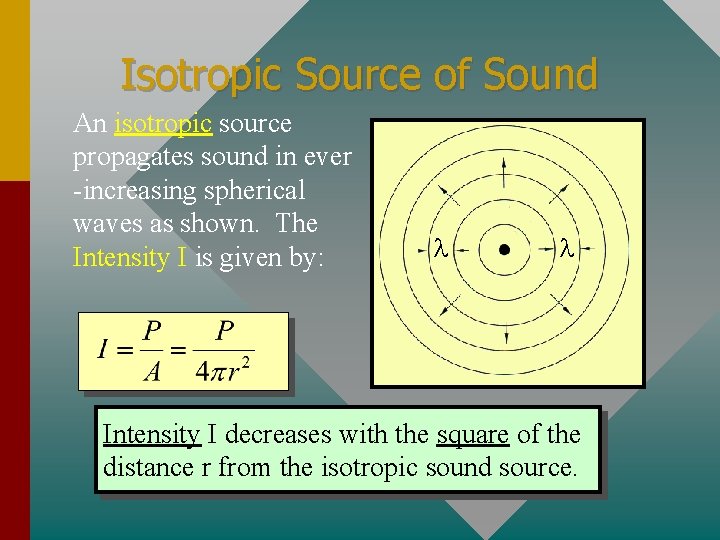
Isotropic Source of Sound An isotropic source propagates sound in ever -increasing spherical waves as shown. The Intensity I is given by: l l Intensity I decreases with the square of the distance r from the isotropic sound source.
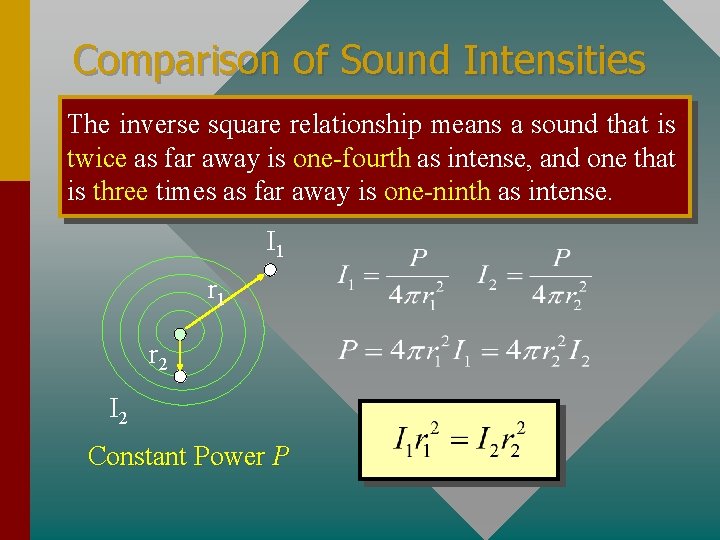
Comparison of Sound Intensities The inverse square relationship means a sound that is twice as far away is one-fourth as intense, and one that is three times as far away is one-ninth as intense. I 1 r 2 I 2 Constant Power P
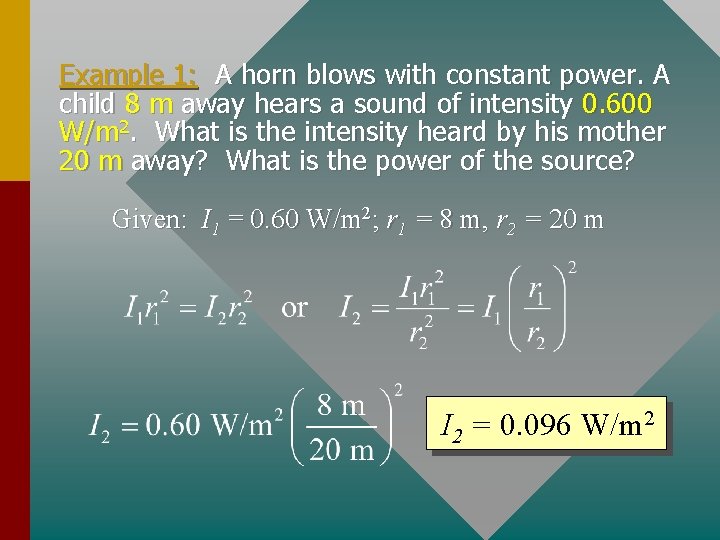
Example 1: A horn blows with constant power. A child 8 m away hears a sound of intensity 0. 600 W/m 2. What is the intensity heard by his mother 20 m away? What is the power of the source? Given: I 1 = 0. 60 W/m 2; r 1 = 8 m, r 2 = 20 m I 2 = 0. 096 W/m 2
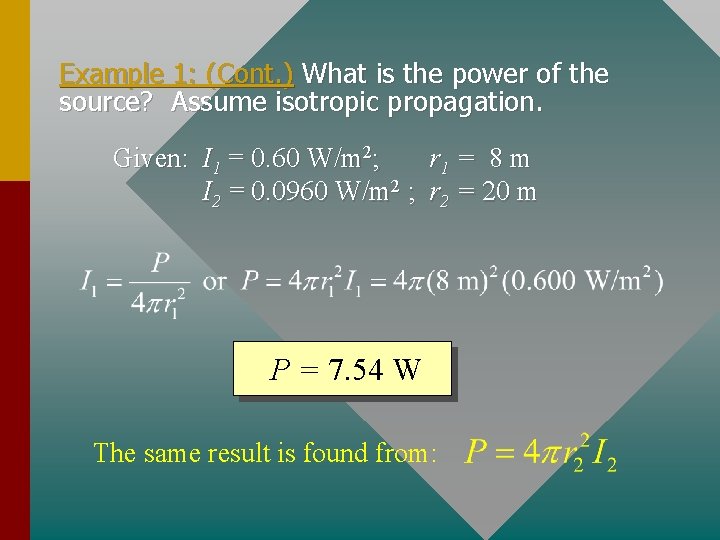
Example 1: (Cont. ) What is the power of the source? Assume isotropic propagation. Given: I 1 = 0. 60 W/m 2; r 1 = 8 m I 2 = 0. 0960 W/m 2 ; r 2 = 20 m P = 7. 54 W The same result is found from:
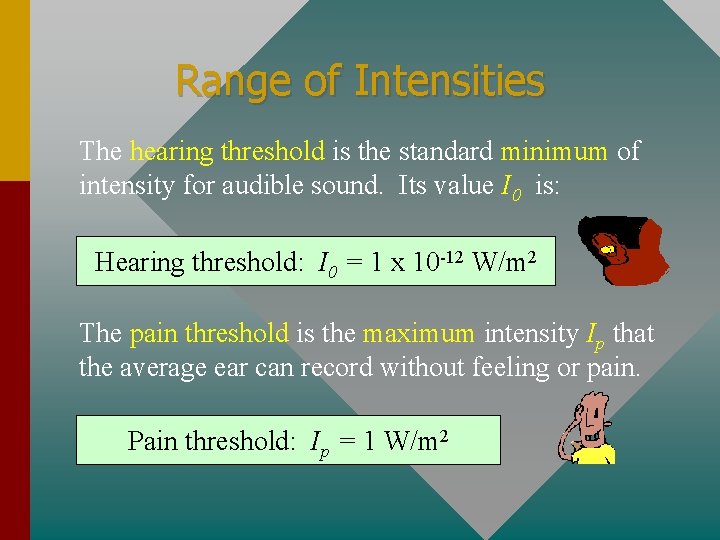
Range of Intensities The hearing threshold is the standard minimum of intensity for audible sound. Its value I 0 is: Hearing threshold: I 0 = 1 x 10 -12 W/m 2 The pain threshold is the maximum intensity Ip that the average ear can record without feeling or pain. Pain threshold: Ip = 1 W/m 2
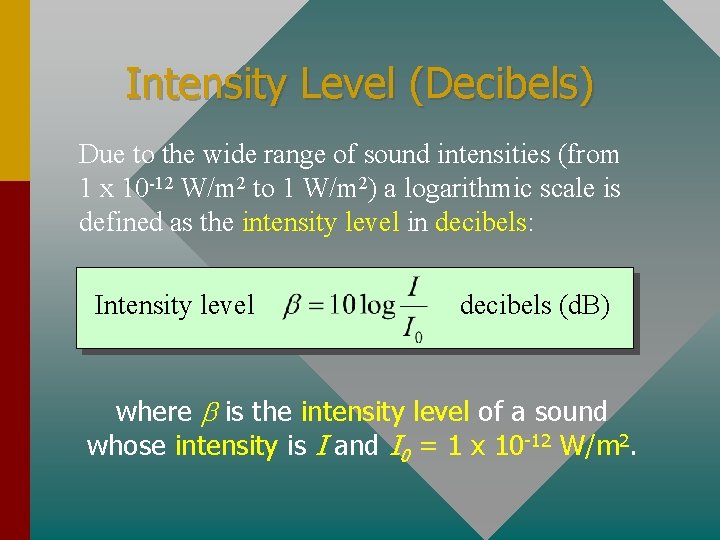
Intensity Level (Decibels) Due to the wide range of sound intensities (from 1 x 10 -12 W/m 2 to 1 W/m 2) a logarithmic scale is defined as the intensity level in decibels: Intensity level decibels (d. B) where b is the intensity level of a sound whose intensity is I and I 0 = 1 x 10 -12 W/m 2.
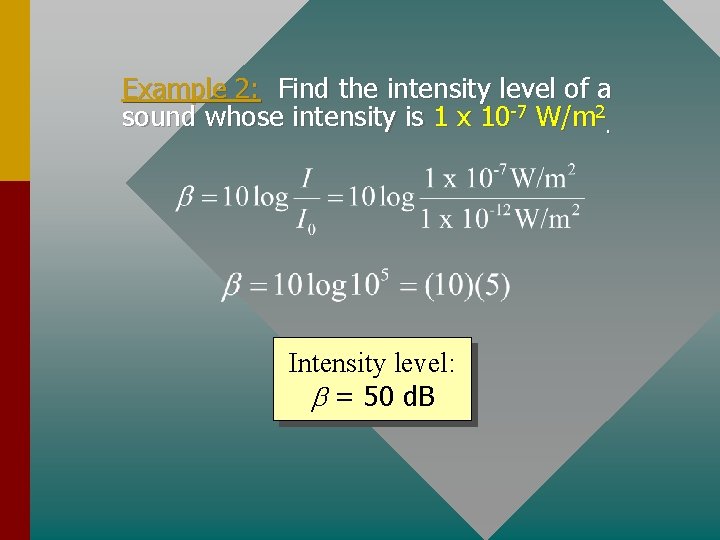
Example 2: Find the intensity level of a sound whose intensity is 1 x 10 -7 W/m 2. Intensity level: b = 50 d. B
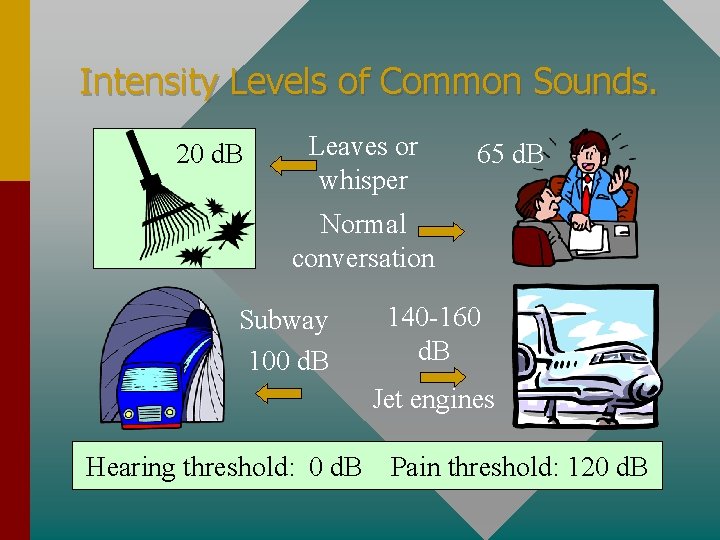
Intensity Levels of Common Sounds. 20 d. B Leaves or whisper 65 d. B Normal conversation Subway 100 d. B 140 -160 d. B Jet engines Hearing threshold: 0 d. B Pain threshold: 120 d. B
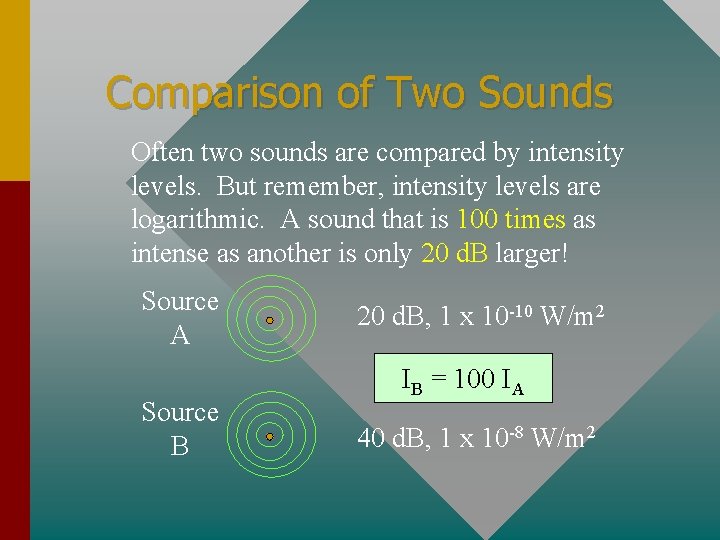
Comparison of Two Sounds Often two sounds are compared by intensity levels. But remember, intensity levels are logarithmic. A sound that is 100 times as intense as another is only 20 d. B larger! Source A Source B 20 d. B, 1 x 10 -10 W/m 2 IB = 100 IA 40 d. B, 1 x 10 -8 W/m 2
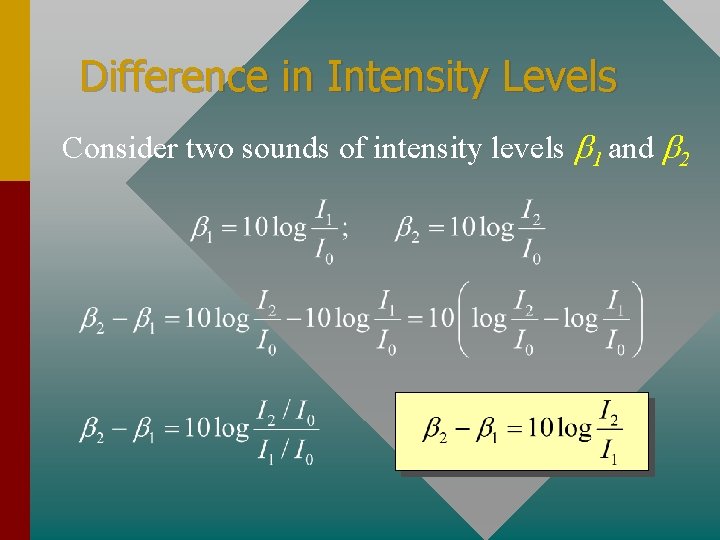
Difference in Intensity Levels Consider two sounds of intensity levels b 1 and b 2

Example 3: How much more intense is a 60 d. B sound than a 30 d. B sound? Recall definition: I 2 = 1000 I 1
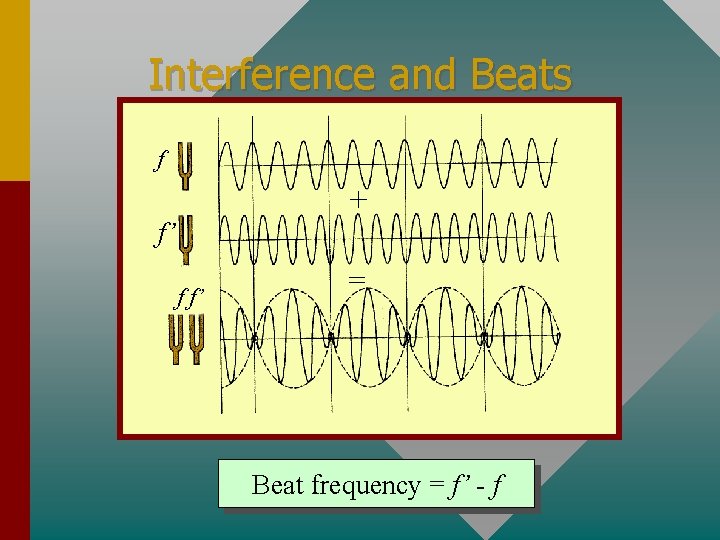
Interference and Beats f + f’ f f’ = Beat frequency = f’ - f
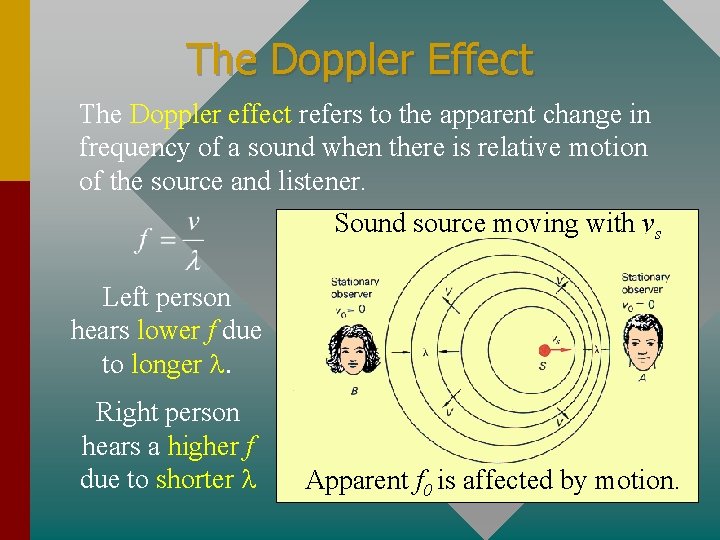
The Doppler Effect The Doppler effect refers to the apparent change in frequency of a sound when there is relative motion of the source and listener. Sound source moving with vs Left person hears lower f due to longer l. Right person hears a higher f due to shorter l Apparent f 0 is affected by motion.
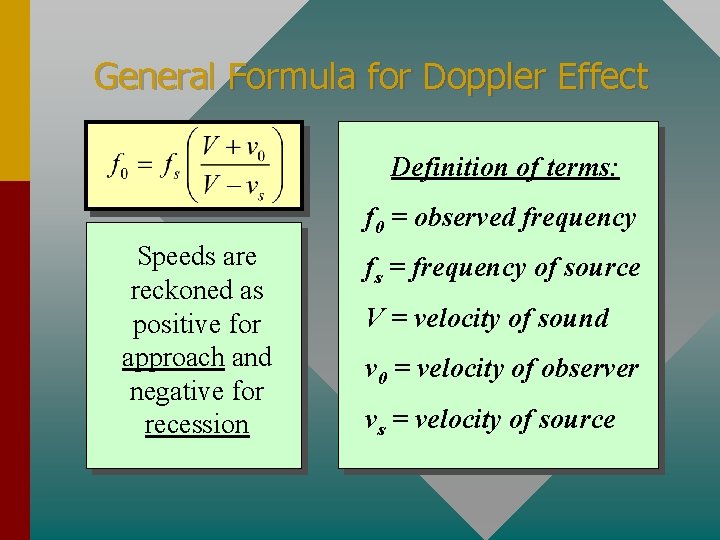
General Formula for Doppler Effect Definition of terms: f 0 = observed frequency Speeds are reckoned as positive for approach and negative for recession fs = frequency of source V = velocity of sound v 0 = velocity of observer vs = velocity of source
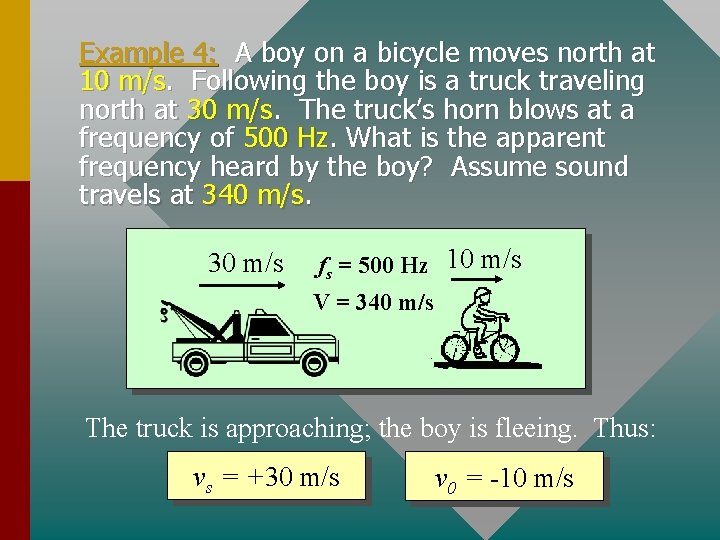
Example 4: A boy on a bicycle moves north at 10 m/s. Following the boy is a truck traveling north at 30 m/s. The truck’s horn blows at a frequency of 500 Hz. What is the apparent frequency heard by the boy? Assume sound travels at 340 m/s. 30 m/s fs = 500 Hz 10 m/s V = 340 m/s The truck is approaching; the boy is fleeing. Thus: vs = +30 m/s v 0 = -10 m/s
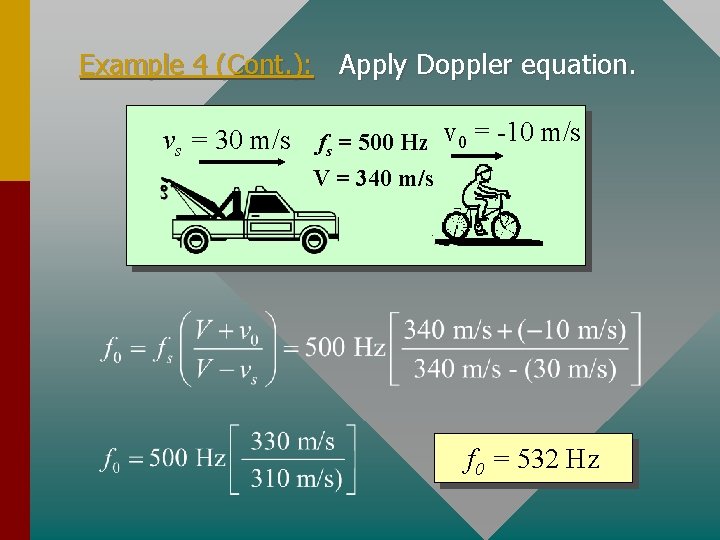
Example 4 (Cont. ): Apply Doppler equation. vs = 30 m/s fs = 500 Hz v 0 = -10 m/s V = 340 m/s f 0 = 532 Hz
Summary of Acoustics is the branch of science that deals with the physiological aspects of sound. For example, in a theater or room, an engineer is concerned with how clearly sounds can be heard or transmitted. Audible sound: Frequencies from 20 to 20, 000 Hz. Infrasonic: Frequencies below the audible range. Ultrasonic: Frequencies above the audible range.
Summary (Continued) Measurable physical properties that determine the sensory effects of individual sounds Sensory effects Physical property Loudness Intensity Pitch Frequency Quality Waveform
Summary (Cont. ) Sound intensity is the power transferred by a sound wave per unit area normal to the direction of wave propagation. Units: W/m 2
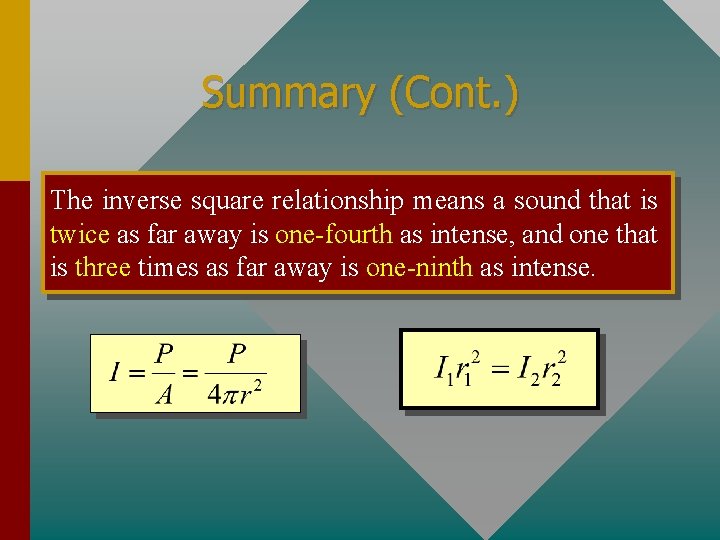
Summary (Cont. ) The inverse square relationship means a sound that is twice as far away is one-fourth as intense, and one that is three times as far away is one-ninth as intense.
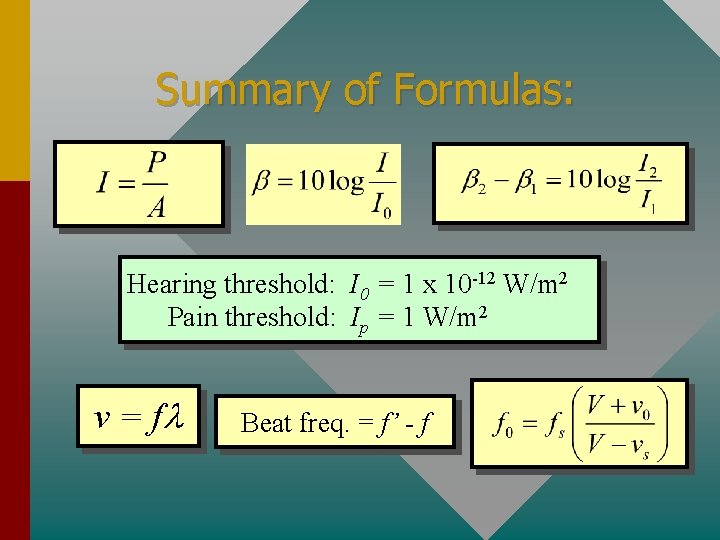
Summary of Formulas: Hearing threshold: I 0 = 1 x 10 -12 W/m 2 Pain threshold: Ip = 1 W/m 2 v = fl Beat freq. = f’ - f
CONCLUSION: Chapter 22 B Acoustics
- Slides: 28