
Chapter 21 Vulnerability and Vulnerable Populations An Overview
Chapter 21 Vulnerability and Vulnerable Populations: An Overview Juliann G. Sebastian Copyright © 2010, 2006, 2002 by Mosby, Inc. , an affiliate of Elsevier Inc.
Introduction People have different genetic compositions, social and environmental resources, skills, support systems, and access to health services People with lower incomes and less education tend to be at higher risk for health problems A goal in the United States is to eliminate health disparities by expanding access to health care for vulnerable or at-risk populations Copyright © 2010, 2006, 2002 by Mosby, Inc. , an affiliate of Elsevier Inc. 2
Vulnerability: Definition and Influencing Factors Vulnerability: susceptibility to actual or potential stressors that may lead to an adverse effect Ø Results from the interaction of internal and external factors that cause a person to be susceptible to poor health Vulnerable populations: those groups with increased risk for developing adverse health outcomes Ø Are more likely than the general population to suffer from health disparities Copyright © 2010, 2006, 2002 by Mosby, Inc. , an affiliate of Elsevier Inc. 3
Vulnerable Populations More likely to develop health problems as a result of exposure to risk or to have worse outcomes from those health problems than the population as a whole More sensitive to risk factors because they are often exposed to cumulative risk factors More likely to suffer from health disparities Vulnerability results from the combined effects of limited physical, environmental, personal resources, and biopsychosocial resources Copyright © 2010, 2006, 2002 by Mosby, Inc. , an affiliate of Elsevier Inc. 4
Predisposing Factors Social and economic factors predispose people to vulnerability Poverty is a primary cause of vulnerability and is a growing problem in the U. S. Ø Poor people have higher rates of chronic illness and infant morbidity and mortality, shorter life expectancy, and more complex health problems; child poverty rates are twice as high as those for adults Age is related to vulnerability because people at both ends of the age continuum are often less able physiologically to adapt to stressors Changes in normal physiology can predispose people to vulnerability Copyright © 2010, 2006, 2002 by Mosby, Inc. , an affiliate of Elsevier Inc. 5
Outcomes of Vulnerability Outcomes of vulnerability can be negative, such as lower health status, or they may be positive with effective interventions Vulnerable populations often have worse health outcomes than other people in terms of morbidity and mortality Often there is a cycle to vulnerability Sometimes when one problem is solved, another quickly emerges Ø Leads to feelings of hopelessness Ø Copyright © 2010, 2006, 2002 by Mosby, Inc. , an affiliate of Elsevier Inc. 6
Public Policies Affecting Vulnerable Populations Social Security Act of 1935: created largest federal support program for elderly and poor Americans Social Security Act Amendments of 1965, Medicare, and Medicaid: provided for health care needs of elderly, poor, and disabled people Ø Title XXI of the Social Security Act (1997) provides for the State Children’s Health Insurance Program (SCHIP) to provide funds to uninsured children Balanced Budget Act of 1997: influenced the use of resources for providing health services Copyright © 2010, 2006, 2002 by Mosby, Inc. , an affiliate of Elsevier Inc. 7
Ways Managed Care and Insurance Affect Vulnerable Populations Not all private health agencies wish to provide services to vulnerable populations Many managed care organizations prefer to care for the healthiest people rather than the most vulnerable (or they must do so for financial reasons); vulnerable populations are more expensive to treat because they have multiple, cumulative risks and require special service delivery considerations Lack of insurance is a major contributing factor to vulnerable populations’ limited access to health care Copyright © 2010, 2006, 2002 by Mosby, Inc. , an affiliate of Elsevier Inc. 8
Nursing Interventions Trend toward providing more comprehensive, familycentered services when treating vulnerable population groups; family-centered “one-stop” services Wrap-around services: comprehensive health services (when available), but social and economic services also provided, either directly or through referrals; in this way, social and economic services that will help ensure effectiveness of health services are “wrapped around” health services Copyright © 2010, 2006, 2002 by Mosby, Inc. , an affiliate of Elsevier Inc. 9
Nursing Interventions (cont’d) Comprehensive services: services that focus on more than one health problem or concern Ø It is helpful to provide comprehensive services in locations where people live and work Advocacy Social justice Culturally and linguistically appropriate health care Copyright © 2010, 2006, 2002 by Mosby, Inc. , an affiliate of Elsevier Inc. 10
Levels of Prevention Healthy People 2010 objectives emphasize improving health by modifying the individual, social, and environmental determinants of health Ø Having a primary care provider who coordinates health services and provides preventive services Copyright © 2010, 2006, 2002 by Mosby, Inc. , an affiliate of Elsevier Inc. 11
Assessment Issues Nurses work as partners with vulnerable clients to identify client strengths and needs and develop intervention strategies designed to break the cycle of vulnerability Assessment should include the client’s: Ø Ø Ø Socioeconomic resources Preventive health needs Congenital and genetic predisposition to illness Amount of stress Living environment/neighborhood surroundings Copyright © 2010, 2006, 2002 by Mosby, Inc. , an affiliate of Elsevier Inc. 12
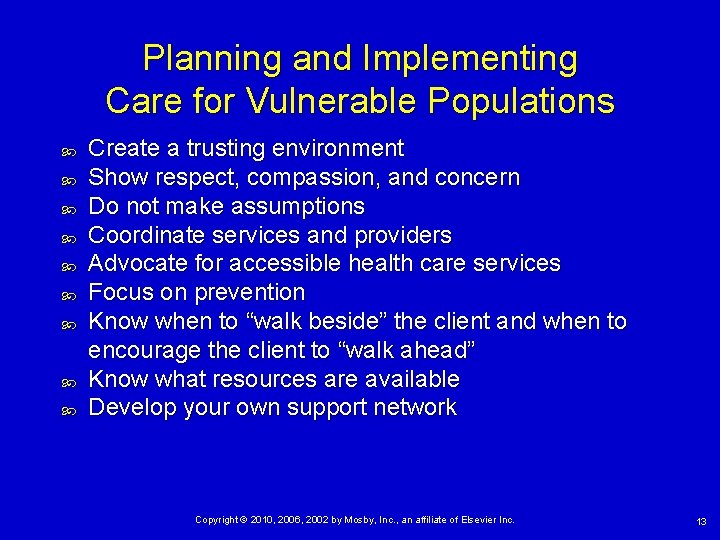
Planning and Implementing Care for Vulnerable Populations Create a trusting environment Show respect, compassion, and concern Do not make assumptions Coordinate services and providers Advocate for accessible health care services Focus on prevention Know when to “walk beside” the client and when to encourage the client to “walk ahead” Know what resources are available Develop your own support network Copyright © 2010, 2006, 2002 by Mosby, Inc. , an affiliate of Elsevier Inc. 13
- Slides: 13