
Chapter 21 Training for Anaerobic and Aerobic Power
Chapter 21 Training for Anaerobic and Aerobic Power Copyright © 2007 Lippincott Williams & Wilkins. Mc. Ardle, Katch, and Katch: Exercise Physiology: Energy, Nutrition, and Human Performance, Sixth Edition
Training Principles • Overload principle • Overload may be achieved using a combination of – Intensity – Duration – Frequency Copyright © 2007 Lippincott Williams & Wilkins. Mc. Ardle, Katch, and Katch: Exercise Physiology: Energy, Nutrition, and Human Performance, Sixth Edition

Training Principles • Specificity principle – Exercise training specificity – Specificity of O 2 max – Specificity of local changes • Individual differences principle • Reversibility principle – Detraining Copyright © 2007 Lippincott Williams & Wilkins. Mc. Ardle, Katch, and Katch: Exercise Physiology: Energy, Nutrition, and Human Performance, Sixth Edition

Anaerobic System Changes with Training • Increases in resting muscle levels of – ATP – PCr – Free creatine – Glycogen – Glycolytic enzymes • Resulting in increased capacity to generate blood lactate Copyright © 2007 Lippincott Williams & Wilkins. Mc. Ardle, Katch, and Katch: Exercise Physiology: Energy, Nutrition, and Human Performance, Sixth Edition

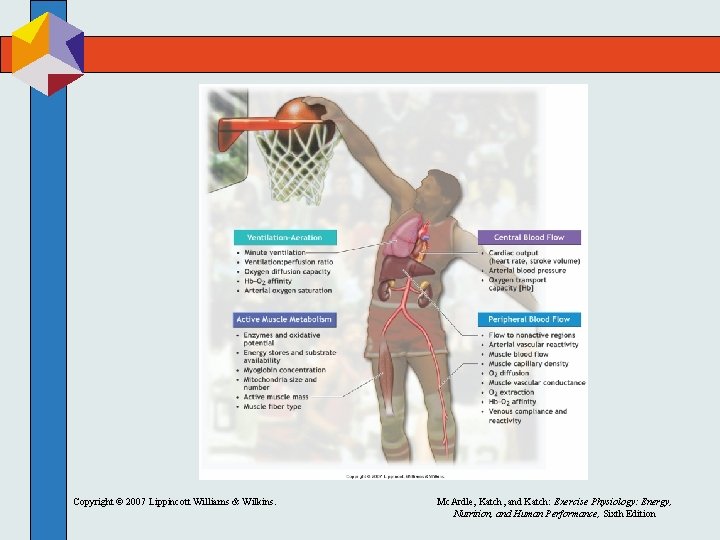
Aerobic System Changes with Training • Metabolic adaptations include – Number and size of mitochondria – Aerobic system enzymes – Fat and carbohydrate metabolism – Muscle fiber type and size – Myoglobin concentration Copyright © 2007 Lippincott Williams & Wilkins. Mc. Ardle, Katch, and Katch: Exercise Physiology: Energy, Nutrition, and Human Performance, Sixth Edition
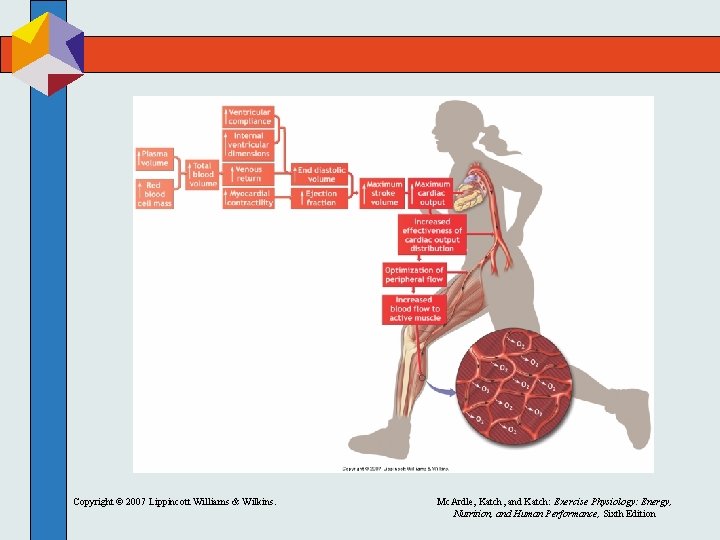
Aerobic System Changes with Training • Cardiovascular adaptations – – – – Cardiac hypertrophy: the “athlete’s heart” Plasma volume Heart rate Stroke volume Cardiac output Oxygen extraction (a- O 2 difference) Blood flow and distribution Blood pressure Copyright © 2007 Lippincott Williams & Wilkins. Mc. Ardle, Katch, and Katch: Exercise Physiology: Energy, Nutrition, and Human Performance, Sixth Edition
Copyright © 2007 Lippincott Williams & Wilkins. Mc. Ardle, Katch, and Katch: Exercise Physiology: Energy, Nutrition, and Human Performance, Sixth Edition
Aerobic System Changes with Training • Pulmonary adaptations with training – Maximal exercise • Increases ventilation – Submaximal exercise • Reduces the ventilatory equivalent for oxygen • Tidal volume increases and breathing frequency decreases – Training may benefit ventilatory endurance. Copyright © 2007 Lippincott Williams & Wilkins. Mc. Ardle, Katch, and Katch: Exercise Physiology: Energy, Nutrition, and Human Performance, Sixth Edition
Aerobic System Changes with Training • Blood lactate concentration – Decreased production – Increased clearance Copyright © 2007 Lippincott Williams & Wilkins. Mc. Ardle, Katch, and Katch: Exercise Physiology: Energy, Nutrition, and Human Performance, Sixth Edition
Other Aerobic Training Adaptations • Body composition changes – Increased lean mass – Decreased fat mass • Body heat transfer • Performance changes • Psychologic benefits Copyright © 2007 Lippincott Williams & Wilkins. Mc. Ardle, Katch, and Katch: Exercise Physiology: Energy, Nutrition, and Human Performance, Sixth Edition
Copyright © 2007 Lippincott Williams & Wilkins. Mc. Ardle, Katch, and Katch: Exercise Physiology: Energy, Nutrition, and Human Performance, Sixth Edition
Factors that Affect the Aerobic Training Response • • Initial level of aerobic fitness Training intensity Training duration Training frequency Copyright © 2007 Lippincott Williams & Wilkins. Mc. Ardle, Katch, and Katch: Exercise Physiology: Energy, Nutrition, and Human Performance, Sixth Edition
Training Intensity • Overload intensity – Train at a percentage of HRmax • 55 – 70% HRmax to get a training effect • Age-predicted maximum heart rates • Karvonen method • Perception of effect • Lactate threshold Copyright © 2007 Lippincott Williams & Wilkins. Mc. Ardle, Katch, and Katch: Exercise Physiology: Energy, Nutrition, and Human Performance, Sixth Edition
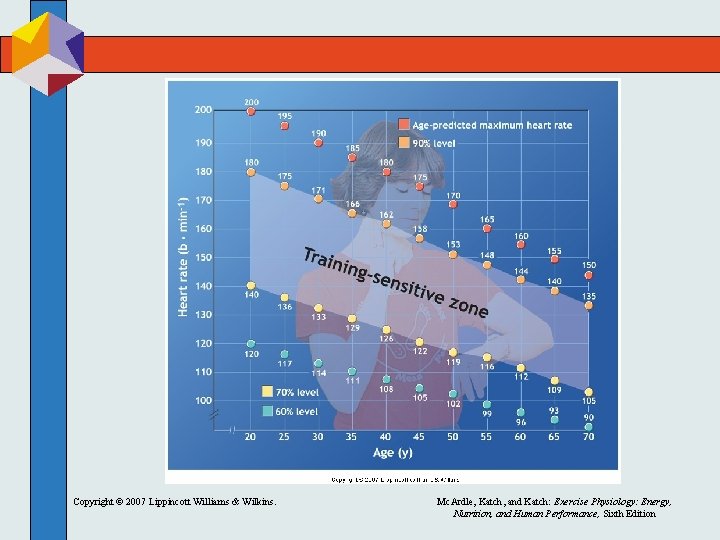
Copyright © 2007 Lippincott Williams & Wilkins. Mc. Ardle, Katch, and Katch: Exercise Physiology: Energy, Nutrition, and Human Performance, Sixth Edition

ACSM’s Updated Fitness Guidelines and Recommendations • Cardiovascular – 40 – 85% of O 2 max – 55 – 90% HR max – 3 or more days per week – 20 – 60 minutes Copyright © 2007 Lippincott Williams & Wilkins. Mc. Ardle, Katch, and Katch: Exercise Physiology: Energy, Nutrition, and Human Performance, Sixth Edition

ACSM’s Updated Fitness Guidelines and Recommendations • Muscular strength – One set of 8 – 10 different exercises – 8 – 12 reps – 2 – 3 days per week • Joint flexibility – Static and dynamic range of motion exercises, 4 reps – 2 to 3 times per week Copyright © 2007 Lippincott Williams & Wilkins. Mc. Ardle, Katch, and Katch: Exercise Physiology: Energy, Nutrition, and Human Performance, Sixth Edition
Trainability and Genes • Responses to training are very dependent upon genetics. – Responder vs. nonresponder Copyright © 2007 Lippincott Williams & Wilkins. Mc. Ardle, Katch, and Katch: Exercise Physiology: Energy, Nutrition, and Human Performance, Sixth Edition
Maintenance of Aerobic Fitness Gains • Intensity plays principal role • Tapering for peak performance Copyright © 2007 Lippincott Williams & Wilkins. Mc. Ardle, Katch, and Katch: Exercise Physiology: Energy, Nutrition, and Human Performance, Sixth Edition
Methods of Training • Anaerobic training – Intramuscular high-energy phosphates – Lactate-generating capacity • Aerobic training – Interval training – Continuous training – Fartlek training Copyright © 2007 Lippincott Williams & Wilkins. Mc. Ardle, Katch, and Katch: Exercise Physiology: Energy, Nutrition, and Human Performance, Sixth Edition
Overtraining • Sympathetic form – Hyperexcitability – Restlessness – Impaired performance • Parasympathetic form – Increased vagal activity at rest – Chronic fatigue during exercise and recovery Copyright © 2007 Lippincott Williams & Wilkins. Mc. Ardle, Katch, and Katch: Exercise Physiology: Energy, Nutrition, and Human Performance, Sixth Edition
Copyright © 2007 Lippincott Williams & Wilkins. Mc. Ardle, Katch, and Katch: Exercise Physiology: Energy, Nutrition, and Human Performance, Sixth Edition
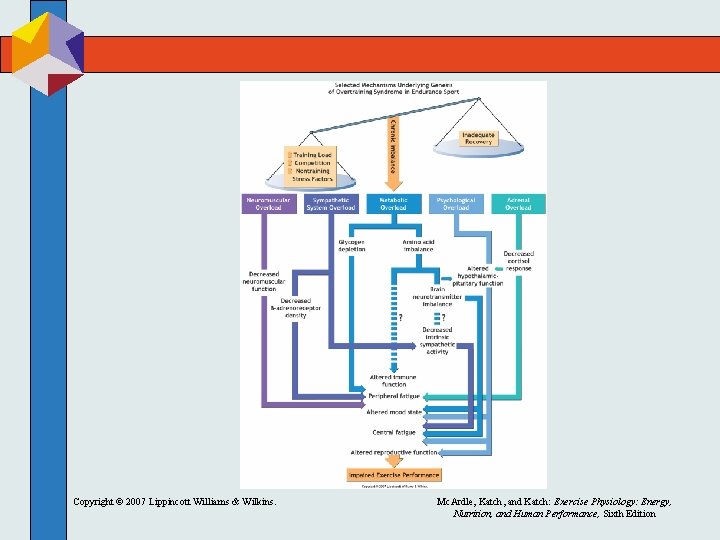
• Selected mechanisms underlying genesis of overtraining syndrome in endurance sports – Overload – Overreaching – Overtraining syndrome Copyright © 2007 Lippincott Williams & Wilkins. Mc. Ardle, Katch, and Katch: Exercise Physiology: Energy, Nutrition, and Human Performance, Sixth Edition
Exercising During Pregnancy • Exercise effects on the mother – Increases in • • Blood volume Resting oxygen consumption Resting heart rate Ventilatory response to exercise Copyright © 2007 Lippincott Williams & Wilkins. Mc. Ardle, Katch, and Katch: Exercise Physiology: Energy, Nutrition, and Human Performance, Sixth Edition
Exercising During Pregnancy • Exercise effects on the fetus – Reduced placental blood flow – Fetal hyperthermia – Reduced fetal glucose supply Copyright © 2007 Lippincott Williams & Wilkins. Mc. Ardle, Katch, and Katch: Exercise Physiology: Energy, Nutrition, and Human Performance, Sixth Edition
- Slides: 24