
Chapter 21 The Statement of Cash Flows Objectives
Chapter 21 The Statement of Cash Flows
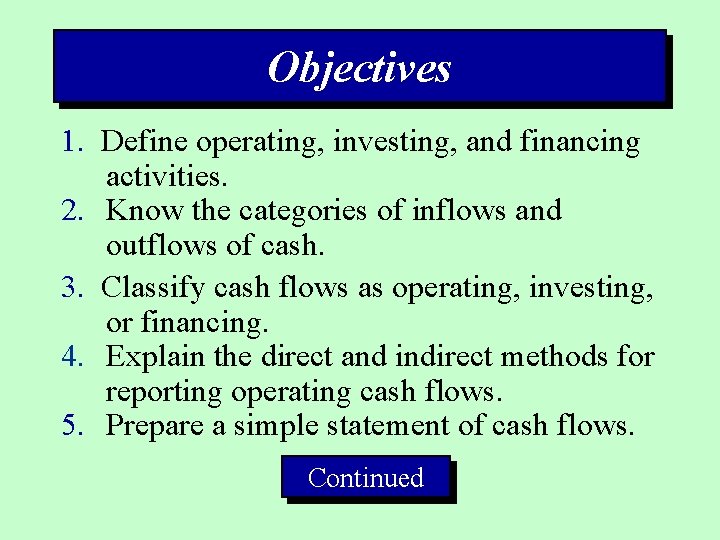
Objectives 1. Define operating, investing, and financing activities. 2. Know the categories of inflows and outflows of cash. 3. Classify cash flows as operating, investing, or financing. 4. Explain the direct and indirect methods for reporting operating cash flows. 5. Prepare a simple statement of cash flows. Continued
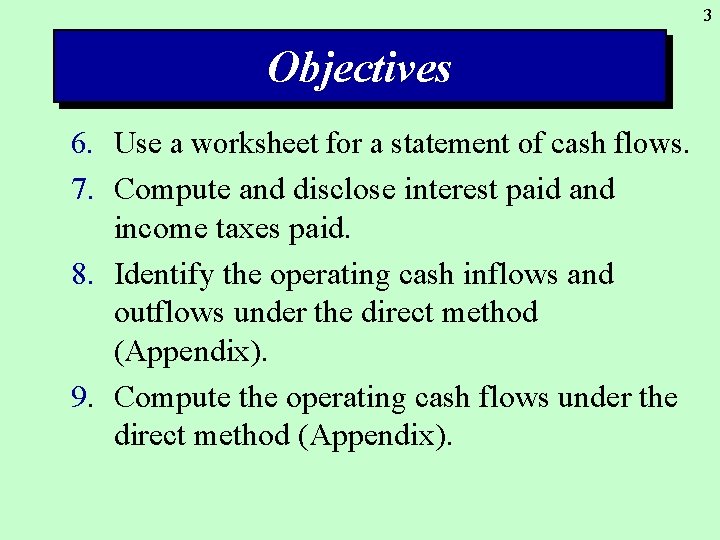
3 Objectives 6. Use a worksheet for a statement of cash flows. 7. Compute and disclose interest paid and income taxes paid. 8. Identify the operating cash inflows and outflows under the direct method (Appendix). 9. Compute the operating cash flows under the direct method (Appendix).
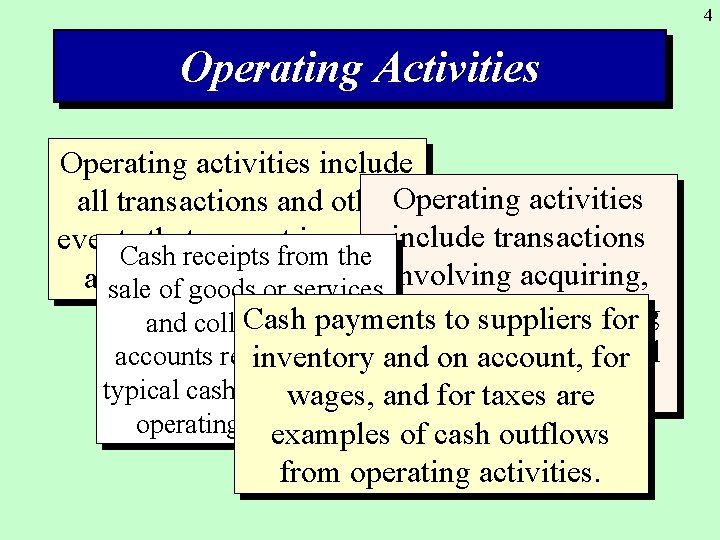
4 Operating Activities Operating activities include all transactions and other. Operating activities include transactions events that are not investing Cash receipts from the and activities. salefinancing of goods or services involving acquiring, delivering Cash payments to and suppliers for and collections of selling, sale, asfor well accounts receivable aregoods inventory and onfor account, typical cash inflows fromas wages, andproviding for taxesservices. are operating activities. examples of cash outflows from operating activities.
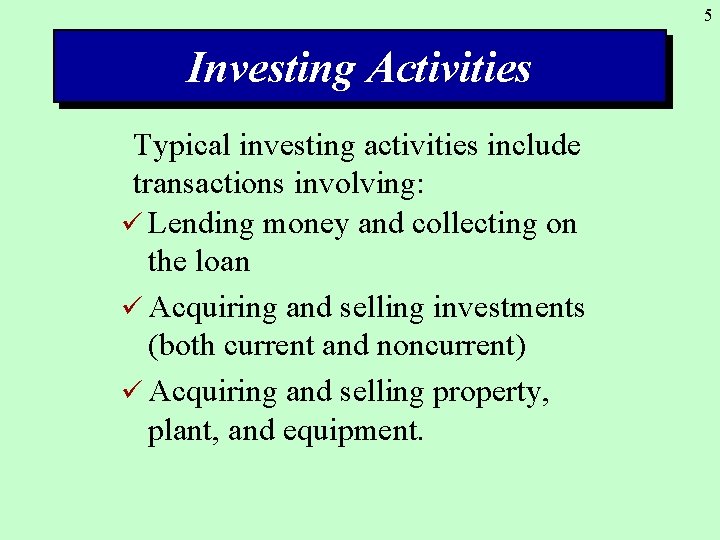
5 Investing Activities Typical investing activities include transactions involving: ü Lending money and collecting on the loan ü Acquiring and selling investments (both current and noncurrent) ü Acquiring and selling property, plant, and equipment.
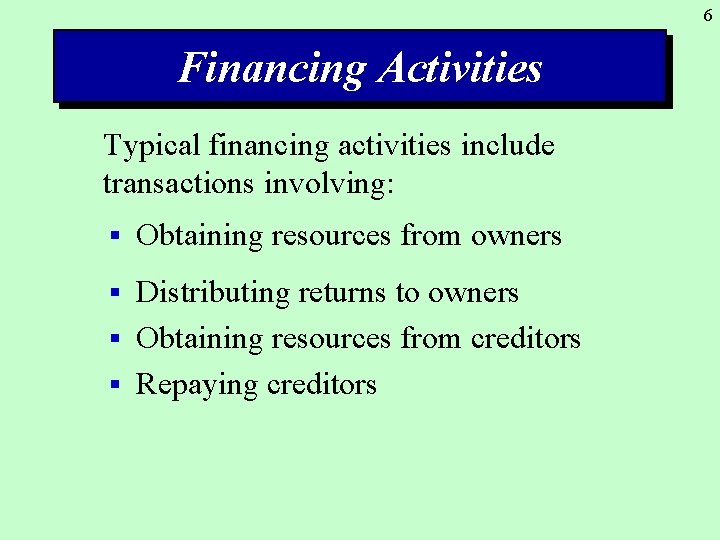
6 Financing Activities Typical financing activities include transactions involving: § Obtaining resources from owners § Distributing returns to owners § Obtaining resources from creditors § Repaying creditors
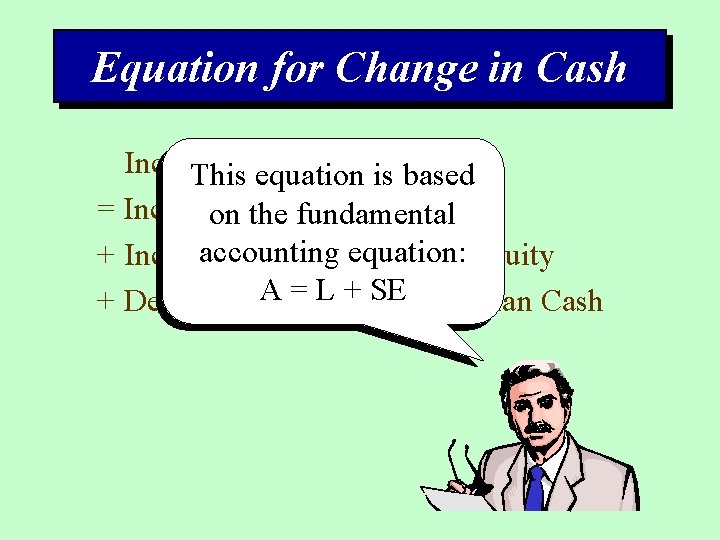
Equation for Change in Cash Increases Cash is based This in equation = Increases in Liabilities on the fundamental accounting equation: Equity + Increases in Stockholders’ L + SE + Decreases A in =Assets Other Than Cash
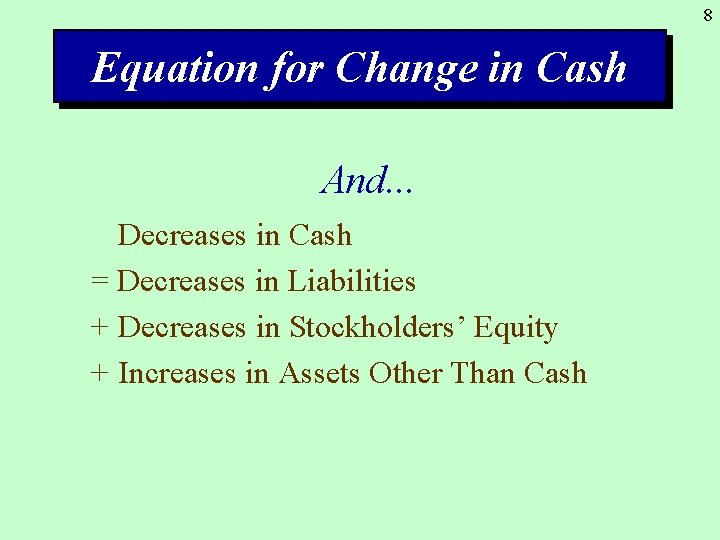
8 Equation for Change in Cash And. . . Decreases in Cash = Decreases in Liabilities + Decreases in Stockholders’ Equity + Increases in Assets Other Than Cash
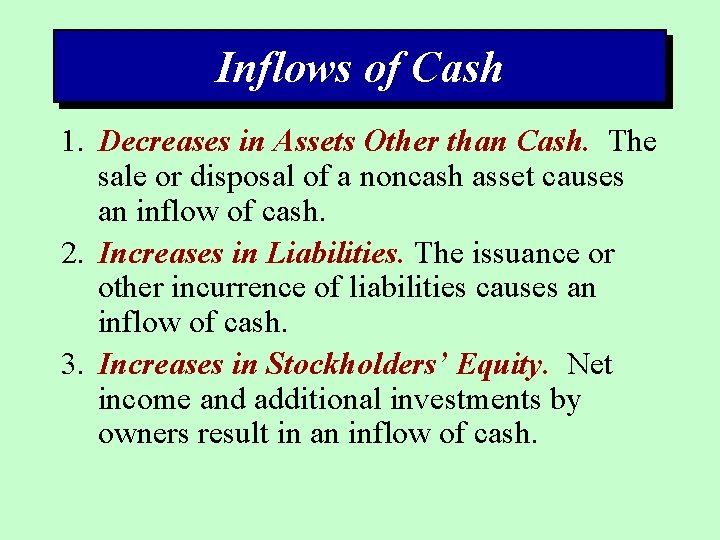
Inflows of Cash 1. Decreases in Assets Other than Cash. The sale or disposal of a noncash asset causes an inflow of cash. 2. Increases in Liabilities. The issuance or other incurrence of liabilities causes an inflow of cash. 3. Increases in Stockholders’ Equity. Net income and additional investments by owners result in an inflow of cash.
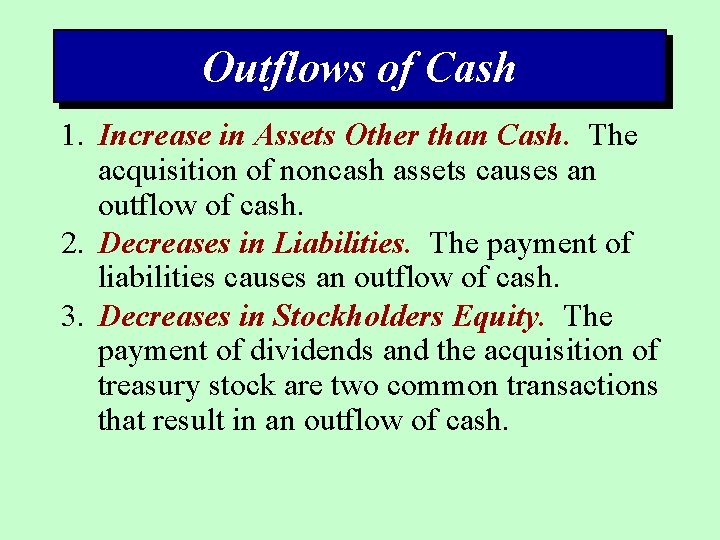
Outflows of Cash 1. Increase in Assets Other than Cash. The acquisition of noncash assets causes an outflow of cash. 2. Decreases in Liabilities. The payment of liabilities causes an outflow of cash. 3. Decreases in Stockholders Equity. The payment of dividends and the acquisition of treasury stock are two common transactions that result in an outflow of cash.
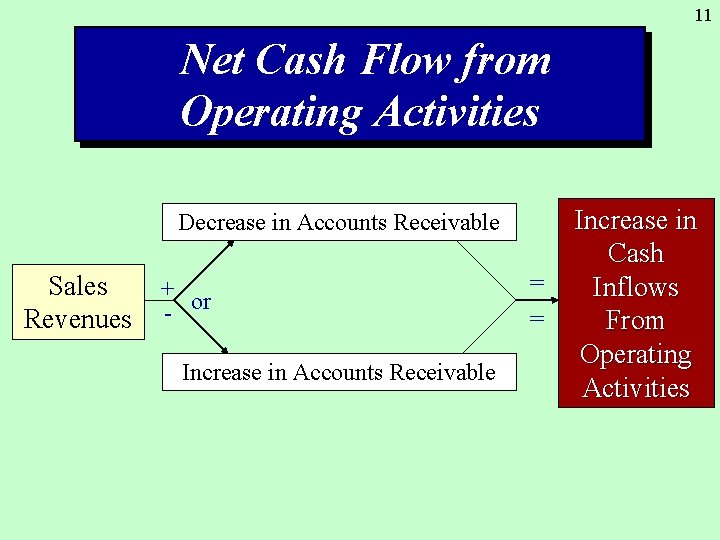
11 Net Cash Flow from Operating Activities Decrease in Accounts Receivable Sales Revenues + or Increase in Accounts Receivable = = Increase in Cash Inflows From Operating Activities
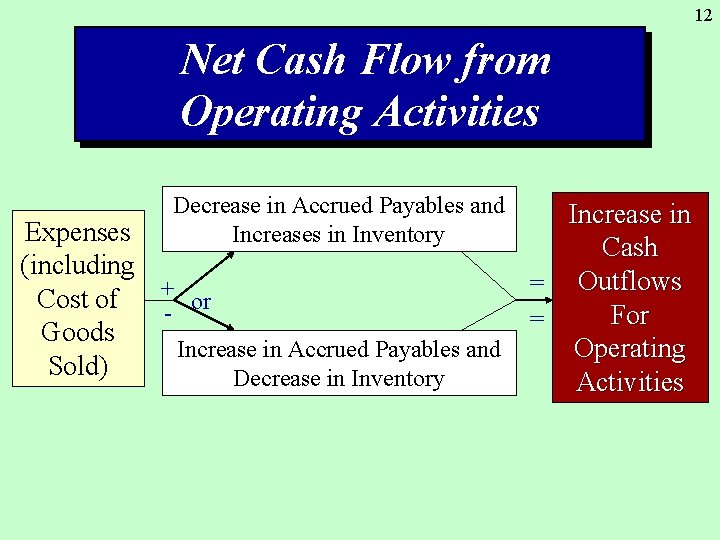
12 Net Cash Flow from Operating Activities Decrease in Accrued Payables and Increases in Inventory Expenses (including + or Cost of Goods Increase in Accrued Payables and Sold) Decrease in Inventory Increase in Cash = Outflows For = Operating Activities
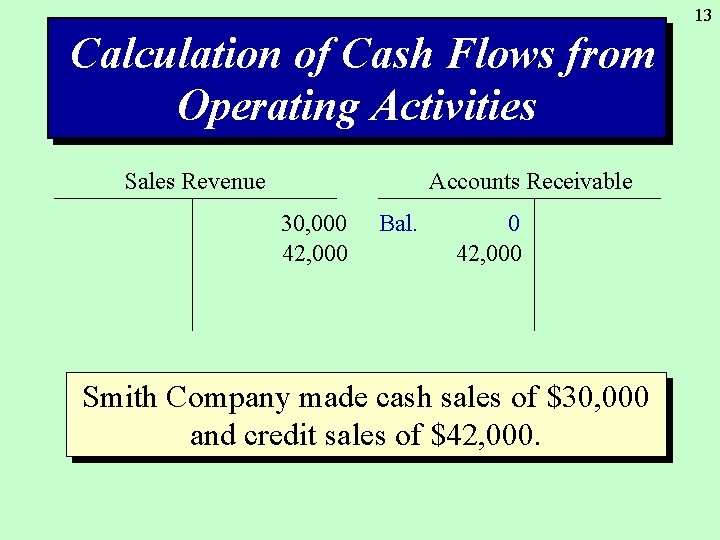
13 Calculation of Cash Flows from Operating Activities Sales Revenue Accounts Receivable 30, 000 42, 000 Bal. 0 42, 000 Smith Company made cash sales of $30, 000 and credit sales of $42, 000.
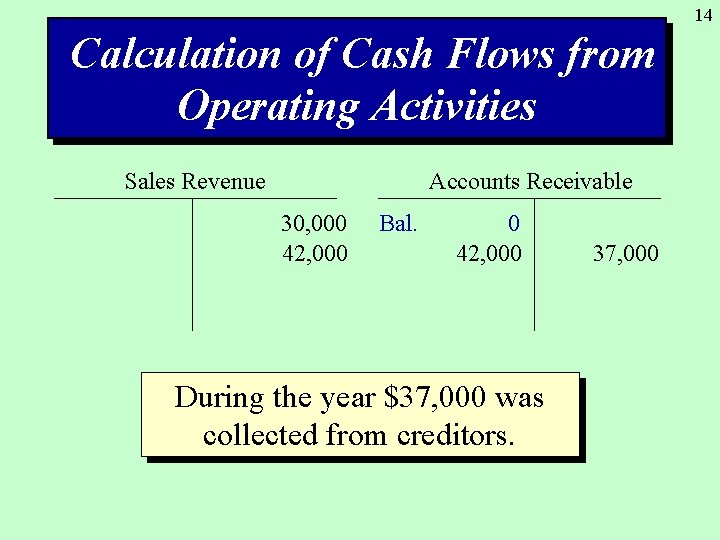
14 Calculation of Cash Flows from Operating Activities Sales Revenue Accounts Receivable 30, 000 42, 000 Bal. 0 42, 000 During the year $37, 000 was collected from creditors. 37, 000
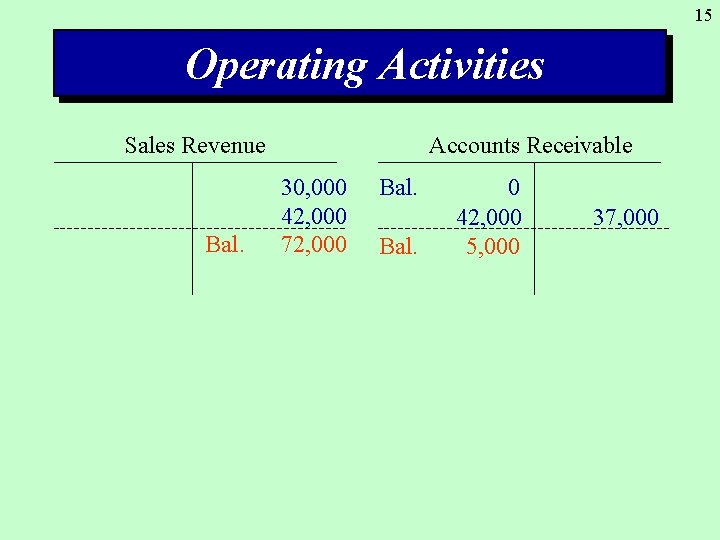
15 Operating Activities Sales Revenue Bal. Accounts Receivable 30, 000 42, 000 72, 000 Bal. 0 42, 000 5, 000 37, 000
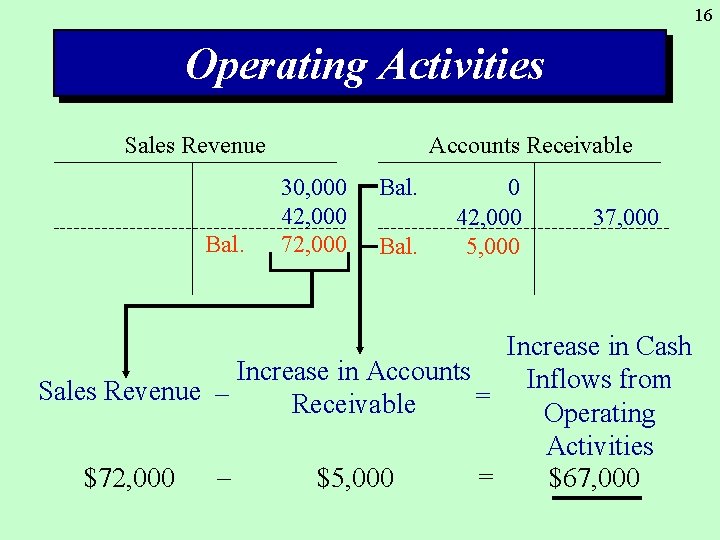
16 Operating Activities Sales Revenue Bal. Accounts Receivable 30, 000 42, 000 72, 000 Bal. 0 42, 000 5, 000 37, 000 Increase in Cash Increase in Accounts Inflows from Sales Revenue – = Receivable Operating Activities $72, 000 $5, 000 = $67, 000
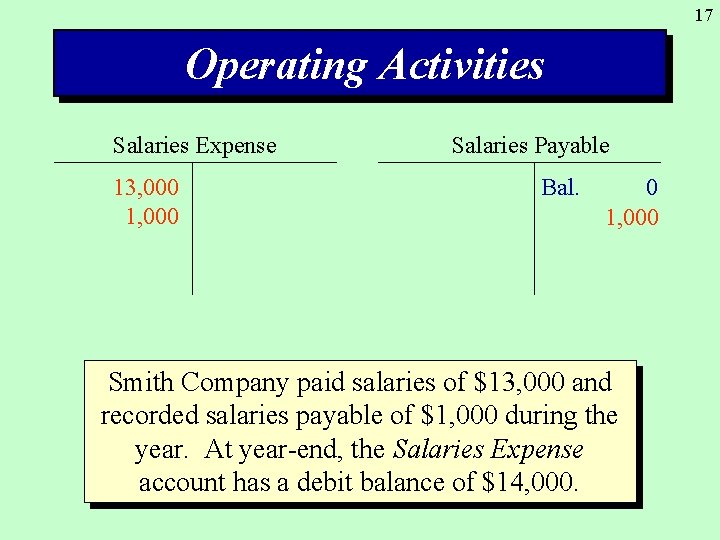
17 Operating Activities Salaries Expense 13, 000 1, 000 Salaries Payable Bal. 0 1, 000 Smith Company paid salaries of $13, 000 and recorded salaries payable of $1, 000 during the year. At year-end, the Salaries Expense account has a debit balance of $14, 000.
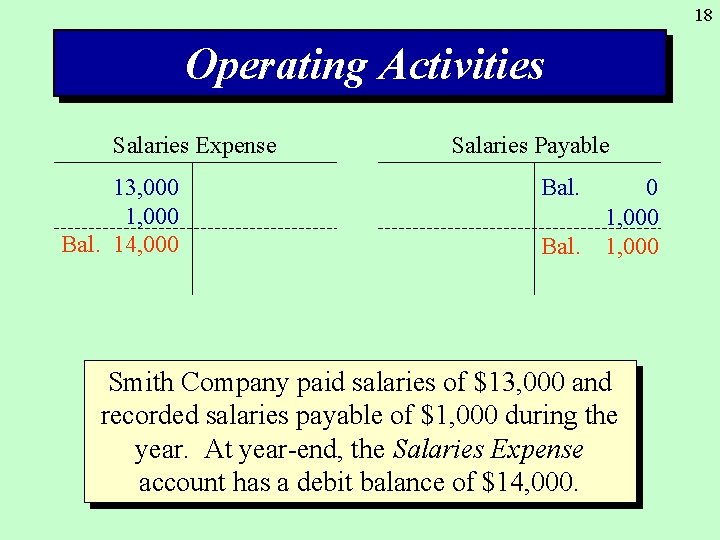
18 Operating Activities Salaries Expense 13, 000 1, 000 Bal. 14, 000 Salaries Payable Bal. 0 1, 000 Smith Company paid salaries of $13, 000 and recorded salaries payable of $1, 000 during the year. At year-end, the Salaries Expense account has a debit balance of $14, 000.
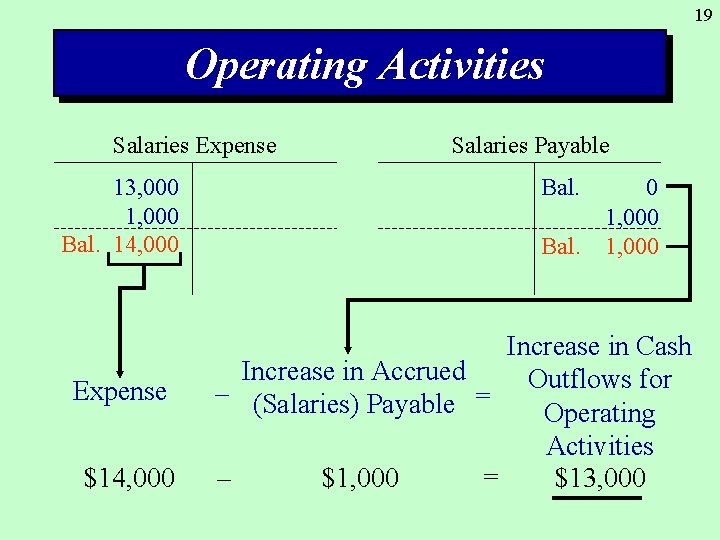
19 Operating Activities Salaries Expense 13, 000 1, 000 Bal. 14, 000 Expense $14, 000 Salaries Payable Bal. 0 1, 000 Increase in Cash Increase in Accrued – (Salaries) Payable = Outflows for Operating Activities – $1, 000 = $13, 000
20 Direct Method FASB Statement Number 95 allows a choice of the direct or indirect method to report cash flows from operations.
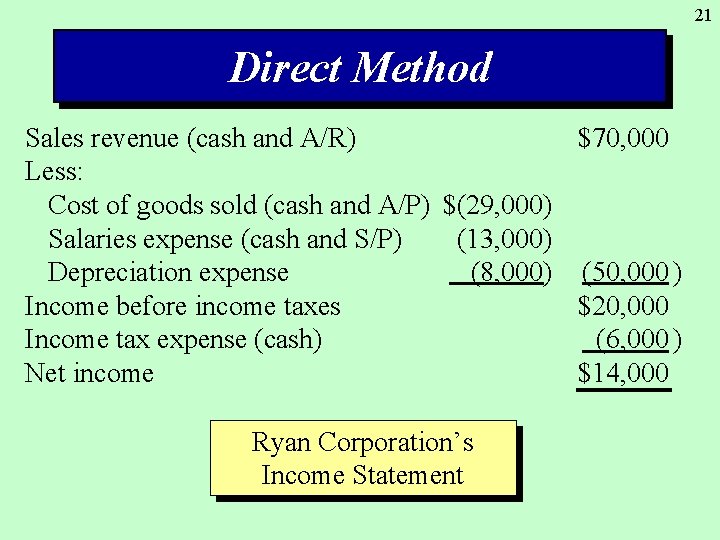
21 Direct Method Sales revenue (cash and A/R) $70, 000 Less: Cost of goods sold (cash and A/P) $(29, 000) Salaries expense (cash and S/P) (13, 000) Depreciation expense (8, 000) (50, 000 ) Income before income taxes $20, 000 Income tax expense (cash) (6, 000 ) Net income $14, 000 Ryan Corporation’s Income Statement
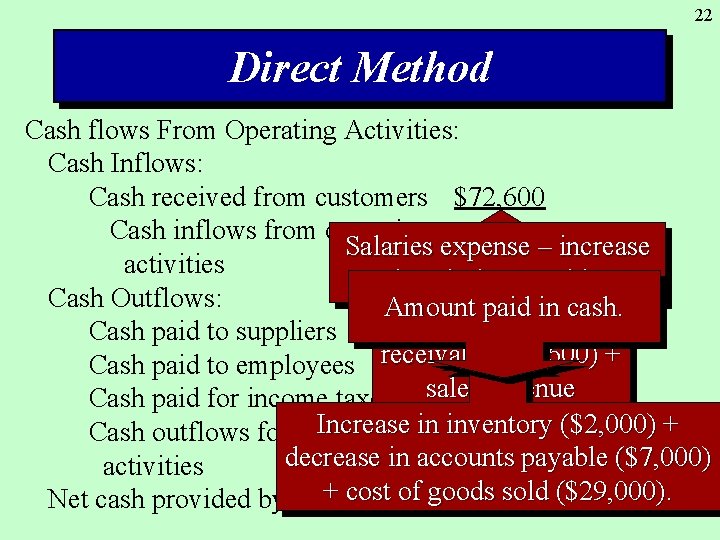
22 Direct Method Cash flows From Operating Activities: Cash Inflows: Cash received from customers $72, 600 Cash inflows from operating Salaries expense – increase activities $72, 600 in salaries payable Cash Outflows: Amount paid in cash. Decrease in accounts Cash paid to suppliers $(38, 000) ($2, 600) + Cash paid to employees receivable (12, 200) revenue Cash paid for income taxes sales(6, 000) ($70, 000) ($2, 000) + Increase in inventory Cash outflows for operating decrease in accounts payable ($7, 000) activities (56, 200 ) + cost of goods sold ($29, 000). Net cash provided by operating activities $16, 400
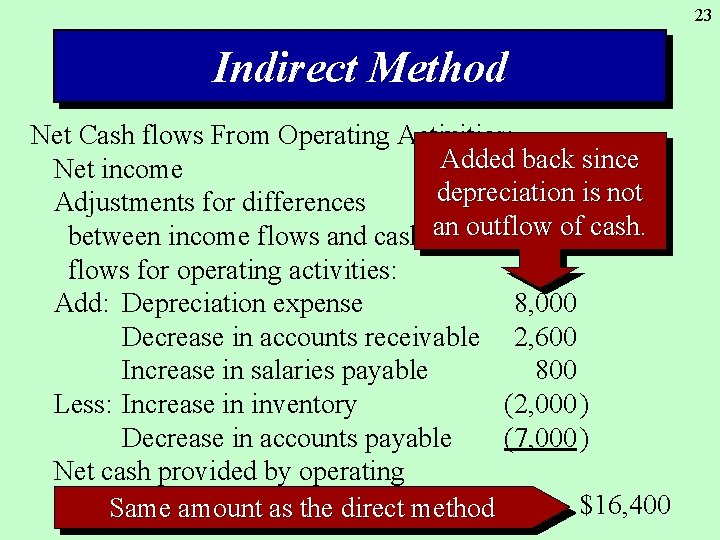
23 Indirect Method Net Cash flows From Operating Activities: Added back since Net income $14, 000 depreciation is not Adjustments for differences between income flows and cash an outflow of cash. flows for operating activities: Add: Depreciation expense 8, 000 Decrease in accounts receivable 2, 600 Increase in salaries payable 800 Less: Increase in inventory (2, 000 ) Decrease in accounts payable (7, 000 ) Net cash provided by operating activities $16, 400 Same amount as the direct method
24 Procedures for Preparation of Statement
Steps in Visual Inspection Method 1. Prepare the heading for the statement of cash flows and list the three major sections. 2. Calculate the net change in cash that occurred during the accounting period. 3. Determine the net income and list this amount as the first item in the net cash flow from operating activities section. 4. Calculate the increase or decrease that occurred during the accounting period in each balance sheet account (except cash). Continued
26 Steps in Visual Inspection Method 5. Determine whether the increase or decrease in each balance sheet account (except cash) caused an inflow or outflow of cash and, if so, whether the cash flow was related to an operating, investing, or financing activity. 6. If no cash flow occurred in Step 5, determine whether the increase or decrease in each balance sheet account (except cash) was the result of a noncash income statement item or a simultaneous investing and/or financing transaction. Continued
27 Steps in Visual Inspection Method 7. Complete the various sections of the statement of cash flows and check that the subtotals of the sections sum to the net change in cash and that the sum of the net change in cash and the beginning cash balance is equal to the ending cash balance reported on the balance sheet.
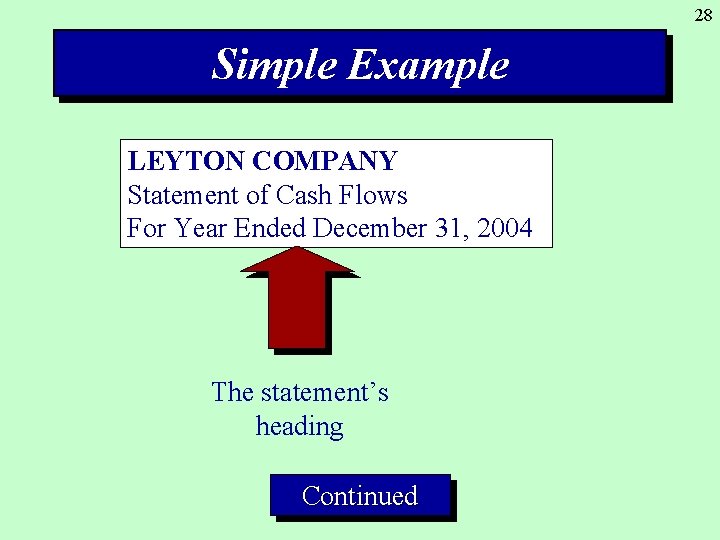
28 Simple Example LEYTON COMPANY Statement of Cash Flows For Year Ended December 31, 2004 The statement’s heading Continued
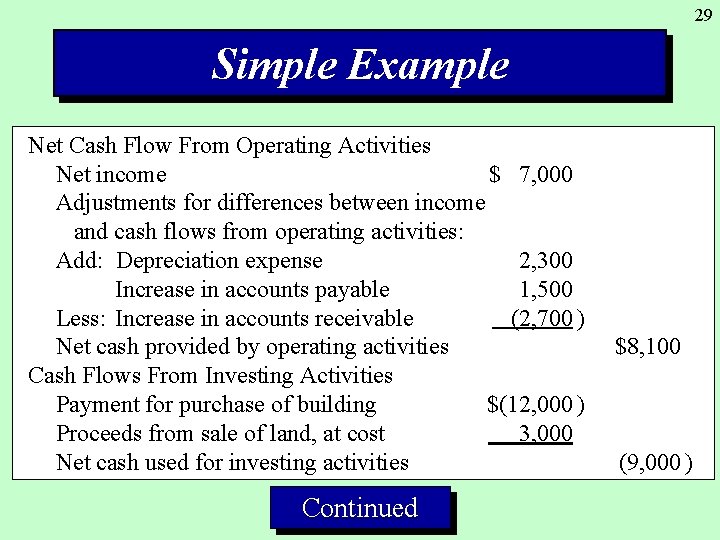
29 Simple Example Net Cash Flow From Operating Activities Net income $ 7, 000 Adjustments for differences between income and cash flows from operating activities: Add: Depreciation expense 2, 300 Increase in accounts payable 1, 500 Less: Increase in accounts receivable (2, 700 ) Net cash provided by operating activities Cash Flows From Investing Activities Payment for purchase of building $(12, 000 ) Proceeds from sale of land, at cost 3, 000 Net cash used for investing activities Continued $8, 100 (9, 000 )
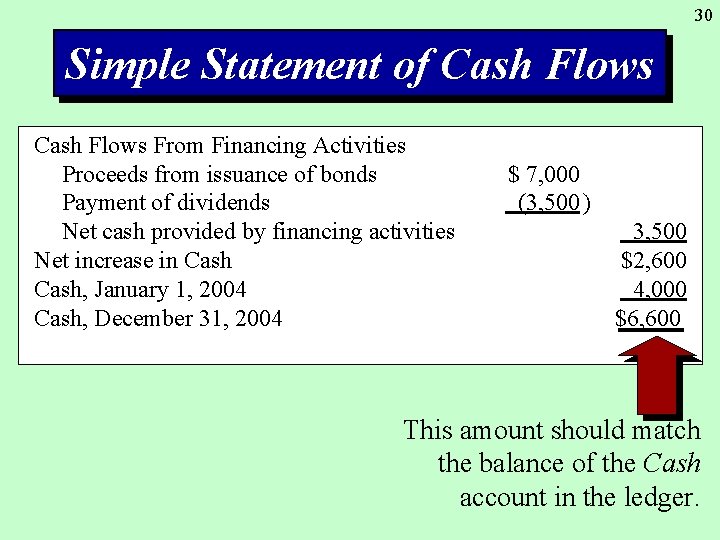
30 Simple Statement of Cash Flows From Financing Activities Proceeds from issuance of bonds Payment of dividends Net cash provided by financing activities Net increase in Cash, January 1, 2004 Cash, December 31, 2004 $ 7, 000 (3, 500 ) 3, 500 $2, 600 4, 000 $6, 600 This amount should match the balance of the Cash account in the ledger.
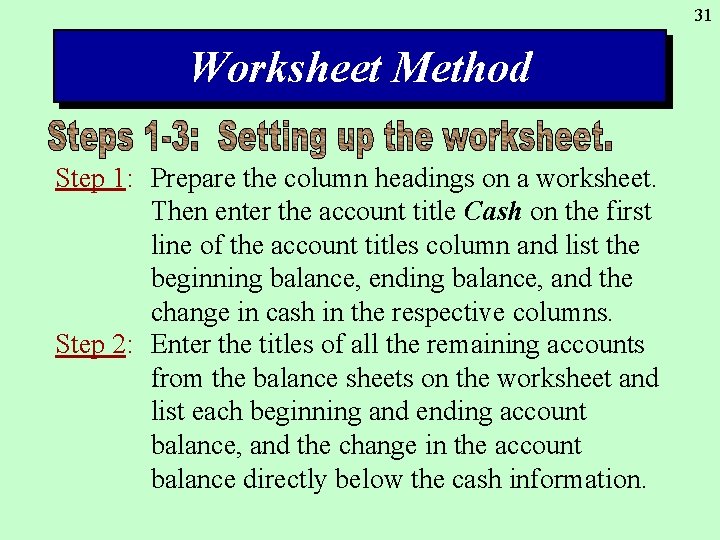
31 Worksheet Method Step 1: Prepare the column headings on a worksheet. Then enter the account title Cash on the first line of the account titles column and list the beginning balance, ending balance, and the change in cash in the respective columns. Step 2: Enter the titles of all the remaining accounts from the balance sheets on the worksheet and list each beginning and ending account balance, and the change in the account balance directly below the cash information.
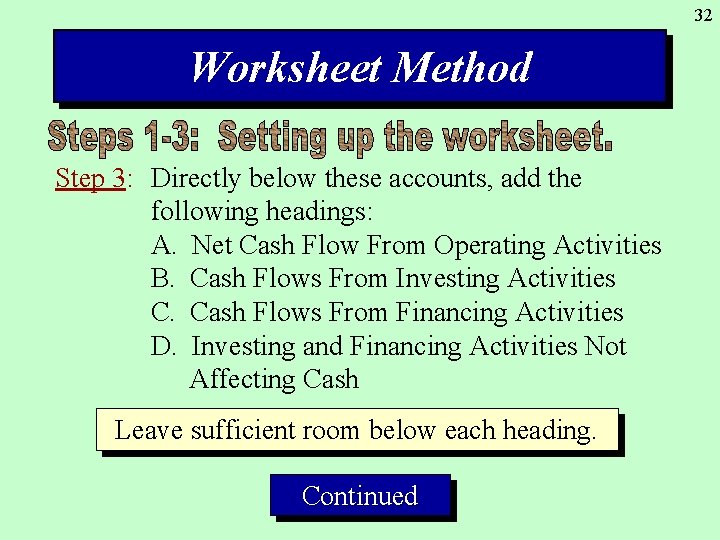
32 Worksheet Method Step 3: Directly below these accounts, add the following headings: A. Net Cash Flow From Operating Activities B. Cash Flows From Investing Activities C. Cash Flows From Financing Activities D. Investing and Financing Activities Not Affecting Cash Leave sufficient room below each heading. Continued
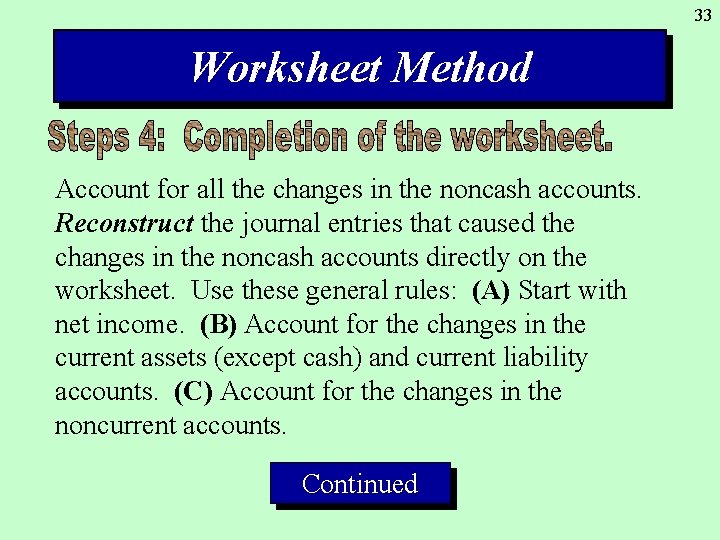
33 Worksheet Method Account for all the changes in the noncash accounts. Reconstruct the journal entries that caused the changes in the noncash accounts directly on the worksheet. Use these general rules: (A) Start with net income. (B) Account for the changes in the current assets (except cash) and current liability accounts. (C) Account for the changes in the noncurrent accounts. Continued
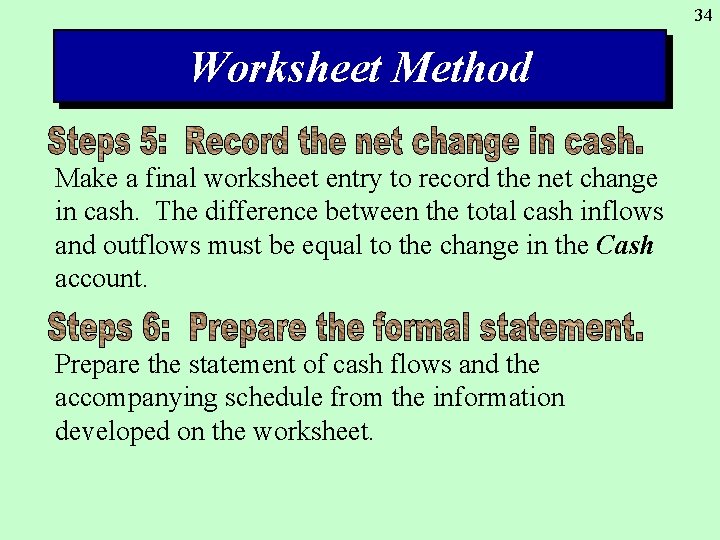
34 Worksheet Method Make a final worksheet entry to record the net change in cash. The difference between the total cash inflows and outflows must be equal to the change in the Cash account. Prepare the statement of cash flows and the accompanying schedule from the information developed on the worksheet.
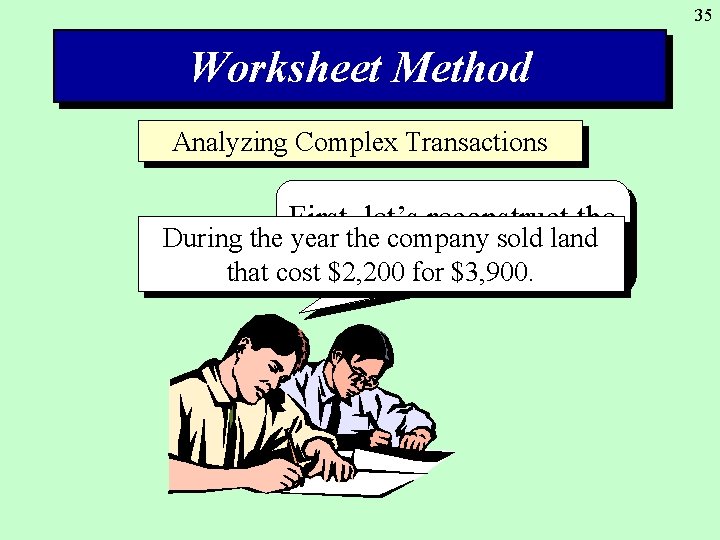
35 Worksheet Method Analyzing Complex Transactions First, let’s reconstruct the During the year the company sold land original entry. that cost $2, 200 for $3, 900.
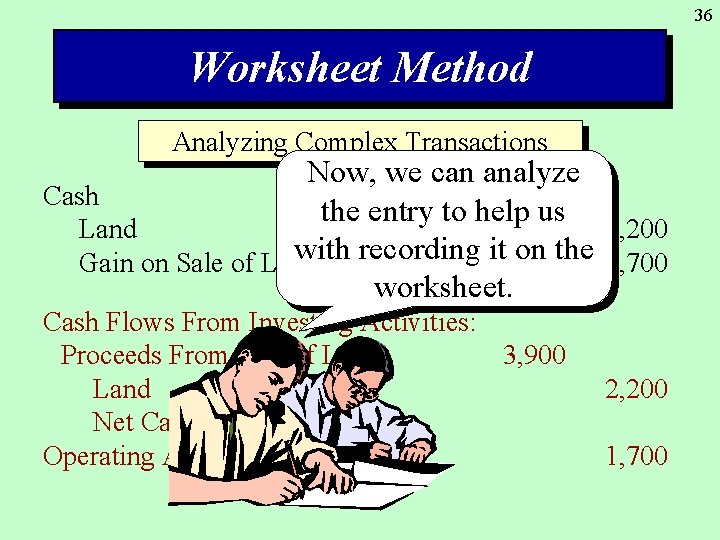
36 Worksheet Method Analyzing Complex Transactions Now, we can analyze Cash 3, 900 the entry to help us Land 2, 200 with recording it on the 1, 700 Gain on Sale of Land worksheet. Cash Flows From Investing Activities: Proceeds From Sale of Land 3, 900 Land Net Cash Flow From Operating Activities: Gain 2, 200 1, 700
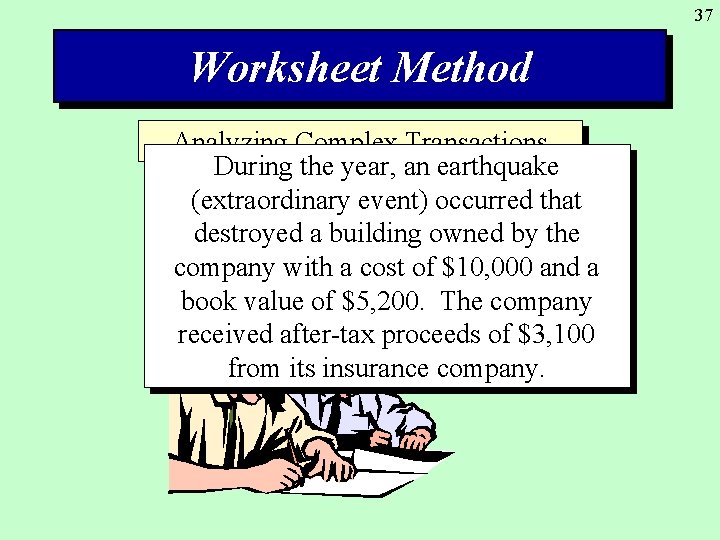
37 Worksheet Method Analyzing Complex Transactions During the year, an earthquake (extraordinary event) occurred that destroyed This a building owned byone. the is a tougher company with a cost of $10, 000 and a book value of $5, 200. The company received after-tax proceeds of $3, 100 from its insurance company.
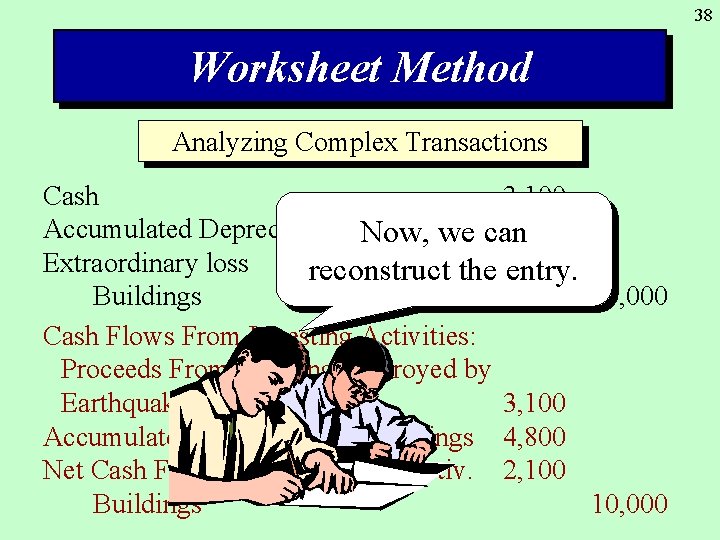
38 Worksheet Method Analyzing Complex Transactions Cash 3, 100 Accumulated Depreciation: Now, Buildings 4, 800 we can Extraordinary loss reconstruct the 2, 100 entry. Buildings 10, 000 Cash Flows From Investing Activities: Proceeds From Building Destroyed by Earthquake 3, 100 Accumulated Depreciation: Buildings 4, 800 Net Cash Flow From Operating Activ. 2, 100 Buildings 10, 000
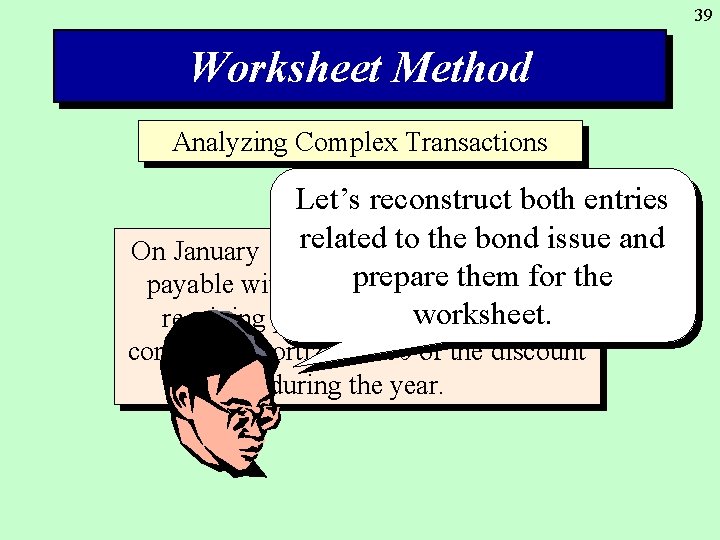
39 Worksheet Method Analyzing Complex Transactions Let’s reconstruct both entries related to the bond issue and On January 1 the company issued bonds for the payable with a faceprepare value ofthem $10, 000, worksheet. receiving proceeds of $9, 000. The company amortized $100 of the discount during the year.
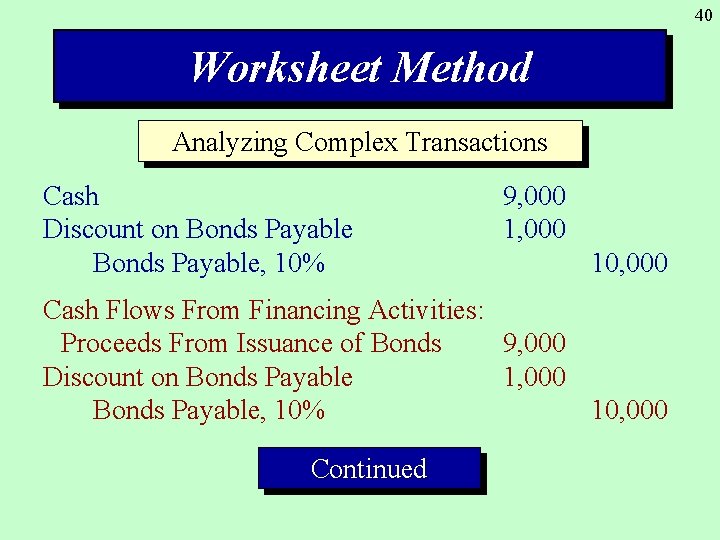
40 Worksheet Method Analyzing Complex Transactions Cash Discount on Bonds Payable, 10% 9, 000 10, 000 Cash Flows From Financing Activities: Proceeds From Issuance of Bonds 9, 000 Discount on Bonds Payable 1, 000 Bonds Payable, 10% 10, 000 Continued
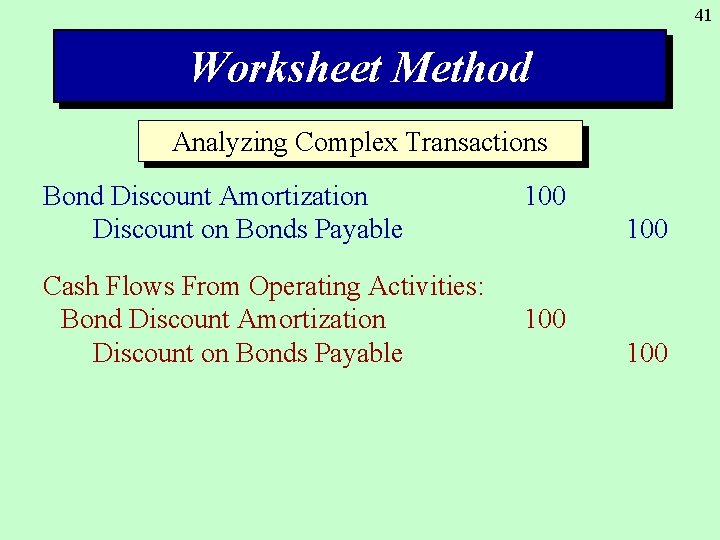
41 Worksheet Method Analyzing Complex Transactions Bond Discount Amortization Discount on Bonds Payable Cash Flows From Operating Activities: Bond Discount Amortization Discount on Bonds Payable 100 100
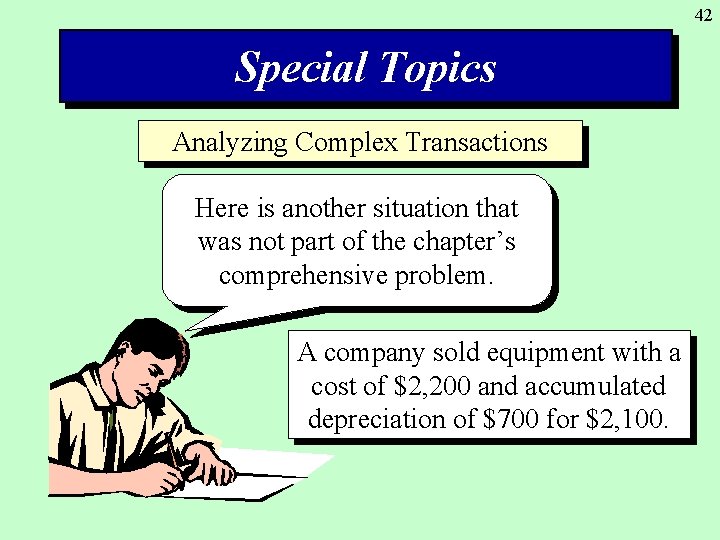
42 Special Topics Analyzing Complex Transactions Here is another situation that was not part of the chapter’s comprehensive problem. A company sold equipment with a cost of $2, 200 and accumulated depreciation of $700 for $2, 100.
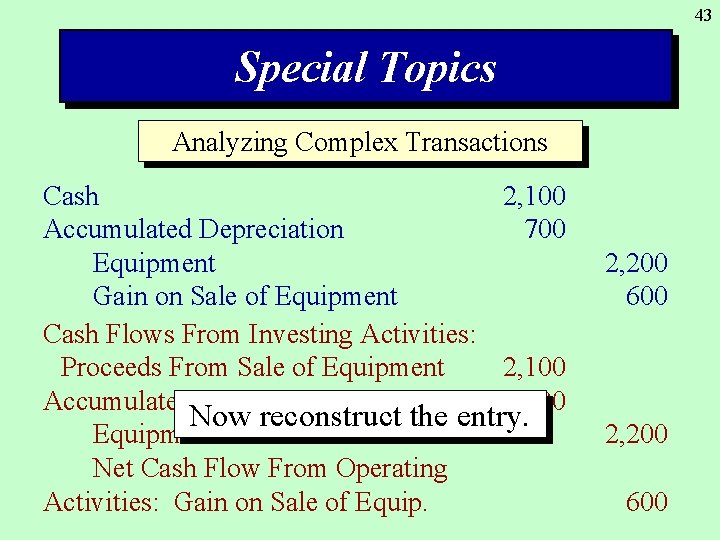
43 Special Topics Analyzing Complex Transactions Cash 2, 100 Accumulated Depreciation 700 Equipment Gain on Sale of Equipment Cash Flows From Investing Activities: Proceeds From Sale of Equipment 2, 100 Accumulated Depreciation 700 Now reconstruct the entry. Equipment Net Cash Flow From Operating Activities: Gain on Sale of Equip. 2, 200 600
Interest Paid and Income Taxes Paid FASB Statement Number 95 requires that a company using the indirect method also disclose its interest paid and income taxes paid. 44
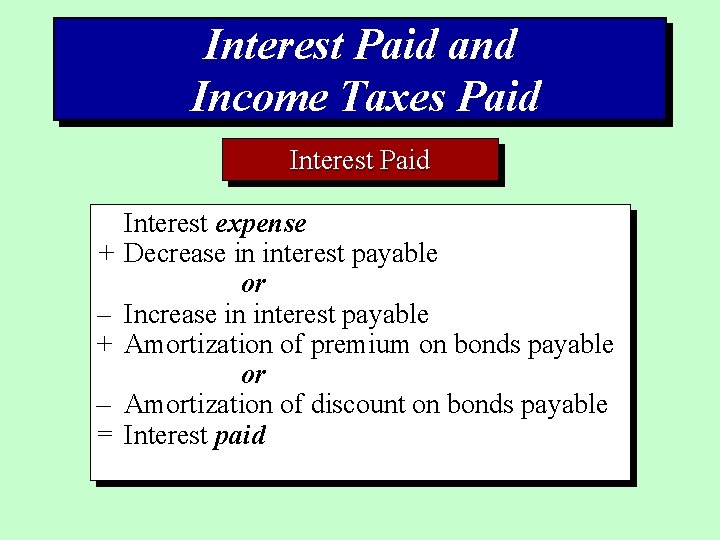
Interest Paid and Income Taxes Paid Interest expense + Decrease in interest payable or – Increase in interest payable + Amortization of premium on bonds payable or – Amortization of discount on bonds payable = Interest paid
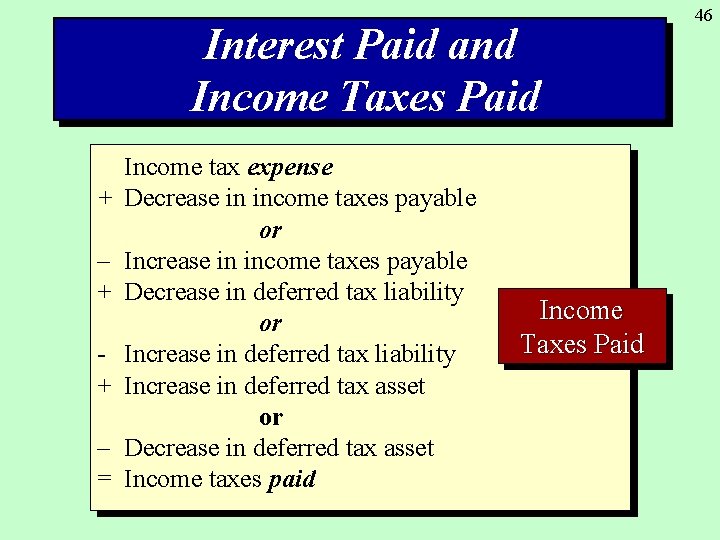
Interest Paid and Income Taxes Paid + – + + – = Income tax expense Decrease in income taxes payable or Increase in income taxes payable Decrease in deferred tax liability or Increase in deferred tax liability Increase in deferred tax asset or Decrease in deferred tax asset Income taxes paid Income Taxes Paid 46
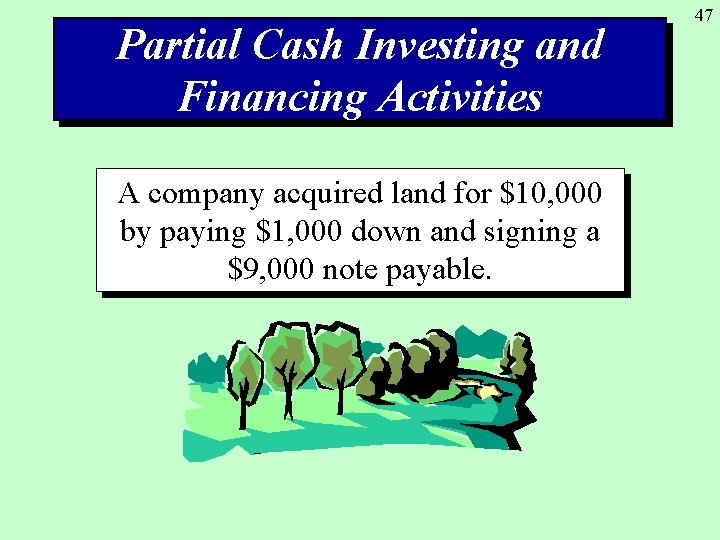
Partial Cash Investing and Financing Activities A company acquired land for $10, 000 by paying $1, 000 down and signing a $9, 000 note payable. 47
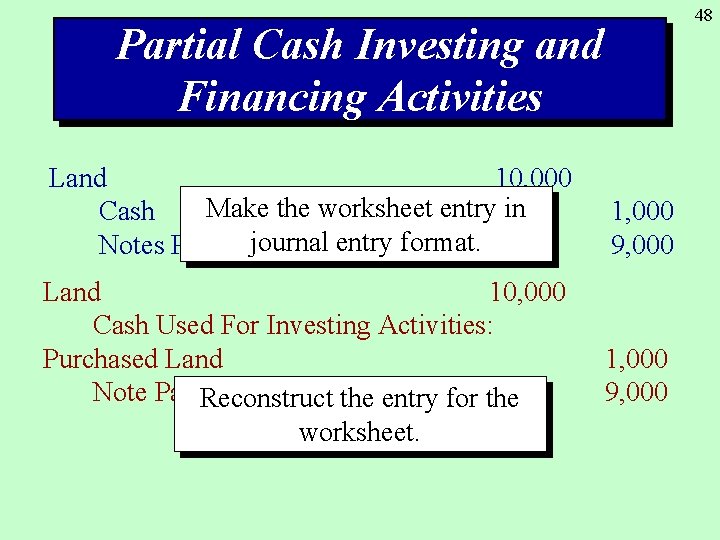
48 Partial Cash Investing and Financing Activities Land 10, 000 Make the worksheet entry in Cash Notes Payablejournal entry format. Land 10, 000 Cash Used For Investing Activities: Purchased Land Note Payable Reconstruct the entry for the worksheet. 1, 000 9, 000

Partial Cash Investing and Financing Activities The …and purchase the issuing of the ofland the note is shown as as a $9, 000 investing financing activity… activity. Schedule of Noncash Transactions 49
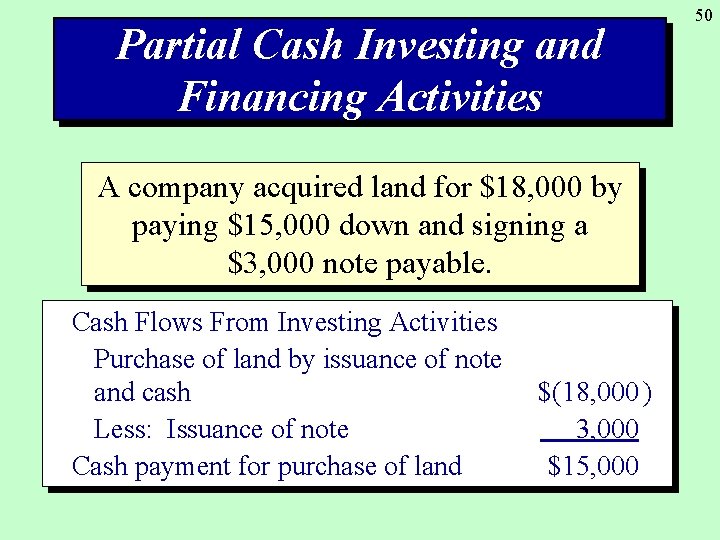
Partial Cash Investing and Financing Activities A company acquired land for $18, 000 by paying $15, 000 down and signing a $3, 000 note payable. Cash Flows From Investing Activities Purchase of land by issuance of note and cash Less: Issuance of note Cash payment for purchase of land $(18, 000 ) 3, 000 $15, 000 50
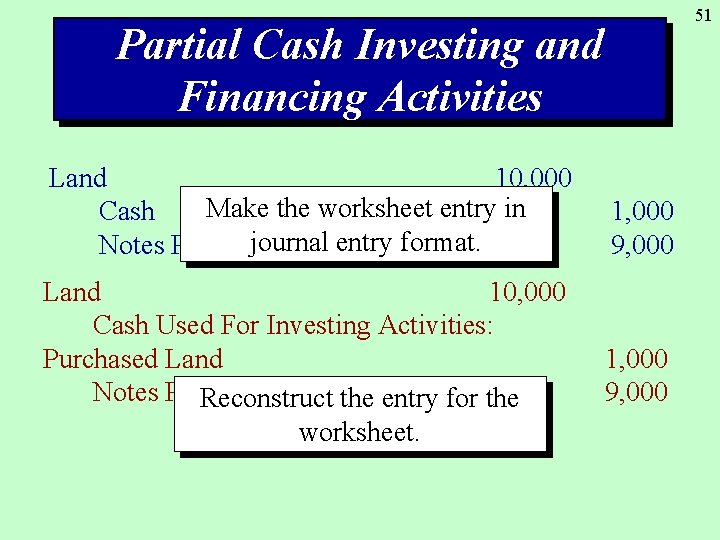
51 Partial Cash Investing and Financing Activities Land 10, 000 Make the worksheet entry in Cash Notes Payablejournal entry format. Land 10, 000 Cash Used For Investing Activities: Purchased Land Notes Payable Reconstruct the entry for the worksheet. 1, 000 9, 000
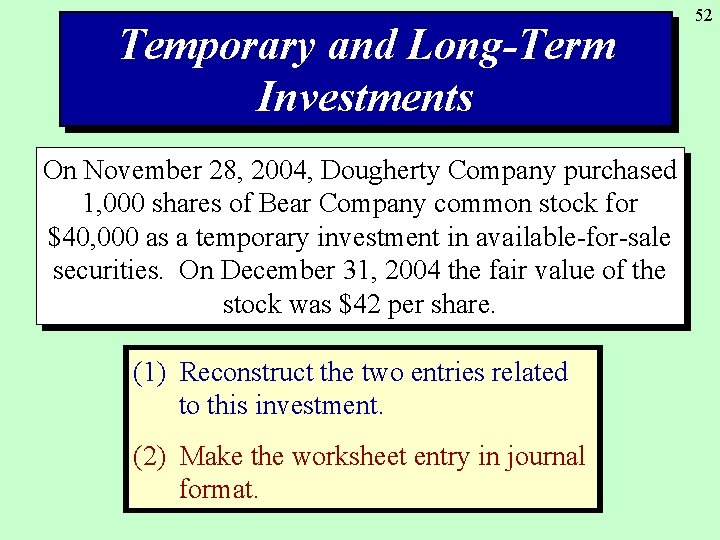
Temporary and Long-Term Investments On November 28, 2004, Dougherty Company purchased 1, 000 shares of Bear Company common stock for $40, 000 as a temporary investment in available-for-sale securities. On December 31, 2004 the fair value of the stock was $42 per share. (1) Reconstruct the two entries related to this investment. (2) Make the worksheet entry in journal format. 52
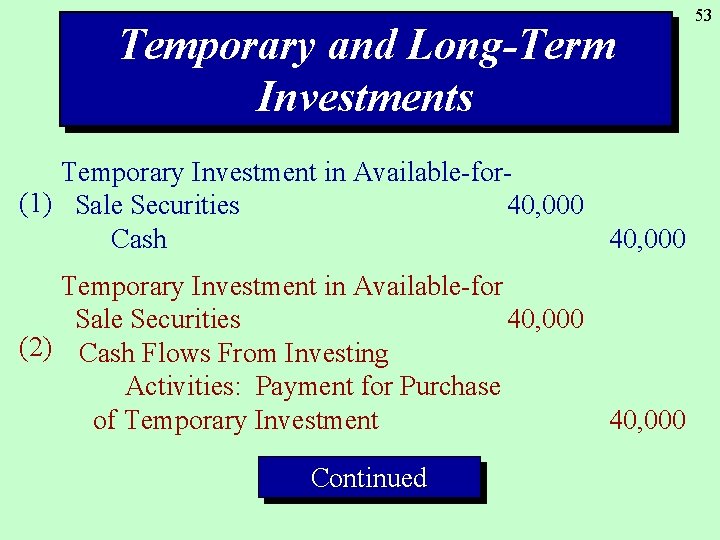
Temporary and Long-Term Investments Temporary Investment in Available-for(1) Sale Securities 40, 000 Cash 40, 000 Temporary Investment in Available-for Sale Securities 40, 000 (2) Cash Flows From Investing Activities: Payment for Purchase of Temporary Investment 40, 000 Continued 53
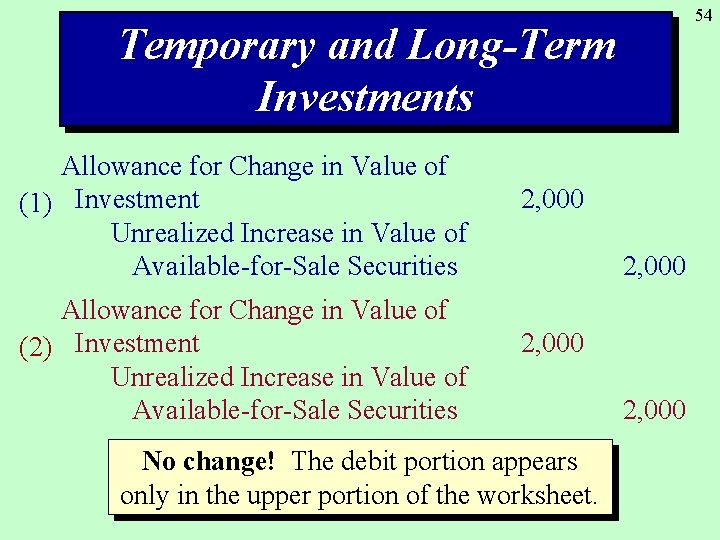
54 Temporary and Long-Term Investments Allowance for Change in Value of (1) Investment Unrealized Increase in Value of Available-for-Sale Securities Allowance for Change in Value of (2) Investment Unrealized Increase in Value of Available-for-Sale Securities 2, 000 No change! The debit portion appears only in the upper portion of the worksheet. 2, 000
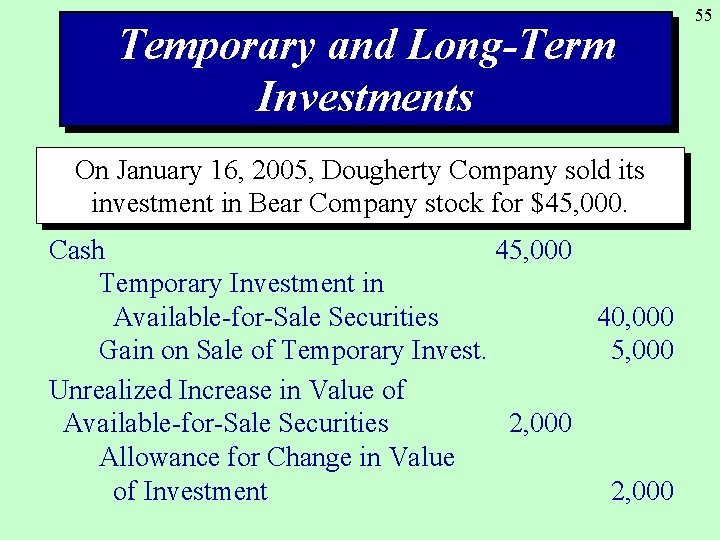
Temporary and Long-Term Investments On January 16, 2005, Dougherty Company sold its investment in Bear Company stock for $45, 000. Cash 45, 000 Temporary Investment in Available-for-Sale Securities 40, 000 Gain on Sale of Temporary Invest. 5, 000 Unrealized Increase in Value of Available-for-Sale Securities 2, 000 Allowance for Change in Value of Investment 2, 000 55
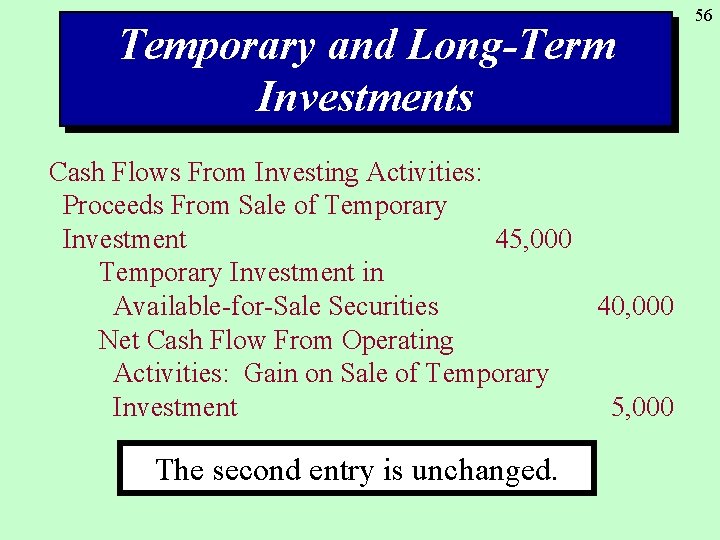
Temporary and Long-Term Investments Cash Flows From Investing Activities: Proceeds From Sale of Temporary Investment 45, 000 Temporary Investment in Available-for-Sale Securities 40, 000 Net Cash Flow From Operating Activities: Gain on Sale of Temporary Investment 5, 000 The second entry is unchanged. 56
57 Chapter 21 The End

58
- Slides: 58