
Chapter 21 The Evolution of Populations What you
- Slides: 31
Chapter 21 The Evolution of Populations
What you must know: • Mutations are the only source of new genes. • The three ways in which sexual reproduction produces genetic variation. • The conditions for Hardy-Weinberg equilibrium. • How to use the Hardy-Weinberg equation to calculate allele frequencies to test whether a population is evolving. • What effects genetic drift, migration, or selection may have on a population, and analyze data to justify your predictions.
Chapter 21 The Evolution of Populations Part A (Sec. 21. 1 & 21. 2): Microevolution and the Hardy-Weinberg Equation
What you must know: • Mutations are the only source of new genes. • The three ways in which sexual reproduction produces genetic variation. • The conditions for Hardy-Weinberg equilibrium. • How to use the Hardy-Weinberg equation to calculate allele frequencies to test whether a population is evolving.
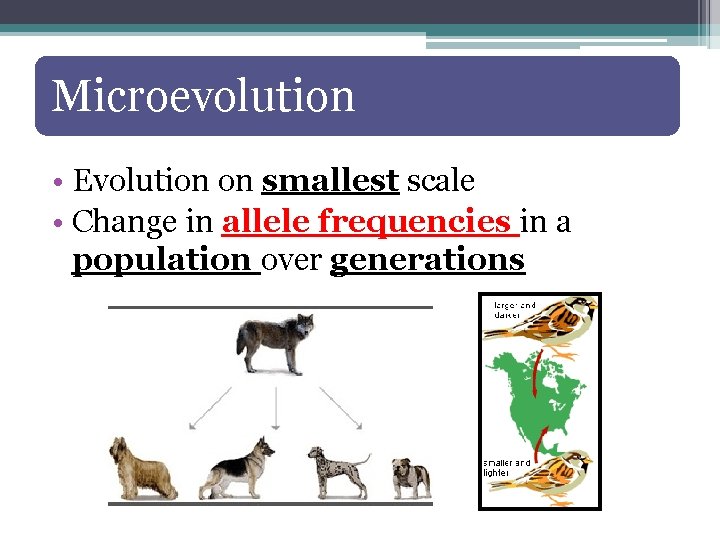
Microevolution • Evolution on smallest scale • Change in allele frequencies in a population over generations
Genetic Variation • Darwin’s could not explain how inherited variations are maintained in populations - not “trait blending” • A few years after Darwin’s “Origin of Species”, Gregor Mendel proposed his hypothesis of inheritance: Parents pass on discrete heritable units (genes) that retain their identities in offspring
Sources of Genetic Variation Mutations = only source of new genes and new alleles • Mutations in gametes passed to offspring • Point mutations • Chromosomal mutations gene duplication • Fast reproduction in prokaryotes: mutations can quickly generate genetic variation • Sexual reproduction: shuffle existing alleles ▫ Crossing over, independent assortment, random fertilization
Population genetics: study of how populations change genetically over time Population: group of individuals of same species that live in the same area and interbreed, producing fertile offspring
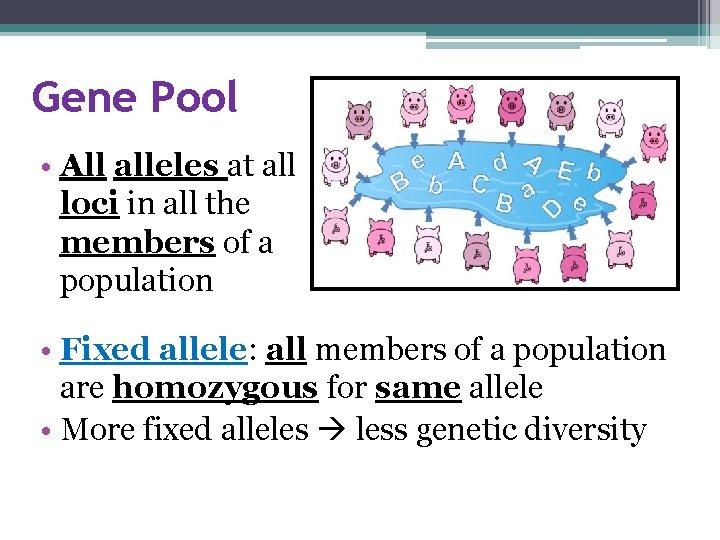
Gene Pool • All alleles at all loci in all the members of a population • Fixed allele: all members of a population are homozygous for same allele • More fixed alleles less genetic diversity
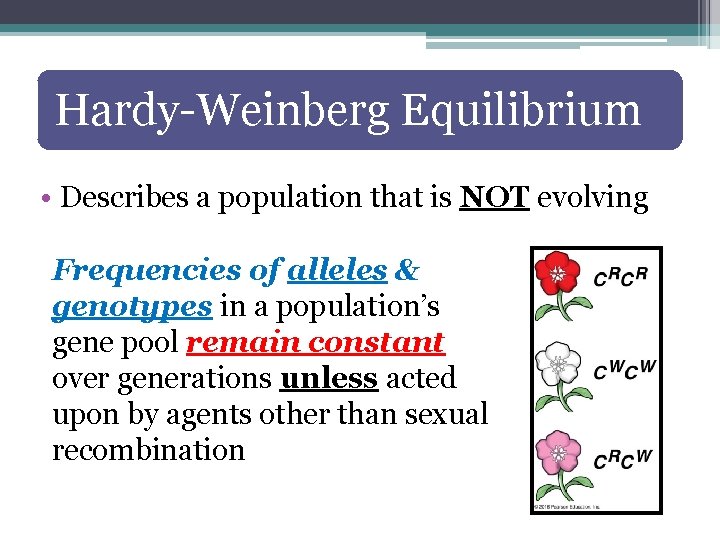
Hardy-Weinberg Equilibrium • Describes a population that is NOT evolving Frequencies of alleles & genotypes in a population’s gene pool remain constant over generations unless acted upon by agents other than sexual recombination
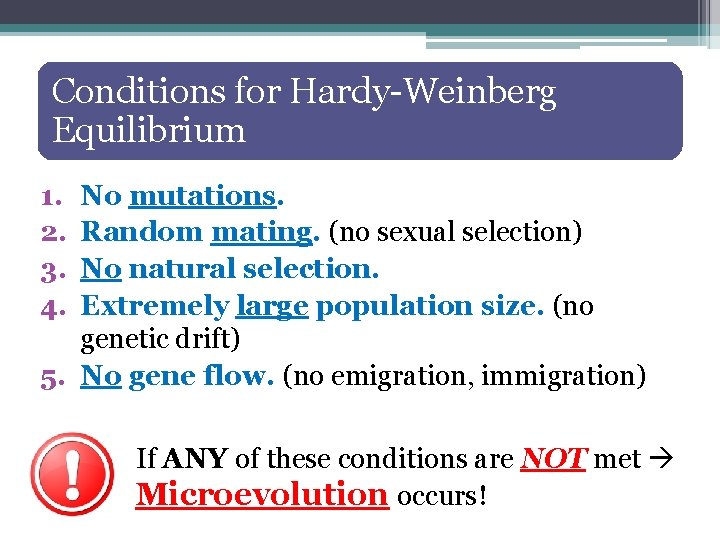
Conditions for Hardy-Weinberg Equilibrium 1. 2. 3. 4. No mutations. Random mating. (no sexual selection) No natural selection. Extremely large population size. (no genetic drift) 5. No gene flow. (no emigration, immigration) If ANY of these conditions are NOT met Microevolution occurs!
Applying the Hardy-Weinberg Equation
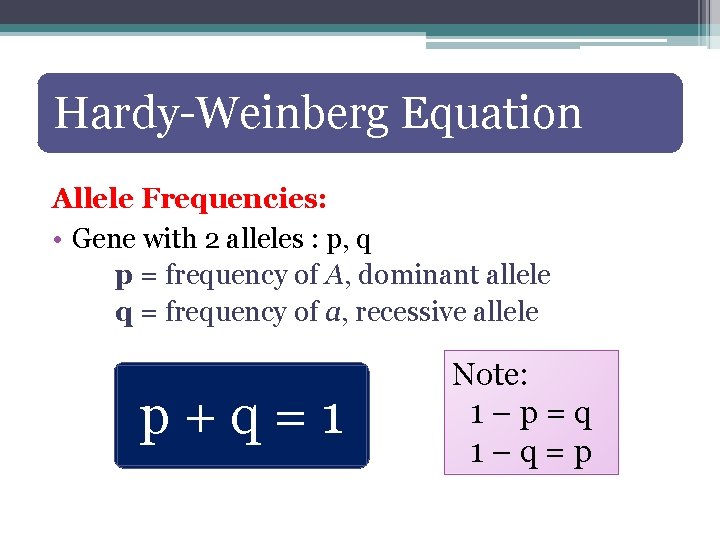
Hardy-Weinberg Equation Allele Frequencies: • Gene with 2 alleles : p, q p = frequency of A, dominant allele q = frequency of a, recessive allele p+q=1 Note: 1–p=q 1–q=p
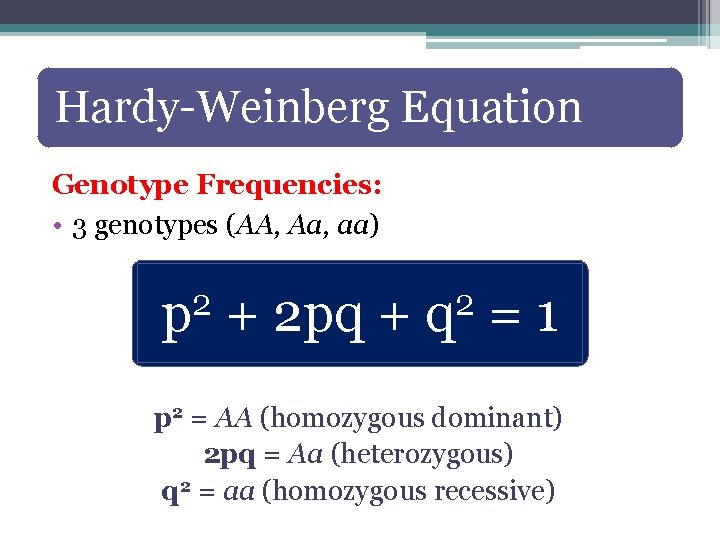
Hardy-Weinberg Equation Genotype Frequencies: • 3 genotypes (AA, Aa, aa) 2 p + 2 pq + 2 q =1 p 2 = AA (homozygous dominant) 2 pq = Aa (heterozygous) q 2 = aa (homozygous recessive)
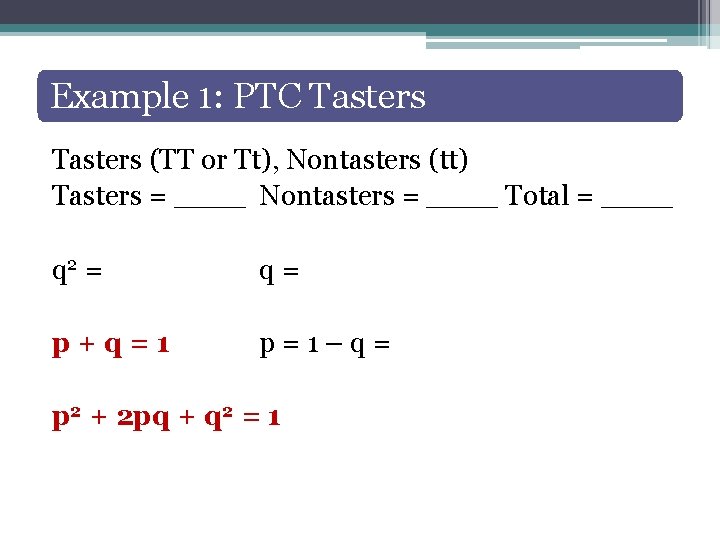
Example 1: PTC Tasters (TT or Tt), Nontasters (tt) Tasters = ____ Nontasters = ____ Total = ____ q 2 = q= p+q=1 p=1–q= p 2 + 2 pq + q 2 = 1
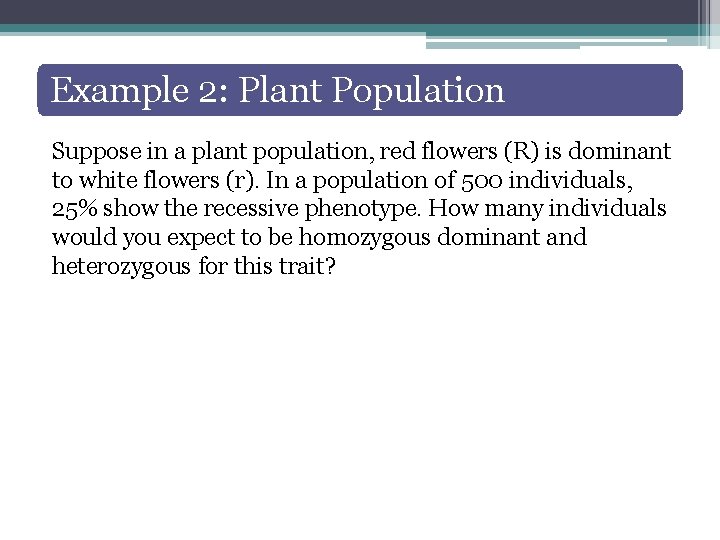
Example 2: Plant Population Suppose in a plant population, red flowers (R) is dominant to white flowers (r). In a population of 500 individuals, 25% show the recessive phenotype. How many individuals would you expect to be homozygous dominant and heterozygous for this trait?
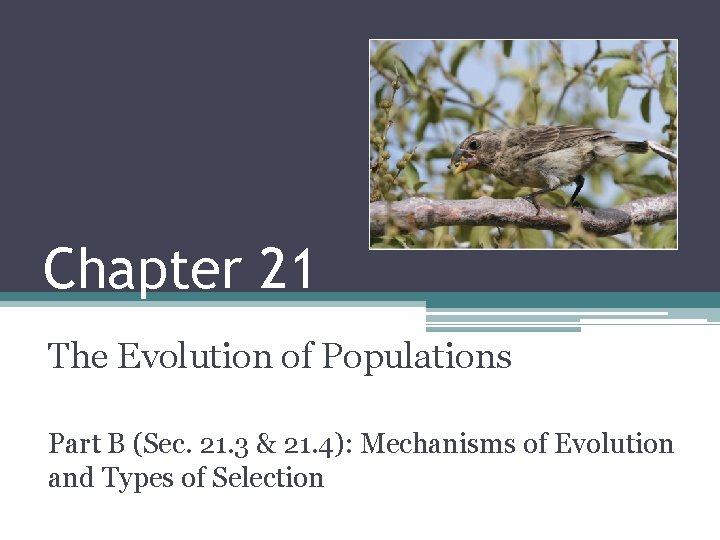
Chapter 21 The Evolution of Populations Part B (Sec. 21. 3 & 21. 4): Mechanisms of Evolution and Types of Selection
What you must know: • What effects genetic drift, migration, or selection may have on a population, and analyze data to justify your predictions.
Hardy-Weinberg Equilibrium • In nature, it is NOT likely all the conditions for H-W Equilibrium will be met Populations are evolving • Allele/genotype frequency changes due to mutations and nonrandom mating are minor • Three MAJOR mechanisms of evolution: 1. Natural Selection 2. Genetic Drift 3. Gene Flow
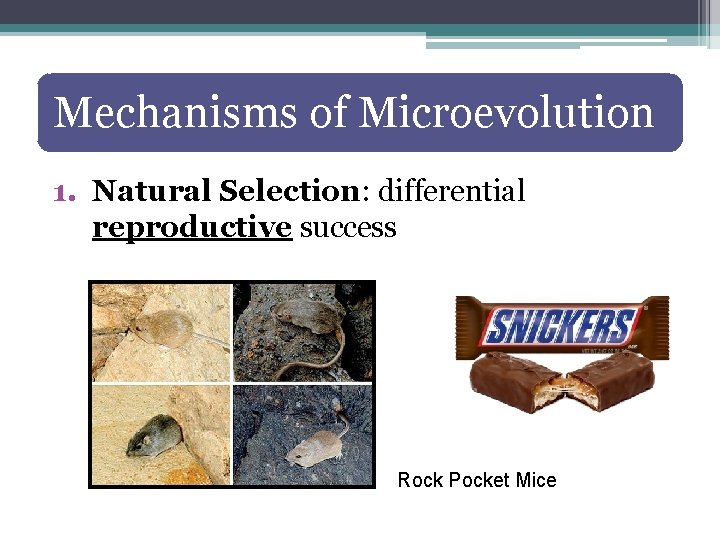
Mechanisms of Microevolution 1. Natural Selection: differential reproductive success Rock Pocket Mice
Mechanisms of Microevolution 2. Genetic Drift: unpredictable fluctuation of alleles from one generation to next ▫ Significant genetic drift in small populations ▫ Allele frequencies change at random ▫ Can lose genetic variation in populations ▫ Can cause harmful alleles to become fixed Types: A. Founder Effect B. Bottleneck Effect
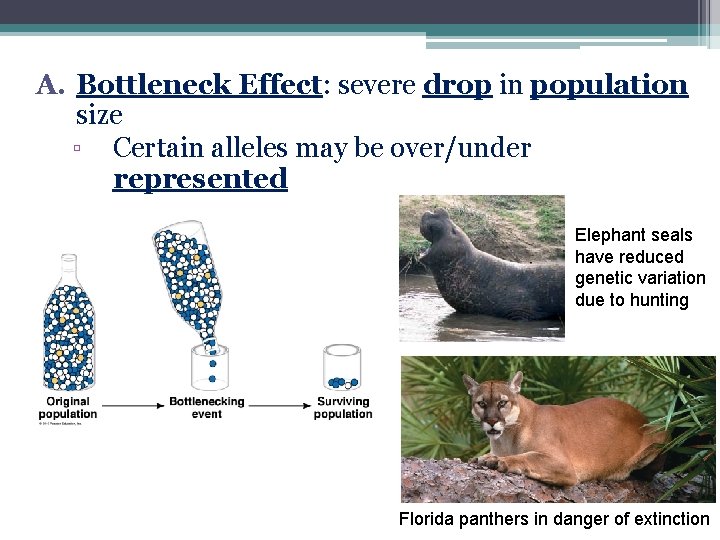
A. Bottleneck Effect: severe drop in population size ▫ Certain alleles may be over/under represented Elephant seals have reduced genetic variation due to hunting Florida panthers in danger of extinction
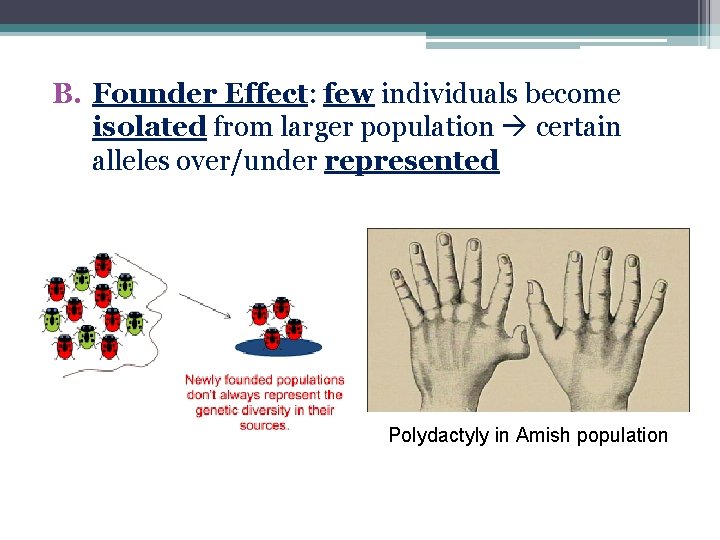
B. Founder Effect: few individuals become isolated from larger population certain alleles over/under represented Polydactyly in Amish population
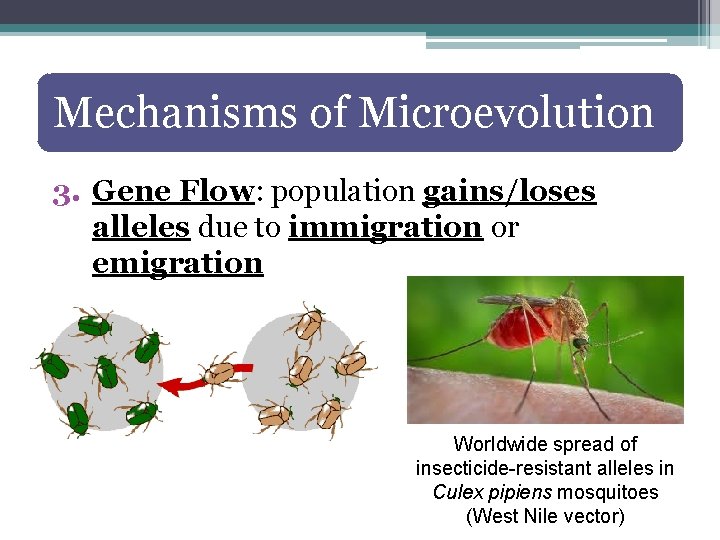
Mechanisms of Microevolution 3. Gene Flow: population gains/loses alleles due to immigration or emigration Worldwide spread of insecticide-resistant alleles in Culex pipiens mosquitoes (West Nile vector)
A Closer Look at Natural Selection
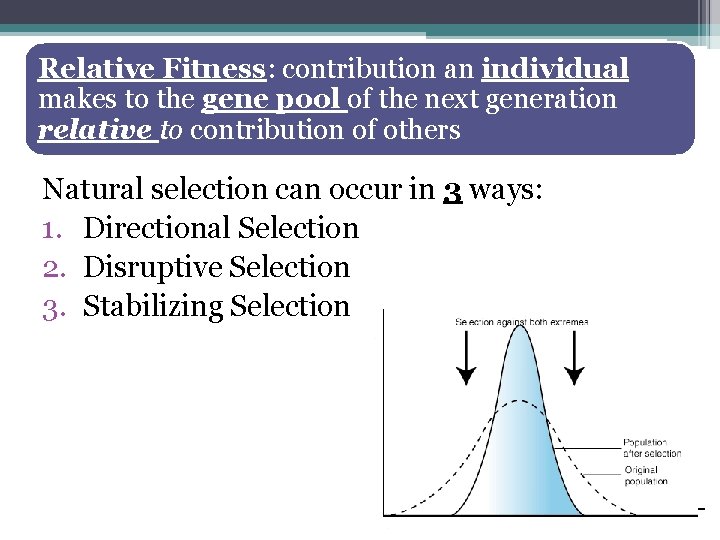
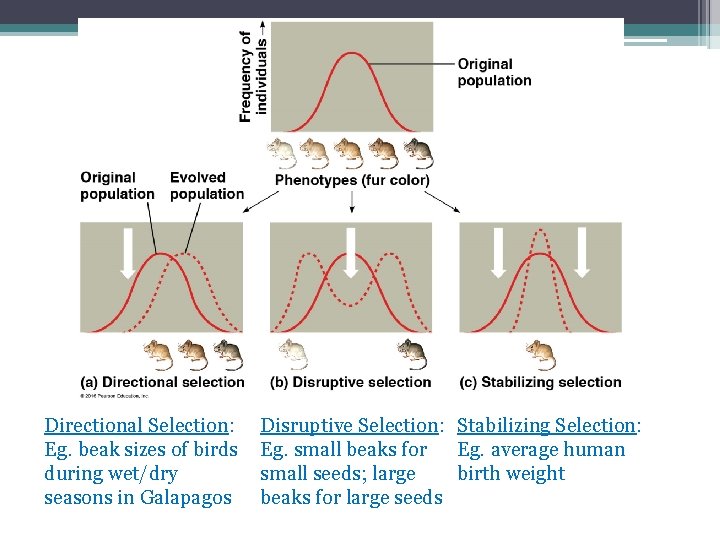
Relative Fitness: contribution an individual makes to the gene pool of the next generation relative to contribution of others Natural selection can occur in 3 ways: 1. Directional Selection 2. Disruptive Selection 3. Stabilizing Selection
Directional Selection: Eg. beak sizes of birds during wet/dry seasons in Galapagos Disruptive Selection: Stabilizing Selection: Eg. average human Eg. small beaks for birth weight small seeds; large beaks for large seeds
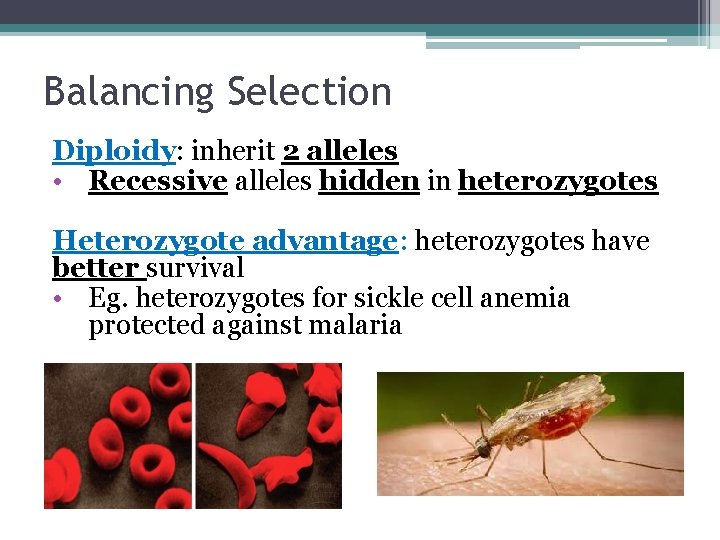
Balancing Selection Diploidy: inherit 2 alleles • Recessive alleles hidden in heterozygotes Heterozygote advantage: heterozygotes have better survival • Eg. heterozygotes for sickle cell anemia protected against malaria
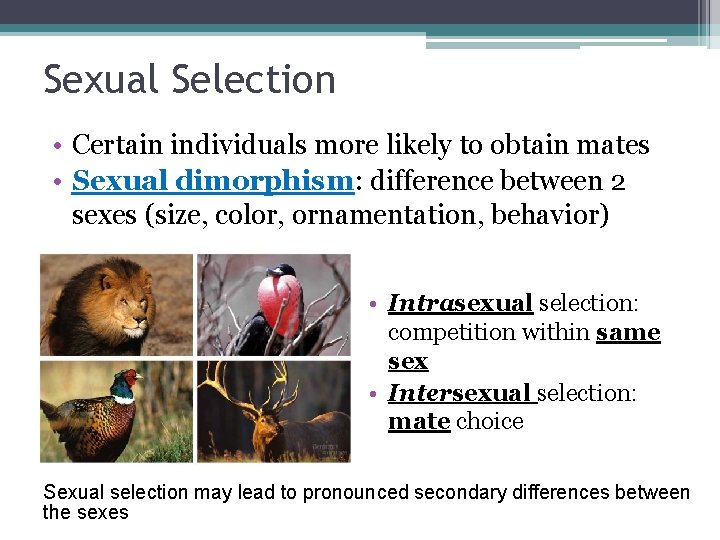
Sexual Selection • Certain individuals more likely to obtain mates • Sexual dimorphism: difference between 2 sexes (size, color, ornamentation, behavior) • Intrasexual selection: competition within same sex • Intersexual selection: mate choice Sexual selection may lead to pronounced secondary differences between the sexes
Natural selection cannot fashion perfect organisms. 1. 2. 3. 4. Selection can only edit existing variations. Evolution is limited by historical constraints. Adaptations are often compromises. Chance, natural selection, and the environment interact.
Bio. Flix: Mechanisms of Evolution