
Chapter 21 The Enlightenment and Revolutions Lesson 3
- Slides: 12
Chapter 21 The Enlightenment and Revolutions Lesson 3 – enlightened absolutism and the balance of power
Philosophes believed in: 1) Natural rights for all people 2) Freedom of: religion, speech, press 3) Rulers that enforced laws fairly for all Most countries were ruled by absolute monarchs they were not limited by laws or a constitution
Philosophes influence: 1) Some rulers tried to govern by Enlightened ideas but still maintaining their royal powers This was known as Enlightened Absolutism
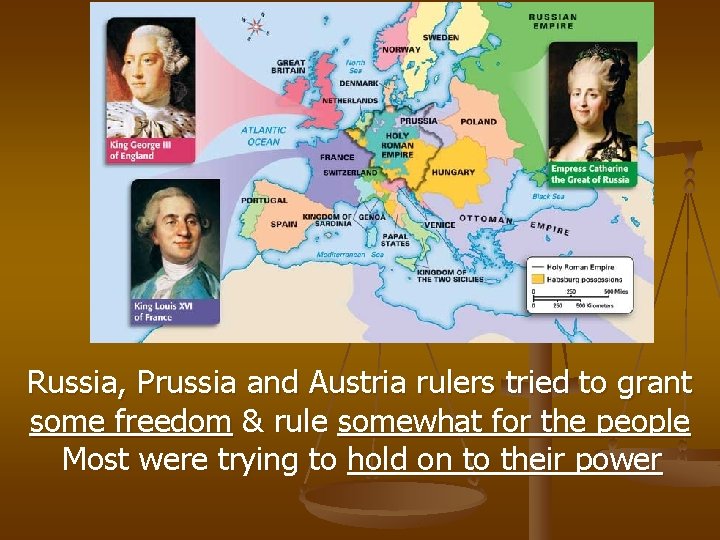
Russia, Prussia and Austria rulers tried to grant some freedom & rule somewhat for the people Most were trying to hold on to their power
Successors often undid their attempted reforms Enlightened actions included: 1) Tax reform 2) Abolish the use of torture 3) Limited freedom of speech 4) Religious toleration
n n Many times these were only temporary and they did not give people a real voice in government or the natural rights they desired Eventually only revolutions would bring about real reforms/change
The Seven Year’s War Has been called the first real World War Britain and France fought territorial wars in Europe, India and the New World The war ended with the Treaty of Paris, 1763 Britain won huge amounts of territory in North America and had become the world’s greatest power
1. What was a motive for Enlightened Absolute rulers? A. B. C. D. Equality for all Hereditary Rule To give people a voice in government To hold on to their power
2. Which country was the most powerful after the Seven Years War/Treaty of Paris 1763? A. Spain B. France C. Britain D. The United States
3. Which of the following was not a cause of the American Revolution? A. B. C. D. The Treaty of Paris, 1763 The Enlightenment Ideas High Taxes British Actions against trade
4. Which was not a feature of the U. S. Constitution? A. B. C. D. Bill of Rights Federalism The Rights of Man and Citizen Separation of Powers
5. What war was said to have been the first real world war? A. B. C. D. The one-hundred years war The seven years war The thirty years war American Revolution