
Chapter 21 The Cardiovascular System The Blood 1
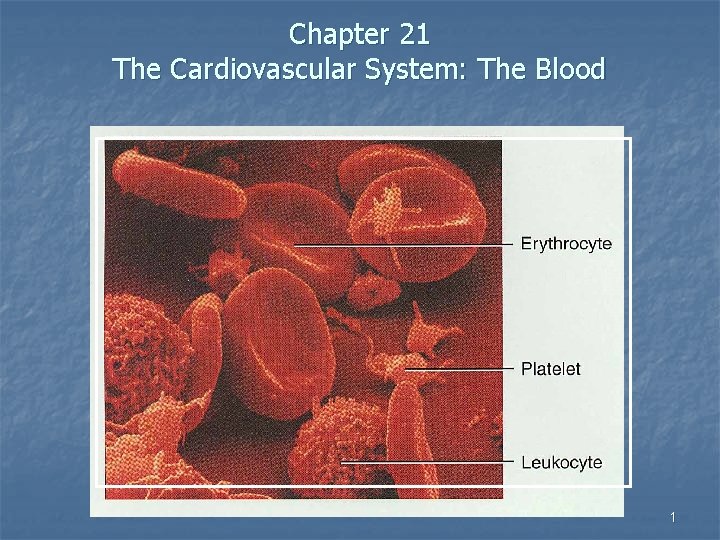
Chapter 21 The Cardiovascular System: The Blood 1
Functions of Blood n Transportation n n O 2, CO 2, metabolic wastes, nutrients, heat & hormones Regulation helps regulate p. H through buffers n helps regulate body temperature n coolant properties of water n vasodilatation of surface vessels dump heat n n n helps regulate water content of cells by interactions with dissolved ions and proteins Protection from disease & loss of blood 2
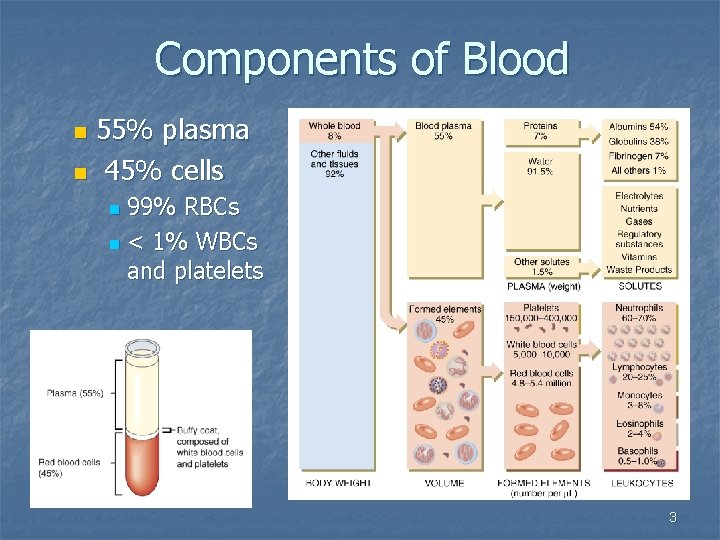
Components of Blood 55% plasma n 45% cells n 99% RBCs n < 1% WBCs and platelets n 3
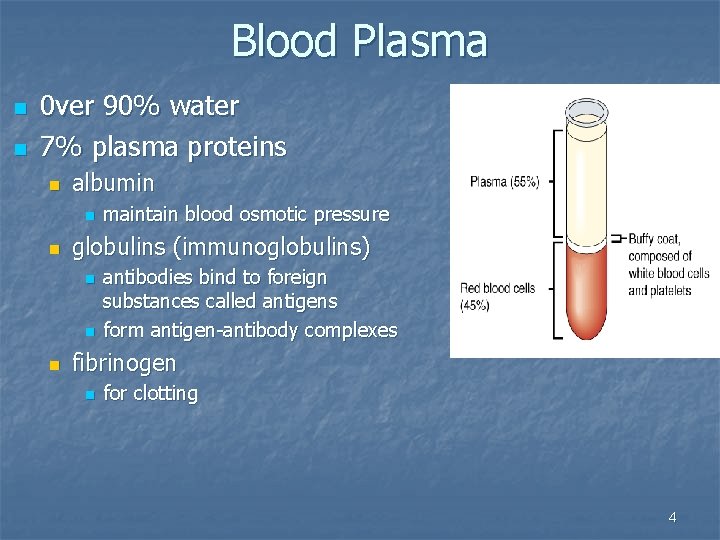
Blood Plasma n n 0 ver 90% water 7% plasma proteins n albumin n n globulins (immunoglobulins) n n n maintain blood osmotic pressure antibodies bind to foreign substances called antigens form antigen-antibody complexes fibrinogen n for clotting 4
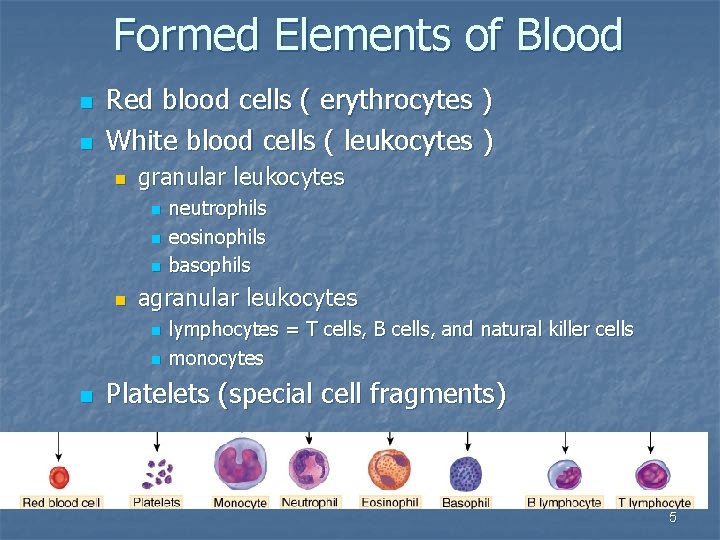
Formed Elements of Blood n n Red blood cells ( erythrocytes ) White blood cells ( leukocytes ) n granular leukocytes n n agranular leukocytes n neutrophils eosinophils basophils lymphocytes = T cells, B cells, and natural killer cells monocytes Platelets (special cell fragments) 5
Hematocrit n n Percentage of blood occupied by cells Anemia n n not enough RBCs or not enough hemoglobin Polycythemia n n too many RBCs (over 65%) dehydration, tissue hypoxia, blood doping in athletes 6
Formation of Blood Cells n Most blood cells types need to be continually replaced n n n die within hours, days or weeks process of blood cells formation is hematopoiesis or hemopoiesis occurs only in red marrow of flat bones like sternum, ribs, skull & pelvis and ends of long bones 7

Red Blood Cells or Erythrocytes n Contain oxygen-carrying protein hemoglobin that gives blood its red color n n 1/3 of cell’s weight is hemoglobin Biconcave disk 8 microns in diameter increased surface area/volume ratio n flexible shape for narrow passages n no nucleus or other organelles n n no cell division or mitochondrial ATP formation 8
RBC Life Cycle n RBCs live only 120 days n n wear out from bending to fit through capillaries no repair possible due to lack of organelles Worn out cells removed by fixed macrophages in spleen & liver Breakdown products are recycled 9
WBC Anatomy and Types n n All WBCs (leukocytes) have a nucleus and no hemoglobin Granular or agranular classification based on presence of cytoplasmic granules made visible by staining 10
WBC Physiology n Less numerous than RBCs n n Leukocytosis is a high white blood cell count n n 1 WBC for every 700 RBC microbes, strenuous exercise Leukopenia is low white blood cell count n radiation, shock or chemotherapy 11
Complete Blood Count (CBC) n n n Screens for anemia and infection Total RBC, WBC & platelet counts; differential WBC; hematocrit and hemoglobin measurements Normal hemoglobin range n 12 to 18 g/100 m. L of blood 12
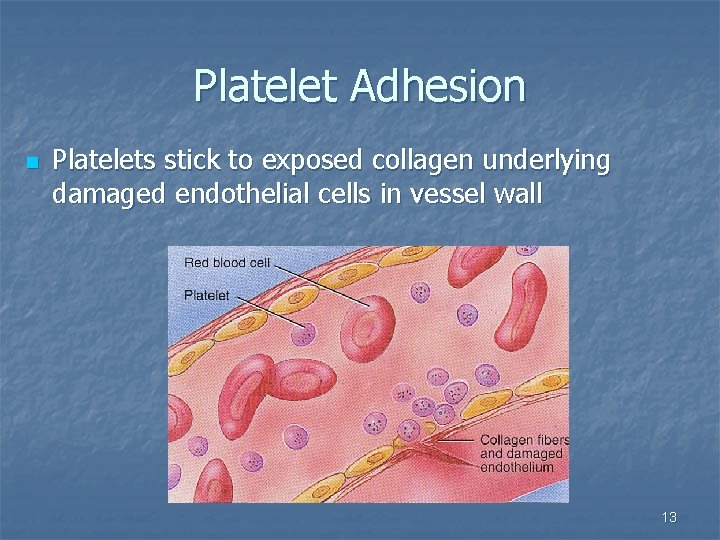
Platelet Adhesion n Platelets stick to exposed collagen underlying damaged endothelial cells in vessel wall 13
Blood Clotting n n n Blood drawn from the body thickens into a gel If clotting occurs in an unbroken vessel is called a thrombosis Substances required for clotting are Ca+2, enzymes synthesized by liver cells and substances released by platelets or damaged tissues 14
Role of Vitamin K in Clotting n n Normal clotting requires adequate vitamin K Produced by bacteria in large intestine 15
Intravascular Clotting n Thrombosis clot (thrombus) forming in an unbroken blood vessel n may dissolve spontaneously or dislodge & travel n n Embolus n n clot, air bubble or fat from broken bone in the blood Low dose aspirin blocks synthesis of thromboxane A 2 & reduces inappropriate clot formation 16
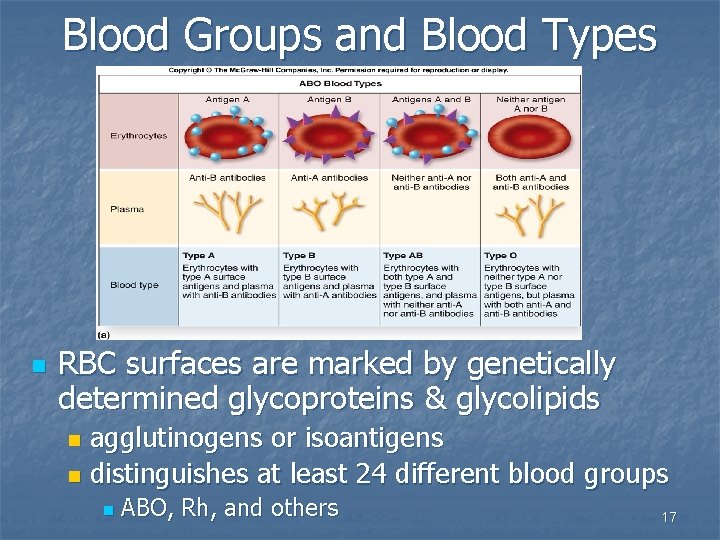
Blood Groups and Blood Types n RBC surfaces are marked by genetically determined glycoproteins & glycolipids agglutinogens or isoantigens n distinguishes at least 24 different blood groups n n ABO, Rh, and others 17
ABO Blood Groups n Based on 2 antigens called A and B found on the surface of RBCs display only antigen A -- blood type A n display only antigen B -- blood type B n display both antigens A & B -- blood type AB n display neither antigen -- blood type O n n Plasma contains antibodies or agglutinins to the A or B antigens not found in your blood anti-A antibody reacts with antigen A n anti-B antibody reacts with antigen B n 18
Universal Donors and Recipients n n People with type AB blood called “universal recipients” since have no antibodies in plasma People with type O blood cell called “universal donors” since have no antigens on their cells n theoretically can be given to anyone 19
Anemia = Not Enough RBCs n Symptoms n n n oxygen-carrying capacity of blood is reduced fatigue, cold intolerance & paleness Types of anemia n n n iron-deficiency =lack of absorption or loss of iron pernicious = lack of intrinsic factor for B 12 absorption hemorrhagic = loss of RBCs due to bleeding (ulcer) hemolytic = defects in cell membranes cause rupture thalassemia = hereditary deficiency of hemoglobin aplastic = destruction of bone marrow (radiation/toxins) 20
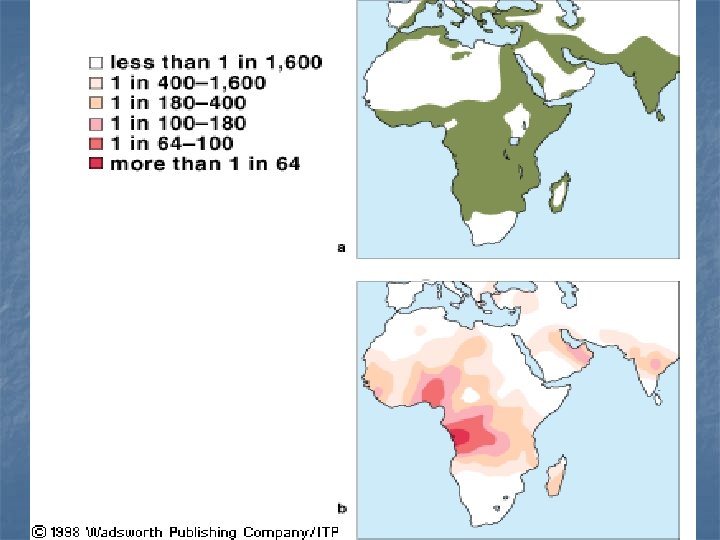
Sickle-cell Anemia (SCA) n Genetic defect in hemoglobin molecule n n Found among populations in malaria belt n n at low very O 2 levels, RBC is deformed by changes in hemoglobin molecule within the RBC Mediterranean Europe, sub-Saharan Africa & Asia Person with only one sickle cell gene n increased resistance to malaria 21
22
Hemophilia n Inherited deficiency of clotting factors bleeding spontaneously or after minor trauma n subcutaneous & intramuscular hemorrhaging n nosebleeds, blood in urine, articular bleeding & pain n n Treatment is transfusions of fresh plasma or concentrates of the missing clotting factor 23
Leukemia n Acute leukemia uncontrolled production of immature leukocytes n crowding out of normal red bone marrow cells by production of immature WBC n prevents production of RBC & platelets n n Chronic leukemia n accumulation of mature WBC in bloodstream because they do not die 24
- Slides: 24