
Chapter 21 Sustainable Approaches Industrial Ecology and Pollution
Chapter 21 Sustainable Approaches: Industrial Ecology and Pollution Prevention © 2004 Thomson Learning/South-Western
Industrial Ecology: A Systems Approach to Sustainable Development l What Is Industrial Ecology? ¡ Industrial Ecology – a multidisciplinary systems approach to the flow of materials and energy between industrial processes and the environment 2
Industrial Ecology: A Systems Approach to Sustainable Development l Revisiting the Materials Balance Model ¡ ¡ Materials balance model – positions the circular flow within a larger schematic to show the connections between economic decision making and the natural environment Residual – the amount of a pollutant remaining in the environment after a natural or technological process has occurred 3
Industrial Ecology: A Systems Approach to Sustainable Development l Linear or Open Materials Flow: Cradle to Grave ¡ Linear flow of materials – assumes that materials run in one direction, entering an economic system as inputs and leaving as wastes or residuals 4
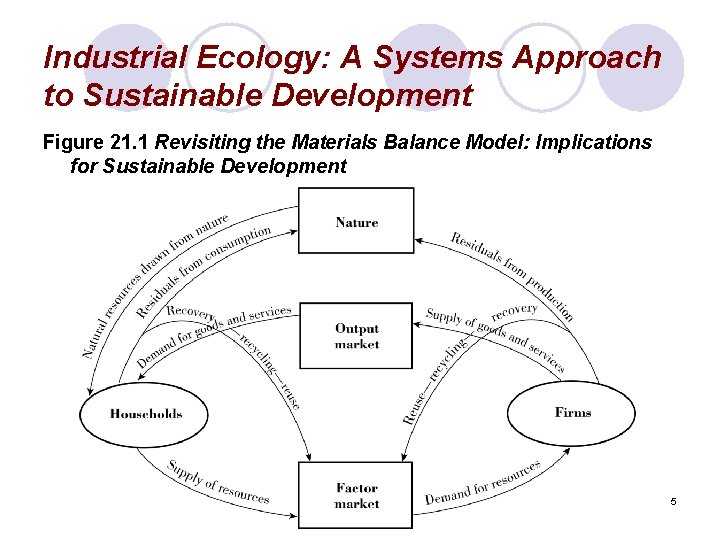
Industrial Ecology: A Systems Approach to Sustainable Development Figure 21. 1 Revisiting the Materials Balance Model: Implications for Sustainable Development 5
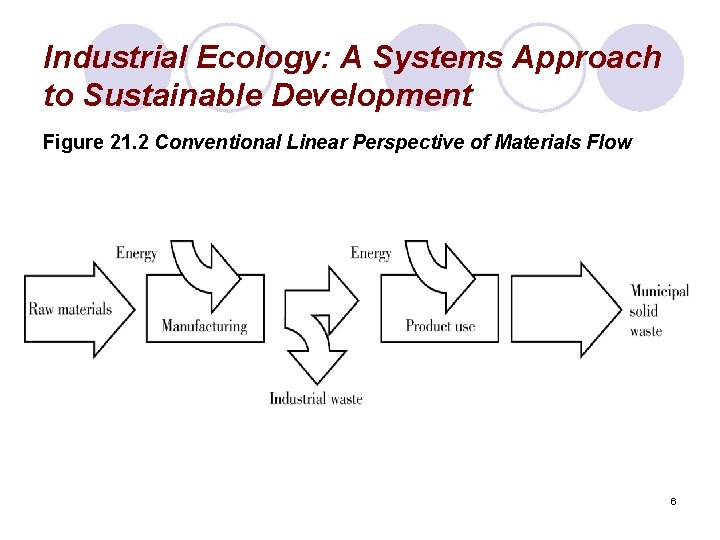
Industrial Ecology: A Systems Approach to Sustainable Development Figure 21. 2 Conventional Linear Perspective of Materials Flow 6
Industrial Ecology: A Systems Approach to Sustainable Development l Cyclical or Closed Materials Flow: Cradle to Cradle ¡ Cyclical flow of materials – assumes that materials run in a circular pattern in a closed system, allowing residuals to be returned to the production process 7
Industrial Ecology: A Systems Approach to Sustainable Development l Life Cycle Assessment (LCA) – Examines the environmental impact of a product or process by evaluating all its stages from raw materials extraction to disposal ¡ ¡ Four Key components l Goal Definition and Scoping l Inventory Analysis l Impact Analysis l Interpretation ISO 14000 standards – voluntary international standards for environmental management 8
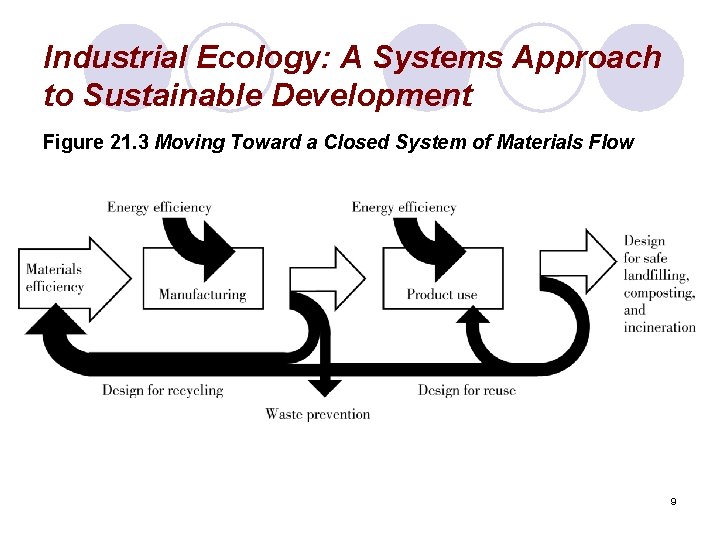
Industrial Ecology: A Systems Approach to Sustainable Development Figure 21. 3 Moving Toward a Closed System of Materials Flow 9
Industrial Ecology: A Systems Approach to Sustainable Development l Industrial Ecosystems –a closed system of manufacturing whereby the wastes of one process are reused as inputs in another 10
Pollution Prevention l What is Pollution Prevention? ¡ Pollution prevention (P 2) – a long-term strategy aimed at reducing the amount or toxicity of residuals released to nature 11
Pollution Prevention l Comparing Pollution Prevention to Industrial Ecology ¡ ¡ ¡ P 2 promotes risk reduction through minimizing or eliminating wastes while Industrial ecology argues in favor of using wastes as inputs in other production processes P 2 solutions are aimed at the single firm while industrial ecology is aimed at a network of businesses P 2 proposals considers efficiency a tool while industrial ecology views efficiency as an end itself 12
Pollution Prevention l Objectives and Techniques in Pollution Prevention ¡ ¡ ¡ Source reduction – preventive strategies to reduce the quantity of any hazardous substance, pollutant, or contaminant released to the environment at the point of generation Toxic chemical use substitution – the use of less harmful chemicals in place of more hazardous substances Raw materials substitution – the use of productive inputs that generate little or no hazardous waste 13
Pollution Prevention ¡ Changes in manufacturing processes – the use of alternative production methods to generate less hazardous by-products ¡ Product substitution – the selection of environmentally safe commodities in place of potentially polluting products 14
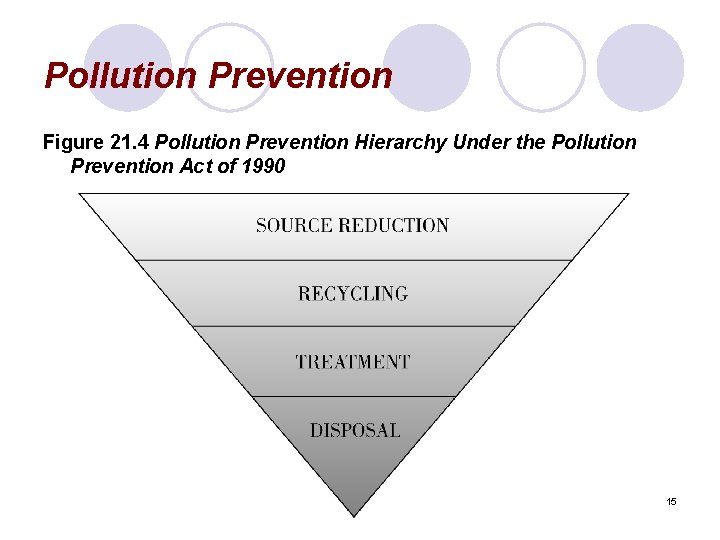
Pollution Prevention Figure 21. 4 Pollution Prevention Hierarchy Under the Pollution Prevention Act of 1990 15
Pollution Prevention l National Legislation Promoting Pollution Prevention ¡ United States P 2 Legislation l National Environmental Policy Act (NEPA) of 1969 integrated pollution prevention into U. S. environmental legislation l Pollution Prevention Act of 1990 formalized pollution prevention as part of U. S. policy 16
Pollution Prevention l P 2 Legislation in Other Nations ¡ ¡ ¡ Integrated Pollution Prevention and Control (IPPCC) Directive of 1996 Canadian Environmental Protection ACT (CEPA) of 1999 Australia’s National Strategy for Ecologically Sustainable Development (ESD) l Cleaner production – a preventive environmental strategy applied to products and processes to improve efficiency and reduce risk 17
Pollution Prevention l Corporate Experience with Pollution Prevention ¡ ¡ 3 M Corporation launched Pollution Prevention Pays Program in 1975 Mc. Donald’s and Environmental Defense collaboration – developed Waste Reduction Action Plan (WRAP) completed in 1991 18
Pollution Prevention l Using Economic Analysis To Implement Pollution Prevention ¡ ¡ Cost-Effectiveness Criterion Efficiency Criterion 19
Strategic Initiatives and Programs l Extended Product Responsibility (EPR) – a commitment by all participants in the product cycle to reduce any life-cycle environmental impacts of products ¡ ¡ More extensive approach than extended producer responsibility All players in a product cycle are expected to participate 20
Strategic Initiatives and Programs l Design for the Environment (Df. E) – an initiative that promotes the use of environmental considerations along with cost and performance in product design and development 21
Strategic Initiatives and Programs l Green Chemistry Program – an initiative that promotes the development and application of innovative chemical technologies to achieve pollution prevention 22
Strategic Initiatives and Programs l Disseminating Information and Technology on a Global Scale Technology Transfer – the advancement and application of technologies and strategies on a global scale ¡ Environmental Literacy – awareness of the risks of pollution and natural resource depletion ¡ 23
- Slides: 23