
Chapter 21 Sets and Maps Liang Introduction to
- Slides: 28
Chapter 21 Sets and Maps Liang, Introduction to Java Programming, Tenth Edition, (c) 2013 Pearson Education, Inc. All rights reserved. 1
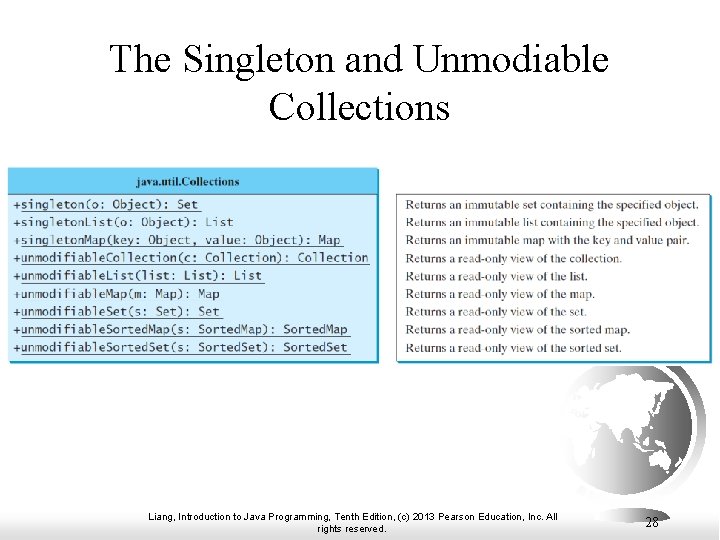
Objectives q q q q To store unordered, nonduplicate elements using a set (§ 21. 2). To explore how and when to use Hash. Set (§ 21. 2. 1), Linked. Hash. Set (§ 21. 2. 2), or Tree. Set (§ 21. 2. 3) to store elements. To compare performance of sets and lists (§ 21. 3). To use sets to develop a program that counts the keywords in a Java source file (§ 21. 4). To tell the differences between Collection and Map and describe when and how to use Hash. Map, Linked. Hash. Map, and Tree. Map to store values associated with keys (§ 21. 5). To use maps to develop a program that counts the occurrence of the words in a text (§ 21. 6). To obtain singleton sets, lists, and maps, and unmodifiable sets, lists, and maps, using the static methods in the Collections class (§ 21. 7). Liang, Introduction to Java Programming, Tenth Edition, (c) 2013 Pearson Education, Inc. All rights reserved. 2
Motivations The “No-Fly” list is a list, created and maintained by the U. S. government’s Terrorist Screening Center, of people who are not permitted to board a commercial aircraft for travel in or out of the United States. Suppose we need to write a program that checks whether a person is on the No-Fly list. You can use a list to store names in the No-Fly list. However, a more efficient data structure for this application is a set. Suppose your program also needs to store detailed information about terrorists in the No-Fly list. The detailed information such as gender, height, weight, and nationality can be retrieved using the name as the key. A map is an efficient data structure for such a task. Liang, Introduction to Java Programming, Tenth Edition, (c) 2013 Pearson Education, Inc. All rights reserved. 3
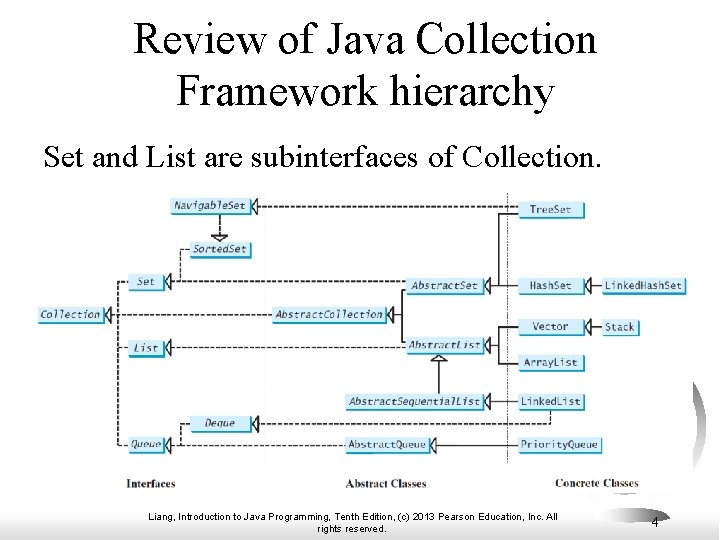
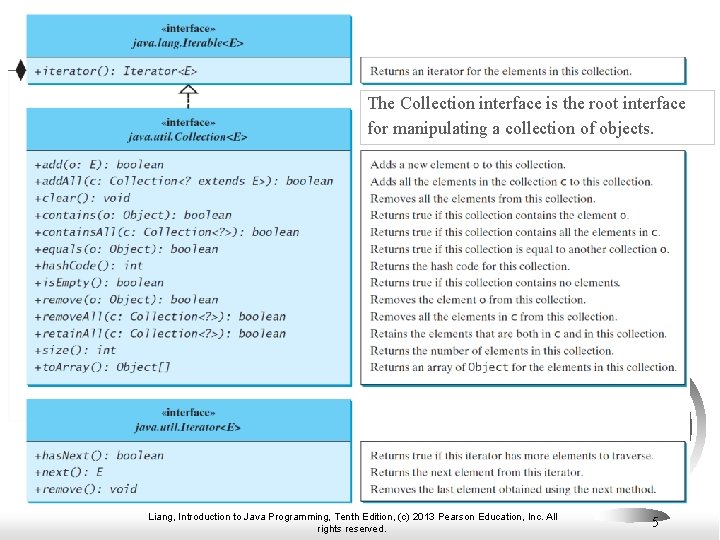
Review of Java Collection Framework hierarchy Set and List are subinterfaces of Collection. Liang, Introduction to Java Programming, Tenth Edition, (c) 2013 Pearson Education, Inc. All rights reserved. 4
The Collection interface is the root interface for manipulating a collection of objects. Liang, Introduction to Java Programming, Tenth Edition, (c) 2013 Pearson Education, Inc. All rights reserved. 5
The Set Interface The Set interface extends the Collection interface. It does not introduce new methods or constants, but it stipulates that an instance of Set contains no duplicate elements. The concrete classes that implement Set must ensure that no duplicate elements can be added to the set. That is no two elements e 1 and e 2 can be in the set such that e 1. equals(e 2) is true. Liang, Introduction to Java Programming, Tenth Edition, (c) 2013 Pearson Education, Inc. All rights reserved. 6
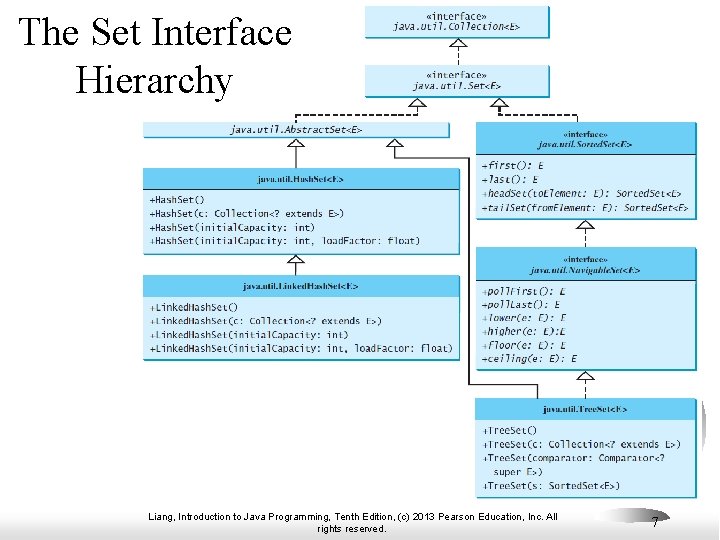
The Set Interface Hierarchy Liang, Introduction to Java Programming, Tenth Edition, (c) 2013 Pearson Education, Inc. All rights reserved. 7
The Abstract. Set Class The Abstract. Set class is a convenience class that extends Abstract. Collection and implements Set. The Abstract. Set class provides concrete implementations for the equals method and the hash. Code method. The hash code of a set is the sum of the hash code of all the elements in the set. Since the size method and iterator method are not implemented in the Abstract. Set class, Abstract. Set is an abstract class. Liang, Introduction to Java Programming, Tenth Edition, (c) 2013 Pearson Education, Inc. All rights reserved. 8
The Hash. Set Class The Hash. Set class is a concrete class that implements Set. It can be used to store duplicate-free elements. For efficiency, objects added to a hash set need to implement the hash. Code method in a manner that properly disperses the hash code. Liang, Introduction to Java Programming, Tenth Edition, (c) 2013 Pearson Education, Inc. All rights reserved. 9
Example: Using Hash. Set and Iterator This example creates a hash set filled with strings, and uses an iterator to traverse the elements in the list. Test. Hash. Set Run Liang, Introduction to Java Programming, Tenth Edition, (c) 2013 Pearson Education, Inc. All rights reserved. 10
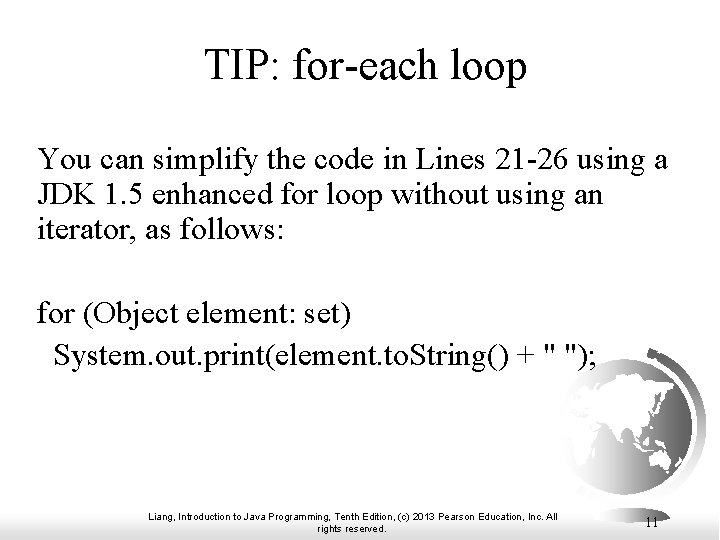
TIP: for-each loop You can simplify the code in Lines 21 -26 using a JDK 1. 5 enhanced for loop without using an iterator, as follows: for (Object element: set) System. out. print(element. to. String() + " "); Liang, Introduction to Java Programming, Tenth Edition, (c) 2013 Pearson Education, Inc. All rights reserved. 11
Example: Using Linked. Hash. Set This example creates a hash set filled with strings, and uses an iterator to traverse the elements in the list. Test. Linked. Hash. Set Run Liang, Introduction to Java Programming, Tenth Edition, (c) 2013 Pearson Education, Inc. All rights reserved. 12
The Sorted. Set Interface and the Tree. Set Class Sorted. Set is a subinterface of Set, which guarantees that the elements in the set are sorted. Tree. Set is a concrete class that implements the Sorted. Set interface. You can use an iterator to traverse the elements in the sorted order. The elements can be sorted in two ways. Liang, Introduction to Java Programming, Tenth Edition, (c) 2013 Pearson Education, Inc. All rights reserved. 13
The Sorted. Set Interface and the Tree. Set Class, cont. One way is to use the Comparable interface. The other way is to specify a comparator for the elements in the set if the class for the elements does not implement the Comparable interface, or you don’t want to use the compare. To method in the class that implements the Comparable interface. This approach is referred to as order by comparator. Liang, Introduction to Java Programming, Tenth Edition, (c) 2013 Pearson Education, Inc. All rights reserved. 14
Example: Using Tree. Set to Sort Elements in a Set This example creates a hash set filled with strings, and then creates a tree set for the same strings. The strings are sorted in the tree set using the compare. To method in the Comparable interface. The example also creates a tree set of geometric objects. The geometric objects are sorted using the compare method in the Comparator interface. Test. Tree. Set Run Liang, Introduction to Java Programming, Tenth Edition, (c) 2013 Pearson Education, Inc. All rights reserved. 15
Example: The Using Comparator to Sort Elements in a Set Write a program that demonstrates how to sort elements in a tree set using the Comparator interface. The example creates a tree set of geometric objects. The geometric objects are sorted using the compare method in the Comparator interface. Test. Tree. Set. With. Comparator Liang, Introduction to Java Programming, Tenth Edition, (c) 2013 Pearson Education, Inc. All rights reserved. Run 16
Performance of Sets and Lists Set. List. Performance. Test Run Liang, Introduction to Java Programming, Tenth Edition, (c) 2013 Pearson Education, Inc. All rights reserved. 17
Case Study: Counting Keywords This section presents an application that counts the number of the keywords in a Java source file. Count. Keywords Run Liang, Introduction to Java Programming, Tenth Edition, (c) 2013 Pearson Education, Inc. All rights reserved. 18
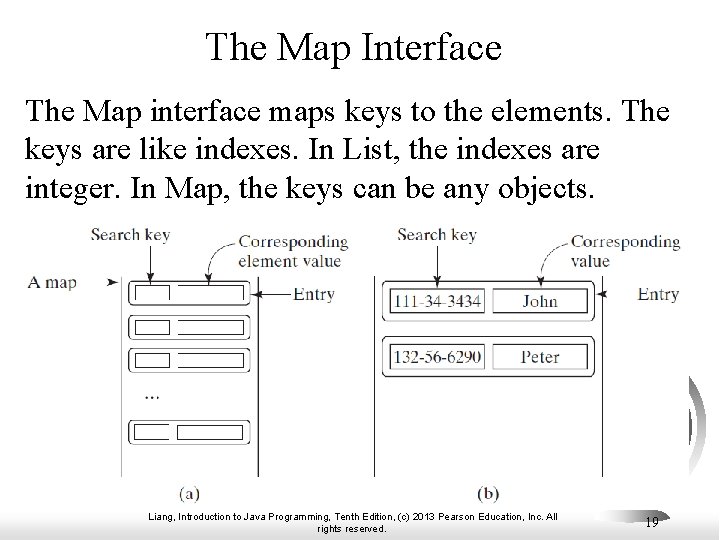
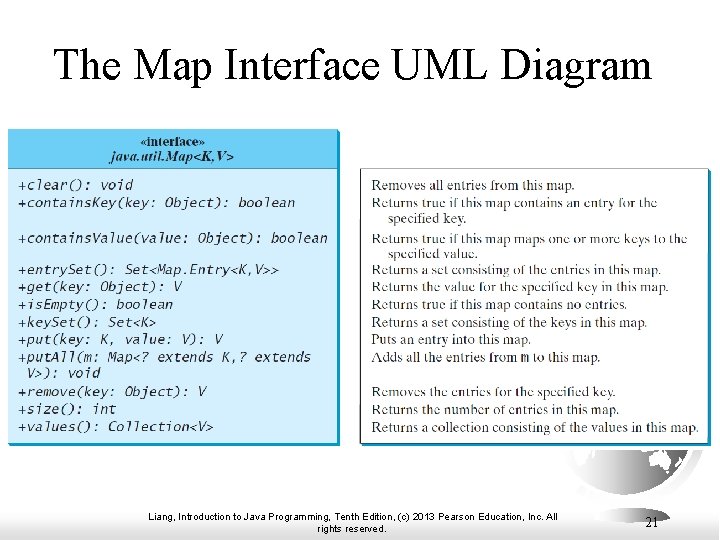
The Map Interface The Map interface maps keys to the elements. The keys are like indexes. In List, the indexes are integer. In Map, the keys can be any objects. Liang, Introduction to Java Programming, Tenth Edition, (c) 2013 Pearson Education, Inc. All rights reserved. 19
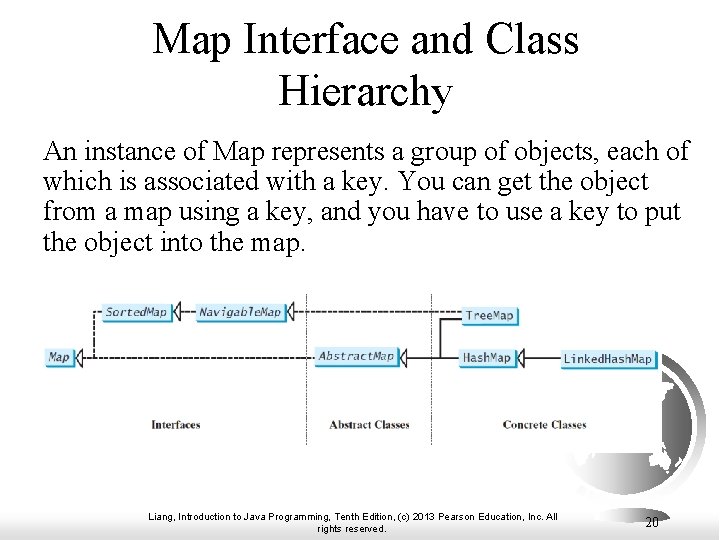
Map Interface and Class Hierarchy An instance of Map represents a group of objects, each of which is associated with a key. You can get the object from a map using a key, and you have to use a key to put the object into the map. Liang, Introduction to Java Programming, Tenth Edition, (c) 2013 Pearson Education, Inc. All rights reserved. 20
The Map Interface UML Diagram Liang, Introduction to Java Programming, Tenth Edition, (c) 2013 Pearson Education, Inc. All rights reserved. 21
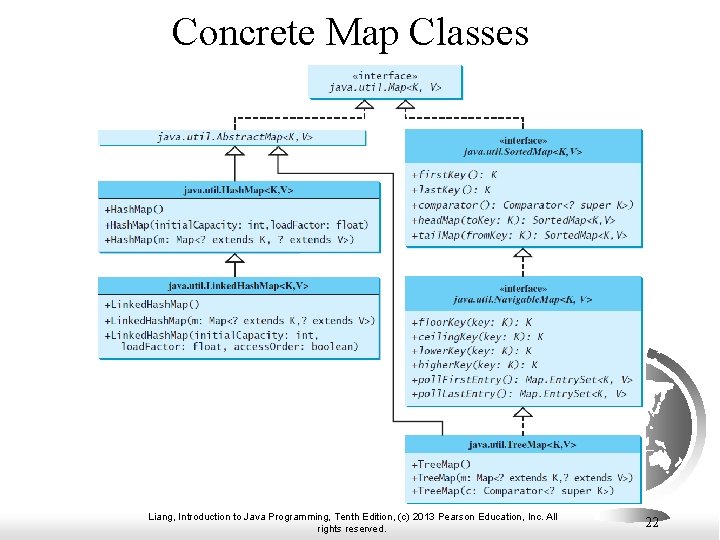
Concrete Map Classes Liang, Introduction to Java Programming, Tenth Edition, (c) 2013 Pearson Education, Inc. All rights reserved. 22
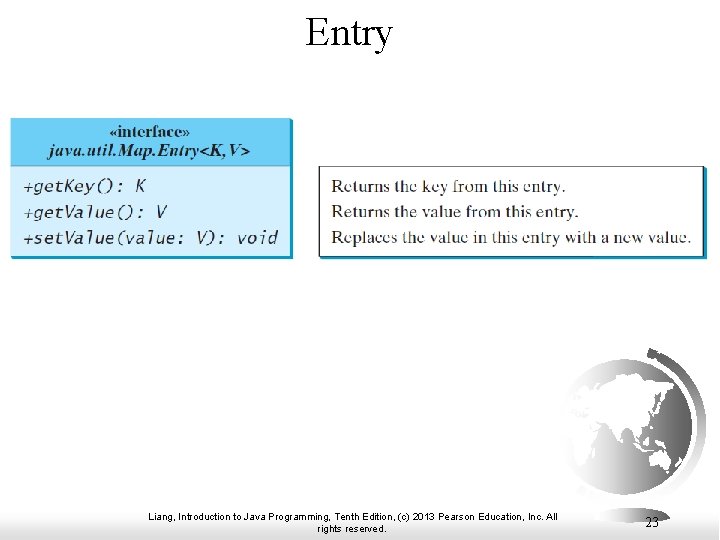
Entry Liang, Introduction to Java Programming, Tenth Edition, (c) 2013 Pearson Education, Inc. All rights reserved. 23
Hash. Map and Tree. Map The Hash. Map and Tree. Map classes are two concrete implementations of the Map interface. The Hash. Map class is efficient for locating a value, inserting a mapping, and deleting a mapping. The Tree. Map class, implementing Sorted. Map, is efficient for traversing the keys in a sorted order. Liang, Introduction to Java Programming, Tenth Edition, (c) 2013 Pearson Education, Inc. All rights reserved. 24
Linked. Hash. Map was introduced in JDK 1. 4. It extends Hash. Map with a linked list implementation that supports an ordering of the entries in the map. The entries in a Hash. Map are not ordered, but the entries in a Linked. Hash. Map can be retrieved in the order in which they were inserted into the map (known as the insertion order), or the order in which they were last accessed, from least recently accessed to most recently (access order). The noarg constructor constructs a Linked. Hash. Map with the insertion order. To construct a Linked. Hash. Map with the access order, use the Linked. Hash. Map(initial. Capacity, load. Factor, true). Liang, Introduction to Java Programming, Tenth Edition, (c) 2013 Pearson Education, Inc. All rights reserved. 25
Example: Using Hash. Map and Tree. Map This example creates a hash map that maps borrowers to mortgages. The program first creates a hash map with the borrower’s name as its key and mortgage as its value. The program then creates a tree map from the hash map, and displays the mappings in ascending order of the keys. Test. Map Liang, Introduction to Java Programming, Tenth Edition, (c) 2013 Pearson Education, Inc. All rights reserved. Run 26
Case Study: Counting the Occurrences of Words in a Text This program counts the occurrences of words in a text and displays the words and their occurrences in ascending order of the words. The program uses a hash map to store a pair consisting of a word and its count. For each word, check whether it is already a key in the map. If not, add the key and value 1 to the map. Otherwise, increase the value for the word (key) by 1 in the map. To sort the map, convert it to a tree map. Count. Occurrence. Of. Words Liang, Introduction to Java Programming, Tenth Edition, (c) 2013 Pearson Education, Inc. All rights reserved. Run 27
The Singleton and Unmodiable Collections Liang, Introduction to Java Programming, Tenth Edition, (c) 2013 Pearson Education, Inc. All rights reserved. 28