
Chapter 21 Musical Sound 12 Feb22 Physics 1
Chapter 21 Musical Sound 12 -Feb-22 Physics 1 (Garcia) SJSU
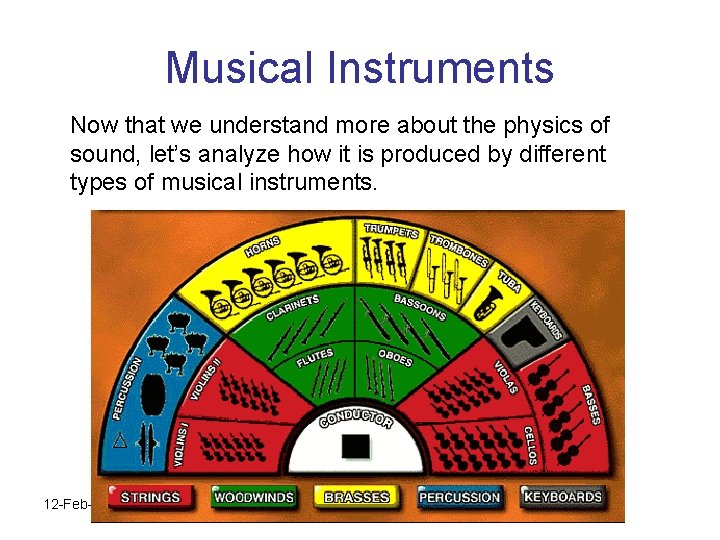
Musical Instruments Now that we understand more about the physics of sound, let’s analyze how it is produced by different types of musical instruments. 12 -Feb-22 Physics 1 (Garcia) SJSU
Musical Notes A musical note has four characteristics: • Duration • Loudness • Pitch (e. g. , soprano versus alto) • Timbre or Quality (e. g, piano versus violin) Let’s investigate the physical properties underlying these four characteristics. 12 -Feb-22 Physics 1 (Garcia) SJSU
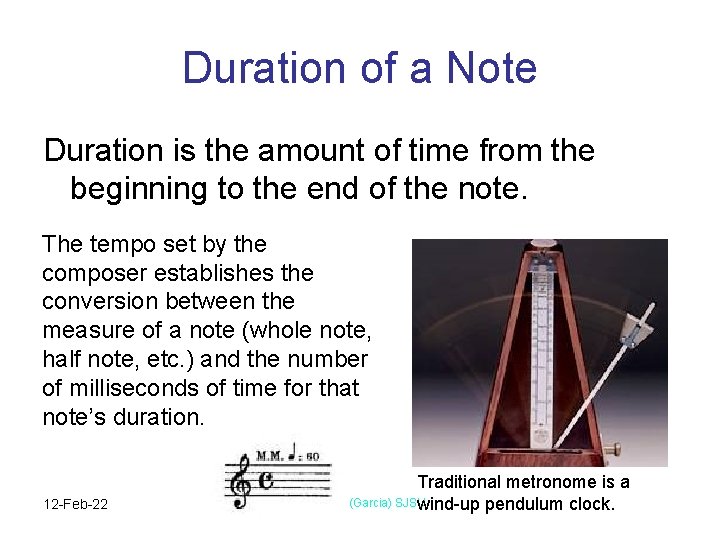
Duration of a Note Duration is the amount of time from the beginning to the end of the note. The tempo set by the composer establishes the conversion between the measure of a note (whole note, half note, etc. ) and the number of milliseconds of time for that note’s duration. 12 -Feb-22 Traditional metronome is a Physics 1 (Garcia) SJSU wind-up pendulum clock.
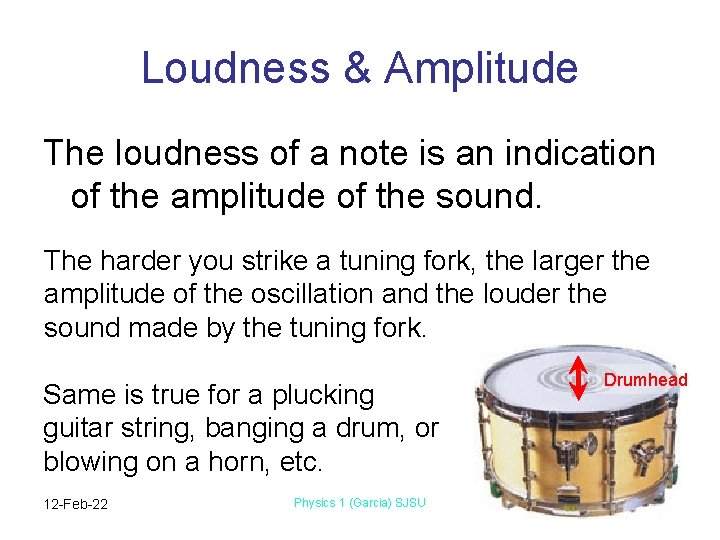
Loudness & Amplitude The loudness of a note is an indication of the amplitude of the sound. The harder you strike a tuning fork, the larger the amplitude of the oscillation and the louder the sound made by the tuning fork. Same is true for a plucking guitar string, banging a drum, or blowing on a horn, etc. 12 -Feb-22 Physics 1 (Garcia) SJSU Drumhead
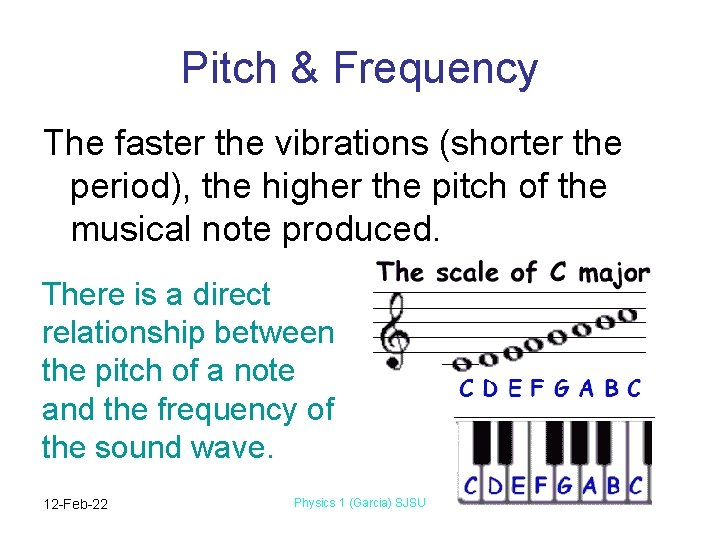
Pitch & Frequency The faster the vibrations (shorter the period), the higher the pitch of the musical note produced. There is a direct relationship between the pitch of a note and the frequency of the sound wave. 12 -Feb-22 Physics 1 (Garcia) SJSU
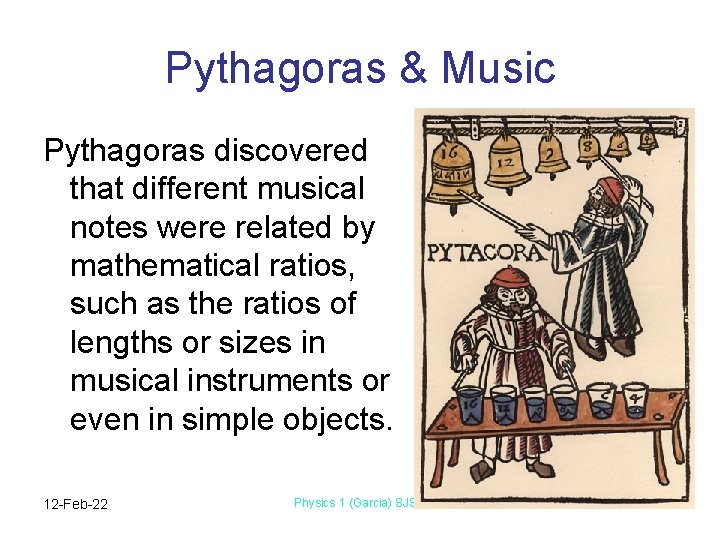
Pythagoras & Music Pythagoras discovered that different musical notes were related by mathematical ratios, such as the ratios of lengths or sizes in musical instruments or even in simple objects. 12 -Feb-22 Physics 1 (Garcia) SJSU
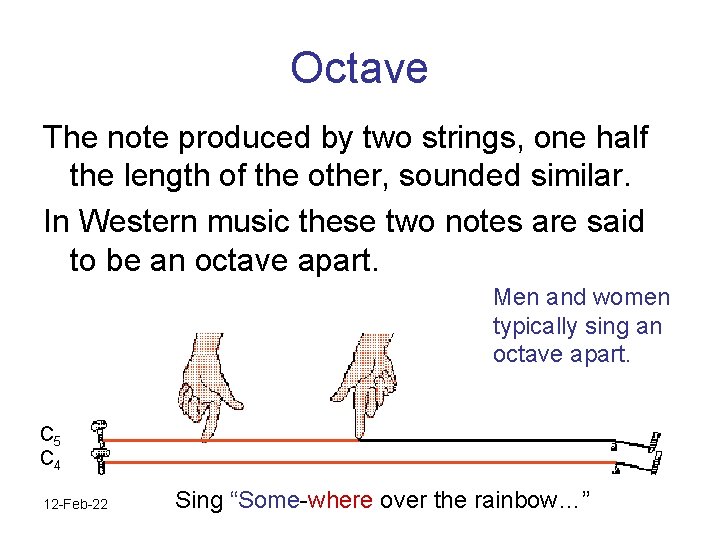
Octave The note produced by two strings, one half the length of the other, sounded similar. In Western music these two notes are said to be an octave apart. Men and women typically sing an octave apart. C 5 C 4 12 -Feb-22 Physics 1 (Garcia) SJSU the rainbow…” Sing “Some-where over
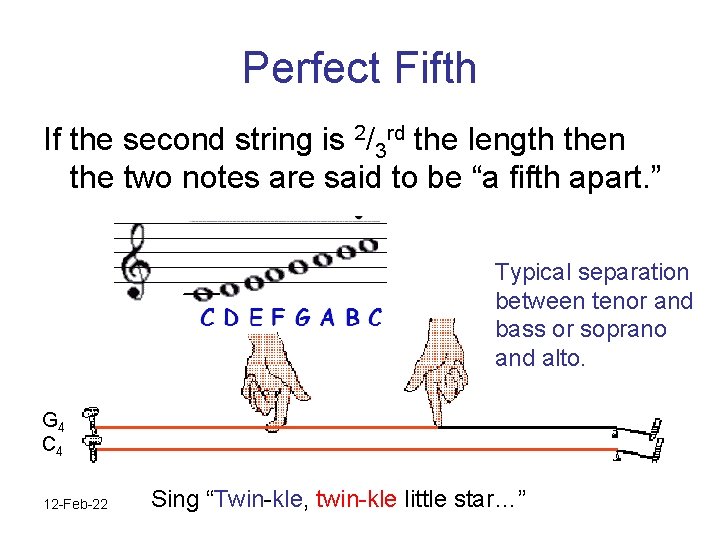
Perfect Fifth If the second string is 2/3 rd the length then the two notes are said to be “a fifth apart. ” Typical separation between tenor and bass or soprano and alto. G 4 C 4 12 -Feb-22 Sing “Twin-kle, twin-kle little star…” Physics 1 (Garcia) SJSU

Fundamental & Overtones The Fundamental is the lowest frequency standing wave. The Overtones are twice, three times, etc. , the frequency of the Fundamental. 110 Hz (A 2) One Octave 220 Hz (A 3) Perfect Fifth 330 Hz (E 4) 12 -Feb-22 Physics 1 (Garcia) SJSU
Notes and Powers of Two An octave has 12 steps and going up an octave doubles the frequency. The frequency of “Concert A” is 440 Hz. The frequency of other notes is (Frequency) = 2(steps)/12 x (440 Hz) counting number of steps from Concert A 12 -Feb-22 Physics 1 (Garcia) SJSU
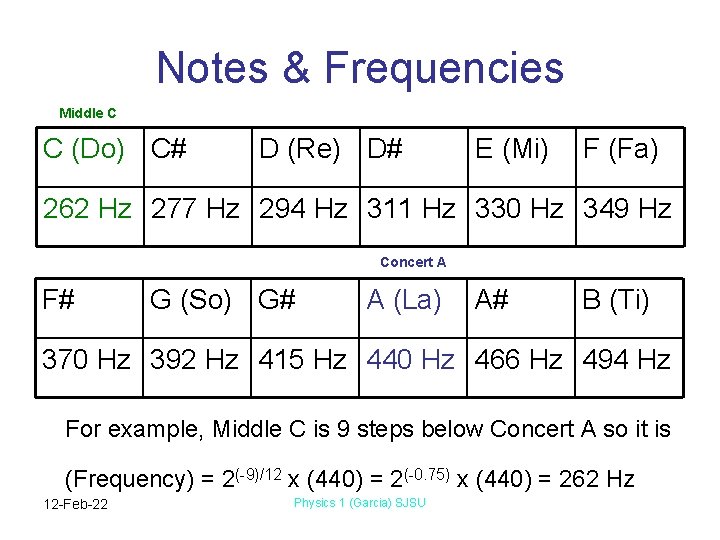
Notes & Frequencies Middle C C (Do) C# D (Re) D# E (Mi) F (Fa) 262 Hz 277 Hz 294 Hz 311 Hz 330 Hz 349 Hz Concert A F# G (So) G# A (La) A# B (Ti) 370 Hz 392 Hz 415 Hz 440 Hz 466 Hz 494 Hz For example, Middle C is 9 steps below Concert A so it is (Frequency) = 2(-9)/12 x (440) = 2(-0. 75) x (440) = 262 Hz 12 -Feb-22 Physics 1 (Garcia) SJSU
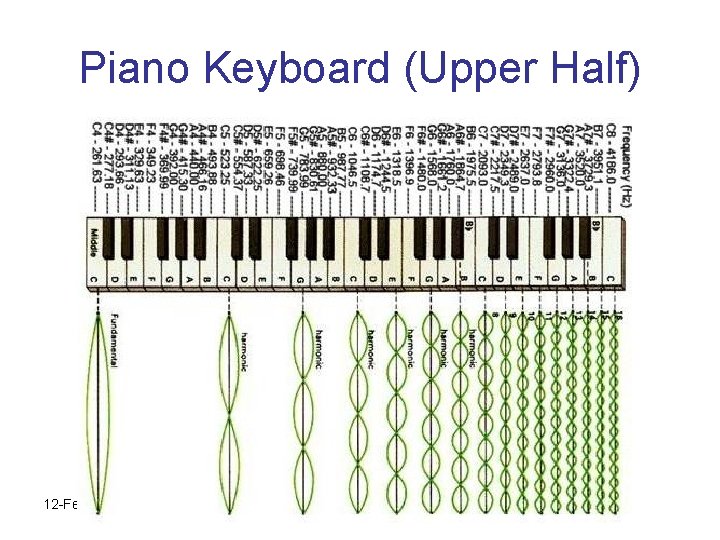
Piano Keyboard (Upper Half) 12 -Feb-22 Physics 1 (Garcia) SJSU
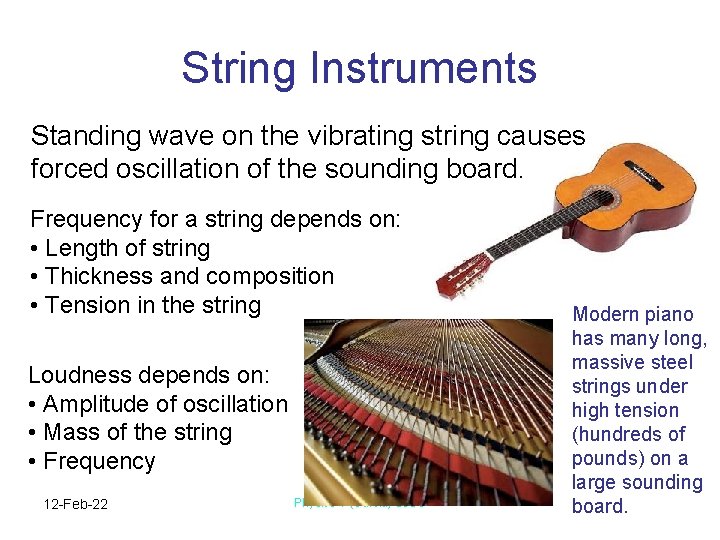
String Instruments Standing wave on the vibrating string causes forced oscillation of the sounding board. Frequency for a string depends on: • Length of string • Thickness and composition • Tension in the string Loudness depends on: • Amplitude of oscillation • Mass of the string • Frequency 12 -Feb-22 Physics 1 (Garcia) SJSU Modern piano has many long, massive steel strings under high tension (hundreds of pounds) on a large sounding board.
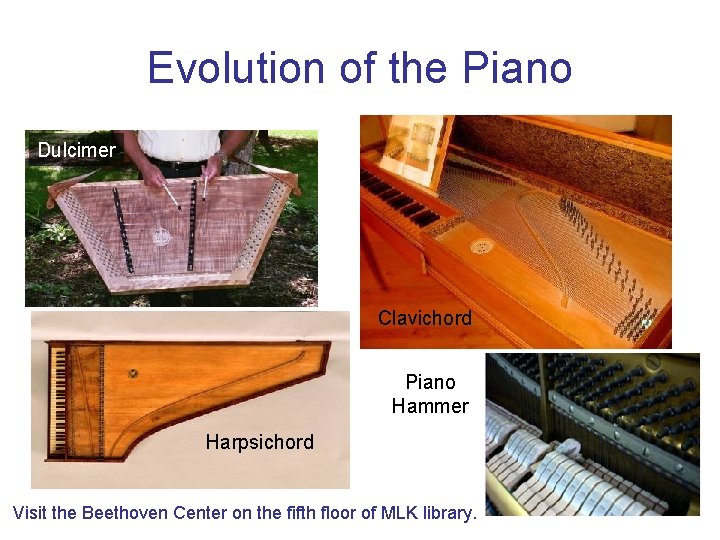
Evolution of the Piano Dulcimer Clavichord Piano Hammer Harpsichord 12 -Feb-22 Physics 1 (Garcia) SJSU Visit the Beethoven Center on the fifth floor of MLK library.
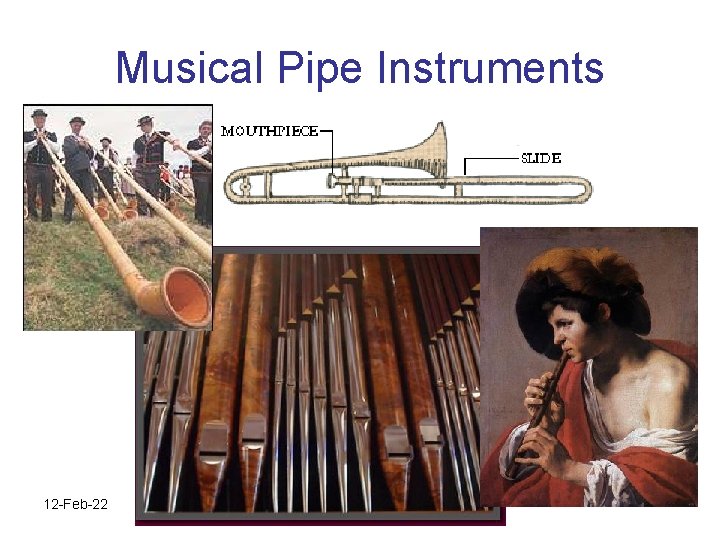
Musical Pipe Instruments 12 -Feb-22 Physics 1 (Garcia) SJSU
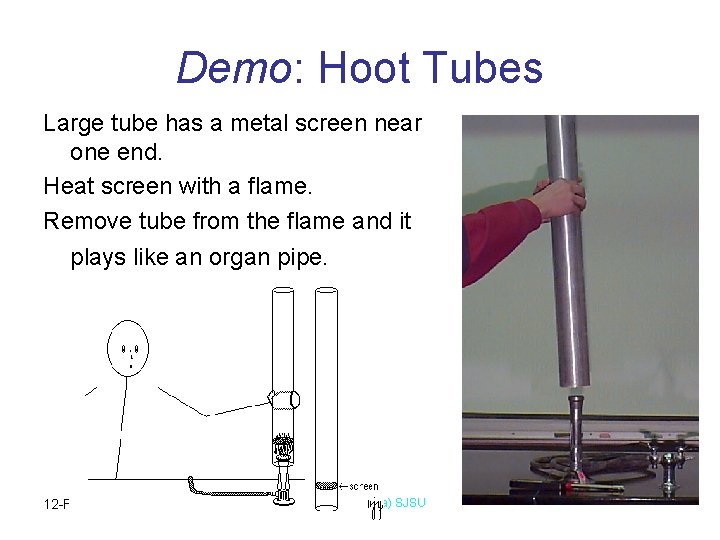
Demo: Hoot Tubes Large tube has a metal screen near one end. Heat screen with a flame. Remove tube from the flame and it plays like an organ pipe. 12 -Feb-22 Physics 1 (Garcia) SJSU
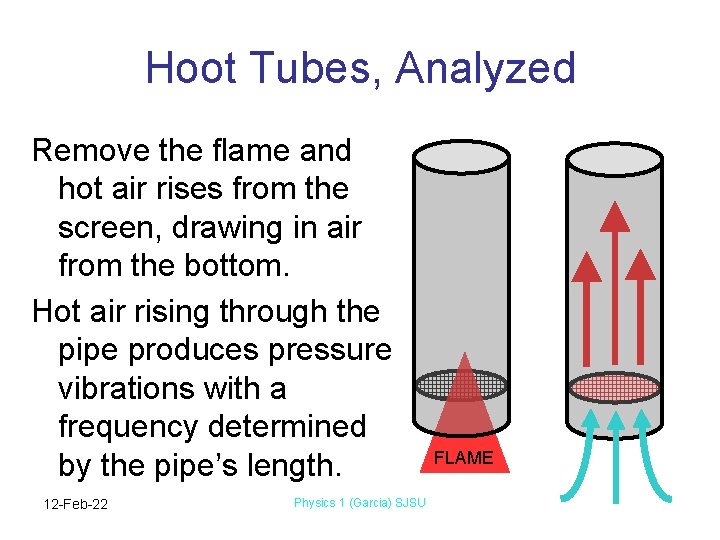
Hoot Tubes, Analyzed Remove the flame and hot air rises from the screen, drawing in air from the bottom. Hot air rising through the pipe produces pressure vibrations with a frequency determined by the pipe’s length. 12 -Feb-22 Physics 1 (Garcia) SJSU FLAME
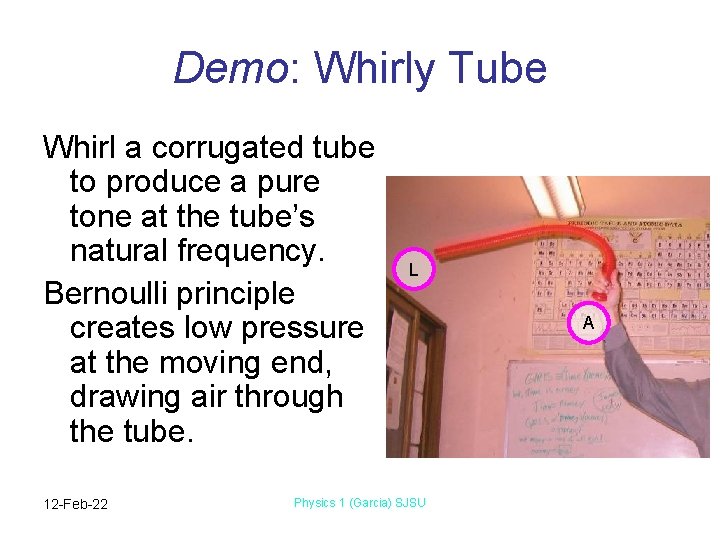
Demo: Whirly Tube Whirl a corrugated tube to produce a pure tone at the tube’s natural frequency. Bernoulli principle creates low pressure at the moving end, drawing air through the tube. 12 -Feb-22 L Physics 1 (Garcia) SJSU A
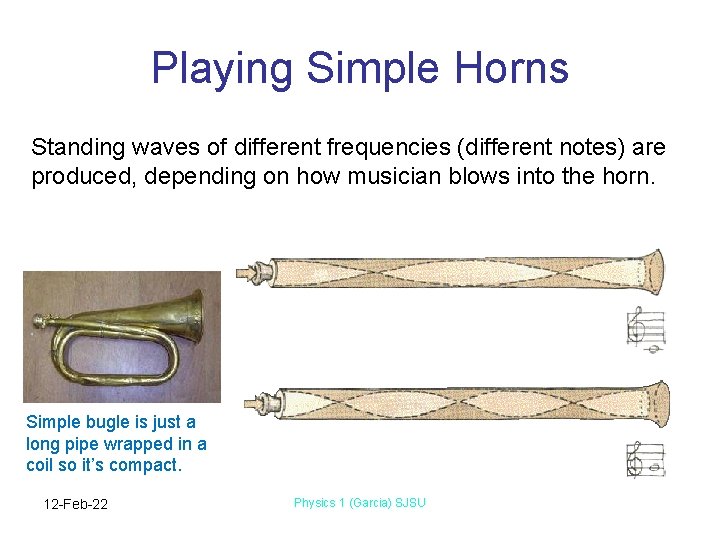
Playing Simple Horns Standing waves of different frequencies (different notes) are produced, depending on how musician blows into the horn. Simple bugle is just a long pipe wrapped in a coil so it’s compact. 12 -Feb-22 Physics 1 (Garcia) SJSU
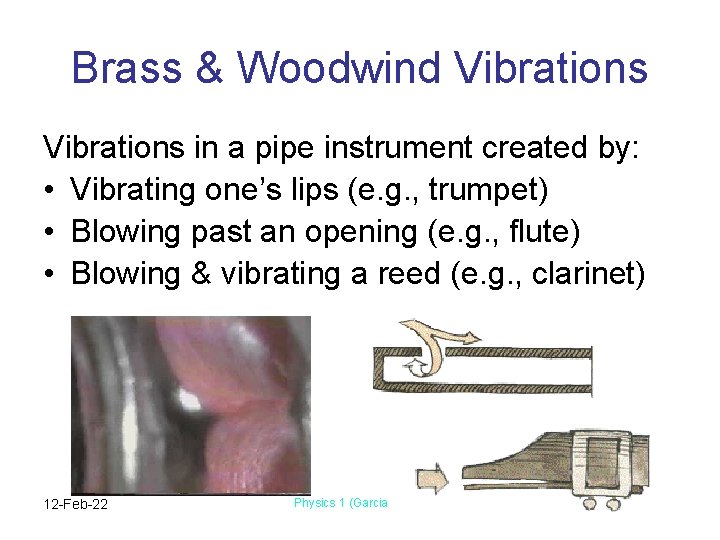
Brass & Woodwind Vibrations in a pipe instrument created by: • Vibrating one’s lips (e. g. , trumpet) • Blowing past an opening (e. g. , flute) • Blowing & vibrating a reed (e. g. , clarinet) 12 -Feb-22 Physics 1 (Garcia) SJSU
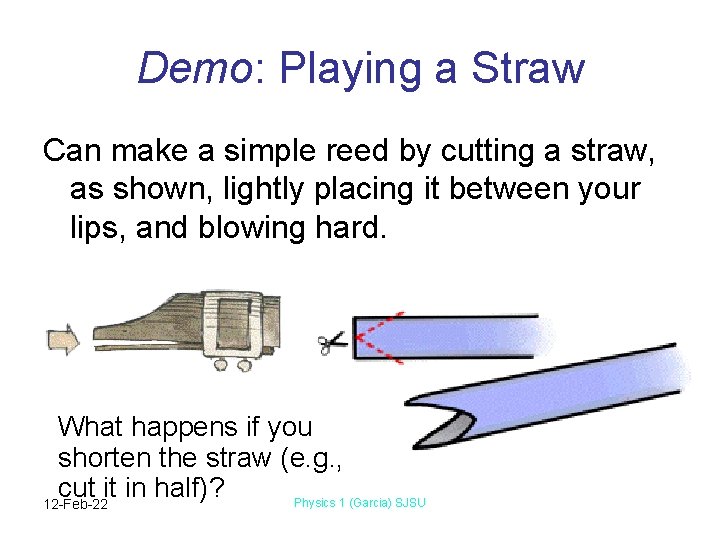
Demo: Playing a Straw Can make a simple reed by cutting a straw, as shown, lightly placing it between your lips, and blowing hard. What happens if you shorten the straw (e. g. , cut it in half)? Physics 1 (Garcia) SJSU 12 -Feb-22
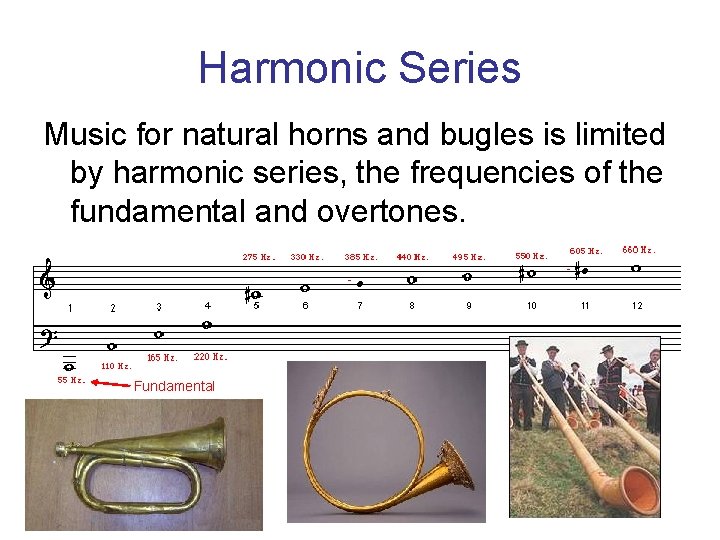
Harmonic Series Music for natural horns and bugles is limited by harmonic series, the frequencies of the fundamental and overtones. Fundamental 12 -Feb-22 Physics 1 (Garcia) SJSU
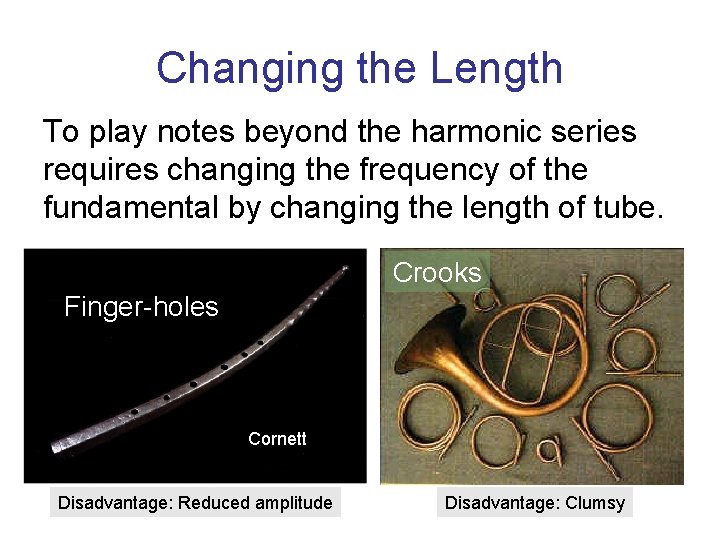
Changing the Length To play notes beyond the harmonic series requires changing the frequency of the fundamental by changing the length of tube. Crooks Finger-holes Cornett Disadvantage: Reduced amplitude Disadvantage: Clumsy
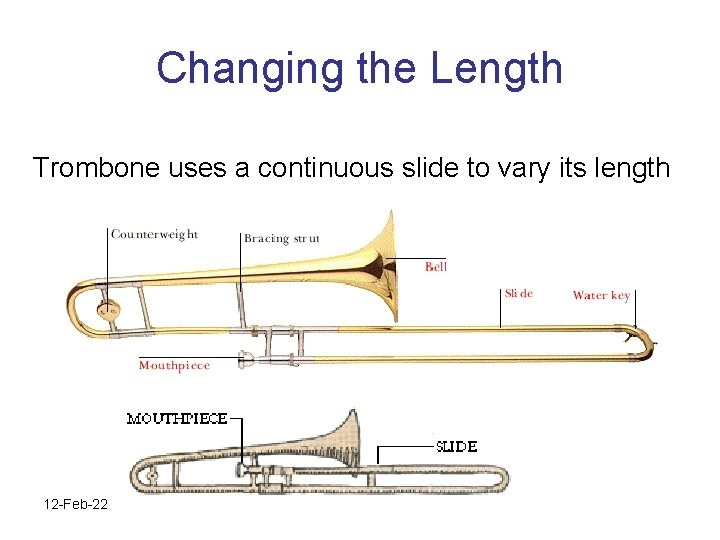
Changing the Length Trombone uses a continuous slide to vary its length Cornett 12 -Feb-22 Physics 1 (Garcia) SJSU
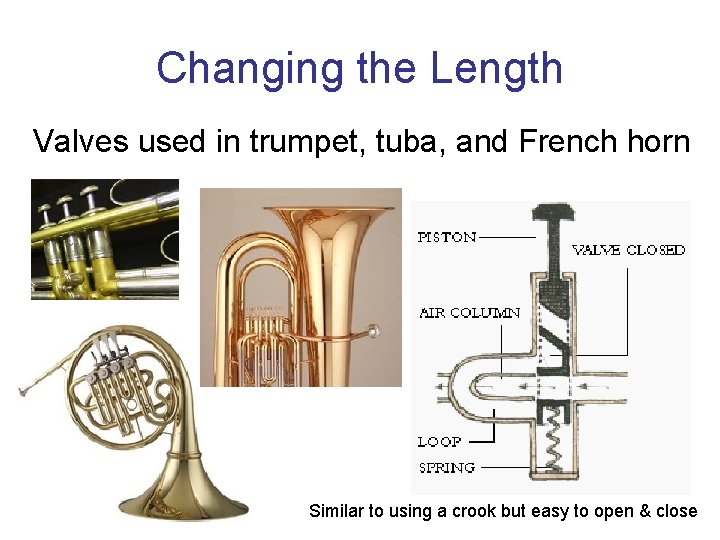
Changing the Length Valves used in trumpet, tuba, and French horn Cornett 12 -Feb-22 Similar to using a crook but easy to open & close
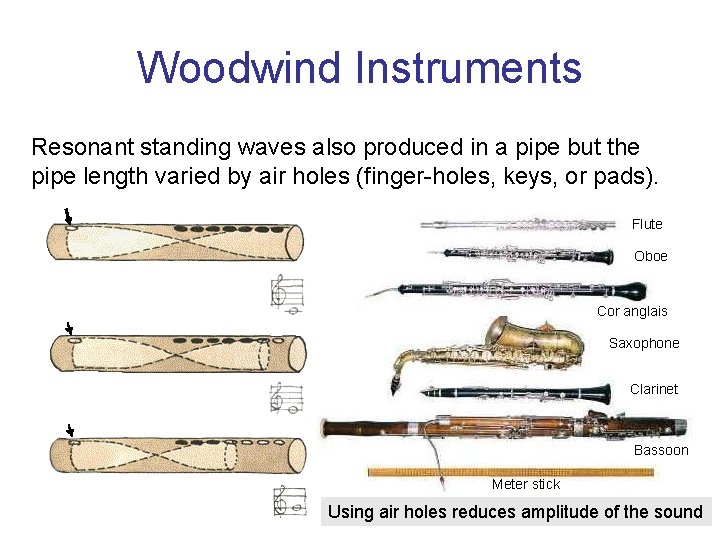
Woodwind Instruments Resonant standing waves also produced in a pipe but the pipe length varied by air holes (finger-holes, keys, or pads). Flute Oboe Cor anglais Saxophone Clarinet Bassoon Meter stick Using air holes reduces amplitude of the sound
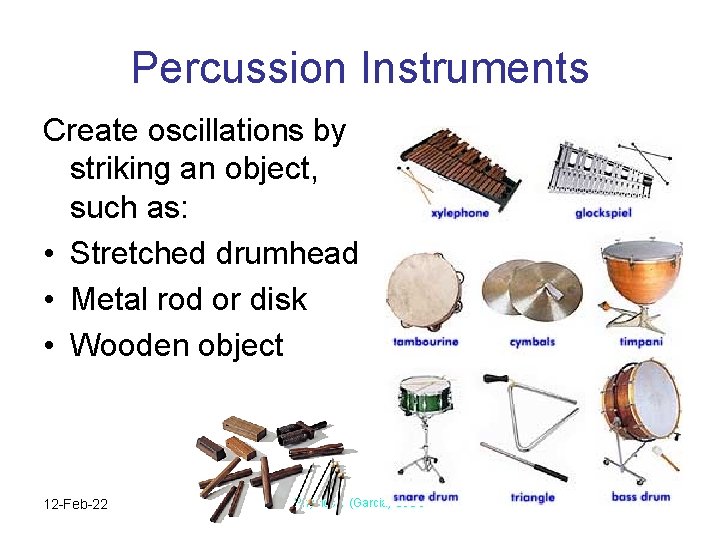
Percussion Instruments Create oscillations by striking an object, such as: • Stretched drumhead • Metal rod or disk • Wooden object 12 -Feb-22 Physics 1 (Garcia) SJSU
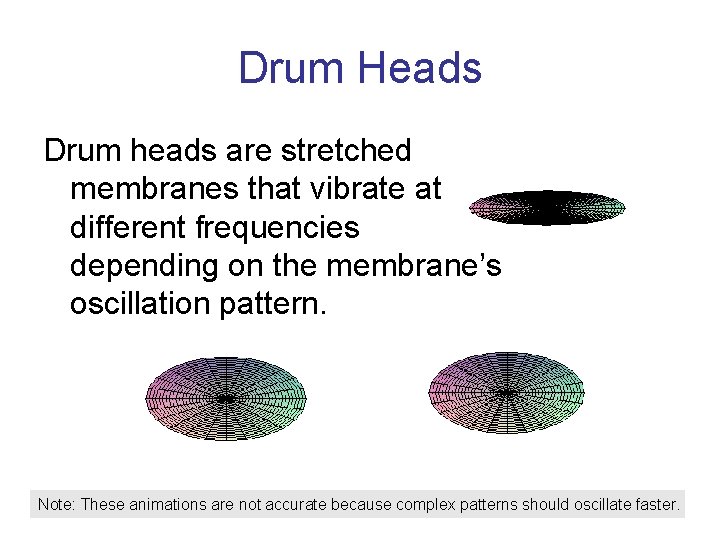
Drum Heads Drum heads are stretched membranes that vibrate at different frequencies depending on the membrane’s oscillation pattern. Physicsbecause 1 (Garcia) SJSU 12 -Feb-22 Note: These animations are not accurate complex patterns should oscillate faster.
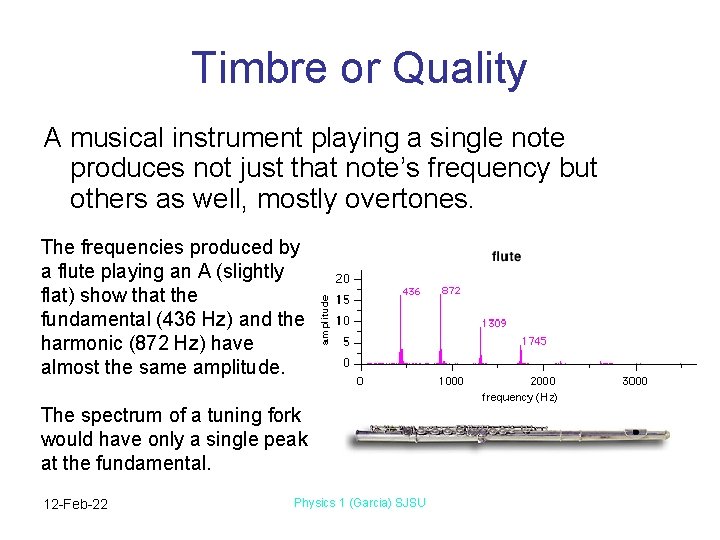
Timbre or Quality A musical instrument playing a single note produces not just that note’s frequency but others as well, mostly overtones. The frequencies produced by a flute playing an A (slightly flat) show that the fundamental (436 Hz) and the harmonic (872 Hz) have almost the same amplitude. The spectrum of a tuning fork would have only a single peak at the fundamental. 12 -Feb-22 Physics 1 (Garcia) SJSU
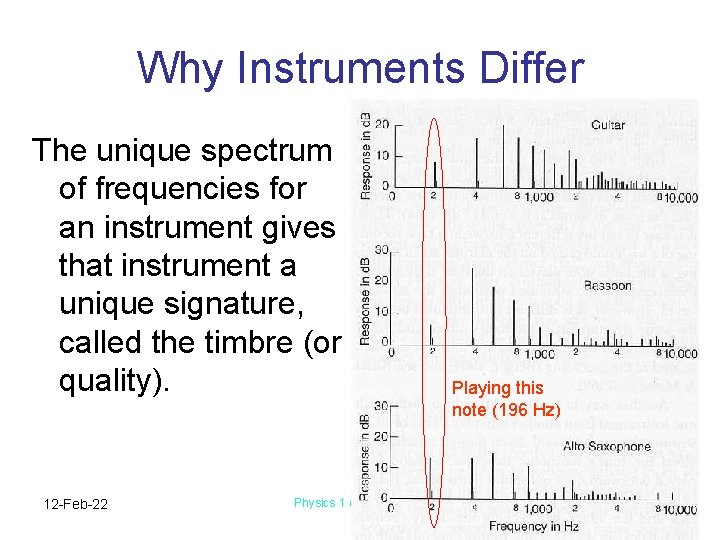
Why Instruments Differ The unique spectrum of frequencies for an instrument gives that instrument a unique signature, called the timbre (or quality). 12 -Feb-22 Physics 1 (Garcia) SJSU Playing this note (196 Hz)
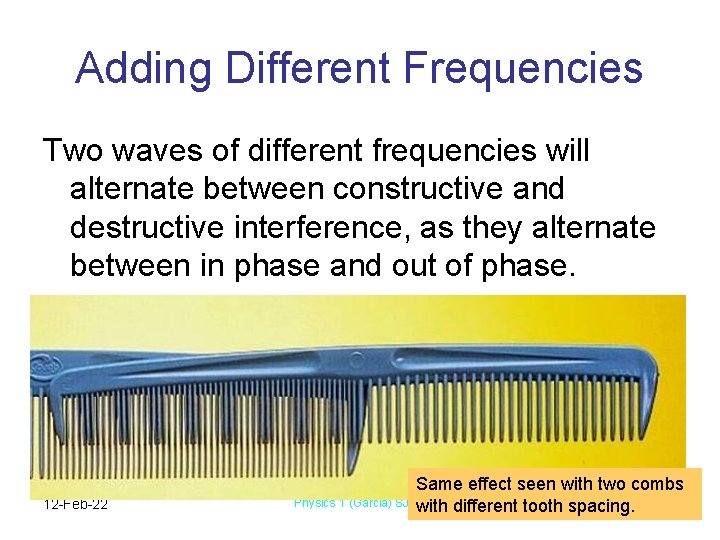
Adding Different Frequencies Two waves of different frequencies will alternate between constructive and destructive interference, as they alternate between in phase and out of phase. 12 -Feb-22 Same effect seen with two combs Physics 1 (Garcia) SJSU with different tooth spacing.
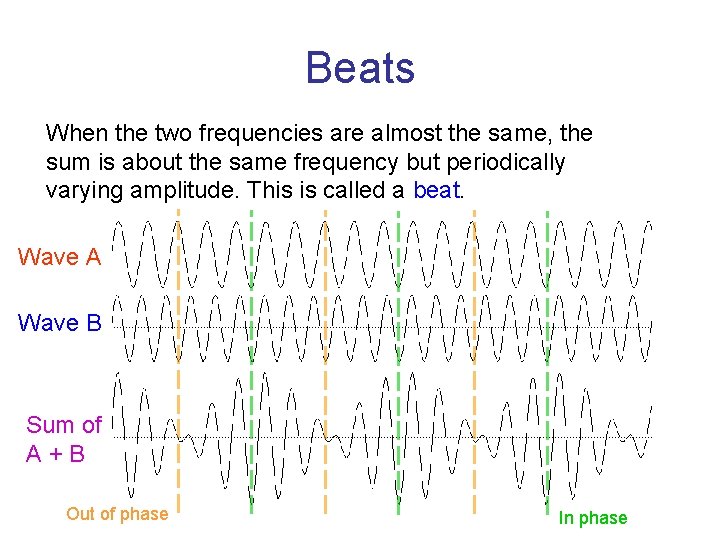
Beats When the two frequencies are almost the same, the sum is about the same frequency but periodically varying amplitude. This is called a beat. Wave A Wave B Sum of A+B Out of phase Physics 1 (Garcia) SJSU In phase
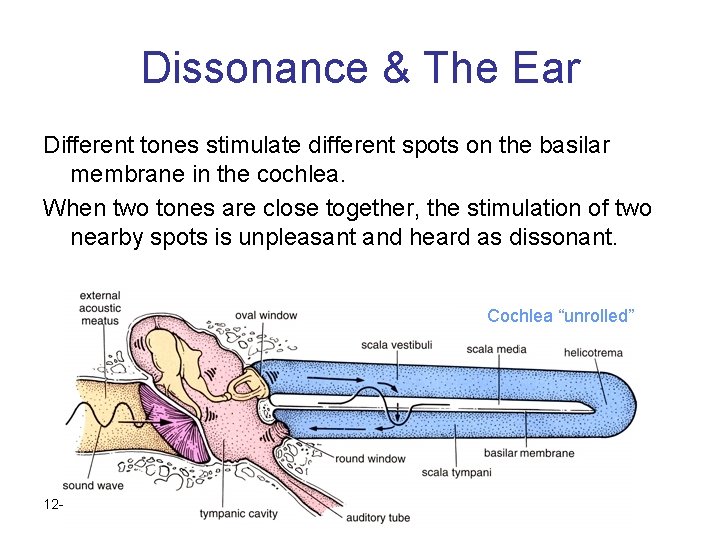
Dissonance & The Ear Different tones stimulate different spots on the basilar membrane in the cochlea. When two tones are close together, the stimulation of two nearby spots is unpleasant and heard as dissonant. Cochlea “unrolled” 12 -Feb-22 Physics 1 (Garcia) SJSU
- Slides: 34