
Chapter 21 GTAW Flat Welding Position credit Jarek

- Slides: 35
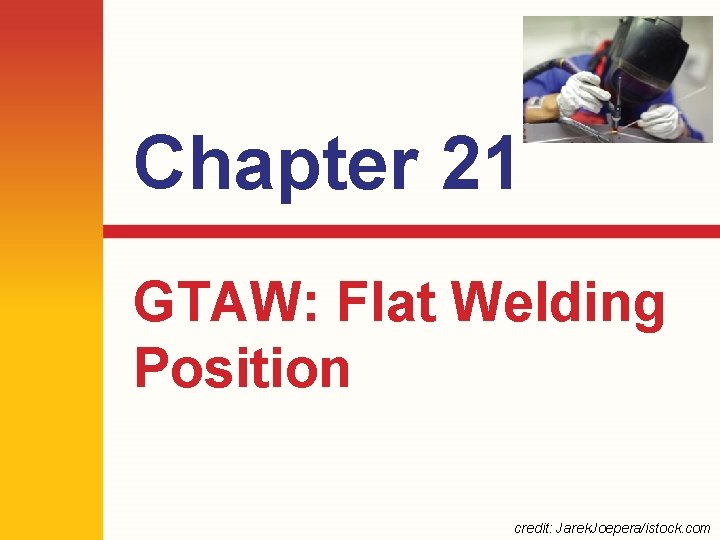
Chapter 21 GTAW: Flat Welding Position credit: Jarek. Joepera/istock. com
Learning Objectives • Describe the GTAW process. • Determine the appropriate welding rod to use when gas tungsten arc welding. • Lay a bead on a plate using GTAW. • Make a fillet weld on a lap joint in the flat welding position. Copyright Goodheart-Willcox Co. , Inc. May not be posted to a publicly accessible website.
Learning Objectives (Cont. ) • Make a fillet weld on a T-joint in the flat welding position. • Weld a butt joint in the flat welding position. • Describe the use of a backing when welding aluminum using GTAW. • Identify various weld defects. Copyright Goodheart-Willcox Co. , Inc. May not be posted to a publicly accessible website.
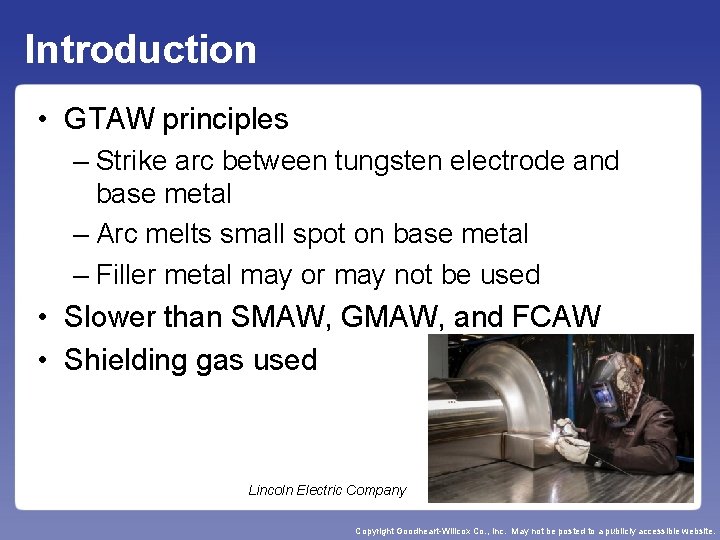
Introduction • GTAW principles – Strike arc between tungsten electrode and base metal – Arc melts small spot on base metal – Filler metal may or may not be used • Slower than SMAW, GMAW, and FCAW • Shielding gas used Lincoln Electric Company Copyright Goodheart-Willcox Co. , Inc. May not be posted to a publicly accessible website.
Preparing to Weld • Assemble equipment – Connect torch cables – Connect source of shielding gas • • Check all connections Select current and other settings Choose, prepare, and install electrode Adjust shielding gas flow Copyright Goodheart-Willcox Co. , Inc. May not be posted to a publicly accessible website.
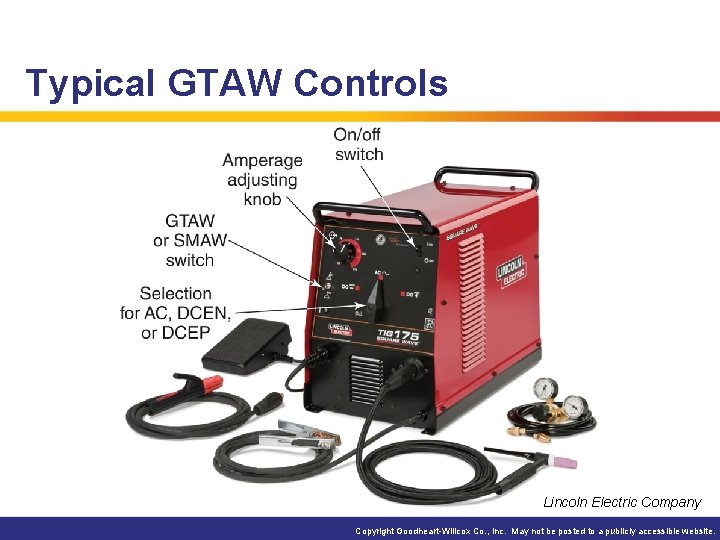
Typical GTAW Controls Lincoln Electric Company Copyright Goodheart-Willcox Co. , Inc. May not be posted to a publicly accessible website.
GTAW Safety • • Use #10, #12, or #14 filter lens in welding helmet Wear proper clothes for welding Protect all body parts from welding arc Remove all combustible materials from area Copyright Goodheart-Willcox Co. , Inc. May not be posted to a publicly accessible website.
Welding Rod • Usually similar to base metal • Diameter is determined by size of weld – Filler metal is added about once every 2 seconds • Hold rod close to arc – Keeps rod heated – Protects tip with shielding gas Copyright Goodheart-Willcox Co. , Inc. May not be posted to a publicly accessible website.
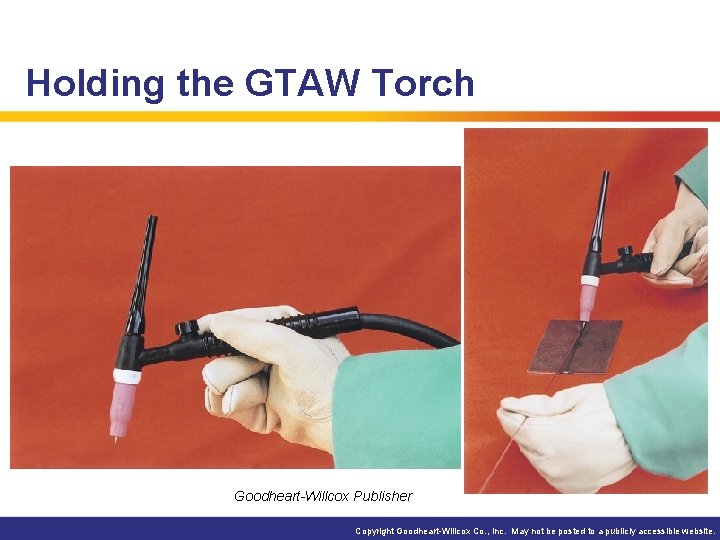
Holding the GTAW Torch Goodheart-Willcox Publisher Copyright Goodheart-Willcox Co. , Inc. May not be posted to a publicly accessible website.
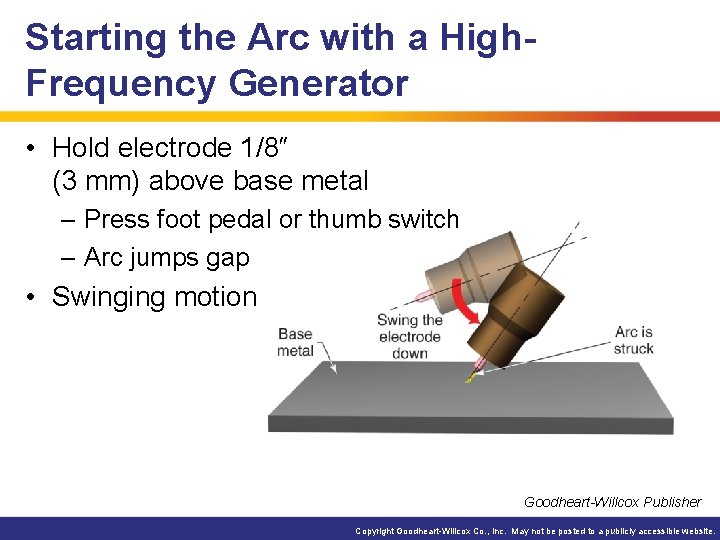
Starting the Arc with a High. Frequency Generator • Hold electrode 1/8″ (3 mm) above base metal – Press foot pedal or thumb switch – Arc jumps gap • Swinging motion Goodheart-Willcox Publisher Copyright Goodheart-Willcox Co. , Inc. May not be posted to a publicly accessible website.
Touch-Starting the Arc • Used only with DC welding • Can contaminate the electrode • Contamination produces unstable arc – Makes welding more difficult – Causes poor-quality weld Copyright Goodheart-Willcox Co. , Inc. May not be posted to a publicly accessible website.
Stopping the Arc • Remove foot from pedal or turn off thumb switch • Keep torch over end of weld area – Post flow protects weld metal as it cools • Use remote control device to reduce current near end of weld – Provides time to fill weld pool if necessary Copyright Goodheart-Willcox Co. , Inc. May not be posted to a publicly accessible website.
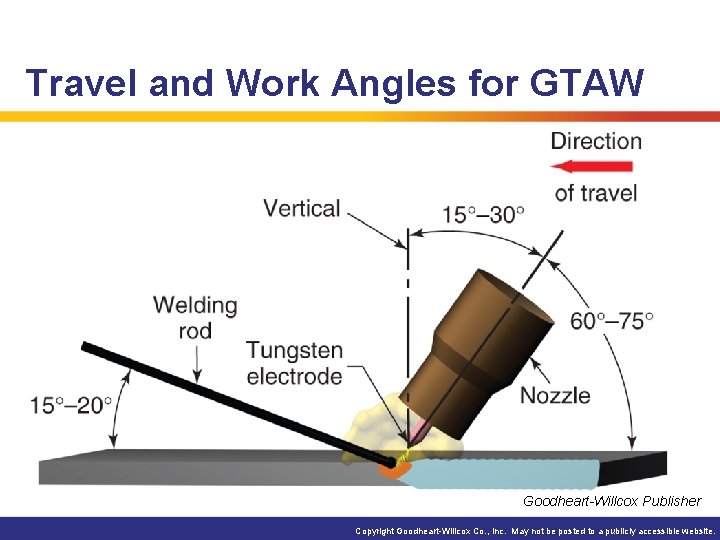
Travel and Work Angles for GTAW Goodheart-Willcox Publisher Copyright Goodheart-Willcox Co. , Inc. May not be posted to a publicly accessible website.
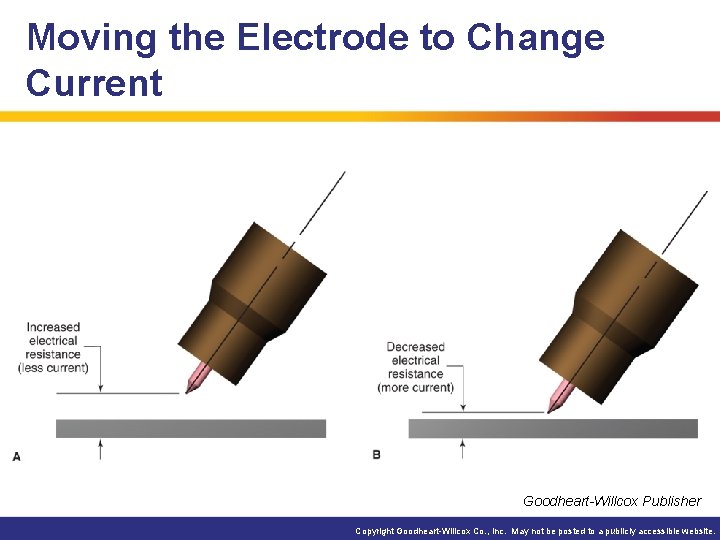
Welding a Bead on Plate • Start and stabilize arc • Hold electrode 1/16″– 1/8″ (1. 5 mm– 3 mm) above work to form weld pool • Move forward • Move electrode to change current slightly – More penetration or heat – Avoid long, unstable arc to prevent porosity Copyright Goodheart-Willcox Co. , Inc. May not be posted to a publicly accessible website.
Moving the Electrode to Change Current Goodheart-Willcox Publisher Copyright Goodheart-Willcox Co. , Inc. May not be posted to a publicly accessible website.
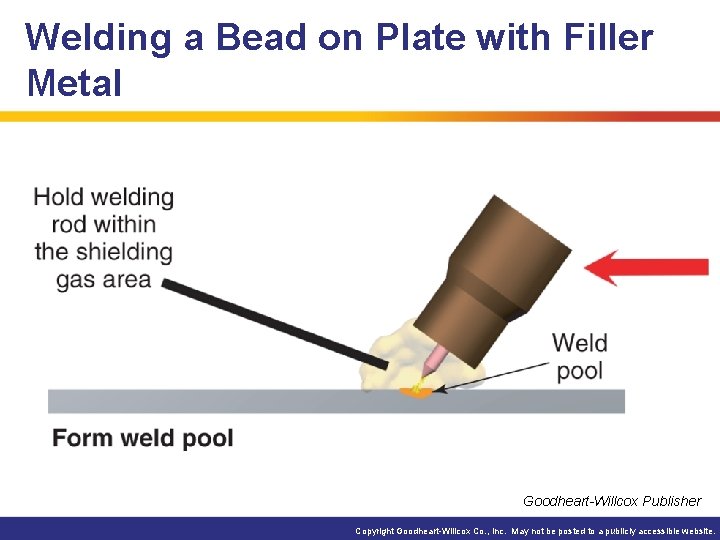
Welding a Bead on Plate with Filler Metal Goodheart-Willcox Publisher Copyright Goodheart-Willcox Co. , Inc. May not be posted to a publicly accessible website.
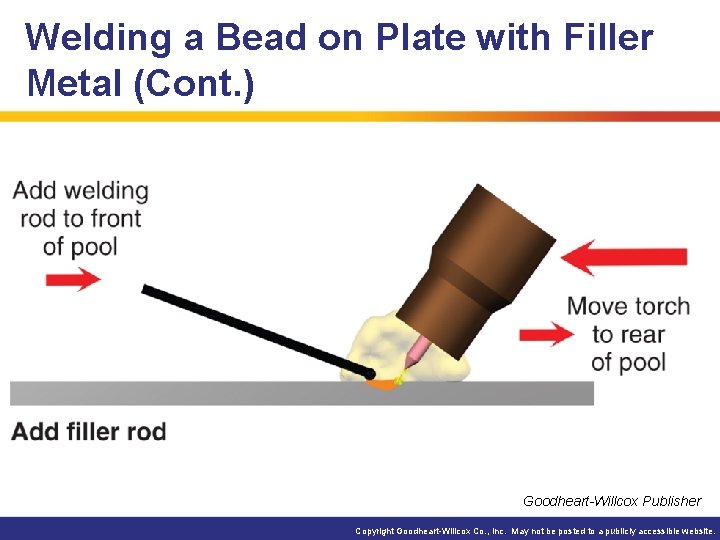
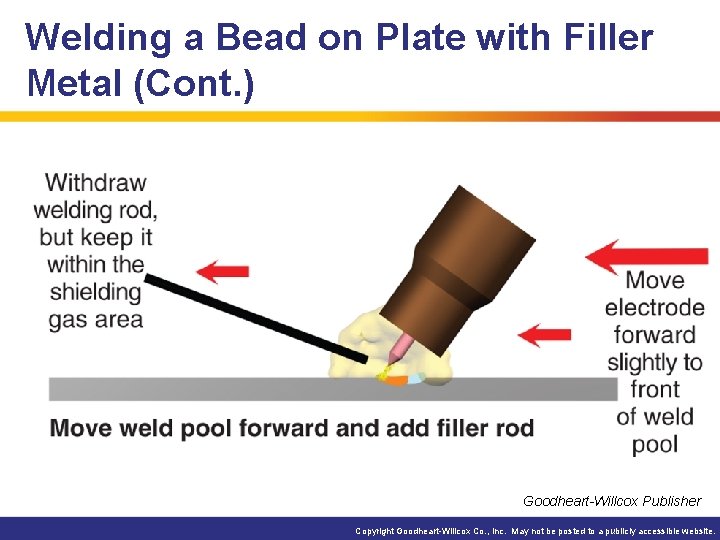
Welding a Bead on Plate with Filler Metal (Cont. ) Goodheart-Willcox Publisher Copyright Goodheart-Willcox Co. , Inc. May not be posted to a publicly accessible website.
Welding a Bead on Plate with Filler Metal (Cont. ) Goodheart-Willcox Publisher Copyright Goodheart-Willcox Co. , Inc. May not be posted to a publicly accessible website.
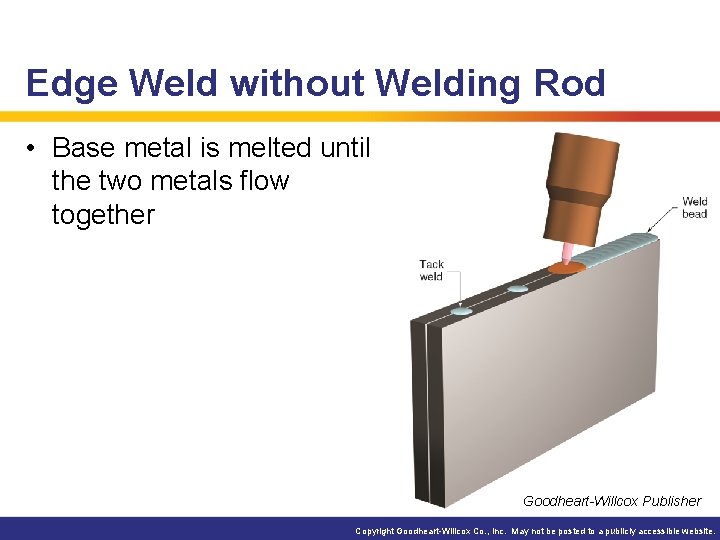
Edge Weld without Welding Rod • Base metal is melted until the two metals flow together Goodheart-Willcox Publisher Copyright Goodheart-Willcox Co. , Inc. May not be posted to a publicly accessible website.
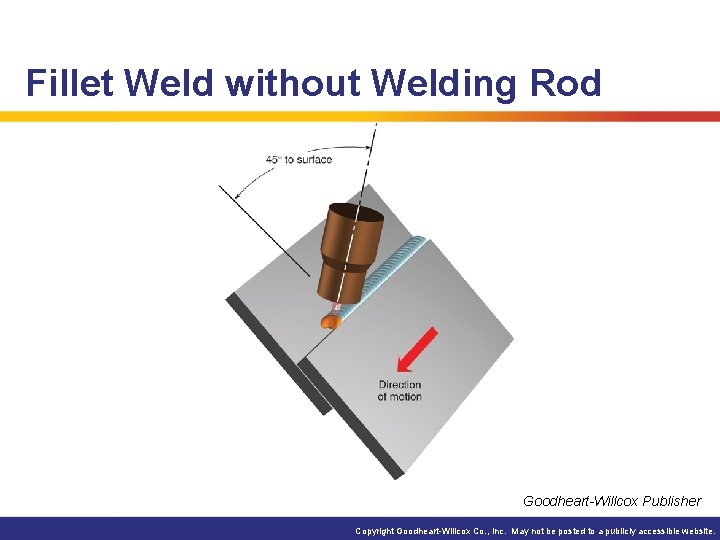
Fillet Weld without Welding Rod Goodheart-Willcox Publisher Copyright Goodheart-Willcox Co. , Inc. May not be posted to a publicly accessible website.
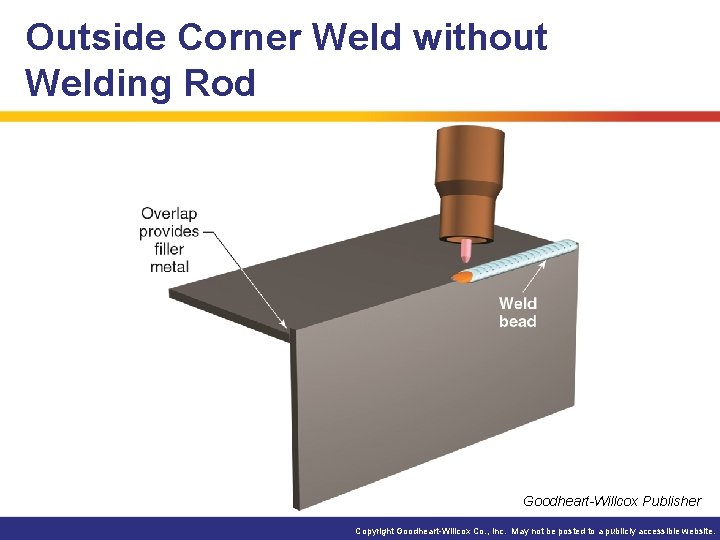
Outside Corner Weld without Welding Rod Goodheart-Willcox Publisher Copyright Goodheart-Willcox Co. , Inc. May not be posted to a publicly accessible website.
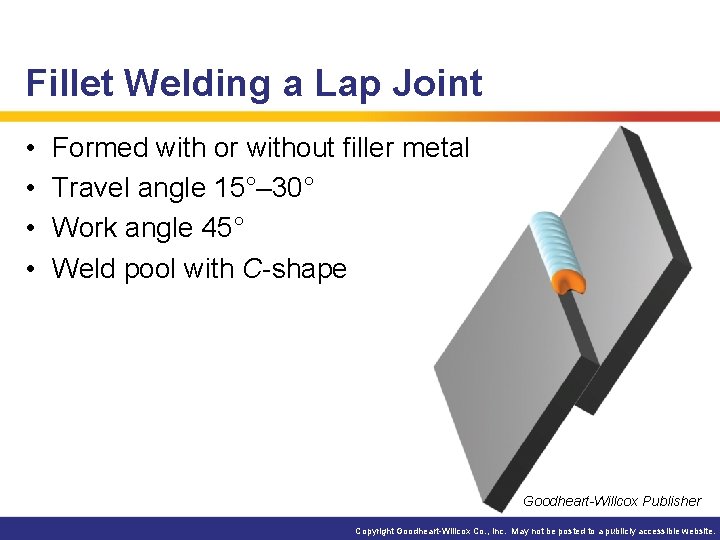
Fillet Welding a Lap Joint • • Formed with or without filler metal Travel angle 15°– 30° Work angle 45° Weld pool with C-shape Goodheart-Willcox Publisher Copyright Goodheart-Willcox Co. , Inc. May not be posted to a publicly accessible website.
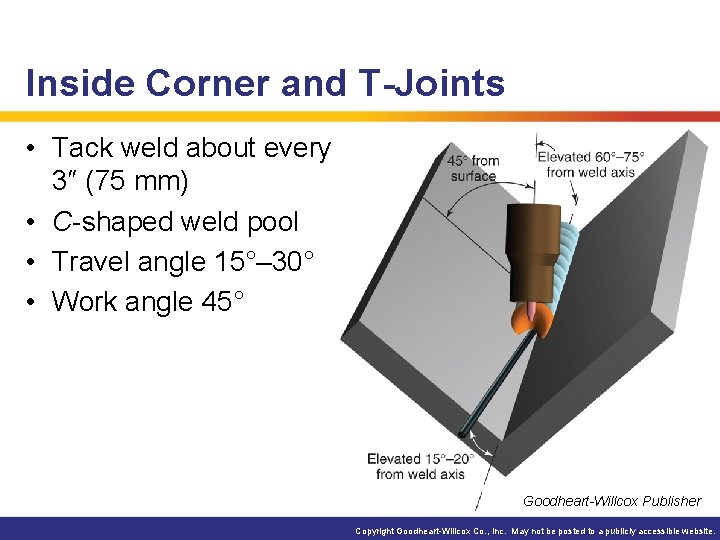
Inside Corner and T-Joints • Tack weld about every 3″ (75 mm) • C-shaped weld pool • Travel angle 15°– 30° • Work angle 45° Goodheart-Willcox Publisher Copyright Goodheart-Willcox Co. , Inc. May not be posted to a publicly accessible website.
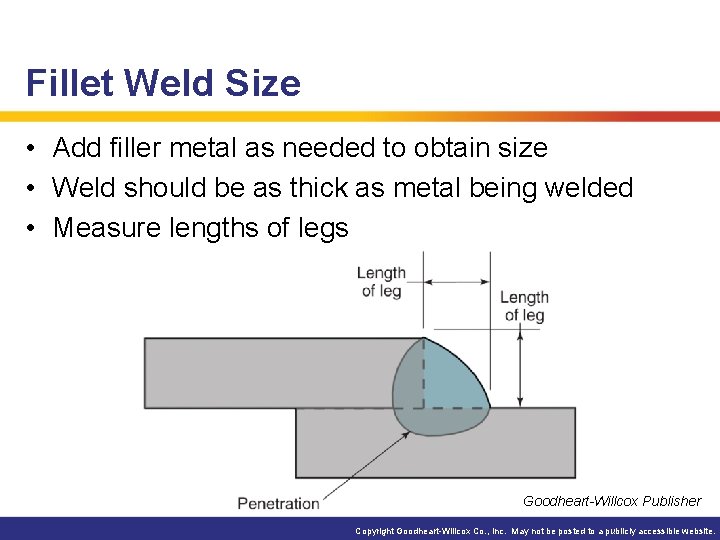
Fillet Weld Size • Add filler metal as needed to obtain size • Weld should be as thick as metal being welded • Measure lengths of legs Goodheart-Willcox Publisher Copyright Goodheart-Willcox Co. , Inc. May not be posted to a publicly accessible website.
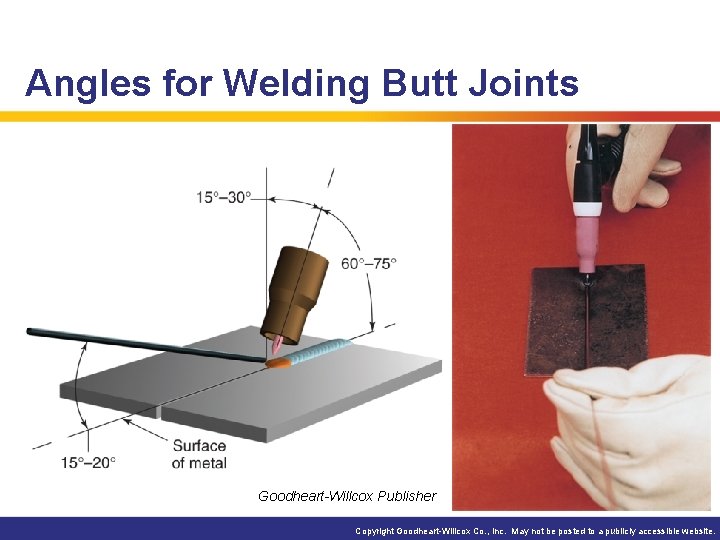
Angles for Welding Butt Joints Goodheart-Willcox Publisher Copyright Goodheart-Willcox Co. , Inc. May not be posted to a publicly accessible website.
Welding Other Metals • Stainless steel – Much like mild steel • Aluminum and magnesium – Hot shortness—little strength when very hot – Prevent sag by using stainless steel backing • Titanium Copyright Goodheart-Willcox Co. , Inc. May not be posted to a publicly accessible website.
Weld Defects • Defects – Porosity – Undercutting – Lack of penetration – Overlap – Tungsten inclusions • Other problems – Metal oxidation – Unstable arc Copyright Goodheart-Willcox Co. , Inc. May not be posted to a publicly accessible website.
Porosity • Cause – Shielding gas does not protect weld area • Corrections – Check flow rate of shielding gas – Check shielding gas connections for leaks – Keep correct arc length Copyright Goodheart-Willcox Co. , Inc. May not be posted to a publicly accessible website.
Undercutting • Cause – Incorrect torch angle • Corrections – Use proper torch angles – Add filler metal to fill any undercutting Copyright Goodheart-Willcox Co. , Inc. May not be posted to a publicly accessible website.
Lack of Penetration • Cause – Base metal is not heated properly • Corrections – Increase amperage – Slow down travel speed – Use correct torch angles Copyright Goodheart-Willcox Co. , Inc. May not be posted to a publicly accessible website.
Overlap • Cause – Large weld pool flows onto base metal and solidifies • Corrections – Keep weld pool proper size – Use correct torch angles – Do not add too much filler metal Copyright Goodheart-Willcox Co. , Inc. May not be posted to a publicly accessible website.
Tungsten Inclusion • Causes – Dipping electrode into weld pool – Using too much welding current – Using an electrode that is too small • Corrections – Use larger diameter electrode – Reduce amount of welding current Copyright Goodheart-Willcox Co. , Inc. May not be posted to a publicly accessible website.
Oxidation • Causes – Oxygen combining with base metal – Lack of shielding gas coverage • Corrections – Check shielding gas flow rate – Use correct electrode extension and arc length – Hold torch over end of weld during post flow Copyright Goodheart-Willcox Co. , Inc. May not be posted to a publicly accessible website.
Causes of Unstable Arc • • Contaminated electrode Electrode is too large in diameter Weld joint is too narrow Dirty base metal Copyright Goodheart-Willcox Co. , Inc. May not be posted to a publicly accessible website.