
Chapter 21 Financial Statement Analysis 31220211999 SouthWestern College
- Slides: 22
Chapter 21 Financial Statement Analysis ® 3/12/20211999 South-Western College Publishing 1
Financial Accounting Concepts • Rules for Financial Information – Collecting – Organizing – Reporting ® 3/12/20211999 South-Western College Publishing 2
Basic Concepts • • Business entity Going concern Monetary Accounting period Consistency Historical cost Matching costs and revenues ® 3/12/20211999 South-Western College Publishing • • Realization Dual aspect Reliability of evidence Disclosure Conservatism Materiality Substance over form 3
Balance Sheet • Assets, Liabilities, and Equity – On a specific date • Look for Patterns • Investigate Changes • Inventory Evaluation • Plant and Equipment • Liabilities • Intangibles • Equity ® 3/12/20211999 South-Western College Publishing 4
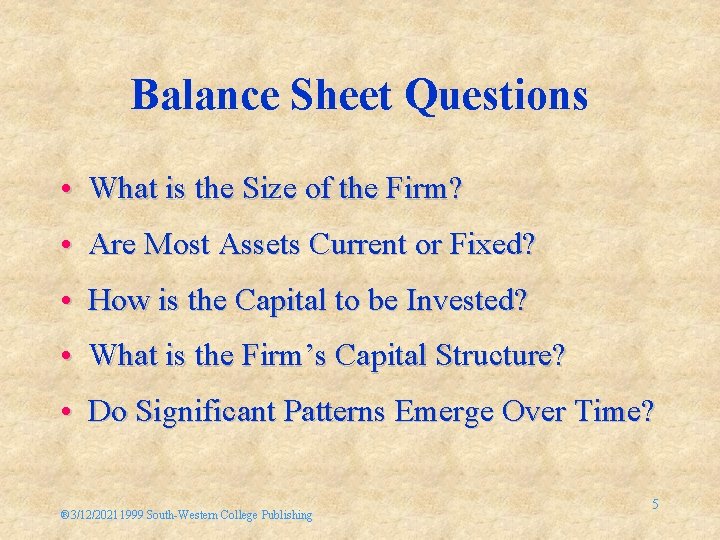
Balance Sheet Questions • What is the Size of the Firm? • Are Most Assets Current or Fixed? • How is the Capital to be Invested? • What is the Firm’s Capital Structure? • Do Significant Patterns Emerge Over Time? ® 3/12/20211999 South-Western College Publishing 5
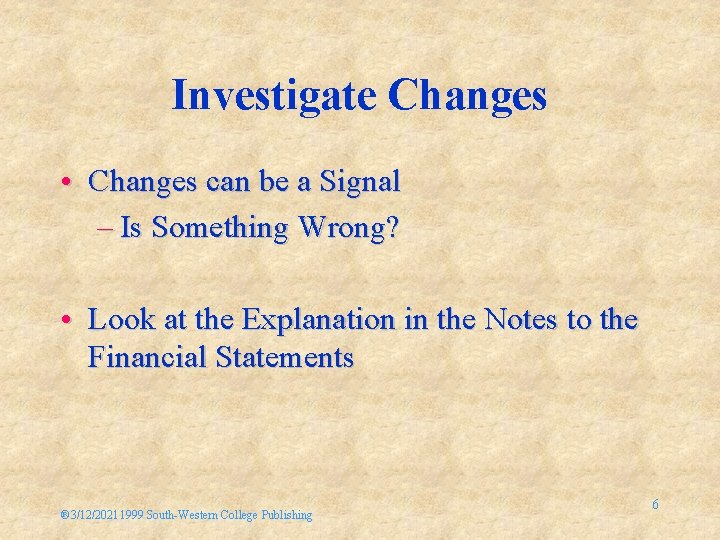
Investigate Changes • Changes can be a Signal – Is Something Wrong? • Look at the Explanation in the Notes to the Financial Statements ® 3/12/20211999 South-Western College Publishing 6
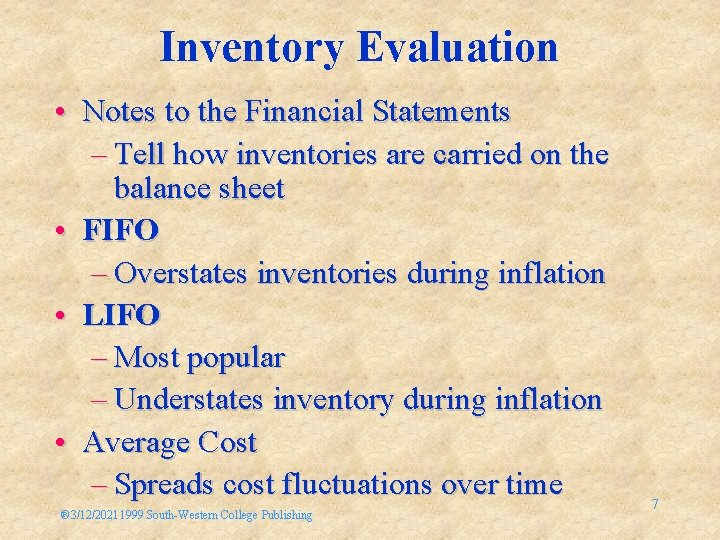
Inventory Evaluation • Notes to the Financial Statements – Tell how inventories are carried on the balance sheet • FIFO – Overstates inventories during inflation • LIFO – Most popular – Understates inventory during inflation • Average Cost – Spreads cost fluctuations over time ® 3/12/20211999 South-Western College Publishing 7
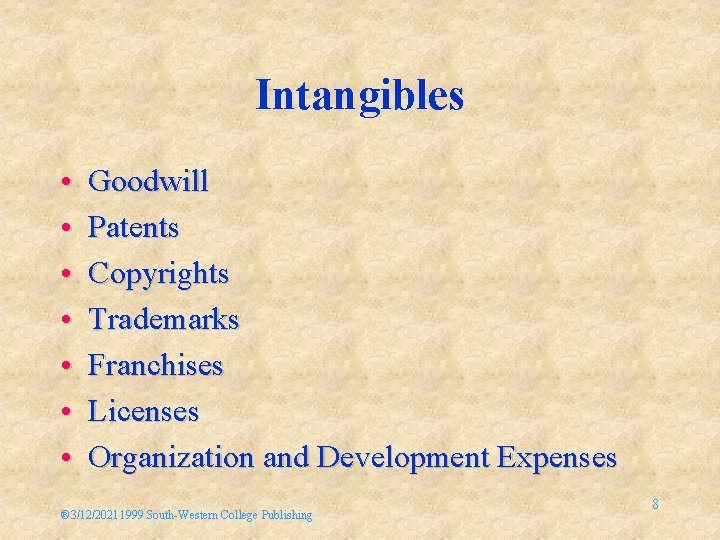
Intangibles • • Goodwill Patents Copyrights Trademarks Franchises Licenses Organization and Development Expenses ® 3/12/20211999 South-Western College Publishing 8
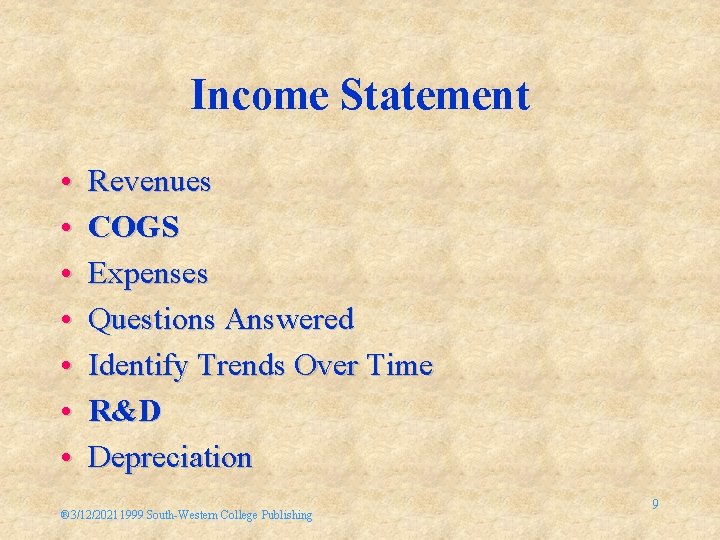
Income Statement • • Revenues COGS Expenses Questions Answered Identify Trends Over Time R&D Depreciation ® 3/12/20211999 South-Western College Publishing 9
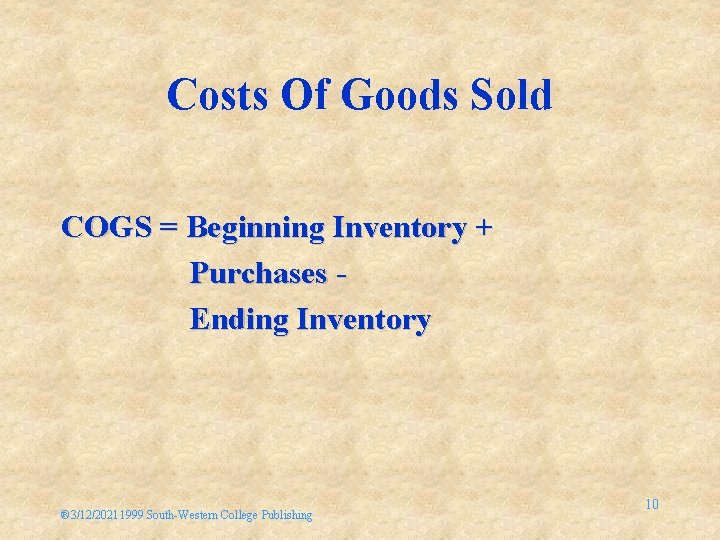
Costs Of Goods Sold COGS = Beginning Inventory + Purchases Ending Inventory ® 3/12/20211999 South-Western College Publishing 10
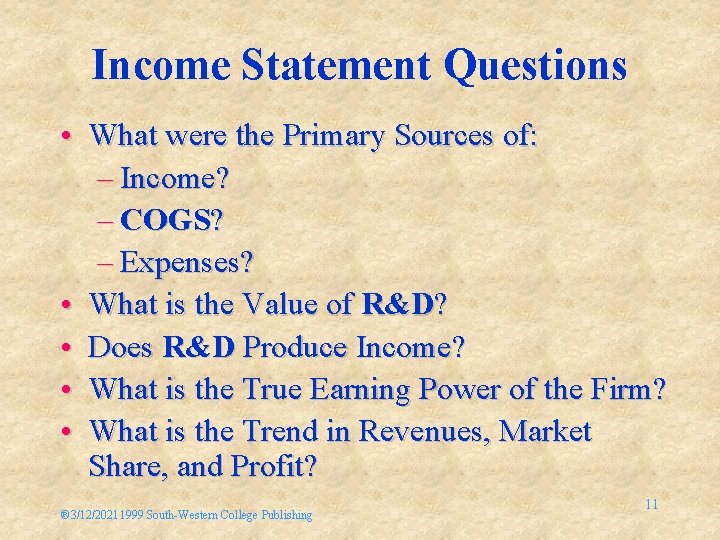
Income Statement Questions • What were the Primary Sources of: – Income? – COGS? – Expenses? • What is the Value of R&D? • Does R&D Produce Income? • What is the True Earning Power of the Firm? • What is the Trend in Revenues, Market Share, and Profit? ® 3/12/20211999 South-Western College Publishing 11
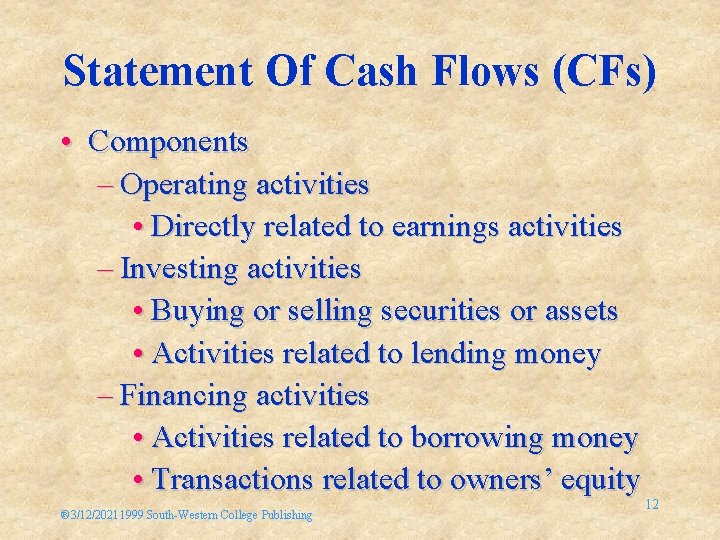
Statement Of Cash Flows (CFs) • Components – Operating activities • Directly related to earnings activities – Investing activities • Buying or selling securities or assets • Activities related to lending money – Financing activities • Activities related to borrowing money • Transactions related to owners’ equity ® 3/12/20211999 South-Western College Publishing 12
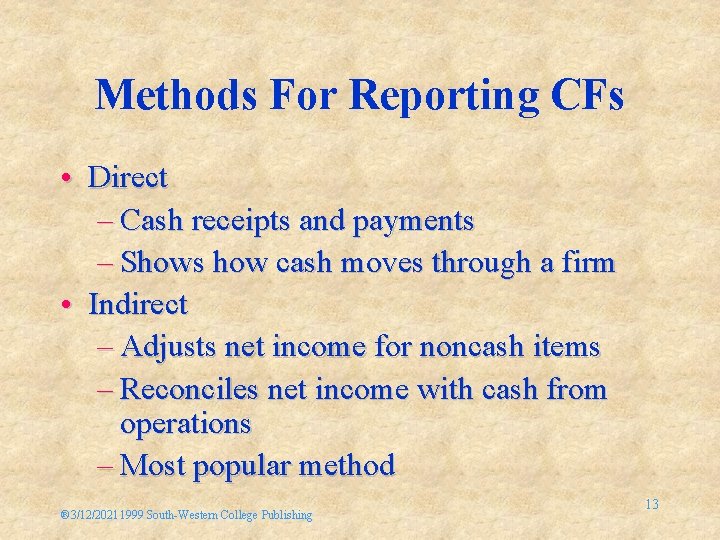
Methods For Reporting CFs • Direct – Cash receipts and payments – Shows how cash moves through a firm • Indirect – Adjusts net income for noncash items – Reconciles net income with cash from operations – Most popular method ® 3/12/20211999 South-Western College Publishing 13
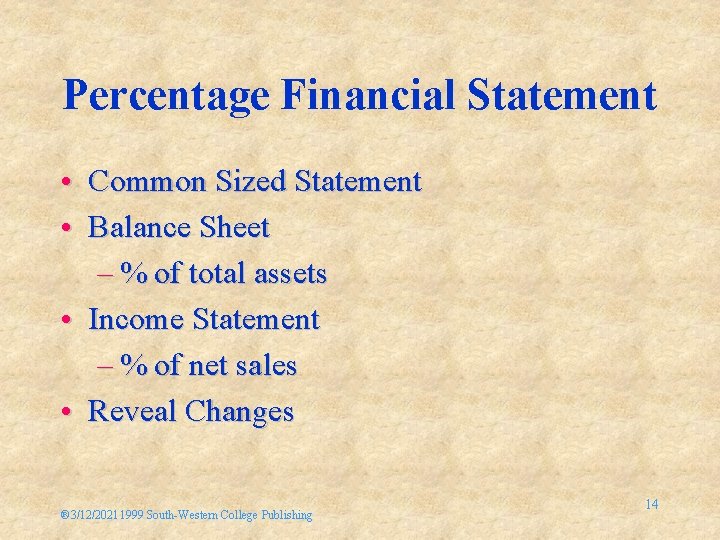
Percentage Financial Statement • Common Sized Statement • Balance Sheet – % of total assets • Income Statement – % of net sales • Reveal Changes ® 3/12/20211999 South-Western College Publishing 14
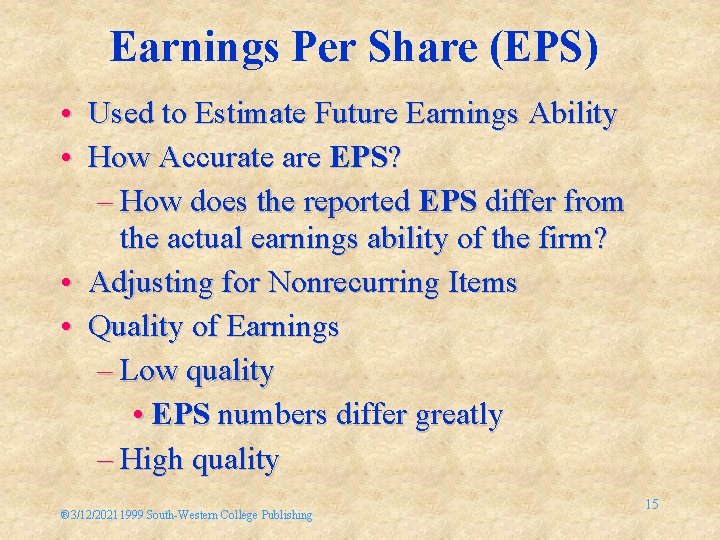
Earnings Per Share (EPS) • • Used to Estimate Future Earnings Ability How Accurate are EPS? – How does the reported EPS differ from the actual earnings ability of the firm? • Adjusting for Nonrecurring Items • Quality of Earnings – Low quality • EPS numbers differ greatly – High quality ® 3/12/20211999 South-Western College Publishing 15
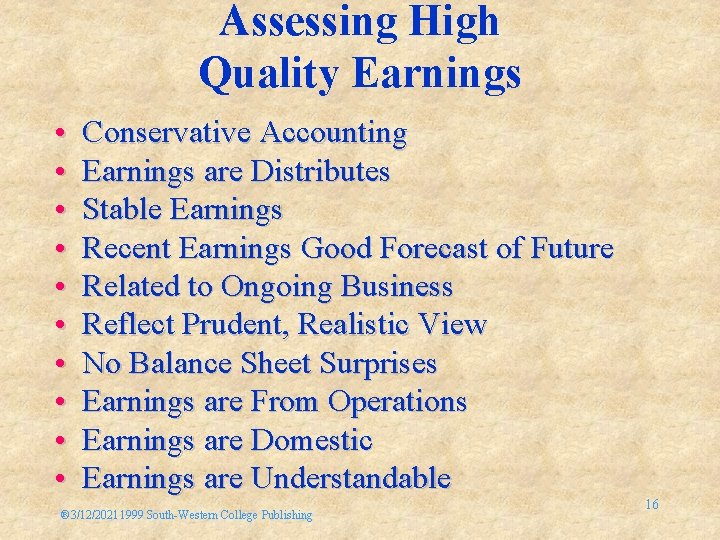
Assessing High Quality Earnings • • • Conservative Accounting Earnings are Distributes Stable Earnings Recent Earnings Good Forecast of Future Related to Ongoing Business Reflect Prudent, Realistic View No Balance Sheet Surprises Earnings are From Operations Earnings are Domestic Earnings are Understandable ® 3/12/20211999 South-Western College Publishing 16
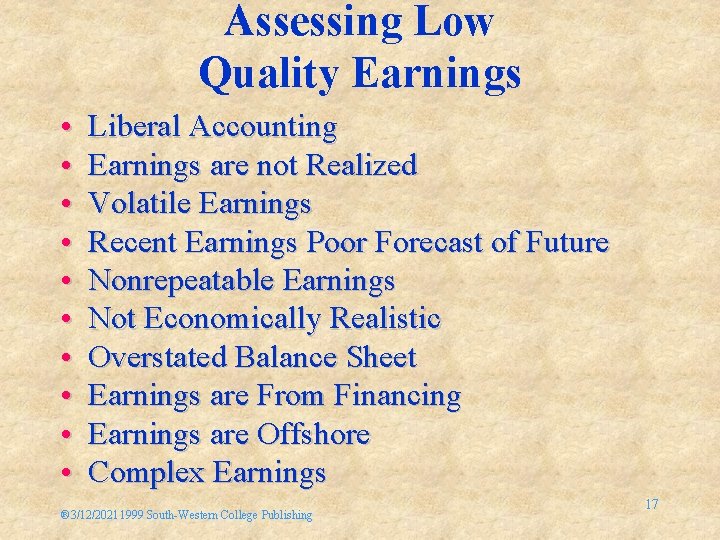
Assessing Low Quality Earnings • • • Liberal Accounting Earnings are not Realized Volatile Earnings Recent Earnings Poor Forecast of Future Nonrepeatable Earnings Not Economically Realistic Overstated Balance Sheet Earnings are From Financing Earnings are Offshore Complex Earnings ® 3/12/20211999 South-Western College Publishing 17
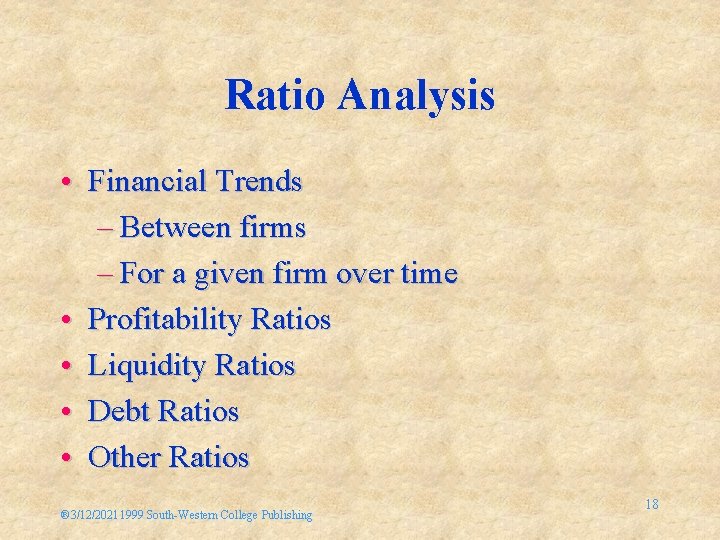
Ratio Analysis • Financial Trends – Between firms – For a given firm over time • Profitability Ratios • Liquidity Ratios • Debt Ratios • Other Ratios ® 3/12/20211999 South-Western College Publishing 18
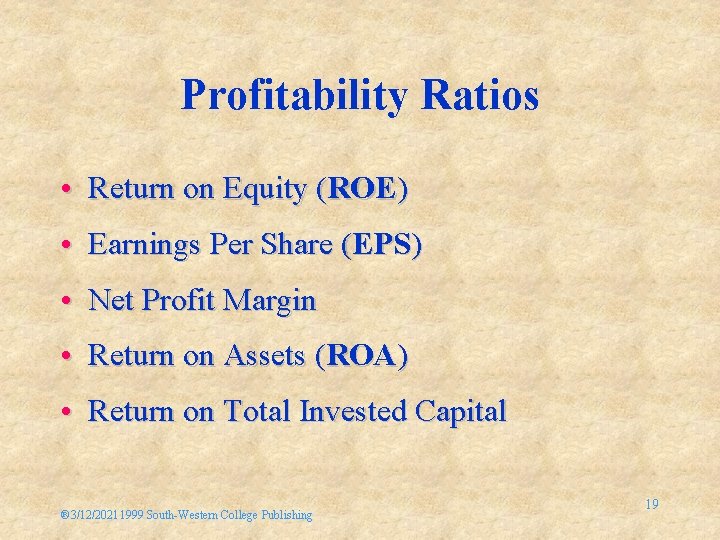
Profitability Ratios • Return on Equity (ROE) • Earnings Per Share (EPS) • Net Profit Margin • Return on Assets (ROA) • Return on Total Invested Capital ® 3/12/20211999 South-Western College Publishing 19
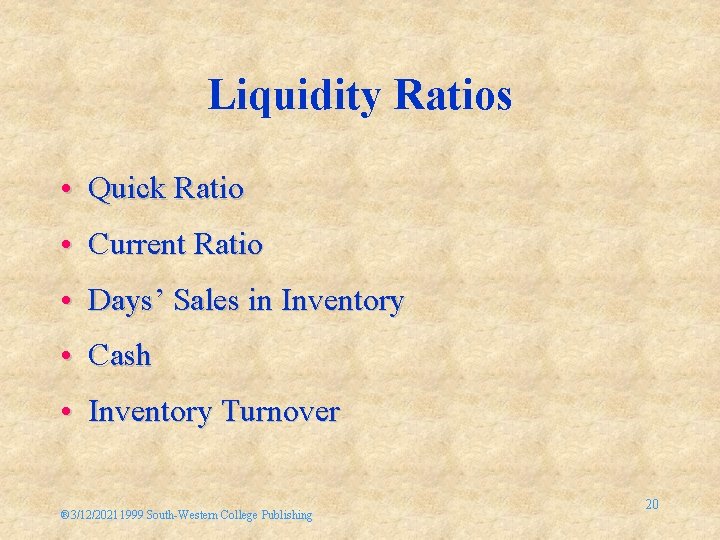
Liquidity Ratios • Quick Ratio • Current Ratio • Days’ Sales in Inventory • Cash • Inventory Turnover ® 3/12/20211999 South-Western College Publishing 20
Debt Ratios • Fixed Charge Coverage • Times Interest Earned • Debt to Equity • Degree of Financial Leverage (DFL) • Debt to Assets ® 3/12/20211999 South-Western College Publishing 21
Other Ratios • P/E Ratio – Earnings multiplier – Combine market and accounting value • M/B Ratio – > 1 implies stock is overpriced – < 1 implies stock is underpriced – Combine market and accounting value ® 3/12/20211999 South-Western College Publishing 22