
Chapter 21 Carboxylic Acid Derivatives and Nucleophilic Acyl
Chapter 21. Carboxylic Acid Derivatives and Nucleophilic Acyl Substitution Reactions Based on Mc. Murry’s Organic Chemistry, 6 th edition © 2003 Ronald Kluger Department of Chemistry University of Toronto Based on Mc. Murry, Organic Chemistry, Chapter 21, 6 th edition, (c) 2003

Carboxylic Compounds n Acyl group bonded to Y, an electronegative atom or leaving group n Includes: Y = halide (acid halides), acyloxy (anhydrides), alkoxy (esters), amine (amides), thiolate (thioesters), phosphate (acyl phosphates) Based on Mc. Murry, Organic Chemistry, Chapter 21, 6 th edition, (c) 2003 2

General Reaction Pattern n Nucleophilic acyl substitution Based on Mc. Murry, Organic Chemistry, Chapter 21, 6 th edition, (c) 2003 3
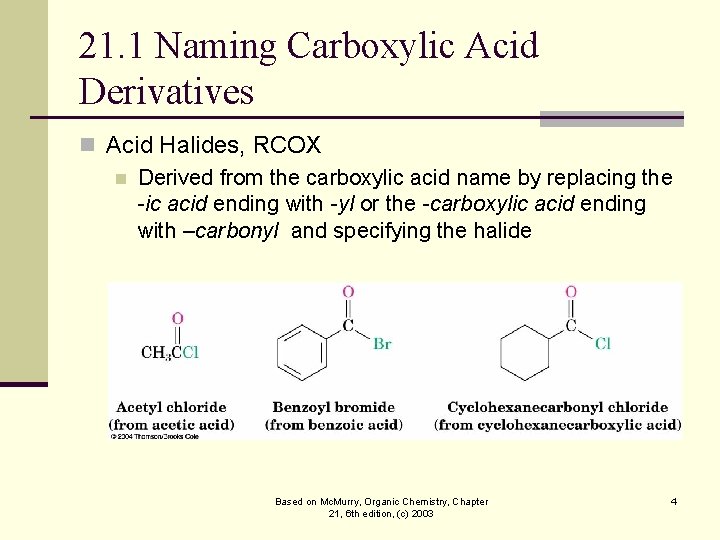
21. 1 Naming Carboxylic Acid Derivatives n Acid Halides, RCOX n Derived from the carboxylic acid name by replacing the -ic acid ending with -yl or the -carboxylic acid ending with –carbonyl and specifying the halide Based on Mc. Murry, Organic Chemistry, Chapter 21, 6 th edition, (c) 2003 4

Naming Acid Anhydrides, RCO 2 COR' n If symnmetrical replace “acid” with “anhydride” based on the related carboxylic acid (for symmetrical anhydrides) n From substituted monocarboxylic acids: use bisahead of the acid name n Unsymmetrical anhydrides— cite the two acids alphabetically Based on Mc. Murry, Organic Chemistry, Chapter 21, 6 th edition, (c) 2003 5
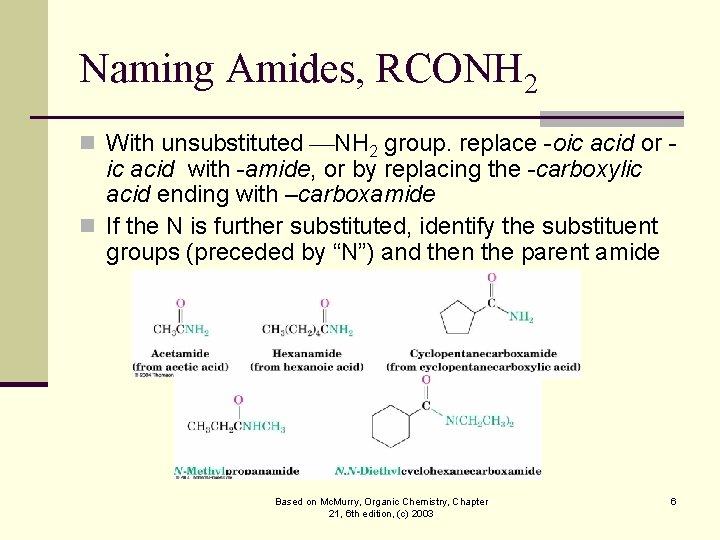
Naming Amides, RCONH 2 n With unsubstituted NH 2 group. replace -oic acid or - ic acid with -amide, or by replacing the -carboxylic acid ending with –carboxamide n If the N is further substituted, identify the substituent groups (preceded by “N”) and then the parent amide Based on Mc. Murry, Organic Chemistry, Chapter 21, 6 th edition, (c) 2003 6
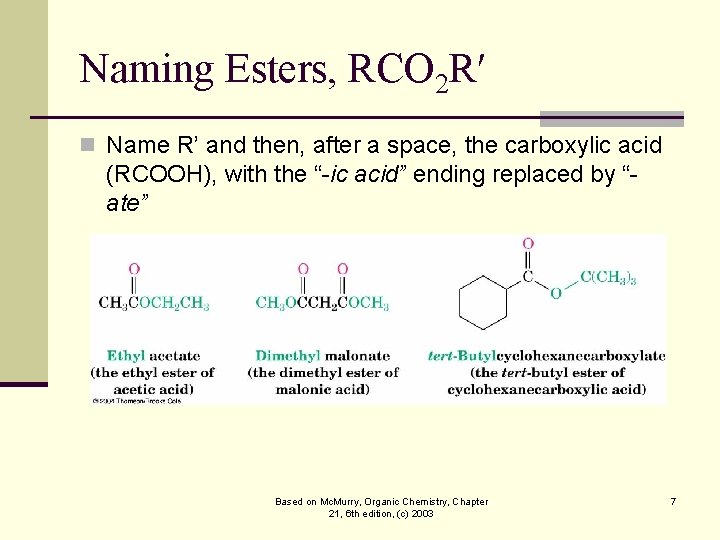
Naming Esters, RCO 2 R n Name R’ and then, after a space, the carboxylic acid (RCOOH), with the “-ic acid” ending replaced by “ate” Based on Mc. Murry, Organic Chemistry, Chapter 21, 6 th edition, (c) 2003 7
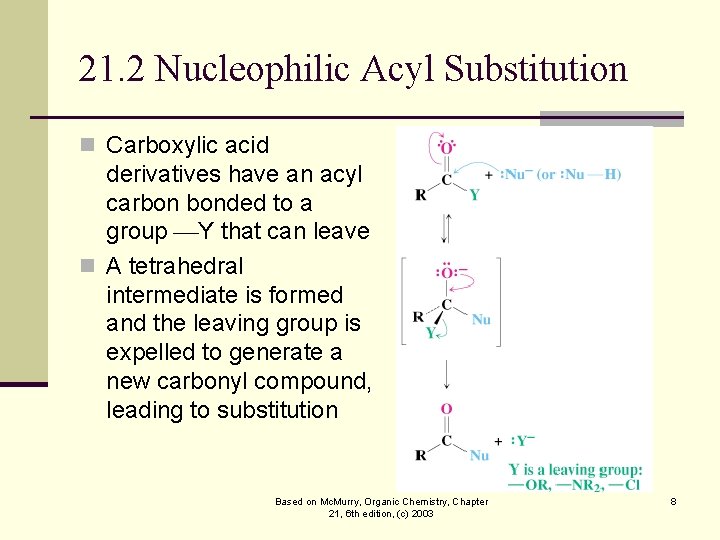
21. 2 Nucleophilic Acyl Substitution n Carboxylic acid derivatives have an acyl carbon bonded to a group Y that can leave n A tetrahedral intermediate is formed and the leaving group is expelled to generate a new carbonyl compound, leading to substitution Based on Mc. Murry, Organic Chemistry, Chapter 21, 6 th edition, (c) 2003 8
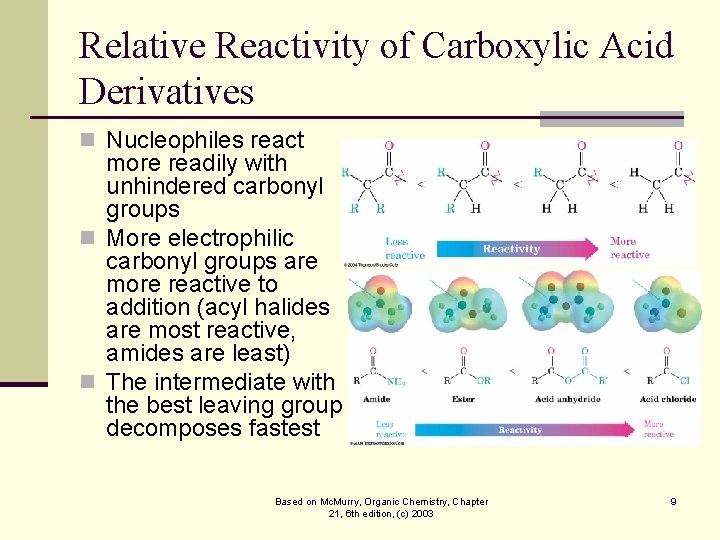
Relative Reactivity of Carboxylic Acid Derivatives n Nucleophiles react more readily with unhindered carbonyl groups n More electrophilic carbonyl groups are more reactive to addition (acyl halides are most reactive, amides are least) n The intermediate with the best leaving group decomposes fastest Based on Mc. Murry, Organic Chemistry, Chapter 21, 6 th edition, (c) 2003 9
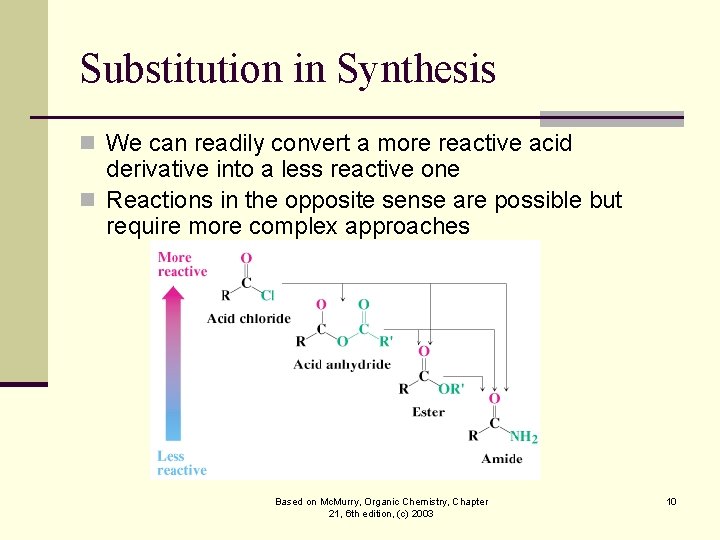
Substitution in Synthesis n We can readily convert a more reactive acid derivative into a less reactive one n Reactions in the opposite sense are possible but require more complex approaches Based on Mc. Murry, Organic Chemistry, Chapter 21, 6 th edition, (c) 2003 10
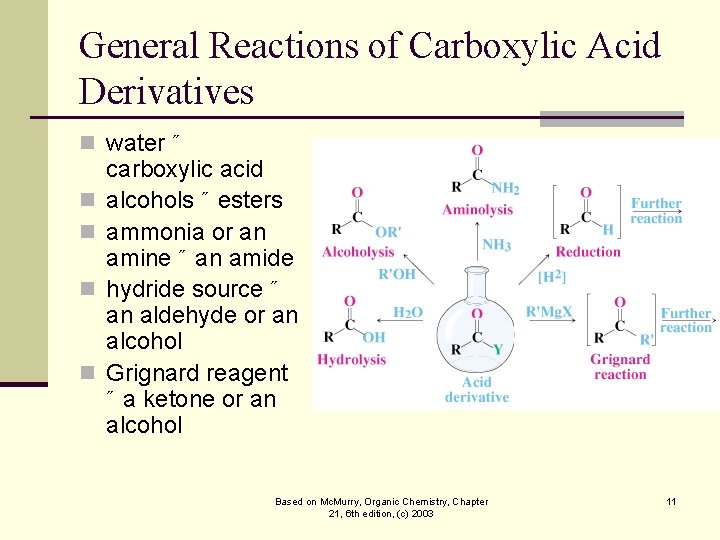
General Reactions of Carboxylic Acid Derivatives n water ˝ n n carboxylic acid alcohols ˝ esters ammonia or an amine ˝ an amide hydride source ˝ an aldehyde or an alcohol Grignard reagent ˝ a ketone or an alcohol Based on Mc. Murry, Organic Chemistry, Chapter 21, 6 th edition, (c) 2003 11
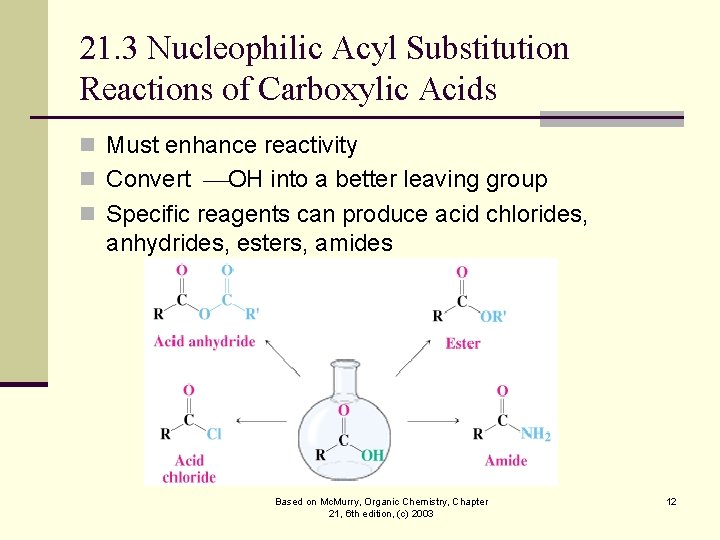
21. 3 Nucleophilic Acyl Substitution Reactions of Carboxylic Acids n Must enhance reactivity n Convert OH into a better leaving group n Specific reagents can produce acid chlorides, anhydrides, esters, amides Based on Mc. Murry, Organic Chemistry, Chapter 21, 6 th edition, (c) 2003 12

Conversion of Carboxylic Acids into Acid Chlorides n Reaction with thionyl chloride, SOCl 2 Based on Mc. Murry, Organic Chemistry, Chapter 21, 6 th edition, (c) 2003 13
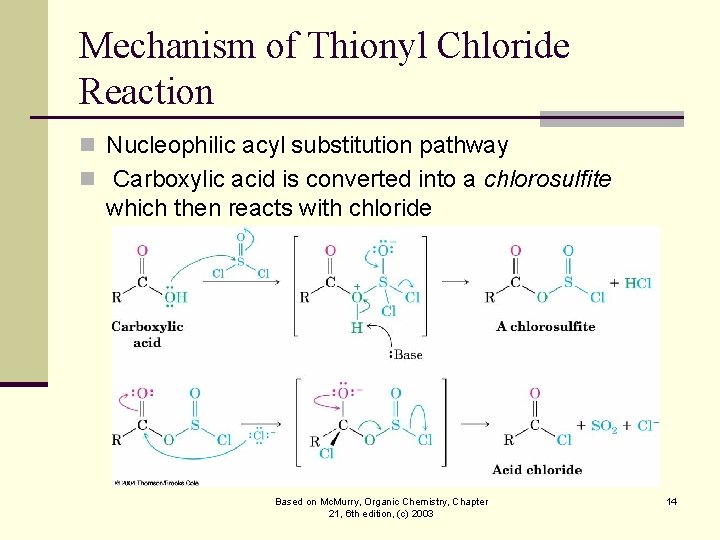
Mechanism of Thionyl Chloride Reaction n Nucleophilic acyl substitution pathway n Carboxylic acid is converted into a chlorosulfite which then reacts with chloride Based on Mc. Murry, Organic Chemistry, Chapter 21, 6 th edition, (c) 2003 14

Conversion of Carboxylic Acids into Acid Anhydrides n Heat cyclic dicarboxylic acids that can form five- or six-membered rings n Acyclic anhydrides are not generally formed this way - they are usually made from acid chlorides and carboxylic acids Based on Mc. Murry, Organic Chemistry, Chapter 21, 6 th edition, (c) 2003 15

Conversion of Carboxylic Acids into Esters n Methods include reaction of a carboxylate anion with a primary alkyl halide Based on Mc. Murry, Organic Chemistry, Chapter 21, 6 th edition, (c) 2003 16

Fischer Esterification n Heating a carboxylic acid in an alcohol solvent containing a small amount of strong acid produces an ester from the alcohol and acid Based on Mc. Murry, Organic Chemistry, Chapter 21, 6 th edition, (c) 2003 17
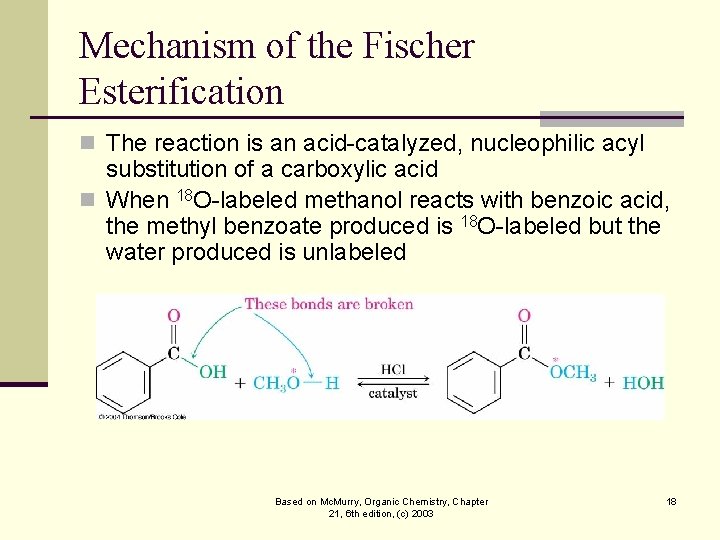
Mechanism of the Fischer Esterification n The reaction is an acid-catalyzed, nucleophilic acyl substitution of a carboxylic acid n When 18 O-labeled methanol reacts with benzoic acid, the methyl benzoate produced is 18 O-labeled but the water produced is unlabeled Based on Mc. Murry, Organic Chemistry, Chapter 21, 6 th edition, (c) 2003 18
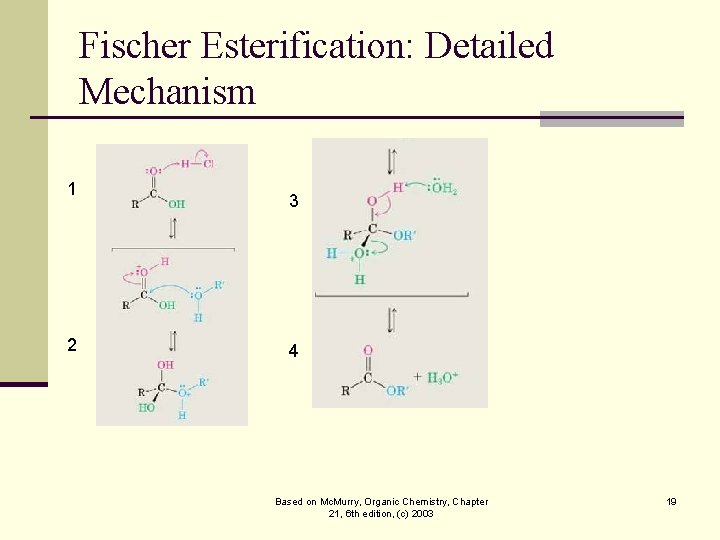
Fischer Esterification: Detailed Mechanism 1 2 3 4 Based on Mc. Murry, Organic Chemistry, Chapter 21, 6 th edition, (c) 2003 19
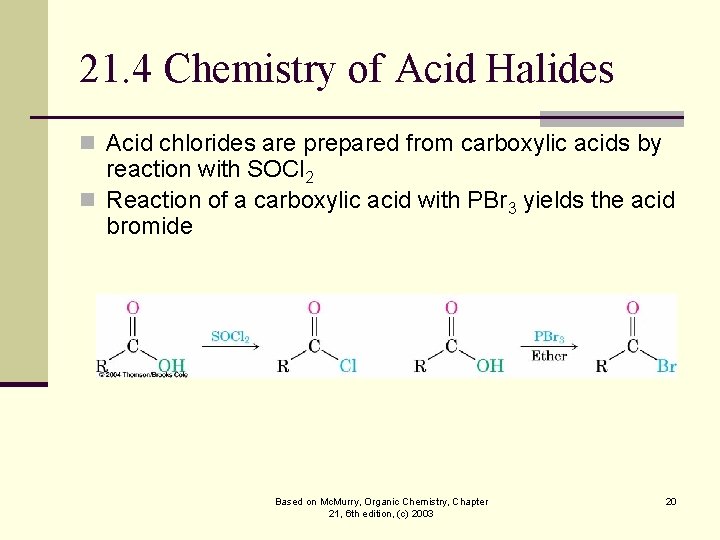
21. 4 Chemistry of Acid Halides n Acid chlorides are prepared from carboxylic acids by reaction with SOCl 2 n Reaction of a carboxylic acid with PBr 3 yields the acid bromide Based on Mc. Murry, Organic Chemistry, Chapter 21, 6 th edition, (c) 2003 20
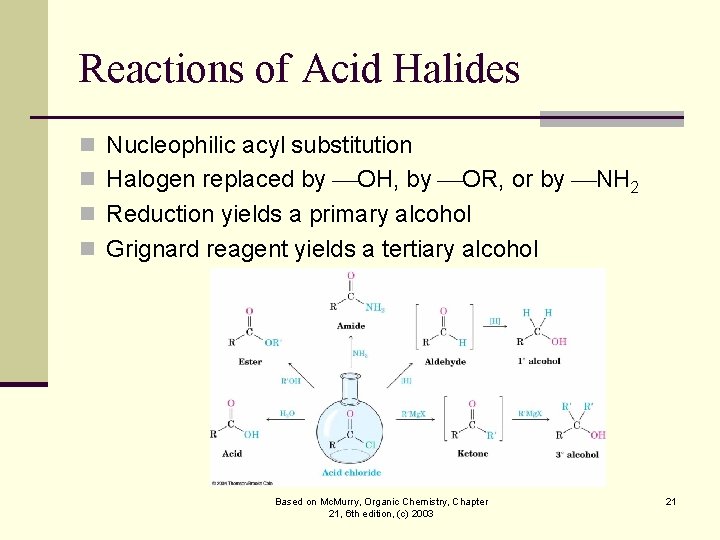
Reactions of Acid Halides n Nucleophilic acyl substitution n Halogen replaced by OH, by OR, or by NH 2 n Reduction yields a primary alcohol n Grignard reagent yields a tertiary alcohol Based on Mc. Murry, Organic Chemistry, Chapter 21, 6 th edition, (c) 2003 21
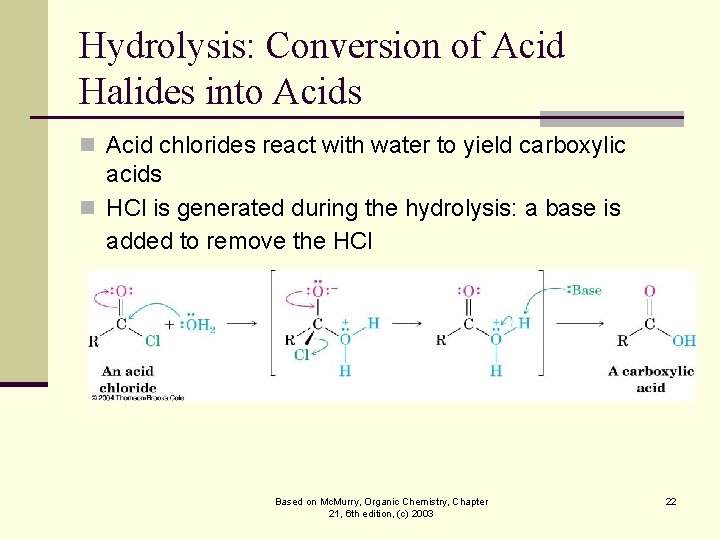
Hydrolysis: Conversion of Acid Halides into Acids n Acid chlorides react with water to yield carboxylic acids n HCl is generated during the hydrolysis: a base is added to remove the HCl Based on Mc. Murry, Organic Chemistry, Chapter 21, 6 th edition, (c) 2003 22
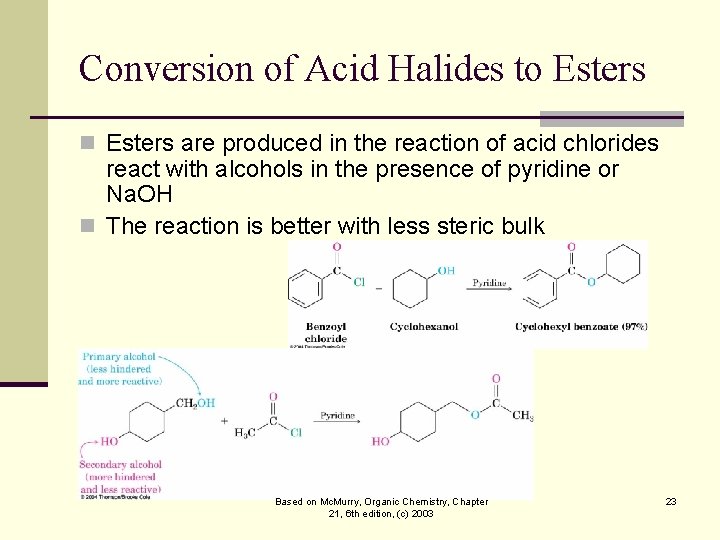
Conversion of Acid Halides to Esters n Esters are produced in the reaction of acid chlorides react with alcohols in the presence of pyridine or Na. OH n The reaction is better with less steric bulk Based on Mc. Murry, Organic Chemistry, Chapter 21, 6 th edition, (c) 2003 23

Aminolysis: Conversion of Acid Halides into Amides n Amides result from the reaction of acid chlorides with NH 3, primary (RNH 2) and secondary amines (R 2 NH) n The reaction with tertiary amines (R 3 N) gives an unstable species that cannot be isolated n HCl is neutralized by the amine or an added base Based on Mc. Murry, Organic Chemistry, Chapter 21, 6 th edition, (c) 2003 24
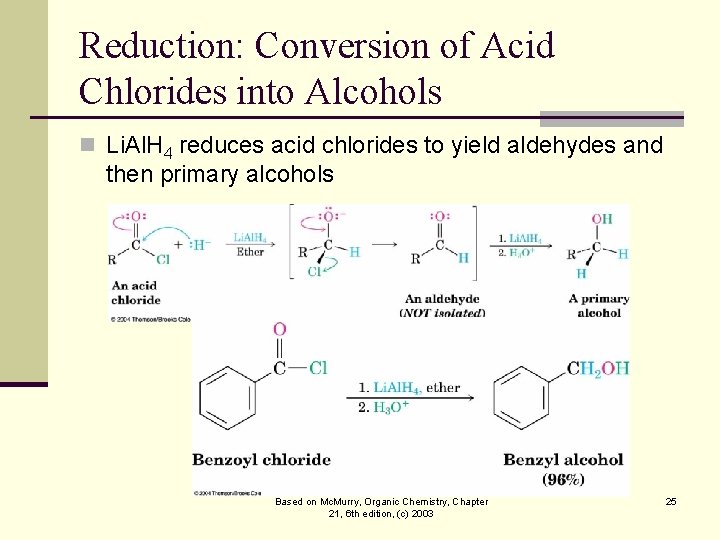
Reduction: Conversion of Acid Chlorides into Alcohols n Li. Al. H 4 reduces acid chlorides to yield aldehydes and then primary alcohols Based on Mc. Murry, Organic Chemistry, Chapter 21, 6 th edition, (c) 2003 25
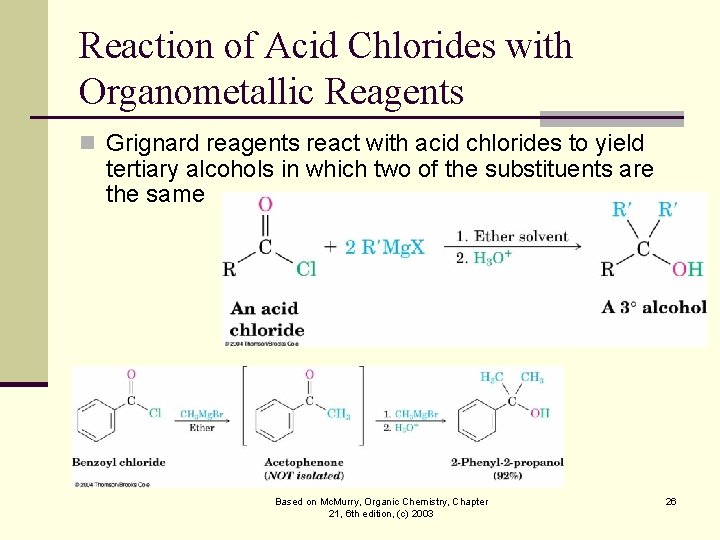
Reaction of Acid Chlorides with Organometallic Reagents n Grignard reagents react with acid chlorides to yield tertiary alcohols in which two of the substituents are the same Based on Mc. Murry, Organic Chemistry, Chapter 21, 6 th edition, (c) 2003 26
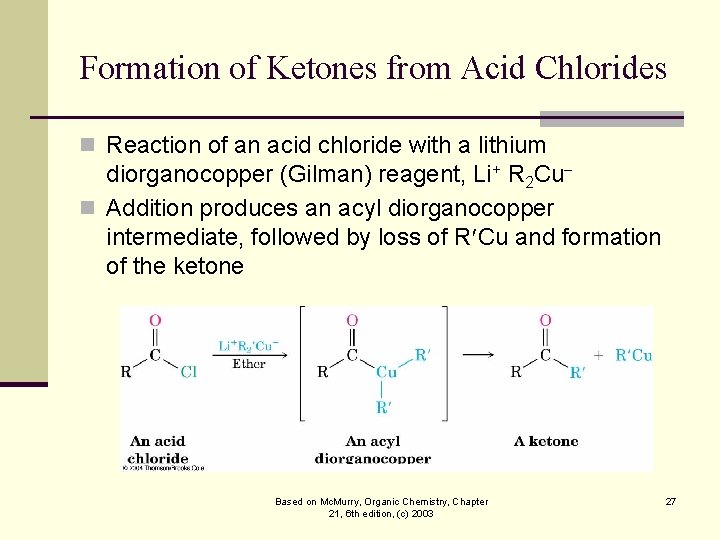
Formation of Ketones from Acid Chlorides n Reaction of an acid chloride with a lithium diorganocopper (Gilman) reagent, Li+ R 2 Cu n Addition produces an acyl diorganocopper intermediate, followed by loss of R Cu and formation of the ketone Based on Mc. Murry, Organic Chemistry, Chapter 21, 6 th edition, (c) 2003 27
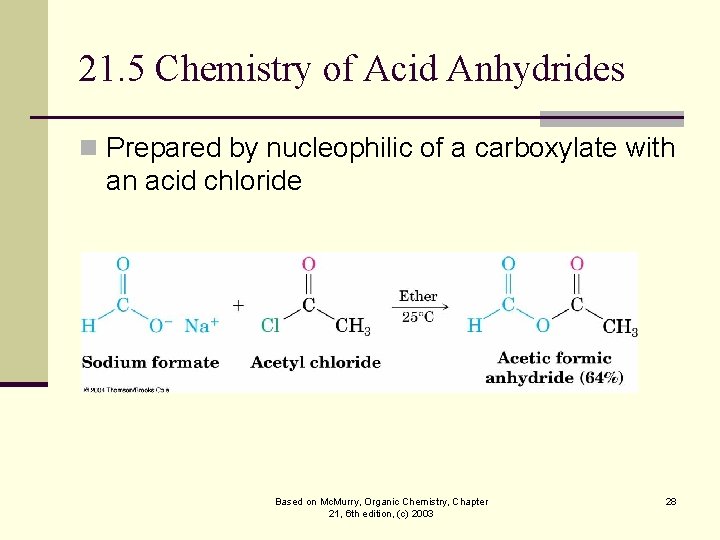
21. 5 Chemistry of Acid Anhydrides n Prepared by nucleophilic of a carboxylate with an acid chloride Based on Mc. Murry, Organic Chemistry, Chapter 21, 6 th edition, (c) 2003 28
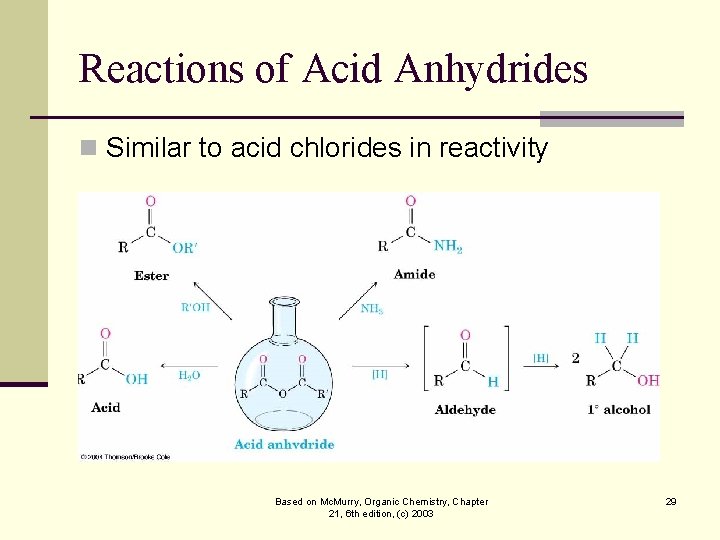
Reactions of Acid Anhydrides n Similar to acid chlorides in reactivity Based on Mc. Murry, Organic Chemistry, Chapter 21, 6 th edition, (c) 2003 29
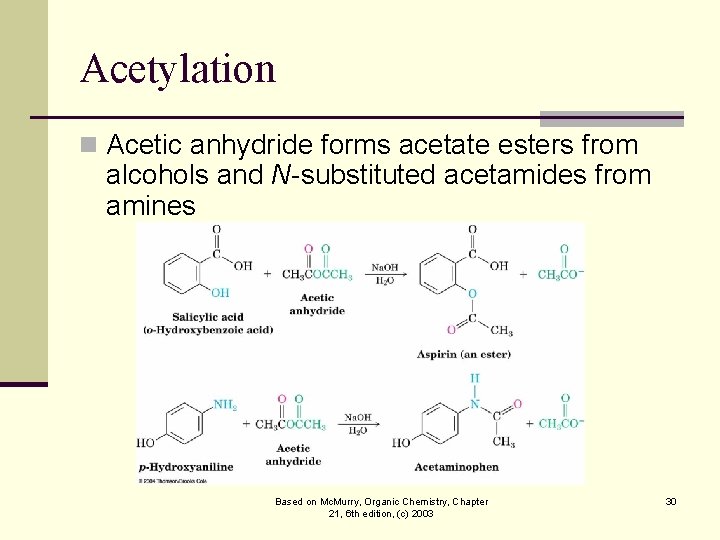
Acetylation n Acetic anhydride forms acetate esters from alcohols and N-substituted acetamides from amines Based on Mc. Murry, Organic Chemistry, Chapter 21, 6 th edition, (c) 2003 30
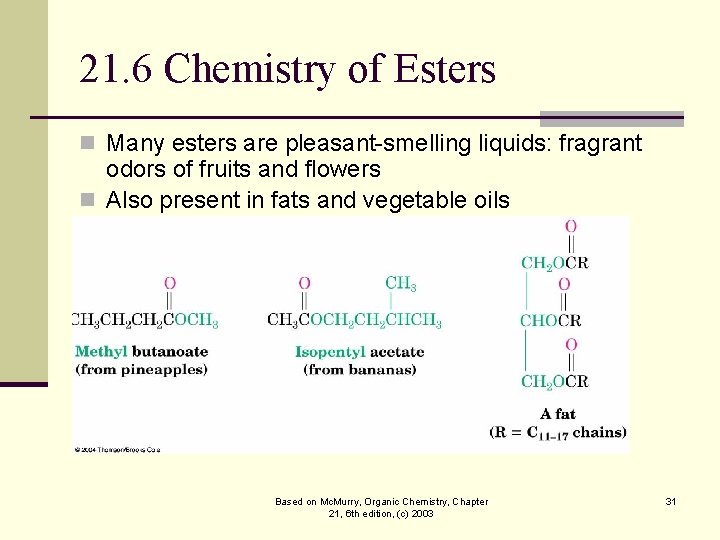
21. 6 Chemistry of Esters n Many esters are pleasant-smelling liquids: fragrant odors of fruits and flowers n Also present in fats and vegetable oils Based on Mc. Murry, Organic Chemistry, Chapter 21, 6 th edition, (c) 2003 31
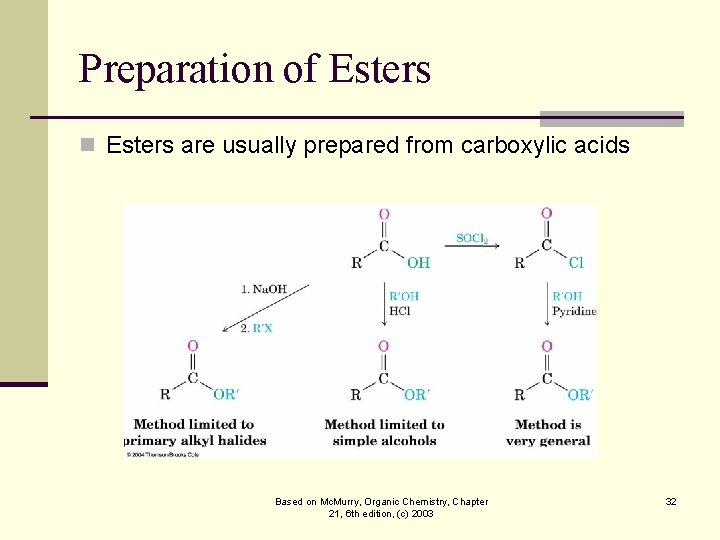
Preparation of Esters n Esters are usually prepared from carboxylic acids Based on Mc. Murry, Organic Chemistry, Chapter 21, 6 th edition, (c) 2003 32
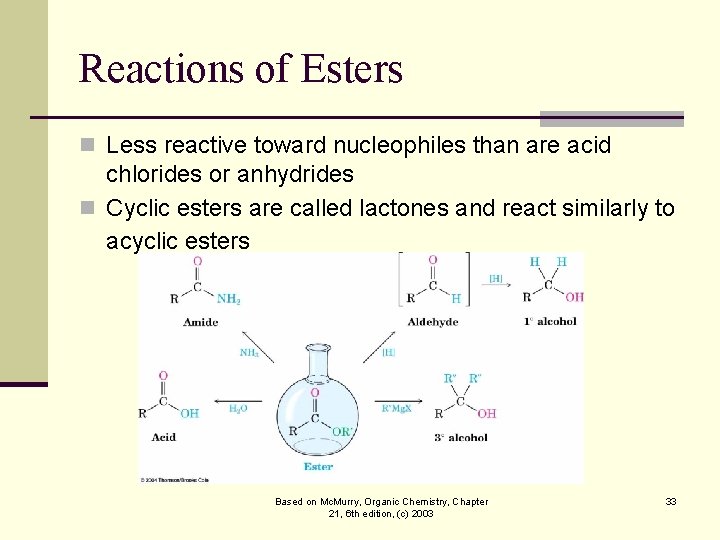
Reactions of Esters n Less reactive toward nucleophiles than are acid chlorides or anhydrides n Cyclic esters are called lactones and react similarly to acyclic esters Based on Mc. Murry, Organic Chemistry, Chapter 21, 6 th edition, (c) 2003 33

Hydrolysis: Conversion of Esters into Carboxylic Acids n An ester is hydrolyzed by aqueous base or aqueous acid to yield a carboxylic acid plus an alcohol Based on Mc. Murry, Organic Chemistry, Chapter 21, 6 th edition, (c) 2003 34
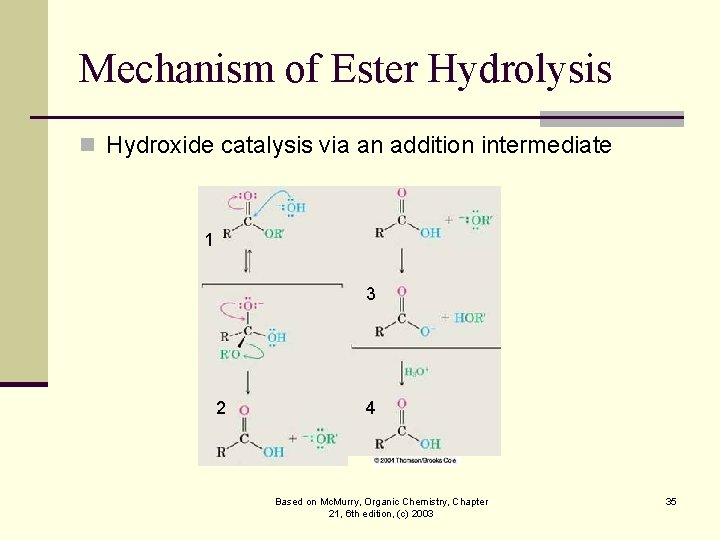
Mechanism of Ester Hydrolysis n Hydroxide catalysis via an addition intermediate 1 3 2 4 Based on Mc. Murry, Organic Chemistry, Chapter 21, 6 th edition, (c) 2003 35
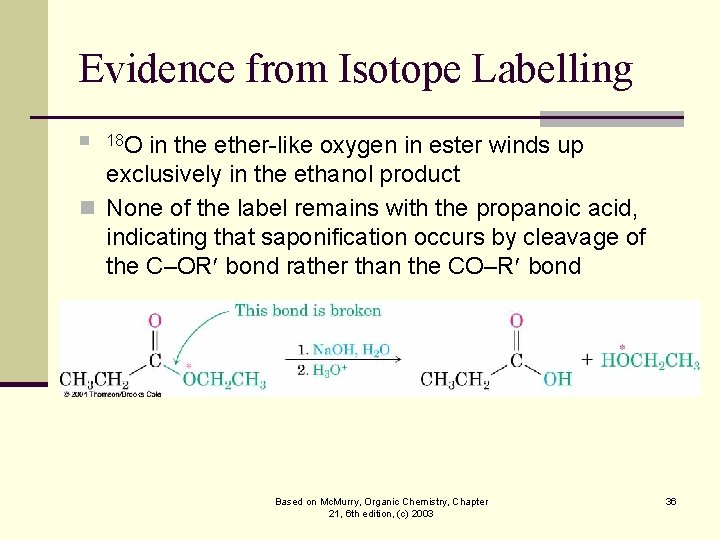
Evidence from Isotope Labelling in the ether-like oxygen in ester winds up exclusively in the ethanol product n None of the label remains with the propanoic acid, indicating that saponification occurs by cleavage of the C–OR bond rather than the CO–R bond n 18 O Based on Mc. Murry, Organic Chemistry, Chapter 21, 6 th edition, (c) 2003 36
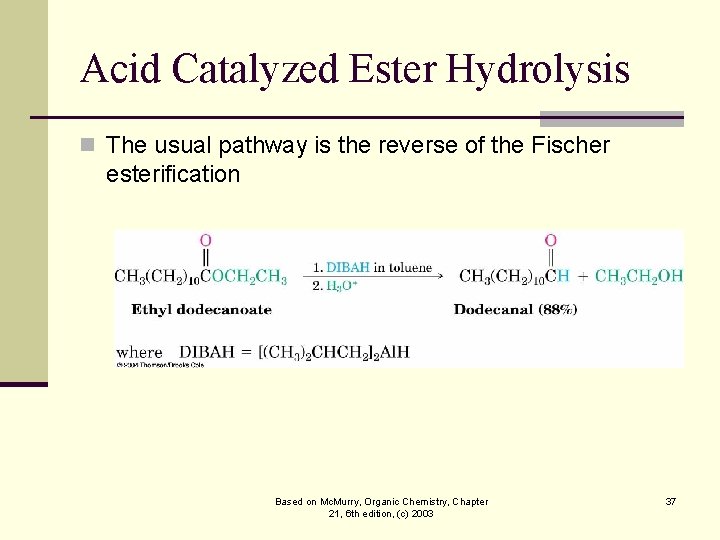
Acid Catalyzed Ester Hydrolysis n The usual pathway is the reverse of the Fischer esterification Based on Mc. Murry, Organic Chemistry, Chapter 21, 6 th edition, (c) 2003 37
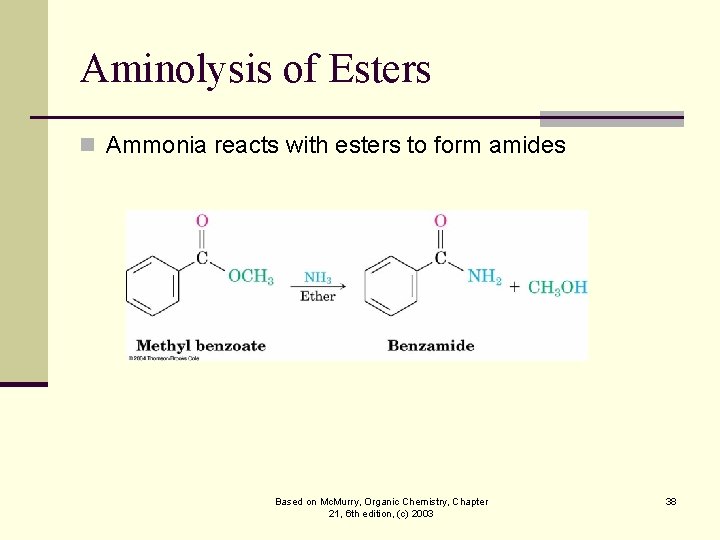
Aminolysis of Esters n Ammonia reacts with esters to form amides Based on Mc. Murry, Organic Chemistry, Chapter 21, 6 th edition, (c) 2003 38
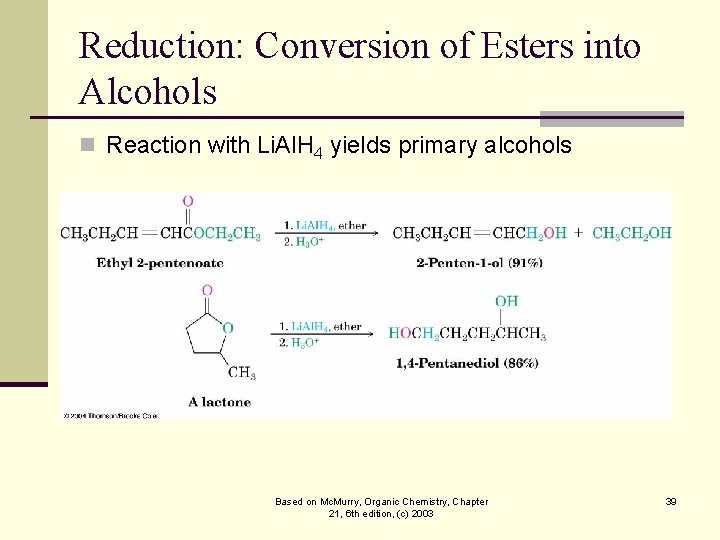
Reduction: Conversion of Esters into Alcohols n Reaction with Li. Al. H 4 yields primary alcohols Based on Mc. Murry, Organic Chemistry, Chapter 21, 6 th edition, (c) 2003 39

Mechanism of Reduction of Esters n Hydride ion adds to the carbonyl group, followed by elimination of alkoxide ion to yield an aldehyde n Reduction of the aldehyde gives the primary alcohol Based on Mc. Murry, Organic Chemistry, Chapter 21, 6 th edition, (c) 2003 40
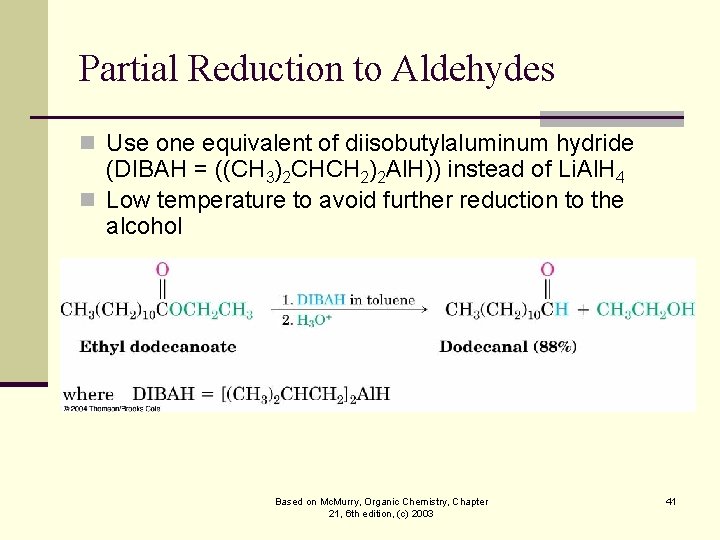
Partial Reduction to Aldehydes n Use one equivalent of diisobutylaluminum hydride (DIBAH = ((CH 3)2 CHCH 2)2 Al. H)) instead of Li. Al. H 4 n Low temperature to avoid further reduction to the alcohol Based on Mc. Murry, Organic Chemistry, Chapter 21, 6 th edition, (c) 2003 41
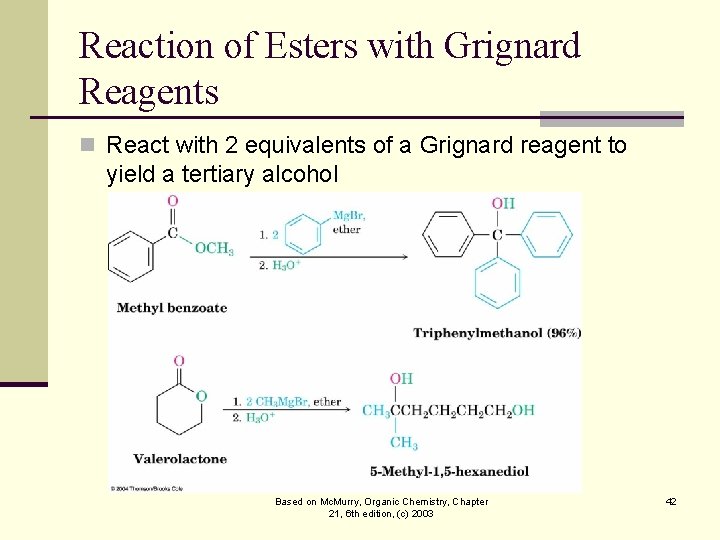
Reaction of Esters with Grignard Reagents n React with 2 equivalents of a Grignard reagent to yield a tertiary alcohol Based on Mc. Murry, Organic Chemistry, Chapter 21, 6 th edition, (c) 2003 42
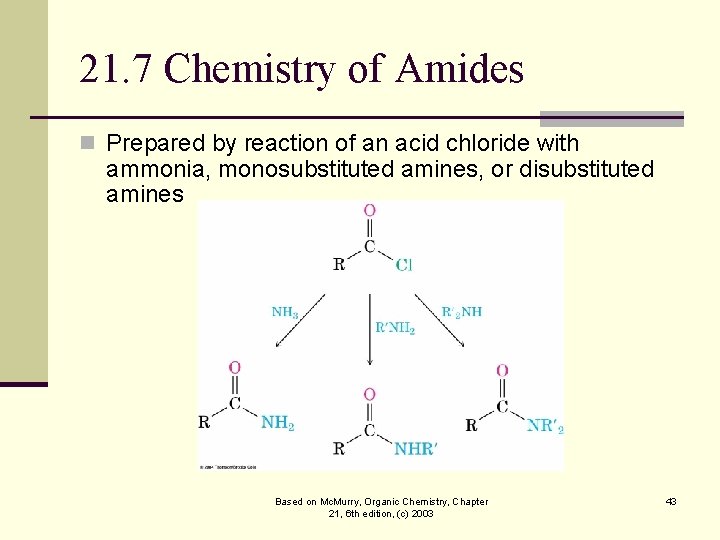
21. 7 Chemistry of Amides n Prepared by reaction of an acid chloride with ammonia, monosubstituted amines, or disubstituted amines Based on Mc. Murry, Organic Chemistry, Chapter 21, 6 th edition, (c) 2003 43
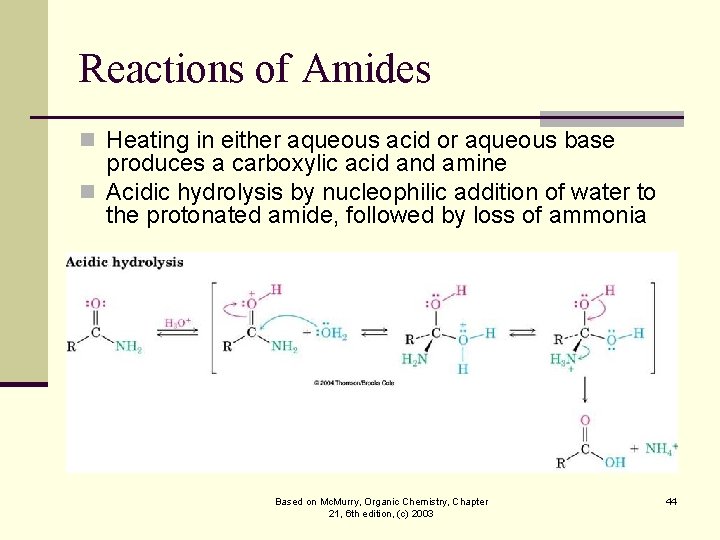
Reactions of Amides n Heating in either aqueous acid or aqueous base produces a carboxylic acid and amine n Acidic hydrolysis by nucleophilic addition of water to the protonated amide, followed by loss of ammonia Based on Mc. Murry, Organic Chemistry, Chapter 21, 6 th edition, (c) 2003 44
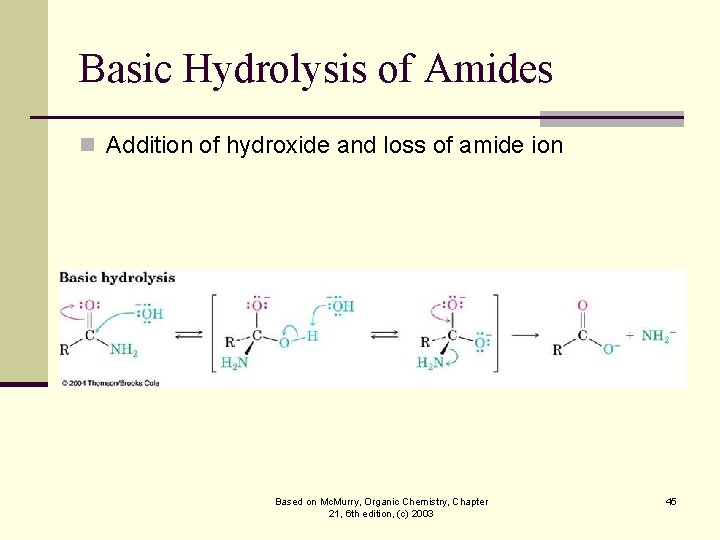
Basic Hydrolysis of Amides n Addition of hydroxide and loss of amide ion Based on Mc. Murry, Organic Chemistry, Chapter 21, 6 th edition, (c) 2003 45
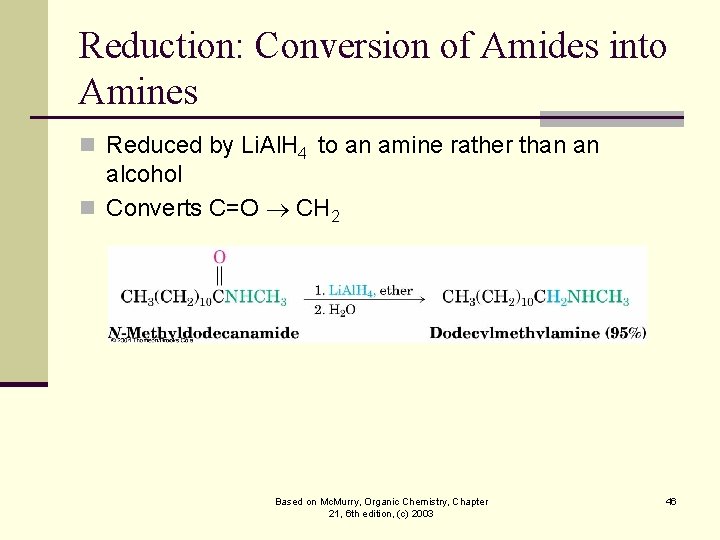
Reduction: Conversion of Amides into Amines n Reduced by Li. Al. H 4 to an amine rather than an alcohol n Converts C=O CH 2 Based on Mc. Murry, Organic Chemistry, Chapter 21, 6 th edition, (c) 2003 46
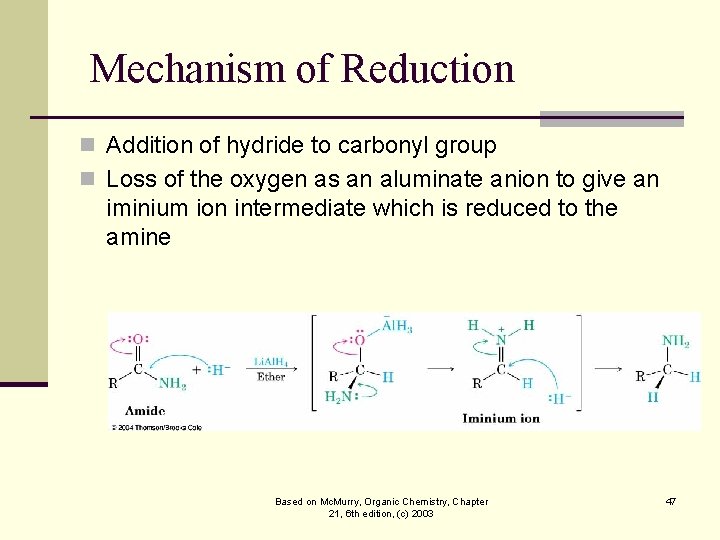
Mechanism of Reduction n Addition of hydride to carbonyl group n Loss of the oxygen as an aluminate anion to give an iminium ion intermediate which is reduced to the amine Based on Mc. Murry, Organic Chemistry, Chapter 21, 6 th edition, (c) 2003 47
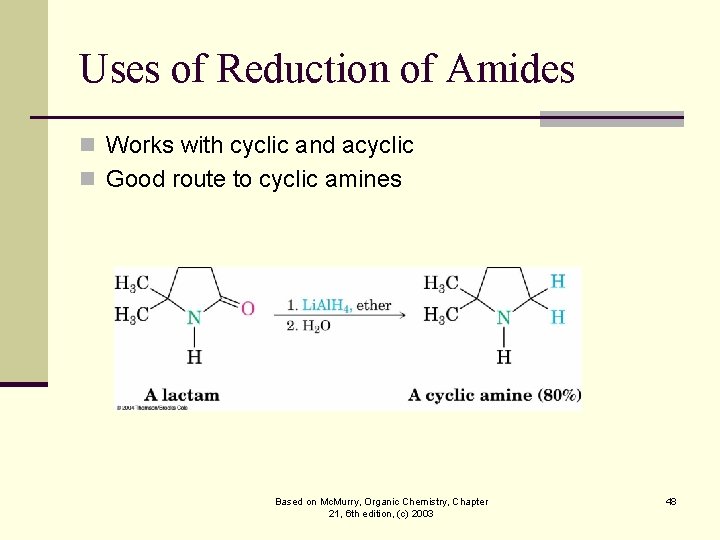
Uses of Reduction of Amides n Works with cyclic and acyclic n Good route to cyclic amines Based on Mc. Murry, Organic Chemistry, Chapter 21, 6 th edition, (c) 2003 48
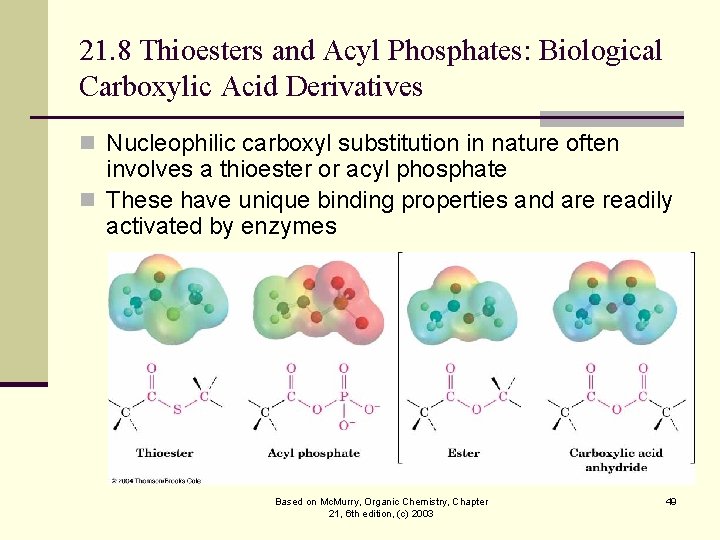
21. 8 Thioesters and Acyl Phosphates: Biological Carboxylic Acid Derivatives n Nucleophilic carboxyl substitution in nature often involves a thioester or acyl phosphate n These have unique binding properties and are readily activated by enzymes Based on Mc. Murry, Organic Chemistry, Chapter 21, 6 th edition, (c) 2003 49
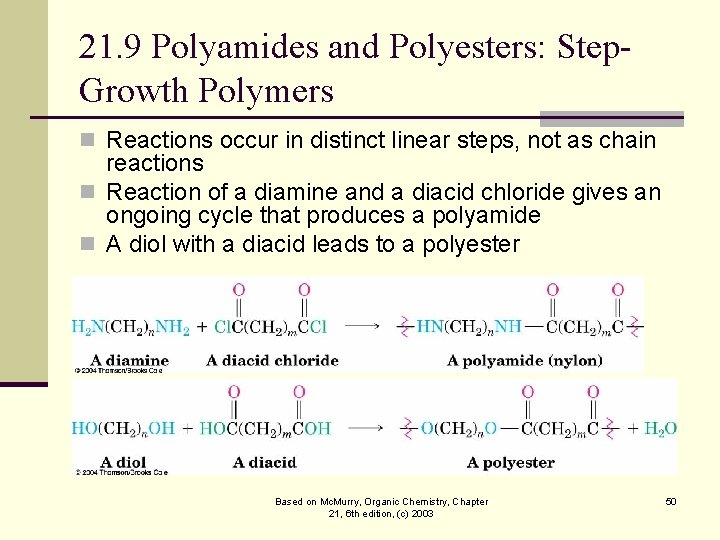
21. 9 Polyamides and Polyesters: Step. Growth Polymers n Reactions occur in distinct linear steps, not as chain reactions n Reaction of a diamine and a diacid chloride gives an ongoing cycle that produces a polyamide n A diol with a diacid leads to a polyester Based on Mc. Murry, Organic Chemistry, Chapter 21, 6 th edition, (c) 2003 50
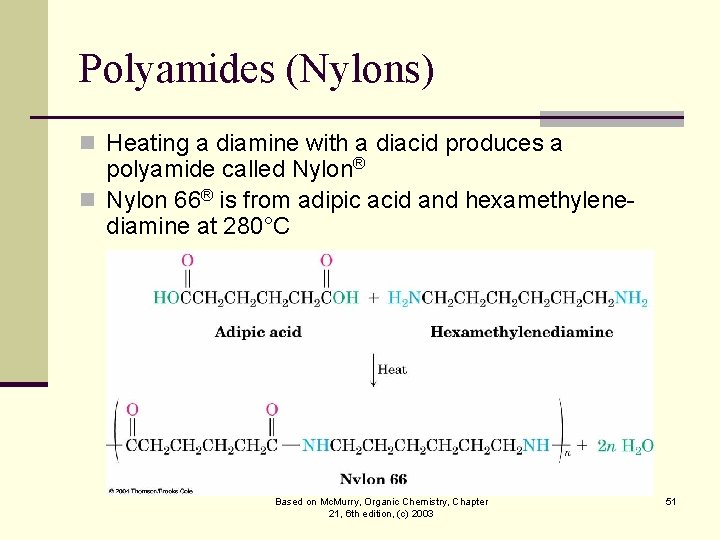
Polyamides (Nylons) n Heating a diamine with a diacid produces a polyamide called Nylon® n Nylon 66® is from adipic acid and hexamethylenediamine at 280°C Based on Mc. Murry, Organic Chemistry, Chapter 21, 6 th edition, (c) 2003 51
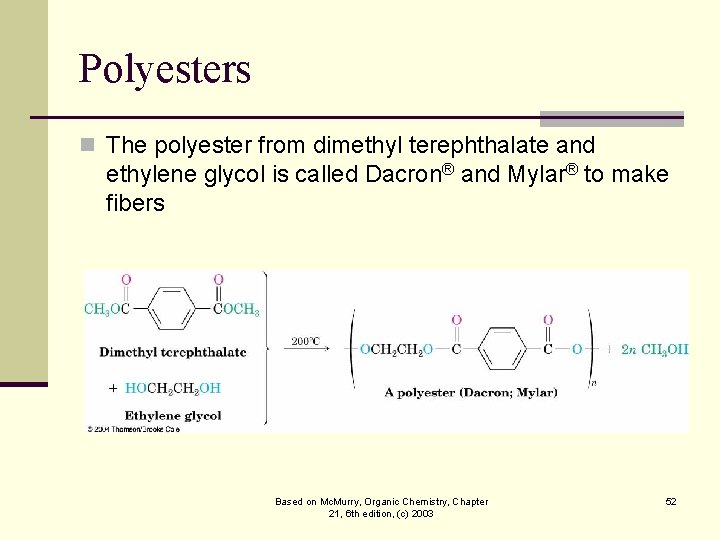
Polyesters n The polyester from dimethyl terephthalate and ethylene glycol is called Dacron® and Mylar® to make fibers Based on Mc. Murry, Organic Chemistry, Chapter 21, 6 th edition, (c) 2003 52
21. 10 Spectroscopy of Carboxylic Acid Derivatives n Infrared Spectroscopy n n Acid chlorides absorb near 1800 cm 1 Acid anhydrides absorb at 1820 cm 1 and also at 1760 cm 1 Esters absorb at 1735 cm 1, higher than aldehydes or ketones Amides absorb near the low end of the carbonyl region Based on Mc. Murry, Organic Chemistry, Chapter 21, 6 th edition, (c) 2003 53
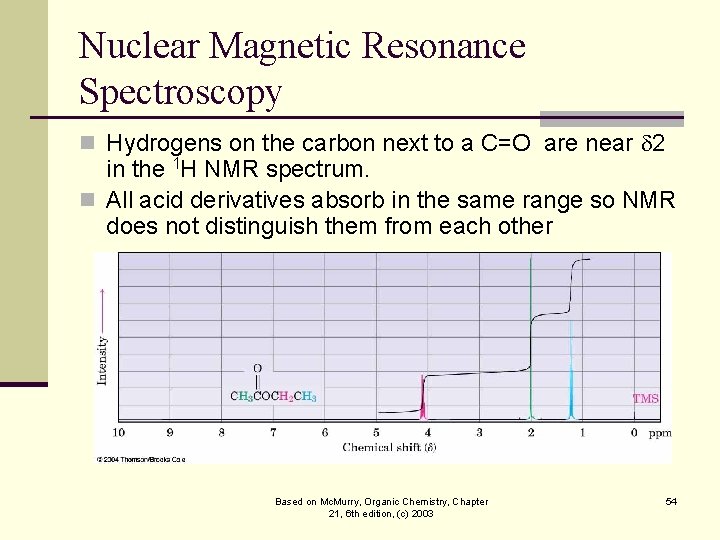
Nuclear Magnetic Resonance Spectroscopy n Hydrogens on the carbon next to a C=O are near 2 in the 1 H NMR spectrum. n All acid derivatives absorb in the same range so NMR does not distinguish them from each other Based on Mc. Murry, Organic Chemistry, Chapter 21, 6 th edition, (c) 2003 54
13 C NMR is useful for determining the presence or absence of a carbonyl group in a molecule of unknown structure n Carbonyl carbon atoms of the various acid derivatives absorb from 160 to 180 n 13 C Based on Mc. Murry, Organic Chemistry, Chapter 21, 6 th edition, (c) 2003 55
- Slides: 55