
Chapter 21 Burns Topics Introduction to Burn Injuries
Chapter 21 Burns

Topics ¥ ¥ ¥ Introduction to Burn Injuries Pathophysiology of Burns Assessment of Thermal Burns Management of Thermal Burns Assessment and Management of Electrical, Chemical, and Radiation Burns
Introduction to Burn Injuries ¥ 1. 25 -2 million Americans treated for burns annually ¤ 50, 000 require hospitalization ¤ 3 -5% considered life threatening ¤ 2 nd leading cause of death for children <12 ¤ Half of all tap-water burns occur to children <5 ¥ Greatest risk ¤ Very young & very old ¤ Infirm ¤ Firefighters ¤ Metal smelters ¤ Chemical workers
Pathophysiology of Burns ¥ Types of Burns ¤Thermal (heat) ¤Electrical ¤Chemical ¤Radiation
Thermal Burns ¥ Heat changes the molecular structure of tissue ¤Denaturing (of proteins) ¥ Extent of burn damage depends on ¤Temperature of agent ¤Concentration of heat ¤Duration of contact
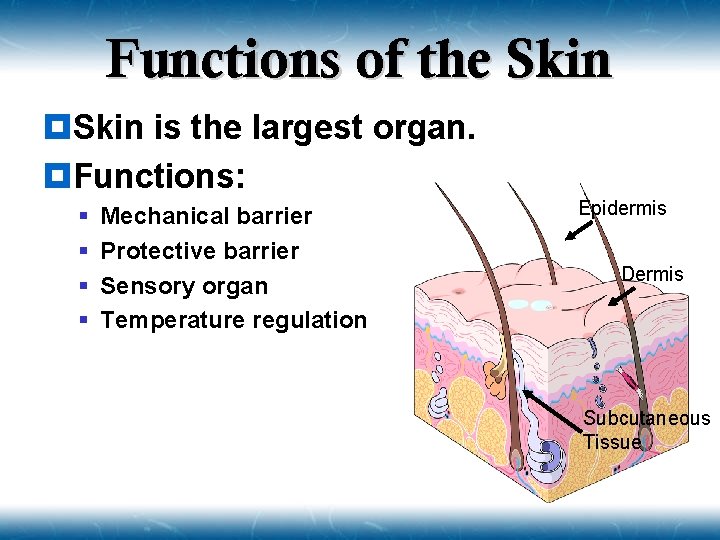
Functions of the Skin ¥Skin is the largest organ. ¥Functions: § § Mechanical barrier Protective barrier Sensory organ Temperature regulation Epidermis Dermis Subcutaneous Tissue
Thermal Burns ¥ Jackson’s Theory of Thermal Wounds ¤Zone of Coagulation Area in a burn nearest the heat source that suffers the most damage as evidenced by clotted blood and thrombosed blood vessels ¤Zone of Stasis Area surrounding zone of coagulation characterized by decreased blood flow. ¤Zone of Hyperemia Peripheral area around burn that has an increased blood flow.
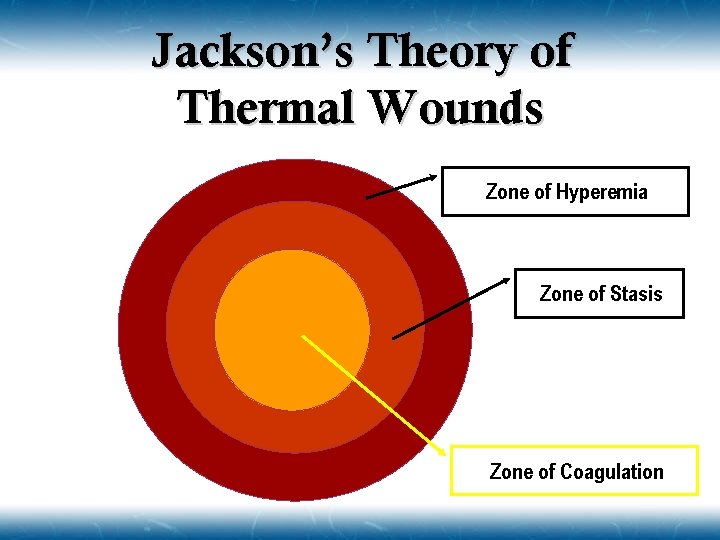
Jackson’s Theory of Thermal Wounds Zone of Hyperemia Zone of Stasis Zone of Coagulation

Body’s Response to Burns ¥ Emergent Phase (Stage 1) ¤ Happens immediately ¤ Pain response ¤ Catecholamine release ¤ Tachycardia, Tachypnea, Mild Hypertension, Mild Anxiety ¥ Fluid Shift Phase (Stage 2) ¤ Length 18 -24 hours ¤ Begins after Emergent Phase Reaches peak in 6 -8 hours ¤ Damaged cells initiate inflammatory response Increased blood flow to cells Shift of fluid from intravascular to extravascular space • MASSIVE EDEMA • “Leaky Capillaries
Body’s Response to Burns ¥ Hypermetabolic Phase (Stage 3) ¤Last for days to weeks ¤Large increase in the body’s need for nutrients as it repairs itself ¥ Resolution Phase (Stage 4) ¤Scar formation ¤General rehabilitation and progression to normal function
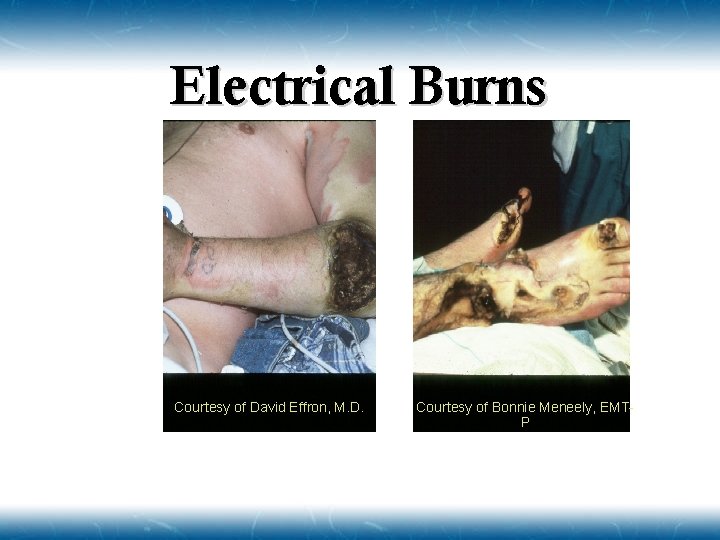
Electrical Burns Courtesy of David Effron, M. D. Courtesy of Bonnie Meneely, EMTP
Electrical Burns ¥ Terminology ¤Voltage Difference of electrical potential between two points Different concentrations of electrons ¤Amperes Strength of electrical current ¤Resistance (Ohms) Opposition to electrical flow
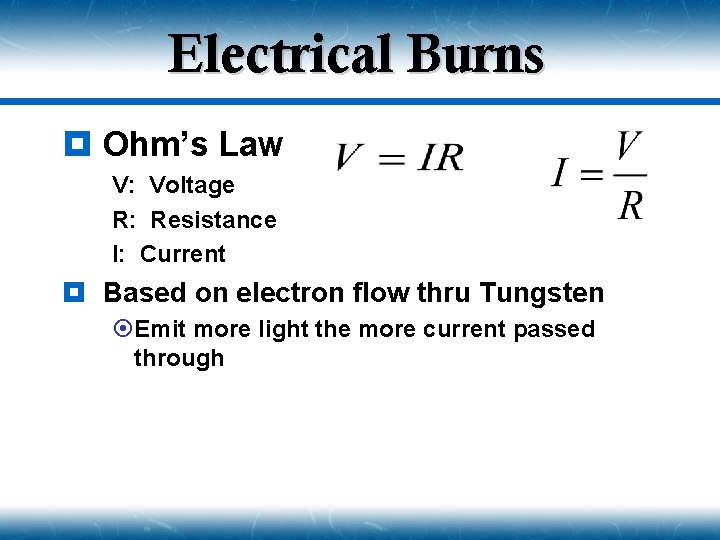
Electrical Burns ¥ Ohm’s Law V: Voltage R: Resistance I: Current ¥ Based on electron flow thru Tungsten ¤Emit more light the more current passed through
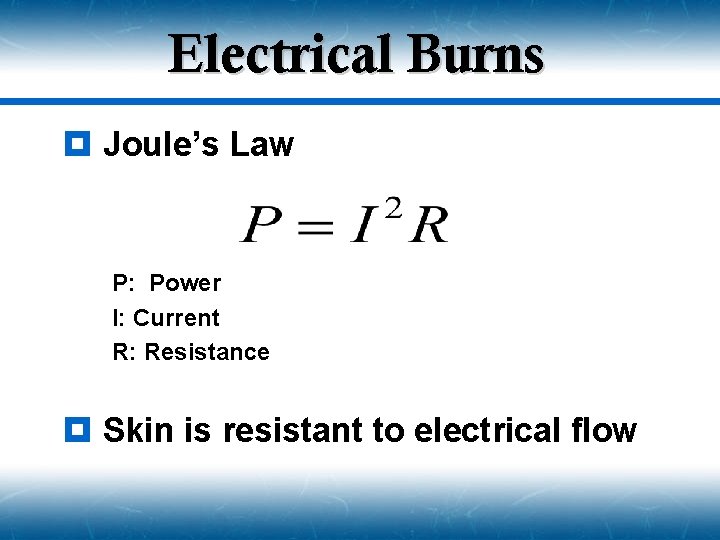
Electrical Burns ¥ Joule’s Law P: Power I: Current R: Resistance ¥ Skin is resistant to electrical flow

Electrical Burns ¥ Greatest heat occurs at the points of higher resistance ¤ Entrance and Exit wounds ¤ Dry skin = Greater resistance ¤ Wet Skin = Less resistance ¥ Longer the contact, the greater the potential of injury ¤ Increased damage inside body ¥ Smaller the point of contact, the more concentrated the energy, the greater the injury
Electrical Burns ¥ Electrical Current Flow ¤Tissue of Less Resistance Blood vessels Nerve ¤Tissue of Greater Resistance Muscle Bone ¥ Results in: ¤Serious vascular and nervous injury ¤Immobilization of muscles ¤Flash burns
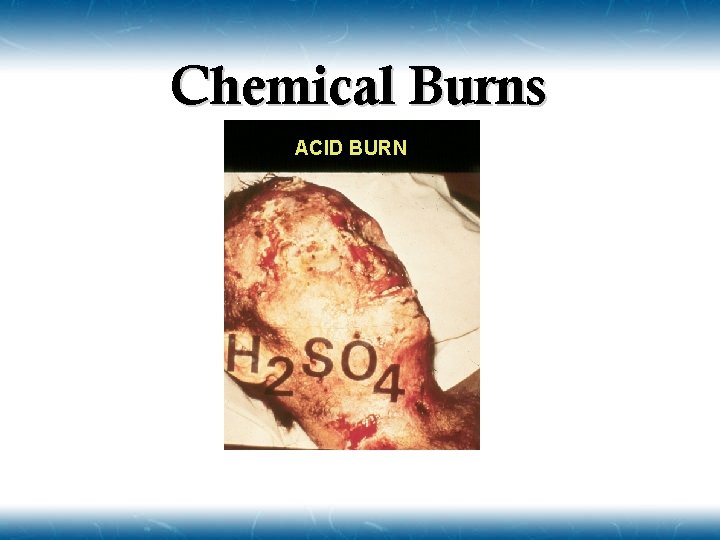
Chemical Burns ACID BURN
Chemical Burns ¥ Chemical destroys tissue ¤Acids Form a thick, insoluble mass where they contact tissue. Coagulation necrosis • Limits burn damage ¤Alkalis No protective coagulum Destroys cell membrane through liquefaction necrosis • Deeper tissue penetration and deeper burns
Radiation Injury ¥ Radiation ¤Transmission of energy Nuclear Energy Ultraviolet light Visible Light Heat Sound X-Rays ¥ Radioactive Substance ¤ Emits ionizing radiation ¤ Radionuclide or Radioisotope
Radiation Injury Basic Physics ¥ Protons ¤Positive charged particles ¥ Neutrons ¤Equal in mass to protons ¤No electrical charge ¥ Electrons ¤Minute electrically charged particles ¤When emitted from radioactive substances are termed Beta Particles (continued)
Radiation Injury Basic Physics ¥ Isotopes ¤Atoms with unstable nuclear composition Ionizing Radiation ¥ Half-life ¤Time required for half the nuclei to lose activity through decay
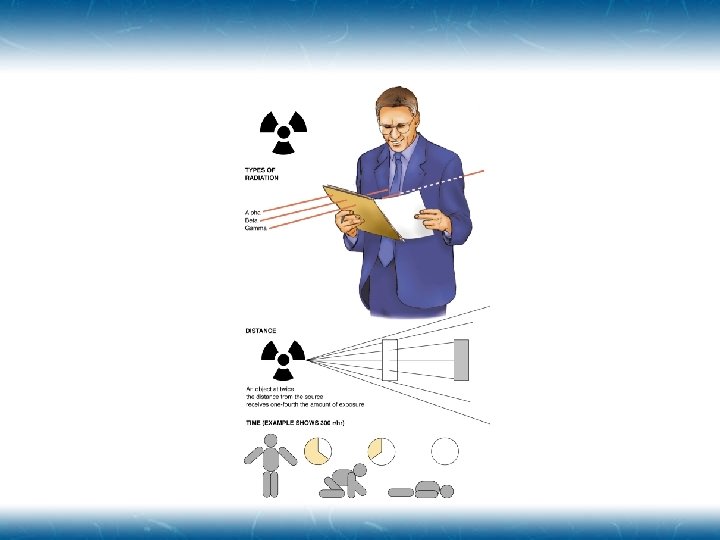
Radiation Injury Radioactive Substances ¥ Alpha Particles ¤ Slow moving ¤ Low-energy ¤ Stopped by clothing and paper ¤ Penetrate a few cell layers on skin ¤ Minor external hazard ¤ HARMFUL if ingested ¥ Beta Particles ¤ Smaller than Alpha ¤ Higher energy than alpha ¤ Stopped by aluminum or similar materials ¤ Less local damage than alpha ¤ HARMFUL if inhaled or ingested
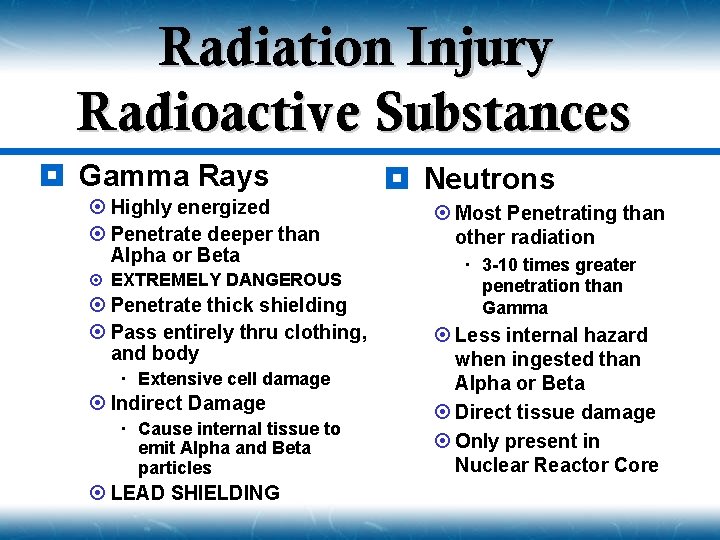
Radiation Injury Radioactive Substances ¥ Gamma Rays ¤ Highly energized ¤ Penetrate deeper than Alpha or Beta ¤ EXTREMELY DANGEROUS ¤ Penetrate thick shielding ¤ Pass entirely thru clothing, and body Extensive cell damage ¤ Indirect Damage Cause internal tissue to emit Alpha and Beta particles ¤ LEAD SHIELDING ¥ Neutrons ¤ Most Penetrating than other radiation 3 -10 times greater penetration than Gamma ¤ Less internal hazard when ingested than Alpha or Beta ¤ Direct tissue damage ¤ Only present in Nuclear Reactor Core
Factors Affecting Exposure to Radiation ¥ Duration of exposure ¥ Distance from the source ¥ Shielding from the source
Radiation Effects on Body ¥ Geiger Counter needed to detect ¤ R/hr: Milliroentgens per hour 1, 000 m. R = 1 R ¥ RAD ¤ ‘Radiation Absorbed Dose’ of local tissue ¥ REM ¤ Roentgen equivalent in man ¤ Injury to irradiated part of organism ¤ RAD=REM for all purposes ¥ Alters body’s cell DNA ¥ Cumulative damage over lifetime exposure ¥ Decreased WBC’s ¥ Acute Effects ¤ minutes-weeks ¥ Long-Term Effects ¤ Effects years or decades later
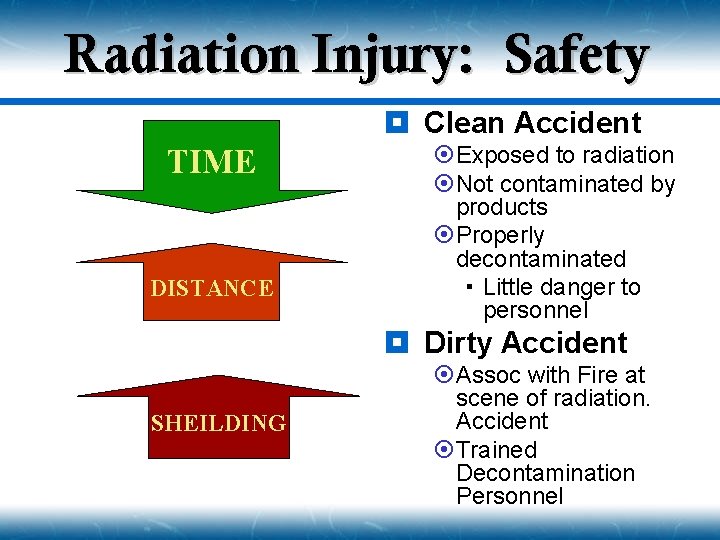
Radiation Injury: Safety ¥ Clean Accident TIME DISTANCE ¤Exposed to radiation ¤Not contaminated by products ¤Properly decontaminated Little danger to personnel ¥ Dirty Accident SHEILDING ¤Assoc with Fire at scene of radiation. Accident ¤Trained Decontamination Personnel
Radiation Injury Management ¥ Refer to BLS standards ¥ Park upwind and uphill ¥ Notify Police, Fire & Haz-Mat ¥ Identify radioactive material ¥ Decontaminate patients before care ¥ Routine medical care (ABC’s, etc)
Inhalation Injury ¥ Toxic Inhalation ¤Synthetic resin and plastic combustion Produces Cyanide & Hydrogen Sulfide Systemic poisoning More frequent than thermal inhalation burn Affects can be immediate or delayed ¥ Carbon Monoxide Poisoning ¤Colorless, odorless, tasteless gas ¤Byproduct of incomplete combustion of carbon products Suspect with faulty heating unit ¤ 200 x greater affinity for hemoglobin than oxygen Hypoxemia & Hypercarbia
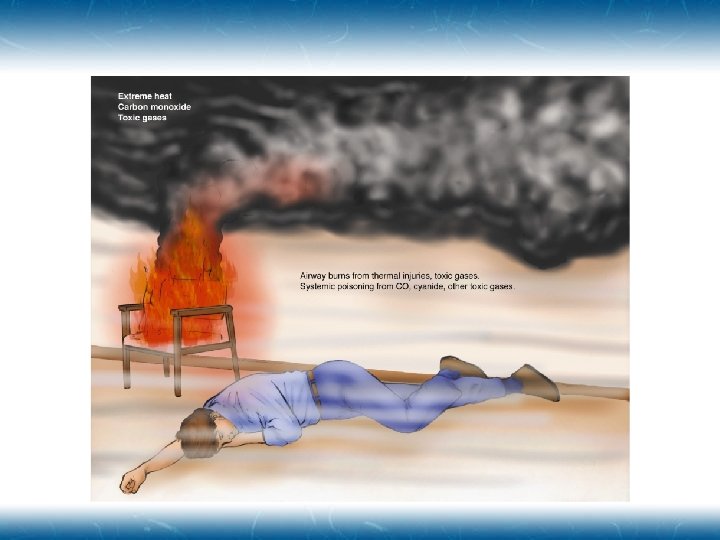

Inhalation Injury ¥ Airway Thermal Burn ¤Supraglottic structures absorb heat and prevent lower airway burns Moist mucosa lining insulates and absorbs heat ¤Superheated steam can injury lower airway ¤Risk Factors Standing in the burn environment Screaming or yelling in the burn environment Trapped in a closed burn environment ¤Symptoms Stridor or “Crowing” inspiratory sounds Singed facial and nasal hair Black sputum or facial burns Progressive respiratory obstruction and arrest due to swelling
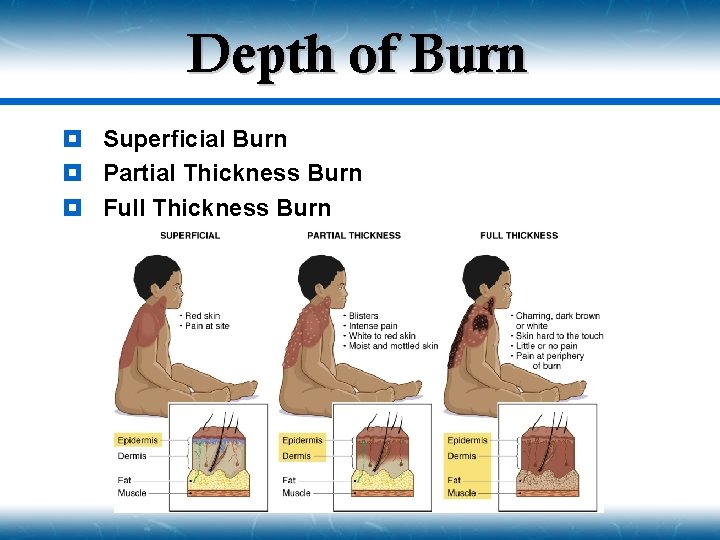
Depth of Burn ¥ Superficial Burn ¥ Partial Thickness Burn ¥ Full Thickness Burn

Burn Depth ¥ Superficial Burn: 1 st Degree Burn § Signs & Symptoms Reddened skin Pain at burn site Involves only epidermis
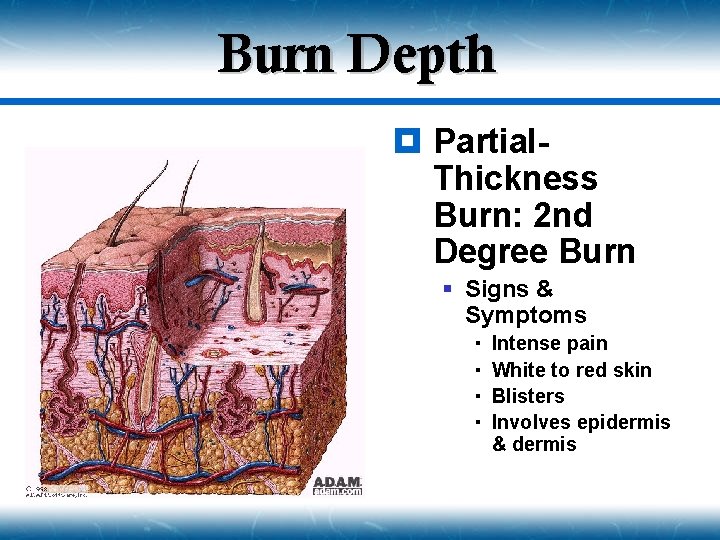
Burn Depth ¥ Partial. Thickness Burn: 2 nd Degree Burn § Signs & Symptoms Intense pain White to red skin Blisters Involves epidermis & dermis
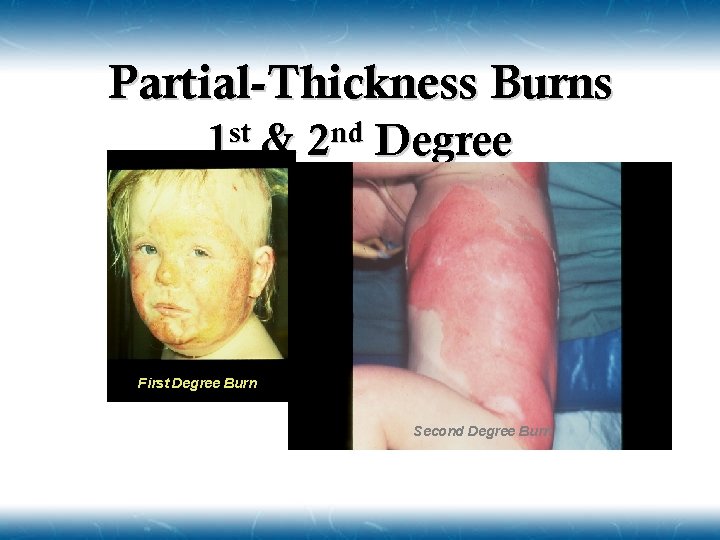
Partial-Thickness Burns 1 st & 2 nd Degree First Degree Burn Second Degree Burn
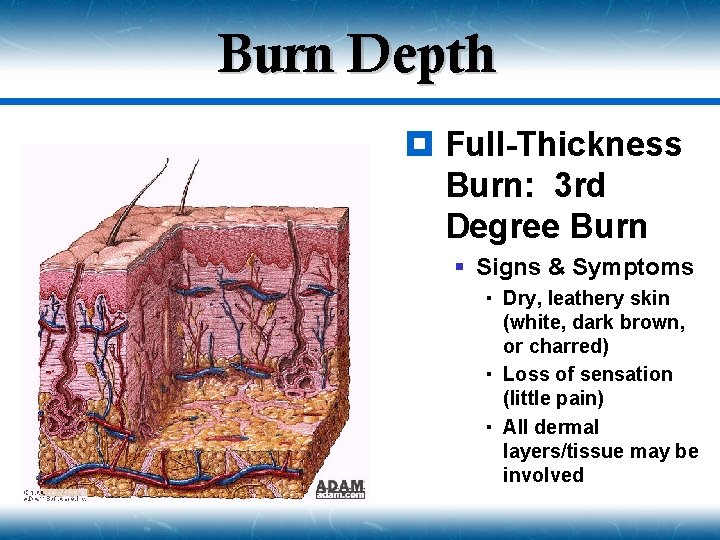
Burn Depth ¥ Full-Thickness Burn: 3 rd Degree Burn § Signs & Symptoms Dry, leathery skin (white, dark brown, or charred) Loss of sensation (little pain) All dermal layers/tissue may be involved

Full-Thickness Burns 3 rd Degree Partialthickness Full-thickness Eschar
Body Surface Area ¥ Rule of Nines ¤Best used for large surface areas ¤Expedient tool to measure extent of burn ¥ Rule of Palms ¤Best used for burns < 10% BSA

Rules of Nines
Rule of Palms ¥ A burn equivalent to the size of the patient’s hand is equal to 1% body surface area (BSA)
Systemic Complications ¥ Hypothermia ¤ Disruption of skin and its ability to thermoregulate ¥ Hypovolemia ¤ Shift in proteins, fluids, and electrolytes to the burned tissue ¤ Loss of osmotic pressure ¤ General electrolyte imbalance ¥ Eschar ¤ Hard, leathery product of a deep full thickness burn ¤ Dead and denatured skin constricts over the wound Increased pressure from edema and restricts blood flow
Systemic Complications ¥ Infection ¤Greatest risk of burn is infection ¥ Organ Failure ¤Kidneys ¤Liver ¤Heart ¥ Special Factors ¤Age & Health ¥ Physical Abuse ¤Elderly, Infirm or Young
Assessment of Thermal Burns ¥ Scene Size-up ¤Fire Department SCBA and protective clothing Stop any continued burning on the patient § MOI ¥ Primary Assessment ¤ABC’s MUST be intact Rapid transport for any airway burns ¤Rapid evacuation of patient if scene is unstable
Assessment of Thermal Burns ¥ Head/Neck, Chest, Abdomen, Pelvis, Extremities ¤ Accurately approximate extent of burn injury Rule of Nines or Rule of Palms Depth of burn Area of body effected • Any burn to the face, hands, feet, joints or genitalia is considered a serious burn “Ringing” burns Age of patient affected, current illnesses
Assessment of Thermal Burns General Signs & Symptoms ¥ Pain ¥ Changes in skin condition at affected site ¥ Adventitious sounds ¥ Blisters ¥ Sloughing of skin ¥ Hoarseness ¥ Dysphagia ¥ Dysphasia Burnt hair Edema Paresthesia Hemorrhage Other soft tissue injury ¥ Musculoskeletal injury ¥ Dyspnea ¥ Chest pain ¥ ¥ ¥
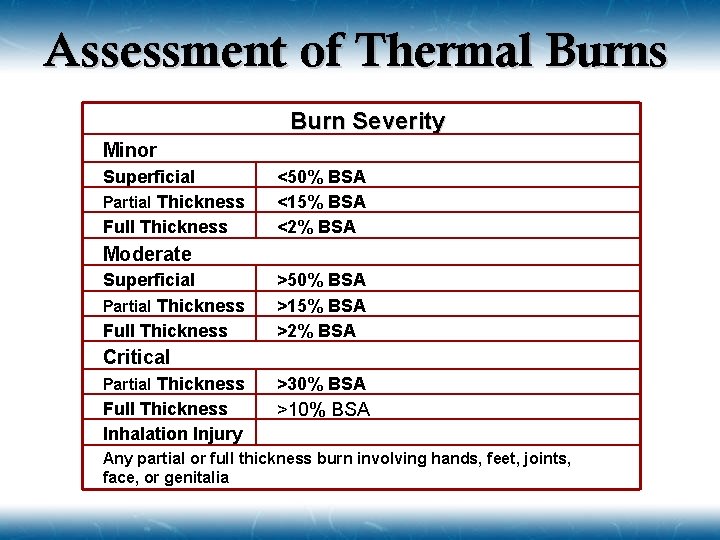
Assessment of Thermal Burns Burn Severity Minor Superficial Partial Thickness Full Thickness <50% BSA <15% BSA <2% BSA Moderate Superficial Partial Thickness Full Thickness >50% BSA >15% BSA >2% BSA Critical Partial Thickness >30% BSA Full Thickness Inhalation Injury >10% BSA Any partial or full thickness burn involving hands, feet, joints, face, or genitalia
Assessment of Thermal Burns ¥ Burns to the face, hands, feet, joints, genitalia, and circumferential burns are of special concern. ¥ Ongoing Assessment ¤Non-critical: Reassess Q 15 min ¤Critical: Reassess Q 5 min ¥ Burn Center Care
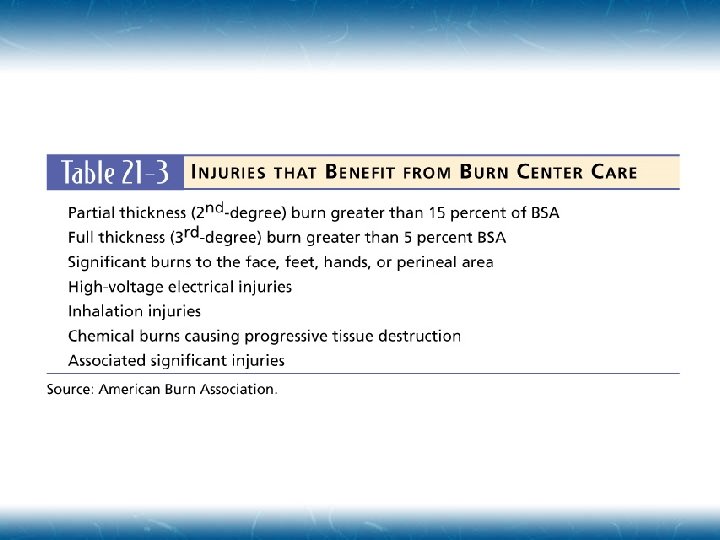
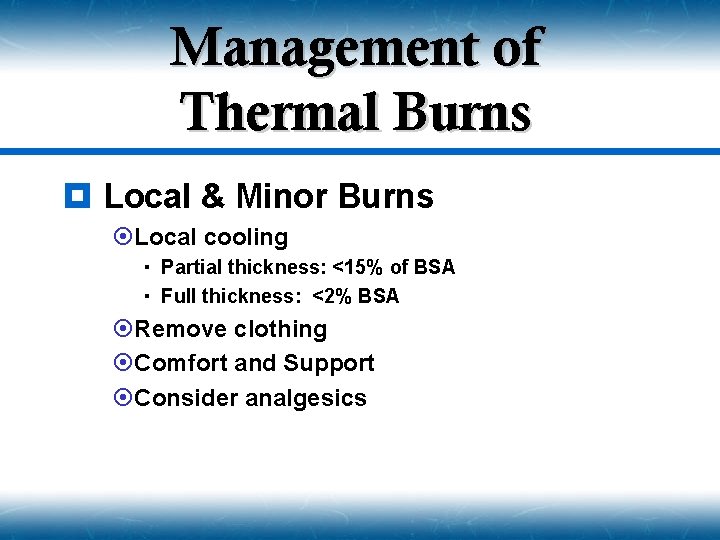
Management of Thermal Burns ¥ Local & Minor Burns ¤Local cooling Partial thickness: <15% of BSA Full thickness: <2% BSA ¤Remove clothing ¤Comfort and Support ¤Consider analgesics
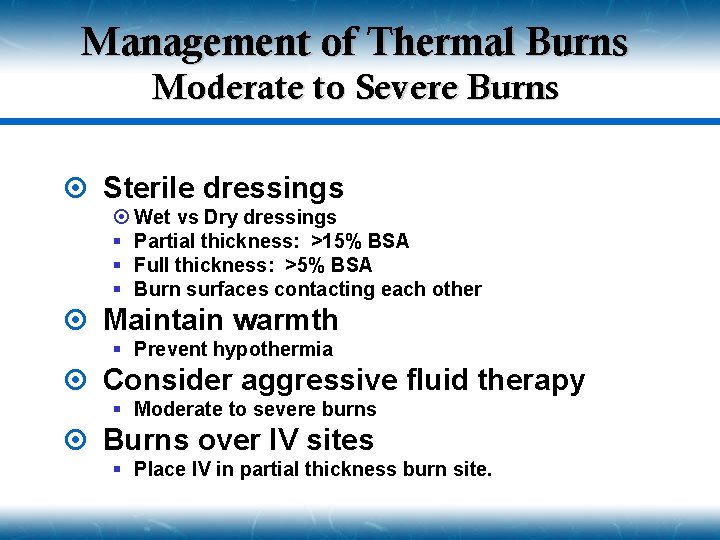
Management of Thermal Burns Moderate to Severe Burns ¤ Sterile dressings ¤ Wet vs Dry dressings § Partial thickness: >15% BSA § Full thickness: >5% BSA § Burn surfaces contacting each other ¤ Maintain warmth § Prevent hypothermia ¤ Consider aggressive fluid therapy § Moderate to severe burns ¤ Burns over IV sites § Place IV in partial thickness burn site.
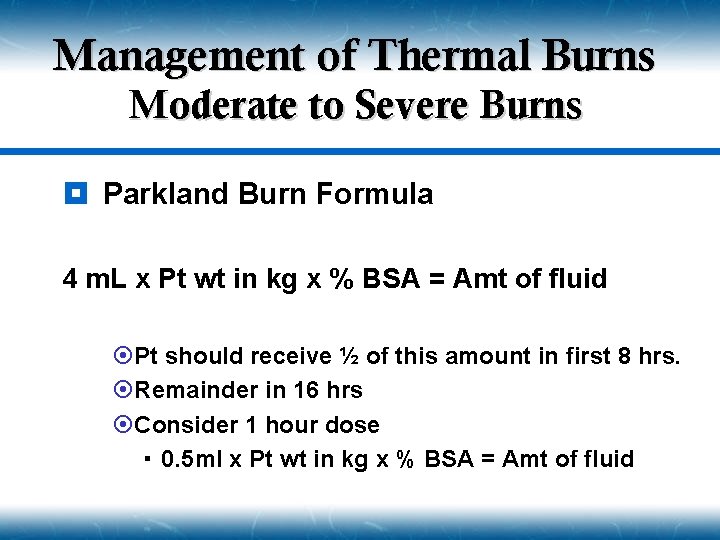
Management of Thermal Burns Moderate to Severe Burns ¥ Parkland Burn Formula 4 m. L x Pt wt in kg x % BSA = Amt of fluid ¤Pt should receive ½ of this amount in first 8 hrs. ¤Remainder in 16 hrs ¤Consider 1 hour dose 0. 5 ml x Pt wt in kg x % BSA = Amt of fluid
Management of Thermal Burns Moderate to Severe Burns ¤ Caution for fluid overload § Frequent auscultation of breath sounds ¤ Consider analgesic for pain § Morphine § Nubain ¤ Prevent infection ¤Clean environment ¤Sterile dressings and sheets
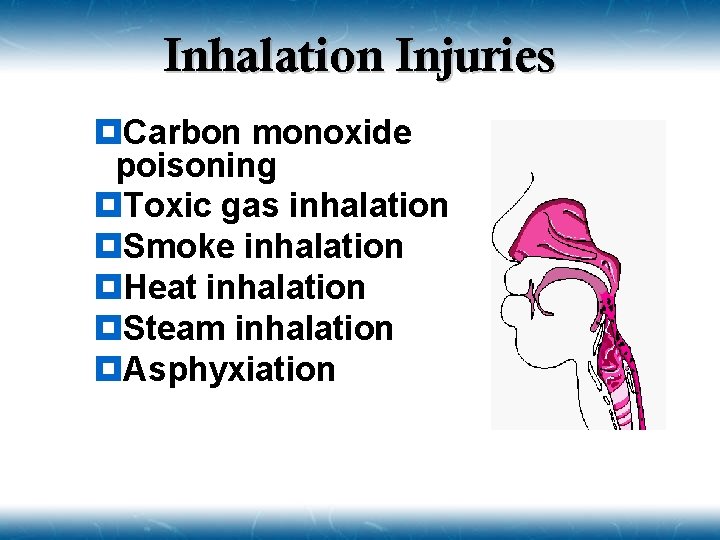
Inhalation Injuries ¥Carbon monoxide poisoning ¥Toxic gas inhalation ¥Smoke inhalation ¥Heat inhalation ¥Steam inhalation ¥Asphyxiation
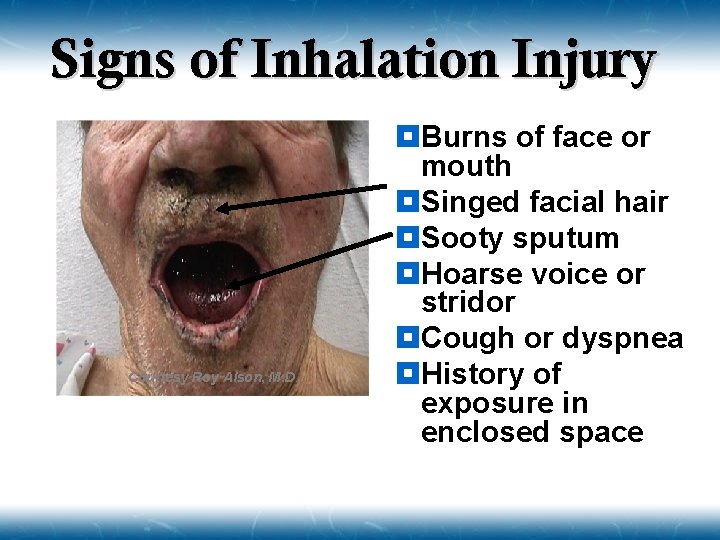
Signs of Inhalation Injury Courtesy Roy Alson, M. D. ¥Burns of face or mouth ¥Singed facial hair ¥Sooty sputum ¥Hoarse voice or stridor ¥Cough or dyspnea ¥History of exposure in enclosed space
Management of Thermal Burns Inhalation Injury ¤ Provide high-flow O 2 by NRB ¤ Rapid transport if swelling ¤ Consider hyperbaric oxygen therapy ¤ Cyanide Exposure ¤Antidote is a 2 stage process Forms methemoglobin binds to cyanide Non-toxic substance secreted in urine
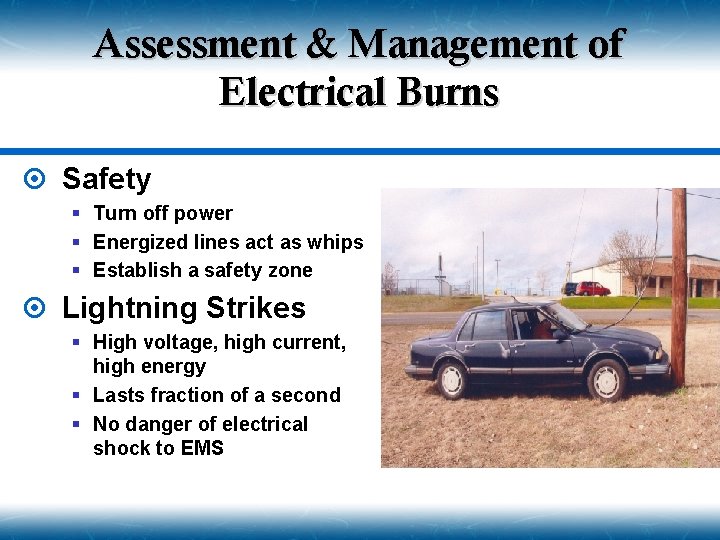
Assessment & Management of Electrical Burns ¤ Safety § Turn off power § Energized lines act as whips § Establish a safety zone ¤ Lightning Strikes § High voltage, high current, high energy § Lasts fraction of a second § No danger of electrical shock to EMS
Assessment & Management of Electrical Burns ¤ Assess patient § § ABC’s + Immobilize c-spine Entrance & Exit wounds Remove clothing, jewelry, and leather items Treat any visible injuries Thermal burns § ECG monitoring Bradycardia, Tachycardia, VF or Asystole • AED Protocols ACLS Protocols Treat cardiac & respiratory arrest Aggressive airway, ventilation, and circulatory management.
Assessment & Management of Chemical Burns ¤ Scene size-up § Hazardous materials team § Establish hot, warm and cold zones § Prevent personnel exposure from chemical ¥ General burn treatment protocols ¤ Specific Chemicals § § Phenol Dry Lime Sodium Riot Control Agents
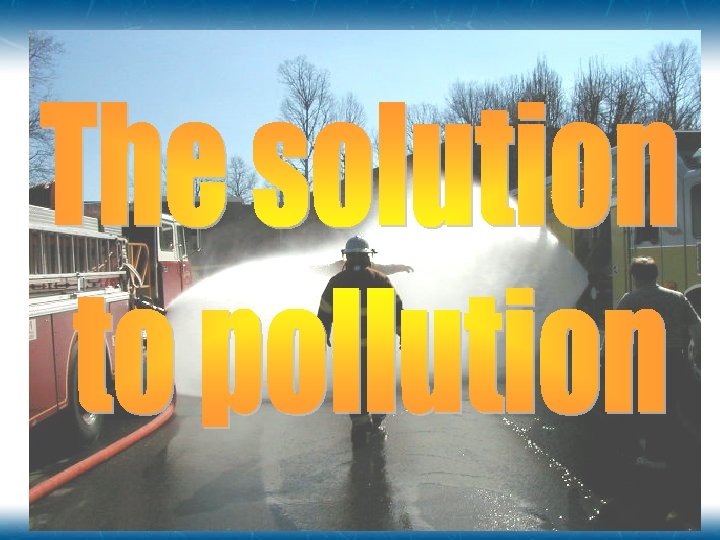
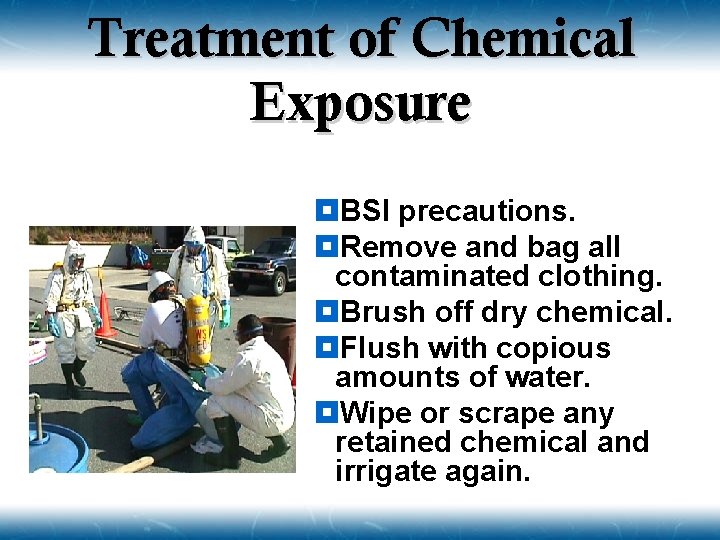
Treatment of Chemical Exposure ¥BSI precautions. ¥Remove and bag all contaminated clothing. ¥Brush off dry chemical. ¥Flush with copious amounts of water. ¥Wipe or scrape any retained chemical and irrigate again.
Chemical Burns ¥Only use water to neutralize chemical. § Flush affected area for 15 -20 minutes ¥Never use other chemicals to neutralize. § Chemical A + chemical B = chemical AB + heat ¥Collect runoff water if hazardous.
Assessment & Management of Specific Chemical Burns ¤ Phenol § Industrial cleaner § Alcohol dissolves Phenol § Irrigate with copious amounts of water ¤ Dry Lime § Strong corrosive that reacts with water § Remove clothes and brush off dry substance § Irrigate with copious amounts of cool water Prevents reaction with patient tissues
Assessment & Management of Specific Chemical Burns ¥ Sodium ¤Unstable metal ¤Reacts vigorously with water Releases • Extreme heat • Hydrogen gas • Ignition ¤Decontaminate: Brush off dry chemical ¤Smother with sand of dirt ¤Cover the wound with oil substance
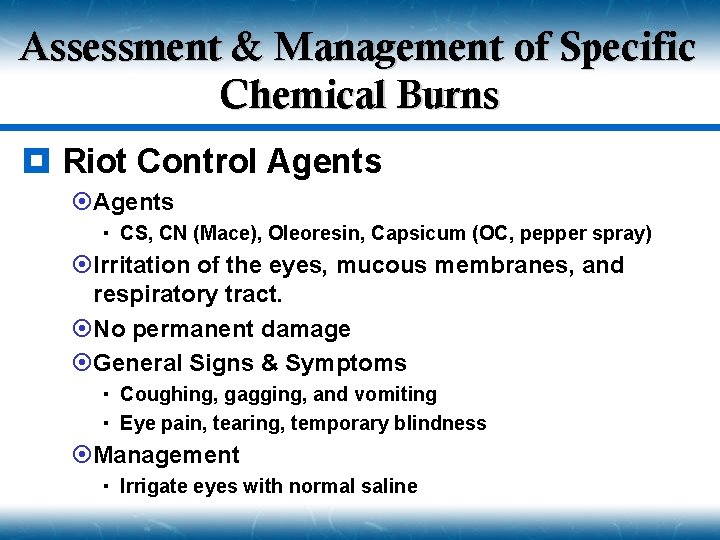
Assessment & Management of Specific Chemical Burns ¥ Riot Control Agents ¤Agents CS, CN (Mace), Oleoresin, Capsicum (OC, pepper spray) ¤Irritation of the eyes, mucous membranes, and respiratory tract. ¤No permanent damage ¤General Signs & Symptoms Coughing, gagging, and vomiting Eye pain, tearing, temporary blindness ¤Management Irrigate eyes with normal saline
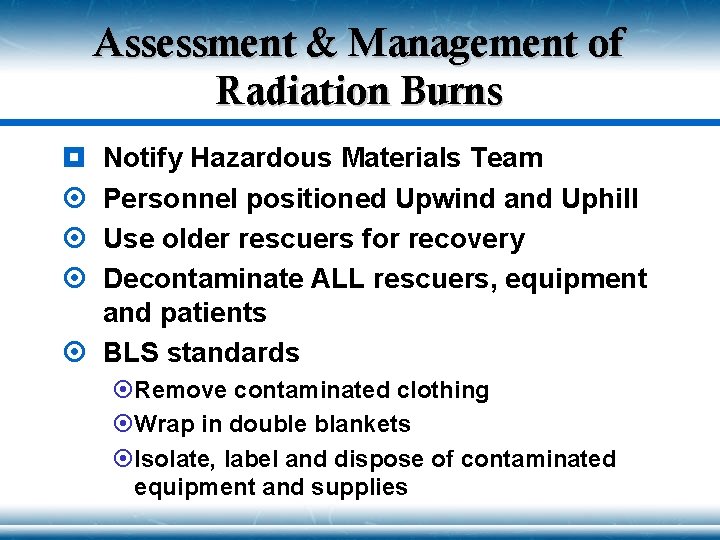
Assessment & Management of Radiation Burns Notify Hazardous Materials Team Personnel positioned Upwind and Uphill Use older rescuers for recovery Decontaminate ALL rescuers, equipment and patients ¤ BLS standards ¥ ¤ ¤Remove contaminated clothing ¤Wrap in double blankets ¤Isolate, label and dispose of contaminated equipment and supplies
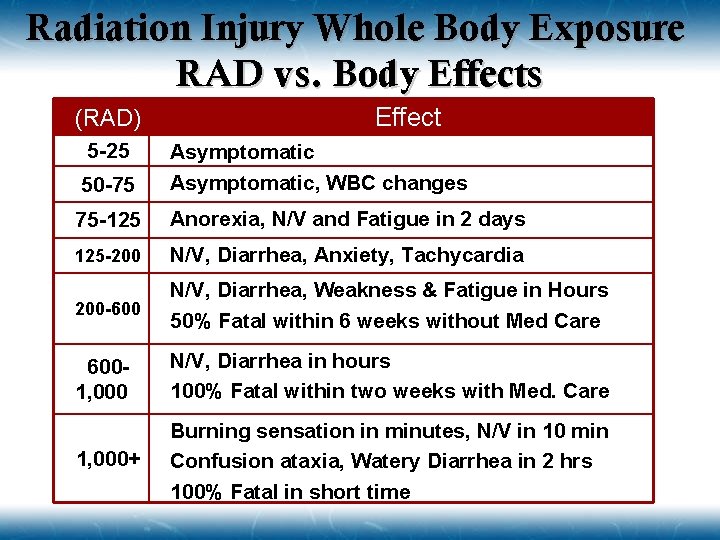
Radiation Injury Whole Body Exposure RAD vs. Body Effects (RAD) 5 -25 Effect 50 -75 Asymptomatic, WBC changes 75 -125 Anorexia, N/V and Fatigue in 2 days 125 -200 N/V, Diarrhea, Anxiety, Tachycardia 200 -600 N/V, Diarrhea, Weakness & Fatigue in Hours 50% Fatal within 6 weeks without Med Care 6001, 000 N/V, Diarrhea in hours 100% Fatal within two weeks with Med. Care 1, 000+ Burning sensation in minutes, N/V in 10 min Confusion ataxia, Watery Diarrhea in 2 hrs 100% Fatal in short time
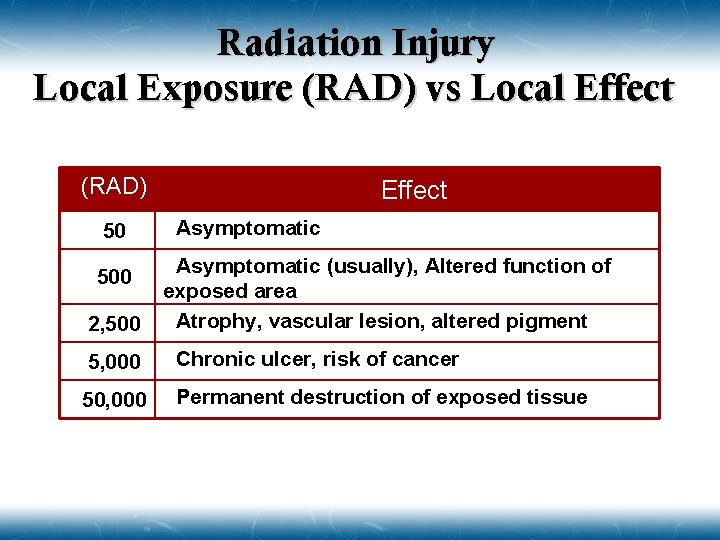
Radiation Injury Local Exposure (RAD) vs Local Effect (RAD) 50 500 2, 500 Effect Asymptomatic (usually), Altered function of exposed area Atrophy, vascular lesion, altered pigment 5, 000 Chronic ulcer, risk of cancer 50, 000 Permanent destruction of exposed tissue
Ongoing assessment ¤ Re-evaluate initial assessment ¤ Re-evaluate all interventions
Summary ¥ ¥ Pathophysiology of Burns Assessment of Thermal Burns Management of Thermal Burns Assessment & Management of Electrical, Chemical, and Radiation Burns
- Slides: 69