
Chapter 20 Sports Medicine Health Care Science Technology
- Slides: 26
Chapter 20 Sports Medicine Health Care Science Technology Copyright © The Mc. Graw-Hill Companies, Inc. Chapter 20
Objectives List the job duties of a sports medicine technician, athletic trainer, personal trainer, strength and conditioning specialist, sports physical therapist, and exercise physiologist. l Identify settings where sports medicine professionals work. l 2 Copyright © The Mc. Graw-Hill Companies, Inc. Chapter 20
Objectives (cont. ) Compare the job duties of a personal trainer and a strength and conditioning specialist. l Identify the situations when hot and cold modalities should or should not be used. l 3 Copyright © The Mc. Graw-Hill Companies, Inc. Chapter 20
Objectives (cont. ) List the uses of hot versus cold modalities. l Identify the components of proper physical fitness. l Calculate a target heart rate. l Successfully complete 2 sports medicine procedures. l 4 Copyright © The Mc. Graw-Hill Companies, Inc. Chapter 20
Careers in Sports Medicine 20 -1 Certified Athletic Trainer l Certified Personal Trainer l Certified Strength and Conditioning Specialist l Certified Exercise Physiologist l Sports Physical Therapist l Sports Medicine Technician l 5 Copyright © The Mc. Graw-Hill Companies, Inc. Chapter 20
Certified Athletic Trainer (ATC) l l l 6 Assess, evaluate, and provide treatment for acute sports injuries. Use a variety of modalities, including ice, heat, and ultrasound. Effective January 1, 2004, ATCs must graduate from an accredited athletic training program and pass a certification exam. Copyright © The Mc. Graw-Hill Companies, Inc. Chapter 20
Certified Athletic Trainer (ATC) (cont. ) l The 4 main job areas: – – 7 Educational facilities. Outpatient sports medicine physical therapy clinics. Professional sports teams. Industrial/ergonomic settings and corporate wellness centers. Copyright © The Mc. Graw-Hill Companies, Inc. Chapter 20
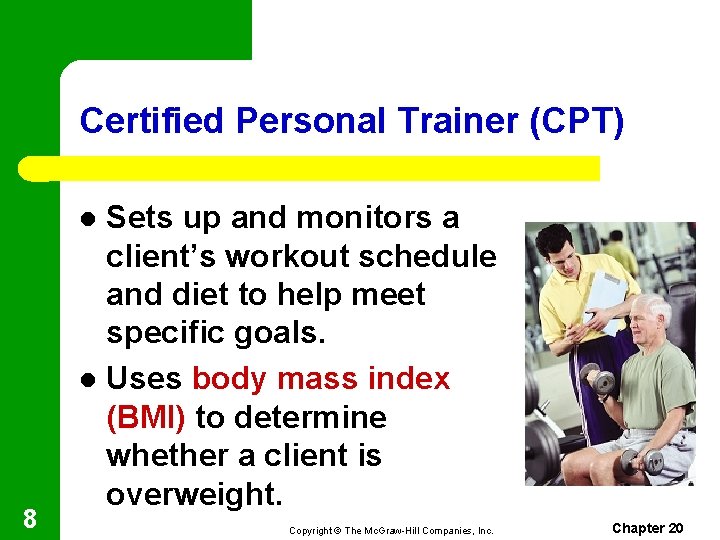
Certified Personal Trainer (CPT) Sets up and monitors a client’s workout schedule and diet to help meet specific goals. l Uses body mass index (BMI) to determine whether a client is overweight. l 8 Copyright © The Mc. Graw-Hill Companies, Inc. Chapter 20
Certified Personal Trainer (CPT) (cont. ) l Job Responsibilities – – May use aerobic or anaerobic exercises or a combination of both. Job duties encompass the following: l l l 9 Taking physical measurements of the client. Deciding what types of exercises would best serve the client. Knowing the proper form for each exercise. Recognizing adverse effects of an exercise. Knowing proper nutritional information and applying it to the client’s needs. Copyright © The Mc. Graw-Hill Companies, Inc. Chapter 20
Certified Strength and Conditioning Specialist (CSCS) l l 10 Must have a strong educational background in kinesiology or a related field. Certification requires passing a two-part multiple-choice test. Once certified, the CSCS must complete 6 continuing education units every 3 years. Usually employed by schools and professional sports teams. Copyright © The Mc. Graw-Hill Companies, Inc. Chapter 20
Certified Strength and Conditioning Specialist (CSCS) (cont. ) l Job Responsibilities – – – 11 Make a physical assessment of the players. Put the athlete through a series of tests to determine any weakness in performance. Design a lifting, running, and conditioning program. Observe the athlete’s technique and make corrections as needed. Ensure proper eating habits are followed. Copyright © The Mc. Graw-Hill Companies, Inc. Chapter 20
Exercise Physiologist Explores the effects of exercise on the body. l May work in a variety of settings, including hospitals, corporations, and the government. l 12 Copyright © The Mc. Graw-Hill Companies, Inc. Chapter 20
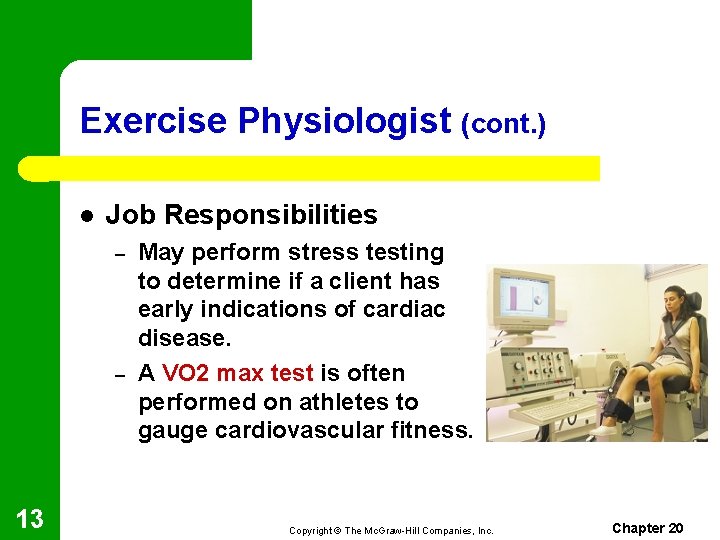
Exercise Physiologist (cont. ) l Job Responsibilities – – 13 May perform stress testing to determine if a client has early indications of cardiac disease. A VO 2 max test is often performed on athletes to gauge cardiovascular fitness. Copyright © The Mc. Graw-Hill Companies, Inc. Chapter 20
Sports Physical Therapist l l 14 Diagnoses an injured athlete’s problem. May plan exercises and modalities to reach treatment goals. May also be certified as a CPT or CSCS. May hold exercise physiology degree. Copyright © The Mc. Graw-Hill Companies, Inc. Chapter 20
Sports Physical Therapist (cont. ) l l 15 Evaluates an injured athlete using SOAP, which is composed of four parts: Subjective, Objective, Assessment, and Plan. Treats the athlete’s deficit by decreasing the pain level, improving range of motion, increasing strength to a functional level, and improving agility, quickness, reaction time, speed, and proprioception. Copyright © The Mc. Graw-Hill Companies, Inc. Chapter 20
Sports Medicine Technician Aids therapists and trainers with basic job tasks. l Usually receives on-the-job training from staff members. l 16 Copyright © The Mc. Graw-Hill Companies, Inc. Chapter 20
Sports Medicine Technician (cont. ) Provides clerical support to the clinic. l Prepares and cleans equipment. l Assists clients into and out of whirlpools. l Monitors clients as they perform exercises. l 17 Copyright © The Mc. Graw-Hill Companies, Inc. Chapter 20
Section 20 -1 Apply Your Knowledge Which field studies the movement of the body? Answer: Kinesiology. 18 Copyright © The Mc. Graw-Hill Companies, Inc. Chapter 20
Sports Medicine Procedures 20 -2 l l l 19 Heat Therapy Cold Therapy Additional Career Skills Copyright © The Mc. Graw-Hill Companies, Inc. Chapter 20
Heat Therapy l l l 20 Dilates the blood vessels, known as vasodilatation. Increases blood flow, which provides increased nutrients and speeds healing. Should not be used for acute injuries, numbness, an active infection, cancer, a bleeding wound, or blood clots. Copyright © The Mc. Graw-Hill Companies, Inc. Chapter 20
Cold Therapy l Should be avoided in the following situations: – – – l 21 Numbness. Compromised circulation in treatment area. Large treatment areas. Should be used to reduce swelling or to help decrease muscle spasms. Copyright © The Mc. Graw-Hill Companies, Inc. Chapter 20
Additional Career Skills l Calculating Body Fat Percentages – The three methods used are: l l l 22 Hydrostatic testing. Electrical impedance testing. Use of a body fat caliper. Copyright © The Mc. Graw-Hill Companies, Inc. Chapter 20
Section 20 -2 Apply Your Knowledge List some situations when heat therapy should NOT be used. Answer: Heat should not be used for acute injuries, numbness, an active infection, cancer, a bleeding wound, or blood clots. 23 Copyright © The Mc. Graw-Hill Companies, Inc. Chapter 20
Procedures for Student Text 20 A 20 B 24 Applying a Hot Pack Applying an Ice Pack Copyright © The Mc. Graw-Hill Companies, Inc. Chapter 20
Additional Procedures in Lab Activity Manual LM 20 -1 LM 20 -2 25 Using a Cold Whirlpool Calculating Body Fat Copyright © The Mc. Graw-Hill Companies, Inc. Chapter 20
Chapter 20 Credits Slide 8 Slide 13 26 David Pollack/CORBIS Custom Medical Stock Copyright © The Mc. Graw-Hill Companies, Inc. Chapter 20