
Chapter 20 section 20 3 Semiconductors and superconductors
- Slides: 13
Chapter 20, section 20. 3 Semiconductors and superconductors © 2008 Brooks/Cole 1
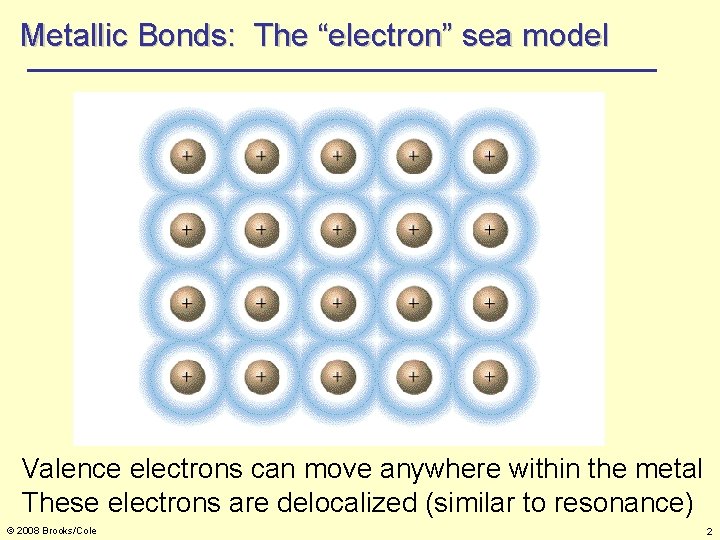
Metallic Bonds: The “electron” sea model Valence electrons can move anywhere within the metal These electrons are delocalized (similar to resonance) © 2008 Brooks/Cole 2
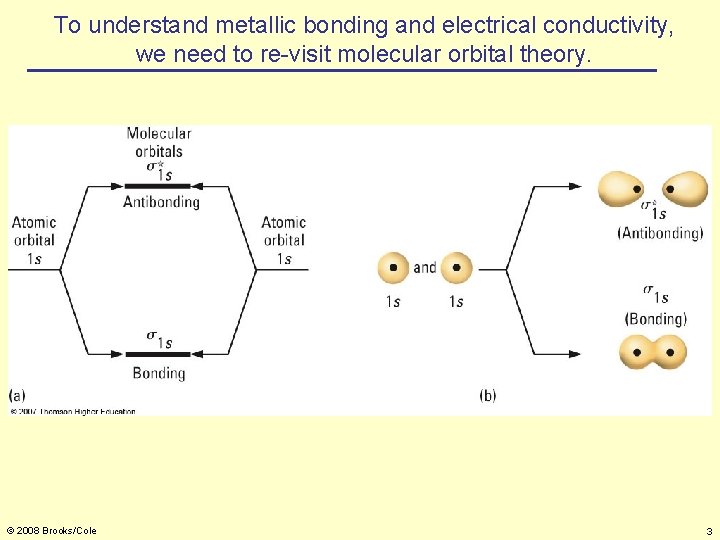
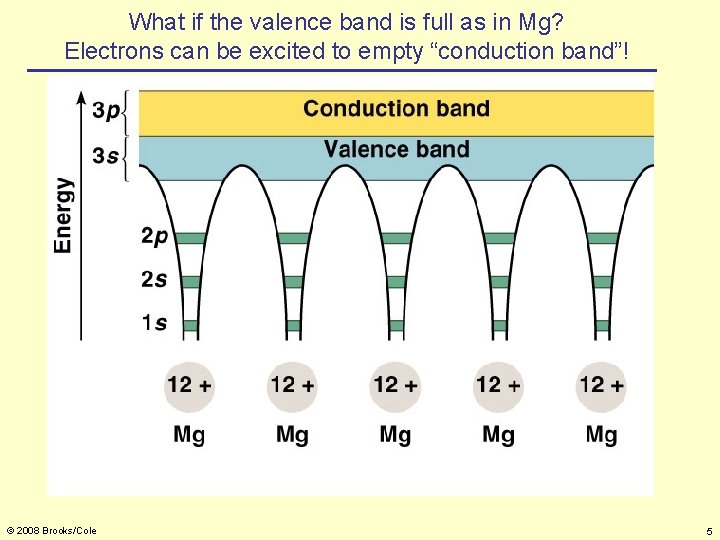
To understand metallic bonding and electrical conductivity, we need to re-visit molecular orbital theory. © 2008 Brooks/Cole 3
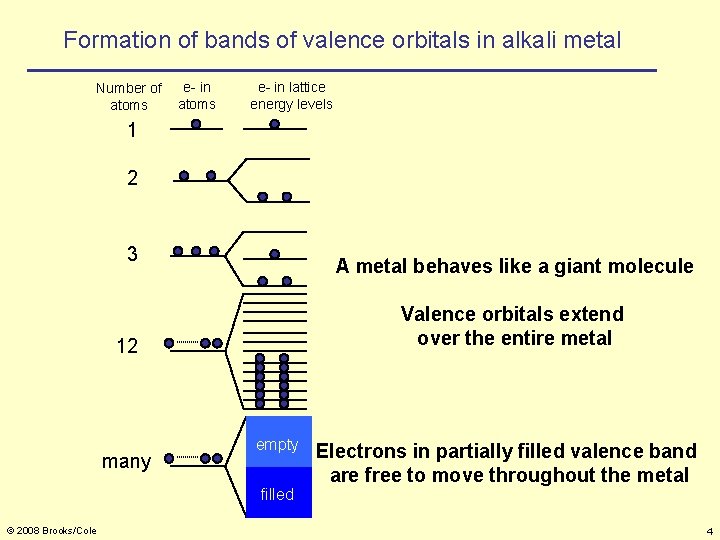
Formation of bands of valence orbitals in alkali metal Number of atoms e- in lattice energy levels 1 2 3 A metal behaves like a giant molecule Valence orbitals extend over the entire metal 12 many empty filled © 2008 Brooks/Cole Electrons in partially filled valence band are free to move throughout the metal 4
What if the valence band is full as in Mg? Electrons can be excited to empty “conduction band”! © 2008 Brooks/Cole 5
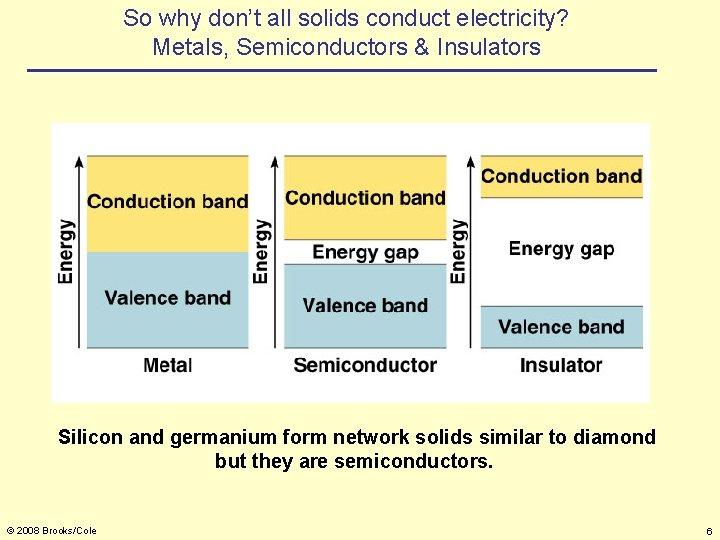
So why don’t all solids conduct electricity? Metals, Semiconductors & Insulators Silicon and germanium form network solids similar to diamond but they are semiconductors. © 2008 Brooks/Cole 6
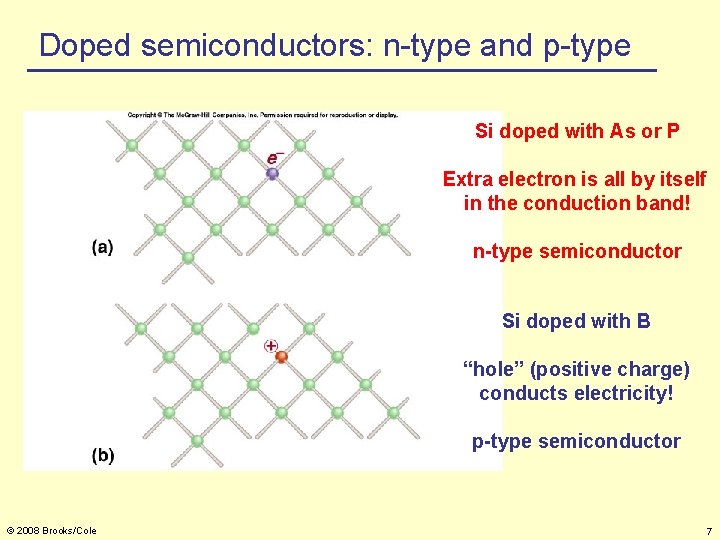
Doped semiconductors: n-type and p-type Si doped with As or P Extra electron is all by itself in the conduction band! n-type semiconductor Si doped with B “hole” (positive charge) conducts electricity! p-type semiconductor © 2008 Brooks/Cole 7
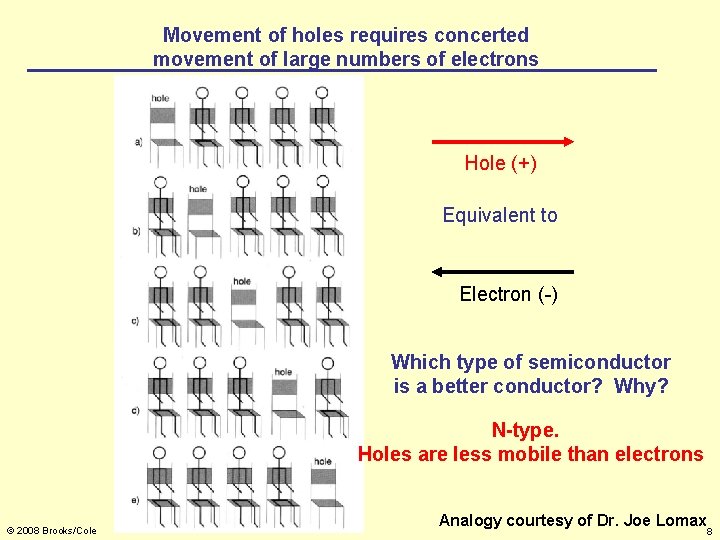
Movement of holes requires concerted movement of large numbers of electrons Hole (+) Equivalent to Electron (-) Which type of semiconductor is a better conductor? Why? N-type. Holes are less mobile than electrons © 2008 Brooks/Cole Analogy courtesy of Dr. Joe Lomax 8
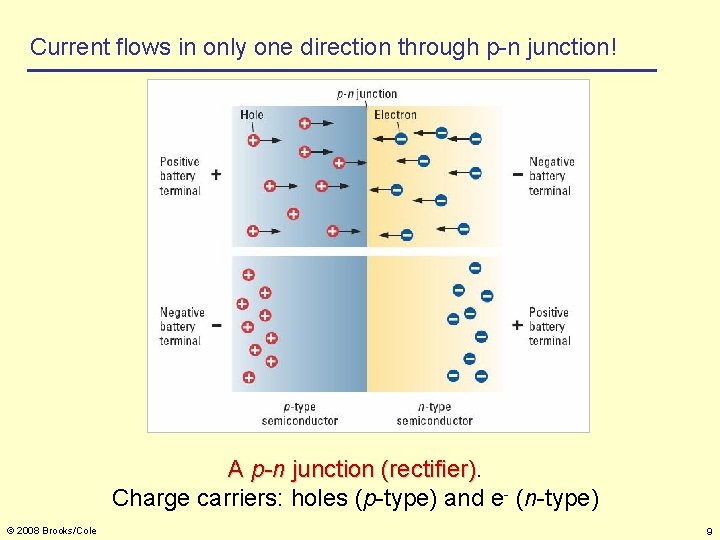
Current flows in only one direction through p-n junction! A p-n junction (rectifier) Charge carriers: holes (p-type) and e- (n-type) © 2008 Brooks/Cole 9
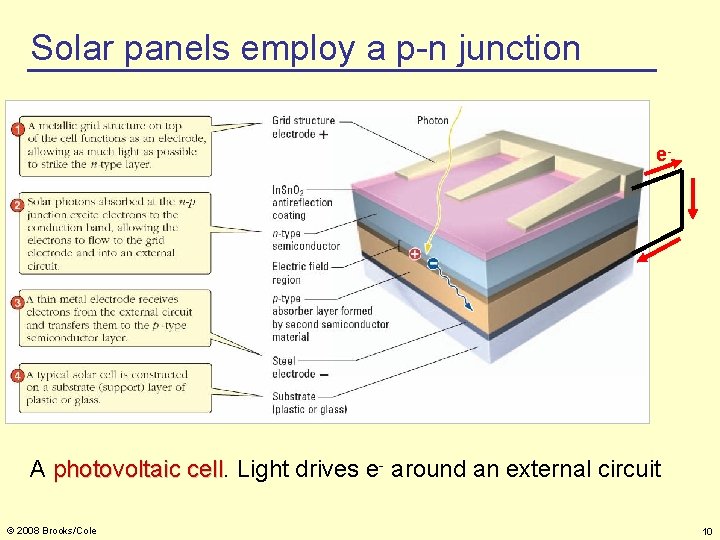
Solar panels employ a p-n junction e- A photovoltaic cell Light drives e- around an external circuit © 2008 Brooks/Cole 10
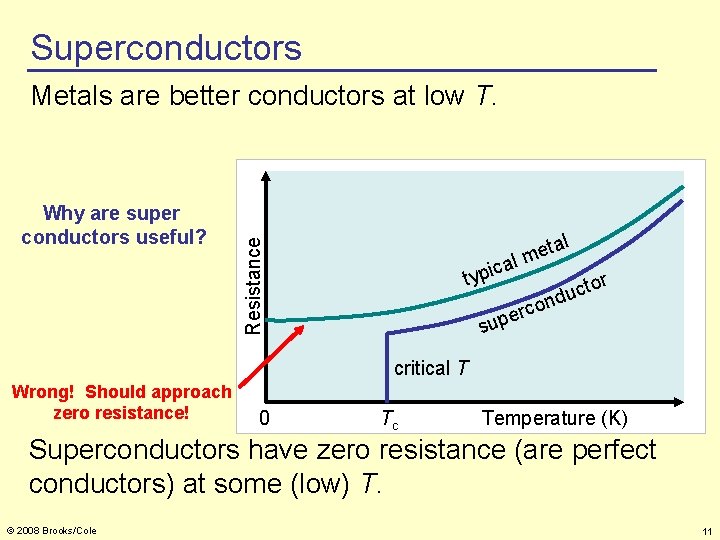
Superconductors Metals are better conductors at low T. al t e lm Resistance Why are super conductors useful? a c i p ty r o t c du n o rc e sup critical T Wrong! Should approach zero resistance! 0 Tc Temperature (K) Superconductors have zero resistance (are perfect conductors) at some (low) T. © 2008 Brooks/Cole 11
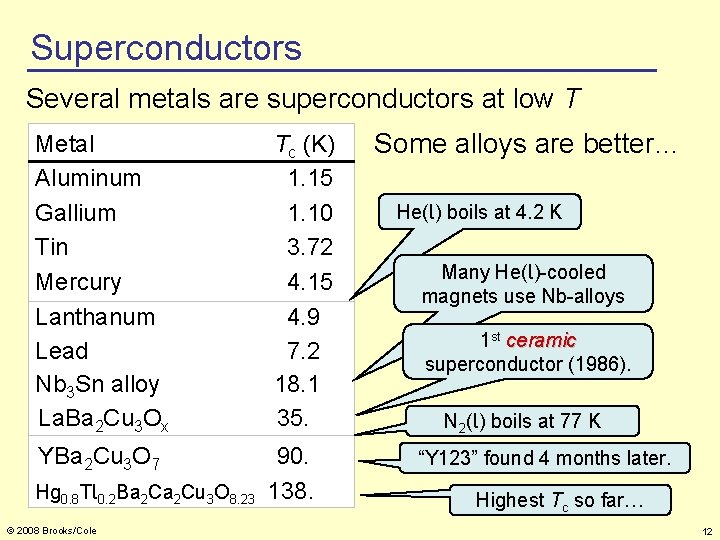
Superconductors Several metals are superconductors at low T Metal Aluminum Gallium Tin Mercury Lanthanum Lead Nb 3 Sn alloy La. Ba 2 Cu 3 Ox Tc (K) 1. 15 1. 10 3. 72 4. 15 4. 9 7. 2 18. 1 35. YBa 2 Cu 3 O 7 90. 138. Hg 0. 8 Tl 0. 2 Ba 2 Cu 3 O 8. 23 © 2008 Brooks/Cole Some alloys are better… He(l) boils at 4. 2 K Many He(l)-cooled magnets use Nb-alloys 1 st ceramic superconductor (1986). N 2(l) boils at 77 K “Y 123” found 4 months later. Highest Tc so far… 12
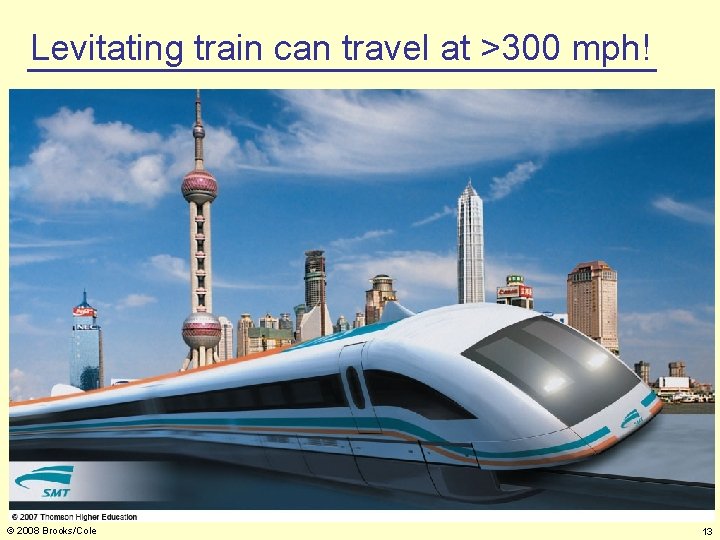
Levitating train can travel at >300 mph! © 2008 Brooks/Cole 13